Stuck Proving Expertise? From More Proof to a Scope Request

The Expertise-Proof Loop at 9:40 p.m.
I first met Maya through the scene she described from the previous Tuesday. At 9:40 p.m., she was sitting in the kitchen of her Toronto condo with a technical design document open on her laptop. The radiator clicked against the wall, the laptop fan hummed under the strain of too many tabs, and her phone had grown warm in her palm. She added one more benchmark to an appendix that was already persuasive. In the tab beside it, a note titled "Scope I Want to Own" contained three unfinished bullets.
Earlier that week, her manager had asked what she wanted from her next role. Maya had arrived with an achievement tracker instead of a direct request. She could explain the system tradeoffs, reconstruct a difficult incident, and defend every technical choice. When the conversation turned to broader authority, however, she began reviewing evidence that no one had challenged.
"I keep assuming the work will make the ask for me," she told me. "I can prove I know the domain, but I freeze when I have to name the role. One more strong project always feels safer than one direct conversation."
I watched her shoulders rise as she said it. Her jaw braced before her mind had even reached the imagined meeting. The apprehension seemed to move through her like a calendar invite marked "career growth" with no agenda attached: ordinary on the screen, but heavy enough to tighten every muscle before she clicked accept. Beneath that contraction, I could hear frustration, resentment, and a quieter longing to be trusted with meaningful scope.
"You can do the difficult work," I said, "but when the conversation turns to the decisions and outcomes you want to own, you open another framework or add another benchmark. That does not mean your ambition is unclear. It means preparation has become the place where you shelter it."
I also told her something I wanted established before a single card appeared. Tarot would not tell us whether a promotion was guaranteed, and I would not use it to turn workplace uncertainty into a prediction. I would use the cards as an objective cognitive map, one that could separate evidence, fear, authority, and choice.
"The work cannot make a request you have never named," I said. "Let's give the fog a structure and see where your agency has been waiting inside it."

Choosing the Shadow Map
I invited Maya to put both feet on the floor, let her exhale become slightly longer than her inhale, and hold one question in mind: "Why am I stuck proving expertise instead of asking for a bigger role?" I shuffled slowly. I treat that pause as a transition for attention, not as a performance of mystery.
I chose a four-card layout called The Shadow Spread. This is how tarot works for me in a career reading: the cards do not issue instructions from outside a person's life. They create distinct positions from which I can examine a pattern that has become too compressed to see clearly.
The visible problem looked like overpreparing for a career conversation, but Maya's question contained a deeper identity equation: expertise seemed to equal permission, and permission seemed to define professional adulthood. A larger spread could have generated more material, but more material was already part of the problem. The four-card Shadow Spread was precise enough to examine the visible expertise-proof loop, the disowned relationship with authority, the protective learner identity beneath it, and the practice that could integrate all three.
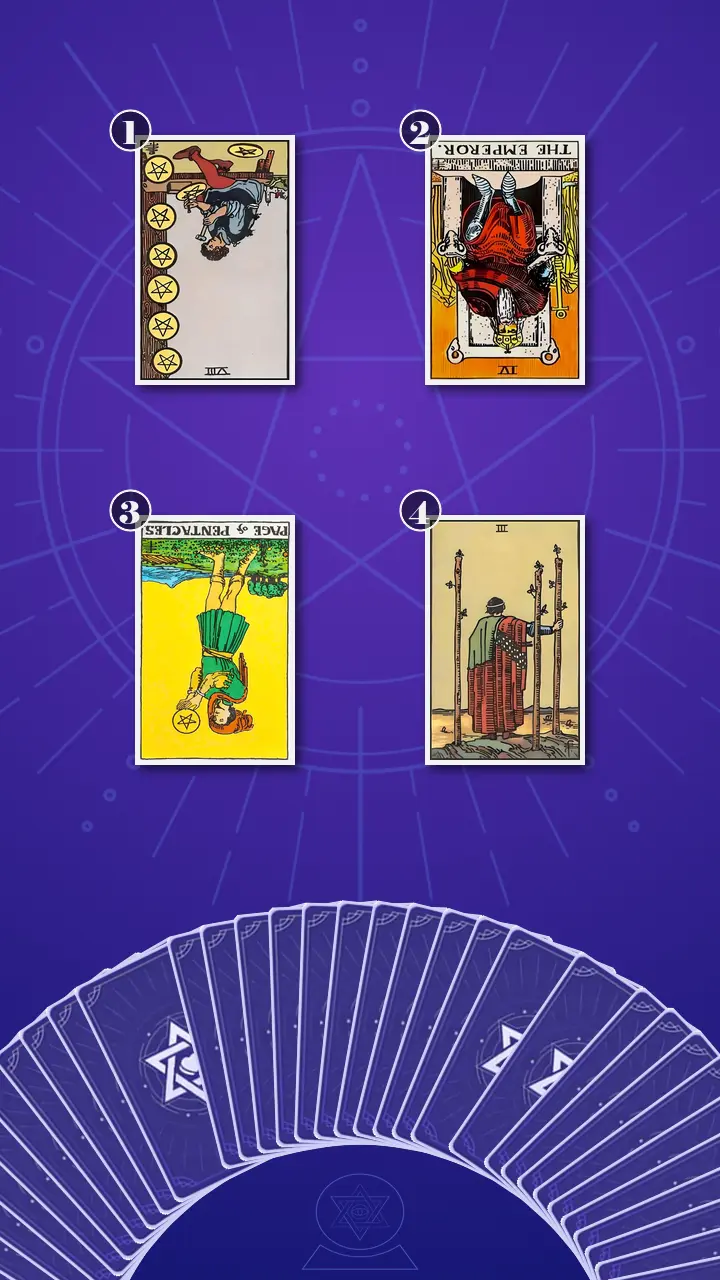
I arranged the cards in a two-by-two grid. The upper-left position would show the visible pattern: refining technical proof, accepting more specialist work, and leaving the bigger role unnamed. The upper-right would expose the disowned shadow: her relationship with authority and decision space. The lower-left would reveal the protective root that kept preparation feeling safer. The lower-right would offer an integration practice grounded in choices she could actually make.
I explained that card meanings only become useful in context. An Emperor in a career Shadow tarot reading is not a command to dominate, just as a reversed Pentacles card is not a verdict of failure. Each image would become a question about Maya's meetings, documents, habits, and decision rights. She nodded once and moved her untouched mug a little farther from the laptop.
The Craft That Became a Waiting Room
Position One: Eight of Pentacles Reversed and the Eleventh Benchmark
I turned over the card representing the visible pattern: the concrete behavior of refining technical proof, accepting more specialist work, and leaving the desired bigger role unnamed. It was the Eight of Pentacles, reversed.
I pointed to the craftsperson's lowered gaze and the row of nearly identical pentacles. In an upright state, I often read this card as disciplined craft, repetition, and the patient development of skill. Reversed here, that Earth energy had moved into excess and blockage. The craft was genuine, but the repetition had stopped creating meaningful access to a wider role.
"This is your 9:40 p.m. tab situation," I said. "You are refining a strong technical design document and adding benchmarks no one requested while the note called 'Scope I Want to Own' remains unfinished. The distant town in the card matters. Your attention is fixed on the workbench while the wider organizational territory stays outside the frame."
I asked her to think of the last career check-in. What work had she explained in detail, and what larger responsibility had she left unnamed? She answered almost immediately: she had spent twelve minutes describing the technical complexity of a platform migration, then had not said that she wanted to own the cross-team architecture decisions connected to it.
"One more proof can be useful," I said. "One more proof is not the same as a bigger mandate. The expertise trap begins when excellent delivery becomes a substitute for telling people what you want that delivery to support."
Maya gave a short laugh, but it had no amusement in it. "That is so accurate it is almost cruel." Her fingers closed around the mug, and her eyes remained on the repeated pentacles.
"Then let's make sure accuracy does not become an indictment," I replied. "This pattern protected you from possible rejection and from appearing presumptuous. It also earned you real expertise. We are not here to mock the protection or discard the skill. We are here to notice that the same strategy now keeps presenting you as the reliable executor inside someone else's frame."
I could see her breathing slow. The first card had not accused her of working too hard. It had distinguished impact-producing work from work used to postpone an exposed conversation.
Position Two: The Emperor Reversed in the Guest Seat
I turned over the card representing the disowned shadow: Maya's blocked relationship with authority, including her reluctance to claim decision space before an external gatekeeper declared her ready. It was The Emperor, reversed.
The stone throne filled the image with structure. Ram heads marked initiative, and armor remained visible beneath the robes. I have seen enough civic foundations on archaeological sites to know that authority likes to make itself look permanent in stone. Yet a throne can preserve the architecture of power long after the person occupying it has gone. Structure is durable; legitimacy still has to be enacted, negotiated, and made accountable.
I read the reversal as a blockage of self-authority, not a deficiency of technical judgment. Maya could already create standards, anticipate consequences, and give shape to ambiguous work. What she did not yet experience as legitimate was saying, before a title confirmed it, "This is a decision domain I am ready to lead."
I asked her to replay a recent planning meeting. She had explained an implementation risk, proposed a technically sound direction, and watched Slack notifications stack up beside the video call. Then she had ended with, "Happy to help wherever needed." Someone else turned her recommendation into the workstream plan and retained the decision.
"The inner sentence I hear in this card is: 'I know how to structure this, but can I say it is mine to lead?'" I told her. "That is the difference between expertise and permission. It is also the difference between authority and control. Naming a decision space does not mean imposing your will. Mature authority includes boundaries, outcomes, alignment, and the possibility of hearing no or not yet."
Her breath snagged first. Then her fingertips pressed into the ceramic while her gaze drifted beyond the cards, as if the meeting were replaying on a second screen. Finally, she released the mug and rubbed one thumb across her palm.
"I say 'happy to help' because it sounds collaborative," she said. "But sometimes I mean, 'Please notice I could lead this without making me say I want to.'"
"Collaboration is not the problem," I said. "The softened language becomes costly only when it deletes your proposed direction. People can only discuss ownership inside the frame you make visible."
I also named the reversal's overcorrection risk. If she treated self-authorization as a reason to make unilateral decisions or demand control without alignment, the Emperor's blocked energy could swing into excess. Her task was narrower and more relational: identify a legitimate decision domain, name the outcomes she could own, and invite a negotiation about boundaries and support.
Position Three: The Page of Pentacles and the Course Tab
I turned over the card representing the protective root: the perpetual-learner identity that made further preparation feel safer than testing whether expertise could support broader ownership. It was the Page of Pentacles, reversed.
The Page holds the pentacle at eye level with such total concentration that the mountains behind it almost disappear. I read the card as preparation energy caught between excess and deficiency: an excess of studying, comparing, and restarting, paired with a deficiency of application in the exposed territory where no checklist can guarantee the answer.
Maya recognized the modern version before I finished describing it. After a peer posted a staff-engineer promotion announcement beginning with "Thrilled to share," she had opened a saved technical-leadership course, a competency matrix, and three promotion examples. The tabs multiplied while the ownership sentence remained untouched.
"Learning is still one of your strengths," I said. "This card does not ask you to become incurious or reject useful feedback. It shows a learner identity that has outlived one part of its protective usefulness. Whenever broader scope becomes discussable, you return yourself to the beginning."
She looked down and said, "If I can answer every objection before I ask, then asking should be safe."
"And has benchmark number eleven made it safe?" I asked.
She shook her head. Her mouth tightened, her eyes briefly lost focus, and then a long exhale lowered her shoulders by perhaps an inch. "No. It just gives me something to do instead of finding out."
I let the silence remain for a moment. The Page's protection was understandable. A request could be declined, narrowed, delayed, or met by organizational limits that had nothing to do with her worth. Preparation offered temporary control over that uncertainty. But it also kept her proving readiness for a role she had not yet made discussable.
I asked her to complete a sentence without decorating it: "Because I can already do X, I am ready to own Y outcome." She started to add a qualification, stopped, and gave me a rueful glance.
"That pause is the card," I said. "Not your incapacity. The pause."
When the Three of Wands Opened the Workshop Window
Position Four: The Horizon Beyond Completed Work
The radiator in Maya's kitchen gave one dry click through her microphone just as I reached for the final card. The small sound echoed the late-night scene where the reading had begun. Then I turned over the card representing the integration practice: using established mastery to make a specific, negotiable request for broader responsibilities, decisions, and outcomes.
It was the Three of Wands, upright, the key card and bridge of the reading.
I showed her the figure standing above the shoreline. Three wands were planted firmly behind and beside him; ships moved across open water; his gaze was no longer lowered toward a proof object. I read this as Fire entering in balance: strategic expansion, self-authorization, and future-facing ownership grounded in demonstrated skill.
The card did not ask Maya to discard expertise. The planted wands were the expertise. It asked her to stand on what was already established and use it to describe a wider field. I invited her to picture a whiteboard with three columns: desired scope, existing evidence, and a time-bounded ownership experiment. She did not need every answer to describe the territory she was ready to enter.
I could see the 9:40 p.m. loop return in her face: design document open, phone warm, three unfinished bullets, another benchmark chosen because polishing felt safer than hearing a clear answer about her future. She was still trying to make certainty speak on behalf of desire.
I told her, "Your expertise is already evidence; it is not a permission slip you have to keep renewing. The next move is to name the decisions and outcomes you want to own, then let the conversation show you what can be negotiated."
Another perfect proof will not grant you a horizon; stand with the Three of Wands, look beyond the completed work, and name the scope you are ready to own.
For a beat, Maya's breath stopped. Her fingers remained suspended above the table, and her pupils widened as though she were looking through the card into every meeting where she had supplied the answer and surrendered the frame. A flush moved across her face. Then her brows pulled together.
"But doesn't that mean I've been doing it wrong?" she asked, her voice suddenly sharper. "All those late nights, all that proof. Was I just wasting time?"
"No," I said. "The work built real competence, credibility, and judgment. It was not wasted. It simply cannot perform the separate task of making a request. A strategy can be intelligent, protective, and no longer sufficient at the same time."
Her jaw moved once before it released. Her hand lowered to the table, her shoulders softened, and a thin shine appeared at the edge of her eyes. The relief did not look triumphant. It looked slightly disorienting, like setting down a heavy case and discovering that the arm still expects its weight.
I asked, "Now, using this new perspective, can you recall a moment last week when this insight might have changed how you felt?"
She returned to the planning meeting. "I could have said, 'I want to own the architecture decision and the cross-team outcome,'" she answered quietly. "I still might have been told no. But at least we would have been discussing the real thing."
Core Competency Excavation
At that point, I used the diagnostic method I call Core Competency Excavation. On an archaeological dig, the visible object is rarely the whole story. I learn by tracing the strata beneath it: what a structure rested on, which parts survived different eras, and what those enduring elements reveal about how the site actually functioned.
I asked Maya to look through the strata of her past roles and major projects, not for obsolete titles or an exhaustive list of tasks, but for foundational abilities that had remained valuable across contexts. Together, we uncovered three: she translated ambiguous risks into usable technical direction; she created standards that other engineers trusted; and she connected implementation decisions to stakeholder outcomes.
Those were not decorative achievements for the bottom of a promotion packet. They were transferable foundations for a broader mandate. The Three of Wands turned the excavation outward: if those capabilities had already survived several project cycles, what future decision territory could they credibly support?
I thought of it as the end of one career epoch rather than a judgment against the years that built it. Maya's era of proving herself through indispensable delivery had produced solid ground. The next era, if she chose to test it, would require a different public structure: an explicit proposal about scope. A foundation does not become a building by being polished indefinitely.
"Expertise is a platform, not an endless entrance exam," I said. "The horizon is not another benchmark."
I named the emotional movement as plainly as I could. This was a step from apprehensive overpreparation and external permission-seeking toward cautious self-authorization, strategic direction, and grounded ownership. Cautious mattered. She did not need to manufacture instant confidence. She needed enough clarity to make one negotiable proposal while allowing discomfort to come with her.
A Scope Request Built from Existing Ground
I read the spread back to Maya as one coherent story. The Eight of Pentacles reversed showed the visible proof-building loop: strong work continued after further polish had stopped changing the role conversation. The Emperor reversed revealed why the loop persisted: authority remained something she imagined receiving only after indisputable proof. The Page of Pentacles reversed exposed the protective root: returning to the learner position kept her from hearing a potentially painful answer. The Three of Wands supplied the underused resource: existing mastery could become the ground beneath a future-facing ownership proposal.
The cognitive blind spot was not simply perfectionism. It was the belief that evidence and permission performed the same function. Evidence could support a request, but it could not state the request. Nor could it guarantee approval. The transformation direction was therefore specific: stop adding proof long enough to name one responsibility, one decision space, and one outcome she wanted to discuss.
I told her that self-authorization did not mean declaring herself entitled to a title or bypassing workplace realities. It meant treating her own judgment as legitimate enough to initiate a conversation. The organization could respond with agreement, negotiation, a smaller experiment, a delay, or a refusal. Each response would provide information that another evening in the appendix could not.
The Resume Stratigraphy Review and the 12-Week Horizon
I gave her two actionable next steps. Both were deliberately small. I wanted movement that generated information, not a new career-improvement project large enough to become another hiding place.
- Run a 15-minute Resume Stratigraphy Review.Before reopening the full promotion packet, choose one existing design document, launch, or incident review. On a blank page, write three layers: the artifact you produced, the enduring capability beneath it, and the wider decision or stakeholder outcome that capability could support. Finish with one sentence: "Because I already do X, I am ready to own Y outcome."Use one artifact only and stop when the timer ends. The urge to add more evidence is part of the pattern, not proof that the exercise is incomplete.
- Draft a three-part, time-bounded ownership proposal.For the next one-to-one or career check-in, write the scope you want, one existing example that supports it, and a 6- to 12-week experiment with a review date. Practice this line once with a trusted peer or privately: "I want to discuss owning [decision area] so I can improve [outcome]. What would make that ownership credible over the next quarter?"Drafting does not obligate you to send it. Keep the request negotiable, and narrow or postpone it if the timing or power dynamics do not feel workable.
I asked Maya to notice the order. Scope came first, evidence supported it, and the experiment made it testable. Her usual algorithm reversed that order: evidence multiplied while scope remained blank. The new structure did not promise a promotion. It gave her a way to move from reliable executor without decision rights toward a clear conversation about responsibilities and outcomes.
"I can do ten minutes," she said, then hesitated. "But I already know I'll want to rewrite the sentence until no one can object to it."
"Then the first practice is not writing a perfect request," I replied. "It is allowing one clear request to exist before every objection has been answered. If your shoulders rise or your jaw tightens, pause and look away from the screen. You decide whether to return. The goal is not to overpower your nervous system; it is to stop mistaking its protective reaction for a final assessment of your readiness."

A Week Later, the Sentence Stayed on the Page
Six days later, I received a message from Maya. She had completed the Resume Stratigraphy Review using the platform migration document and found that her enduring asset was not merely knowledge of the system. It was her ability to turn cross-team risk into a decision structure other people could use.
She drafted a proposal to own a defined architecture decision area for twelve weeks, with a review based on stakeholder alignment and delivery outcomes. She practiced the opening sentence with a trusted colleague. Then, in her next one-to-one, she said it without attaching a paragraph of qualifications.
Her manager did not place a promotion on the table. He did agree to map the boundaries of the proposed experiment and identify what support she would need. That response was incomplete, but it was real information about the role rather than another interpretation of silent evidence.
That night, she slept through until morning. Her first thought was still, "What if I'm wrong?" She told me she smiled, opened the note, and left the sentence where it was.
I did not regard that message as proof that tarot had granted her authority. The cards had made the mechanism visible; Maya had chosen the sentence, the boundary, the colleague, and the conversation. Her Journey to Clarity did not end in certainty. It began with ownership of the next move.
I keep returning to the image of the workshop window opening onto the Three of Wands horizon. When asking for a bigger role makes your shoulders lock and your jaw brace, it makes sense to keep polishing proof so no one can say you are not ready. Yet the waiting can hold you inside the smaller frame you are trying to outgrow. Simply noticing the difference between evidence and permission means you are no longer standing at the exact beginning.
If your existing work were the planted ground beneath the Three of Wands, what is the smallest decision space you could name in one sentence, for your own clarity, before anyone else gets to respond?