How an Unsent Slack Message Turned Career Gridlock Into a Test

Finding Clarity at 11:40 p.m.
You call it being responsible, but at 11:40 p.m. you are still comparing the same two futures, reopening the same career advice, and holding your breath over one unsent question. I recognize that overthinking loop as effort without fresh evidence, not a lack of intelligence.
Alex described the scene so precisely that I could picture it from across my reading table. A yellow pendant light flattened their Toronto kitchen into a small island. Cold tea sat beside the trackpad, the refrigerator hummed, and six job-search tabs crowded a spreadsheet labelled STAY and LEAVE. Each time one column looked slightly safer, Alex added a new risk to restore the deadlock.
“If I stay, I am wasting another year,” they said. “If I leave, I am reckless. There has to be an answer I have somehow failed to see.” I watched their shoulders fold inward as their restless thumb rubbed the edge of their phone. The trapped confusion had the physical pressure of a subway door catching a coat sleeve: nothing had moved, yet their whole body was already bracing to be dragged.
“Your caution makes sense,” I told them. “Toronto rent is real, and repetitive work can cost you something real too. I am not going to use tarot to choose your job or pretend risk can be wished away. I want us to see how the question has been constructed, then find one place where you still have authorship. Let us draw a map for this fog. What if the missing choice is not another package, but a part of the package you have never tested?”

Choosing the Compass: The Decision Cross
I invited Alex to take one slow breath while holding the question, What am I missing when every choice looks like only two bad options? I shuffled at an unhurried pace. I use that brief ritual as a psychological threshold, a way to leave the browser tabs outside the room long enough to look at the pattern underneath them.
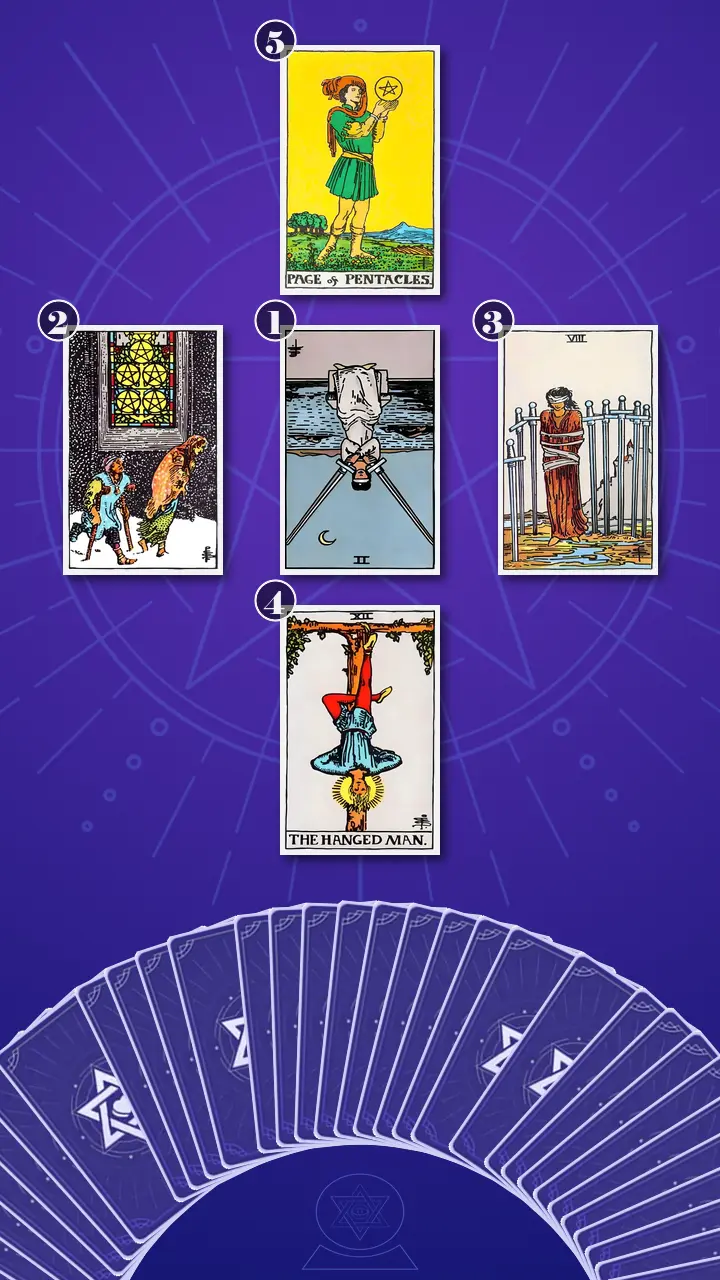
I chose a five-card Decision Cross tarot spread. For anyone wondering how tarot works in a stay-or-leave career reading, I treat the spread as a structured reflection tool, not a prediction engine. The Decision Cross is especially useful when option A and option B appear exhaustive because it gives each feared path its own position, then adds a hidden factor and practical guidance. It is focused enough to examine the actual trade-off without burying Alex beneath unrelated history or a fixed future outcome.
I placed the first card in the center for the current deadlock. The second and third went to the left and right for the two apparent paths: leaving and risking security, or staying and fearing a loss of agency. The fourth went below for the overlooked assumption, negotiable condition, or sequence. The fifth went above for one reversible next step. The finished spread looked like a compass whose horizontal arms held the argument while its vertical line suggested that the way forward might not be farther left or right.
Two Blindfolds and the Same Unsent Message
Position 1: The Comparison That Keeps Rebuilding Itself
I turned the card in the central position, the place that shows the present symptom of repeated A-versus-B comparison and delayed action. It was the Two of Swords, reversed.
The blindfold and crossed blades mirrored Alex's spreadsheet with almost uncomfortable precision. At 11:40 on Sunday, they had added “financial risk” beneath LEAVE, then balanced it with “career stagnation” beneath STAY. Six tabs remained open, their message to their manager remained in drafts, and their body held the unstable symmetry through a locked jaw and hunched shoulders.
Reversed, the card showed blocked and overloaded Air energy. Thought had been recruited to prevent an intolerable loss, but every new criterion was still being processed through the same two labels. Alex's inner script ran like this: If I protect security, I lose agency. If I protect agency, I risk security. So I need one more night to think, and I will call the delay responsible. The analysis produced short-term relief from committing, but it also prevented reality from contributing anything new.
Looking at the crossed swords, I remembered an editing session from my own art practice. Two cuts of a scene both seemed wrong until I realized they shared the same bad opening frame. No amount of polishing inside either cut could repair what the edit had excluded. “More detail inside the same frame is not new evidence,” I said. “Your spreadsheet is getting more sophisticated, but its inputs have stopped changing.”
Alex gave a short laugh that carried no amusement. “That is so accurate it feels a little cruel.”
“Cruel would be calling you irrational for wanting to protect your livelihood,” I replied. “I see a careful person using a strategy that once created control. The card is only showing us where that strategy has begun charging more than it returns.” Their thumb stopped rubbing the phone. Their shoulders did not soften yet, but their gaze stayed on the card.
Position 2: The Financial Cold Around Leaving
I turned the card in the position that examines the first apparent path and the scarcity assumptions making it look wholly bad. It was the Five of Pentacles, upright.
I focused on the two figures moving through snow beneath an illuminated window. Alex told me how quickly a job listing could become a banking-app calculation: rent, benefits, groceries, savings runway, and an imagined stretch with no income. The radiator would click in their kitchen while their mind jumped from “changing direction carries financial risk” to “I would be entirely exposed.” Before asking what support existed, they felt compelled to prove they could survive with none.
I read this as Earth energy under strain, with legitimate material caution overshadowed by an excess of total-loss forecasting. The Five of Pentacles did not predict hardship, and the lit window did not guarantee rescue. It asked for verification. What did the employment contract say about notice and benefits? How much runway was actually available? Could a transition be phased? Was an internal move possible? Which support could be requested without presuming it would be granted?
“Your financial concern belongs in the decision,” I said. “It just does not deserve to impersonate a complete forecast.” Alex released a breath that seemed to have been waiting behind their ribs. They nodded once, slowly. I could see the relief of having their material reality acknowledged without being turned into fate.
Position 3: When Staying Becomes a Locked Room
I turned the card in the position that examines the second apparent path and the restrictions making it feel like a permanent loss of agency. It was the Eight of Swords, upright.
The repeated blindfold mattered. A figure stood loosely bound inside a ring of swords, yet open ground remained visible between the blades. During sprint planning, Alex had been describing staying as endless repetition, even though their draft asking about research ownership, team movement, or a defined role-review date had never been sent. Some workplace limits could be completely real. The card asked which ones had been confirmed and which ones had become walls because no direct conversation had tested them.
This was another blockage of Air, but it worked differently from the reversed Two of Swords. The first card showed an overloaded comparison system. The Eight showed thoughts hardening into enclosure: The role cannot change. Staying means surrendering another year. Asking will make me look disloyal. The open ground did not mean Alex could simply walk away from every structural constraint. It meant the constraints did not all have the same evidentiary status.
I told Alex that Severance had become a useful shorthand in their mind: repetitive work felt like a sealed version of the self, cut off from authorship. The image captured a real hunger, but it also made any continued employment look like consent to permanent captivity. Like endlessly swiping through the same two disastrous matches, their career algorithm had learned only two outcomes: deprivation or confinement.
The cursor switching between STAY and LEAVE now had its matching image in the two blindfolded cards. “If I leave, I lose security. If I stay, I lose agency. So I need one more night,” Alex murmured, repeating the loop back to me. Their fingers tightened around the phone, then loosened. For the first time, they placed it face down.
When The Hanged Man Turned the Question
Position 4: The Missing Dimension
I turned the card in the position that reveals what Alex was missing: an overlooked assumption, negotiable condition, sequencing possibility, or perspective capable of loosening the false binary. This was the key card, The Hanged Man, upright.
The room became very quiet. Even the street noise beyond my window seemed to recede. The figure hung upside down with open eyes, a calm face, and a golden halo. Unlike the figures in the Sword cards, this one could see. The apparent restriction remained, but the viewing angle had changed.
I explained that The Hanged Man does not recommend passive delay. Its energy restores balance through deliberate suspension: stop forcing an answer from the old question, release the demand for immediate control, and examine how the categories were assembled. A pause becomes active when it changes the question.
I asked Alex to imagine pausing new research for twenty-four hours and duplicating the spreadsheet. Instead of STAY and LEAVE, the headings would become VERIFIED FACT, UNTESTED ASSUMPTION, NEGOTIABLE CONDITION, and SEVEN-DAY TEST. The exercise would not manufacture a painless secret option. It would separate two complete imagined futures into parts that could be checked, requested, sequenced, or left alone.
In my work, I call this Hero's Journey Alignment. Stagnation often appears at the Refusal of the Call, but I never use that phrase to accuse someone of cowardice. I use it to locate the scene where the protagonist believes they must understand the entire final act before taking one step into the next. Alex had not refused a job decision. They had stayed bravely in a painful scene because the limiting script insisted that a responsible main character must know the ending before changing the shot.
At 11:40 on Sunday, the fridge had hummed while Alex added one more risk to STAY and one more to LEAVE, glanced at the unsent manager message, and closed the laptop with their jaw still tight. They had been trying to identify the correct complete future, because anything less felt like losing control.
“The missing option may not be a third complete future,” I said. “It may be permission to unbundle the two futures, test one assumption, and let evidence return some of the control that certainty never could.”
You are not trapped by the two labels in front of you; turn the question upside down as The Hanged Man does, then make one reversible move that tests the frame.
I let the sentence stand. Somewhere down the street, a streetcar bell sounded once, clean and bright, as if the city itself had marked the turn.
For two beats, Alex did not breathe. Their fingers froze above the face-down phone, and their pupils widened as though they were replaying every Sunday-night spreadsheet revision at once. Then their expression tightened. A flash of anger lifted their chin. “But doesn't that mean I have been doing all of this wrong?” they asked, their voice sharper than before. I watched the question reach them in layers: first the physical freeze, then the recognition, then the sting of responsibility. “No,” I said. “It means you used analysis to protect two needs that genuinely matter. We are not condemning that strategy. We are updating it now that it is withholding the feedback you need.” Their eyes grew wet but did not spill over. One fist slowly opened against their knee. Their shoulders dropped, followed by a long, unsteady exhale. Relief arrived, but it carried the slight dizziness of realizing that a clearer map also returned the next choice to their own hands.
“Now, using this new perspective, can you think back to a moment last week when this insight might have made you feel different?” I asked.
“Tuesday at 4:57,” Alex said after a pause. “I had the Slack message open. I thought sending it meant admitting I was unhappy, or committing to stay if my manager offered anything. I could have treated it as one question instead of a declaration.”
I set an eight-minute timer and turned a blank page sideways. Alex wrote one line under each heading: verified fact, the current role is repetitive; untested assumption, responsibilities cannot change; negotiable condition, ownership of one research task; seven-day test, request an exploratory conversation. I reminded them that stopping after one verified fact would still count. Nothing had to be sent in the room, and no resignation, binding agreement, private disclosure, or high-stakes confrontation belonged inside a reversible exercise.
I named the change I had just witnessed. This was not certainty, and it was not a final career decision. It was the first movement from trapped confusion and security-versus-agency gridlock toward cautious curiosity and evidence-based agency. Control built from evidence is quieter than control built from prediction.
One Pentacle at Eye Level
Position 5: The Apprentice's Next Question
I turned the final card in the position that integrates the reading into one self-directed, reversible action. It was the Page of Pentacles, upright.
The Page studied a single pentacle at eye level. A fertile field stretched beneath them, and mountains remained in the distance. I saw the practical answer to the spread in that scale: Alex did not need to scan their entire career horizon. They needed to examine one tangible condition closely enough for reality to answer back.
The Page brought Earth into balance. In the Five of Pentacles, Earth had carried feared deprivation. Here it became observation, boundaries, practice, and a manageable beginning. The Page's modern-life scenario looked like one bounded request for a twenty-minute conversation about taking ownership of a research or strategy task in an upcoming sprint, followed by a written record of what was actually said. Like a product discovery test, the purpose was to learn whether one condition could change, not to promise that Alex would stay, resign, or accept unpaid extra work.
“I still worry the question will sound disloyal,” Alex said. The practical obstacle was visible in the way their shoulders lifted again.
“Then the message should state its boundary,” I replied. “You can say, ‘I am gathering information and am not making a decision in this meeting.’ A request is not an obligation. You control what you disclose, and you can choose a different source of information if that conversation does not feel safe or useful.”
Alex opened a note and typed a two-sentence draft. Their breathing did not become perfectly calm, but it became audible and even. I also pointed out what the spread lacked: no Cups and no Wands. Feeling and initiative had barely been given a seat at the table. The cards were not telling Alex to follow desire blindly. They were showing why thought and material-risk calculation alone could not produce a complete map.
From a Life Verdict to a Seven-Day Test
I gathered the five cards into one coherent story. LinkedIn promotion posts, Toronto living costs, and a stable but repetitive role had taught Alex to experience the career crossroads as a contest between two essential needs. The reversed Two of Swords preserved that conflict through repetitive comparison. The Five of Pentacles turned leaving into total exposure. The Eight of Swords turned staying into permanent confinement. The Hanged Man rotated the frame, and the Page of Pentacles placed one observable question in Alex's hands.
The cognitive blind spot was not a failure to think hard enough. It was treating plausible predictions as verified facts, treating negotiable conditions as nonexistent, and treating STAY and LEAVE as indivisible packages. Two bad options may be two untested packages. The transformation was therefore specific: stop asking which complete future must be accepted, audit what makes the packages appear exhaustive, and run one bounded test before demanding a verdict.
Because I see lives as films still in production, I used my Character Bible Directive to keep the plan rooted in identity rather than panic. A film character bible does not dictate every future scene. It records how the character behaves when the plot applies pressure. Alex's future self did not need the specification “always knows the right answer.” Their useful specification was: checks one fact, names one assumption, requests one condition, and preserves the right to stop.
- The Eight-Minute Package-Unbundling Pause.On Tuesday evening at the kitchen table, duplicate one current decision sheet. Replace STAY and LEAVE with VERIFIED FACT, UNTESTED ASSUMPTION, NEGOTIABLE CONDITION, and SEVEN-DAY TEST. Write only one sourced line under each heading, then move every research tab into a folder called AFTER 24 HOURS.Set an eight-minute timer. If the exercise starts becoming another elaborate system, stop after one fact and one assumption; that minimum version counts.
- The Scoped Exploratory Conversation.By Wednesday afternoon, draft a Slack message or email requesting twenty minutes with the manager: “I would like to explore whether I could own one research or strategy task in the next sprint. Could we discuss whether a limited trial is possible?” In the meeting, ask about flexibility, timing, and how a trial would be reviewed.State that the conversation is exploratory and not a commitment. If approaching the manager is unsafe or unhelpful, direct one narrower factual question to a trusted internal colleague or former teammate instead.
- The Character Bible Evidence Log.Create a note titled SEVEN-DAY EVIDENCE LOG. At the top, write the future-self specification: “I check one fact, name one assumption, request one condition, and keep an exit.” For seven days, record only what you tested, what happened, and which assumption changed or remained unverified. Review it at a cafe or library on day seven.Define reversibility before starting: set a time limit, cost limit, review date, and exit condition. Resigning, signing a binding agreement, or accepting ongoing unpaid work is not an experiment.
I told Alex that exact contracts, current cash figures, workplace policies, personal boundaries, and qualified advice remained more authoritative than any card. Tarot had helped us inspect the decision frame. Alex alone retained the authority to decide whether a test was appropriate, when to stop, and what any evidence meant for their life.

A Week Later: The Quiet Proof
Six days later, I received a message from Alex. They had sent the scoped request, held the conversation, and recorded the response. Their manager could not promise a permanent role change, but agreed to discuss a two-sprint research task with a defined review date. It was not a new career, and it was not proof that staying was right. It was one verified opening where Alex had previously written “impossible.”
That night, Alex slept through until morning. Their first thought was still, What if I am wrong? This time, they told me, they smiled slightly and answered, Then I will look at what the test actually showed.
I thought of the Page holding one pentacle while the mountains remained far away. The cards had not created Alex's agency or delivered a hidden fate. They had helped Alex see the pen that was already in their hand. Their Journey to Clarity began with a modest proof: one message left the drafts folder, one assumption met reality, and uncertainty remained survivable.
When both choices seem to take something non-negotiable, I know how quickly a jaw can lock over an unsent message, as if one click could close the only future in which control survives. I also know that noticing the hinges, the sequence, and the parts that can be tested means the old two-door corridor is no longer the whole set.
If neither option in your own story had to be accepted as a complete package, which one hinge, condition, or assumption would you be curious to test for seven days, with full permission to stop?