When the Rules Change Retroactively

A clear map of shifting workplace standards, with relevant tarot cards and reading insights from sessions shaped by the same pressure.

Workplace Accountability Reset
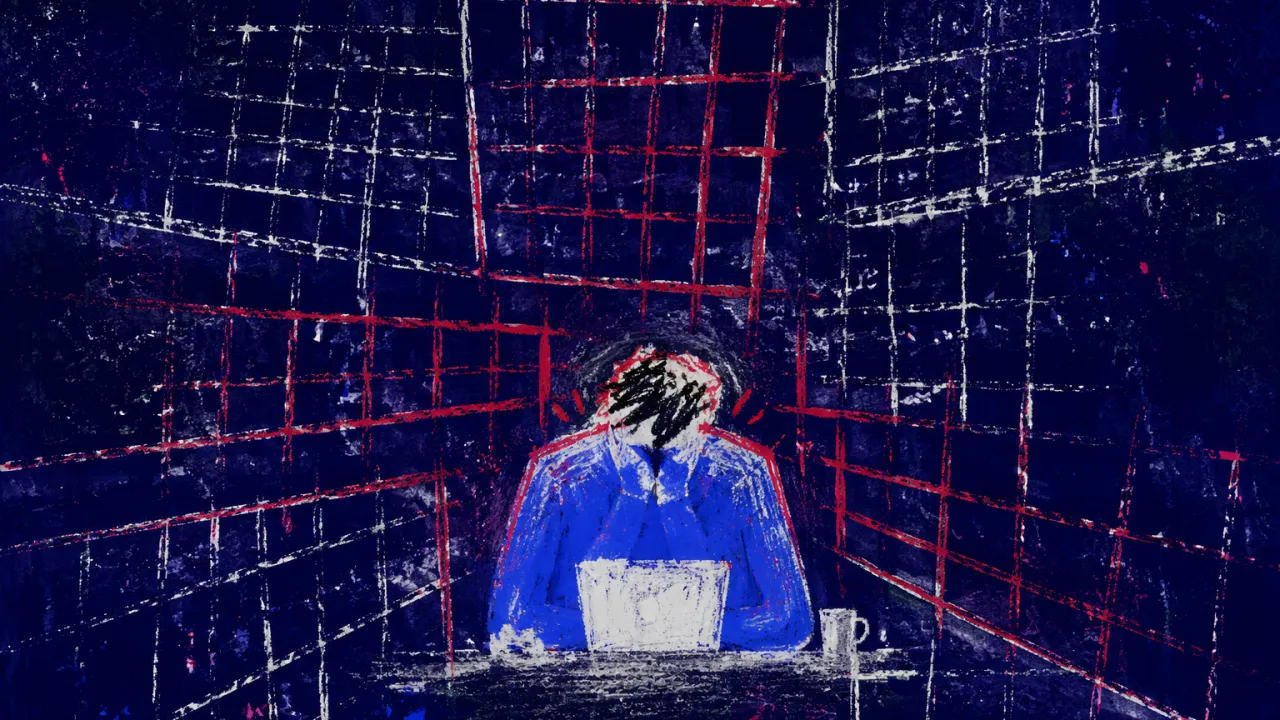
A seated figure with shoulders drawn inward as red review grids press in, narrowing the indigo workspace around their torso.

What is this situation?

Workplace Accountability Reset — you first notice it when a meeting appears on your calendar with a neutral title such as 'Role Clarity' or 'Ways of Working,' and you leave with a new scorecard, tighter deadlines, and a list of outcomes newly assigned to your name. Work that used to be handled through conversation moves into trackers, every missed date requires a written explanation, and delays caused by changing briefs, missing approvals, or another team's handoff are reduced to a mark beside your deliverable. At stand-ups, managers ask who owns each problem before asking what would solve it; in one-to-ones, last quarter's work is reviewed against standards that were only recently written down. Messages gain extra recipients, handoffs are saved in public threads, and every update is phrased to make ownership unmistakable. The people who define the measures also decide which context counts, leaving you to rebuild timelines, locate old messages, and explain decisions made under earlier rules. By late afternoon, your shoulders are drawn inward over the laptop as routine work competes with the expanding paper trail, and after hours you may reopen your notes so the next check-in cannot rewrite what happened. Completion no longer brings closure because every finished item can be reopened under the new standard. By the next review, you are not simply doing the job; you are repeatedly defending your position on uneven ground, much like the figure in the Seven of Wands, standing alone while six raised wands press in from below.

Why it's not you?

This is not evidence that you suddenly became unreliable; the workplace changed the terms, the record, and the level of scrutiny at the same time. When standards are applied retroactively while shared dependencies stay off the page, the pressure comes from an uneven accountability process, not a personal failure.

Workplace Accountability Reset in Tarot Cards

In a Workplace Accountability Reset, routine work is recast as a record you must repeatedly defend under shifting standards. The shoulders drawn inward over your laptop reflect environmental, structural, and dynamic pressure created when the same workplace sets the measures, decides which context counts, and reopens completed work. The Tarot Cards below mirror the contours of narrowed rules, uneven footing, and repeated scrutiny.

The Emperor
Reversed
The armored ruler sits rigidly on a stone throne marked with ram heads, with bare mountains behind him and a sceptre held as a sign of concentrated authority. Reversed, the structure designed to create order hardens into unilateral control: the same managers can define the metric, decide which explanation counts, and enforce the resulting judgment. The blocked resource is reciprocal governance. You are assigned responsibility for outcomes without equivalent authority over scope, staffing, approvals, or the official narrative. The reversed throne exposes why apparently clear ownership can feel unstable in practice: control remains centralized while accountability is pushed downward.
Justice
Reversed
The scales, raised sword, and formal seat between pillars present evaluation as an institutional act rather than a casual opinion. Reversed, the same apparatus can still produce an official decision while weighing incomplete inputs: management defines the score, excludes shared dependencies, and applies the result to your individual performance record. The obstruction is not the existence of standards but the separation of accountability from authority and context. You can be held answerable for a date without controlling the approval, brief, or handoff that determined it. The reversed image names that governance gap clearly, locating the instability in the measurement process rather than treating the resulting mark as a complete account of your reliability.
Judgement
Upright
The trumpet above the rising figures turns private history into a public call for accounting, while the open coffins show that settled material is being brought back into view. In career terms, the scene resembles a performance process that reopens completed work and asks you to answer for it under a newly consolidated standard. The upright orientation makes the summons explicit and therefore traceable. You are not dealing only with vague disapproval; there is a named review, a scorecard, and an archive that can potentially show when decisions were made and which conditions applied. The card frames the reset as a consequential professional reckoning while preserving access to a fuller record than the final score alone.
Three of Pentacles
Reversed
A craftsperson works inside a stone building while two other figures hold the plans and observe the work, making delivery, coordination, and evaluation part of one shared scene. Reversed, those roles stop functioning as an integrated system: the person producing the work is scored separately while the planners, approvers, and handoff owners recede from the account of what happened. The plans still exist, but access to genuine coordination is blocked by fragmented ownership. You may be expected to explain a missed outcome even when another team changed the brief or withheld an approval. The reversed workshop reveals the core career problem as a failure of shared operating design that is being recorded as an individual performance deficit.
Five of Swords
Upright
A foreground figure gathers swords while two others walk away beneath a turbulent sky, turning the aftermath of conflict into a scene of uneven victory. The image fits meetings where managers ask who owns the problem before asking what would solve it: securing a name for the record becomes the immediate win, even when team trust and operational learning are lost. The upright scene makes the cost of that win visible in the departing figures and emptied ground. You can read the accountability reset as a governance pattern that rewards defensible blame placement over shared correction. That distinction preserves a practical form of clarity: an adverse mark may show who prevailed in the meeting without proving that the underlying delivery system has improved.
Nine of Swords
Upright
Sitting upright in a dark bed with both hands covering the face, the figure is framed by nine horizontal swords while the patterned quilt remains pulled across the body. The office is absent, but its evaluative machinery has entered the private recovery space. You replay check-ins, reopen notes, and test whether the record will survive another interpretation after the formal workday has ended. The swords hang on the wall rather than physically entering the body, keeping the image anchored in thought, language, and anticipated judgment rather than destiny. The card makes the hidden cost of the external scorecard visible: managerial scrutiny is being stored as an internal monitoring loop. That distinction allows the pressure to be named as organizational spillover instead of automatic proof that your memory or competence is defective.
Seven of Wands
Upright
Standing alone on high ground, the figure braces one wand across his body while six raised wands press upward from positions outside his full view. The uneven terrain mirrors a workplace where you remain the named owner while changing briefs, missing approvals, and team handoffs approach from below the visible scorecard. Each challenge arrives as an individual exception to explain, even though the pressure is structurally multiple. The upright stance preserves leverage: the figure is under pressure, but he has footing, visibility, and a wand he can actively hold. In workplace terms, the accessible resource is a coherent record linking outcomes to dependencies and rules to dates. The card does not reduce the conflict to personal defensiveness; it reveals why defending the integrity of the timeline has become part of doing the job.
Nine of Wands
Upright
A bandaged figure grips one wand while eight others form a barrier behind him, his body still upright but turned toward the possibility of another challenge. The scene mirrors repeated check-ins in which each completed explanation becomes preparation for the next review rather than closure. You remain at your post, but routine work is reorganized around anticipating contest. The upright stance preserves experience, memory, and a defensible boundary as available resources. The accumulated wands resemble an archive of prior incidents that can show recurring dependencies and shifting expectations rather than isolated personal misses. The card names vigilance as an occupational adaptation to repeated scrutiny while keeping its energy cost visible.
Ten of Wands
Upright
Ten wands are gathered into one person’s arms, bending his posture and obscuring the route to the buildings ahead. The image mirrors a role in which the original deliverable, dependency tracking, status reporting, evidence preservation, and written defense are consolidated under one name without a corresponding transfer of capacity or control. The upright figure is still moving, and the burden is visibly finite enough to be counted. You therefore retain a basis for separating core role output from the accountability work added around it. The card reveals the career risk of treating every extra control as weightless: continued delivery can conceal role expansion until the overload itself is entered as a performance problem.

Workplace Accountability Reset in Tarot Card Reading Insights

Others have brought the shifting targets, documented check-ins, and disputed ownership of a Workplace Accountability Reset into their readings. The Tarot Reading Insights below collect what surfaced in those sessions.

Moving the Red Card Again, Then Sending a Realistic Timeline Update

Moving the Red Card Again, Then Sending a Realistic Timeline Update

Topic:Lifestyle Tarot Reading

Struggle:Productivity Shame Bind

Context:Always On Availability

When the Slide Carried Someone Else's Name, Ownership Became Visible

When the Slide Carried Someone Else's Name, Ownership Became Visible

Topic:Career Tarot Reading

Struggle:Control Lock

Context:Undefined Role Scope

Three Slack Threads to One Decision Lane: Redefining the Final Yes

Three Slack Threads to One Decision Lane: Redefining the Final Yes

Topic:Career Tarot Reading

Struggle:Control Lock

Context:Authority Approval Bottleneck

Career-Risk Rationalization: Name the Downside Before Saying Yes

Career-Risk Rationalization: Name the Downside Before Saying Yes

Topic:Career Tarot Reading

Struggle:Responsibility-Authority Split

Context:Unscaffolded Learning Environment

Four Approved PRs: From a Mandatory Final Pass to a Peer-Owned Merge

Four Approved PRs: From a Mandatory Final Pass to a Peer-Owned Merge

Topic:Career Tarot Reading

Struggle:Responsibility-Authority Split

Context:Authority Approval Bottleneck

Calling Coworkers Secretive While Withholding Context: One Clear Ask

Calling Coworkers Secretive While Withholding Context: One Clear Ask

Topic:Career Tarot Reading

Struggle:Boundary Control Strain

Context:Information Gatekeeping

"It Worked" Is an Outcome: Testing Whether the Shortcut Was Sound

Topic:Career Tarot Reading

Struggle:Freedom-Structure Conflict

Context:Work Life Integration Trial

From a Red-to-Amber Edit for 'Family' Harmony to One Early Risk Report

From a Red-to-Amber Edit for 'Family' Harmony to One Early Risk Report

Topic:Career Tarot Reading

Struggle:Belonging-Authenticity Split

Context:Toxic Positivity Culture

Certainty Performance in Software Launch Readiness: Testing One Open 0

Certainty Performance in Software Launch Readiness: Testing One Open 0

Topic:Career Tarot Reading

Struggle:Performative Readiness

Context:Premature Launch Pressure

Over-Explaining After Feedback: Naming the Impact, Testing One Change

Over-Explaining After Feedback: Naming the Impact, Testing One Change

Topic:Introspection Tarot Reading

Struggle:Clarity-Exposure Split

Context:Feedback Friction Window

A Work Win Felt Wrong—Then Four Columns Put Cost Beside Reward

A Work Win Felt Wrong—Then Four Columns Put Cost Beside Reward

Topic:Career Tarot Reading

Struggle:Unseen Cost Bind

Context:Hustle Culture Trap

A Sixty-Second Pause: From Approval Reflex to Visible Ownership

A Sixty-Second Pause: From Approval Reflex to Visible Ownership

Topic:Career Tarot Reading

Struggle:Unseen Cost Bind

Context:Responsibility Without Authority

Psychological Contexts Related to Workplace Accountability Reset