Over-Explaining After Feedback: Naming the Impact, Testing One Change

The 11:47 p.m. Closing Argument: Inside the Over-Explaining Accountability Gap
If you’re a 29-year-old product-ops professional in Toronto who can explain exactly why a conflict happened but still cannot say what you’ll do differently by Friday, I don’t assume you lack insight. I listen for the over-explaining accountability gap: the place where being understood feels safer than becoming observable.
Jordan sat opposite me and opened a screenshot stamped Tuesday, 11:47 p.m. In their apartment that night, the laptop fan had hummed beneath the silence, blue-white screen light had stung their eyes, and their phone had grown warm in one hand while their jaw stayed locked. Six paragraphs filled the Notes app. They had dragged the sentence naming what they would change beneath three paragraphs about intent.
“I can explain why it happened,” Jordan said, pressing their tongue briefly against the inside of their cheek, “but I still can’t name what I’ll do differently without first making sure they know I’m not careless.”
I could almost hear the feeling as microphone feedback: a sudden high whine of heat in the face, pressure in the throat, and one urgent command—respond before the other person’s version becomes the official story. Beneath that noise sat the quieter fear that one flawed handoff might swallow Jordan’s entire identity as a thoughtful, reliable person.
“The context can be true, and the impact can still be yours to address,” I told them. “I’m not here to put your character on trial. I want us to see why explanation keeps taking the place of change, then find one response that leaves your dignity and your agency intact. Let’s draw a map through the noise.”

Choosing the Four-Layer Insight Ladder
I invited Jordan to place their phone face down, feel both feet against the floor, and hold the question in one plain sentence: Why do I keep explaining myself instead of owning what must change? I shuffled slowly, not to create mystery, but to give their fast-moving mind a clean transition from rehearsal into observation.
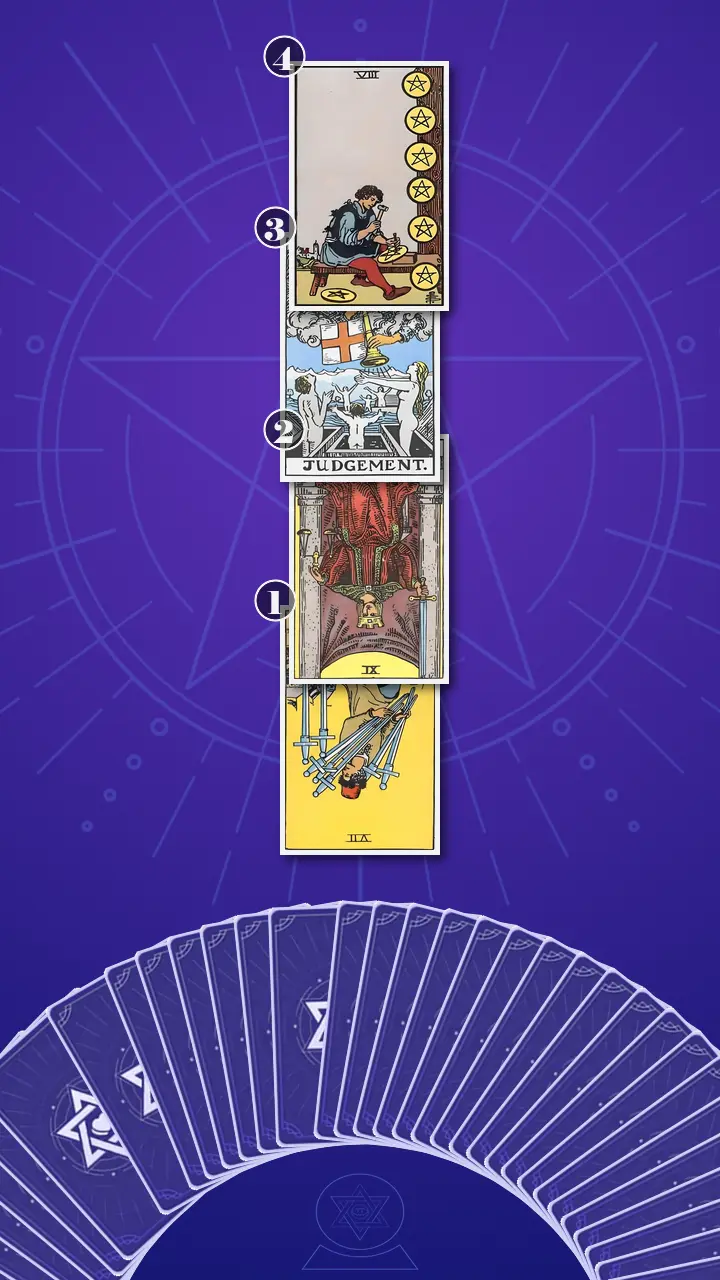
I chose the Four-Layer Insight Ladder, arranging four cards face down in a vertical line that climbed from the edge of the table toward the rain-dark window. At the base, the first position would show the visible pattern. Above it, the second would reveal the worth-based fear sustaining that pattern. The third would form the hinge—the internal reorientation capable of interrupting it—and the fourth would ground the insight in a repeatable action.
I use this spread for tightly focused self-inquiry because it does not bury the question under peripheral predictions. A larger Celtic Cross could have added environment, hopes, and possible outcomes, but Jordan did not need ten more angles from which to analyse the same conflict. They needed a compact sequence: present behaviour, root fear, transformative insight, embodied practice.
This is how tarot works in my practice. I do not ask the cards to declare who is guilty, forecast a fixed future, or replace a difficult conversation. I use card meanings in context to place an internal pattern outside the body for a moment, where I can examine it with the person rather than letting it operate invisibly. The cards offer the map; Jordan remains the one choosing where to walk.
Reading the Lower Rungs: Where Explanation Becomes Delay
Position One: The Backward Glance of the Seven of Swords
I turned over the card representing the present layer: the observable pattern of supplying context, clarifying intent, and extending the explanation while the specific behaviour change remains unnamed. It was the Seven of Swords, reversed.
I pointed to the figure carrying five swords while looking back at the two left standing behind. In Jordan’s modern life, those five carried swords were the Slack timeline, the moved deadline, the late-arriving data, the exact upload time, and the proof that their intention had been reasonable. The two unattended swords were much smaller sentences: I see the effect, and I will test this different action by this date.
“This card isn’t accusing you of lying,” I said. “Your explanations may be factually accurate. Reversed here, the Air energy is blocked inside a strategy that no longer delivers the clarity it promises. You keep looking backward to make the old behaviour understandable, so your attention never fully turns toward what the next interaction needs.”
I described the loop as an algorithm trained by Jordan’s own clicks. Every time exposure rose in their chest, they clicked on context; the internal feed responded by recommending more context. Soon, the action they needed sat outside the feed entirely while the mind kept serving increasingly persuasive versions of the past.
Jordan’s fingers stopped rubbing the edge of their phone case. They gave one brief laugh, but the sound landed without humour. “That’s so accurate it feels a little brutal.”
“I hear that,” I said. “But the card is showing a protective strategy, not a moral defect. It gave you short-term relief because your version of events had somewhere to go. We’re only noticing that the relief expired before the practical problem did.”
I asked when someone had most recently named a recurring concern and Jordan had opened Slack or Notes before naming the effect. They looked toward the window and described a Wednesday meeting in a glass room downtown. Their manager had said, “The handoff was incomplete again.” Jordan had immediately pulled up the timestamp showing that a source file arrived late.
“In my head, I was saying, ‘I’m only adding context because it matters,’” Jordan told me. Their hand moved toward their jaw and then stopped. “But the useful sentence—‘You still had to chase me for a usable handoff’—never came out. Neither did the next update time.”
The reversal carried another warning, too: Jordan could overcorrect by abandoning explanation altogether, declaring themselves terrible, and promising to change everything. I told them that a dramatic blanket confession would still postpone the modest action in front of them. It would merely replace defence counsel with a prosecutor inside the same private courtroom.
Position Two: Justice and the Uneven Weight of Intent
I turned over the card representing the root layer: the hidden fear that acknowledging impact without a defence would threaten Jordan’s personal worth. Justice appeared reversed.
The card’s scales, designed to weigh evidence, looked destabilised in reversal. I translated the image into a private performance review: the intent column had expanded across most of the page; workload, timing, motives, and factual distinctions each had their own entry. The impact column had been collapsed. The next-controllable-action field was empty.
“This is the deeper intent-versus-impact imbalance,” I said. “When your manager names a repeated late handoff, you correct the exact time the file arrived because accuracy matters to you. But Justice reversed asks whether that correction changes the effect on your teammate or changes what is now within your control.”
The analytical energy was in excess, while practical decision-making had become deficient. Thought was no longer helping Jordan distinguish relevant context from irrelevant detail; it was being recruited to produce an acquittal. The sword of discernment could catalogue every fact, but it could not reach a decision while Jordan’s worth remained the unspoken defendant.
Looking at the reversed scales, I thought of a mixing desk from my years of sound-energy research. One channel can be pushed so high that it masks everything else, not because the quieter signals are false, but because the mix has become unbalanced. Jordan’s intent channel was accurate and loud. Impact and action had not disappeared; they simply could not be heard at that level.
“Owning a behaviour is not the same as handing it your whole name,” I told them. “Justice does not require self-erasure. It asks for a fairer mix: facts, effect, and the next action you can actually control.”
Jordan’s breath paused. Their thumb hovered above the blank phone screen, then their gaze lost focus as if an old conversation had begun replaying behind their eyes. After several seconds, they released a breath from low in their chest and their shoulders shifted half an inch downward.
“I keep turning accountability into a closing argument,” they said quietly. “If I accept the effect first, I assume they’ll reduce me to the mistake. So I make them understand me before I let myself understand them.”
I did not rush to reassure them that nobody would ever judge them. That would have been a promise I could not make. Instead, I asked, “After every fair and relevant explanation has been included, what remains true and actionable?”
Jordan stared at the two central cards. “The source file was late,” they said. “And I still could have sent a risk flag before the handoff deadline. Both are true.”
That answer mattered. Jordan had not discarded context or accepted responsibility for another person’s delay. They had separated what explained the situation from what remained theirs to address. The scales did not need to erase either side; they needed to stop treating understanding as a prerequisite for action.
When Judgement’s Trumpet Cut Through the Noise
Position Three: The Call That Was Not a Verdict
I moved to the card representing the transformation layer: the internal shift from defending identity to conducting an honest, non-condemning self-review and answering it with a chosen response. As I turned it over, the room seemed to lower its volume. Even the radiator clicked into silence, and a streetcar bell sounded once through the rain—a single clear note. The card was Judgement, upright.
I showed Jordan the figures rising with open arms toward the angel’s trumpet. They were not cross-examining the sound or producing evidence that they deserved to remain where they were. They were hearing a call and responding with movement. Upright, Judgement carries awakening, accountable self-compassion, and renewal after recognition. Its energy was available and flowing rather than contracted.
In Jordan’s life, the card became the moment someone said, “This keeps happening,” and Jordan allowed the concern to register before opening a defence file. The trumpet was not a public verdict on their identity. It was a clear notification that the old strategy had stopped producing change. A response could begin with two statements: This is what I recognise. This is what I will test.
I brought us back to the late-night draft. Jordan had been caught in the belief that a perfectly fair version of the story had to exist before ownership could begin. Being understood felt like protection; one plain acknowledgment felt like exposure.
This was where I used what I call Mental Noise Cancellation. I could hear three psychological frequencies colliding: a sharp channel insisting, Prove that you are thoughtful; a low channel warning, If you own the impact, the mistake will become your identity; and a steadier signal saying, Name what happened and choose what comes next. The resulting friction was not evidence that Jordan was morally broken. It was the chaotic overlap of incompatible internal instructions.
I explained that mental noise cancellation does not destroy context. It identifies which frequency carries useful information and which one merely grows louder under pressure. Judgement isolated the clean signal beneath the private courtroom: Jordan did not need an acquittal before they could respond differently.
A longer defense will not free you; answer Judgement's trumpet by naming what is yours and rising into one changed action.
I let the sentence remain in the air. For one beat, Jordan stopped breathing. Their fingers, which had been rubbing the seam of their sleeve, hung in midair. Then their eyes slipped away from the card and fixed on the rain threading down the window; I could see them replaying something behind that unfocused gaze. Their pupils widened. The jaw that had been set since they arrived loosened by a fraction, then tightened again.
“But doesn’t that mean I’ve been doing accountability wrong for years?” they asked. Their voice came out sharper than anything they had said before, with a small tremor underneath it. A flush crossed their cheeks; their eyes brightened; one fist opened slowly against their knee. I waited. Their next breath arrived unevenly, then lengthened into a low, surprised “Oh.” Both shoulders dropped. The release did not look triumphant. It looked slightly dizzying, like stepping off an escalator and discovering that solid ground still requires participation.
“It means the strategy that once protected you is no longer helping you build the relationships or reliability you want,” I said. “That is not a retroactive conviction. You can acknowledge impact without turning one flawed behaviour into a verdict on your worth. Name what is yours, then let one changed action carry the proof.”
I leaned forward slightly. “Now, with this new perspective, think back to last week. Was there a moment when this insight could have made you feel different?”
Jordan closed their eyes. “When my manager said the handoff was incomplete again. I thought I had to choose between accepting all the blame and explaining every dependency. I could have said, ‘I hear that the late update left the team without a usable handoff. I own that I didn’t flag the risk early. I’ll send a status note by three next Tuesday and check in with you on Friday.’”
I gave Jordan ten quiet minutes to write those three lines: I heard, I own, and I will test by this date. I told them they did not have to send the message during our session, and that they could stop if the exercise felt unsafe or too activating. They read the draft once, removed a sentence that existed only to prove their intention, and left the necessary context available for a later conversation.
This was the central crossing in the reading. Jordan had not moved from “bad” to “good,” or from uncertainty to perfect confidence. They had taken one step from defensive urgency toward accountable self-compassion: enough separation between behaviour and identity to let honest self-review become movement.
At the Workbench, One Action Was Enough
Position Four: The Eight of Pentacles and Visible Practice
I turned over the card representing the action layer: the practical method for grounding ownership in one repeatable, observable behaviour. It was the Eight of Pentacles, upright.
The craftsperson on the card was concentrating on one pentacle while completed pieces formed a visible sequence nearby. I told Jordan that this was not a personality renovation. It was a workbench. Upright Earth energy offered balance after the contracted Air of the first two cards: less narration, more contact with what could be practised, observed, and adjusted.
In Jordan’s daily life, the card became one communication habit across several real interactions. They could send a risk flag before a deadline, pause before correcting a minor detail, or give one clear status update at an agreed time. A checkbox would record whether the replacement behaviour happened—not whether Jordan felt perfectly calm, and not whether the other person responded exactly as hoped.
“I don’t have to prove I’ve changed,” Jordan said, tracing the line of completed pentacles with one finger. “I can practise and review what happened.”
“Exactly,” I said. “You do not need a new personality; you need one behaviour you can see yourself repeat. Let the changed action carry the proof.”
I also noted what the spread did not contain. No Cups suggested that emotional language would need to be added deliberately rather than expected to emerge from analysis. No Wands suggested that momentum would need a calendar cue rather than a burst of inspiration. Jordan chose a specific practice: if a handoff might slip, they would send a risk flag by 3 p.m. instead of waiting until they could explain the full situation.
Their hand moved toward their phone again, but this time they did not open the old six-paragraph draft. They opened Google Calendar and created a seven-day check-in. The motion was ordinary enough to miss. In the reading, it was the first piece placed on the workbench.
From the Private Courtroom to a One-Behaviour Evidence Loop
I drew the four cards into a single story. Jordan’s ability to analyse context had helped them become articulate and capable in a fast hybrid workplace, where competence felt closely tied to stability. Under pressure, however, that strength turned into the Seven of Swords’ backward glance: more energy went into carrying explanations than into naming impact. Justice reversed revealed why—the inner scales treated one behaviour as evidence in a trial about Jordan’s whole worth. Judgement interrupted the trial with recognition rather than condemnation, and the Eight of Pentacles redirected attention from the story under appeal to the behaviour under construction.
The pattern was like adding footnotes to a warning light while the same dashboard icon kept flashing. The footnotes might all be correct. They still did not repair the system producing the alert.
I named the cognitive blind spot directly: Jordan had been treating full understanding as the condition that had to be met before accountability could begin. Their research, drafts, communication podcasts, and carefully sourced Slack threads felt like movement because they lowered the immediate pressure. But insight had become emotional regulation when it repeatedly left the next action undefined.
The transformation direction was equally direct: acknowledge the impact first, keep only the context that changes a fair decision, commit to one observable behaviour, and choose a check-in date. I wanted the next steps to be small enough that Jordan could use them while their face was still warm and their throat was still tight—not only in the calm after a consultation.
The Frequency Reset and the Three-Line Response
Jordan’s dissonant baseline showed up as rapid typing, held breath, a clenched jaw, and the urge to respond before the other person finished. I calibrated a Frequency Reset Pause around a slow pulse and a longer exhale. I use it to encourage the mind out of frantic beta-like speed and toward an alpha-like steadiness—not as magic, but as a repeatable cue that gives a clear sentence enough room to form.
- The 40-Second Frequency Reset and Three LinesBefore the next recurring concern from a manager, collaborator, friend, or partner, place both feet on the floor. Tap one finger at roughly 60 beats per minute, inhale for four counts, and exhale for six counts through four rounds. Then open a blank note titled Three Lines and write: “What I heard is…” “What I own is…” “I will test… by [date].” Say or send those lines before adding context, then ask whether the context changes the next decision or only makes the old behaviour more understandable.Tip: If the full version feels too exposed, say only the first two lines and pause. Context and boundaries may follow. You do not have to accept an inaccurate claim, disclose private information, or remain in a hostile conversation.
- The One-Behaviour Evidence LoopChoose one repeated communication behaviour within your control, such as sending a risk flag before a deadline or pausing before correcting a minor detail. Track only the next three relevant interactions with one checkbox per interaction. Put a review on your calendar for seven days later, then write one sentence: “When I did X, the next interaction became Y,” or “X became difficult when Z happened.”Tip: Record whether the behaviour happened, not whether you felt calm or received approval. If you miss once, mark it plainly and continue; a checkbox is information, not a moral score.
Jordan frowned at the first action. “What if I don’t even have forty seconds? In Slack, I’m already typing before I realise what’s happening.”
I shortened the reset with them. One long exhale. Four slow fingertip taps against the desk. Then only: “I hear the impact. I own this part. I want ten minutes to name a realistic next action.” If a live conversation felt coercive or unsafe, I told Jordan to postpone it or choose a written response. Accountability was not submission; it was a voluntary return to what they could genuinely own and change.
Jordan tried the shorter version once in the room. Their shoulders did not become perfectly loose, and their voice did not become cinematic. But the sentence came out without a “but” attached to it. That was enough for a first repetition.

A Week Later: The Quiet Proof
Seven days later, I received a message from Jordan that was four lines long rather than six paragraphs. At 2:54 p.m. on Tuesday, they had sent the promised risk flag. During Friday’s check-in, they had used the three-line response and left a full breath of silence after naming the impact. Their manager had replied, “That’s clear. Let’s review it next week.”
Nothing had been magically resolved. One teammate still wanted a more reliable handoff process, and Jordan still had to practise it. But the issue was finally sitting on a workbench instead of circling a courtroom.
Jordan had slept through the night, yet their first waking thought was still, “What if they think I’m unreliable?” This time they noticed it, gave a small laugh, checked the calendar box, and left the six-paragraph draft closed.
I did not see the cards change Jordan’s life for them. I saw Jordan use the cards to separate signal from noise, choose one controllable behaviour, and begin building grounded confidence through evidence. That was the Journey to Clarity: not perfect certainty, but enough internal space to answer a difficult truth without handing it their whole name.
If feedback makes your face burn, your throat narrow, and your jaw lock, I want you to remember that the noise is not your identity. When you can hear both frequencies—the urge to defend the story and the quieter invitation to change the behaviour—you already have a hand on the mixing board.
When those two frequencies overlap again, if you let one honest acknowledgment ring without forcing it to prove anything about your worth, what single workbench action—and what dated check-in—might you quietly test next?