Three Slack Threads to One Decision Lane: Redefining the Final Yes

Finding Clarity in the 6:40 p.m. Slack Spiral
If you say you want an autonomous team but a low-risk recommendation in the group channel makes your jaw tighten until you reopen the document, I recognise the shape of the problem. Alex (name changed for privacy) sat in a glass-walled office near Old Street at 6:40 p.m., with three Slack threads open beside the strategy document he had meant to finish. The ventilation hummed, his abandoned coffee tasted metallic, and the blue screen light sharpened the tiredness behind his eyes.
I watched him replace a teammate's wording in Google Docs, add two edge cases, and type, "Please wait for my final check." He wanted colleagues to take ownership, yet every decision still had to pass through his seat. For ten seconds, checking worked; then the next request arrived. Control gives fast relief and sends the invoice after 6 p.m.
When I asked what he was protecting, Alex looked at the Slack messages rather than at me. "If they can make a sound decision without me, what proves I am adding value?" I heard the responsibility pressure beneath the operational argument. It was not a character verdict or a prediction about his team. It was a leadership identity caught between building capability and proving necessity. I told him, "It makes sense that releasing control feels risky when accountability still sits with you. Let us use the cards to draw a map of the pattern, so the next move can belong to you rather than to the fear."

Choosing a Ladder for the Manager Approval Bottleneck
I invited Alex to put both feet on the floor, take one slower breath, and hold the question in plain language: What am I protecting by making every team decision pass through me? I shuffled slowly. The point was not to summon an unavoidable answer; it was to create a clean pause between the impulse to check and the choice to check.
For this consultation, I chose the Four-Layer Insight Ladder, a compact F5 Inner Excavation spread. It suits a question that names an observable defence and asks for the vulnerability beneath it. The layout runs like a small staircase from lower left to upper right: the present pattern, the protected root, the transforming principle, and the practical behaviour that can test the change.
This is one way how tarot works as a reflective tool rather than a verdict. The first position shows the visible manager approval bottleneck: the behaviour through which the problem currently appears. The second asks what holding authority close is protecting. The third identifies the shift from personal approval to decision rights, fair criteria, and proportionate accountability. The fourth turns that shift into a bounded team practice. A Celtic Cross would have added environmental and outcome positions that were not needed here, while a three-card line would have blurred the root and the remedy.
I explained the structure to Alex and to the reader who may recognise the same decision queue in a different office, inbox, or project board. The cards would not decide what Alex's team should do. They would help separate actual impact from delegation anxiety, and personal accountability from personal authorship.
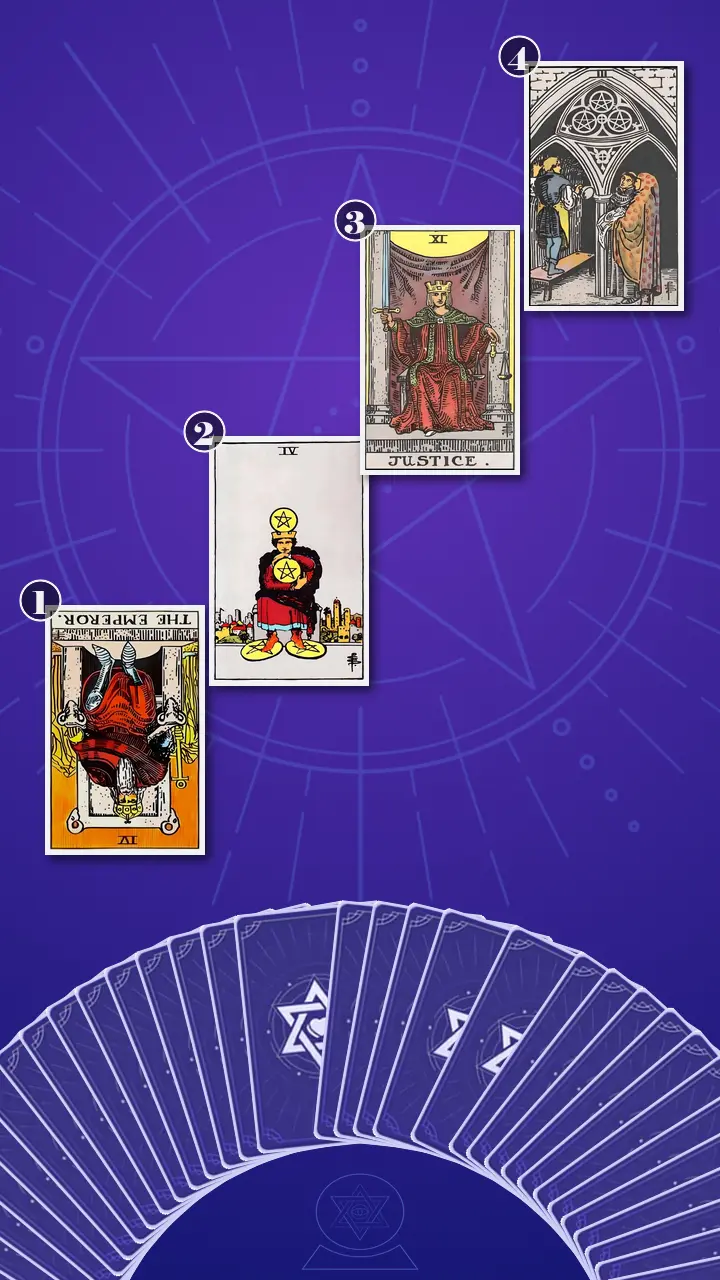
The Approval Gate, Reopened
The Fixed Centre: The Emperor, Reversed
Now I turned over the card representing the present layer: the observable bottleneck created by routing team decisions through personal review, revising other people's work, and delaying movement until approval is granted.
The card was The Emperor, in reversed position. In the Rider-Waite-Smith image, a solitary ruler sits on a stone throne, armour beneath a red robe, holding the symbols of authority close to his body. In Alex's working life, that throne was the fixed centre of three Slack workflows. A teammate could generate a recommendation, but the choice did not move until it passed through Alex's final check.
Reversed, the Emperor's authority was not absent; it was overcentralised. Leadership structure had become a blockage. Alex's effort to prevent visible mistakes required sign-off on reversible decisions, and the team learned that authority was borrowed and revocable. The more he reopened completed work, the more colleagues polished their recommendations to predict his preferred answer instead of strengthening their own judgment.
I asked him to listen for the sentence beneath the edits: "I want them to own it, but..." But the customer might notice. But the numbers could be read differently. But the method was not how he would have done it. Each exception sounded reasonable in isolation, yet together they made one person the only open turnstile in a station full of available routes.
Alex gave a short, bitter laugh. "That is too accurate. Almost a little rude." His mouth stayed curved for a moment, but his hand stopped above the phone and his eyes moved from the shared document to the card. I did not ask him to agree with the card. I said, "The point is not that you are a controlling person. The point is that your current structure teaches people to wait, even while your words tell them to lead." His shoulders lowered by a fraction, enough for the contradiction to become something we could examine.
The Grip Behind the Gate: Four of Pentacles, Upright
Now I turned over the card representing the root layer: the psychological protection beneath the behaviour, where decision authority is held close to preserve a sense of necessity, worth, and control.
Four of Pentacles appeared in upright position. The figure in the image presses one pentacle to the chest, balances another over the crown, and pins two beneath the feet. The posture looks secure until I notice that nothing can circulate. For Alex, the pentacle against the chest became the belief that being consulted on every decision was evidence that the team still needed him.
I brought him back to Monday morning in his Hackney flat. Rain had tapped the kitchen window, the kettle had clicked off, and the toast had gone cold while he scrolled through a former colleague's LinkedIn post about a self-managing team. Before assessing whether the comparison was useful, he had felt the pull to ask a teammate to route a routine vendor decision through him. The practical request was carrying a private question: "If they can do this without me, then what am I for?"
Upright, the Four of Pentacles can describe sensible conservation. Here, its protective energy had become excessive and immobilising. Alex was not only guarding quality. He was guarding against the moment when a teammate used a sound method he would not have chosen and the team continued without his personal authorship. Checking narrowed uncertainty for a few seconds, but it also kept responsibility, learning, and status pinned beneath the same pair of feet.
When I asked him to name what he might lose, his breath paused halfway in. Then his eyes left the card and went unfocused, as though a week of reopened recommendations were replaying behind them. Finally, his fingers tightened around the coffee cup before releasing it, and he said, "I can feel proud when they do well and still feel a bit redundant. I do not like admitting both are there."
I told him that the two feelings could sit in the same room without either one becoming a moral failure. The spread contained no Cups card, so the emotional meaning of usefulness could easily disappear inside operational objections about numbers, standards, and edge cases. Naming it was not surrendering accountability. It was removing the need to disguise every feeling as a workflow problem.
When Justice Moved the Final Yes
The Balancing Point: Justice, Upright
The room became unusually quiet as I turned over the card representing the transformation layer: the shift from personal approval to explicit decision rights, fair criteria, and proportionate accountability.
Justice appeared upright. The scales offered one test for impact and reversibility; the raised sword offered a boundary for genuine escalation. The pillars framed a structure that did not depend on one person's constant availability. In practical terms, I saw Alex choosing one reversible launch decision, naming Priya as its owner, writing the success criterion, defining customer or legal harm as an escalation threshold, and scheduling a Friday review of the reasoning rather than requesting pre-approval.
Justice's tarot meaning for leadership is not blind trust and it is not passive detachment. It is impartial discernment made visible. I told Alex, "Your standard can stay high without your hands staying on every choice. Delegation without decision rights is ambiguity handed to someone else." The upright sword gave the ambiguity an edge: who decides, what counts as acceptable, and what consequence genuinely requires Alex to step in.
At this point I used one of my signature diagnostic tools, Career Cycle Phase Identification. In a career crossroads, I ask whether a bottleneck reflects a personal skill gap or an industry-wide macro contraction. Nothing in Alex's situation suggested that the team needed more of his private checking because the market was shrinking around them. The deeper issue was a leadership-cycle change: he had carried an individual-contributor proof system into a role where his value could be measured by the structure he made possible.
I also used Promotion Window Calibration, not to predict a promotion, but to map where an organisational shift creates the path of least resistance for advancement. Alex had been trying to advance by absorbing more approvals. The clearer route was to make authority legible, protect high-impact decisions with real thresholds, and let capable colleagues demonstrate judgment inside a fair lane. The question was no longer, "How do I remain the author of every answer?" It became, "What system allows responsible answers to exist beyond my immediate reach?"
At 6:40 p.m., three Slack threads glowed beside the strategy document Alex had not touched. He had rewritten a teammate's recommendation, felt his jaw ease for ten seconds, and then noticed the next approval request waiting. The control worked briefly and cost him twice: once in attention, and once in the lesson the team learned about who was truly allowed to decide.
You do not need to guard the throne of every choice; set fair criteria, name an owner, and let Justice's balanced scales carry accountability.
For several seconds, Alex did not move. His breath stopped, and his pupils seemed to widen as the sentence reached the place where quality control and professional worth had become tangled. His jaw released first, then his raised shoulders dropped with a visible heaviness. The fist resting beside his phone loosened one finger at a time. He looked toward the rain-dark window, swallowed, and let out a breath that sounded almost like a laugh but carried no performance in it. "That means I can still be accountable without being the author," he said, more as a test than a conclusion. Relief crossed his face, followed by a brief, unsteady blankness: if the final yes was no longer the proof, he would have to decide what else his leadership was for. I let the silence stay long enough for both truths to remain. Then I asked, "Now, use this new perspective to revisit last week. Was there a moment when accountability could have lived in a written boundary instead of in your constant presence?"
This was the first real movement from hypervigilant personal control toward steadier trust supported by clear boundaries and visible collaboration. It was not a finished transformation. It was a change in where Alex placed the burden of proof.
The Workshop at the Top of the Ladder: Three of Pentacles, Upright
Finally, I turned over the card representing the action layer: the practical behaviour through which Alex could test the transformation by giving a named teammate ownership of a bounded decision and reviewing the reasoning without reclaiming the choice.
Three of Pentacles appeared upright. In the image, a craftsperson stands on a workbench while two collaborators hold architectural plans. No single figure occupies every role. The work is visible, standards are present, and expertise moves through conversation. This was not a picture of Alex disappearing from the team. It was a picture of his contribution changing from final approver to clear brief, fair criteria, and useful review.
I described the modern version: at a scheduled twenty-minute checkpoint, Priya would control the screen and explain what she noticed, what trade-off she chose, and what she would change next time. Alex would keep his suggestions in a separate note instead of editing the completed recommendation. He could evaluate whether the written guardrails held, but he would not turn a different valid method into a problem simply because it was different.
"Different is not automatically below standard," I said. "Review the reasoning; do not repossess the decision." Alex nodded, then caught himself before reaching for the document on his laptop. That small interruption mattered. His hand hovered, his attention moved to the urge rather than obeying it, and he wrote the thought in a separate note. The old reflex had appeared, but it had not become the operating model.
From Personal Approval to Shared Accountability
When I placed the four cards together, the sequence told a practical story. The Emperor reversed showed the visible manager approval bottleneck: authority had become a single gate. The Four of Pentacles showed what the gate protected, namely the belief that being needed for every answer proved leadership value. Justice introduced the antidote, moving accountability into decision rights, success criteria, escalation thresholds, and proportionate oversight. Three of Pentacles grounded the change in shared expertise and visible learning.
The blind spot was not simply that Alex checked too much. He was treating discomfort as evidence of decision risk. A teammate using a different method could trigger the same physical alarm as a genuinely high-impact issue, so his body was quietly setting the escalation policy. The control-relief loop then made the problem self-confirming: he intervened, felt brief relief, slowed the work, and watched colleagues ask for more permission. The team's hesitation looked like proof that he had to remain involved.
I offered him a different frame for the career transition. A team is not made autonomous by being told, "You own this," while the decision is later reopened in the shared document. Ownership becomes real when the lane is clear, the owner is named, the impact is proportionate, and the checkpoint is about learning rather than permission. This is the path from personal authorship to shared accountability, and it gives Alex a way to protect standards without protecting dependence.
For actionable next steps, I gave Alex three deliberately small experiments. They were designed to test the structure, not force him to suppress every instinct or hand away high-impact responsibility.
- One owner, two guardrails, one checkpointBefore Friday, choose one reversible decision already expected in the current sprint. Name one teammate as the owner in Slack, state that pre-approval is not required, write one success criterion and one escalation condition, then schedule a twenty-minute meeting after the decision is made called "Reasoning and learning review." Keep legal, safety, personnel, customer-harm, and genuinely high-impact risks as clear escalation points.Implementation tip: test the list of exceptions against impact and reversibility. If the experiment feels too exposed, choose a decision that can be corrected within one working day. Discomfort alone does not have to become an emergency review.
- Build a three-row decision-rights tableSpend fifteen minutes in Notion or Confluence creating three rows titled "Team decides," "Consult Alex," and "Alex decides." Add three recurring decisions from the current sprint, a named owner for each, the maximum acceptable impact, and the evidence that would trigger escalation. Bring the one-week draft to the next team meeting and ask which category has previously been unclear.Implementation tip: use a timer so the table does not become a complete policy covering every edge case. Record disagreement without defending the old process in the moment; clarity is the first version, not surveillance of every method.
- Run a reasoning-only review and observe the micro-orbitAt the checkpoint, let the decision owner control the screen and ask three questions: "What did you notice?" "What trade-off did you choose?" and "What would you change next time?" Keep edits in a separate note. For thirty days, use my Micro-Orbit Observation to record subtle blueshifts such as clearer ownership, faster reversible decisions, and more specific questions, alongside redshifts such as repeated high-impact escalations, missing boundaries, or evidence of organisational contraction.Implementation tip: make the review ten minutes if necessary. A redshift is a prompt to inspect evidence, not a layoff prediction, and a blueshift is information about where the team is gaining room. The smallest useful version is one owner, three questions, and one note that remains separate from the completed decision.

The Quiet Proof of a Different Kind of Leadership
Five days later, I received a Slack message from Alex. Priya had made the reversible launch call within the written guardrails, using a method Alex would not have chosen. At the Friday review, he asked the three questions, listened to the trade-off, and left the recommendation intact. He told me, "I still wanted to edit it. I also realised the urge was about my role, not the customer impact."
That night, he slept a full night, though his first thought at 7:04 a.m. was, "What if I got it wrong?" He smiled at the question, checked the written threshold instead of the entire Slack history, and made breakfast before opening his laptop. The uncertainty had not vanished. It had stopped being the only voice allowed to make a decision.
I saw that as the first quiet proof of finding clarity: not a solved career, not a magically self-managing team, but one person choosing a fair structure while the old reflex was still present. The cards had not made Alex less accountable. They had helped him return accountability to a scale he could actually sustain, where leadership value could live in the conditions he created for other people to think and act.
When every unanswered team message tightens your jaw, it can feel as though releasing one decision would also release the proof that you matter. But being needed for every answer is not the same as being valuable as a leader. If your value could live in the clarity of the lane rather than the final yes, which small decision might you be curious to watch someone else carry this week?