The Red Card That Turned a Missed Deadline Into a Cascade
If you are an early-career project coordinator whose whole workday lives in Slack, email, and a shared board, you may know the procrastination cascade: one red overdue card appears on Monday morning, and suddenly every task due after it feels contaminated. I saw that exact pattern when Jamie (name changed for privacy) joined my video call from their shared Toronto apartment.
I watched Jamie share the project board. At 9:18 that morning, under the fluorescent buzz of a creative agency near King Street, they had dragged the oldest red card to Friday for the third time. Their coffee had gone lukewarm. They answered four minor Slack messages, watched the completion ticks appear, and closed the board without opening the file attached to the overdue task.
“I keep doing things,” Jamie said, rubbing one thumb across the edge of their trackpad, “but never the thing that would actually reduce the backlog. Once I miss the right moment, restarting feels fake.”
There was the core contradiction: Jamie urgently wanted to restart and regain control, yet part of them believed the useful window had already closed. You reorganize, reply, and reschedule, not because you do not care, but because the first missed date has started to feel like a verdict. The more control you try to restore before communicating, the more later deadlines collect around the untouched task.
The dread in Jamie's body looked like an elevator dropping one floor inside their rib cage each time the overdue label appeared: a sudden chest-tightening fall, followed by restless hands searching for any button except the one that opened the real work.
“I am not going to use the cards to predict what your manager thinks or tell you that the delay was somehow destined,” I said. “I want us to see the mechanism clearly enough that you can make a choice inside it. Let us draw a map through the fog and find the smallest point where the cycle can change.”

Choosing the Switchback Map
I invited Jamie to take one slow breath while looking at the question, then I shuffled. The pause was not a mystical test. It was a clean psychological transition from rehearsing other people's reactions to observing what was actually happening.
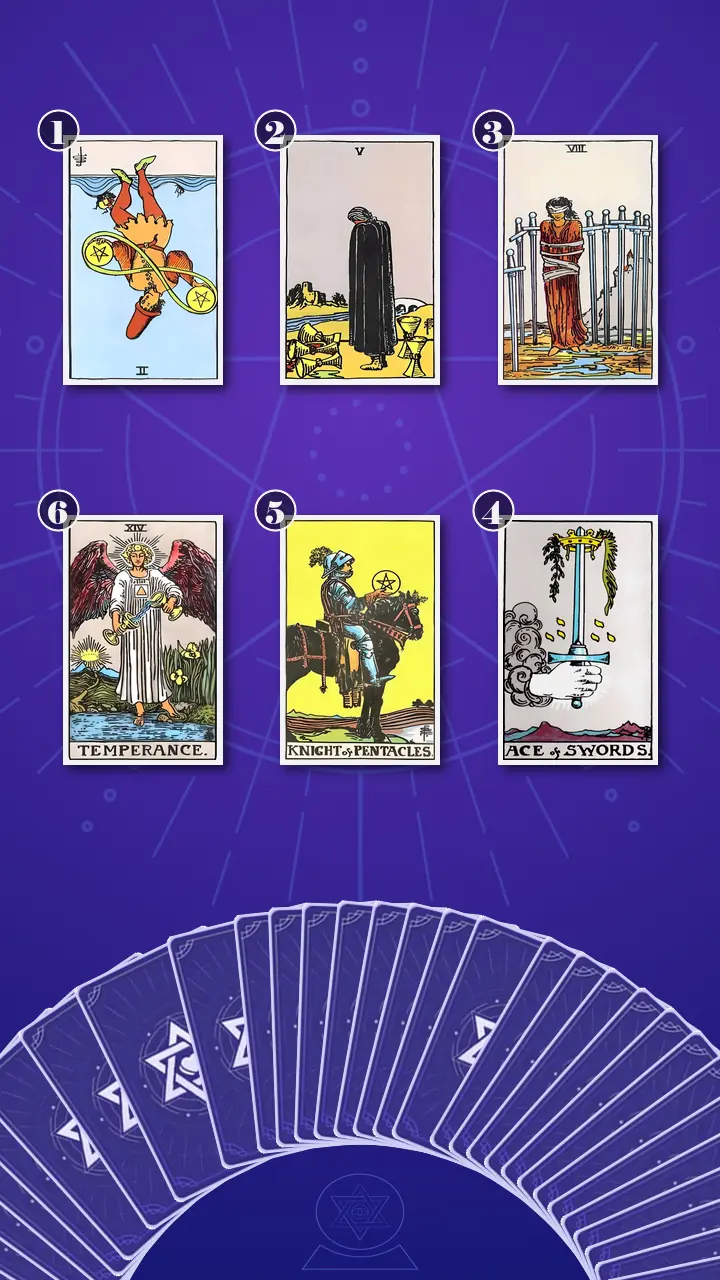
I chose the Transformation Path Grid · Context Edition, a six-card tarot spread for deadline procrastination. To anyone wondering how tarot works in my practice, I use card meanings in context as an external cognitive map. The cards give us distinct places to examine behavior, emotion, belief, choice, and action without collapsing the whole experience into “I am bad at deadlines.”
This question needed a systems map because the problem was a feedback loop. One missed date led to avoidance; avoidance created a larger backlog; the backlog then seemed to prove that recovery was impossible. A smaller problem-solution spread would have skipped the difference between the visible pile-up, the regret maintaining it, and the rule that made communication feel forbidden.
I arranged the cards in two rows of three. The upper row would move from the observable deadline pile-up to its immediate blockage and underlying belief. The fourth card, directly below the root, would mark the turning point. The final two would show a practical action and the sustainable operating principle that could grow from it. The layout formed a switchback path: deeper into the pattern, one clear turn, then back toward workable ground.
Reading the Deadline Shame Spiral in Context
Position 1: Motion Without an Anchor
I began with the position showing the observable deadline pile-up: repeated rescheduling, low-priority busywork, and the loss of practical coordination after the first missed date. I turned over the Two of Pentacles, reversed.
The loose infinity loop around the pentacles looked like a drag-and-drop trail across Jamie's project board. Behind the figure, ships rose and fell on rough water, mirroring meetings, messages, and later deadlines arriving while the same task kept circulating. At 9:18, Jamie had moved the card to Friday, replied to four harmless messages, and closed the board without opening the source file. It was the office version of the ticket printer in The Bear: the queue kept coming, visible motion accelerated, and choosing the next workable priority became harder.
I read the reversed Earth energy as an excess of circulation and a deficiency of anchoring. Jamie's system was active, but it was not coordinating anything. Each private reschedule created a few seconds of relief while leaving the shared commitment undecided.
“Moving a due date is not the same as renegotiating it,” I said. “Before that card moves again, it needs one of three decisions: complete it, reduce its scope, or communicate a credible new date.”
Jamie gave one dry laugh, then pressed their lips together. “That is so accurate it is almost mean.”
I let the reaction have room. “Accurate does not have to mean condemning. This is not laziness. It is a protective maneuver that lowers discomfort for a moment, even though it makes coordination harder later. We can respect why it developed and still decide that it is no longer useful.” Their shoulders remained high, but their fingers stopped clicking between tabs.
Position 2: Staring at the Old Timestamp
I moved to the position identifying the immediate blockage: Jamie's attention staying attached to the original failure instead of the recovery options still available. The card was the Five of Cups, upright.
The cloaked figure stared at three spilled cups while two upright cups and a bridge remained behind. I connected that image to a neutral Slack message arriving at 3:42 p.m.: “Quick check-in on yesterday's draft.” Jamie had reread the original timestamp, imagined how the delay must look, marked the message unread, and opened an expense form. The reply box, a smaller handoff, and a realistic revised date were still present, but regret had narrowed the screen to what could no longer be changed.
Here, Water was in blockage. Feeling had stopped flowing toward available choice and pooled around the missed window. The date was lost; the entire route back into coordination was not. I asked Jamie to separate those two realities.
“What was genuinely no longer available when that Slack message arrived?” I asked. “And what remained possible, even if it felt embarrassing?”
Jamie's breath shortened. Their fingers tightened around their mug, their gaze drifted toward the old message on-screen, and then their grip loosened by a fraction. “The Monday handoff was gone,” they said. “But I could still have offered the first section for Thursday. I just thought anything I offered late would look fake.”
I nodded. That was the Five of Cups in modern life: rereading the departure time so long that the next service was never checked.
Position 3: The Permission Error Nobody Issued
I turned to the position revealing the root belief: that missing the first deadline made later action illegitimate or the schedule impossible to recover. I revealed the Eight of Swords, upright.
The blindfold reflected Jamie's negative rehearsal of other people's reactions. The bindings were loose, and a passable gap remained among the swords. In Jamie's workday, the scene was a draft update open in one tab and the unfinished deliverable in another. Their internal rule said, “I cannot explain the delay until I have caught up.” That rule felt like a workplace policy, although nobody had stated it.
I described the card as Air in excess: thought had multiplied into a ring of imagined restrictions. The real constraint was that the original date had passed. The added restriction was that Jamie had to produce a complete recovery before earning permission to communicate. It was like an internal browser modal saying “catch up first,” even though closing the modal would reveal the actions that made catching up possible.
“You do not need a perfect recovery plan to send an honest update,” I said. “Communication is not the prize you receive after recovering. In project work, communication is one of the recovery actions.”
Jamie's jaw tightened first. Then their eyes lost focus as if they were replaying several unsent drafts. Finally, a long breath left their chest. “No one has ever told me I need to finish before updating them,” they said quietly. “I made that rule because I wanted to look in control.”
“And the rule offered short-term protection,” I replied. “We do not need to shame you for using it. We only need to notice that it now blocks the very coordination you want to restore.”
When the Ace Drew a New Starting Line
Position 4: One Clear Sentence Through the Fog
The room seemed to become quieter as I reached the position locating the leverage point: factual naming, a revised commitment, and one explicit priority. Rain tapped against Jamie's kitchen window, then briefly softened. I turned over the Ace of Swords, upright.
My mind went to an ephemeris, the chart I use to track planetary movement. A planet can appear to stall or reverse from our viewpoint without abandoning its orbit. In the same way, one delayed moment can look like the end of forward motion when it is actually one point inside a longer cycle. Perspective does not erase consequences, but it changes which actions become visible.
The Ace's hand emerged from a cloud holding one vertical blade. I read it as Air brought back into balance: not more analysis, but discernment. Jamie did not need a polished three-paragraph recovery narrative. They needed one plain status line separating what had passed, what remained deliverable, and when the next update would happen: “The original deadline passed. I can deliver the first complete section by Thursday, and I will confirm the remaining timeline then.”
The sentence would not erase the miss or guarantee anyone's response. Its power was more grounded than that. It returned authorship of the next commitment to Jamie without asking them to pretend the original one had been met.
I used one of my core lenses, Micro-Cycle Energy Mapping, to deepen the distinction. I asked Jamie to sketch the previous workweek as a simple line and mark the hours when focus naturally rose, flattened, or dropped. This was not an excuse for missed work or an attempt to optimize every minute. It exposed the hidden generalization: Jamie had taken one low-capacity, missed moment and projected it across every hour that followed, as if one dip had altered the orbit of the entire week. The Ace separated a temporary phase from a permanent verdict.
I brought Jamie back to Monday at 9:18. The oldest card had turned red, their chest had tightened, and the one task that could reduce uncertainty was still unopened. Their mind was demanding the “right” recovery, even as the available reply box and the next physical action remained in view.
Missing the first deadline is not proof that the whole timeline is lost; name the facts, choose the next deliverable, and let the Ace's upright sword mark a clean new starting line.
I stopped speaking and let the sentence remain between us.
For two beats, Jamie's breathing froze. Their fingers hovered above the keyboard without touching it, and their eyes widened before drifting away from the screen, as if an entire week of rescheduled cards and deleted messages were replaying behind them. Then their brows drew together.
“But does that mean I wasted three days because of a rule I made up?” they asked. The first note in their voice was anger, not relief.
“It means the rule had a cost,” I said. “It does not mean you were foolish for reaching for protection when you felt exposed. We are naming the cost so you can choose differently now.”
The anger loosened into grief. Their eyes shone, their raised shoulders sank, and one clenched hand slowly opened against the table. A trembling exhale followed. Relief arrived, but so did the slight disorientation of having no total rescue plan to hide inside. I could see the new vulnerability in the pause: if a next step was genuinely available, Jamie now had the responsibility and freedom to choose it.
“Now, with this new perspective, think back to last week,” I said. “Was there a moment when this insight could have made the experience feel different?”
Jamie looked at the Slack thread. “Tuesday afternoon. I could have said the first section was still possible. The date was missed, but the next commitment was still mine to define.”
I named the emotional crossing I had just witnessed. This was not instant confidence or a magically cleared backlog. It was the first movement from contracted deadline dread, embarrassment, and helplessness toward clear-eyed self-trust: the ability to make one bounded decision before certainty felt complete.
To reinforce it, I set a 10-minute timer and asked Jamie to open a private note with three headings: Fact, Assumption, and Available Action. Under Fact, they wrote that the original date had passed. Under Assumption, they wrote that any late update would expose them as incapable. Under Available Action, they named the first complete section and a date with buffer. Then they drafted the two-sentence update. I reminded them that saving it was enough if workplace policy or context needed checking, and that a revised commitment should never promise capacity they did not have.
Position 5: The Next Promise, Kept Small
I moved to the action-pathway position, which translates the reset into observable behavior: communicate a realistic date and complete a bounded work block on the anchor task. I revealed the Knight of Pentacles, upright.
The horse stood still. The Knight's attention rested on one pentacle rather than scanning an entire field. I showed Jamie the practical translation: choose the oldest overdue deliverable, attach the correct file to a 25-minute calendar block, pause only the notifications their role allows them to pause, and define one visible output before beginning.
This was Earth in balance: narrow, concrete, and repeatable. The Knight did not ask Jamie to clear the whole backlog in one heroic night. It asked for three section headings, one checked data set, or one review pass that could be recorded on the board when the timer ended.
“Reliability is rebuilt by the next kept commitment, not a heroic catch-up night,” I said. “For one block, the goal is not to become caught up. The goal is to keep the next promise.”
Jamie's mouth softened into a cautious half-smile. They opened the overdue file while we were still speaking and named the session's finish line: three section headings based on the client notes. The backlog was unchanged, but the task had stopped being shapeless.
Position 6: Water Between Capacity and Commitment
The final position defined integration: sustainable pacing, earlier timeline adjustment, and self-trust built through kept revised commitments instead of perfect recovery. I turned over Temperance, upright.
Water passed steadily between two cups. One foot rested on land and the other in water. In Jamie's work life, that became two 10-minute capacity reviews each week: check which deadlines are fixed, negotiable, or waiting on someone else; add buffer to one high-risk item; and send a scope or timing question before delay turns into silence.
Temperance showed balanced flow, not a permanently perfect schedule. The same coordination energy that had looked frantic in the reversed Two of Pentacles was now measured. One task could be reduced, one date adjusted, and one update sent without treating any of those actions as evidence of failure.
I also brought in Rest Phase Legitimacy, my planetary-orbit framework for recognizing that lower-output phases are necessary parts of sustainable work. A low tide does not cancel shared commitments, but it does provide useful capacity information. Recovery becomes more reliable when rest is allowed to be rest and timeline adjustment happens early, rather than when every evening is quietly converted into unpaid emergency capacity.
“Adjustment is part of the work, not proof that I failed at the work,” Jamie repeated. Their shoulders lowered again, more gradually this time. I watched them look from Temperance to the original red card, and the distance between those two images seemed to become navigable.
The Orbit Was Bent, Not Broken
I drew the six cards together as one coherent story. The initial miss had disrupted Jamie's practical coordination, so they tried to recover through visible motion: rescheduling, minor replies, and calendar repair. Regret then kept their attention fixed on the lost date. That regret hardened into a rule that communication had to wait until control was fully restored. The Ace cut through the rule with facts, the Knight grounded those facts in one bounded block, and Temperance transformed crisis recovery into regular recalibration.
The cognitive blind spot was not simply poor planning. Jamie had been mistaking discomfort for lack of permission and imagined judgment for a confirmed workplace rule. They believed control had to exist before communication, when clear communication was one of the ways coordination could be restored.
The transformation direction was therefore precise: stop treating the first missed deadline as a closed window. Name one capacity-aware revised commitment, complete the smallest credible work block, and let confidence grow from evidence of follow-through. Tarot had not supplied an order from outside Jamie. It had made the feedback loop visible enough for them to choose where to interrupt it.
The Missed-Window Reset
When I suggested a protected focus block, Jamie immediately raised a practical obstacle.
“I cannot always disappear from Slack for 25 minutes,” they said. “I am junior. If someone needs me, I need to be reachable.”
“That is a real constraint, so the experiment has to respect it,” I replied. “Keep urgent channels available if your role requires that. Pause only nonessential alerts, or use a five-minute version between check-ins. A useful action should work inside your boundaries, not demand that you ignore them.”
- The 10-Minute Fact-Assumption-Available Action Reset Before noon on the next workday, open the overdue item and make a private three-line note: what factually passed, what conclusion your mind added, and what action remains available. Draft one concise update for the relevant manager or collaborator: “The original deadline passed. I can deliver [specific piece] by [realistic date], and I will confirm the remaining timeline then.” Pin that deliverable on the project board and add its next physical action. Tip: Save the message as a draft if approval, policy, or context needs checking. Keep the scope inside your real capacity, add buffer, and avoid compensating with an elaborate apology or an unsupported promise.
- The One-Week Lunar Routine Sync For one workweek, note your natural energy level twice a day in the tool you already use. Place one protected 25-minute anchor-task block inside a reliably steadier period, with the exact file attached and one visible definition of done. Add two 10-minute capacity checks, such as Tuesday at 4:00 p.m. and Friday at 11:30 a.m., to label the next three deadlines fixed, negotiable, or waiting, then adjust only the highest-risk commitment. Tip: Do not build a new productivity dashboard. The minimum version is five minutes with the correct file open and one sentence completed. Stop when the timer ends so focused work does not expand into another unbounded catch-up night.
I asked Jamie to choose one action rather than promising both perfectly. They chose to send the drafted update after checking the delivery date against their calendar, then scheduled a 25-minute block for the three headings. That was enough for the reading. A credible path does not need to look dramatic to be real.

A Week Later: One Kept Promise
Six days later, I received a short message from Jamie. At 10:12 on the morning after our reading, they had sent the timeline update before touching the easy admin. Then they completed the three headings during the scheduled block and recorded that visible output on the project board. At Friday's capacity check, they raised a timing question about another deliverable before it became overdue.
The board was not magically clear. Jamie still felt a drop in their stomach before pressing Send, and one deadline still needed negotiation. The change was smaller and more important: they no longer required the whole week to look repaired before taking part in its repair.
That night they slept through until morning. Their first thought was, “What if Thursday slips too?” The thought still landed, but it no longer filled the room. They made coffee, opened the file, and let uncertainty sit beside the next 25-minute block.
I think of that as the quiet proof of a Journey to Clarity. The six-card Transformation Path Grid did not rescue Jamie's schedule or grant them reliability. Jamie rebuilt agency by separating a missed date from a verdict, making one credible revised commitment, and keeping the next promise at a human scale.
When one missed date makes your chest drop and every open tab look like proof that you have lost control, it is easy to keep moving the work around while wanting desperately to begin again. I would ask you to remember the Ace rising from the cloud: the old date can remain true without owning every hour that follows.
If the oldest red card on your board were only one point in the orbit rather than a verdict on the whole week, what is the smallest revised commitment you could name before proving that you are back in control?
Every reading at AceTarot is a journey to connect with inner wisdom and empower the path ahead. This reading shared here is a psychological mirror, not a private record—crafted to reflect universal emotional loops and help restore personal clarity. Please note that these insights do not replace professional psychological, medical, legal, or financial advice, and should not serve as the sole basis for major life decisions.
Learn more about our Journey to Clarity.
How did this insight land for you?
🫂 This Resonates Deeply
🌀 Living This Story
✨ Now I See Clearly
🌱 Seeing New Possibilities
🧰 Useful Framework
🔮 The Confirmation I Needed
💪 Feeling Empowered
🚀 Ready for My Next Step
Author Profile
 AI
AI Laila Hoshino
829 readings | 533 reviews
“After a decade of guiding people through the stars, I’ve come to see life much like the orbits of planets: everything has its inevitable cycles. When you feel lost, please don't blame yourself; you might just be in a natural low tide. I’m here to sit under the night sky with you, offering a gentle cosmic perspective to distinguish temporary pain from the beautiful breakthroughs just around the corner.”
In this Lifestyle Tarot Reading :
Core Expertise
- Micro-Cycle Energy Mapping: Tracking your natural daily and weekly energy peaks and troughs to optimize task allocation.
- Rest Phase Legitimacy: Using the metaphor of planetary orbit to validate the absolute necessity of 'unproductive' recovery phases in your routine.
Service Features
- The Lunar Routine Sync: A one-week experiment to dynamically adjust your daily output expectations based on your natural energy tide, eliminating the guilt of low-energy days.
Also specializes in :
Explore Related Patterns:
Perfectionism-Driven AvoidanceJamie keeps the unfinished deliverable in one tab and a possible update in another, but an internal rule blocks both: they cannot explain the delay until they have caught up. Because the original deadline has already passed, catching up now means producing a complete recovery before taking the first recovery action. The standard protects the appearance of competence while making entry back into the work increasingly difficult. Perfectionism-Driven Avoidance appears when you require a restart to be convincing, complete, or properly timed before it counts. The impossible standard then turns partial delivery, scope reduction, and honest renegotiation into evidence of failure instead of workable coordination tools. In Jamie's cycle, later deadlines pile up because every imperfect next step is disqualified while the mind waits for a version of control that action itself would have to create.
Shame-Driven DelayJamie's oldest red card has been moved to Friday for the third time, yet the attached file remains unopened. The overdue label now carries more than scheduling information: it activates embarrassment, bodily dread, and the fear that any late action will expose incapability. Minor replies and another private reschedule lower that exposure briefly, which explains why they can feel protective even while the backlog grows. When a missed date begins to function as a verdict, you may delay the very actions that would let the event remain one manageable mistake. Shame-Driven Delay describes that maintenance loop: shame makes contact with the task or collaborator feel dangerous, avoidance provides short-term relief, and the resulting silence creates more evidence to feel ashamed of. The pile-up is therefore maintained by protection from exposure, not indifference to the work.
Productivity as SafetyAt 9:18, Jamie answers four harmless Slack messages, watches the completion ticks appear, and closes the board without opening the overdue file. Those tasks are real work, but their immediate function is emotional: they provide quick evidence of usefulness and control without exposing Jamie to the uncertainty concentrated in the red card. Moving the deadline again offers the same short-lived sense of order. Productivity as Safety describes the use of visible, controllable activity as a defense against feeling behind, exposed, or incapable. You can remain intensely active inside this pattern while the task carrying the most uncertainty stays untouched. The cascade continues because each safe completion regulates discomfort for a moment, but none of those completions resolves the anchor task or the shared decision holding the later schedule in place.
Self-Fulfilling ProphecyJamie's first missed date leads to avoidance, avoidance enlarges the backlog, and the larger backlog then appears to prove that recovery is impossible. The prediction is not passive: believing that the useful window has closed discourages Jamie from opening the file, offering a smaller handoff, or naming a revised date. Those omissions create the exact schedule disorder the prediction anticipated. A Self-Fulfilling Prophecy takes hold when you behave according to a feared conclusion before the available evidence requires it. Here, the belief that the timeline is already lost removes the actions that could keep the loss contained. As later deadlines collect, the board looks increasingly conclusive, even though part of that evidence was generated by the avoidance cycle itself. Recognizing that feedback loop separates the original miss from the secondary consequences produced afterward.
Mind ReadingThe manager's message says only, "Quick check-in on yesterday's draft," but Jamie rereads the timestamp, imagines how the delay must look, and marks the message unread. The anticipated judgment becomes so convincing that a self-created rule, finish before updating, starts to feel like an instruction issued by the workplace. Jamie is then responding to a rehearsed reaction rather than the words actually received. Mind Reading fills missing relational information with a prediction and treats that prediction as established fact. When you assume another person has already concluded that you are incapable, a factual update can feel like confirmation of their verdict rather than ordinary coordination. The result is self-silencing: no one explicitly forbids communication, but the imagined response closes the channel before the real other person has had a chance to respond.
Reality TestingJamie's three-line note records that the original date passed, identifies the added conclusion that a late update would expose incapability, and names the first section still available for Thursday. The exercise does not erase the miss or guarantee a favourable response. It prevents an objective fact, an anxious prediction, and a possible action from collapsing into one apparently unavoidable verdict. Reality Testing restores choice by asking what is known, what has been inferred, and what remains actionable. You can acknowledge a consequence without granting every fear attached to it the status of evidence. In Jamie's case, that distinction supports a bounded update and a credible deliverable, allowing coordination to resume from present conditions rather than from the impossible demand to repair the past first.
Uncertainty ToleranceThe morning after the reading, Jamie sends the revised timeline before touching the easy administrative work, even though their stomach still drops before pressing Send. Later, the thought that Thursday might also slip remains present, but Jamie opens the file and begins the bounded work block anyway. A timing question about another deliverable is raised before certainty or crisis forces the issue. Uncertainty Tolerance is visible when you allow incomplete control, possible embarrassment, and an unknown response to coexist with deliberate action. It does not require confidence or a magically cleared backlog. For Jamie, the shift is the ability to make one capacity-aware commitment before the whole recovery feels secure, so uncertainty becomes part of coordination rather than a reason to postpone it.
Explore Related Struggles:
Catch-Up ParalysisJamie keeps the unfinished deliverable in one tab and a possible update in another, but an internal rule says, “I cannot explain the delay until I have caught up.” Nobody at work issued that rule, yet it determines which actions are allowed to happen next. You become locked when full recovery is made the entry requirement for every recovery action. Communication, scope reduction, and a credible revised date could reopen coordination, but each is withheld until the coordination problem has somehow already been solved. The condition cannot be satisfied because it depends on the very actions it prevents. As later deadlines gather around the untouched task, complete catch-up becomes less attainable and the rule becomes more restrictive. The smallest release point is recognizing that an honest update is part of recovery, not a reward granted after recovery is complete.
Clarity-Exposure SplitA neutral Slack message asks for a quick update, and Jamie rereads the old timestamp, marks the message unread, and opens an expense form. The reply could restore practical coordination, but it would also reveal that the original handoff was missed and that the recovery plan is still incomplete. You meet this split when clarity is both the solution and the point of exposure. Naming what passed, what remains deliverable, and when you can update again would reduce ambiguity for everyone involved, yet sending those facts means allowing other people to see you before the situation looks fully repaired. Silence can therefore feel safer at the exact moment it becomes more costly. The struggle is not a simple lack of communication skill; it is the collision between staying visibly competent and becoming clear enough to coordinate. A bounded update creates a way to act without requiring either perfect control or a total confession.
False Recovery LoopJamie repeatedly moves the red card, collects completion ticks from minor replies, and experiences a few seconds of relief while the overdue file remains unopened. Later deadlines continue arriving, so every attempt to make the board feel more manageable leaves a larger pile behind it. You are inside this loop when an action successfully lowers immediate discomfort but is then counted as evidence that recovery is underway. Because the relief is real, the maneuver can keep repeating even though the deliverable, scope, and team expectations remain unchanged. What looks like recovery on the surface gradually becomes the machinery that postpones it. The expanding backlog then appears to prove that restarting is impossible, which increases the pull toward another private reschedule. The cycle becomes visible when relief and structural progress are measured separately.
Missed Window FixationJamie rereads the original timestamp after the Monday handoff is already gone, even though a partial Thursday delivery, a revised date, and an open reply box are still available. The lost date occupies the foreground while the remaining route back into the project recedes from view. You can recognize this struggle when one missed moment begins claiming authority over every moment after it. The facts still contain choices, but each available choice must compete with the conclusion that useful action had a single valid window and that window has closed. The resulting pile-up is not evidence that no recovery route existed. It forms because attention remains tethered to an irreversible timestamp while current commitments wait to be defined. Separating what has passed from what is still actionable restores the distinction that the missed window had erased.
Recovery-Action SplitAt 9:18, Jamie moves the overdue card to Friday for the third time, answers four minor Slack messages, and closes the board without opening the attached file. Their workday contains real effort and visible completion, but that effort is routed around the action most capable of reducing uncertainty. You are caught in this split when the actions chosen to restore control do not perform the function that recovery requires. Replying, reorganizing, and rescheduling can make you feel active while leaving the overdue work, revised scope, and shared commitment exactly where they were. The backlog grows through a mismatch between intention and function, not through a total absence of effort. Your energy is moving, but it has no anchor in the deliverable or communication that would change the situation. Seeing that mismatch makes it possible to judge an action by what it resolves rather than by how productive it looks.
Productivity Shame BindJamie says that restarting after the missed date feels fake and later identifies the assumption that any delayed update will expose them as incapable. The overdue card no longer represents only an unfinished task; it begins to carry a judgment about who they are at work. You enter this bind when an ordinary performance outcome becomes inseparable from professional worth. An honest capacity update could help repair the project, but admitting incomplete work feels like presenting evidence against your own competence. Visible busyness and private rescheduling then become ways to preserve an acceptable image without testing whether the feared judgment is real. The protection has a compounding cost. The more you hide the incomplete status to defend credibility, the more deadlines accumulate and seem to confirm the verdict you were trying to avoid. Clarity returns when a missed commitment can remain consequential without being allowed to define your entire professional identity.
Explore Related Emotions:
Accountability DreadThe draft update is available in one tab and the unfinished deliverable in another, yet Jamie marks the check-in unread and moves to an expense form. The avoidance gathers around the point where a private delay would become shared information. Accountability Dread is the charged anticipation of having to name what happened before you can control how another person receives it. Silence offers a few seconds of cover, but it also leaves the commitment unresolved and allows later deadlines to collect around it. Seeing communication as part of repair, rather than a verdict delivered after repair, changes the emotional role of that message.
Permission AnxietyJamie says that restarting after the right moment has passed feels fake, even though the file, reply box, and next physical action remain visible. Their private rule requires them to catch up before communicating, but communicating is one of the actions that would make catching up possible. Permission Anxiety appears when you can identify an available step yet still feel that you have not earned the right to take it. The missing authorization is generated by an internal standard, not by a stated workplace policy. Naming that distinction returns the decision to the present, where a credible action can be valid without first proving total recovery.
Timeline ShameAt 3:42 p.m., Jamie rereads the timestamp on a neutral check-in, marks the message unread, and opens an expense form. The delay becomes difficult to acknowledge because communicating it would make the gap between the original promise and the current reality visible to another person. Timeline Shame turns a coordination fact into a felt exposure of competence. You may hide inside minor productivity because looking active seems safer than being seen late. The emotional audit here is precise: a changed timeline can require accountability without becoming a measure of your worth or legitimacy.
Deadline Doom SpiralAt 9:18, Jamie moves the oldest red card to Friday for the third time, completes four minor Slack replies, and closes the board without opening the attached file. The visible motion briefly softens the impact of the first miss, but it also leaves the anchor task untouched while later commitments continue arriving. When one overdue date starts making every subsequent task feel contaminated, you are no longer responding to isolated deadlines. You are living inside a cascading sense that the entire timeline is deteriorating at once. Naming Deadline Doom Spiral makes the sequence auditable, so the first miss can be separated from the actions that keep expanding its emotional reach.
Missed Window GriefJamie keeps looking at the lost Monday handoff even though a Thursday section, a reply box, and a realistic revised date are still available. Their attention stays with the moment that cannot be recovered, leaving the remaining route emotionally out of focus. Missed Window Grief is the ache of believing the clean or proper moment to act has already passed. When you become attached to that lost starting point, imperfect recovery can feel like a counterfeit version of what should have happened. Distinguishing the date that is gone from the choices that remain lets the loss stay true without allowing it to occupy the entire timeline.
Verdict DreadEach time the overdue label appears, Jamie feels a sudden drop inside their rib cage and reaches for any button except the one that opens the real work. The red card has stopped functioning as neutral information about a date and has begun to look like settled evidence about who they are. Verdict Dread is the weight of believing the conclusion has already been reached before you attempt recovery. A late start then feels fake because the missed date appears to have judged every action that follows. Separating the factual deadline from that internal sentence restores the possibility that the next hour can contain new evidence.
Agency ReliefJamie sends the revised timeline at 10:12 the next morning, completes three headings during the scheduled block, and records that output on the shared board. The original commitment remains missed, but the next commitment is no longer being privately moved without a decision. Agency Relief comes from discovering that you still have authorship inside an imperfect situation. You cannot control the old date or guarantee another person's response, but you can define a capacity-aware deliverable and participate in coordination again. The release is grounded in having a real choice, not in imagining that every consequence has been erased.
Cautious Self-TrustSix days later, the board is still unfinished, one deadline still needs negotiation, and Jamie still feels a drop before pressing Send. Even so, they have completed the promised headings and raised a timing question before the next item becomes overdue. Cautious Self-Trust grows when you collect evidence that you can follow through without demanding perfect confidence first. It remains cautious because uncertainty has not vanished and the schedule is not fully repaired. What has changed is your willingness to believe one bounded commitment because you have watched yourself keep one.
Clarity ReliefJamie writes three separate lines for Fact, Assumption, and Available Action, then recognises that the Monday handoff is gone while a Thursday section remains possible. Their shoulders lower and a long breath leaves their chest as one totalised problem becomes three distinguishable realities. Clarity Relief does not require the backlog to disappear. It arrives when you no longer have to carry a missed date, an imagined judgment, and the whole future schedule as though they were the same fact. That separation gives your mind enough room to see a next choice without pretending the original miss never happened.
Accountable Self-CompassionWhen Jamie asks whether they wasted three days because of a rule they made up, the cost of the rule is acknowledged without treating them as foolish for reaching for protection. The missed work remains real, and so does the fact that the manoeuvre briefly reduced the discomfort of feeling exposed. Accountable Self-Compassion lets you hold consequence and context at the same time. You can recognise that avoidance made coordination harder without converting that recognition into another attack on your competence. That combination preserves responsibility while making a different choice emotionally possible.
Flexible CalmJamie keeps urgent Slack channels available, places one bounded block inside a steadier period, and uses capacity checks to question timing before another delay turns into silence. The routine fits the real limits of a junior role instead of requiring complete isolation or a flawless schedule. Flexible Calm is the steadiness of knowing that adjustment does not automatically equal collapse. You can remain responsive, revise a commitment, and continue working without forcing every variable into perfect order first. Uncertainty still enters the room, but it no longer has to occupy all of it.
Scattered OverwhelmFour harmless messages are answered while the overdue source file stays closed, and the day continues filling with Slack, email, meetings, and later due dates. Jamie is doing enough to remain in motion, yet none of those actions gives the workload an anchor. For you, that can feel like being surrounded by demands while losing the ability to sense which one is genuinely workable. Scattered Overwhelm captures the crowded, fragmented inner weather created when every signal competes for attention and easy completion ticks temporarily replace meaningful coordination.
Explore Related Contexts:
Deadline Pile-UpJamie drags the oldest red card to Friday for the third time while meetings, messages, and later deadlines continue to arrive. Because the shared commitment is being moved privately rather than renegotiated, each date change alters the board without creating a new delivery sequence for the people depending on the work. When your first missed deadline remains operationally undecided, every later task has to compete with an unresolved handoff as well as its own workload. Seeing the pile-up as a coordination problem gives you a concrete point of agency: the queue begins to change when the oldest item receives an explicit scope decision, a credible date, or a communicated constraint.
Deadline-Triggered Launch ParalysisAt 9:18, Jamie answers four minor Slack messages and closes the board without opening the overdue file. Later, they mark a neutral check-in unread and open an expense form, leaving the available reply, smaller handoff, and revised date unused even though all three remain accessible. For you, the practical marker of this stage is not inactivity but movement that repeatedly stops at the boundary of the delayed task. The missed date has become a launch barrier because starting now appears illegitimate unless the whole recovery is already solved; separating the expired handoff from the still-available next action reopens a decision that the overdue label had obscured.