Calling Coworkers Secretive While Withholding Context: One Clear Ask

Finding Clarity in the 8:47 PM Slack Spiral
I recognized the workplace reciprocity blind spot before Jordan finished describing it. At 29, they could spot a process gap in seconds, yet they sometimes answered a Slack question with the smallest technically correct fragment, then experienced a coworker's equally brief reply as intentional secrecy.
Jordan joined my evening video session from the kitchen table of the small Toronto apartment they shared. They took me back to 8:47 the previous Tuesday, when they had been riding Line 1 home from downtown. The carriage hummed beneath the conversation in their headphones; blue-white phone light floated over their reflection in the window; the device had grown warm in their palm as they scrolled backward through a delayed-handoff thread.
A coworker had written, “Let's revisit this tomorrow.” Jordan's jaw had locked. Their shoulders had climbed toward their ears. In another tab, however, a private Notion note still held an unresolved dependency that Jordan had never mentioned in the shared channel.
“I can tell when someone is leaving something out,” Jordan told me. Their thumb rubbed the edge of their phone case as they added, more quietly, “But I know I leave things out too. I want honest collaboration. I just don't want to be the easiest person to read.”
I heard the whole contradiction in that sentence: wanting coworkers to be open while keeping information close enough to preserve control. The suspicion was not an abstract cloud. It behaved like a smoke alarm wired to every missing noun, sending tension through Jordan's jaw before the available facts had time to arrive. Underneath it sat defensiveness, resentment, and a small, hot point of shame.
“You can want transparency and still use withholding to feel safe; noticing both is more honest than choosing the flattering version,” I said. “I am not going to ask you to overshare, and I am not going to pretend every coworker is automatically acting in good faith. I want us to separate legitimate confidentiality from defensive control. Let's give this fog a map.”

Choosing the Transformation Path Grid
I asked Jordan to place both feet on the floor and take one slow breath while holding the workplace question in mind. I shuffled at an unhurried pace. I use that pause as a transition from reacting to observing, not as a performance of mystery.
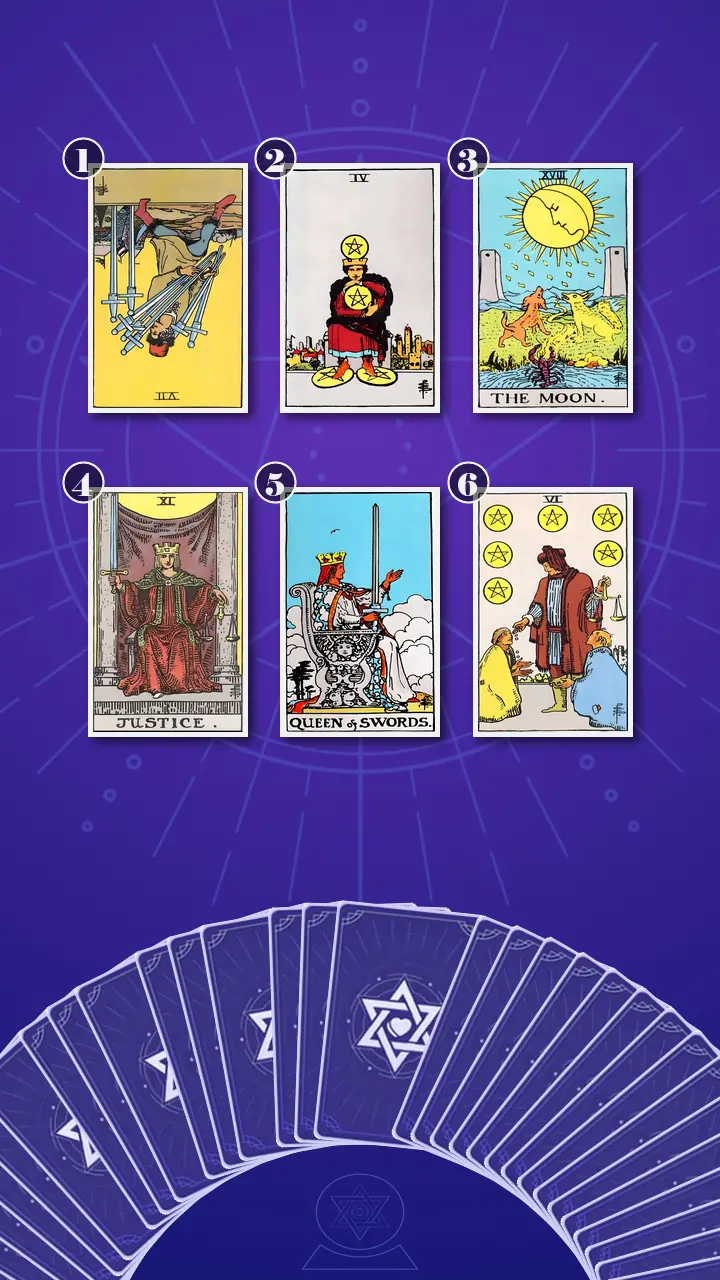
I chose the Transformation Path Grid (6) · Context Edition. For anyone wondering how tarot works in a workplace trust reading, I treat the cards as a structured cognitive mirror. They do not reveal a coworker's hidden intentions or issue a verdict about the future. They give me six distinct angles from which to examine behavior, protection, fear, accountability, communication, and integration.
I chose this six-card workplace self-audit because Jordan's problem was not a simple decision or a timeline. It was a feedback loop. Jordan shared fragments, coworkers received incomplete context and responded cautiously, Jordan interpreted that caution as concealment, and the resulting suspicion justified sharing even less. A Past-Present-Future spread would have forced a temporal story onto a reciprocal system. This grid could show the system itself.
I laid three cards across the upper row and three beneath them. The first would show the present pattern. The second would identify the protective blockage. The third would reveal the fear beneath Jordan's motive-reading. In the lower row, the fourth would act as the catalyst, the fifth would turn insight into a sentence, and the sixth would show what bounded reciprocity could look like in practice.
The layout resembled a closed information system opening into a usable path. I guided Jordan's attention across the diagnostic row, then diagonally down toward the catalyst and through the action and integration cards. The point was not to decide who was the villain. The point was to find where Jordan still had agency.
The Backward Glance in the Shared Channel
Position 1: The Present Pattern and the Reversed Seven of Swords
I turned over the card representing the present pattern: the observable behavior in which Jordan called coworkers secretive while selectively withholding information. It was the Seven of Swords, reversed.
In the Rider-Waite-Smith image, a figure carries five swords away while looking back over one shoulder; two swords remain behind. I read that backward glance as Jordan's private Slack audit made visible. They posted the headline while keeping the article, footnotes, and messy timeline in a private Notion page, then investigated everyone else's headlines for missing facts.
I brought the card directly into the delayed handoff. Jordan had supplied the launch date but not the unresolved dependency. When the coworker answered only the narrow information they had received, Jordan scrolled backward for evidence of withholding. The card did not ask Jordan to disclose everything. It asked them to notice which useful context they had deliberately removed from the shared field before assigning meaning to somebody else's omission.
The reversed Sword energy showed a blockage beginning to turn inward. Strategy had become recursive: Jordan's ability to detect gaps was being used to monitor other people while avoiding a full audit of their own contribution. Yet the reversal also held unused potential. The same strategic intelligence that could build a prosecution could instead distinguish a real boundary from an attempt to control who knew what.
“In the last handoff where you thought someone was being secretive,” I asked, “what did you actually say, what relevant context stayed in your private note, and what did you expect them to volunteer without receiving that context?”
Jordan gave a short, bitter laugh. “That is so accurate it's kind of brutal.” Their fingers stopped scrolling over the edge of the phone, but their eyes stayed on the card. “I sent the date. I didn't send the dependency. Then I got annoyed that they didn't explain why they were asking.”
I did not turn that recognition into a character judgment. “This is a pattern under pressure, not your permanent identity. The card is useful because it makes the sequence observable. Once a sequence is observable, you can interrupt it.”
Position 2: The Map Held Against the Chest
I turned over the card representing the core blockage: the protective control strategy that kept the contradiction active. It was the Four of Pentacles, upright.
The figure pressed one pentacle to the chest, planted both feet on two more, and held another at the crown. I saw Jordan's private spreadsheet in the image: emotional protection at the chest, practical control under the feet, and constant monitoring in the mind. The full project history stayed under one person's permissions while the shared channel received only the polished status.
“If they can see the whole context, they can see where I am uncertain,” Jordan said when I asked what the grip protected. Their voice had lost its defensive edge. It sounded tired.
I read the Four as an excess of fixed Earth. Information that might have supported the project had become immobilized because possession felt like stability. Holding the map offered temporary protection from surprise, but it also left coworkers navigating with fewer directions. Their caution then produced more incomplete replies, which made Jordan grip the map harder.
I kept the distinction precise. A confidentiality boundary protects private client details, unverified allegations, personal data, or information outside someone's authority to share. A defensive grip withholds relevant, permitted context mainly because being the only person with the complete version feels safer. The card was not calling every closed file unethical. It was asking whether each closed file had a work-relevant reason.
I watched Jordan's shoulders rise once more, hold for a second, then lower by less than an inch. Their hand had been closed around the phone. It slowly opened on the table. The movement was small, but it told me the protective logic had been recognized: sharing context felt riskier than requesting it because disclosure might expose uncertainty.
Position 3: When a Vague Message Becomes a Motive
I turned over the card representing the underlying root: the fear and interpretive habit that transformed incomplete information into evidence of secrecy. It was The Moon, upright.
I pointed to the dog and wolf responding beneath the Moon, the crayfish emerging from dark water, and the path winding between two towers. I saw two browser tabs in those symbols. One tab contained the observable words: “Let's revisit this tomorrow.” The other contained the story Jordan's nervous system had written: “They know something, they are hiding it, and my position may be at risk.”
The Moon's Water energy was running in excess. Imagination was filling a factual gap faster than a direct question could reach it. Jordan was not wrong to notice ambiguity, and The Moon did not prove the coworker innocent. It showed that several explanations were available, while the most threatening explanation had been promoted from possibility to fact without verification.
“An incomplete reply is a data point, not a verdict about someone's character,” I said. “Which words did you actually observe, and which motive did you infer?”
Jordan looked away from the card. I watched their gaze lose focus as if the Line 1 window had returned in front of them. First their breathing paused. Then their brow tightened while they replayed the message. Finally, a longer breath moved through their chest.
“I observed that they wanted to revisit it tomorrow,” they said. “I inferred that they were hiding a problem from me. I guess I also feared they had decided something without me.”
I nodded. “That distinction does not require you to dismiss a real warning sign. It simply keeps your internal caption from impersonating metadata. You can investigate a pattern while remaining honest about what is known, what is inferred, and what still needs to be asked.”
When Justice Weighed the Slack Thread
Position 4: The Catalyst That Applied One Standard to Both Sides
The radiator in my reading room clicked once and fell quiet as I reached the lower row. Even through a video call, the silence felt newly exact. I turned over the card representing the key catalyst: the insight capable of interrupting the loop by applying the same standard to Jordan's withholding and the coworkers' openness. It was Justice, upright.
I showed Jordan the balanced scales, the upright sword, and the two steady pillars. Justice moved the reading out of The Moon's competing stories and into accountable comparison. Before Jordan typed, “Why are you being so secretive?” the card asked them to place the coworker's brief reply beside their own minimal answer and examine what each person had actually been given.
This was where I brought in my Career Cycle Phase Identification, a diagnostic lens I normally use to distinguish a personal skill bottleneck from an industry-wide macro contraction. I adapted it to the team's information flow because accountability becomes distorted when every problem is assigned either entirely to the individual or entirely to the system.
I first asked Jordan about systemic contraction: had permissions recently narrowed, had a restructure changed who could authorize disclosure, were legal or client restrictions affecting several teams, or had terse replies increased across the organization regardless of what Jordan shared? Those would be organizational redshifts, evidence that the information environment itself was contracting.
“Not really,” Jordan said. “There are silos, but no new policy. This gets worst when I send a really narrow update and expect them to fill in the rest.”
That answer placed the issue in a more personal cycle without pretending the company was perfectly transparent. Justice kept both scales honest: Jordan could own their contribution without absorbing responsibility for every colleague's behavior. If a coworker had a documented pattern of misusing information, retaliation, or unauthorized secrecy, a boundary and an escalation route might be appropriate. But where the evidence showed a reciprocal communication loop, Jordan had a lower-risk intervention available.
I asked Jordan to return to 9:03 on Thursday morning. They pictured the cursor blinking beside “Why are you being so secretive?” while their private note still contained the missing decision history. Their thinking had narrowed to one demand: prove that the other person was open first.
Do not use a complaint about secrecy to avoid examining your own withholding; use Justice's scales to compare what you ask for with what you share, then use its sword to make one clear, bounded request.
I let the sentence remain between us without explaining it away.
I watched Jordan's breath stop first. Their right index finger froze above the phone screen, and the muscles beside their mouth held the expression they used when preparing a rebuttal. Then their gaze slipped past the camera. I could almost see them replaying the handoff: the dependency in the private note, the polished status in Slack, the coworker's narrow response, and the accusation waiting in draft. Their pupils widened slightly. Their eyes grew bright, but their shoulders did not relax yet. Recognition arrived before relief.
Then their jaw reset. “But doesn't that mean I was wrong about all of it?” Jordan asked, with a flash of anger that sounded closer to fear. “Doesn't it mean I caused the whole problem?”
“No,” I said. “Justice is not asking you to prosecute yourself in place of your coworker. Some omissions are real. Some boundaries are necessary. This only means your own message belongs in the evidence. Accountability gives you one more source of leverage: a behavior you can change without waiting for somebody else to confess.” Their fist loosened against the table. A shaky exhale left their chest, followed by the faint disorientation that can come when a familiar burden is removed and responsibility remains.
“Now, with this new perspective, think back to last week. Was there a moment when this insight could have made the exchange feel different?” I asked.
Jordan remembered a teammate asking whether there had been earlier warning signs. Jordan had answered, “Nothing that changes the immediate action,” although they had an unresolved dependency in the incident timeline. “I could have said the immediate action was unchanged and there was one unverified dependency I was still checking,” they said. “Then I could have asked what decision they were trying to make.”
I named the movement I was witnessing: a first step from suspicion-driven motive-reading and defensive withholding toward balanced accountability, clear boundaries, and steadier reciprocal trust. It did not require perfect trust. It required one consistent standard.
Before moving to the next card, I invited Jordan to open a low-stakes thread and draft three lines without sending them yet: “What is confirmed,” “What is unclear,” and “What I can share or need to ask.” They wrote for less than two minutes. The draft included one relevant dependency and one boundary around an unverified client detail. Nothing private had to be surrendered.
The Upright Sword Becomes a Usable Sentence
Position 5: The Queen of Swords and the Action Pathway
I turned over the card representing the action pathway: the concrete communication practice that could combine observable facts, a clear boundary, and a direct information request. It was the Queen of Swords, upright.
I read her visible blade and open hand together. The sword offered precision; the hand kept the exchange human. Her Air energy was balanced rather than blocked or excessive. She did not use clarity to prosecute, and she did not use privacy as a reason for silence.
I asked Jordan to replace the accusation with a boundary-aware handoff sentence: “I have the timeline but not the decision context. I can share the confirmed timeline and the unresolved dependency; the client detail is still unverified, so I am keeping that out for now. What constraint shaped the change?”
This was the modern card meaning in context. Jordan could state what was known, name what was missing, disclose the information they were authorized to share, and ask one answerable question. The communication did not require them to narrate every uncertainty or become fully readable to everyone.
“Transparency does not mean handing over every private file; it means making the relevant boundary visible,” I said. “The test is not whether you disclosed everything. The test is whether the other person received enough appropriate context to respond meaningfully.”
Jordan read the draft aloud once. Their first attempt sounded clipped, as though the question were a cross-examination. I asked them to remove “obviously” and every motive word. On the second attempt, their tone became operational rather than accusatory.
“That feels weirdly less exposed,” they said. “I'm saying more, but I'm also saying where the limit is.”
“Exactly,” I replied. “A visible boundary often creates more safety than a polished half-answer because nobody has to guess whether the missing material is confidential, unknown, or being held as leverage.”
Position 6: The Six of Pentacles and Measured Reciprocity
I turned over the final card, representing integration: the practice of sharing information reciprocally without confusing healthy confidentiality with defensive withholding. It was the Six of Pentacles, upright.
I drew Jordan's attention to the scales held by the central figure and the coins moving into another person's hand. Pentacle energy had changed since the Four. In the blockage position, Earth had been fixed and contracted. Here it was balanced and circulating. Security no longer depended on one person possessing the whole map.
I translated the card into one low-stakes workplace exchange. Jordan could share a relevant timeline, ask what context the coworker needed to proceed, and clarify what remained confidential. The coworker could then supply the missing decision constraint or state their own limit. Neither person had to earn the right to speak by revealing everything first.
I also kept the power dynamics visible. Six of Pentacles is not a fantasy that every workplace exchange is equal. Managers, coordinators, vendors, and client-facing teams may have different authority. A person with a history of retaliation may not be a safe partner for an experiment in openness. Bounded reciprocity means useful information moves where it is appropriate, while privacy, role limits, and consent keep their permissions.
“Trust is not a test they pass before you speak; it is a pattern built from bounded exchanges,” I told Jordan. “You can offer one relevant fact, ask one direct question, and observe what happens. That is participation, not surrender.”
Jordan looked from the Four of Pentacles to the Six. “The first one is me holding the only project map,” they said. “The last one is giving someone the section they actually need.”
I nodded. “And keeping the confidential pages appropriately closed. The movement is from access as control to access as discernment.”
A Map That Can Leave the Private Tab
I gathered the six cards into one story. The Reversed Seven of Swords showed Jordan removing context from the shared field while monitoring everybody else's omissions. The Four of Pentacles explained why: holding the complete map protected them from exposure and surprise. The Moon revealed what happened inside the resulting gap, where ambiguous messages acquired threatening motives before facts were checked.
Justice interrupted that loop by placing Jordan's request for openness and Jordan's own disclosure on the same scales. The Queen of Swords supplied the language for a direct, proportionate request. The Six of Pentacles grounded the insight in repeated exchanges where relevant context could circulate without erasing confidentiality.
The cognitive blind spot was not simply “I withhold too.” It was the unequal way Jordan classified the same behavior. Their own omission felt like a justified boundary because they knew its protective reason; a coworker's omission looked like secrecy because Jordan could not see the reason behind it. That asymmetry made an inference feel like evidence.
The transformation direction was clear: before labeling a coworker secretive, disclose one relevant piece of context within a visible boundary and ask directly for the information needed in return. That shift replaced private evidence-gathering with accountable inquiry. It also preserved Jordan's right to protect confidential, unsafe, unverified, or unauthorized material.
I reminded Jordan of the map metaphor. They had been holding the map close so nobody else could control the route, then resenting coworkers for not producing maps of their own. The cards did not demand that Jordan hand over the whole atlas. They suggested sharing the relevant section, marking the blank area honestly, and asking for the missing route.
The Two Practices for the Next Work Cycle
I gave Jordan two small actions. The first could interrupt the next tense Slack reply in 90 seconds. The second adapted my Micro-Orbit Observation, a 30-day tracking strategy, so Jordan could distinguish an individual communication pattern from a wider organizational contraction without turning the exercise into surveillance or self-criticism.
- Run the 90-Second Justice Scales CheckBefore replying to the next incomplete Slack message or project handoff, open a two-column note labeled “Observed” and “Inferred.” Write one exact behavior under Observed, one story about motive under Inferred, and one direct question. Then check your previous message for one relevant detail you knew but did not share.Keep the whole check to 90 seconds. If a bounded disclosure is appropriate, add one useful fact and one visible limit, such as: “I can share the timeline and current risk; the client detail is still unverified.” If the material is confidential, private, outside your authority, or unsafe to share, protect it.
- Use a Three-Line Handoff Inside a 30-Day Micro-OrbitIn the next relevant shared-channel update, write three lines: “What is confirmed,” “What is still unclear,” and “What I need from you.” For 30 days, log no more than three exchanges per week in a phone note: what you offered, what you requested, and what boundary you kept. Spend two minutes per entry.Look for blueshifts, such as coworkers offering more usable context after a bounded share, and redshifts, such as access narrowing across several teams regardless of your wording. A redshift is a prompt to verify policy, role, or restructuring conditions, not a prediction of layoffs or proof of bad intent. Stop the exercise if it increases rumination.
I framed the experiment as calibration, not a moral performance review. If clearer messages improved the exchanges, Jordan would have evidence that their own communication could change part of the cycle. If information stayed restricted across multiple teams despite direct, appropriate requests, they would have evidence of a wider organizational issue worth addressing through a manager, documented process, or formal access conversation.
“You do not have to solve workplace trust in one message,” I said. “You only need enough information to tell the difference between a temporary low tide, a system-level contraction, and a habit you can alter. The next honest data point matters more than a perfect confession.”

Six Days Later: A Small Change in the Orbit
Six days later, I received Jordan's message: they had sent the three-line handoff. Their coworker supplied the missing constraint and thanked them for naming the unresolved dependency. Jordan slept through the night, then woke thinking, “What if I handled it wrong?” This time, they smiled before checking Slack.
I did not call the pattern solved. One useful exchange could not guarantee trust, erase real information silos, or make every colleague safe. It was simply the first concrete proof that Jordan could tolerate a little uncertainty, share relevant context without oversharing, and replace an accusation with a question.
That was the real Journey to Clarity. The cards had organized the evidence and made the loop visible, but they had not sent the message. Jordan had chosen the boundary, written the words, and tested the new behavior. Tarot had offered a map; the person holding it still decided where to walk.
If you also want coworkers to show the whole map while keeping your own uncertainty close to your chest, I invite you to notice the body-level cost of trying to stay protected and connected at the same time: the tight jaw, the lifted shoulders, the restless return to the thread. Recognizing that cost does not make you dishonest. It means the old orbit has become visible enough to change.
If openness could be one small, bounded exchange rather than proof that you have surrendered control, what is the first piece of relevant context you could place on the shared map, and what direct question would you ask in return?