When the Slide Carried Someone Else's Name, Ownership Became Visible
The 9:40 p.m. Deck That Kept Jordan Invisible
If you are the product operations person whose Slack status stays green after the project lead logs off, invisible labor at work may be the part of burnout no productivity system can solve.
At 9:40 on a Tuesday night, Jordan (name changed for privacy) joined my video call from the kitchen table of their Toronto apartment. Cold takeaway sat beside the trackpad. The laptop fan whirred beneath ten open tabs, soy sauce and stale coffee hung in the air, and a blue-white Google Slides deck made their tired eyes look glassy.
A slide bearing a colleague's name was still open. Jordan had rewritten most of it.
“I don't mind working hard,” they told me, pressing two fingers into the hinge of their jaw. “I mind disappearing from the story. I keep fixing everything because I want the launch to succeed. Then someone else presents it, and I wonder whether asking to be named will make me look difficult or insecure.”
I heard the whole contradiction in that sentence: Jordan wanted a genuinely collaborative result to receive genuinely collaborative credit, yet every private rescue made them less visible inside the result. Their resentment did not feel like an abstract mood. It seemed more like a strip of aluminum foil caught between the back teeth: metallic, sharp, and impossible to ignore each time the jaw closed.
I also understood why the obvious advice to “just speak up” would be inadequate. Jordan's salary covered Toronto rent, but not the fantasy that workplace conflict carried no consequences. Hierarchy, reputation, and financial limits were real parts of the question.
“I'm not going to use tarot to tell you what your coworkers secretly intend or predict whether anyone will suddenly become fair,” I said. “I want us to make the pattern visible. Let's draw a map of where the work goes, where the credit goes, and where you still have a meaningful choice.”
Choosing the Compass for a Workplace Credit Imbalance
I asked Jordan to place both feet on the floor and take one unforced breath while holding one question in mind: Why do I keep doing the heavy lifting while other people get the credit? I shuffled slowly. The pause was not a mystical performance; it was a way to step out of the Slack-speed reflex long enough to look at the situation deliberately.
I chose a five-card Relationship Spread. For readers wondering how tarot works in a workplace problem, I use the cards as an external cognitive map. Each position separates one part of a tangled experience so that an intuition can be tested against observable behavior, documents, meetings, and choices. Tarot can reveal a pattern worth examining; it does not replace evidence, consent, workplace policy, or Jordan's judgment.
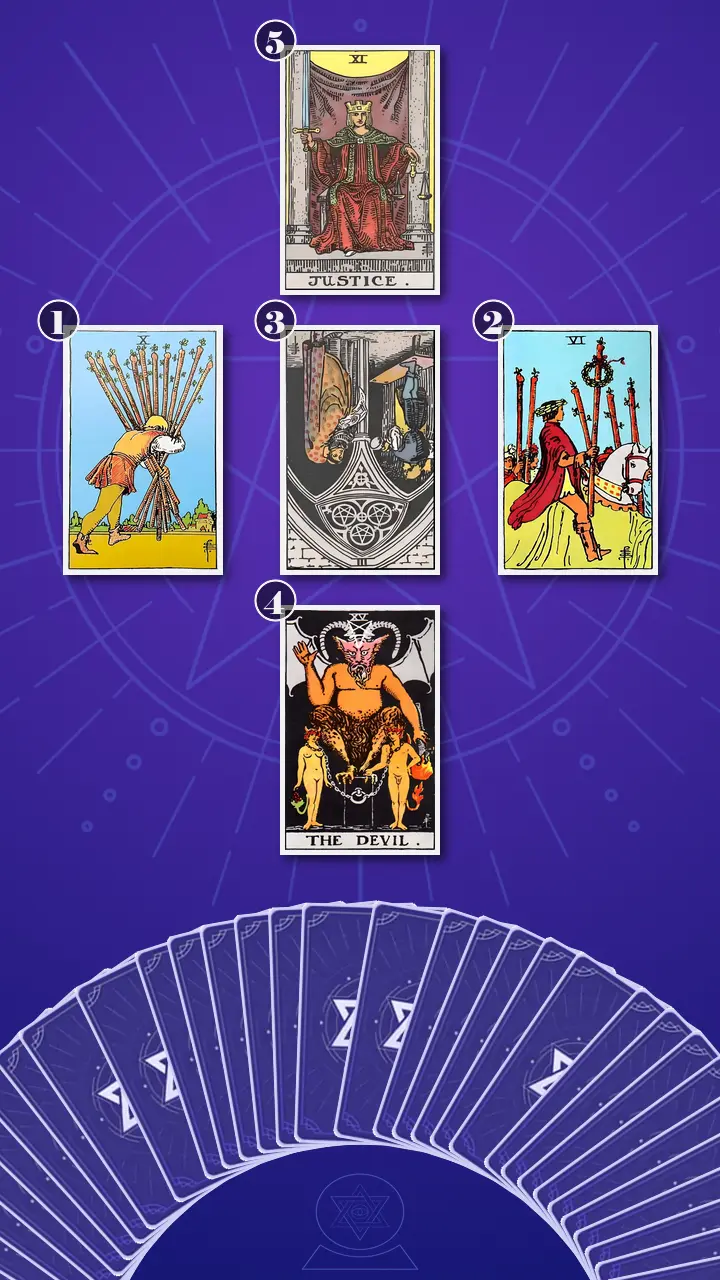
This was the smallest spread that could hold the real structure of the issue. The first position would show Jordan's observable role in the credit imbalance. The second would examine the collaborator-side visibility channel without pretending to read anyone's private motives. The center would reveal the shared working process. Beneath it, I would look for the attachment that kept the cycle repeating. Above it, the final card would offer the healthiest available direction.
I placed the first card to the left and the second to the right, with the third between them. The fourth sat below the center and the fifth above it. The layout resembled a balance scale crossed by a plumb line: hidden labor on one side, public recognition on the other, and the collaboration mechanism suspended between them.
Hidden Execution, Visible Victory
Position One: The Worker Behind the Bundle
“The card I'm turning now represents your observable role in the credit imbalance: the habit of accepting unassigned labor and carrying a project beyond a sustainable share.”
I revealed the Ten of Wands, upright.
In the Rider-Waite-Smith image, a worker bends beneath ten bundled wands. The load obscures the worker's face and forward view, even though the town is close. I pointed to that hidden face because it mirrored Jordan's Tuesday night exactly: cold dinner, open Slack, unfinished analysis copied into a shared presentation, and a slide carrying somebody else's name becoming polished through Jordan's private labor.
The upright Fire of this card was in excess. Jordan had plenty of competence, urgency, and endurance, but those strengths had expanded past purposeful contribution into chronic overextension. The deadline remained protected while authorship, capacity, and the cancelled evening disappeared behind the bundle.
“Think about the last project that followed you home,” I said. “Which task was assigned to you, and which one did you pick up because nobody else had claimed it?”
Jordan gave one short laugh, but no warmth came with it. Their shoulders lifted closer to their ears. “That's too accurate. Kind of brutal, actually. Two sections were mine. The other four just looked bad, so I fixed them.”
“The card isn't criticizing your ability to carry the load,” I replied. “It's asking whether carrying it has become the only professional value you're allowed to display. Capability is a resource. Permanent overload is a role, and roles can be renegotiated.”
Position Two: When Credit Follows the Microphone
“The next card represents the observable collaborator-side pattern: who speaks, presents, answers questions, and occupies the channels where recognition is distributed.”
I turned over the Six of Wands, upright.
The rider in this card is elevated, recognizable, and crowned with a victory wreath while the crowd faces them. In Jordan's workplace, that rider was the enlarged Zoom tile. It was the colleague sharing Jordan's completed deck in Thursday's status meeting, narrating the analysis, answering leadership's questions, and remaining on screen while praise appeared in the chat.
The upright visibility energy was not inherently harmful. Being seen, presenting well, and receiving acknowledgment are healthy expressions of the Six of Wands. The imbalance came from the way that energy was distributed. Hidden execution and visible representation were traveling through separate workplace channels.
I held the Ten and Six of Wands side by side and described the image I saw as a split screen. On the left, Jordan moved comments into a polished deck while the laptop fan ran and dinner went cold. On the right, a colleague's Zoom tile expanded while the finished analysis was narrated.
“I thought the work would speak for itself,” Jordan said quietly, following my gaze from one card to the other. “But the person speaking became the work's public face.”
“Exactly. That does not prove malicious intent,” I said. “It shows how the system assigns recognition. If the work were truly capable of speaking for itself, credit would not so consistently follow the person holding the microphone.”
Jordan's knee stopped bouncing for a moment. Their eyes moved away from the cards as if a recent meeting were replaying on the wall beside the screen. I watched their jaw tighten, then release by a fraction.
Position Three: The Workshop Without a Shared Plan
“The card at the center represents the working relationship itself: the structure connecting your hidden labor to somebody else's public visibility.”
I revealed the Three of Pentacles, reversed.
Upright, the card depicts a craftsperson and two other figures consulting visible architectural plans beneath a cathedral arch. Reversed, that practical Earth energy was blocked. The team possessed skill and a shared deadline, but not a reliable structure for coordinating ownership, review, presentation, and acknowledgment.
I translated the cathedral workshop into the project document Jordan used every day. The Google Slides deck existed. The launch date existed. What did not exist were fields for Owner, Reviewer, Presenter, and Attribution. Comments accumulated without a review checkpoint, and Jordan quietly became the unofficial craftsperson, coordinator, and quality-control layer.
“We had a shared output, but we never built a shared process, so I became the process,” Jordan said.
“Yes. If ownership stays vague, credit follows the microphone.”
I saw their fingers freeze against the rim of their mug. Then their focus drifted, as if they were scanning every project brief they had opened that quarter. Finally, a breath left their chest in one long stream, and their shoulders dropped half an inch.
This was the hinge of the reading. Jordan had been treating the pattern as evidence that they were personally bad at visibility. The reversed Three of Pentacles relocated part of the pain into an observable system failure: collaboration in name, but weak coordination in practice. Jordan's competence had become an unofficial gap-filling service because the team could still produce a polished result without repairing its process.
“Open one current brief in your mind,” I said. “Can you point to a named owner, reviewer, presenter, and attribution plan for every major deliverable?”
“No,” Jordan answered immediately. “We usually say we'll figure out ownership later.”
“And later arrives after the public narrative has already formed.”
Position Four: The Loose Chain in the Slack Thread
“The card below the center represents the underlying challenge: the bargain between being indispensable, maintaining control, and feeling valuable.”
I turned over The Devil, upright.
I never use The Devil to declare that a person is bad, cursed, or trapped by fate. I directed Jordan's attention to the loose chains around the figures' necks. The pressure was real, but so was the small space in which the pattern could be noticed.
For Jordan, that space appeared at 6:17 p.m. when Slack displayed a task that still needed an owner. Their stomach tightened. Their cursor hovered over the thread. Nobody else answered, so Jordan typed that they would handle it before checking the next day's calendar. The moment they claimed the task, anxiety dropped because the deadline felt controllable again.
The Devil showed excessive control joined to blocked choice. Every silent rescue worked like clicking the same recommendation again: the team's informal algorithm learned to route more unowned work toward Jordan, while Jordan's nervous system learned that accepting the work was the fastest route to temporary relief. Control now kept winning over sustainable value later.
“No one formally assigned it to you,” I said, “but leaving it visible felt more dangerous than losing another evening. What did you fear the team would notice if you let the task remain with its actual owner?”
Jordan stared at the loose chain. “That the project might slip. And then, maybe, that I wasn't as useful as everyone thought.”
Their thumb pressed hard into the side of the mug, then loosened. “I hate that taking the task makes me feel better for ten minutes.”
“That relief doesn't make you defective,” I said. “It tells us the bargain is doing something for you under real workplace pressure. But a bargain can protect you in one moment and still overcharge you over time. Resentment can be data about a term you never agreed to.”
When Justice Put Terms on the Table
Position Five: The Antidote Above the Center
The laptop fan finally slowed, and the rain against Jordan's window separated into distinct, quiet taps. I turned the last card with more space around the movement than I had given the others.
“This position represents the constructive direction: reconnecting effort with meaning through explicit scope, documented ownership, fair attribution, and sustainable limits.”
I revealed Justice, upright.
Jordan had been caught in one compressed sequence: at 9:40 p.m., the takeaway went cold while they rewrote slides carrying somebody else's name; by morning the deck looked effortless; in the meeting another person presented it, praise crossed the screen, and Jordan's jaw locked around everything they had not named.
Justice brought balanced energy where the spread had shown excess Fire, blocked Earth, and compulsive control. I translated the scales into a visible contribution record and the upright sword into one precise sentence spoken before the rescue began. The card did not ask Jordan to become the loudest person in the room. It asked them to make the terms legible.
This was also where I used a diagnostic lens I call Promotion Window Calibration. I map organizational movement before advising someone to push harder: who is gaining decision authority, which projects leadership can actually see, when presentation roles are assigned, and where recognition can be established with the least resistance. For Jordan, the practical window was not a dramatic confrontation after the launch post. It was the kickoff note, before the analysis and the microphone had been assigned to separate people.
The scales asked for evidence. The sword asked for clean language. Together, they offered a sentence such as: “I can own the analysis; who will present it, and how should we name both contributions in the recap?”
More invisible work cannot solve a visibility problem.
You do not have to earn fairness by carrying more; name the work, set the terms, and let Justice's scales measure contribution instead of exhaustion.
For one beat, Jordan did not move. Their breath stopped just below the collarbone, and their fingers hovered above the mug as though the next motion had been removed from the script. Their pupils widened. Then their gaze slipped out of focus, and I could almost see the internal replay: the kickoff where “team support” had disguised full analysis ownership, the after-hours rebuild, the presenter tile, the private version-history audit on the streetcar.
Color rose around their eyes. Their shoulders descended, but the release was followed by a slight backward sway, the small dizziness that can arrive when a familiar burden is set down and personal choice suddenly has weight. Their hands opened. A breath came out with a tremor, followed not by immediate relief but by anger.
“But doesn't that mean I've been doing this to myself? That I was wrong the whole time?”
“No,” I said. “It means you used a strategy that protected deadlines and reduced immediate risk. It also means the strategy now has costs you can see. The team remains responsible for fair process, and you are responsible only for the choices and limits that are genuinely yours. Clarity is not a retroactive conviction.”
I let the room stay quiet before asking, “Now, with this new perspective, think back: was there a moment last week when this insight could have made you feel differently?”
Jordan remembered a Monday kickoff. The meeting agenda had called their role “support,” even though they had already drafted the full analysis plan. The presenter was named without any discussion of authorship. Jordan had noticed the mismatch, felt their chest tighten, and then told themselves the quality of the final work would make everything obvious.
“I could have named the analysis as mine before I started fixing the rest,” they said. Their voice remained soft, but each word landed separately. “Not as an accusation. Just as a fact.”
I nodded. That was the key crossing in the Journey to Clarity: not from uncertainty to perfect confidence, but from silent rescue work, exhaustion, and resentment toward grounded self-advocacy through explicit ownership, fair attribution, and sustainable contribution. The vulnerability remained. So did Jordan's agency.
The One-Screen Justice Record
Reading the Pattern as One Story
I drew the five cards together. The Ten of Wands showed Jordan carrying accumulated rescue labor until their face disappeared behind the load. The Six of Wands showed recognition following visible representation. The reversed Three of Pentacles identified the broken bridge between them: a shared result without a shared process. The Devil exposed the hidden contract that made automatic usefulness feel safer than an unclaimed task. Justice replaced that contract with proportion, evidence, and explicit terms.
The cards formed an orbit I recognized from years of watching careers move through expansion, contraction, visibility, and reassessment. A cycle can feel inevitable while it is running, but a cycle is not a sentence. Jordan's blind spot was treating an attribution problem as an output-volume problem. They believed harder work would eventually become undeniable, even though the extra work kept happening in the least visible channel.
I used another part of my practice, Career Cycle Phase Identification, to keep the reading grounded. I did not want Jordan to assume every missing acknowledgment proved a personal skill gap. I asked them to compare several projects: Were promotion opportunities and role scopes contracting across the organization, or did Jordan's contribution become visible whenever ownership was documented and disappear whenever it stayed vague? That distinction would help separate an industry or company-wide contraction from a local collaboration structure that could be tested and addressed.
The transformation direction was precise: Jordan did not need to abandon collaboration or become performatively loud. They needed to shift from repairing shared work in silence to agreeing on ownership, visibility, and credit before absorbing extra responsibility. Their disappointment could inform a boundary. It did not have to be converted into another evening of labor.
Actionable Next Steps Before the Next Rescue
I gave Jordan three small experiments. None required a dramatic confrontation, and none assumed that every workplace was equally safe or responsive.
- The Seven-Minute Justice RecordSet a seven-minute timer and open one active Google Doc, Notion page, Jira ticket, or project brief. Add four fields: Owner, Reviewer, Presenter, and Attribution. Fill in only what is already clear, then draft one neutral question for the missing field: “I can own the analysis; who will present it, and how should we name contributions in the recap?”You do not have to send the draft immediately. If naming attribution could expose you to retaliation, keep it private, check workplace policy, or review it with a trusted manager or colleague. The minimum version is one written sentence confirming the workstream you own.
- The Ten-Minute No-Rescue PauseWhen an unassigned Slack task appears this week, wait ten minutes before volunteering. Put both feet on the floor, check your calendar, and write down the prediction that makes waiting feel dangerous. If a response is needed, ask who owns the task or state the tradeoff: “I can complete the analysis by Thursday; taking the slide rebuild as well would move that date, so which outcome should take priority?”Test this first with one low-risk task. A capacity boundary is information, not a guarantee that other people will respond well. The minimum version is simply allowing the task to remain visible for ten minutes.
- The Micro-Orbit ObservationFor 30 days, spend two minutes after relevant meetings recording the task owner, reviewer, presenter, attribution, any scope change, and the response when a limit is named. I call invitations to present, clearer ownership, and acknowledged tradeoffs organizational blueshifts. Repeated omission, shrinking scope, ignored documentation, or broader role contraction are redshifts worth evaluating with context.Keep the log private and factual. One difficult meeting is not a prediction of layoffs or failure. Review the pattern only after 30 days, ideally with a trusted person, so observation supports a career decision instead of becoming another version-history spiral.
I reminded Jordan that Justice could not promise recognition, promotion, or a fair response. What it could provide was a basis for evaluation. If clear, proportionate requests were respected, Jordan would have evidence of movement. If the team continued depending on hidden labor while resisting visible ownership, Jordan would have evidence of that too.
“Your workload is not a receipt for your worth,” I said. “The aim is not to prove that you can carry everything. It is to discover what becomes possible when the work, the limits, and the name of the person doing it occupy the same record.”
A Week Later: Ownership, Not Certainty
A week later, Jordan sent me a screenshot: four new fields in a launch brief, one unassigned task still visible, and a three-line recap naming their analysis. They had slept through the night. In the morning, “What if this backfires?” arrived first, but it no longer opened the laptop.
The workplace had not transformed in seven days, and Jordan had not stopped feeling the old pull. The proof was smaller and more important: they had paused, made contribution legible, and allowed the team to see a gap before automatically becoming the person who filled it.
I did not credit the cards with making that choice. The five-card Relationship Spread gave Jordan a map of labor, visibility, structure, attachment, and fair participation. Jordan decided what felt accurate, what felt safe, and which term they were ready to name. They remained the author of what happened next.
For me, that was the real Journey to Clarity. It was not certainty that every request would be welcomed. It was the cautious relief of knowing that fairness did not require louder self-promotion or deeper exhaustion. It could begin with one documented workstream, one capacity tradeoff, and one task left visible long enough for responsibility to find its proper owner.
I know that when the work is resting on your shoulders but someone else's name is on the slide, your jaw can lock around the fear that putting the load down might make you disappear with it. Noticing that fear already places a little space inside the old orbit.
If your contribution did not have to prove your worth, which line on Justice's scale would you feel curious enough to name before the next task begins: Owner, Reviewer, Presenter, or Attribution?