Career-Risk Rationalization: Name the Downside Before Saying Yes

The Blank Owner Field at 8:47 A.M.
You hear “high visibility,” say yes before ownership is clear, and call the knot in your stomach good learning. That was how Casey (name changed for privacy), a 30-year-old product manager in London, began describing the pattern to me.
At 8:47 on a Tuesday morning, she had been sitting at the narrow kitchen table in her East London flat after a planning call. Slack was still chiming through her warm laptop, her coffee had gone cold and metallic, and she was already building launch deliverables in Jira even though the riskiest dependency still had a blank Owner field. Her jaw locked. Then she typed “good learning opportunity” into a private note and kept moving.
“I genuinely want difficult work,” she told me when she sat across from me later. “I’m close enough to promotion that I can’t exactly disappear. But I keep agreeing before I know whether I have the authority or support to deliver. Then, when it starts going wrong, I tell myself it was valuable because I learned something. Why do I keep calling serious work risks ‘good learning’?”
I heard the real contradiction clearly: she wanted to learn through challenging work, and she also needed to protect her professional stability from disproportionate risk. Neither need was unreasonable. The pressure came from feeling that she had to betray one to honour the other.
Her unease seemed to sit behind her ribs like a phone vibrating against a locked screen: insistent, easy to conceal, and impossible to mistake once she stopped talking over it. Excitement brightened her voice whenever she said “visibility,” but her fingers tightened around her cup whenever she said “ownership.”
“Good learning is not a risk control,” I said. “That doesn’t mean the learning is fake. It means we need to let the lesson and the exposure be two separate facts. I’m not here to tell you whether to say yes or no. I want us to map the moment before the yes, so you can make that choice with your judgment fully online.”
I told her that our Journey to Clarity would not produce a prediction about her promotion or pronounce a task safe from a distance. Tarot, as I use it, externalises a pattern so we can inspect it without letting urgency write the conclusion. Casey would remain the decision-maker. My role was to give the fog edges.
Choosing a Map for the Shadow Behind the Stretch
I invited Casey to put her phone face down, take one unforced breath, and hold one specific question in mind: “What happens inside me between noticing a serious work risk and calling it good learning?” I shuffled slowly, using the pause as a change of mental pace rather than as mystical theatre.
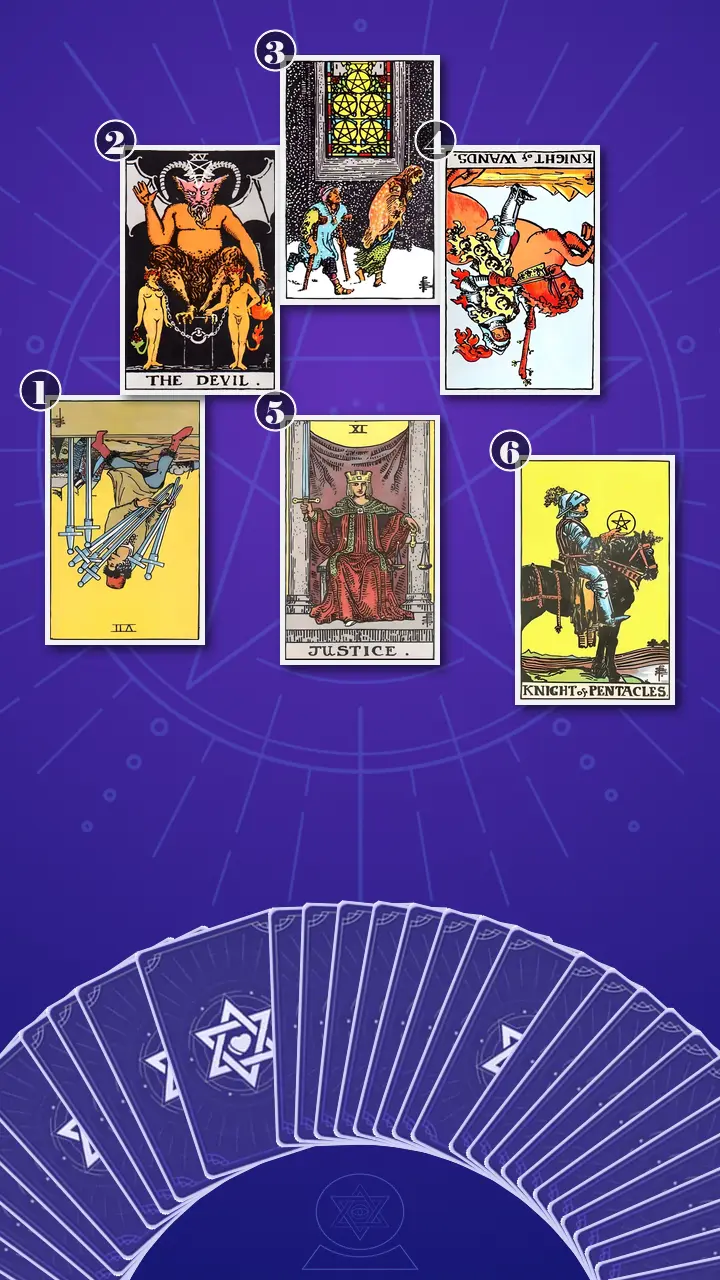
I chose The Shadow Spread · Context Edition, a six-card tarot spread for recurring workplace patterns. For anyone wondering how tarot works in a career-risk reading, this spread is useful because Casey was not asking what an external project would do. She was asking why the same internal script kept appearing. The layout moves from visible behaviour into the attachment and fear beneath it, then towards an integrating resource and a conscious practice.
I placed the cards in a broken inward-and-outward arc. The first position would show the visible habit of accepting consequential work before assessing it. The second and third would reveal what that habit protected and what fear gave it force. The fourth would identify the immediate reward of moving too quickly. The fifth, placed at the visual centre, would offer the key transformation. The sixth would turn that insight into a repeatable work practice.
This was not a test of whether Casey had been brave or reckless. It was a structured way to ask a more useful question: when does a genuine growth opportunity become unmanaged professional exposure, and what evidence would help her tell the difference?
The Facts Left Outside the Jira Ticket
Position 1: The Seven of Swords and the More Flattering Story
I turned over the card representing the visible shadow pattern or presenting behaviour: the observable habit of accepting consequential work and calling the exposure “good learning” before the downside had been assessed.
It was the Seven of Swords, reversed.
I pointed to the figure carrying five swords while looking backwards, with two swords left standing behind him. “In context, this backward glance is the instant you already know an important fact has been omitted,” I said. “At 8:47, you carried visibility, speed, and learning into the Jira plan. The unanswered questions about ownership, authority, and reputational consequence remained outside the official story.”
The reversal showed a blockage in the card’s strategic Air. Casey’s intelligence was active, but it had been recruited for self-persuasion rather than appraisal. She could identify the risk quickly. The problem was that she used equally quick language to make the discomfort disappear after she had already started.
I gave the pattern her own internal syntax: “I noticed the dependency had no owner, but I renamed it a learning opportunity, because saying ‘a public delay could land on me even though I cannot control the input’ would force me to decide whether the task was acceptable as offered.”
“What fact would you have to name,” I asked, “if you stopped making the assignment sound educational for one minute?”
Casey gave a short laugh with no amusement in it. Her shoulders lifted, her jaw tightened, and then her eyes dropped to the card. “That’s so accurate it feels a bit brutal,” she said. “The fact is that I could be held accountable for something I have no authority to fix.”
I let the sentence stand without turning it into an indictment. “The card is not calling you dishonest,” I said. “It is showing how a capable mind protects itself under pressure. You were trying to preserve momentum and avoid the shame of appearing hesitant. That strategy makes sense as protection, even though its long-term cost is weakened trust in your own judgment.”
I also warned against the reversal’s opposite extreme. Honest risk appraisal did not require Casey to reject every stretch assignment, document every minor uncertainty, or wait for impossible certainty. A lesson can be real while the exposure was still disproportionate. The task was to count both facts.
The Loose Chain and the Lit Window
Position 2: The Devil and the Identity That Says Yes
I turned over the card representing the unconscious material or blind spot: what the learning narrative protected Casey from noticing about status, competence, and professional belonging.
It was The Devil, upright.
I drew her attention to the loose chains around the two figures. The card did not tell me that a manager was secretly controlling her, and I did not use it to invent a hidden villain. It showed an attachment strong enough to make a negotiable situation feel compulsory.
“Imagine a director calling an unstable project ‘career-making,’” I said. “No one explicitly forbids you from asking for a realistic deadline. But praise, promotion pressure, and the identity of being the person who can rescue anything make the yes feel emotionally mandatory before the professional terms have been evaluated.”
The energy here was an excess of attachment combined with a blockage in perceived choice. The opportunity became valuable not only because of what Casey might learn, but because accepting it seemed to purchase membership in the group she imagined as ambitious, senior, and difficult to replace.
“The unspoken bargain sounds like this,” I said. “‘If I absorb enough pressure, I get to count as ambitious.’ Which identity feels threatened when you ask for a safeguard: the reliable one, the future leader, or the person who can handle anything?”
Casey’s thumb rubbed slowly across the seam of her notebook. “The future leader,” she said. “I think leaders are meant to walk into the mess and figure it out.”
“Leaders do enter uncertainty,” I replied. “They also establish ownership, decision rights, escalation routes, and limits. Capability is not measured by how much unowned risk you can absorb.”
Position 3: The Five of Pentacles and the Fear of Being Left Outside
I turned over the card representing the underlying belief or fear: the fear that treating serious work risk seriously could prove Casey lacked professional worth or leave her outside opportunity.
It was the Five of Pentacles, upright.
The two figures moved through snow beneath a bright stained-glass window. I asked Casey to notice the contrast between visible hardship and nearby shelter. The card did not dismiss the reality of London rent, uncertain promotion cycles, or teams that reward visible rescue work. It showed how those realities could make every safeguard feel like a possible door closing.
I returned to a scene she had mentioned earlier. On Sunday night, she had been scrolling a former colleague’s polished LinkedIn promotion post while a Monzo rent notification remained on her screen. Rain tapped the flat window and the radiator clicked. By Monday morning, requesting a realistic scope no longer felt like an ordinary professional question. It felt like volunteering to be left outside the group considered “next level.”
Here, the difficult energy was a felt deficiency of security and belonging. The fear underneath the risk-taking was not simply “I might miss an opportunity.” It was “If I ask for shelter, I might discover that shelter was never meant for me.” That fear gave The Devil’s loose chain its weight.
“The last time you considered slowing down an assignment,” I asked, “what outcome did you actually picture?”
Her breathing paused. Her gaze moved past me towards the rain-dark window, as though she were replaying a meeting on an invisible screen. Then her fingers loosened around the cup. “Someone else saying yes faster,” she said. “And everyone quietly deciding they were more ready than me.”
I nodded. “That is not a silly fear. It is a fear shaped by real incentives and selective online evidence. But a LinkedIn feed is like an algorithm trained on dramatic outcomes: it shows the promotion announcement, not the invisible safeguards, private support, failed projects, or unequal consequences behind it. It cannot set the risk standard for your actual life.”
When Momentum Mistook Itself for Courage
Position 4: The Reversed Knight of Wands and the Relief of Moving First
I turned over the card representing the protective function and immediate payoff: how rapid acceptance and optimistic reframing reduced shame and the feeling of falling behind in the short term.
It was the Knight of Wands, reversed.
The rearing horse and raised wand made the energy easy to recognise. In its healthy form, the Knight’s fire brings initiative and appetite for experience. Reversed, that fire had become excessive and unstable. Motion was outrunning preparation, while the slower energy of judgment remained blocked.
I translated the card into Casey’s workday. A late-afternoon Slack message calls a slipping release “an exciting stretch.” Before the urgent planning call ends, she says yes, opens a project channel, and books three meetings. The calendar fills while success, authority, and the stop condition remain undefined. For twenty minutes, activity feels like certainty.
“The inner monologue is, ‘If I move now, I’ll look capable; if I pause, someone may see the uncertainty,’” I said. “Your laptop is warm, the inbox is racing, and your chest lifts because the decision tension has ended. Hours later, the same laptop is beside cold takeaway, your shoulders are rigid, and you are using personal speed to compensate for missing structure.”
The insight was not that Casey lacked courage. Her willingness to learn and act was real. The card separated courage from adrenaline’s short-term reward. Ambition needs criteria, not a permission slip from adrenaline.
Casey’s foot, which had been tapping beneath the chair, became still. “That first burst feels amazing,” she said. “I hate admitting that. It feels like I’ve become the version of myself who gets promoted.”
“That relief is why the pattern repeats,” I said. “We do not have to shame the reward to stop letting it make the decision. Before the next urgent assignment, one success condition and one stop condition can give your fire ground beneath it.”
When Justice Put the Offer on the Scales
Position 5: The Sword That Named the Risk Plainly
The rain against the window thinned until I could hear the quiet mechanical tick of the wall clock. I turned over the card at the visual centre of the spread, the card representing the integrating resource and key transformation: the shift from calling risk educational by default to weighing learning value against credible consequences and safeguards.
It was Justice, upright.
I indicated the upright sword and balanced scales. Justice was not predicting punishment or promising that a fair request would produce a fair manager. Its energy was balance: truth without catastrophising, ambition without self-abandonment, and accountability distributed according to actual control. The sword named the risk in a plain sentence. The scales kept learning value visible beside downside, support, authority, and responsibility.
Seeing the card took me briefly back to Wall Street. On a trading desk, a position did not become prudent merely because it might produce valuable information. The learning could be genuine and the exposure could still breach the limit. Strategic logic was not there to make a person cold. Properly used, it protected them from paying unnecessary friction for someone else’s ambiguity.
I used one of my central diagnostic lenses, Power Dynamic Deconstruction. I asked Casey to examine the assignment through five questions: Who gains from the fast yes? Who controls the missing dependency? Who can authorise a scope or timeline change? Who receives the visibility if the work succeeds? Who carries the reputational consequence if it fails?
The purpose was not to accuse anyone of a hidden agenda. It was to reveal the leverage structure. In Casey’s case, the task had been framed as her opportunity, while authority over a crucial input sat elsewhere and the public delivery risk travelled downwards towards her. Once that structure was visible, she could identify real leverage points: her product knowledge, stakeholder trust, delivery data, and the assigner’s need for a credible plan. Those were not weapons. They were bargaining chips she could translate into a named owner, decision authority, a checkpoint, or a narrower first phase.
I staged the same assignment twice. In the first version, it was “a great high-visibility stretch opportunity.” In the second, it had four written facts: the external dependency had no owner; Casey could not approve a timeline change; a public delay could affect her credibility; and no one had defined when the scope would return to decision. Nothing about the task had changed. Only the facts were now allowed into the room.
I brought her back to 8:47 a.m. The planning call had ended, the deliverables were open, and nobody owned the missing dependency. Her jaw was tight, her cursor was moving, and “good learning” had arrived just before the honest risk question.
“A challenge can teach you something and still be too exposed to accept as offered. Learning is a benefit to weigh, not a waiver for the downside.”
I waited, then gave her the sentence I wanted the whole spread to hold.
Stop using the phrase "good learning" to make every high-stakes exposure sound wise; use Justice's upright sword to name the risk and her balanced scales to choose a fair, bounded experiment.
For one beat, Casey stopped breathing. Her pen froze above the notebook, and her pupils widened as if the 8:47 scene had started replaying behind my shoulder. Then her mouth tightened. “But doesn’t that mean I got all those decisions wrong?” she asked, sharper than before. I heard anger first, then grief beneath it. I told her the reading was not erasing the skill, resilience, or genuine learning she had earned. It was separating her ability to survive a consequence from evidence that the original exposure was proportionate. Her eyes reddened slightly. Her fist opened against the table, her shoulders descended, and a long breath left her with a faint tremor. Relief arrived, followed by a brief blankness. Clearer standards meant she could no longer outsource the next choice to adrenaline, and that new responsibility left her momentarily unsteady.
“Now, using this new perspective, think back to last week,” I said. “Was there a moment when this distinction could have made the situation feel different?”
She looked at the scales. “A director said, ‘We trust you to figure it out.’ I almost asked who could approve a scope change, but I thought that would spoil the confidence of the moment.”
“What would Justice have allowed you to say?” I asked.
She answered more slowly. “I’m interested in the stretch. Before I commit, I need to know who owns the dependency and who can change scope if it slips.”
I heard the shift in her language. She was no longer trying to prove the assignment bad or herself fearless. She was asking whether the offered version was fair. That was the first movement from defensive excitement and urgency towards grounded discernment: ambition remained, but evidence and proportionate safeguards had entered the decision.
The Knight Who Refused to Rush
Position 6: The Knight of Pentacles and the Bounded Experiment
I turned over the card representing the conscious practice for integration: a small work behaviour involving scope, ownership, checkpoints, and a stop condition.
It was the Knight of Pentacles, upright.
I pointed to the stationary horse, the pentacle held steadily at eye level, and the furrowed field. This Knight was not passive. He was progressing at a pace that allowed evidence to be inspected before the next commitment was made. His Earth energy was balanced: diligent, accountable, and repeatable.
I translated the card into a bounded learning experiment. Instead of accepting an undefined full rescue, Casey could agree to a five-working-day first phase. The project note would name the dependency owner, a Wednesday review, the evidence to be checked, and one condition that returned scope and timeline to decision if the dependency slipped. She could still learn something difficult. She would simply stop requiring a preventable crisis to deliver the lesson.
“The inner sentence changes,” I said. “‘I can learn this through a five-day test with a checkpoint. I do not have to learn it through an unowned public failure.’”
Casey’s shoulders dropped again, this time without the earlier shock. She opened a blank note on her phone but did not begin frantically building a full framework. “That feels almost boring,” she said.
“Good,” I replied. “Professional judgment is often low-drama. The goal is not to eliminate uncertainty. It is to keep the uncertainty proportionate to your authority, support, and capacity.”
I made the boundary explicit: the Knight of Pentacles did not promise that every manager would accept a checkpoint or that every task could be made safe enough. It gave Casey a way to gather evidence. If the assigner would not name ownership, authority, or a renegotiation condition, that response would become part of the decision rather than a cue to work faster.
The Four Facts Between Ambition and Exposure
I drew the cards together as one coherent story. Repeated praise for rescue work had taught Casey’s internal career algorithm to optimise for visible speed. The reversed Seven of Swords supplied the attractive explanation, The Devil tied that explanation to worth, and the Five of Pentacles made caution feel like exclusion. The reversed Knight of Wands then converted discomfort into immediate motion. Justice interrupted the loop by restoring facts and proportionality, while the Knight of Pentacles placed that clarity inside a small, repeatable practice.
It was like changing a red risk flag in Jira to a green “learning” label without changing the owner, deadline, dependency, or consequence underneath it. The label reduced Casey’s discomfort, but it did not alter the project structure. Her blind spot was not an inability to recognise risk. She recognised it quickly. The blind spot was treating her capacity to extract a lesson or repair damage as proof that the original exposure had been acceptable.
The transformation direction was therefore precise: separate genuine learning value from unacceptable exposure before consenting. Name the credible downside. Identify the available safeguard. Establish who has decision authority. Set a condition for stopping or renegotiating. Then decide whether the bounded version still serves the growth Casey actually wants.
I told her that she did not need a new personality. Her ambition, strategic intelligence, and appetite for challenge were assets. She needed a fairer pricing method for them. She had been giving away judgment, rescue capacity, and stakeholder trust as though requesting structure would reduce their value. In reality, those assets gave her leverage to negotiate how consequential work would be carried.
- Run the seven-minute Justice-Before-Yes check. Before one consequential task this week, open a private note with four headings: Credible Downside, Safeguard, Decision Owner, and Stop Condition. Write one plain sentence under each, using “unknown” wherever information is missing. Then place the learning upside beside the worst credible consequence so neither can erase the other. Tip: Stop after seven minutes. If naming all four fields feels too exposing, write only the downside. An honest unknown is better evidence than a polished guess.
- Use the Leverage Mapping Protocol for a bounded first phase. Before the next scope conversation with the assigner, take 15 minutes to map what you contribute, who controls each dependency, who can approve trade-offs, and who carries the consequence. Convert one real bargaining chip, such as product knowledge, stakeholder trust, or delivery data, into one concrete request: a five-day first phase, a named owner, a 15-minute checkpoint, and a written trigger that returns scope and timeline to decision. Tip: Keep the message to two sentences: “I’m interested in the stretch here. Before I commit, can we confirm scope, decision authority, and what happens if the dependency slips?” Ask for one observable condition rather than apologising for needing certainty.
I asked Casey to choose only one current task for the experiment. No career overhaul, no dramatic refusal, and no promise that caution would always be rewarded. Name the downside before you name the opportunity. Then let the response provide information.
That was the practical meaning of Justice-based proportionate discernment: “good learning” could remain a benefit, but it no longer had permission to function as a waiver. The scales belonged in Casey’s hands.

Six Days Later, One Question in Slack
Six days later, I received a message from Casey. She had used the two-sentence scope check before accepting another high-visibility assignment. Her director named an owner for the dependency, and the undefined rescue became a five-day discovery phase with a Wednesday checkpoint. The project was not solved. Casey had simply made the offered risk visible before consenting to it.
She also told me that her breath caught before she sent the message and that she nearly added three softening paragraphs. She deleted them, asked the question plainly, and waited. That was her first evidence that a boundary could be professional communication rather than a confession of weakness.
That night she slept through, but her first thought the next morning was still, “What if they think I’m difficult?” She told me she smiled at the thought, opened the four-field note, and checked the facts again.
I did not see that as a perfect ending. I saw it as grounded confidence in progress: the old fear still spoke, but it was no longer the only voice authorised to make the decision. Tarot had not rescued Casey or chosen her future. It had given her a visible structure, and she had used her own judgment to act.
When a stretch assignment lights up the room, some of us feel our jaw tighten and still say yes, because naming the risk can feel frighteningly close to admitting we may not deserve the next level. If that tension is familiar, remember what Casey placed on Justice’s scales: ambition on one side does not require silence about the downside on the other.
If you trusted that judgment also counts as capability, what is one small condition you would place on those scales before your next yes?