Baby questions, public deadlines, related tarot cards, and reading insights for pressure around choosing when or whether to become a parent.
Parenthood Timeline Pressure
What is this situation?
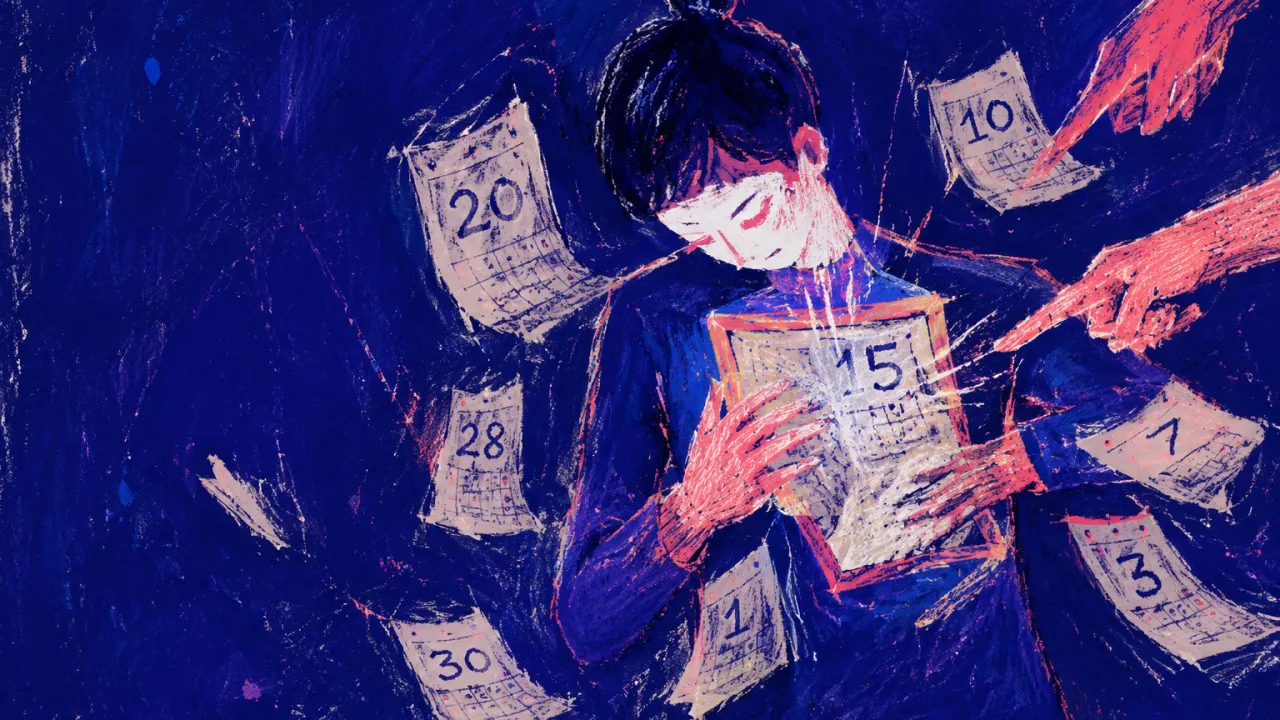
Parenthood Timeline Pressure - you first notice it when a casual conversation stops being casual: a friend posts a baby announcement, someone at brunch asks when you're "thinking about kids," or a relative turns your age into a countdown before you've even finished your drink. At first you laugh it off, because the question is wrapped in small talk, but then it starts following you into more places: group chats full of ultrasound photos, coworkers making jokes about being "next," dating profiles that demand a five-year plan, partners asking for certainty, relatives treating your calendar like shared property, algorithms feeding you nursery tours and fertility ads after one search. The pressure is not one single person standing over you; it is a whole set of voices turning a private decision into public timing, as if adulthood has a loading bar and everyone can see whether you are behind. You may be building a career, paying rent, figuring out your relationship, recovering from a breakup, unsure whether you want children at all, or sure you do but not on this schedule, and still the questions keep landing like they require an answer by the end of the room. Over time, your body starts bracing before the topic even appears: shoulders tight at family dinners, stomach drawn in at baby showers, thumb hovering over social posts you don't know how to respond to. The exhausting part is the way the outside world turns your future into a group project while you are still trying to hear your own timing, much like the figure on the Two of Wands, holding the globe and staring out at a horizon everyone else keeps trying to mark with dates.
Why it's not you?
This pressure is not proof that you are behind, confused, selfish, or indecisive. It is what happens when other people's milestones, comments, and expectations get treated as a clock you are supposed to obey. A private life decision becomes distorted when the room keeps asking for a public deadline.
Parenthood Timeline Pressure in Tarot Cards
In Parenthood Timeline Pressure, the baby question turns into a public deadline, and your shoulders can tighten before anyone has even finished asking. That reaction sits inside an environmental, structural dynamic: private timing gets pulled into group chats, partner expectations, friend milestones, workplace small talk, and algorithm-fed comparisons. The point is not whether you want kids, don't want kids, or don't know yet; the pressure comes from being asked to answer on someone else's schedule. Here are the Tarot Cards that mirror this situation's outline.
The High Priestess sits between black and white pillars, with a veil behind her and a scroll held partly out of view. You can see a private threshold between what is known internally and what the surrounding world keeps demanding that you explain aloud. The structure makes silence meaningful rather than empty. You may be protecting an unfinished answer from family questions, partner pressure, or algorithmic scrutiny because the most accurate information is still emerging inside you; the strain comes from having to perform certainty before inner knowledge has settled.
An armored ruler sits on a heavy stone throne marked by ram heads, gripping a staff while the mountain landscape behind him remains hard and immovable. You can see family authority taking the form of rules, dates, and confident pronouncements about what your adult life should contain. The pressure does not require open hostility; it can travel through practical questions, jokes, financial leverage, or the assumption that elders know the correct sequence. You may be treated as a subordinate whose future needs administration, making the parenthood conversation a contest over authority as much as a conversation about desire.
The Hierophant sits above two kneeling figures between stone pillars, with keys at the feet and a formal ritual built into the composition. You can see family expectations operating like a ceremony that has already decided what adulthood is supposed to look like before your own answer enters the room. That arrangement makes the pressure more than a personal preference from one relative. You may be asked to reproduce an inherited family structure so that continuity is preserved, while your hesitation or refusal is interpreted as disobedience instead of a legitimate boundary around your own future.
Reversed
The robed teacher, pillars, kneeling followers, and crossed keys remain physically present, but the reversed arrangement makes the ritual feel unstable rather than unquestionably authoritative. You can see the inherited script clearly enough to examine its claims instead of receiving it as neutral truth. The structure marks a change in your cognitive system: adulthood no longer has to be validated by reproducing the sequence that came before you. You may still feel the pull of family approval and social legitimacy, but the pressure becomes information about the script’s reach, not proof that the script is correct.
Two figures stand beneath an angel, separated by distinct trees while the angel’s gesture joins the scene above them. You can see a relationship made of two separate people who must create a shared future without allowing outside expectations to speak for either one. The parenthood question becomes structurally important because it tests values, timing, and consent at the same time. You may be asked to treat a partner’s urgency as evidence of love or a mismatch as personal failure, when the real issue is whether the future is being chosen together rather than inherited from a social script.
A gray figure stands alone on a mountain holding a lantern that lights only a small section of the dark path. You can see the value of a limited, private field of attention when family dinners, social feeds, and partner conversations keep expanding the question into a demand for total certainty. The scene does not promise an instant answer; it shows a slower way of locating one. You may need to distinguish your own voice from the accumulated noise of other people’s milestones, because the social environment keeps presenting visibility as progress while your actual work is quiet examination.
A great wheel turns through the center of the image while a sphinx, a serpent, and winged figures occupy different positions around it. You can watch other people move through visible milestones and feel the whole social cycle rotating faster than your private decision. The structure separates collective timing from personal agency. A friend’s announcement or an algorithmic fertility ad may be a real event in the environment, but the turning wheel does not prove that the same stage is due for you; it shows the pressure created when shared cultural cycles are mistaken for individual instructions.
Justice sits directly between two pillars, holding balanced scales in one hand and an upright sword in the other. You can see the social world constructing a verdict from age, partnership, and parenthood status, as though a private future could be weighed against a standardized adulthood score. The structure makes the judgment feel objective even when the standard is cultural. You may hear concern presented as common sense or fairness, but the visible cost is that your life is repeatedly reviewed against other people’s milestones and found wanting whenever your timing does not match the expected record.
A figure hangs upside down from a living tree by one leg, hands relaxed behind the back and a halo bright around the head. You can see a body outside the usual flow of movement, suspended while the social world continues to announce who is moving ahead. That pause exposes the difference between delay and chosen timing. You may be using the interval to assess partnership, housing, finances, or desire, but the surrounding culture reads the lack of a public milestone as stagnation and keeps asking you to justify the pause.
An angel stands with one foot on land and one in water, pouring liquid steadily between two cups without spilling either one. You can see several parts of adult life being blended at once, while outside questions insist that parenthood must become the dominant ingredient immediately. The image holds timing as coordination rather than acceleration. Your relationship, income, housing, health, and desire may need to develop at different rates, and the pressure becomes visible when a social deadline treats that unevenness as a defect instead of a real condition of planning.
The chained pair, the elevated Devil, and the torchlit darkness create a physical system of attachment in which the figures remain close to the source of their restriction. You can see how an adulthood script becomes part of the identity structure when approval, romance, family continuity, and status all hang from the same symbol. The growth work is cognitive rather than performative. You may still hear the social clock and feel its pull, but the scene helps separate inherited beliefs from chosen values, so parenthood can be understood as one possible expression of a life rather than the condition that makes the life legitimate.
A dancer is enclosed by an oval wreath while four fixed figures watch from the corners of the scene. Reversed, the closed wreath reads like a checklist that has not been completed, and you can feel the surrounding audience treating parenthood as the missing item. The visual structure makes social timing measurable and therefore coercive. Friends’ announcements, relatives’ questions, and age-based comparisons can turn an open future into a status review, even though an unfinished public script does not establish that your actual life is late.
Three women raise cups in a circle, surrounded by flowers and the energy of a shared celebration. You can see the same social warmth that makes baby announcements and showers meaningful also create a visible pattern of who has reached the next milestone and who has not. The group is not necessarily hostile; that is what makes the pressure difficult to name. You may be expected to celebrate sincerely while absorbing questions about when you will be next, so ordinary belonging starts to feel conditional on matching the group’s life stage.
A seated figure leans beneath a tree with arms folded, three cups set in front and a fourth cup offered from a cloud. You can see a future being presented repeatedly while your attention remains elsewhere, and the refusal to reach for it is treated by the room as evidence that something is wrong. The scene captures ambivalence without forcing it into a yes or no. You may be unsure about children, unconvinced by the version of family being advertised, or simply unwilling to decide during someone else’s conversation; the external pressure is the insistence that non-acceptance must immediately become a public position.
Two children stand inside a walled courtyard, one offering a cup filled with flowers to the other while the old village sits behind them. You can see childhood and family memory entering an adult decision, carrying the emotional weight of what your relatives believe should be repeated or repaired. The scene explains why the pressure may feel familiar before anyone asks a direct question. You may be assigned an old role such as the responsible child, the family hope, or the next caretaker, so parenthood becomes entangled with proving continuity rather than hearing what your present life actually supports.
A lone figure turns from eight cups and walks into the night toward a mountain, carrying only what is needed for the journey. You can see a choice that involves departure from an established emotional arrangement, not because the cups are empty to everyone else, but because they no longer settle your own future. The pressure comes from the meaning attached to the exit. You may be asked to remain inside a parenthood timeline so that friends, relatives, or a partner do not have to revise their picture of you, while the real decision concerns whether that picture has authority over your life.
A couple raises their arms beneath a rainbow of ten cups while children play beside a home and green landscape. Reversed, the same perfect tableau becomes a standard that can feel emotionally out of reach or imposed from outside rather than a shared reality. You may be surrounded by family images, announcements, and comments that treat this picture as the natural endpoint of adulthood. The pressure comes from the mismatch between a polished symbol of fulfillment and the complicated facts of your relationship, finances, desire, or decision not to follow that image on schedule.
A figure keeps two pentacles moving inside an infinity loop while ships rise and fall on a rough sea behind them. You can see the everyday labor of balancing income, housing, work, partnership, and energy before anyone adds the expectation of a child to the system. The pressure becomes physical because the social clock treats coordination as effortless. You may be paying rent, building a career, or recovering from a relationship change while friends and relatives ask for a date, turning a complex capacity problem into a judgment about whether you are ready enough.
An elder sits beneath an arch while a couple, child, dogs, and multiple generations occupy the same enclosed scene, with pentacles distributed through the architecture. You can see the family future represented as a complete social and material system that appears to expect your participation. That abundance can carry pressure as well as security. You may be asked to produce continuity, grandchildren, or the next visible branch of the family tree so that the existing structure feels complete, while your own timing and uncertainty are treated as interruptions to a legacy plan.
A blindfolded figure crosses two swords over the heart, seated between a quiet shore and a dark stretch of water. You can feel the relationship holding two protected positions at once, while a partner’s request for certainty turns the unresolved future into a test of commitment. The crossed blades show that intimacy has become a negotiation over timing rather than a simple expression of love. You may be asked to prove the relationship by accepting a schedule, even though the real issue is whether both people can remain honest while their readiness and desired futures are still different.
A blindfolded figure stands bound among eight swords, with a castle behind and open ground beyond the loose circle of blades. You can see how repeated questions about age, children, and being next can form an enclosure even when the physical barriers are not completely closed. The structure captures internalized social pressure without treating it as a personal defect. You may brace before family dinners, avoid announcements, or feel your choices shrink whenever the topic appears; the visible task is to separate the external voices from the full range of decisions that still exists.
A figure grips a globe beside two wands and studies a far horizon from a high wall. You can see the future as a sequence of possible windows, while every pregnancy announcement and age-related comment tries to label one window as the correct one. The tension is not a lack of time; it is competing ownership of time. The scene gives you a clear picture of how a social deadline can crowd out the slower work of deciding whether your relationship, resources, body, and values are actually aligned.
Five figures crowd the same patch of ground, each raising a wand into the others’ space so that the scene becomes a tangle of competing movements. You can recognize the pressure of group chats, jokes, and milestone comparisons that do not come from one authority but still leave no room to think quietly. The structure is socially competitive without requiring anyone to admit that a competition exists. Your parenthood timeline can become a score implied by who is engaged, pregnant, partnered, or already parenting, and the cost is a constant need to locate yourself inside a contest you never entered.
A lone figure braces on a steep patch of ground while six wands rise toward the body from below. You can see the family dynamic as a repeated approach from multiple directions, with every question about age or children adding another wand to the boundary you are trying to hold. The image shows why a relative’s comment can feel larger than the sentence itself. In a family system, the question may carry inherited expectations about lineage, adulthood, and duty, so you are defending not only a date but your right to keep the future from being administered by the room.
A bent figure carries a bundle of ten wands that blocks the face and narrows the view of the road toward town. You can see how every announcement, family question, partner discussion, and fertility advertisement can become one more obligation added to an already overloaded day. The burden is not proof that parenthood is your responsibility on anyone else’s schedule. It shows the physical cost of carrying a public timeline alongside work, rent, relationships, and ordinary life administration, until the weight makes it difficult to hear what you actually want or have capacity to choose.
No cards available for this filter.
Parenthood Timeline Pressure in Tarot Card Reading Insights
Parenthood Timeline Pressure often shows up when private timing is dragged into public questions, milestone comparisons, and partner conversations. Other people bring that same pressure into readings when they want to see the shape of the decision without handing it over to someone else. Tarot Reading Insights from sessions on this situation.