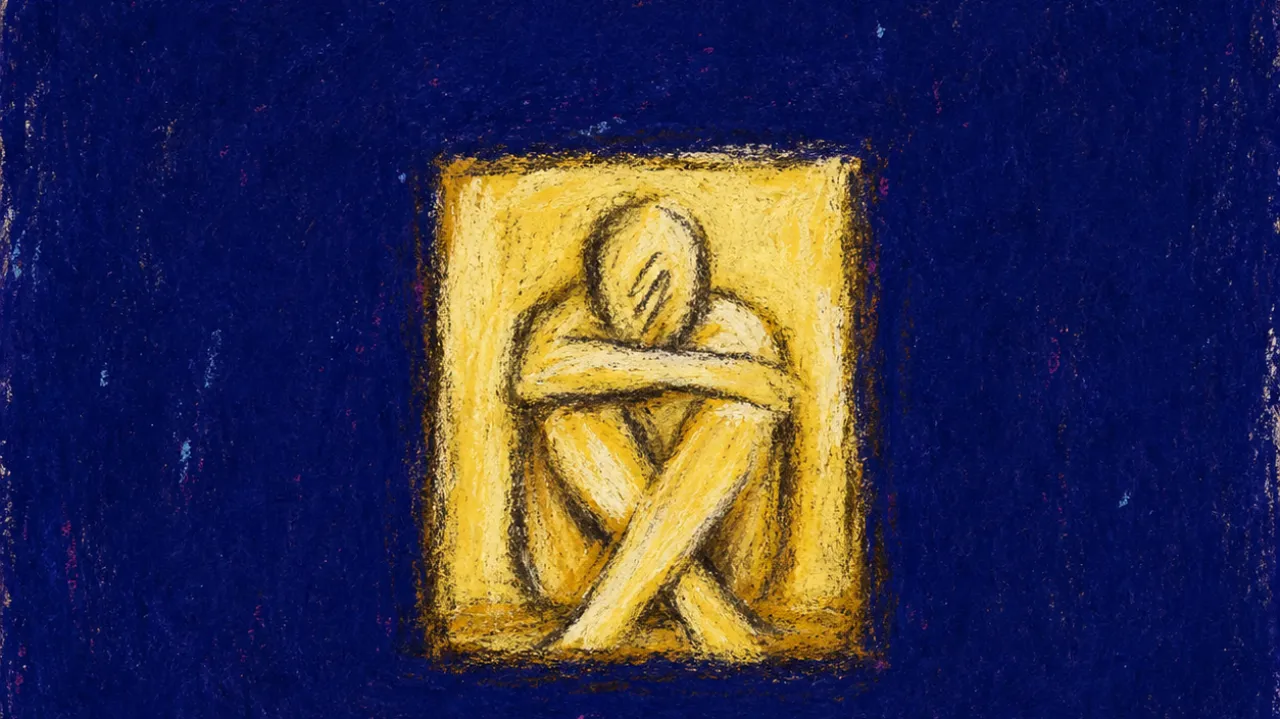
Comfort Zone Lock-In is the situation where the setup around you keeps rewarding the same route until movement starts to lose its shape. The tight chest you feel when a new opening appears is not separate from that setup; it is the body's contact point with a familiar perimeter that has become too efficient. This is an environmental, structural dynamic: routines, feeds, roles, and social expectations can organize themselves into a soft enclosure. The Tarot Cards below reflect the visible outline of that enclosure and the moment where comfort stops circulating.
Four of Cups ReversedThe tree's shade and the folded body create a soft enclosure rather than a hard prison. The figure is sheltered, grounded, and still surrounded by intact cups, yet the same protected space has started to narrow what can be reached. Comfort Zone Lock-In is the personal growth version of that enclosure. You may have a stable routine, a familiar identity, or a low-risk environment that genuinely reduces pressure, but the image shows how unused resources can pile up when safety becomes the default container for every decision. The Four of Cups names the cost of staying under the tree too long. The structure does not condemn comfort; it shows where comfort stops functioning as recovery and starts functioning as a quiet boundary around expansion.
Six of Cups ReversedThe bright courtyard holds the figures inside a beautifully preserved scene, with no visible road pulling them beyond the manor. The exchange has motion, but the motion stays within the same small circle, repeating a safe ritual rather than changing the wider environment. For personal growth, that structure mirrors the comfort zone that looks wholesome, stable, and even productive from the outside. You may be reading, planning, reflecting, or refining, but the system keeps returning you to the protected courtyard before risk can convert insight into lived change. The card connects to this context through containment disguised as ease. The issue is not a lack of intention; it is a familiar environment that absorbs action before it can become irreversible enough to update your life.
Eight of Cups ReversedThe cups still stand, the swamp water sits heavy around them, and the moon darkens the route beyond the known arrangement. The reversed structure holds the body near what is recognizable while the crossing remains technically available but practically delayed. In personal growth, that is the lock-in of safe routines, familiar narratives, and almost-good-enough progress. You are not trapped by a lack of options so much as by a container that still gives enough stability to postpone the next stage.
Nine of Cups ReversedThe crossed arms create a visible barricade across the chest, and the stool reduces the body to a fixed center point. Behind him, the cups remain arranged and untouched, turning satisfaction into a static environment. For personal growth, this is the stage where familiar wins and familiar routines keep proving that the current identity works. You can stay functional, comfortable, and even visibly successful while the structure quietly removes exposure to challenge. The lock-in is not laziness. The card shows a protected zone that has become too efficient at protecting you from the friction required for expansion.
Queen of Cups ReversedThe throne is luxurious and stable, but it sits on a small strip of land ringed by water. The Queen has status, shelter, and beauty around her, yet the image gives her almost no visible route away from the seat. For personal growth, comfort can become a structure that asks for no immediate sacrifice and therefore quietly narrows the next move. You may have enough safety to avoid collapse, while the same safety keeps challenge, exposure, and experimentation outside the wall.
Ace of Pentacles ReversedThe flowered arch and road are present, but the protected garden still defines the main field of safety. The low fence is not a prison; it is a soft boundary that can become a reason to remain near what already feels manageable. In personal growth, this fits the stage where stability has become the outer container of delay. You may have a safe routine, familiar identity, or cushioned environment, and the card shows how a legitimate shelter can quietly harden into a threshold you keep approaching but not crossing.
Four of Pentacles ReversedThe figure’s body wraps around the pentacles until protection becomes enclosure. The foreground seat gives him a stable place to remain, while the wider town stays separate from the resources held against his body. In a timing reading, this points to an external setup that keeps rewarding stillness. A familiar job, routine, relationship arrangement, savings buffer, home base, or lifestyle structure may be offering enough comfort to make movement feel unnecessary until the next phase starts losing oxygen. The card does not shame the need for security. It shows how a protected zone can become a lock-in when nothing circulates, and how the timing question becomes sharper when staying safe starts costing access to the wider field.
Seven of Pentacles ReversedThe garden is familiar, fertile, and close at hand, while the distant mountains remain small on the horizon. The figure's whole stance is organized around the cultivated vine, with the hoe acting less like a tool of expansion and more like a stabilizer inside the known field. That composition shows how comfort can become a structural lock. The current option does not need to be bad in order to limit movement; it only needs to be established, legible, and easier to justify than the unknown path beyond the garden. In choice work, this card marks the point where safety starts shaping the decision before you have named it. You can reclaim agency by seeing which parts of the option are genuine support and which parts are simply the low-friction continuation of what already exists.
Nine of Pentacles ReversedThe manor garden holds everything within reach: fruit, pentacles, shelter, trained power, and a slow creature moving near the woman's feet. The scene can support life so thoroughly that outward motion no longer has an obvious route. In personal growth, this is the lock-in created by a life that functions well enough to defend itself against change. The structure keeps rewarding maintenance, refinement, and familiar competence while the next challenge remains outside the visible path. The card gives language to a specific kind of stuckness: not collapse, but over-stabilization. Seeing the garden as a system helps you identify which comforts are nourishment and which ones have become barriers to movement.
Knight of Pentacles ReversedThe armor, gloves, helmet, and mounted height keep the Knight protected even in open terrain. The field is available, but the body remains sealed inside equipment designed to reduce exposure. For personal growth, this points to a stable routine that has become too protective. You may have built a life structure that prevents chaos, but the same structure can limit contact with the uncertain field where the next version of you would have to be tested.
Queen of Pentacles ReversedThe carved throne is stable, shaded, and surrounded by a flourishing estate. In the reversed frame, that same comfort becomes a fixed seat: the body is supported so completely that movement toward the distant hills and water never begins. The timing issue becomes harder because the environment is not visibly hostile. It offers enough safety, beauty, and material continuity to make delay look reasonable even when the cycle is asking for a shift. For you, this context identifies the point where protection turns into containment. The card does not shame stability; it shows where stability has started to absorb the energy needed for the next threshold.
King of Pentacles ReversedThe King is not standing at a threshold; he is seated inside a domain that already works. The throne supports him, the wall encloses him, and the castle behind him confirms that the visible path has been replaced by an established place. In personal growth, this context names the external lock created by a life that is functional enough to keep repeating. You may not be blocked by chaos or lack of resources; the stronger constraint may be that your current setup keeps paying you to remain recognizable. The card’s reversed texture makes the stillness important. The same structures that once proved competence can become the structures that make movement feel irrational, inconvenient, or too costly to justify.
Two of Swords ReversedThe figure has a small platform, two intact swords, and a sealed posture. The stone slab keeps her out of the water, but it also keeps the whole body fixed at the edge of a larger field she is not entering. In personal growth, that image describes a familiar identity or routine that still offers protection while no longer producing expansion. The tools are available, but they are gripped defensively, used to maintain the known position rather than cut a new passage. Comfort Zone Lock-In belongs here because the card's safety is narrow, cold, and physically costly. The structure asks you to see where protection has become containment, so agency can return through a chosen threshold rather than a forced rupture.
Four of Swords ReversedThe cushion and slab create a quiet protected surface, but the same surface also holds the knight completely still. The chapel boundary shields the body from intrusion, yet the sealed quality of the scene can turn safety into a container with no re-entry point. This is the growth problem of staying where nothing disrupts you. You may call it rest, privacy, or self-protection, but the card reveals when the protected zone has started to preserve the old operating system instead of preparing you for the next stretch.
Six of Swords ReversedThe boat protects the passengers from open water, but it also limits their range of movement. The swords create a neat internal corridor, and the seated figures remain small inside the very structure that makes the crossing possible. In reverse, the protective vessel can become a narrowing life arrangement. The situation may be stable enough to prevent immediate disruption, yet too contained to allow a real change in direction, leaving you preserved inside a route that no longer expands. For direction work, this card identifies the cost of a safe container that has outlived its purpose. It asks where security is still carrying you across water, and where it has become the reason the far shore keeps staying theoretical.
Eight of Swords ReversedThe woman occupies a narrow strip of ground between upright swords, with her body held in place by bindings that keep her posture small and controlled. The castle in the distance proves that another position exists, but the immediate space has become the whole operating world. Comfort Zone Lock-In is not simple laziness in this image. It is a contained environment where familiar restriction feels more navigable than the exposed walk toward a different role, higher visibility, or a less predictable self-concept. In personal growth, this card shows the cost of staying inside a known limit after it has stopped functioning as protection. You are not being asked to leap blindly; the structure invites a clear audit of what the current zone still protects, what it now prevents, and where the first real opening sits.
Two of Wands ReversedOne wand is active in the man’s hand while the other is fastened to the wall, making the body look prepared but still tethered to the known structure. The ocean, coastline, and distant land are available to the eye, yet the figure remains in the controlled space where possibility can be studied without being entered. For introspection, this is the external shape of repeated inner work that never becomes embodied change. You may understand the pattern, name the wound, map the alternatives, and still keep returning to the familiar environment because it preserves predictability. The reversed Two of Wands makes the lock-in visible through suspended movement. It shows that the blockage is not a lack of awareness, but a system where planning, self-analysis, and familiar safety have fused into one holding pattern.
Three of Wands ReversedThe figure's hand rests on the forward wand while his body stays fixed at the cliff edge. Behind him, the two planted wands create a stable frame that can read like a private gate, a place secure enough to stand in but not wide enough to complete the crossing. In this reversed structure, the threshold becomes a holding pattern. The cliff offers vision without movement, the wand offers support without transit, and the open water keeps demanding a level of exposure that the protected frame can postpone indefinitely. For personal growth, this is the outer architecture of comfort zone lock-in: a life system that lets you stay close to expansion while avoiding the cost of entering it. You may have tools, language, routines, and insight, but the card exposes how those supports can become a polished waiting room when they are never tested beyond the shore.
Four of Wands ReversedFour sturdy posts create a protected square in the foreground, while the bridge toward the house sits off to the side. The space is secure and well-defined, but its clarity can also keep attention fixed on the known frame instead of the crossing that would change the situation. In personal growth, this maps onto a safe life structure that once helped you stabilize but now absorbs the movement needed for expansion. The card makes the lock-in visible without shaming safety: protection is useful until it becomes the architecture that delays the next stretch.
No cards available for this filter.