Trapped In The Daily Route

A grounded look at commute pressure, matching tarot cards, and Tarot Reading Insights from readings shaped by lost time.

Commute Grind Lock-in
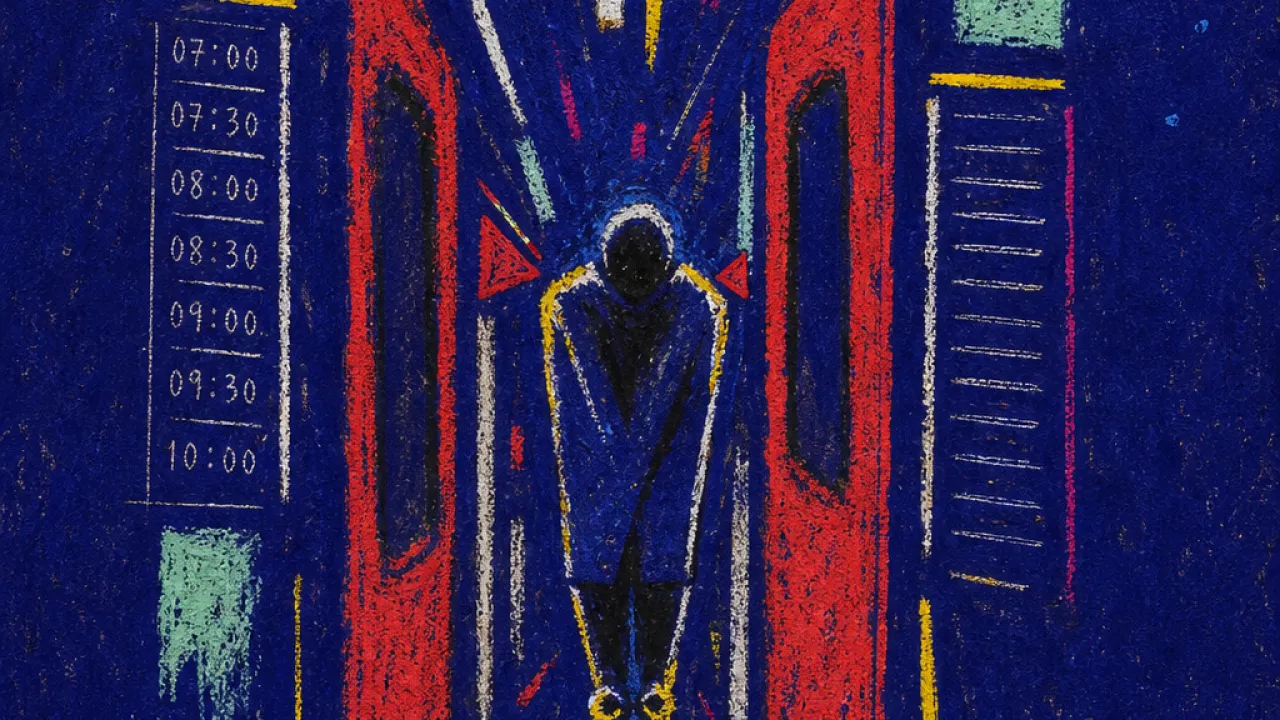
A solitary figure compressed in a narrow corridor of transit doors, brake lights, and timetable marks pressing inward

What is this situation?

Commute Grind Lock-In — you step out before the day has properly started, phone battery already dropping, coffee balanced against a train pole, bus strap, steering wheel, or station wall while the city decides how much of your time it will take. At first it looks like a normal commute: a route you picked because rent, work, classes, childcare, shift times, or the nearest affordable place left you with few clean options. Then the pattern hardens. A ten-minute delay becomes a missed connection, a packed carriage turns your body sideways before 8 AM, traffic pins you between brake lights, and every small errand has to be measured against the return trip. The people around you are not enemies; they are pressed into the same narrow system, all elbows, bags, wet coats, loud calls, dead signal, and nowhere to put yourself. Work or school acts like the clock starts when you arrive, but your body has already spent an hour being carried, stalled, scanned, squeezed, and watched by timetables that do not care how tired you are. By the time you get home, the day has edges missing: no clean space to decompress, no simple way to see friends across town, no easy room for cooking, movement, dating, rest, or a version of yourself that is not planned around departure times. You are not just traveling from one place to another; you are being held inside a corridor of cost, distance, scheduling, and infrastructure, much like the figure on the Eight of Swords, bound in place while every visible path is narrowed by sharp barriers.

Why it's not you?

The problem is not that you are bad at managing your time; the route itself is taking more than a routine trip should take. Delays, long distances, high transport costs, crowded vehicles, traffic, and rigid start times create a structure that drains hours before the day has even begun. This is a lock-in made by logistics, not a personal failure.

Commute Grind Lock-in in Tarot Cards

Commute Grind Lock-In is the part of daily life where movement stops feeling optional and starts feeling assigned. The tight shoulders, locked knees, and repeated platform waits point to an environmental, structural dynamic built into routes, schedules, costs, and access. The cards below do not decide the route for you; they reflect the shape of the pressure around it. Here are the Tarot Cards that often mirror this kind of lock-in.

The Chariot
Reversed
The student-like driver occupies a vehicle that appears ready for progress, yet the two sphinxes are not aligned and no reins connect intention to movement. Reversed, the scene reflects educational performance being made contingent on transport you do not control: a cancelled bus or stalled train becomes lateness, missed instruction, an attendance penalty, or reduced access to staff and peers. The chariot's formal appearance mirrors the assumption that enrolment equals access. You can possess motivation, preparation, and academic direction while the mobility layer repeatedly interrupts participation. The card exposes the difference between being ready to learn and being reliably delivered to the place and time where learning is recognised.
The Hanged Man
Reversed
Suspended by one foot from a fixed wooden structure, the figure remains physically capable but unable to convert time into forward movement. Reversed, the pause loses any restorative quality and resembles compulsory waiting on a platform, in gridlocked traffic, or between services where the minutes cannot be used for work, rest, or home life. The halo marks awareness, but awareness does not make the timetable responsive. You can understand the route perfectly and still be required to surrender time because the next viable movement belongs to the network. The card separates strategic waiting from extracted waiting: this commute is consuming a resource without giving you meaningful control over when the suspension ends.
Temperance
Reversed
Water is meant to pass cleanly between two cups while the figure bridges land and water and a path extends toward a distant destination. Reversed, the transfer fails to preserve flow, matching a commute in which service intervals, walking time, shift starts, and connection windows are scheduled as separate systems with no margin between them. The divided terrain makes the commuter responsible for crossing an interface no single institution owns. You can leave on time and still lose the connection because the official schedule ignores platform changes, crowding, boarding time, or ordinary variation. The card identifies timing friction at the handoff point, where seemingly adequate services become unusable as a complete journey.
The Devil
Upright
Two people stand chained to a raised pedestal beneath a dominant figure, their material dependency displayed as part of the architecture around them. The scene mirrors a career commute lock-in where income, affordable rent, benefits, status, or scarce alternatives keep you attached to a workplace that consumes far more time and mobility than the contract formally records. The chains are visible and loose enough to inspect, but removing them would still carry real consequences. That distinction matters: economic dependence is not imaginary simply because an exit can be pictured. The card names the bargaining-power imbalance that lets an employer externalise travel costs onto you while treating location and start time as neutral facts.
Two of Pentacles
Upright
Two coins move through an endless loop while ships pitch behind a figure who must keep adjusting his balance. The image reflects assignments, classes, paid work, meals, and travel being continually reshuffled around changing train or bus conditions. The upright juggler retains functional coordination, showing real study skill and adaptability despite the unstable route. You may be keeping up only because every delay is converted into reading on a train, a moved deadline block, or sacrificed recovery, making apparent balance more fragile than it looks.
Reversed
A figure loops two pentacles through an infinity-shaped band while ships rise and fall on steep waves behind him. Reversed, the loop resembles a closed logistics circuit: one delay shifts the transfer, the transfer shifts arrival, and arrival shifts every meal, errand, appointment, or bedtime that follows. The ships show that the instability is environmental, not simply a failure to juggle well enough. When the route keeps changing the conditions under your feet, daily priorities are forced to compete for a shrinking block of usable time. You are not dropping routines because they lack value; the commute is repeatedly making full participation mathematically impossible.
Four of Pentacles
Upright
A figure holds one coin against his chest while two more pin his feet and a fourth occupies his crown. The image presents the commute choice as a conflict between protecting a tight budget and recovering the mobility, time, and mental space consumed by distance. The upright figure has successfully retained his resources, so financial caution remains a legitimate capacity rather than a flaw to overcome. You can see why the current route survives: it may be the mechanism protecting rent or income even while that same protection prevents movement toward a less costly daily structure.
Five of Pentacles
Upright
Two figures move through snow beneath a lit stained-glass window, visibly exposed while warmth and resources remain close but inaccessible. The scene reflects a commute shaped by affordability, where cheaper housing or necessary work leaves you spending more time and money moving through weather, dark mornings, and under-served routes. The illuminated window keeps support and shelter visible, so the upright card does not erase the possibility of material alternatives; it shows the access gap between seeing them and being able to use them. Your physical depletion is tied to where transport, housing, and employment resources are located, not simply to whether you prepared well enough for the day.
Two of Swords
Upright
A blindfolded figure holds two equally weighted swords across her body while rocks interrupt the water behind her. The composition mirrors a commute decision in which the visible alternatives oppose each other: pay more to live closer, keep affordable housing and lose time, change jobs and risk stability, or preserve the job while accepting the route. The seated posture creates a temporary decision boundary rather than forcing immediate motion. You may need criteria that expose total cost, including fares, unpaid hours, sleep loss, care logistics, and access to the rest of the city, before one option can be evaluated honestly. The stalemate is not proof that you cannot decide; it reflects choices whose hidden costs have not been placed on the same scale.
Six of Swords
Reversed
A boat carries passengers and six swords across water divided between rough and calmer surfaces, with the destination still beyond the frame. Reversed, the crossing becomes a journey that repeatedly fails to resolve on schedule: the final leg stretches, the connection disappears, or arrival occurs too late to preserve the evening. The passengers remain seated while someone else controls the pace of passage. That arrangement mirrors the commuter's limited authority over service frequency, traffic, and recovery after disruption. You are not merely impatient with travel; the route has made arrival time contingent on systems that offer little protection when the crossing runs long.
Eight of Swords
Upright
A loosely bound figure stands inside eight visible barriers, with an opening in the blades and solid ground still available beneath her. The image supports a cognitive upgrade from treating the commute as a personal endurance test to mapping it as a system of housing, work, money, timing, and infrastructure constraints. The upright path is narrow but inspectable, so growth does not require pretending that every barrier can be removed through mindset. You can recover clearer agency by identifying which constraints are fixed, which are institutional, which are negotiable, and which costs have been hidden by the phrase normal commute.
Three of Wands
Reversed
A figure stands at a high lookout watching ships move across a broad body of water toward a distant horizon. Reversed, the scene captures waiting for an incoming train, bus, ferry, or connection whose arrival remains visible as a possibility but unreliable as a usable time anchor. The lookout provides information without control, which is the central timing problem of real-time boards that keep changing while you remain in place. You can monitor the route closely and still lose the evening because visibility into a delay does not restore the time or connection it removes.
Five of Wands
Upright
Five figures crowd the same patch of ground while their staffs cross and interrupt one another's space. The image resembles a packed platform, carriage, or bus where people who share no personal conflict are forced into physical competition by insufficient room and poorly coordinated movement. No single figure controls the field, and the upright scene keeps the friction visible rather than assigning one commuter as the problem. You are navigating a capacity issue in which bags, bodies, doors, announcements, and narrow aisles compete for the same limited space before the day has properly begun.
Eight of Wands
Reversed
Eight parallel wands appear to travel quickly toward settled ground, their close formation suggesting a sequence that depends on uninterrupted momentum. Reversed, that sequence becomes the missed connection pattern of commute lock-in: one late vehicle interrupts the next leg, and the entire chain loses the speed promised by the timetable. The open landscape offers no shelter or intermediate stop once the movement is disrupted. You can experience the delay as much larger than its stated ten minutes because work, class, care handoffs, and later return services are attached to the same sequence. The card names the multiplying effect of broken timing rather than treating each incident as an isolated inconvenience.
Ten of Wands
Upright
The figure carries a dense bundle of wands toward a destination that still requires more walking, with the load obscuring much of the view ahead. For a commuting student, the image combines course workload with the physical burden of reaching campus, carrying materials, coordinating paid work, and preserving enough energy to study after returning home. The destination remains visible, confirming that the academic goal itself may still matter. You can be committed to the course and simultaneously overloaded by the infrastructure required to participate in it. The card separates academic capacity from access burden, showing how transport hours can turn a manageable syllabus into an unsustainable total workload.

Commute Grind Lock-in in Tarot Card Reading Insights

Commute Grind Lock-In also shows up when people bring the grind of trains, traffic, transfers, and lost hours into a reading. The shift here is from the card list to the way this pressure appears inside readings. Explore the Tarot Reading Insights connected to this situation.

Psychological Contexts Related to Commute Grind Lock-in