The 9:40 p.m. Quiet Promotion: Scope Creep Beneath “Next Quarter”
You open LinkedIn Jobs beside the deck you inherited, then close the listings after a manager says “next quarter” without offering a date, criteria, authority, or compensation change. I have heard many versions of that sentence, but this one arrived with the unmistakable weight of someone doing the job before getting the title.
At 9:40 p.m. on a Tuesday, Jordan, a 29-year-old product marketing manager in Toronto, appeared on my screen from their apartment. A presentation glowed on the laptop behind our call, even though it had originally belonged to someone else. I could hear the laptop fan humming through the microphone. Blue-white light sharpened the tired line of their face while one hand moved restlessly between the keyboard and a phone carrying a message about a possible leadership opportunity next quarter.
“I just need to see whether next quarter changes anything,” Jordan said. Then they pressed their thumb into the hinge of their jaw and added, “I cannot tell whether I am being patient or just making the risk easier to ignore. What present risk do I keep excusing for a promised future?”
I could see the central contradiction before I touched the cards: the current cost was measurable, but the promised future kept asking to be treated as more important. Jordan wanted to preserve a real salary and a possible promotion while their role absorbed more launches, presentations, coordination, and late-night recovery time. Each reassuring message tightened the situation like a ratchet turning one click at a time: almost painless in the moment, then suddenly difficult to release.
Jordan had built a professional identity around being the dependable person who could absorb more. What online career advice might call Career Pivot Anxiety was not indecision in any simple sense. It was hope, guilt, and apprehension compressed into raised shoulders, shallow breaths, and a job-search tab that never stayed open for long.
“You are not confused because you cannot think clearly,” I told them. “You are trying to make an undefined promise carry the weight of a real plan. I am not going to tell you whether to stay or leave. Let us give the present and the future separate places on the table, then see what becomes clear.”

Choosing the Cross at a Career Crossroads
I asked Jordan to place the phone face down, put both feet on the floor, and take one slower breath while holding only the question. I shuffled at an even pace. The preparation was not an appeal to fate; it was a practical transition from reacting to the latest message toward examining the whole arrangement.
I chose the five-card Decision Cross: Context Edition. I use this career decision tarot spread when someone is weighing a real source of security against a present burden while an emotionally persuasive future promise influences both sides. It is the smallest structure that can hold the current problem, the argument for staying, the pressure toward changing course, the hidden driver, and guidance that returns the final choice to the person asking.
This is how tarot works in my practice: the spread does not forecast whether a promotion will happen. It organizes competing information so card meanings in context can reveal what hope, fear, habit, and evidence are each contributing to a decision.
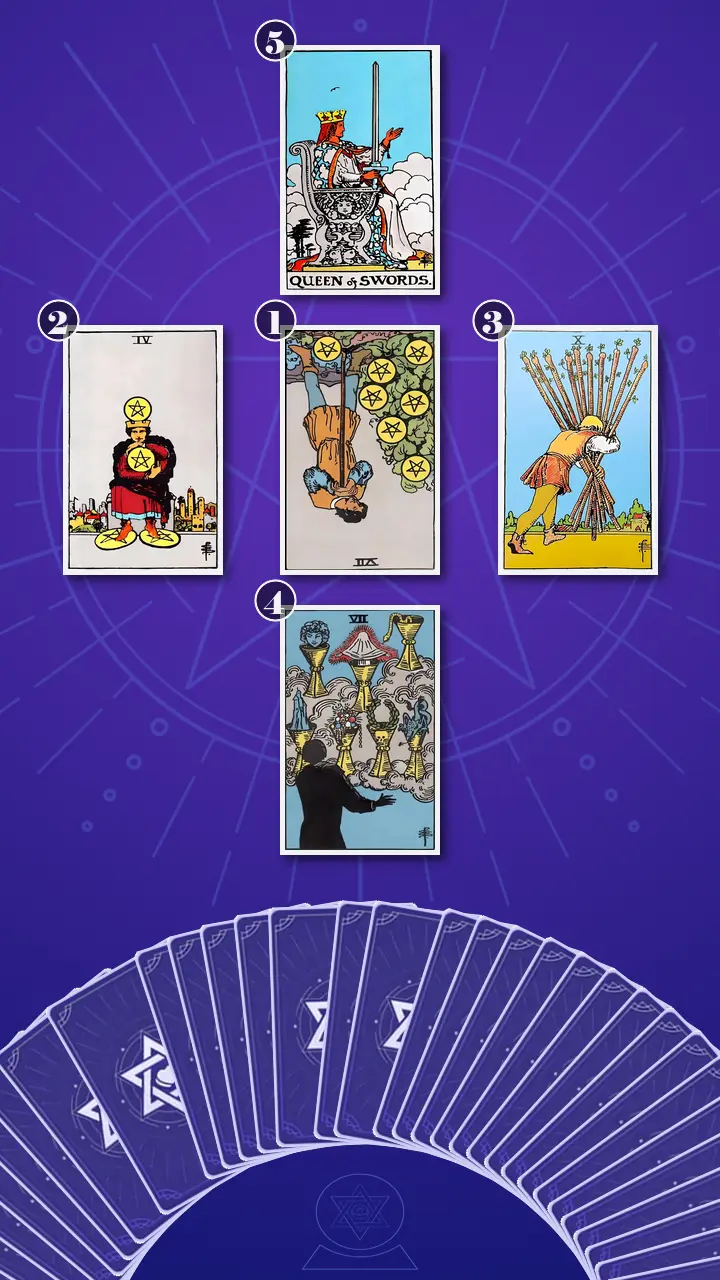
I placed the first card at the centre to diagnose Jordan's postponed review of the arrangement. The second went to the left, showing the immediate security gained by staying. The third went to the right, naming the burden an alternative course would need to address. Beneath the centre, the fourth would expose the projection sustaining the delay. Above it, the fifth would offer an integrating standard. The layout resembled a balance scale on a vertical axis: security against burden, imagined outcomes beneath discernment.
The Harvest Review That Kept Moving
Position 1: Seven of Pentacles, Reversed
The card I turned first represented the diagnosis-level symptom: Jordan kept extending the investment period instead of firmly reviewing present costs and returns. It was the Seven of Pentacles, reversed.
I showed Jordan the worker leaning on a hoe and looking down at the crop. In their life, the figure became someone bent over an overloaded project tracker after another long cycle, comparing months of launches and inherited presentations with the missing title, decision authority, compensation change, written timeline, and recovery time. Jordan had reached the review point repeatedly. After each encouraging conversation, however, the inner sentence became, “I will review it after this launch,” then after the quarterly meeting, then after next quarter.
The reversed Earth energy showed a blockage in evaluation. Disappointing or uncertain returns were not leading to a clearer investment standard; they were prompting Jordan to add more effort. Sunk cost had quietly changed roles. Instead of being information to review, it had become an argument for continuing.
“When you remove the possible promotion from the picture for one minute,” I asked, “what has the extra work produced in the last four weeks? Not what might grow from it. What exists now?”
Jordan's breath stopped briefly. Their eyes moved toward the presentation behind our call as if rereading its ownership history. Then they gave a small, bitter laugh. “That is too accurate. Honestly, it is a little brutal.”
I did not rush to soften the card into something more comfortable. “Accurate does not mean condemning,” I said. “Wanting an investment to pay off is human. The card is only showing us that the review date has become movable. We can correct that without pretending the past effort meant nothing, and without swinging to an impulsive resignation after one difficult evening.”
Position 2: Four of Pentacles, Upright
The next card represented the immediate psychological and practical payoff of continuing to trust the promised future: familiarity, income, internal status, and a sense of control. I turned the Four of Pentacles, upright.
I pointed to the crowned figure clutching one pentacle to the chest and pinning two beneath both feet while the city remained in the distance. For Jordan, those coins were a known salary, benefits, established credibility, and routines that mattered in an expensive Toronto rental market. Staying meant no abrupt transition, no immediate pressure to explain a move, and no need to test their value in a wider job market before the next review cycle.
I treated that security as real. The upright Earth energy began as balance, the sensible protection of resources, but had tilted toward excess. Jordan was holding the familiar arrangement like a phone battery at three percent: preserving the remaining charge felt so urgent that moving toward another power source seemed more dangerous than staying still.
“The question is not whether security matters,” I said. “It is which parts of this security are already true, and which parts have been borrowed from the future. Salary and benefits belong in the first category. A promotion with no terms does not.”
Jordan lowered their hand from their jaw. I watched their fingers spread flat on the desk, then draw together again. “I keep comparing a real job to the scariest possible version of leaving,” they said. “I never compare it to simply gathering information.”
Position 3: Ten of Wands, Upright
The third card represented the present risk that a different course would need to address: an expanding burden that had become normal while Jordan remained focused on the promised destination. I turned the Ten of Wands, upright.
The figure carried all ten wands in one bundle, back bent and line of sight obstructed, even though the town appeared close. I translated the image into Jordan accepting one more launch, executive deck, stakeholder follow-up, or coordination task because the next review cycle seemed only a few weeks away. Each task had once been temporary. Together they had become the unofficial job description.
The card carried Fire in excess: action had accumulated into obligation without enough redistribution, authority, or recovery. The issue was not whether Jordan could carry the load. Their ability was obvious. The risk was that capability had been mistaken for consent, both by other people and eventually by Jordan themselves.
“There is an important difference between ‘I can carry it’ and ‘I agreed to keep carrying it,’” I said. “What responsibility has become permanent in your calendar while everyone still calls it temporary?”
Jordan's shoulders rose before their answer. Their gaze dropped, their fingers hovered over the keyboard, and then a long breath travelled out through their chest. They named a product launch they had been coordinating for two months after stepping in “just for the handover.”
“More effort can prove that you are capable,” I said. “It cannot, by itself, prove that the arrangement will change.”
Position 4: Seven of Cups, Upright
The fourth card represented the mechanism beneath the delay: imagined future outcomes and the fear that questioning them would expose a loss of control. Beneath the centre of the cross, I turned the Seven of Cups, upright.
Seven cups floated inside a grey cloud, each carrying a different possibility. In Jordan's career, those images became a new title, leadership scope, higher pay, more influence, a future team, and the relief of finally being recognized. None of those outcomes was unreasonable. The distortion occurred when separate possibilities merged into one assumed future, even though they depended on different decisions, people, criteria, and dates.
The Water energy was in excess and created a blockage in verification. The future promise had begun to work like an algorithm recommendation: vivid, personalized, and persuasive, but still not a booking confirmation. Praise brought genuine emotional relief, and that relief was repeatedly mistaken for new evidence.
On Jordan's side of the screen, passing headlights briefly reflected across the apartment window and then disappeared. The cups seemed to brighten and fade with them. I asked which part of the imagined future had a named owner, a written criterion, a decision date, and a confirmed change in scope or compensation.
Jordan went still. Their eyes lost focus as if several past one-to-ones were replaying at once. Their thumb rubbed the edge of the darkened phone, then stopped. “I can describe exactly how the future is supposed to feel,” they said quietly. “I cannot tell you who has actually approved it.”
“Hope can stay in the room without being allowed to sign the contract,” I replied. “Testing one part of the promise does not destroy every possibility. It only stops possibility from impersonating proof.”
When the Queen's Sword Divided Promise from Proof
Position 5: Queen of Swords, Upright
The final card represented the key transformation: separate documented facts from projected outcomes, then express one measurable, time-bound boundary. I turned the Queen of Swords, upright.
The laptop fan on Jordan's side dropped into silence. I held the card closer to the camera. The Queen's sword rose in a clean vertical line, while her other hand remained open toward whatever might approach. In modern terms, I saw Jordan entering a review conversation with a written record of current responsibilities, asking for specific terms and dates, and stating what they would no longer continue without a concrete change.
The Queen brought Air into balance: clear-eyed discernment, independent judgment, direct language, and a boundary informed by experience. Her sword did not reject the opportunity. Her open hand could still receive a genuine proposal. Together, they showed the difference between remaining receptive and giving automatic consent.
My years at Cambridge and on archaeological sites have taught me to notice when an official story outlives the material conditions supporting it. At major historical crossroads, continuity is often claimed long after maintenance records show that more labour is producing less stability. That does not mean collapse is inevitable, and I was not comparing Jordan's employer to a fallen empire. I was using what I call Historical Crossroad Matching to move the dilemma into a wider frame: when the narrative and the material record diverge, the material record deserves an independent review.
I paired that with my Enduring Value Assessment. Praise can be sincere and still weather quickly. A documented scope, decision authority, compensation, and a workload that permits recovery are load-bearing. They are the parts of an arrangement that can survive the test of time. The Queen's sword was the line between the attractive reconstruction and the evidence still present in the ground.
I asked Jordan to return to 9:40 p.m.: the inherited presentation, the open job-search tab, the glowing “next quarter” message, and their raised shoulders. Their familiar equation was still running: one more sacrifice might make the promise real, while challenging it might make every previous sacrifice feel wasted.
You do not need to keep funding uncertainty to prove commitment; use the Queen's raised sword to separate present evidence from future salesmanship and speak the boundary clearly.
I left the sentence in the quiet.
Jordan did not exhale. Their thumb froze against the phone, then their gaze slipped past the card as though an old week were replaying on the apartment wall. Their pupils widened. The jaw I had watched tighten all evening hardened once more. “But doesn't that mean I was wrong this whole time?” they asked, sharper than before.
I let the anger have room. “No,” I said. “It means your effort was real, while the conclusion you were asked to draw from it remained unproven. Updating a judgment is not betraying your past self.”
The rims of Jordan's eyes reddened. One fist loosened finger by finger; their shoulders dropped, and a long breath left them with a faint tremor. Then came an expression I recognize from excavations: relief mixed with the slight vertigo of seeing firm ground after the dust clears. Jordan looked lighter, but not triumphant. Clarity had returned responsibility to them, and for a few seconds they seemed unsure what to do without waiting as the default.
“Now, using this new perspective, think back to last week,” I said. “Was there a moment when this insight could have made you feel different?”
Jordan remembered agreeing to another launch deliverable minutes after receiving praise about their leadership potential. The praise had changed their emotional state, but it had not removed a task, altered their title, expanded their authority, or created a promotion date.
I gave them the smallest version of the Queen's practice: set a ten-minute timer and write two headings, Current Evidence and Future Claims. Add one item beneath each, then complete the sentence, “For me to continue taking on this scope, I need...” I reminded Jordan that the page could remain private. If the exercise flooded their system, they could stop, look around the room, and return to one factual category such as hours or authority.
This was not a leap from hope into cynicism. It was the first movement from defensive hope and sunk-cost loyalty toward clear-eyed evaluation, conditional commitment, and steadier self-trust. Jordan did not need a complete career decision that night. They needed present evidence and future potential to stop occupying the same column.
The Boundary Before the Next Sacrifice
I read the full cross back to Jordan as one continuous story. The reversed Seven of Pentacles watched the investment but postponed the review. The Four of Pentacles gripped the known salary and internal reputation. The Ten of Wands carried every temporary task forward. The Seven of Cups turned several possible rewards into one persuasive future. The Queen of Swords finally named what each earlier card could not: commitment needed criteria.
Jordan had been financing a possible future with today's attention, energy, recovery time, and negotiating power. The cognitive blind spot was not hope itself. It was treating renewed hope as if it changed the present arrangement, then using the size of the past investment as evidence that more investment must be justified.
The Decision Cross: Context Edition did not produce a verdict of “stay” or “leave.” It revealed two questions crossing at the centre: What am I protecting versus what am I carrying? And what am I imagining versus what can I clearly state? The transformation was practical: review the current arrangement against three non-negotiable criteria, then make continued effort conditional on one measurable boundary and a personal deadline.
A Two-Part Promise-to-Proof Check
- Run the 20-Minute Current Cost Audit Before the next one-to-one, create a private document with two columns: “Current Evidence” and “Future Claims.” Under Current Evidence, record the last four weeks of responsibilities, approximate hours, decision authority, compensation, recovery time, and written commitments. Put phrases such as “next quarter,” “leadership opportunity,” and “you are close” under Future Claims unless each has a named owner, criterion, and date. Circle only what is already true today. Then choose three non-negotiables for continued investment: a workload ceiling, authority and compensation aligned with scope, and protected recovery time. Keep the first version rough and stop after 20 minutes. If six categories feel too activating, begin with workload, authority, and recovery time. The document is evidence for your judgment, not a case you must prosecute.
- Use the Time Stratigraphy Exercise Before Saying Yes Five minutes before the next stretch-assignment conversation, imagine your ten-year future self looking back at this exact decision as one layer in a longer career. Ask what will retain enduring value in that layer: another unpriced task, or a clear record that you protected scope, leverage, and health. Then ask in writing, “What current priority should move off my plate, who owns the decision, and what specific outcome would this assignment count toward?” If the answer remains general, state: “I can take this on if X is paused, or I can revisit it after the scope and decision date are confirmed.” Put your own review date on the calendar within 30 days. Draft the words before the meeting so you do not have to invent them while your jaw is tight. A boundary is about the conditions of your participation, not control over another person's response. The minimum version is one question and one sentence.
“A boundary is not a resignation letter,” I told Jordan. “It is the point where your participation becomes conditional on clear terms. You can preserve income, remain open to a real opportunity, and still stop adding work at an undefined price.”

A Week Later: The Quiet Proof
A week later, I received a short message from Jordan. They had completed the two columns, brought one question into a meeting, and declined to absorb another presentation unless an existing priority moved. Their manager reassigned the deck and agreed to send a written outline of the promotion criteria. There was still no promotion decision, but Jordan had stopped treating the absence of one as a command to overperform.
They slept through the following night. In the morning, their first thought was still, “What if I have misread this?” Jordan told me they smiled, opened the evidence document, and checked the facts instead of reopening another future scenario.
I did not consider that message proof that the cards had changed Jordan's career. Tarot had supplied an objective structure for the conflict; Jordan supplied the honesty, language, and action. The Journey to Clarity ended not with certainty, but with one small piece of evidence that waiting was no longer the only available response.
“Do not ask the promise to explain the present,” I had told them before we ended. “Ask the present what it is consistently giving you.”
When your shoulders stay raised over another late-night task because admitting the promise may not hold would make all that effort feel wasted, it can be hard to tell whether you are protecting your future or trying to prove you were never out of control. Simply separating those motives means you are no longer standing at the beginning of the same loop.
If you let the future remain possible without allowing it to set today's price, what single line could you place beneath the Queen's raised sword this week: a date, a criterion, or a boundary before the next sacrifice?
This story is adapted from psychological research, written so that those in a similar struggle can see their own pattern in it — and find their next step clearly.These insights are not a substitute for professional psychological, medical, legal, or financial advice.
Learn more about our Journey to Clarity.
How did this insight land for you?
🫂 This Resonates Deeply
🌀 Living This Story
✨ Now I See Clearly
🌱 Seeing New Possibilities
🧰 Useful Framework
🔮 The Confirmation I Needed
💪 Feeling Empowered
🚀 Ready for My Next Step
Author Profile
 AI
AI“Having spent a lifetime at Cambridge and on archaeological digs, I’ve witnessed the rise and fall of countless civilizations. Please know that your current struggles are not a permanent fate, but merely a necessary fracture before rebuilding. I won't lecture you; instead, I invite you to sit with me in the ruins, using a patient, historical perspective to gently dust off the true, enduring value hidden beneath your temporary doubts.”
In this Choice Tarot Reading :
Core Expertise
- Historical Crossroad Matching: Contextualizing your dilemma by comparing it to macro-historical turning points, providing an objective bird's-eye view.
- Enduring Value Assessment: Evaluating competing options based on what will survive the test of time versus what is merely a short-term impulse.
Service Features
- The Time Stratigraphy Exercise: A mental time-travel protocol evaluating your current dilemma strictly from the perspective of your 10-year future self, instantly dissolving trivial anxieties.
Also specializes in :
Explore Related Patterns:
Defensive OverfunctioningJordan is working on an inherited presentation at 9:40 p.m. after temporary launches, decks, follow-ups, and coordination tasks have accumulated into an unofficial role. Doing more protects several things at once: the dependable professional identity, the existing income, and the hope that visible capability will eventually force the arrangement to catch up. When capability repeatedly substitutes for consent, you can become the person who stabilizes an unclear system at your own expense. Defensive Overfunctioning reduces immediate uncertainty by making you more useful, but it also teaches the workplace to treat exceptional effort as the normal price of your participation.
Emotional ReasoningThe next-quarter message calms Jordan enough to close the job listings, and leadership praise changes how the situation feels even though none of its material conditions have changed. The relief is genuine, but the story shows it crossing categories and being treated as information about the likelihood of promotion. Emotional Reasoning occurs when you use a changed feeling state to update a factual conclusion without new factual support. In this case, hope does not merely coexist with the evidence. It temporarily impersonates evidence, making the present workload feel safer than the documented arrangement warrants.
Intermittent ReinforcementJordan receives praise about leadership potential and agrees to another launch deliverable minutes later, even though no task, title, authority, compensation, or decision date has changed. Each encouraging conversation provides a small emotional reward at exactly the point when Jordan might otherwise review the arrangement. Intermittent Reinforcement can keep you invested because the reassurance arrives often enough to restore hope, but not concretely enough to settle the question. The loop is sustained by the timing of the reward rather than by improved terms, so relief repeatedly resets the review before evidence can complete it.
Sunk Cost FallacyJordan moves the review from after the launch to after the quarterly meeting and then to next quarter, while the extra work remains real and the expected return remains undefined. When earlier effort becomes an argument for adding more effort, you are no longer evaluating the arrangement only by what it gives you now. You are also trying to protect the meaning of what you have already spent. That is how Sunk Cost Fallacy allows a promised future to keep funding a measurable present risk. The corrective is not to call the past effort worthless. It is to let current evidence determine whether the next unit of time, energy, and leverage deserves to be invested.
Boundary DiscernmentJordan declines to absorb another presentation unless an existing priority moves, and the manager responds by reassigning the deck and agreeing to provide written promotion criteria. The action does not demand a guaranteed promotion or control the manager's reaction. It identifies the conditions under which Jordan will continue participating. Boundary Discernment separates "I can do this" from "I consent to keep doing this under the current terms." You can preserve income, remain receptive to a genuine opportunity, and still stop allowing undefined potential to authorize the next sacrifice automatically.
Potential ProjectionJordan combines a title, higher pay, leadership scope, influence, a future team, and recognition into one compelling picture, even though each outcome would require separate decisions and approvals. The future is emotionally detailed, but its owner, criteria, authority, compensation, and date cannot be named. Potential Projection lets you respond to the fullest imagined version of an opportunity rather than to the offer that currently exists. Possibility remains legitimate, but the present risk grows when several hoped-for outcomes are bundled together and allowed to set today's price before any of them has been confirmed.
Reality TestingJordan places salary and benefits under what is already true, while "next quarter" and "leadership opportunity" remain future claims until they acquire an owner, criteria, and a date. A week later, the same structure is used again when uncertainty returns and Jordan checks the document instead of generating another future scenario. Reality Testing does not require you to reject hope or assume the worst. It allows hope to remain possible while observable facts retain authority over present decisions, so a reassuring message can be emotionally meaningful without automatically changing your assessment of risk.
Achievement FusionJordan has built a professional identity around being the person who can absorb more, so questioning the arrangement immediately produces the sharper question, "Doesn't that mean I was wrong this whole time?" The decision is no longer only about workload or promotion terms. It has become entangled with what competence, dependability, and past effort are supposed to prove. Achievement Fusion makes updating a strategy feel like withdrawing a claim about who you are. When your identity is tied to carrying the load, you may continue carrying it to avoid interpreting a boundary as personal failure, even when the boundary is the clearest evidence of independent judgment.
Avoidance CopingJordan opens the job listings, receives another next-quarter message, and closes them before gathering information. The review is then moved beyond another launch or meeting, preserving both the current job and the imagined promotion without requiring either to face a direct test. Avoidance Coping works here by reducing the immediate discomfort of possible disappointment, conflict, or regret. You do not have to make an abrupt career decision to interrupt it. Even a small act of verification can stop waiting from functioning as the decision you never consciously made.
Loss AversionJordan protects a known salary, benefits, credibility, and familiar routines while comparing the current job with the most threatening version of departure. The overlooked comparison is not between staying and resigning immediately. It is between staying unchanged and gathering enough information to create another option. Loss Aversion makes a visible possible loss feel larger than a gradual cost already being paid. You may therefore protect familiar security while discounting the quieter erosion of recovery time, negotiating power, and freedom to test your value elsewhere.
Explore Related Struggles:
Evidence DisconnectionJordan receives praise about leadership potential and agrees to another launch deliverable minutes later. The message changes the immediate emotional atmosphere, but it removes no task, grants no authority, alters no compensation, and establishes no promotion date. You lose contact with evidence when the relief created by recognition is allowed to perform the work of verification. A future can feel specific because you can imagine its title, influence, pay, and emotional payoff, even while no one can name the approval behind it. Reconnecting feeling with fact does not require rejecting hope; it requires letting hope remain a possibility rather than treating it as a completed decision.
Responsibility-Authority SplitJordan coordinates launches, inherits executive presentations, and handles stakeholder follow-up while the title, compensation, decision rights, and formal mandate remain unchanged. Their capability is visible in the work, yet the organisational power needed to shape that work has not moved with the responsibility. You carry this split when you are held accountable for outcomes without being given matching control over priorities, resources, or terms. Competence can keep the system functioning, but it cannot resolve the underlying mismatch; the more effectively you compensate for missing authority, the easier it becomes for the unequal arrangement to appear workable.
Security-Choice SplitJordan closes the LinkedIn listings whenever "next quarter" reappears, even though the opportunity still has no date, criteria, authority, or compensation attached to it. The salary, benefits, and internal credibility are real resources worth protecting, but protecting them has begun to restrict even low-risk actions such as gathering information or comparing options. You become caught in this split when security is treated as evidence that choice itself is dangerous. The struggle is larger than whether you stay or leave: it is the tension between preserving today's resources and preserving your ability to investigate, negotiate, and move without letting an unverified future make the decision for you.
Unseen Cost BindAt 9:40 p.m., Jordan is still beside an inherited presentation while a promotion message occupies the phone and the job-search tab struggles to remain open. The possible reward has a vivid name and imagined future, while its current price is scattered across late nights, raised shoulders, reduced recovery, and work performed without matching leverage. You become bound when a future gain is easy to picture but its present cost arrives in small, ordinary deductions. No single task appears large enough to force a reckoning, yet the cumulative arrangement spends your attention, time, and negotiating position before the promised return has been defined. Seeing the cost as one connected structure restores your ability to decide what the possibility is actually worth.
Clarity-Exposure SplitJordan reaches the review point after each launch or quarterly conversation, then moves it forward when another reassuring message arrives. When the absence of approval becomes undeniable, their first question is not only what the facts mean now, but whether those facts make all of their earlier judgment wrong. You can want clarity while also experiencing it as exposure. Asking for proof may uncover an unsupported promise, but it may also force you to revise the meaning assigned to months of effort, patience, and professional loyalty. The struggle lives between the need to know what is real and the wish to protect your past self from being reduced to a mistake.
Moving Finish Line TrapJordan's review date moves from one launch to the next meeting and then into another quarter. The destination remains close enough to justify present effort, but each arrival point produces a renewed delay instead of a decision, criterion, or documented change. You are trapped when waiting is organised around milestones that never become genuine evaluation points. The promise survives because its terms can move whenever reality catches up with them. A personal deadline matters here because it gives the review a location that does not depend on another person's ability to keep the future undefined.
Sunk Cost ParalysisJordan plans to review the arrangement after a launch, then after the quarterly meeting, and then after next quarter. Each cycle adds more work, and the accumulated effort gradually stops functioning as information about the arrangement; it becomes the reason another cycle must be funded. You become locked when changing course appears to declare that everything already invested was wasted. That interpretation gives the past control over the next decision, even though previous effort cannot confirm a future return. Updating your terms does not erase what you contributed; it prevents the meaning of that contribution from depending on an outcome no one has approved.
Burden Identity FusionJordan has built a professional identity around being the person who can absorb more, and the workplace repeatedly confirms that identity by routing additional launches, presentations, and coordination through them. Carrying the burden proves capability, but it also makes the burden harder to question without appearing to contradict the dependable person they have become. You become fused with the burden when reliability no longer describes how you work and starts dictating what you must accept. A workload limit can then feel like a loss of competence or professional worth, even when the limit is simply asking responsibility, authority, and recovery to occupy the same role. Separating capacity from obligation allows your skill to remain real without making endless availability its price.
Explore Related Emotions:
Conditional Hope AnxietyThe possible-leadership message gives Jordan an immediate lift, but it contains no decision date, criteria, named owner, authority, or compensation change. Each new promise makes postponing the review feel reasonable for a little longer, even as the current cost remains unchanged. You are left waiting for one more conversation, launch, or quarter to convert possibility into proof. That conditional hope carries anxiety because the desired future remains vivid enough to influence today's choices but undefined enough to resist evaluation. Separating possibility from commitment allows hope to remain without letting it set the price of your present participation.
Grounded AgencyJordan brings one prepared question into the meeting and declines another presentation unless an existing priority moves. They remain employed, stay receptive to a concrete proposal, and change the conditions under which additional work receives consent. Your sense of agency returns when the choice expands beyond silent endurance or immediate departure. You can gather information, define a review date, ask for written criteria, and decide what your continued participation requires. The future remains open, but waiting is no longer the only response available to you.
Hollow RecognitionJordan agrees to another launch deliverable minutes after receiving praise about their leadership potential. The praise changes the emotional temperature, but it does not remove a task, alter the title, expand decision authority, adjust compensation, or establish a promotion date. Recognition feels hollow when it names your value without changing the conditions under which that value is used. You may feel briefly seen and then discover that the acknowledgement has functioned as another reason to wait. Testing recognition against material follow-through helps you distinguish sincere words from terms capable of carrying real weight.
Resentful ExhaustionThe inherited deck is still glowing behind Jordan at 9:40 p.m., and their body is carrying the arrangement through raised shoulders, shallow breaths, jaw pressure, and restless movement between the phone and keyboard. Launches and coordination continue to move outward while authority, compensation, and recovery time do not move back. Your exhaustion gains a resentful edge when capability repeatedly produces more obligation instead of clearer terms or redistribution. The bitter laugh is the moment the imbalance becomes speakable: you can perform the work, but your ability to perform it does not equal endless consent. Recognizing that distinction turns resentment into information about where participation needs conditions.
Scope Creep DreadAt 9:40 p.m., Jordan is still working on an inherited presentation while another message points toward "next quarter." Temporary launches, decks, follow-ups, and handovers have accumulated into the present role without a corresponding title, authority, compensation change, or workload ceiling. Your dread grows from the realization that the burden is already measurable while the endpoint keeps moving. The risk is not merely that one more assignment will be tiring; it is that repeated exceptions may continue becoming the unofficial job before you have consciously agreed to its terms.
White-Knuckle SecurityJordan opens LinkedIn Jobs, hears "next quarter," and closes the listings while their shoulders remain raised and their thumb presses into the hinge of their jaw. A real salary, benefits, credibility, and familiar routines become fused with the imagined need to avoid every uncertain alternative. You may experience security as something that must be gripped so tightly that even gathering information feels dangerous. The tension comes from protecting what is genuinely valuable while allowing an undocumented possibility to borrow the authority of those real resources. Naming that distinction gives you room to protect stability without making permanent overextension its admission price.
Sunk Cost GriefAfter months of launches and inherited responsibilities, Jordan hears the present arrangement described plainly and asks, "But doesn't that mean I was wrong this whole time?" The question reveals how strongly the meaning of past effort has become attached to the hope of an eventual return. Your grief is not only about a promotion that may remain uncertain. It also concerns the time, recovery, and personal faith already invested in making that future plausible. Revising your judgment can hurt because it removes the promised explanation for those sacrifices, but it does not make the effort unreal or turn your past self into an enemy.
Cautious Self-TrustA week later, Jordan's first thought is still, "What if I have misread this?" Instead of reopening another future scenario, they open the evidence document and check what is currently true. The uncertainty remains, but it no longer automatically outranks their own observations. You rebuild self-trust by treating your judgment as revisable and still worthy of use. Asking one question, setting one deadline, and declining one unpriced task do not require absolute certainty. They let you test whether your perception can guide a measured response while new evidence continues to arrive.
Clarity ShockJordan's thumb freezes against the phone when current evidence is separated from future claims, and their first response is sharper than before: "Doesn't that mean I was wrong this whole time?" The facts do not merely answer the career question; they disrupt the explanation that had made repeated sacrifice feel coherent. The shock comes when you see firm ground and simultaneously lose the familiar script of waiting. Clarity can feel destabilizing because it returns responsibility before you have decided what to do with it. That jolt is not a command to make an immediate move; it marks the moment when an inherited equation becomes available for conscious review.
Clarity ReliefJordan's fist loosens finger by finger, their shoulders drop, and a long breath leaves after the undefined promise is removed from the column of present evidence. A week later, the reassigned deck and written outline provide concrete information that praise alone had never supplied. Your relief comes from no longer forcing an imagined outcome to function as a complete plan. The future can remain unresolved while the present becomes legible enough to evaluate. This is clarity with usable edges: you can see what is already true, what remains only a claim, and which conditions belong to your decision.
Explore Related Contexts:
Permanent Temporary ModeJordan stepped into product launch coordination 'just for the handover,' yet the responsibility is still active two months later. Other launches, decks, and stakeholder tasks follow the same route from temporary exception to recurring calendar obligation. Permanent Temporary Mode emerges when an organization avoids formally redesigning a role because provisional coverage continues to deliver the needed output. You face a moving endpoint rather than a defined transition, so every completed task can become evidence that the temporary arrangement is sustainable instead of evidence that it should end or be formalized.
Praise as Performance ContractJordan agrees to another launch deliverable minutes after receiving praise about leadership potential. The recognition changes the tone of the moment, but it does not remove a task, expand authority, increase compensation, or establish a promotion date. When praise repeatedly accompanies requests for more output, it can begin functioning like an informal performance contract: recognition is delivered now while the material return remains deferred. You can audit that exchange by asking whether each encouraging message changes a concrete employment condition or simply makes the existing condition easier to continue.
Promotion Criteria Black BoxJordan reaches the review point after launches and quarterly meetings, only for the decision horizon to move forward again. The manager's messages offer proximity to promotion without identifying who approves it, what standards apply, when the decision occurs, or what title and compensation would follow. The process keeps advancement plausible while its governing rules remain inaccessible. You are being asked to keep supplying evidence of readiness inside a system that has not supplied evidence of commitment, leaving the organization free to extend the assessment period without formally denying or granting the role.
Quiet PromotionJordan is carrying inherited decks, additional launches, stakeholder coordination, and late-night delivery while their title, authority, and compensation remain unchanged. The expanded scope is already operating as a leadership job, but the promotion exists only as 'next quarter,' with no date, criteria, owner, or approval. That is the structure of a Quiet Promotion: the organization receives higher-level output before formally pricing, authorizing, or recognizing the role. You can locate the present risk by separating evidence that you are capable from evidence that the employer has actually committed to changing the job.
Work Life Boundary CreepAt 9:40 p.m., Jordan is in their apartment with an inherited presentation still glowing on the laptop. The extra launches, executive decks, coordination, and follow-up are no longer contained by a temporary handover or a normal workday; they are drawing on evening attention and recovery time. When an undefined promotion process is financed with private time, the workload expands without having to appear as a formal staffing or compensation decision. You can treat that encroachment as present evidence, because the cost is already occurring even while the proposed reward remains unconfirmed.
Career ROI ReckoningJordan places responsibilities, hours, authority, compensation, recovery time, and written commitments under Current Evidence, while phrases such as 'next quarter' remain under Future Claims. A personal review date and the manager's promised written criteria give the investment a defined point of inspection. This reckoning does not require an immediate decision to stay or leave. It gives you a way to measure whether continued effort is producing durable career value, preserving the genuine benefits of the role while preventing an imagined return from setting today's workload price.
Sunk Cost Exit DilemmaJordan moves the review from one launch to the quarterly meeting and then to next quarter, adding effort whenever the return remains uncertain. When a firmer boundary becomes visible, the immediate question is whether that would mean the earlier judgment was wrong. The exit dilemma forms because accumulated work is being asked to justify future work, even though it has not produced the missing title, authority, compensation, or timetable. You do not have to dismiss the value of your previous contribution to update the conditions for your next contribution; the relevant evidence is what the arrangement consistently provides now.
Career Stability Lock-InJordan has a real salary, benefits, established credibility, and familiar routines in an expensive Toronto rental market. Each new message about next quarter arrives beside those concrete protections, and the LinkedIn Jobs tab closes before outside information can challenge the comparison. The lock-in is material rather than irrational: the current role protects resources that an uncertain move might disrupt. You can preserve that security without allowing it to define every alternative as a full resignation, because gathering market information and setting workload conditions do not require surrendering the income you already have.