Relocation Decision Paralysis in the TTC Glow
You’ve reread the relocation clause so many times you could quote it—yet the recruiter is still waiting because you’re stuck in relocation decision paralysis.
Jordan showed up to our session looking like they’d been sprinting inside their own head all week. They’d taken the TTC straight from work—fluorescent lights flickering, their phone still warm from reopening the offer email, leg bouncing like a metronome they couldn’t switch off.
“It’s a great offer,” they said, and I watched their hand hover near their chest the way people do when they’re trying to keep a feeling from spilling out. “But what if I’m only saying yes because I want to get away from… this?”
They described the nightly routine like it was a second job: laptop glow at 10:13 p.m., the “Move vs Stay” Google Sheet, apartment listings in the new city, and seventeen tabs of cost-of-living calculators and neighborhood deep-dives. Then the same ending, every time—closing all the tabs like pausing the browser could pause their life.
It wasn’t that Jordan couldn’t choose. It was that either choice felt like it would say something final about them.
Their anxiety didn’t look like panic; it looked like productivity that never produced relief. A tight chest with restless energy in their legs—like standing at a departure gate holding two boarding passes and scanning neither, trying to guarantee they wouldn’t regret the flight.
I leaned in a little, keeping my voice level. “I hear how hard you’re trying to be responsible,” I said. “And I also hear the deeper question: ‘Am I growing, or am I fleeing?’ Let’s try to give the fog a shape. We’re not here to predict your future—we’re here to find clarity and a next step you can actually live with.”

Choosing the Compass: The Transformation Path Grid (6)
I asked Jordan to take one slow breath with a hand on their chest—just enough to shift from doom-researching mode into listening mode—then I shuffled while they held the question in mind: “Offer needs me to relocate—do I go, or is it just fleeing my past?”
“Today I’m using something I designed for career crossroads,” I told them, turning the deck and tapping it once on the table. “It’s called the Transformation Path Grid (6) · Context Edition—a six card tarot spread for relocation decisions that tend to spiral into ‘growth vs escape.’”
To you, reading this: although the question sounds binary—move or stay—the real trap is psychological. A classic decision spread can accidentally inflate the pros/cons debate and reinforce motive-policing (“If my motive isn’t pure, I can’t choose”). This grid does something more ethical and more useful: it maps the loop (what you’re doing, what blocks you, what’s underneath), then builds a bridge (the catalyst insight, the grounded action path, and what integration feels like). It’s how tarot works when it’s practical: pattern recognition, context, and next steps—not fortune-telling.
In this layout, the top row diagnoses the stuckness: Present, then Blockage, then the Root. Then we drop to the bottom row—Catalyst, Action path, Integration—like stepping down from a crowded overpass of analysis onto an actual path you can walk.
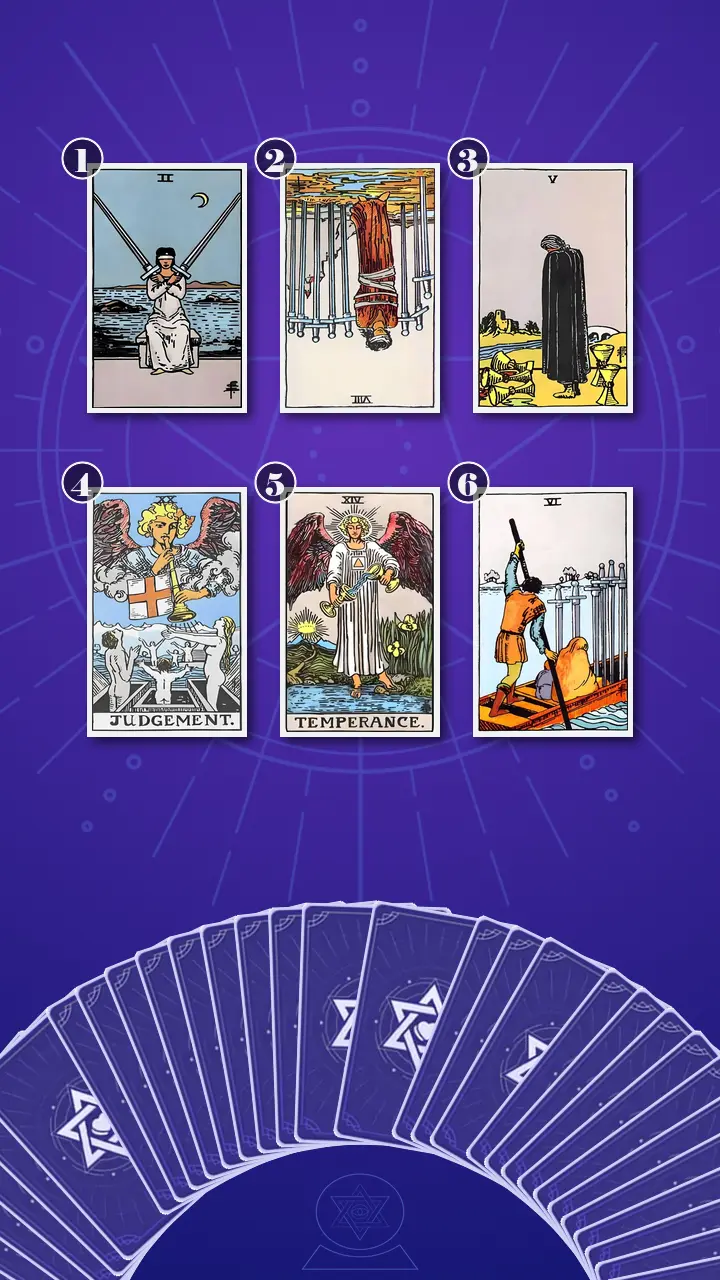
Reading the Map: From Draft Mode to the Root
Position 1: Surface situation — Two of Swords, upright
“Now flipped over,” I said, “is the card that represents how this relocation decision is showing up in your behavior right now.”
Two of Swords, upright.
I didn’t have to reach for a metaphor; Jordan’s whole week was already printed on the card. “This is you at the kitchen counter with Gmail open,” I said, “three reply drafts saved—‘accept,’ ‘decline,’ ‘ask for time’—and the spreadsheet called ‘Move vs Stay.’ You keep rereading the relocation clause like the fine print will hand you emotional certainty. Because sending any reply makes one path real, and ends the safety of ‘not yet.’”
In this card, the energy is balanced but frozen—not calm, not stable, just held. It’s protection. The crossed swords at the chest are like a reflex: don’t let either option touch the heart.
“You’re not indecisive—you’re in motive-audit mode,” I added, gently. “It’s not laziness. It’s self-protection.”
Jordan let out a short laugh that had a little sting in it. “That’s… brutally accurate,” they said, eyes flicking from the card to the table edge. Then a tiny exhale—like a pressure valve giving up one degree.
Position 2: Primary blockage — Eight of Swords, reversed
“Now we’re looking at the card for the main mental pattern that keeps the decision stuck—how control is being attempted.”
Eight of Swords, reversed.
I traced the image with my finger—swords forming a corridor, the sense of confinement—but reversed, the bindings loosening. “The door is already unlocked,” I said. “But habit keeps you standing still.”
Then I used the translation that matched Jordan’s life with unfair precision: “This is you telling yourself, ‘I have no choice,’ while actively having options—negotiate start date, ask for a visit, request a day to think, or decline cleanly. And yet your finger won’t click ‘send,’ so you keep cycling the same tabs—cost of living, ‘worst neighborhoods’ threads, flights—because the real bind is the fear that a ‘wrong’ choice proves you’re not in control of your life.”
The reversed energy here isn’t a collapse; it’s a blockage loosening that you don’t fully trust. It’s the moment you could step out, but your nervous system hasn’t gotten the memo.
Jordan went still. Not dramatic—just a brief silence like their brain lost the next line of the script. Their stomach visibly dropped; their throat worked once like swallowing a truth.
“I do say ‘I have no choice’ a lot,” they admitted, quieter. “Even when… yeah, I guess I do.”
“Research can’t give you permission,” I said. “Only you can.”
Position 3: Root layer — Five of Cups, upright
“Now flipped over is the card for what from the past is still emotionally active and shaping what this move means.”
Five of Cups, upright.
“This isn’t about you being dramatic,” I said, because I could feel their shame rising to defend them. “This card is plain grief.”
I described the modern scene that fit the card: “Walking past a specific Toronto street that still holds an old chapter—friendship fallout, a breakup, a version of you you’re tired of. Stomach drops. Ten minutes later you’re deep in apartment photos from the new city, using the offer as a mental exit ramp so you don’t have to sit with what was lost here.”
The Five of Cups energy is water that’s fixated—attention glued to what spilled. The spilled cups are real. But the two upright cups behind the figure? That’s the support and steadiness you forget counts when grief is loud.
Jordan’s face softened in a way the earlier cards hadn’t allowed. Their eyes didn’t look watery exactly—more like they’d gone farther away for a moment, replaying something private.
“I hate that there are places here that still… hijack me,” they said. “Like I’ll be fine and then I’m not.”
“That’s the root,” I said. “And it matters, because otherwise the relocation decision gets forced to do two jobs: career growth and emotional cleanup.”
When Judgement Sounded Like a Trumpet
Position 4: Catalyst — Judgement, upright
I held the next card for half a beat longer than usual. The room felt quieter, like the city noise outside my window had been turned down one notch.
“Now flipped over,” I said, “is the card that represents what breaks the loop and reframes ‘moving’ versus ‘running’. This is the turning point.”
Judgement, upright.
Judgement is not a scolding card, not in my practice. It’s a signal. An unignorable ping cutting through muted notifications. “This is the moment you stop negotiating with the past,” I told Jordan, “and let one clear truth lead.”
I used the scenario that belonged to them: “It’s a quiet ‘enough’ moment—not hype, not panic—just clarity that the old chapter can’t be the hidden co-author anymore. Before you choose yes or no, you do one closure action so the decision stops being a character verdict and becomes an authored transition.”
Setup: Jordan nodded, but I could see the old mechanism trying to seize the wheel again. This was that after-work moment: reopening the “Move vs Stay” spreadsheet, rereading the relocation clause, still unable to reply—because the email wasn’t logistics. It felt like a verdict on whether they were brave… or just running.
Delivery:
Stop auditioning your motives for purity and start answering the trumpet call of what you’re ready to release and renew.
I let it hang there, the way a hard truth does in a quiet room.
Reinforcement: Jordan’s reaction came in layers. First: a tiny freeze—breath caught, fingers hovering over the edge of their sleeve like they’d forgotten what to do with their hands. Second: their gaze unfocused, not on the card anymore, like they were rewinding an old scene on a loop and finally seeing what the loop was doing. Third: their shoulders dropped, not all at once, but in two small releases, and the air left their chest in a shaky exhale that sounded half like relief and half like grief.
“But… if that’s true,” they said, and there was a flash of anger under the words—clean, defensive, human—“doesn’t it mean I’ve been lying to myself? Like, all this time?”
I didn’t rush to soothe them. “No,” I said. “It means you’ve been trying to survive with the tools you had. On a trading floor, we used to call it risk management—but sometimes you’re managing the wrong risk.”
That old part of me—the Wall Street part that still thinks in scenarios—clicked in. “Here’s the Strategic Crossroads Analysis version,” I told them. “Right now you’re treating the decision as one single all-or-nothing bet. But Judgement splits it into two separate deals: closure and choice. When you separate them, the probability of regret drops—not because the future becomes certain, but because you stop asking the relocation to carry the entire burden of healing.”
I leaned forward, voice steady. “This is the key shift: Shift from trying to prove you’re not “running” to making a values-based choice while separately giving the past honest closure. That’s not spiritual. That’s practical. It’s how you stop putting your motive on trial and start authoring the next paragraph.”
Then I invited the question that makes insight real: “Right now—using this new lens—think back to last week. Was there a moment you felt that tightness in your chest and started motive-auditing? If you’d given yourself one honest closure moment then, how would it have changed the next hour?”
Jordan swallowed again, softer this time. “There was a corner near my building,” they said. “I walked past it and I just… spiraled. And then I went straight into apartment listings. Like, instantly.”
“That’s the trumpet,” I said. “Not telling you where to live. Telling you what wants to be released so your choice can be yours.”
In that moment, the transformation I could feel beginning wasn’t “anxiety to confidence.” It was more honest: from anxious motive-auditing and analysis paralysis to a self-authored decision with room for honest closure. A small, real step.
A Move Doesn’t Have to Be a Rupture
Position 5: Action path — Temperance, upright
“Now flipped over is the card for the healthiest way to proceed—blending emotion with practical planning.”
Temperance, upright.
Temperance is a nervous system card as much as it’s a planning card. “This is you treating relocation like a paced transition,” I said, “not a total identity reset. Buffers. Realistic money math. A visit if possible. Two stabilizers you carry with you so you don’t abandon yourself in the move.”
The energy here is balance—not perfect harmony, but steady regulation. “A move doesn’t have to be a rupture to be real,” I reminded them.
Jordan’s leg had slowed. Not stopped—just slower, like the body could finally imagine a path that didn’t require a clean narrative.
Position 6: Integration — Six of Swords, upright
“Now flipped over is the card for what alignment feels like in the near term—what your mind and body feel like once the choice has a container.”
Six of Swords, upright.
“This card doesn’t promise the move will be magical,” I said. “It promises something more believable: calmer mental water once you commit to a direction.”
I translated it into their modern life: “After you take one committing step—even just sending the questions email or booking the recruiter call—your brain stops reopening the same tabs on loop. The transition has a container: timeline, next step, support. Your thoughts come with you, but they don’t have to drive.”
I caught myself thinking of old deal rooms—how certainty never arrived before the term sheet, only after the structure existed. “Clarity isn’t a mood,” I said, almost to myself. Then I looked back at Jordan. “It’s a container you build.”
The One-Page Container: Closure-Then-Choice Protocol
I pulled the whole grid together for Jordan the way I would summarize a complex decision in a boardroom—clear, respectful, no theatrics.
“Here’s the story these cards tell,” I said. “Right now, you’re in a protective stalemate (Two of Swords): three drafts, zero sends. The main obstacle isn’t missing information—it’s the rule that says you need perfect certainty and a perfectly pure motive before you’re allowed to choose (Eight of Swords reversed). Under that, there’s real grief (Five of Cups): specific memories in Toronto still landing in your body, and the offer becoming an emotional exit ramp. Judgement changes the frame: closure first, so the decision stops being a verdict. Temperance turns that into an integrated plan, and the Six of Swords is the payoff: fewer loops, more direction.”
The cognitive blind spot was cleanly visible now: “You’ve been asking the relocation to prove something about your character,” I said. “That’s why every pros/cons list becomes a courtroom exhibit. But you don’t need a pure motive. You need an honest one—and you need to separate closure from choice.”
I wrote three words on my notepad and turned it toward them: Closure first. Choice second.
“Let’s make this actionable,” I said. “Not a life overhaul. Just small steps that create real information.”
- The 10-minute ‘motive-audit’ interruptionSet a 10-minute timer. Open Notes and write two headers: “What I’m actually leaving” and “What I’m actually choosing.” Add 3 blunt bullet points under each—no polishing, no explaining to imaginary critics.If your chest tightens or your brain starts debating, label it out loud: “motive-auditing.” Then go back to bullets. Stop at 10 minutes on purpose.
- One non-final step: the 3-question email draftDraft (don’t send yet) a short email to the recruiter/HR with three questions: relocation support, start date flexibility, and whether a brief visit is possible. Save it as a draft titled “Information, not decision.”Expect the thought “This is dumb; I need the full answer.” That’s the loop trying to stay in charge. Saving the draft still counts as movement.
- The Two Stabilizers Transition PlanPick two stabilizers you will keep regardless of where you live (example: a weekly friend call + a gym/yoga ritual). Put them on your calendar for the next two weeks as if the move is happening.Choose stabilizers that already exist in your life. Urgency isn’t truth; continuity builds safety.
Before we ended, I used one of my old trading-floor focus habits as a pre-commitment ritual—simple, not mystical. “When you leave,” I said, “your only job is to do the 10-minute Notes exercise. Then save the email draft. Sending is optional today. We’re building the container first.”

A Week Later: The Quiet Proof
Five days later, Jordan messaged me a screenshot—not of a grand decision, just a calendar invite: “Recruiter call — Information, not decision.” Under it, a second screenshot: a Notes page with two headers and six blunt bullets.
“I didn’t think it would matter,” they wrote. “But after I wrote what I’m actually leaving, the email stopped feeling like a moral test. I still don’t have a final answer, but I slept. Like, a full night.”
The bittersweet part was honest, too: they admitted their first thought the next morning was still, What if I’m wrong?—and then, for the first time, they noticed the thought and didn’t obey it. They made coffee, opened the draft, and left it there without spiraling.
That’s what a Journey to Clarity often looks like in real life: not certainty, but authorship. Not escaping the past, but giving it a clean boundary so it can’t secretly steer the wheel.
When a move starts feeling like a personality test, it’s not the new city you’re afraid of—it’s the idea that one ‘wrong’ yes or no will prove you were never really in control.
If you didn’t have to defend your motive to anyone, what’s one tiny closure you’d want to give the past—so your next step can be yours, even if it’s not perfectly clean?
This story is adapted from psychological research, written so that those in a similar struggle can see their own pattern in it — and find their next step clearly.These insights are not a substitute for professional psychological, medical, legal, or financial advice.
Learn more about our Journey to Clarity.
How did this insight land for you?
🫂 This Resonates Deeply
🌀 Living This Story
✨ Now I See Clearly
🌱 Seeing New Possibilities
🧰 Useful Framework
🔮 The Confirmation I Needed
💪 Feeling Empowered
🚀 Ready for My Next Step
Author Profile
 AI
AI“I spent years in the intense, high-stakes world of Wall Street. I know exactly how isolating and heavy the weight of uncertainty can feel in the dead of night. I use strategic, commercial logic not to be cold, but to protect you from unnecessary friction. Think of me as a fellow traveler who has walked the same rocky path—offering sharp but deeply supportive wisdom to help you clear the fog and confidently win your narrative back.”
In this Choice Tarot Reading :
Core Expertise
- Sunk Cost Neutralization: Objectively decoupling past investments (time, money, emotion) from future opportunity costs in your decision matrix.
- Asymmetric Risk-Benefit Analysis: Evaluating high-stakes choices for structural advantages and long-term scalability.
Service Features
- The 3rd-Option Leverage Test: A rigorous 72-hour strategic exercise to map out a hidden 'third path' when Option A and Option B both appear to be zero-sum dead ends.
Also specializes in :
Explore Related Patterns:
Closure AvoidanceThe Toronto streets, the old chapter, and the corner near Jordan's building are not neutral background details. They still activate the body, and when that activation hits, Jordan moves quickly into apartment listings rather than staying with the loss long enough to name it. The avoidance is not laziness or denial in a simplistic sense. It is a protective detour around grief. The relocation decision becomes overloaded because it is being asked to solve a career question and quietly clean up unfinished emotional material at the same time. Closure Avoidance fits because the story shows the past steering the decision from underneath. Once closure is handled as its own task, the move no longer has to function as emotional anesthesia; it can become a choice rather than a disappearance act.
Analysis ParalysisThe nightly 'Move vs Stay' spreadsheet, the seventeen research tabs, and the three unsent reply drafts show a mind trying to make the decision safer by keeping it in analysis mode. The research looks responsible on the surface, but it repeatedly ends with the same browser-closing ritual and no actual movement. That loop matters because the problem is not a lack of data. The deeper mechanism is that choosing would collapse the protective space of 'not yet' and force one path to become real. You can see the defense clearly: as long as the decision stays in comparison mode, the emotional risk of committing is postponed. Analysis Paralysis fits because the story shows repeated cognitive labor replacing action. You are not simply thinking carefully; the thinking has become a holding pattern, where more research temporarily lowers anxiety while quietly extending the stuckness.
Fresh Start FantasyThe moment after Jordan walks past a painful Toronto corner, they go straight into apartment photos from the new city. That jump is psychologically important: the future city becomes a fast emotional exit from a place that still carries grief. The fantasy is not simply wanting a new job or a better environment. It is the hope that a new location can also reset the self, erase the old chapter, and remove the body-level reactions attached to familiar streets. That hope is understandable, but it asks the move to do more than a move can do. Fresh Start Fantasy fits because the new city starts carrying the promise of emotional escape. You may still choose to relocate, but the pattern asks whether the move is being used as a clean-slate fantasy instead of a paced transition with continuity, grief, and support built in.
Self-Judgment LoopThe question 'Am I growing, or am I fleeing?' turns the relocation offer into a character trial. The email is no longer just an answer to a recruiter; it starts to feel like evidence about whether Jordan is brave, avoidant, honest, or secretly lying to themselves. That is the core mechanism of the Self-Judgment Loop. Instead of using the decision to clarify needs, values, and constraints, the mind uses it to prosecute motive. Every pros and cons list becomes a courtroom exhibit, and every mixed feeling becomes suspicious. This pattern fits because the story repeatedly shows Jordan trying to prove that their motive is pure enough to justify action. You can feel the bind: if the motive is imperfect, the choice feels morally contaminated, even though real adult decisions almost always contain mixed motives.
Black-and-White ThinkingThe relocation question keeps collapsing into paired extremes: growth or escape, brave or running, right life or wrong life. Jordan is not only choosing between cities; they are being pulled into a binary story where one answer must prove the whole self. The cognitive distortion is that mixed reality gets flattened into a moral either-or. A move can be partly career growth and partly a response to pain. Staying can be partly steadiness and partly fear. The story becomes clearer when closure and choice are separated instead of forced into a single verdict. Black-and-White Thinking fits because the pressure comes from treating complexity as contamination. You do not need a perfectly clean narrative to make a grounded decision; you need enough honesty to see the different motives without making one of them erase the others.
Values-Based Decision MakingThe phrase 'Closure first. Choice second.' gives Jordan a different decision architecture. Instead of trying to prove that moving would be morally pure, they begin separating what they are leaving from what they are choosing. That shift changes the psychological center of gravity. The choice stops being a defense against shame or grief and starts becoming an authored response to values, constraints, and next steps. A recruiter call labeled 'Information, not decision' creates motion without forcing a premature identity verdict. Values-Based Decision Making fits because the healthier path is not instant confidence. It is choosing from an honest hierarchy: what matters, what needs closure, what support is required, and what next step can be lived with even before total certainty arrives.
Explore Related Struggles:
Closure DeficitThe story shows the relocation decision being asked to repair something it did not create. The offer has to answer the recruiter, organize the next career step, and somehow clean up the emotional residue of a breakup, a friendship fallout, or an old version of life in Toronto. That overload keeps the choice from becoming clean enough to act on. If Jordan says yes, it might feel like using geography to outrun what still hurts. If they say no, it might feel like letting the past keep the steering wheel. Without a separate closure action, both options stay tangled in unfinished meaning. Closure Deficit fits because the missing piece is not more information about the new city. It is a contained way to acknowledge what is being left, what still has weight, and what no longer gets to quietly co-author the decision. You reclaim movement by giving the past a boundary before asking the future to carry You.
Identity Verdict LockJordan is not only weighing a job offer; they are treating the reply email like a character statement. Three drafts sit unsent because each possible answer seems to declare something final about who they are: brave, irresponsible, trapped, healed, or secretly running. That is why the spreadsheet cannot stay a spreadsheet. Every practical line item becomes evidence in a private trial over motive, and the choice stops being a life decision with tradeoffs. It becomes a verdict on whether You are the kind of person who grows or the kind of person who escapes. Identity Verdict Lock fits because the pressure is not simply to choose well. The pressure is to choose in a way that proves the right thing about You. Once the decision carries that much identity weight, even a reasonable next step can feel dangerous, because clicking send seems to freeze a whole self-narrative into place.
Wound-Compass FusionJordan walks past a specific corner near their building, feels the old chapter land in their body, and then goes straight into apartment listings for the new city. The offer becomes more than a professional opening; it becomes a possible exit ramp from places, memories, and versions of themself that still have a grip. The struggle is not that the move is automatically wrong or that staying is automatically healthier. The friction is that the compass is picking up two signals at once: a real career opportunity and the pull to get away from what Toronto still activates. When those signals merge, even sincere ambition can feel contaminated by unfinished pain. Wound-Compass Fusion names that mixed signal. You may be trying to orient toward a future, but the past is still close enough to steer the needle. The task is not to purify the motive until it becomes spotless; it is to see which part of the decision belongs to growth and which part belongs to closure.
Certainty-Safety FusionJordan keeps searching the practical details as if the fine print might finally deliver emotional certainty. The cost-of-living calculator can compare rent, and the neighborhood tabs can map daily life, but none of them can certify that future regret has been eliminated. The friction is that safety has been fused with certainty. If the motive is mixed, the choice feels unsafe. If the future cannot be guaranteed, action feels premature. This turns every reasonable planning tool into another checkpoint that must be passed before You are allowed to move. Certainty-Safety Fusion fits because the decision is being held hostage by a demand for impossible reassurance. The way out is not careless risk; it is building enough structure to act while accepting that clarity often arrives through a container, not before one exists.
Control LockJordan says, “I have no choice,” while the story names several choices already on the table: ask for time, negotiate the start date, request a visit, send questions, or decline cleanly. The door is not locked, but the hand still will not click send. The lock comes from what the choice has been made to prove. A wrong move would not just be inconvenient; it would seem to confirm that Jordan is not in control of their life. That makes every available option feel less like agency and more like a trap with consequences attached. Control Lock fits because the decision system is organized around preventing the feeling of being wrong. You keep the options technically open, but the need to manage every possible regret freezes the authority to use them. Real control returns when the next step becomes specific, limited, and survivable instead of a demand to master the whole future.
Analysis ParalysisJordan rereads the relocation clause, reopens the offer email, builds the Move vs Stay spreadsheet, checks apartment listings, compares cost-of-living calculators, and then closes the tabs without sending a reply. The behavior has motion, but it does not become movement. The loop keeps Jordan in the protected space of not yet. As long as there is another tab to open or another draft to revise, the decision can remain suspended just outside consequence. The body is already at the departure gate, but the action that would make one path real keeps getting delayed. Analysis Paralysis fits because the blockage is not lack of intelligence or lack of effort. You are overworking the thinking system to avoid the exposed moment where a choice becomes lived. The work is to shrink the decision back into a next step that can be taken, rather than a total guarantee that can never arrive in advance.
Explore Related Emotions:
Unspoken GriefA specific Toronto street still makes Jordan's stomach drop, and ten minutes later they are deep in apartment photos from the new city. You can feel the old chapter entering the present through the body before the mind has time to explain it. Unspoken Grief is the part of the story that has been hidden inside the relocation question. The offer is being asked to do two jobs at once: open a career door and remove Jordan from places that still hold a breakup, a friendship fallout, or an older version of themself. Naming the grief does not decide whether the move is right. It stops the move from becoming an emotional cleanup crew, which gives you a cleaner boundary between what needs to be mourned and what can be chosen.
Choice Paralysis OverwhelmThe nightly routine has a precise shape: laptop glow, the "Move vs Stay" spreadsheet, apartment listings, calculators, neighborhood deep-dives, and then the same closing of tabs. You can feel how each round creates more motion without creating a landing place. Choice Paralysis Overwhelm is the inner weather of too many live paths carrying too much personal meaning. The mind keeps expanding the map because choosing one road would end the protective safety of "not yet." The way out is not to force instant certainty. It is to reduce the choice back into a sequence: one closure action, one information-gathering step, one stabilizer, one reply at a time.
Grounded AgencyFive days later, the screenshot is not a dramatic final answer; it is a calendar invite titled "Recruiter call — Information, not decision" and a Notes page with six blunt bullets. You can see agency return in a form small enough to be real. Grounded Agency is not the rush of suddenly knowing everything. It is the steadier feeling of having options, containers, and next steps without making the decision prove your entire identity. The power in this story comes from authorship. You do not have to erase uncertainty before acting; you need enough structure to make the next step yours rather than letting old fear or over-research steer it for you.
Integration ReliefAfter Jordan writes what they are actually leaving, the email stops feeling like a moral test. They still do not have a final answer, but they sleep for a full night, which tells you the inner system has stopped treating every open question as an emergency. Integration Relief arrives because closure and choice are no longer fused into one impossible task. The past gets named as past, the offer gets returned to the present, and the next step gains a container that can hold mixed feelings without collapsing. This relief is practical, not escapist. You are not asking certainty to appear before movement; you are building enough order that your mind can travel with you without driving the whole vehicle.
Permission AnxietyJordan says "I have no choice" while real options are already on the table: ask for time, negotiate the start date, request a visit, decline cleanly, or send questions. You can feel the gap between external possibility and internal authorization. Permission Anxiety lives in that gap. The body is waiting for the recruiter, the spreadsheet, or the perfect motive to make the next move feel allowed, but none of those can grant the deeper permission Jordan is withholding from themself. The shift begins when a non-final step becomes legitimate. Drafting questions without forcing a final answer lets you gather information while also practicing the quieter authority of choosing your own pace.
Self-Audit AnxietyJordan keeps reopening the offer email, rereading the relocation clause, and asking whether saying yes would mean growth or escape. You can feel the decision stop being about a role in another city and become an internal cross-examination, where every motive has to defend itself before the next step is allowed. That is the shape of Self-Audit Anxiety here: the mind is not looking for information so much as permission to be morally clean. The tighter Jordan inspects the motive, the harder it becomes to hear the simpler truth of what they want, what they are leaving, and what they are choosing. The useful clarity is not that the motive must become pure. It is that a human motive can be mixed and still be honest, which gives you back enough agency to separate emotional closure from the career decision itself.
Verdict DreadThree reply drafts sit unsent: accept, decline, ask for time. You can see how the email stops functioning like correspondence and starts feeling like a courtroom door, where clicking send would make one version of Jordan official. Verdict Dread emerges because the choice has been overloaded with identity meaning. A yes risks becoming evidence that they are running, while a no risks becoming evidence that they are stuck. The fear is not only making the wrong move; it is being permanently defined by the move. The emotional pressure softens when the decision is treated as an authored transition rather than a character ruling. You do not need a yes or no to prove who you are before you are allowed to take the next honest step.
Cautious Self-TrustThe next morning, the thought "What if I'm wrong?" still appears, but Jordan notices it and does not obey it. They make coffee, open the draft, and leave it there without spiraling. Cautious Self-Trust is exactly this kind of quiet shift. It does not require the fear to vanish; it means the fear no longer gets automatic control over the next action. That makes the decision space more humane. You can move one step closer to an answer while still being a person with doubt, history, and mixed motives, instead of demanding a perfectly clean inner state before you are allowed to act.
Bittersweet ReleaseJordan's shoulders drop in two small releases, and the air leaves their chest in a shaky exhale that sounds half like relief and half like grief. The body registers a truth before the decision has been solved. Bittersweet Release fits because the opening is not clean or triumphant. Letting go of the old loop also means admitting how much work it has been doing, how much it protected, and how much it cost. The release becomes useful when it is allowed to be mixed. You can feel lighter without pretending the past did not matter, and you can create a boundary with an old chapter without turning that boundary into a rupture.
Explore Related Contexts:
Baggage Transfer LoopJordan’s pattern is precise: a Toronto memory lands in the body, and the next move is to open apartment listings in the new city. The relocation offer becomes the place where career ambition, old grief, and the fantasy of a clean reset all converge. The loop is structural because the past is being transferred into the future-facing plan. A new city can offer genuine opportunity, but it cannot automatically sort the unfinished meaning attached to the old one. When that distinction collapses, every practical step toward relocation starts carrying emotional freight it was never designed to hold. Baggage Transfer Loop captures the risk that You move the unresolved chapter into the decision process rather than out of Your life. The agency move is to separate what You are choosing from what You are leaving, so the next city is not drafted into doing silent repair work for the old one.
Breakup Closure LimboJordan describes walking past a specific Toronto corner and getting pulled back into an old chapter: friendship fallout, a breakup, and a version of themselves they are tired of. Ten minutes later, they are looking at apartment photos in the new city, using the offer as a mental exit ramp. That sequence shows why the past is not just background atmosphere. It is still shaping the practical relocation decision by making the city itself feel overmarked with unfinished meaning. The offer is then forced into a double role: it must be a career move and also perform the work of closure. Breakup Closure Limbo fits because You are seeing an unresolved relational chapter turn a geographic decision into a test of escape versus growth. The path is not to deny the appeal of leaving, but to give the old chapter a clean boundary first, so the job offer can be judged on its actual terms rather than made responsible for repairing what happened in Toronto.
Career Transition FogJordan names the core uncertainty directly: is this growth, or is it fleeing? That question shows the career move is no longer only about compensation, title, city, or timing. It has become tangled with the meaning of leaving Toronto and the old chapter attached to it. The fog forms because two transitions are stacked on top of each other. One is professional: a new offer, a relocation clause, a recruiter waiting. The other is personal and place-based: streets, memories, friendship fallout, a breakup, and a version of Jordan they are tired of carrying. When both are forced into one yes-or-no decision, the path loses definition. Career Transition Fog fits because You are not simply choosing between two jobs or two cities. You are trying to read a career opportunity through unresolved signals from the past, which makes every practical variable feel like evidence about identity. The way through is to separate the career question from the closure question before asking the offer to answer both.
Decision ParalysisJordan has three reply drafts saved, a Move vs Stay spreadsheet, apartment listings, cost-of-living calculators, neighborhood research, and a recruiter still waiting. The surface looks highly organized, but every tool returns to the same endpoint: no reply sent, no next step taken, no real-world exchange completed. The paralysis is externalized through the decision architecture itself. The offer has multiple valid responses, and each one would make a different future more real. Because the choice is treated like a character verdict, even a simple email becomes loaded with the fear of closing off the safety of not yet. Decision Paralysis belongs here because You are watching action get trapped at the threshold between preparation and commitment. The useful shift is to reduce the decision from a total life judgment into one bounded move, such as saving the recruiter questions draft or booking an information call, so the system starts moving again without demanding full certainty upfront.