Sunday's Invented Deadline Gave Way to One Reversible Next Step

The Sunday-Night Deadline Nobody Asked For
I met Alex, a reliable, proactive project coordinator who could calmly handle five shifting priorities at work, yet one postponed approval could send their whole evening into motion. At 10:36 on a rainy Sunday night, I watched them stand at the kitchen counter of their Toronto condo, dragging an invented Monday deadline across Google Calendar while LinkedIn served another “thrilled to announce” promotion. The fridge hummed behind them. Blue laptop light sharpened the tension in their jaw, and their shoulders climbed toward their ears.
“If the timing is bad, I have to move before it gets worse,” Alex told me. “Waiting feels suspiciously like giving up.”
The urgency was not merely a thought. It sat behind their ribs like a calendar notification wired to a fire alarm: one schedule change, and their entire system prepared to evacuate. Their hands wanted to send, schedule, research, and reorganise before they had decided what the situation actually required.
“An open loop can feel urgent without being an emergency,” I said. “I’m not going to ask you to become passive or pretend timing never matters. I want us to find out why a delay becomes a command in your body, then recover enough space for you to choose your pace.”
That distinction mattered. Alex did not lack initiative. They were caught between the urge to protect an opportunity and the need for enough time to understand what they genuinely wanted. Our journey to clarity would not produce a perfect answer. It would make the pressure easier to read.

Choosing a Map for the Open Loop
I invited Alex to place both feet on the floor and take one ordinary breath. I shuffled slowly while they held the question, “Why do I keep treating bad timing as a reason to rush?” The small ritual was simply a transition from reacting to observing; it required no belief in prediction.
I chose a four-card Shadow Spread. Through a Jungian psychological lens, I use “shadow” to describe a protective pattern that operates faster than conscious choice, not a bad or shameful part of the self. This spread suited Alex’s question because it follows a clean sequence: visible behaviour, hidden root, constructive gift, and conscious integration. It shows how tarot works best in this kind of consultation: not as fortune-telling, but as a structured mirror for examining card meanings in context.
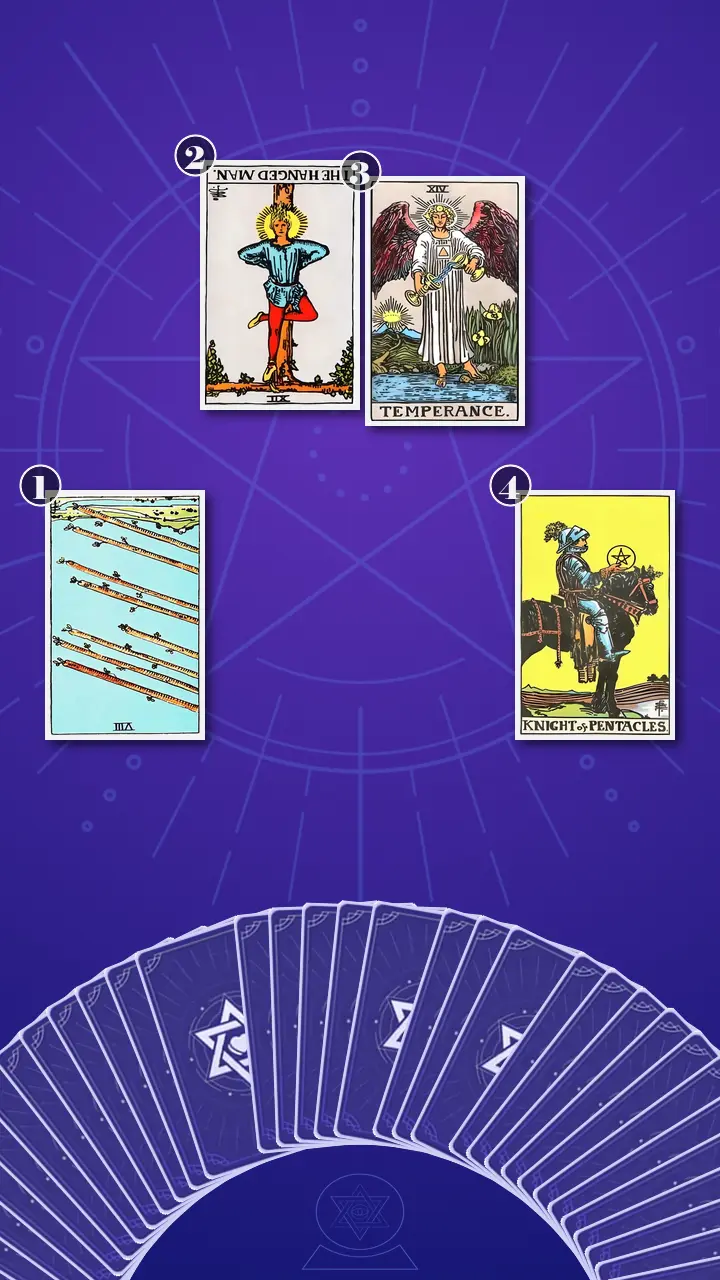
The first position would show the exact moment bad timing became manufactured momentum. The second would uncover why waiting felt like lost control. The central card would reveal the capacity hidden inside the pattern, and the final card would turn that insight into one observable next step. I laid the cards like a road leaving congested traffic and settling into a steadier lane.
Messages Already in Flight
Position 1: The Visible Shadow
I turned over the card representing the visible shadow: the moment when disrupted timing triggered Alex to manufacture movement. It was the Eight of Wands, reversed.
The card returned us to 4:18 on a Friday afternoon. A client had pushed approval into the following week. Before checking what the delay actually affected, Alex sent a Slack follow-up, moved three tasks into the evening, and asked a vendor to hold the earliest slot. Like the eight wands suspended in an empty sky, the messages and commitments were already airborne without a confirmed destination.
I described the reversed Fire as both a blockage and an excess. Useful momentum was blocked because the project lacked information, while activity became excessive as Alex tried to compensate. Eight active Slack threads could demonstrate responsiveness, but none could resolve the missing decision.
“The internal sentence sounds like, ‘If I keep everything moving, then I’m not stuck,’” I said. “But what would meaningful progress look like if you did not have to force the full outcome today?”
Alex gave one short, bitter laugh. “That’s so accurate it’s almost cruel. I reorganised everyone’s work, then spent Monday repairing the plan I’d created.”
I let the laugh settle before answering. “The card isn’t criticising you. It is showing the intelligence inside the reaction: visible motion has probably been rewarded in your job. We’re only checking whether that same strategy still helps when the missing piece cannot be accelerated.”
Position 2: The Pause That Felt Like Defeat
I turned over the card representing the hidden root: the fear that made waiting feel like a loss of control and allowed activity to replace perspective. The Hanged Man appeared reversed.
I asked Alex to picture an unanswered message. They recognised the scene immediately: three research tabs open, Monday’s calendar rewritten, a second follow-up drafted, and warm air from the laptop fan passing over restless hands. The external situation had not changed, but their raised shoulders were already treating suspension as evidence that something was slipping away.
In this position, the Hanged Man’s energy was blocked. Upright, the calm suspended figure suggests that stillness can contain awareness and a changed angle of view. Reversed, Alex resisted that possibility because the pause seemed too much like helplessness. They tried to move the project card from “Waiting” back to “In Progress,” even when the dependency belonged elsewhere.
“I can handle a hard answer,” Alex said quietly. “I can’t handle having no answer.”
“That makes sense,” I replied. “You are not always chasing the opportunity; sometimes you are chasing relief from waiting.”
Their fingers stopped above the trackpad. Their gaze drifted past the screen as if an old sequence were replaying: send, feel relief, reread, repair. Then their hands loosened, and a breath left their chest with a low, surprised “Oh.”
Having travelled across cultures, I have spent plenty of time on platforms where I could not yet read every sign. The image that came to me was simple: sprinting toward the first moving train never translated the map. I told Alex that a deliberate pause was not surrender. It was a temporary position from which better information could become visible.
When Temperance Adjusted the Mix
Position 3: The Constructive Gift
The rain softened against the window, and the fridge motor clicked off. In that sudden quiet, I turned over the central card representing the constructive gift: Alex’s capacity to read timing, pace, capacity, sequence, and readiness without treating delay as personal failure.
Temperance appeared upright.
I pointed to the angel transferring liquid between two cups, with one foot on land and one in water. In Alex’s life, the two cups became practical facts and emotional pressure. The grounded foot held what had actually changed; the foot in water acknowledged the restless hands, shrinking-window story, and fear of missing out. Neither side had to disappear.
Temperance brought balance rather than deficiency or excess. Before sending a non-urgent follow-up, Alex could place four things side by side: what had changed, what remained unknown, what their current capacity allowed, and what fear was demanding. A twenty-minute pause and one reversible action would not guarantee the opportunity. They would preserve agency while the answer remained incomplete.
I used one of my core diagnostic lenses, Fear-Driven Logic Decoupling. I drew two columns on a blank page. Under “Authentic desire,” I wrote: “I want a clear answer and a workable project.” Under “Fear of failure,” I wrote: “If I wait, I will miss the window and prove I never had control.”
“Both statements can feel logical,” I explained, “but only one describes what you want. The other describes what you are trying not to feel. When they remain fused, fear borrows the voice of strategy. Temperance separates them without dismissing either one.”
I could see the familiar decision matrix reforming behind Alex’s eyes: act now or lose it, wait or admit defeat. Temperance introduced a third option: adjust the pace, preserve choice, and let evidence arrive without requiring the discomfort to vanish first.
You do not have to outrun a pause; Temperance asks you to adjust the mix one vessel at a time until your pace matches what the moment can actually hold.
I left a few seconds around the sentence.
Bad timing is information, not an instruction to sprint; the useful move is the one that adjusts your pace without surrendering your options.
Alex’s breath stopped first. Their fingers stayed curled against the counter, and their pupils widened as they stared at the liquid moving between the two cups. Then their brow tightened. Their eyes lost focus for a moment, as though the last several months of premature messages and private deadlines were passing behind them. Moisture gathered along their lower lashes, but their jaw remained set.
“But doesn’t that mean I’ve been doing it wrong this whole time?” they asked, the words sharper than before.
I did not rush to turn the reaction into relief. “It means the strategy protected you from uncertainty and also sent you some expensive emotional bills. Recognising that is not a verdict on your past self. It gives your present self another option.”
Their shoulders lowered by a fraction. Their fist opened against the counter, one finger at a time. A shaky exhale followed, and then a quieter admission: “I don’t know what to do with the space if I’m not filling it.” The clarity had brought relief, but also the brief vertigo of discovering that choice carries responsibility.
“Now, using this new perspective, was there a moment last week when this insight could have made you feel differently?” I asked.
Alex remembered a Tuesday follow-up they had sent eight minutes after a timeline changed. “I could have asked what actually moved,” they said. “The deadline hadn’t changed. I just hated that the sequence had.”
That was the crossing point: not from uncertainty to certainty, but from fear-driven acceleration to measured self-trust. Alex could feel the impulse to rush without automatically promoting it to evidence.
Position 4: One Pentacle, Kept in View
I turned over the final card representing conscious integration: one steady, observable way to act after a pause. It was the Knight of Pentacles, upright.
The knight held one pentacle at eye level while the horse stood still in cultivated ground. I translated the scene into Alex’s Friday-afternoon project board: one clearly defined task remained active, “done” was written in a single sentence, and its result would be reviewed before another corrective commitment entered the calendar.
This was balanced Earth energy: consistent, scoped, and repeatable. Alex did not need to extinguish their drive. They could give it a container. Progress would be measured by the usefulness of one completed action, not by how quickly every trace of uncertainty disappeared.
“Preserve the option before you force the outcome,” I said. “The question is no longer, ‘How quickly can I close this?’ It is, ‘What reliable action can I take, and what will it teach me?’”
Alex looked from the still horse back to Temperance. This time, they did not reach for the calendar. They rested both palms on the counter and said, “One thing, then evidence. I can try that.”
The Pace-Before-Progress Reset
I gathered the spread into one causal story. Alex worked in an environment where quick replies often looked competent, and social feeds made other people’s milestones appear perfectly timed. When a delay interrupted that script, the Eight of Wands reversed launched messages and plans before the destination was clear. The Hanged Man reversed exposed the protective root: suspension felt like losing control. Temperance recovered the ability to adjust pace and sequence, while the Knight of Pentacles grounded that insight in one dependable action.
The cognitive blind spot was precise: Alex had been confusing the discomfort of uncertainty with evidence that immediate action was necessary. Their calendar had become a fire alarm, and every open loop sounded like smoke. The shift was not toward endless patience. It was toward checking what timing communicated, then choosing a reversible next step that kept options available.
I also applied Hidden Cost Deconstruction. A rushed follow-up might buy ten minutes of relief, but its emotional bill could include an evening of rereading, a promise made without capacity, and Monday-morning repair work. A bounded pause had a cost too: several uncomfortable minutes without an answer. Seeing both bills allowed Alex to choose consciously instead of treating speed as the only affordable option.
I gave them two small practices. Neither required ignoring a real deadline, tolerating unsafe circumstances, or waiting indefinitely. A pause is useful only when it returns choice to you.
- The Eight-Minute Timing CheckThe next time a work timeline changes, open a note beside Slack and create two headings: “Timing is telling me” and “Urgency is telling me.” Start an eight-minute timer, write one sentence under each, and circle one reversible next step. Do not contact anyone until the timer ends.If eight minutes feels too exposed, use two. Real deadlines and safety needs take priority; the pause is there to recover choice, not enforce passivity.
- The Shadow Choice ExperimentChoose one low-stakes unanswered message or postponed plan. On paper, intentionally choose the option you fear most: “I will wait until Thursday’s review time.” For 48 hours, record each impulse to check, explain, schedule, or follow up. At the review, choose one reversible move, such as requesting a missing detail, revising the draft, or waiting again with a new reason.Mute the thread or move the draft out of view. If genuinely time-sensitive information arrives, respond to the evidence; this is an experiment in observing your defence mechanisms, not a rule against acting.
These were not instructions from the cards. They were experiments Alex could accept, modify, or reject. Tarot had made the pattern visible; authority over the next move remained entirely theirs.

Friday’s Quiet Proof
Five days later, I received a message from Alex. A client had delayed another review, and Alex had opened the two-column note before Slack. They discovered that timing was asking for one missing dependency, while urgency was asking them to promise an entire turnaround. They requested the dependency and left the rest of the calendar alone.
That night, they slept through until morning. Their first thought was still, “What if I missed something?” But this time, they smiled, checked the Friday review event, and made coffee before opening Slack.
I did not read that as a solved life or a personality transformed by four cards. I read it as evidence of a new relationship with choice. Alex had moved one small distance from manufactured deadlines toward measured self-trust, without requiring perfect calm first.
When timing slips and your chest tightens, I know how exhausting the pull can be between wanting enough time to choose well and needing to move now so a missed chance cannot become proof that you were never in control. Noticing that pull already gives you one more place to stand.
If this pause could be information rather than a verdict, what one small, reversible possibility might you place between Temperance’s two cups before choosing your pace?