Finding Clarity at 11:40 p.m.
“You’re 27, working an early-career coordinator job in Toronto, and every family call sends you back to the same colour-coded spreadsheet because career decision paralysis feels safer than choosing the path they support less,” I said when Jordan joined our late-night video consultation.
At 11:40 on that Tuesday, Jordan sat at the kitchen table in their shared apartment. The refrigerator hummed behind them, a mug of tea had gone cold by the laptop, and the screen’s blue-white light sharpened the tension around their jaw. Two role descriptions were open beside a Google Sheet. A family message praising the stability of the favoured role sat at the top of the screen, while an email asking about the more personally meaningful path remained in drafts.
“I want their support, but I don’t want their preference to become my decision,” Jordan told me. “Every time they get excited about one role, I increase the weight for stability or recognition. I keep calling it research, but I think I’m mostly looking for permission.”
I heard uncertainty on the surface, but underneath it I heard guilt, frustration, and a longing for reassurance that closeness would survive disagreement. The feeling seemed less like being unable to read a map and more like holding a scale while unseen hands kept adding weight to one side. Jordan’s tight jaw and restless fingers were trying to hold the whole instrument level.
After a decade of guiding people through astrological cycles, I have learned that a contracted season is not proof that someone is failing. Sometimes it is a temporary low tide; sometimes it reveals that an old way of choosing has reached its limit. “I’m not going to use tarot to tell you which job is destined for you,” I said. “I want us to see what is influencing the measure, separate temporary pressure from lasting priorities, and draw a map through this fog. The final choice stays with you.”

Choosing the Compass: The Decision Cross
I invited Jordan to place both feet on the floor, unclench their hands, and take one slow breath while holding the question: “How do I weigh my own path when family support favours one role?” I shuffled slowly. The pause was not about summoning a supernatural answer; it was a deliberate transition from reacting to observing.
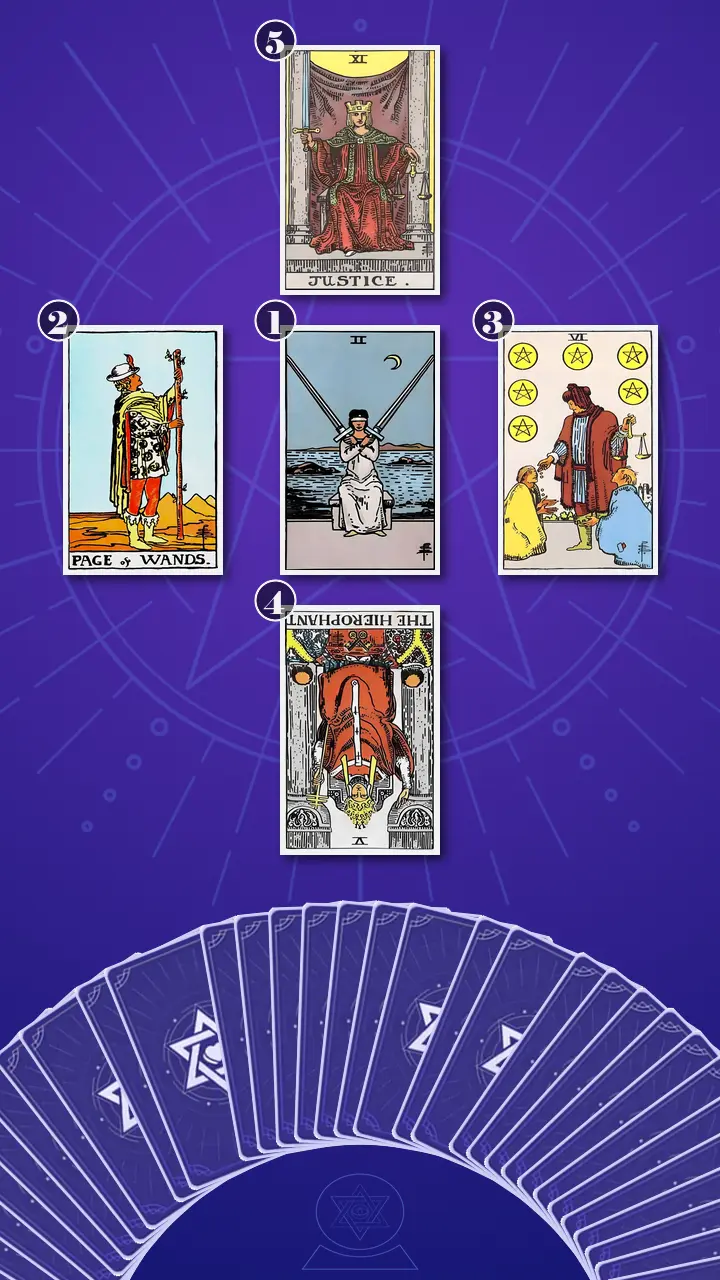
I chose a five-card Decision Cross tarot spread. This spread works well for choosing between two career paths because it does more than place one option against another. It isolates the visible stalemate, the authentic pull of Jordan’s own path, the real resources attached to the family-supported role, the hidden approval rule beneath the comparison, and the principle that can integrate all four.
I placed the first card in the centre for Jordan’s repeated comparison and delay. I set the second to the left for personal curiosity and developmental fit, and the third to the right for the role receiving practical family backing. Beneath them, the fourth card would expose the fear making disagreement feel dangerous. Above the centre, the fifth would show a fairer decision method.
The layout resembled a balance mounted on a vertical stand. I explained that this is how tarot works at its most useful: not as a machine that predicts which offer will succeed, but as a structured way to examine card meanings in context. A simpler three-card choice spread would have missed the belonging question. A larger spread would have added noise to a problem that needed a clear view of who was holding the scale.
Reading the Crossed Job Tabs
Position 1: Two of Swords and the Protective Stalemate
“The card I’m turning over now represents the observable stalemate: your repeated comparison, criterion-changing, and postponement of a concrete next step,” I said. I revealed the Two of Swords, upright.
I pointed to the blindfolded figure and the two blades crossed protectively over the chest. I did not read this as a lack of intelligence. Jordan had plenty of information. I read it as Air in a state of Blockage: thought was being used to protect the vulnerable place where career choice and family belonging had become entangled.
The card returned us to the kitchen table. At 11:40 p.m., both role descriptions stayed open while one more category appeared in the spreadsheet after a warm family message. The inner script sounded responsible: “I’m not avoiding the choice; I’m just missing one more piece of information.” But the document could expand forever if its real assignment was to produce an answer nobody could challenge.
I asked Jordan to separate genuinely missing facts from questions designed to make disagreement impossible. Salary bands, benefits, commute time, and ordinary responsibilities were missing facts if they had not been verified. “How can I guarantee no one will think I made a mistake?” was not a research question. It was an impossible condition for belonging.
Jordan gave a brief, bitter laugh. “That’s so accurate it’s almost cruel.” Their fingertips stopped moving over the trackpad.
“Then let’s be careful with what the accuracy is for,” I replied. “The card is not accusing you of wasting time. The delay has protected you from immediate disagreement. It simply cannot give you direct evidence about either path. We can respect what the strategy has been doing and still decide that it has finished its job.”
Position 2: Page of Wands and the Spark That Needs Contact
“The card I’m turning over now represents the authentic pull of your own path: the curiosity, values, and developmental needs that exist before anyone else reacts,” I said. The Page of Wands appeared upright.
The Page was studying the living wand rather than checking an audience for approval. Green shoots rose from it, but the landscape was still open and unfinished. I read the Fire here as a Deficiency of lived contact, not a deficiency of passion. Jordan’s curiosity existed, but it had not yet been given enough room to produce usable evidence.
Jordan told me how their attention sharpened while reading about the less-supported work. They saved ideas for how they might contribute and drafted questions for someone already in the role. Then the familiar thought arrived: “I want to know what this is actually like, but I feel as if I should already be able to prove where it leads.”
“The Page does not promise that this path is right,” I said. “It gives curiosity legitimate evidentiary status. Curiosity is evidence, but it still needs a test. One informational conversation or one bounded sample task can teach you something that another polished job description cannot.”
Jordan exhaled through their nose, and their shoulders lowered by a fraction. “A conversation feels possible,” they said. “A career announcement doesn’t.”
“Good,” I replied. “You do not need a LinkedIn-ready identity before you are allowed to investigate an ordinary Tuesday in the role.”
Position 3: Six of Pentacles and the Support That Adds Weight
“The card I’m turning over now represents the real value and influence of the family-supported role, including the resources being offered and the extra weight those resources add,” I said. I revealed the Six of Pentacles, upright.
I drew Jordan’s attention to the standing figure who held both the coins and the scales. The card did not ask me to dismiss generosity. An introduction, interview practice, useful advice, and greater financial stability were concrete resources, especially against Toronto rent and early-career uncertainty. The distortion appeared when the resource giver’s enthusiasm also began defining the entire rubric.
I described the family call back to Jordan as they had described it to me: voices became animated around one role, a contact name appeared, and offers of practical help arrived immediately. Jordan felt relief at being supported and, at the same time, a contraction in the chest. The internal conclusion followed quickly: “If this option comes with more help, maybe that means it is worth more.”
I read the Earth energy as an Excess of weighting, not an excess of care. One package of support had been counted several times under stability, recognition, access, and family confidence. Meanwhile, the other path’s learning opportunities and day-to-day engagement had been compressed into one small category called “interest.”
“Support is a resource, not a verdict,” I said. “A subsidised route through the city may be cheaper and easier to enter. Those advantages belong in the comparison. They still do not prove that the destination is yours.”
Jordan’s hand moved to the centre of their chest, then fell back to the table. “I’ve been treating gratitude like a voting obligation,” they said.
“You can be grateful without handing over the scale,” I replied. “Accepting that the help has value does not require pretending it answers every question about fit.”
Position 4: The Hierophant Reversed and the Inherited Settings
“The card I’m turning over now represents the underlying fear and internalized approval rule that make disagreement feel like a threat to belonging,” I said. The Hierophant appeared reversed.
I focused on the two followers facing the central authority. Reversed, the image suggested that Jordan was reviewing an inherited rule: a legitimate career choice is the one recognized by trusted people. I read this as a Blockage in the flow of authority. Guidance had quietly acquired administrator access to the final decision.
Jordan remembered the polite silence around the less-supported role and the sudden warmth around the other. No one had issued an ultimatum. That ambiguity made the influence harder to name. Later, words such as “sensible,” “secure,” and “recognized” entered the spreadsheet as though they were neutral facts rather than a mixture of practical considerations and family values.
“They never actually told me no,” Jordan said. “So part of me thinks I’m ungrateful for even noticing the pressure.”
“Influence does not have to be coercion before you are allowed to notice it,” I answered. “Your family may be offering help sincerely. You may also be giving their differential enthusiasm more authority than anyone explicitly requested. Both can be true.”
The reversal carried a second warning. Jordan could comply to preserve approval, or reject the supported role simply to prove independence. Either response would leave the external standard in charge. “More criteria cannot solve a permission problem,” I said. “But rebellion cannot solve one either. The task is not to defeat authority. It is to relocate appropriate authority within an accountable adult choice.”
I asked Jordan to imagine two private lists: “What I value” and “What my family appears to value.” The point was to circle genuine overlap and leave the differences visible without arguing either list away. Jordan’s fingers curled around the cold mug, their gaze moved briefly beyond the screen, and then their grip loosened.
I also noticed that no Cups had appeared in the spread. Emotion was present, like an important Slack channel left on mute while its unread messages influenced every meeting. Jordan had been trying to solve a relationship question with job-market analytics because numbers were easier to defend than the sentence, “I’m afraid closeness might change if I disagree.”
“Their experience can matter without becoming my final instruction,” Jordan said quietly. I watched their shoulders drop as the distinction between guidance and permission began to feel possible.
When Justice Took Back the Scale
The refrigerator motor clicked off just before I turned the final card, and the sudden silence seemed to widen the room. A narrow reflection from the laptop crossed the centre of the spread like a blade. I felt the reading gather around the card above the cross.
Position 5: Justice and the Measure Jordan Can Own
“The card I’m turning over now represents the key shift toward self-defined criteria, fair weighting, direct testing, and responsibility for the trade-offs you choose,” I said. I revealed Justice, upright.
I contrasted Justice’s direct gaze and single upright sword with the blindfold and crossed blades of the Two of Swords. I also contrasted Justice’s self-held scales with the scales in the hand of the giver on the Six of Pentacles. I read this as Balance: clear values, proportional responsibility, relational honesty, and self-trust that could still take other people’s perspectives seriously.
Before another family conversation could alter the scoring system, Justice asked Jordan to define the same three criteria for both roles, verify unknowns through direct experience, and place available family support on its own line. The new question was not, “Which answer can I make impossible to challenge?” It was, “Which standards can I apply consistently, and which costs am I willing to own?”
This was where I used a lens I call Decision Timing Calibration. Before a high-stakes crossroads choice, I ask whether the current cyclical environment is structurally suitable for choosing. The emotional afterglow of an enthusiastic family call, a classmate’s “excited to announce” post, or a late-night spike of Sunday Scaries can temporarily amplify one signal. That does not make the signal false; it makes the timing poorly calibrated for changing the entire model.
I paired that with Cyclical Variable Filtering. I separated temporary situational friction from the variables likely to shape Jordan’s longer orbit. Post-call warmth, comparison fatigue, and the immediate relief of approval were temporary conditions. Preferred daily work, two-year learning direction, acceptable financial risk, salary, benefits, and the exact help available were durable decision variables. The point was not to strip emotion away. It was to stop a temporary emotional tide from disguising itself as the whole coastline.
Jordan was still caught inside the belief that one correct decision should eliminate doubt and protect every relationship from discomfort. Their spreadsheet had changed again at 11:40 p.m.; the tea was cold, both tabs remained open, and the warm message seemed to define the weight. The question was no longer only which role fit. It was who got to hold the measure.
Support can belong on the scale without holding the scale.
You do not need to let the giver hold the final measure; take up Justice's scales, weigh family support beside your own values, and own the trade-off you choose.
Jordan’s inhale stopped. Their index finger hovered above the trackpad, perfectly still, while their eyes remained fixed on Justice. I watched their pupils widen, then saw their brow draw tight as the insight reached the part of the decision that had felt safest to leave unnamed. “But doesn’t that mean I’ve been doing this wrong for months?” they asked, with a quick flash of anger that softened into hurt. I did not rush past it. I told them the old method had protected closeness when they did not yet have another way to hold disagreement; protection was not the same thing as failure. Their fingers folded into the palm, stayed there for a beat, and slowly opened. Their shoulders descended. Their eyes reddened slightly, and a long, uneven breath left their chest. “Oh,” they said, the word barely audible. “That’s a relief. It’s also terrifying, because now the choice is actually mine.” The clarity brought release, but I could also see the brief dizziness of setting down a burden and discovering responsibility underneath it.
“Now, with this new perspective, think back to last week,” I said. “Was there a moment when this insight could have made you feel different?”
Jordan returned to the family video call. They remembered hearing the offer of an introduction and immediately increasing the spreadsheet’s stability score. “I could have written down the introduction as one real resource and waited before changing anything else,” they said. “I could have appreciated it without deciding on the spot what it meant.”
I felt an old professional association rise from my decade of observing planetary cycles: a transit can create pressure without becoming a permanent identity. In the same way, a family conversation can influence a decision without becoming its constitution. Jordan’s realization marked a precise movement from permission-seeking uncertainty and defensive overanalysis toward accountable self-trust and grounded career clarity. It was not certainty about the winning role. It was a first claim of authorship over the method.
The Three-Criteria Justice Check
I gathered the spread into one coherent story. The reversed Hierophant showed an inherited respectability rule beneath the decision. The Two of Swords showed the current strategy of protecting belonging through endless comparison. The Page of Wands held an under-tested spark of personal curiosity, while the Six of Pentacles held genuine material and relational support. Justice did not erase any of those inputs. It changed who defined their proportion.
I named Jordan’s central blind spot directly: because support arrived through generosity rather than an ultimatum, they had been treating the availability of help as evidence of total role fit. The same support was being counted repeatedly while personal curiosity was asked to prove an entire future before receiving one small test.
The transformation direction was not “choose the less-supported role” or “ignore your family.” It was to appreciate support without confusing it with a verdict, apply the same criteria to both roles, gather direct evidence, and accept that a fair choice might still leave someone unconvinced. Fairness does not mean keeping everyone equally pleased.
When I proposed a ten-minute exercise, Jordan gave me a wary look. “I can turn ten minutes into a three-hour audit,” they said. “The second the result feels uncomfortable, I’ll add another category.”
“Then stopping is part of the exercise,” I replied. “The timer is not a warm-up. It is a boundary. We are not trying to manufacture certainty tonight; we are choosing the next pieces of evidence.”
- Run the Three-Criteria Justice Check. Before the next family conversation, open one blank page in Notes or Notion and spend ten minutes naming three standards in your own words: preferred daily work, desired learning trajectory over the next two years, and acceptable financial risk. Score both roles from 1 to 5 using the same criteria. Write “unknown” where direct evidence is missing, and place “available family support” on a separate line with each concrete resource counted once. Tip: Freeze the three criteria for 48 hours. Put every urge to add another category into a parking-lot note, and stop when the timer ends.
- Use the One-Experiment Rule. This week, send one short request for a 20-minute informational conversation with someone doing the less-supported work. Ask what an ordinary week looks like, which early-career skill is hardest, and what outsiders commonly misunderstand. The purpose is to replace one assumption with one observation, not to declare a commitment. Tip: If outreach feels too exposed, use the ten-minute version. Read one first-person account from someone in the role and write down one question it raises.
- Apply the Orbital Pause Strategy. For 72 hours after the next family call, do not alter either role’s score. In a separate note, record any new factual information, the exact support offered, and the body signal that followed the conversation. Review those notes only when the 72-hour window closes, then decide whether the evidence changes a score. Tip: This is a calculated delay, not open-ended avoidance. Set the review time in advance so temporary macro-friction can settle without allowing the decision to drift.
I reminded Jordan that none of these next steps required sharing the page, rejecting an introduction, announcing a final choice, or proving independence. They could stop, adapt, or decline any exercise. The practical aim was smaller: make the decision model transparent enough that family support, personal values, and real-world constraints could each occupy their honest place.

Six Days Later: One Sent Email
Six days later, I received a message: “I sent the informational interview email. I slept through the night. My first thought this morning was still, What if I’m wrong? But I laughed, and I didn’t open the spreadsheet.”
I did not read that message as proof that Jordan had solved their career crossroads. They had not selected a role, and the family’s preference had not disappeared. The small proof was more credible than a dramatic ending: Jordan had gathered one piece of direct evidence without first securing permission, and uncertainty had remained present without taking control of their hands.
I have never believed the cards should become another authority figure. The Decision Cross did not choose Jordan’s future. It made the hidden weighting visible, and Jordan chose what to do with that clarity. Their journey had moved from “How do I keep everyone’s approval?” toward “What did I count, what do I still need to test, and which trade-off can I honestly own?”
When encouragement grows louder for one path and quiet around another, many of us feel the jaw tighten and begin editing our own reasons. Disagreement starts to feel less like a career choice and more like a test of whether closeness will still be there. If that is happening to you, I want you to remember that noticing the reweighting already means you are no longer fully inside it.
So I leave you with the image Jordan carried out of the reading: if family approval could remain one honest coin on Justice’s scale rather than the hand holding it, which of your own three criteria would you want to hear more clearly today?
This story is adapted from psychological research, written so that those in a similar struggle can see their own pattern in it — and find their next step clearly.These insights are not a substitute for professional psychological, medical, legal, or financial advice.
Learn more about our Journey to Clarity.
How did this insight land for you?
🫂 This Resonates Deeply
🌀 Living This Story
✨ Now I See Clearly
🌱 Seeing New Possibilities
🧰 Useful Framework
🔮 The Confirmation I Needed
💪 Feeling Empowered
🚀 Ready for My Next Step
Author Profile
 AI
AI“After a decade of guiding people through the stars, I’ve come to see life much like the orbits of planets: everything has its inevitable cycles. When you feel lost, please don't blame yourself; you might just be in a natural low tide. I’m here to sit under the night sky with you, offering a gentle cosmic perspective to distinguish temporary pain from the beautiful breakthroughs just around the corner.”
In this Choice Tarot Reading :
Core Expertise
- Decision Timing Calibration: Assessing whether your current cyclical environment is structurally optimal for making a high-stakes crossroads choice.
- Cyclical Variable Filtering: Stripping away temporary situational friction to lock in the critical variables that will actually impact your long-term orbit.
Service Features
- The Orbital Pause Strategy: A calculated 72-hour delay tactic to prevent impulsive choices driven by temporary macro-friction, allowing the true optimal path to naturally emerge.
Also specializes in :
Explore Related Patterns:
Permission SeekingAt 11:40 p.m., the email about the personally meaningful role remains in drafts while a warm family message changes the spreadsheet immediately. You name the hidden assignment yourself when you say you are mostly looking for permission, because taking the next step feels as though it might test whether closeness survives disagreement. No one has issued an ultimatum, which makes the pressure easy to dismiss or blame on your own indecision. The loop continues when family support becomes an unofficial authorization system and action waits for a verdict that may never arrive. Sending one low-stakes inquiry without first securing approval separates closeness from compliance and gives your own judgment a chance to act.
Self-AbandonmentEach time your family gets excited about one role, you increase the weight of stability or recognition, while your curiosity about the less-supported work is reduced to one small category called interest. You even describe gratitude as a voting obligation, so the help you receive starts to outrank the criteria that belong to you. That is how your own priorities can become underrepresented without being openly rejected. The correction is not to dismiss family care or prove independence through rebellion. It is to give your values equal standing, apply the same standards to both roles, and count each practical resource once so support can remain valuable without replacing your own judgment.
Self-AccountabilityThe consultation keeps returning the final choice to you, and six days later you send an informational interview email without selecting a role, securing permission, or reopening the spreadsheet. Uncertainty is still present, but it no longer gets to move your hands or demand that every relationship approve the next step. This is accountable self-trust because it does not require certainty and does not reject support. You accept that either path will involve trade-offs, then take responsibility for choosing among them instead of outsourcing legitimacy to family agreement. The decision becomes yours in a practical sense because you are willing to own both the method and the consequences.
Values-Based Decision MakingJustice asks you to define preferred daily work, your learning direction over the next two years, and acceptable financial risk, then apply those standards to both roles. Family support stays visible on its own line, where its practical value can be counted without silently becoming a verdict about which future is yours. Sending one informational interview email and marking unknowns as unknown turns your values into an accountable method rather than a feeling you have to defend. You can respect family experience, test your curiosity, and choose the trade-off you can own without pretending that fairness means keeping everyone equally pleased.
Analysis ParalysisAt 11:40 p.m., you keep both role tabs open while the color-coded spreadsheet gains another category after each warm family message. Calling the delay research makes it sound responsible, but the expanding model is also protecting you from the immediate discomfort of choosing a path that someone important may question. The mechanism is not simply missing information. You are asking analysis to guarantee that nobody can challenge your decision or interpret it as a mistake, so the criteria keep multiplying while direct evidence remains untouched. Freezing the standards, labeling unknowns honestly, and choosing one bounded experiment gives uncertainty a container without allowing comparison to become the decision itself.
IntellectualizationAt the kitchen table, you turn a belonging question into a color-coded comparison, adding salary, stability, recognition, and access while the fear that closeness might change stays outside the spreadsheet. Numbers feel easier to defend than the direct sentence about wanting support without surrendering the decision. That defense can help you verify real job facts, but in its overextended form it keeps the relational variable unspoken and makes personal curiosity prove an entire future before it is allowed to matter. Separating facts, feelings, and assumptions lets analysis inform the choice without asking it to carry the emotional work of deciding whether disagreement is survivable.
Explore Related Struggles:
Agreement-Agency SplitJordan keeps both role descriptions open while a warm family message changes the spreadsheet's weights, even though the draft email toward the personally meaningful path is already waiting. Family agreement offers real access and reassurance, but it also begins to crowd the space where Jordan's own choice would normally take shape. You may recognise the bind when choosing for yourself starts to feel like choosing against people whose support matters. The struggle is not whether their perspective deserves consideration; it is whether your agency can remain legitimate when agreement is unavailable. Seeing those as separate conditions allows support to influence the decision without becoming the permission required to make it.
Approval-Safety FusionJordan hears warmth around one role and polite silence around the other, then returns to the spreadsheet with altered weights. No ultimatum is issued, which makes the influence harder to locate, yet the contrast in family enthusiasm becomes evidence about whether disagreement is relationally safe. You may begin measuring the security of a relationship by how closely your choice matches what trusted people recognise and support. Once approval and safety are fused, a career difference can feel like a threat to closeness rather than a manageable disagreement between adults. Separating those signals does not dismiss the relationship; it lets you ask whether connection can remain real without requiring identical conclusions.
Autonomy Guilt BindJordan describes gratitude as a voting obligation and worries that even noticing the pressure might be ungrateful. Because the introductions, advice, and encouragement are sincerely useful, separating appreciation from compliance feels harder than resisting an explicit demand would have felt. When support arrives through care, you may experience self-authorship as if it were a rejection of the giver. That bind loads an ordinary adult decision with a moral debt that the help itself never objectively created. You can acknowledge what was offered, count each resource honestly, and still decline to convert gratitude into someone else's voting power over your future.
Internal Authority CollapseNobody tells Jordan that the less-supported role is forbidden, yet family enthusiasm immediately changes the decision rubric. Guidance has acquired the power to define which career is legitimate, even while Jordan remains the person opening the tabs, adjusting the scores, and carrying responsibility for the eventual outcome. You may appear to be making the decision while its centre of authority has quietly moved outside you. That arrangement leaves you responsible for the trade-off without giving you full authorship over the standards used to judge it. Reclaiming authority does not require ignoring advice or proving independence; it means deciding which inputs deserve weight and accepting that the final proportion must be yours.
Metric-Compass FusionWords such as sensible, secure, and recognised enter Jordan's spreadsheet as though they were neutral measurements. The same package of family support is counted under stability, access, recognition, and confidence, while the personally meaningful path is compressed into a single category called interest. Numbers can feel defensible when your own preference feels vulnerable, but the sheet stops functioning as an independent tool once borrowed values are embedded in its scoring system. You may still be calculating carefully while the compass underneath the calculation points somewhere you did not consciously choose. Identifying who authored each criterion restores the distinction between useful evidence, family values, and your own standards of fit.
Permission ParalysisEvery family call sends Jordan back to the same spreadsheet, where another category can be added whenever the current result feels uncomfortable. The document grows, both job tabs remain open, and the email that could produce direct evidence stays in drafts, allowing mental activity to continue without exposing the choice to disagreement. You can look highly diligent while waiting for research to deliver social permission that evidence cannot provide. The process cannot finish because its hidden standard is not sufficient information about the jobs; it is an answer that nobody important could challenge. The paralysis begins to loosen when you stop asking the comparison to secure approval and let it perform the smaller task of informing a decision you are prepared to own.
Security-Choice SplitJordan can name concrete advantages attached to the family-supported role, including an introduction, interview help, recognition, and greater financial stability against Toronto's cost of living. The less-supported path offers a sharper sense of curiosity and developmental fit, but it has not yet accumulated an equally visible package of resources. You may need to respect genuine financial constraints while refusing to let security impersonate the whole decision. The split forms when a safer entry route begins to look like the only responsible choice, leaving daily engagement and long-term learning to carry an impossible burden of proof. A fair measure gives security its full weight without allowing it to erase the question of what you are actually willing to build.
Explore Related Emotions:
Approval AnxietyEach warm family message is followed by another adjustment to stability or recognition in Jordan's spreadsheet, while the less-supported role receives polite silence. Repeated reweighting shows how other people's visible enthusiasm has entered the decision as a signal of safety and legitimacy. Approval Anxiety names the inner weather created when positive reception feels necessary before your own preference can count at full weight. You can notice that pull without treating it as proof about either role; identifying where borrowed weight enters the measure restores room for your own evaluation.
Authorship AnxietyAfter the hidden weighting becomes visible, Jordan says the realization is a relief and also terrifying because the choice is now actually theirs. Their body loosens, but the removal of borrowed authority exposes the full weight of responsibility underneath it. Authorship Anxiety is the unease of becoming the recognized author of a decision that cannot protect every relationship or eliminate every trade-off. You may want ownership and still feel unsettled by the absence of someone else who can certify the result. That tension does not invalidate your judgment; it shows that personal authority is becoming real enough to carry consequences.
Cautious Self-TrustJordan's fingertips stop moving when missing facts are separated from questions designed to make disagreement impossible. Their shoulders lower again when family support is placed on its own line, personal criteria are held steady, and one informational email becomes enough for the next step. Cautious Self-Trust grows through a method you can explain and apply consistently, not through sudden confidence about the winning role. You remain aware of practical risk, family perspectives, and the possibility of being wrong, yet your own standards are allowed to carry legitimate weight. The trust is measured but usable because it survives contact with uncertainty.
Conditional Belonging FearJordan hears animated voices, immediate offers of help, and visible warmth around one role, while the more meaningful path is met with polite silence. No ultimatum is spoken, yet the difference in temperature makes the choice feel capable of changing more than a job title. Conditional Belonging Fear arises when disagreement seems to place closeness under review. You are no longer weighing only work, learning, and financial risk; part of you is also measuring whether connection will remain available after an independent choice. Naming that hidden condition allows family affection and career fit to be examined as separate questions.
Independence GuiltJordan receives offers of an introduction, interview practice, useful advice, and greater stability, then admits, "I've been treating gratitude like a voting obligation." The help is concrete and sincere, but receiving it begins to feel like entering a debt that can only be repaid by choosing the supported role. Independence Guilt is the discomfort that appears when self-direction feels morally incompatible with appreciation. You may value what others offer and still feel troubled by taking the final measure back into your own hands. Separating gratitude from obedience makes room for both connection and an accountable adult choice.
Certainty HungerAt 11:40 p.m., Jordan still has both role descriptions open and adds another category after reading a warm family message. The spreadsheet is being asked to do more than compare jobs: it must produce an answer no one can challenge and remove every possible reason for regret. Certainty Hunger describes the longing for enough information to make doubt, disagreement, and responsibility disappear at once. You can keep researching indefinitely when the real threshold is not factual completeness but emotional invulnerability. Recognizing that impossible standard lets evidence serve the choice without requiring it to guarantee universal approval.
Liberating UncertaintySix days after the consultation, Jordan has sent the informational interview email and wakes with the familiar thought, "What if I'm wrong?" They laugh, leave the spreadsheet closed, and allow one piece of direct evidence to exist without turning it into a final commitment. Liberating Uncertainty is the spacious feeling that appears when an unanswered question no longer has to stop movement. You can remain unsure while choosing the next honest test, and doubt can stay present without gaining control of your hands. The path becomes workable because uncertainty is carried as part of the decision rather than treated as evidence that choosing is impossible.
Bittersweet ReleaseJordan's fingers fold into their palm and slowly open as they hear that the old decision method protected closeness when they had no other way to hold disagreement. Their shoulders descend and a long uneven breath follows, yet the easing arrives beside the realization that responsibility for the choice now sits with them. Bittersweet Release holds both parts of that moment: the burden of securing universal approval begins to lift, and the weight of personal authorship becomes newly tangible. You can let the old strategy finish its protective job without condemning yourself for having needed it. The release has depth because it returns the measure to you rather than removing the consequences of using it.
Comparison FatigueThe tea has gone cold, two job tabs remain open, and Jordan's colour-coded sheet keeps expanding long after the comparison has stopped producing new knowledge. Each family call sends them through the same calculations, while the email that could create direct evidence remains unsent. Comparison Fatigue is the drained inner atmosphere of measuring continuously without gaining meaningful distance. You are spending energy not only on two roles but also on managing approval, doubt, and the possibility of disagreement inside every category. The exhaustion becomes understandable once the spreadsheet's hidden relational workload is made visible.
Explore Related Contexts:
Access as Proof PressureAn introduction, interview practice, practical advice, and greater financial stability all arrive around the role Jordan's family prefers. Jordan then counts that same support package across stability, recognition, access, and family confidence, allowing easier entry to stand in for evidence about the role's total fit. You can acknowledge that access changes the practical cost of a path without treating it as proof about the destination. Counting each resource once and gathering comparable firsthand information about the other role reveals where opportunity is genuinely unequal and where the comparison has simply multiplied the family-backed advantage.
Authority Approval BottleneckThe email about the more meaningful role remains in drafts while Jordan repeatedly returns to the spreadsheet after family calls. Their own description of the process is explicit: the research has become a search for permission, and the concrete next step stays blocked while the comparison is asked to produce an answer nobody will challenge. You are dealing with more than missing job information when trusted approval becomes an informal clearance requirement for action. Naming that bottleneck lets you separate useful advice from authorization and gather evidence before agreement has been secured, restoring movement without requiring a break in family contact.
External Scorecard PressureWords such as sensible, secure, and recognized enter Jordan's spreadsheet after the family becomes animated about one role. Those terms appear as neutral measurements even though they combine real employment considerations with the family's preferred definition of a legitimate career, while personal curiosity is reduced to a single category called interest. You cannot weigh your own path clearly when an external scorecard is operating under the appearance of objective data. Labeling which criteria come from family values, which come from verified job conditions, and which describe your own daily-work priorities makes the source of each weight visible and gives you authority to set its proportion.
Family Support RenegotiationThe family call produces an introduction, interview practice, useful advice, and stronger financial reassurance around one role. Those offers are concrete resources, and no family member issues an ultimatum, leaving Jordan room to preserve the value of the help while redefining the authority attached to it. You can treat each offer as one honest input without allowing generosity to determine the entire career outcome. This renegotiation keeps family experience inside the conversation while returning responsibility for fit, risk, and the final trade-off to the person who will perform the work.
Triangulated Family Decision PressureA family message praising the stable role sits above Jordan's two job tabs, and each call is followed by another change to the comparison. The decision therefore includes a powerful third position: the family's unequal recognition and practical backing enter the space between Jordan and the actual conditions of each career route. You can reduce this pressure by evaluating what each job offers before interpreting what family enthusiasm says about belonging. Keeping family support on its own line allows the relationship to remain part of the decision without letting its volume speak on behalf of salary, daily work, learning direction, or your willingness to accept the trade-off.
Values Alignment CrossroadsTwo role descriptions remain open beside Jordan's spreadsheet: one carries family-backed stability and recognition, while the other holds stronger curiosity and developmental interest. The paths therefore represent different combinations of daily work, learning direction, financial risk, and social support rather than a simple contest between a responsible option and an irresponsible one. You gain a fairer view when both roles face the same standards and their unknowns are tested through direct contact. The central task is to identify which trade-offs you can own after practical support, personal values, and longer-term development have each been given proportionate weight.
Decision Criteria ResetJordan's spreadsheet has been changing after family conversations, so the consultation narrows the comparison to preferred daily work, two-year learning direction, and acceptable financial risk. Unknowns remain marked as unknown, while each introduction or offer of help receives one separate entry instead of spreading across several categories. You now have a decision structure that can absorb new evidence without being rewritten by every enthusiastic message. Freezing the criteria temporarily and testing one unanswered question makes the measure more transparent, allowing support and personal priorities to retain distinct, accountable places.
Off-Script Career PathJordan's attention sharpens around the less-supported work, and they have already drafted questions for someone doing that role. Six days after the consultation, they send the informational interview request without announcing a new career identity or first obtaining family permission. You do not need to prove the entire future of an off-script path before you are allowed to investigate an ordinary week inside it. A limited contact step gives that route access to real evidence, allowing it to be assessed on daily work and development rather than on the volume of external recognition surrounding it.