One Unsent Application: Turning Role or Purpose Into a Six-Week Test

The 11:40 p.m. Identity Verdict
A nearly finished application can feel ordinary until its deadline becomes real; then the submit button starts to resemble a referendum on your entire future. That was how identity-based career decision paralysis appeared for Maya, a 29-year-old contract content designer in Toronto who had enough experience for a stable team role and enough self-awareness to know that meaningful contribution mattered to her.
At 11:40 p.m. on a Tuesday, she had the role application open beside a note titled Work That Matters. The laptop fan warmed her wrists. Her tea had gone cold, and the scrape of streetcar brakes rose faintly from the road below. When the application became ready to submit, she added future identity flexibility to her comparison table and moved the reminder to tomorrow.
When Maya joined my video consultation the following afternoon, she shared the two windows on her screen before saying anything. I watched her jaw tighten as the cursor passed over the unfinished application.
“A clear role feels safe until it starts to feel like a cage,” she said. “Purpose sounds right until I have to make it practical. I keep trying to choose the identity before I choose the next step.”
Her ambivalence had the bodily weight of standing in a closing streetcar doorway: one shoulder braced toward salary, boundaries, and reliable rent money; the other toward usefulness, accessibility, and work that still left some light in her at the end of the day. Moving either way felt as though it would scrape away the person she might have become on the other path.
“I am not going to tell you which future is destined,” I said. “That would replace your judgment with mine, and it would not be honest. I want to help you see why an ordinary next step has acquired the weight of a permanent verdict. Then we can draw a map through the fog and leave the steering in your hands.”

Choosing the Compass Around One Hinge
I invited Maya to put both feet on the floor, take one unforced breath, and hold one question in mind: Why do I keep waiting instead of choosing between role and purpose? I shuffled slowly, not to manufacture mystery, but to mark a clean transition from maintaining the comparison system to observing it.
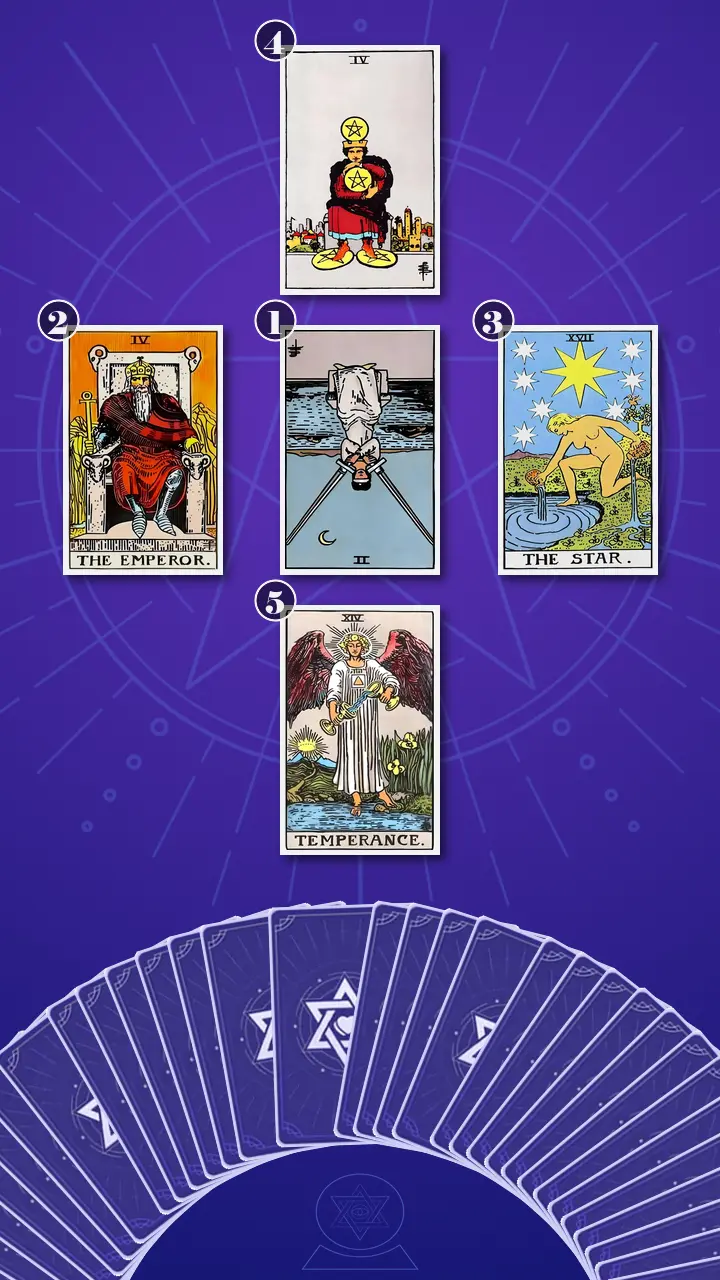
I chose the Decision Cross · Context Edition. This focused five-card Decision Cross was sufficient because Maya did not lack options; she had one compressed decision knot. A larger spread would have introduced more contextual material when the useful work was to separate five things: her visible stalemate, what the role actually offered, what she meant by purpose, what waiting protected, and what could integrate the two paths.
I placed the diagnosis at the centre. The role path went to its left and the purpose path to its right. Above the centre, I placed the hidden influence keeping the choice suspended. Below it, I left space for the grounding principle that could turn insight into a practical experiment.
This is how tarot works in my practice. The cards do not issue career orders or guarantee outcomes. They give me a stable symbolic structure through which I can distinguish observable facts from fear-based forecasts. Card meanings in context help me ask better questions; Maya remains the person who evaluates the answers, her material circumstances, and her next steps.
Reading the Hinge Instead of the Headlines
Position 1: The Pause That Became a Pressure Chamber
Now, the card I turned for the diagnosis was the one representing Maya's observable pattern of delaying replies, expanding comparison criteria, and holding role and purpose in a stagnant mental stalemate. It was the Two of Swords, reversed.
The blindfolded figure still held two swords defensively across the chest, but the reversal showed that the carefully maintained pause could no longer contain the pressure. Air, the energy of thought and comparison, had become blocked through overload. Maya was not calmly considering two paths anymore. She was reopening the same decision at 11:40 p.m., adding long-term identity fit, searching one more career thread, and moving the reminder again while her trust in her own judgment quietly thinned.
I compared it to scrolling through a streaming menu with increasingly precise filters. Each new criterion promises that the perfect choice is almost visible, yet the evening disappears before anything begins. Maya's career version was more consequential, but the behavioural loop was similar: more comparison felt like progress because it postponed contact with an imperfect experience.
“The inner sentence sounds something like this,” I said. “If I can clarify one more thing, then I can choose without risking regret. But there is a difference between wanting an informed choice and demanding a harmless one. You are not short on options; you are asking one next step to explain your entire future.”
Her breath caught first. Her gaze then drifted from the card to the spreadsheet on her shared screen, as though she were replaying every new row appearing before a deadline. Finally, she gave a short laugh with a bitter edge and rubbed the heel of her hand against her jaw.
“That is uncomfortably accurate,” she said. “A little brutal, honestly. I keep calling it research because that sounds responsible.”
“The research is not fake,” I replied. “It helped you understand the options. The card is showing the point at which research stopped answering new questions and started protecting you from owning a next step. That is a pattern to observe, not a character flaw.”
Position 2: The Emperor's Seat Is Not a Life Sentence
Now, the card I turned for what a defined role genuinely offered Maya, including its practical support and the identity assumptions she attached to structure, was The Emperor, upright.
The Emperor's squared posture, visible armour, and stone throne represented balanced structural energy: a clear remit, stable pay, resources, accountability, boundaries, and decision-making authority. None of those conditions was automatically liberating, and none was automatically confining. They could be investigated.
I asked Maya to replace “Would this title make me less purposeful?” with a role audit. What did the salary make possible? Was the manager open to challenge? Were the working conditions accessible? Would she own content standards or merely execute them? Could she influence how the team communicated with users? What were the probation, review, and exit conditions?
“A title can describe your work without defining your whole future,” I said. “The throne is a seat with a written remit, not a custody agreement for the self. Sitting down does not remove your ability to stand up, although the actual terms still matter.”
I had seen the opposite story amplified by professional feeds: a “thrilled to share” post compresses months of doubt, negotiation, and compromise into one clean identity arc. Maya had begun reading job titles as if they were complete biographies. The Emperor returned her attention to permissions, resources, boundaries, and facts.
Her shoulders lowered by a fraction. She opened the job description without editing her comparison sheet.
“The title is the part I hate,” she said. “But the actual scope includes plain-language standards and access to user research. I have barely let myself count that.”
Position 3: The Star in an Ordinary Workday
Now, the card I turned for what Maya meant by purpose, what authentically drew her toward it, and how lived meaning differed from an idealised label was The Star, upright.
The figure poured water into both the pool and the land. I read that as purpose in balanced circulation: inner conviction had to replenish Maya, but it also had to reach users, schedules, practical work, and material life. The Star did not demand one flawless career name. Its potential had been underused because Maya kept trying to convert a repeatable value into a single impressive identity.
I asked her to remember a recent task that had left her clear and usefully tired rather than hollowed out. She described simplifying an inaccessible public-service page for a short contract. She had reorganised the information, tested plain-language alternatives, and watched a participant find the eligibility answer without assistance. At the end of that session, she had still had energy.
“Purpose is not only a label; it is a value you can watch yourself practise,” I said. “Maybe the evidence is not a perfect LinkedIn headline. Maybe it is the recurring quality of making complex information accessible, wherever you are able to do that without crossing your boundaries or giving away labour.”
Maya's hand loosened around her mug. Her eyes remained on the water pouring onto both ground and pool.
“That feels less glamorous than finding my calling,” she said, “but it is also the first thing here that feels real.”
“Real is useful,” I said. “A practised value can guide several roles. A perfect label can remain beautiful and still tell you very little about Tuesday afternoon.”
Position 4: The Future Held Too Tightly to Be Lived
Now, the card I turned for the protective function of waiting, especially Maya's fear of losing control over who she became, was the Four of Pentacles, upright.
The figure clutched one pentacle to the chest and pinned two beneath the feet while the active city remained at a distance. Here, earth energy had moved into excess. Security was no longer supporting participation; it was immobilising it. Maya kept an application, a freelance invitation, and a purpose statement technically alive, but untouched options produced no evidence about money, meaning, energy, or fit.
“It resembles holding several event tickets in an online cart until every timer expires,” I said. “For a moment, every possible evening still belongs to you. Then none of them does. Waiting keeps every imagined future alive and every real future untested.”
I asked what specific loss appeared when she imagined pressing submit. Not accepting the role, just submitting the application.
Her palm moved to the centre of her chest. She went quiet long enough for a streetcar bell to sound below her window.
“Control,” she said at last. “As long as I do not choose, I cannot prove myself wrong. If the deadline chooses for me, I can tell myself the other version of my life was still possible.”
I let the sentence settle before I answered. “Waiting has been protecting something important: your authority over your future. The cost is that the protection prevents you from gathering the lived information that could strengthen that authority. We do not need to shame the grip. We need to give it a safer way to loosen.”
When Temperance Began to Pour
Before I turned the final card, the room seemed to change register. The laptop fan quieted. The late light across Maya's kitchen counter reached the cold cup beside her, and the two open windows on her screen no longer looked like rival worlds so much as unfinished pieces of the same question.
Position 5: The Bridge Between Role and Purpose
Now, the card I turned for the transformation framework, a self-directed criterion and bounded experiment through which Maya could test whether role and purpose coexisted, was Temperance, upright.
At 11:40 p.m., the application had remained open beside Work That Matters. Maya had added one more row, felt her jaw lock, and postponed the reply because she was trying to predict which entire future self the next click would create.
Temperance offered balanced energy through patient integration. Water moved between two cups; one foot rested on land and the other in water. I translated that controlled flow into a six-week role-purpose experiment: one practical container, one chosen value, two observable signs, confirmed boundaries, and a review date. The point was not to make uncertainty disappear. It was to let experience produce information that analysis could not manufacture alone.
My mind went to an image I have encountered repeatedly through archaeology: a road visible in several layers of the same site, first laid for one civic order, then repaired, narrowed, widened, or redirected by people living under another. At major historical crossroads, durable structures rarely survive because their first builders predicted every later use. They survive because later generations retain what carries value and alter what no longer does.
I call that lens Historical Crossroad Matching. It gave Maya a bird's-eye correction in scale. One application was not the founding charter of her identity. Through an Enduring Value Assessment, the better question became: ten years from now, what was more likely to matter, the temporary purity of never having chosen incorrectly, or the enduring ability to practise accessibility, evaluate structures, negotiate boundaries, and revise a path with evidence?
You do not need a final identity verdict; make one measured experiment, and let Temperance's flowing cups show what role and purpose can blend in practice.
I stopped speaking.
Maya went completely still. Her inhale paused halfway, and her fingers hovered above the trackpad without touching it. Then her eyes lost focus, as if the last year of drafts, reminders, and expiring invitations were replaying somewhere just beyond the screen. Her eyebrows drew together.
“But doesn't that mean I have wasted all this time trying to solve the wrong problem?” she asked. The first note in her voice was not relief but anger, followed by a small break on the final word.
“No,” I said. “It means your old method reached its limit. It protected you until its cost became greater than its usefulness. Seeing that now does not make your earlier self foolish.”
Her eyes brightened. She pressed her lips together, exhaled through her nose, and slowly lowered both shoulders. Her hand unclenched beside the mug.
“Oh,” she said, almost under her breath. Then came the new vulnerability: “But if I call it an experiment, I still have to decide which experiment to run.”
“Yes,” I replied. “Clarity returns responsibility to you. That can feel briefly dizzying after waiting has carried it for so long. The difference is that you are choosing a test, not sentencing your future.”
I asked, “Now, using this new perspective, can you recall a moment last week when this insight might have changed how the choice felt?”
Maya returned to a project invitation she had nearly allowed to expire. She could see, she said, that replying with one question about accessibility scope would not have committed her to the whole project. It would have generated one missing fact.
I set an eight-minute timer. Maya wrote down that pending choice and assessed it using only three criteria: basic viability, one value she wanted to practise, and the reversibility of the immediate step. She circled the smallest next action and added a review date. I made it clear that she did not have to submit, accept, or decline anything during the exercise. For decisions carrying significant contractual, financial, immigration, health, safety, or accessibility consequences, a short reflective exercise is not a substitute for relevant qualified support.
This was not instant certainty. It was the first movement from tense ambivalence and identity-based choice paralysis toward calm integration, experience-based self-trust, and a workable relationship between structure and meaning. Maya still had to assess the role. What changed was the scale of the question.
What Survives the Test of Time
I drew the five cards back into one story. Maya had learned to use analysis well; it helped her navigate short contracts and protect her autonomy. Under the pressure of a career crossroads, that strength had become overloaded air in the reversed Two of Swords. The Emperor showed that her wish for structure was legitimate and assessable. The Star showed that purpose was already appearing as a practised value. The Four of Pentacles revealed why waiting felt safer: it preserved the belief that no future had been lost. Temperance turned those competing needs into a reviewable exchange.
No Wands card had appeared, so I did not expect action to arrive as spontaneous confidence or a cinematic leap. The necessary fire would have to be generated deliberately through one small commitment. The five-card Decision Cross had not selected a career for Maya. It had shown why she kept treating two door handles as permanent locks, and how a bounded test could let her touch one without bricking up the other.
Her cognitive blind spot was the scale mismatch between the action and the meaning she assigned to it. An application was being treated as an acceptance; a conversation as a contract; a role as a total identity; uncertainty as proof that she lacked control. The transformation direction was more proportionate: treat the role as reviewable infrastructure, purpose as a value expressed through observable work, and identity as something informed by experience rather than settled by one decision.
The Time Stratigraphy Plan
For actionable advice, I used my Time Stratigraphy Exercise. I asked Maya to view the choice strictly from the standpoint of her ten-year future self, as though the present moment were one exposed layer in a much larger site. From that distance, short-lived image concerns became easier to distinguish from durable conditions such as financial viability, accessibility, transferable authority, values, and the right to revise. The perspective did not erase material risk; it made the risks easier to rank.
- Use the Eight-Minute Three-Criteria Container. This week, open one pending application or invitation in Notes and set an eight-minute phone timer. Write only three criteria: basic viability, one value the work could express, and how reversible the immediate next step is. When the timer ends, name one action such as submitting the application, requesting the full remit, or emailing one clarifying question. Tip: treat three criteria as a boundary for this round, not a claim that nothing else matters. If the choice carries major legal, financial, immigration, health, safety, or accessibility consequences, pause and add qualified support.
- Build a Six-Week Time-Stratigraphy Test. Spend twenty minutes creating a one-page Role-Purpose Experiment with four fields: the role or project as the practical container; one value to practise, such as accessible information; two observable signs of support or restriction; and a calendar review date. Before agreeing, ask the hiring manager: “How much scope would I have to improve the accessibility and clarity of the information this team publishes?” At the review, record one supporting example, one restricting example, and one adjustment or exit question. Tip: build the review date into the choice, not into your panic. Confirm that any promised review, renegotiation, or exit is compatible with the actual contract; a private calendar reminder cannot override formal terms.
“Your future self is not asking you to produce a perfect career identity,” I told Maya. “She is asking whether this layer gave her useful evidence, protected what truly mattered, and left her able to build again.”

A Week Later: The Quiet Proof
Six days later, I received a message. Maya had emailed the hiring manager about accessibility scope and booked a six-week review. She slept through the night. Her first morning thought was still, “What if I am wrong?” She told me she smiled, then made coffee.
I did not regard that email as proof that the role would be right. It was proof of something more useful: Maya could take a reversible step without demanding that certainty make it harmless first. The cards had supplied an objective map, but she had chosen the question, assessed the boundary, sent the message, and kept the authority to revise.
That was her Journey to Clarity. She did not excavate one flawless identity from beneath the doubt. She found a sounder foundation: structure could be tested, purpose could be practised, and a choice could become evidence rather than fate.
When a reply deadline makes your jaw lock and your chest turn heavy, I invite you to remember that two fears may be pulling at once: that a role will trap you, and that an unproven purpose will expose how little control anyone has over becoming. Clarity is not always the final reconstruction. Sometimes it is the first moment the dust thins enough for you to see which foundation still carries weight.
If your next career choice could become one reviewable stratum rather than an inscription in stone, what value would you pour into Temperance's practical cup, and what small piece of evidence would you be curious to find?