An Uneven Offer Spreadsheet Became Three Questions and a Boundary

The 11:40 p.m. Offer and the Strings Called “Probably Manageable”
You can quote the salary, title, and growth path from memory, but the moment you reach “additional duties” or “availability as required,” you skim. I have seen this form of job-offer negotiation anxiety many times: the opportunity feels so valuable that ordinary due diligence starts to feel like a threat.
When Maya joined our video session at 11:40 on a Tuesday night, she was sitting at the narrow kitchen table in her Toronto condo. Her peppermint tea had gone cold. The laptop fan whirred beneath an open offer PDF and a colour-coded comparison sheet, while the screen light sharpened the shadows under her eyes. She added another sentence to the salary-growth row. Beside “availability,” she had written only two words: “probably manageable.”
“I know the wording is vague,” she told me, pressing her thumb into the hinge of her jaw, “but maybe every offer sounds like that. The title fixes so many things that the conditions feel like details.”
She could explain exactly why the offer was good, but when she reached broad responsibilities, she renamed them “flexibility.” She could explain exactly how the raise would help with Toronto rent and savings, but when she reached after-hours availability, she renamed it “probably standard.” The more she wanted the yes, the harder it felt to ask what the yes included.
Earlier that morning, a former colleague’s “Thrilled to announce” post had appeared on LinkedIn during Maya’s Line 1 commute. By evening, the offer no longer felt like one career option. It felt like the last train leaving a platform while she stood there trying to read the timetable through fog.
“I don’t want to negotiate myself out of the opportunity,” she said. “If I ask too much, they might decide I’m difficult. But if a friend showed me this offer, I’d ask harder questions.”
I did not tell her that her tight chest was an omen, or that the employer was hiding something. Neither conclusion was supported by what we knew. I told her, “I hear how much this could change for you, and I also hear how expensive it feels to look directly at the unanswered parts. We’re not asking the cards to accept or reject the offer for you. We’re going to use them to draw a map of the fog, so you can decide with your eyes open.”

Choosing the Compass: A Five-Card Decision Cross
I asked Maya to place both feet on the floor, take one ordinary breath, and read her question aloud: “What strings do I keep minimizing because I want this offer?” I shuffled slowly. The pause was not a mystical performance; it was a psychological threshold, a way of moving her attention from the acceptance deadline to the structure of the decision itself.
I chose a five-card Decision Cross tarot spread. For anyone wondering how tarot works in a career decision, this spread does not predict whether an offer will succeed or tell someone what choice to make. It separates five things that fear and desire tend to compress into one: the current knot, the genuine attraction, the attached trade-offs, the minimized blind spot, and the grounded response.
The centre card would show how Maya’s attachment was shaping her attention. The cards to either side would hold the offer’s real benefits and its unanswered costs at equal visual weight. The card above would examine her evaluation process, while the card below would turn insight into direct questions, boundaries, and actionable next steps. It was the smallest map that could honour both truths: she genuinely wanted the opportunity, and she did not yet know enough about its conditions.
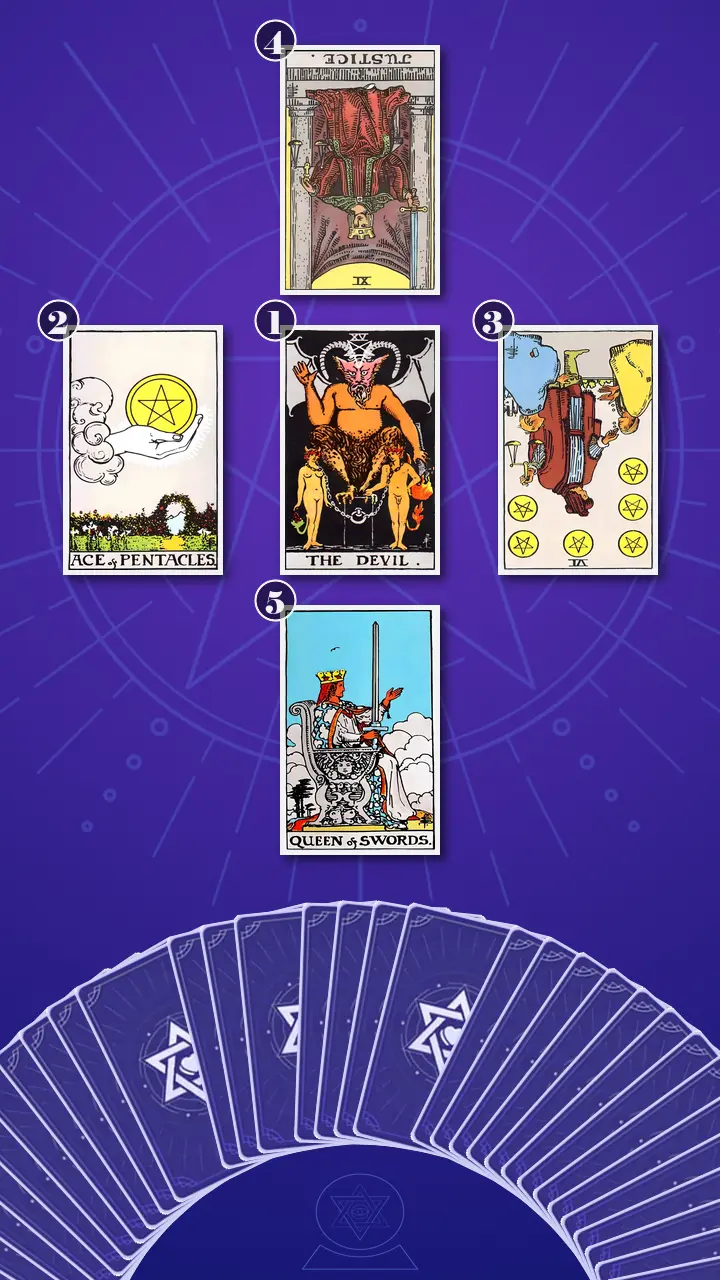
Reading the Knot Before Judging the Offer
Position 1: The Current Knot Beneath the Acceptance Draft
I turned over the card representing the current knot: the dynamic narrowing Maya’s attention and sustaining her habit of minimizing the conditions. It was The Devil, upright.
I began with the loose collars around the two figures. The chains look binding, but they are wide enough to inspect and potentially remove. I did not read this as proof that the employer was malicious or that the offer was corrupt. I read it as a picture of an untested restriction that had already acquired the emotional force of a fact.
At 11:40 p.m., Maya could technically open a blank email and ask what “periodic after-hours availability” meant. Instead, she hovered over the acceptance draft while the real question remained in Notes. The inner sentence was not simply, “I want this role.” It was, “I technically could ask, but if I do, they may reconsider me, and then I’ll know I was never valuable enough to choose without conditions.”
The Devil showed attachment in excess and evaluative control in blockage. The salary, title, and visible career progress were not the problem. The blockage began when preserving access to those benefits seemed to require silence. It was like a recommendation algorithm trained only on evidence that predicted “accept,” then presenting its skewed feed as the whole decision.
“Which clause feels most impossible to question,” I asked, “and what do you believe asking about it would say about you?”
Maya’s mouth opened, then closed. She gave one short laugh, but there was no humour in it. “That’s too accurate. Kind of brutal.” Her fingers tightened around the cold mug before she added, “The availability clause. I think they’ll hear the question as me saying I’m not committed.”
“Then let’s separate what has happened from what fear has forecast,” I said. “The clause exists. Your question has not been asked. Their response is unknown. Your body is reacting to a possible rejection as though it has already occurred. That reaction deserves compassion, but it does not have to serve as evidence.”
Position 2: The Doorway That Is Genuinely Worth Considering
I turned over the card representing the genuine attraction: the concrete benefits and needs that made Maya want the offer. It was the Ace of Pentacles, upright.
A hand emerges from a cloud and openly presents a pentacle. Beneath it, a cultivated path passes through an arch toward distant mountains. I saw a real opportunity, not a mirage. The higher salary could ease the monthly pressure Maya felt whenever she checked rent and savings. The stronger title could make her experience legible in a competitive field. The broader ownership could reopen a career path that her stable but narrow role had stopped providing.
I pictured the scene she had described in the grocery queue: the scanner beeping, cold air spilling from the freezer aisle, and her banking app showing what the higher monthly figure could change. The relief in that calculation was legitimate. The card’s Earth energy was balanced here. It grounded desire in practical value rather than status alone.
“An attractive offer can be real and still contain unanswered questions,” I told her. “A doorway is an invitation to investigate the path. It is not a command to sign the lease without viewing the property.”
I asked her to name three benefits that would materially affect an ordinary week, rather than only how the announcement might look online. She named the salary, a larger strategic remit, and the chance to lead launches instead of only supporting them. Then her voice softened. “And being chosen for something bigger,” she said.
I let that answer stand without shaming it. Wanting recognition was human. The Ace asked only that she distinguish practical momentum from the hope that a new title could permanently settle her worth. Her shoulders moved down by less than an inch, but I noticed it. The reading had made room for ambition without forcing ambition to defend every clause.
Position 3: When the Reward Is Precise but the Obligation Can Expand
I turned over the card representing the strings and trade-offs: the conditions, power distribution, and long-term costs receiving less attention than the benefits. It was the Six of Pentacles, reversed.
In the upright image, a standing figure distributes coins while holding a set of scales. Reversed, the apparent balance becomes unstable. I did not treat that instability as a verdict of unfairness. I treated it as a deficiency of defined reciprocity: what Maya would receive had been measured, while parts of what she might be expected to give remained expandable.
The offer named salary, title, and start date with precision. Responsibilities included “other duties as required.” Availability depended on “business needs.” Success measures had not been translated into examples, time frames, or decision authority. It resembled a mobile plan advertising the monthly price in bold while describing the overage charges as “subject to usage.”
“They have named exactly what I receive,” I said, “but have you learned exactly what you are expected to give?”
Maya went still. Her eyes shifted away from the cards and toward the offer on her second screen. I asked her to picture an ordinary Tuesday three months into the role, not a launch announcement or a first-day photo. Who could add work? Which existing priority would be removed? Did after-hours availability mean one planned launch week per quarter, or routine evening coverage? Who decided whether performance was successful?
“I don’t know,” she said. The words came out quietly. “I’ve been treating ‘broad ownership’ as automatically senior, but I don’t know whether it means authority or just more things landing with me.”
That distinction was the card meaning in context. Gratitude for an offer does not establish reciprocity. A high salary does not answer a workload question. Maya did not need to reject the exchange; she needed enough information to weigh it. Her thumb stopped rubbing the mug handle. For the first time in the session, she looked at the conditions without immediately following them with a reason they were probably fine.
Position 4: The Spreadsheet That Looked Objective
I turned over the card representing the minimized blind spot: the weighting bias that allowed Maya to apply a softer standard to the strings than she would use for someone else. It was Justice, reversed.
The scales and upright sword are normally images of balanced evidence and accountable choice. In reversal, I read their energy as distorted weighing. Maya had built an impressive decision matrix, but its symmetry was cosmetic. Salary had calculations. The title had market comparisons. Career growth had examples and links. The workload, availability, and performance rows contained softened guesses in yellow cells.
“If the benefits get evidence, the conditions deserve evidence too,” I said.
I watched her enlarge the spreadsheet on her screen. Green cells contained sources, figures, and confirmed details. Yellow cells contained “probably manageable,” “likely standard,” and “can revisit later.” The sheet was not proof that Maya had failed to think rationally. It showed selective hyper-analysis: she had been rigorous wherever evidence protected the answer she wanted, and reassuring wherever evidence might complicate it.
As I looked at reversed Justice, I remembered hearing different versions of the same instruction in different cities and cultures: don’t make trouble, don’t appear ungrateful, don’t risk losing your place. The vocabulary changes, but the shadow bargain is remarkably consistent. From a Jungian lens, the disowned concern does not disappear; it keeps returning through the jaw, the chest, the 2 a.m. search tab, and the sentence we cannot quite send.
“Would you accept this level of ambiguity for a close friend with your rent, career goals, and need for downtime?” I asked.
Maya’s breathing paused. Her eyes lost focus for a moment, as if she were rereading the document from across the table rather than from inside her own fear. Then she exhaled and said, “No. I’d tell her to ask for examples before deciding.” Her expression held recognition and embarrassment at once.
“This is a correctable weighting bias, not a character flaw,” I said. “You don’t need a harsher opinion of the offer. You need the same standard of proof on both sides.”
When the Queen’s Sword Separated Desire from Consent
Position 5: The Grounded Response
The room seemed to become quieter as I reached the final position. On Maya’s side of the call, the laptop fan dropped into silence, and a streetcar bell sounded once through the condo window. I turned over the card representing the grounded response: the questions, boundaries, and criteria that would return the decision to her. It was the Queen of Swords, upright.
The Queen holds her sword vertically while extending her other hand toward the horizon. I read the two gestures together. The sword distinguishes confirmed fact from hopeful interpretation. The open hand remains receptive. Discernment does not require hostility, and openness does not require compliance.
I asked Maya to imagine the recruiter call with three concise questions and one private non-negotiable beside her laptop. She could ask what after-hours availability had looked like for the team during a recent quarter. She could ask how priorities were adjusted when new responsibilities were added. She could ask who assessed success at 30, 60, and 90 days. She did not need to perform indifference or turn the conversation into a fight.
The Queen’s Air energy was balanced: enough clarity to separate, enough openness to listen. The inner sentence changed from “I need the answer to be reassuring” to “I can want the answer to be reassuring without writing the answer for them.”
At 11:40 p.m., Maya’s offer had glowed beside a spreadsheet where salary and title received full paragraphs while availability and performance expectations received two words: “probably manageable.” Her jaw had tightened, but her cursor kept drifting toward acceptance because she believed she had to make the right decision before collecting the missing facts.
At that point, I used a framework I call Fear-Driven Logic Decoupling. On one line, I wrote the authentic desire: “I want the role because the compensation, scope, and career movement matter to me.” On another, I wrote the fear-driven forecast: “If I ask a reasonable question, they will withdraw the offer, and that will prove I was not worth choosing.” The first line was a preference supported by facts. The second was a subconscious prediction being treated as a contract term.
I then applied Hidden Cost Deconstruction. Accepting without clarification did not merely carry a possible workload cost; it carried an emotional bill for ongoing self-silencing, repeated second-guessing, and the pressure to remain grateful whenever an ambiguous expectation expanded. Asking could also carry a cost: discomfort, delay, or an answer she did not want. Clarity meant comparing both bills instead of pretending only one option had a price.
You do not have to blur the conditions to preserve the opportunity; name each string, ask the clean question, and let the Queen's raised sword separate desire from consent.
I let the sentence remain between us before adding, “Wanting the offer can explain why it matters; it cannot make the conditions acceptable. Clarity begins when every string gets a name, a question, or a boundary.”
Maya froze first. Her inhale stopped halfway, and two fingers remained suspended above the trackpad. Then her gaze slipped out of focus, as though she were replaying the recruiter’s “Just checking in” email and the sentence she had typed before deleting: “Everything looks great.” Her mouth tightened. “But doesn’t that mean I’ve spent three days building a spreadsheet just to avoid the actual decision?” she asked, with a flash of anger aimed mostly at herself. I told her the spreadsheet had been a protective strategy, not evidence that she was foolish; it had given her a sense of movement while direct clarification still felt unsafe. Her fist loosened against the table. She released a breath that trembled at the end, then pressed her palm flat beside the yellow cells. I asked, “Now, from this new angle, can you think of a moment last week when this insight might have made you feel different?”
She returned to Wednesday at 4:56 p.m., when the recruiter had followed up and her shoulders had risen toward her ears. “I could have seen the question as information gathering,” she said, “not as proof that I was difficult.” Her voice was steadier, but the new clarity left a brief blankness in her face. She could no longer hide inside the fantasy that a perfect answer would arrive without her participation.
I named the shift carefully. This was not instant certainty. It was the first movement from opportunity-attached selective analysis toward grounded confidence: from protecting the feeling of being chosen to protecting her capacity for informed consent. The Queen did not promise that every answer would suit her. She showed that Maya could tolerate an answer without abandoning her standards or handing the decision to fear.
From Chained, to Weighed, to Clearly Named
I laid the five cards back into their cross and followed the story they made together. Maya’s current role had become professionally narrow, while Toronto’s cost of living made the Ace of Pentacles genuinely significant. That real value intensified The Devil’s attachment loop: the opportunity began to feel scarce enough that scrutiny seemed dangerous. The reversed Six of Pentacles exposed the practical problem beneath the fear: the rewards were specific, but parts of the expected exchange were not. Justice reversed revealed why more research had not resolved the decision; the evaluation system itself gave benefits facts and conditions guesses. The Queen of Swords restored the missing function: clear language, equal evidence, and boundaries Maya could use without pretending she did not want the job.
The cognitive blind spot was not simply that Maya had overlooked fine print. She had mistaken a polished decision process for a balanced one, while fear quietly changed the weighting rules. Her personal algorithm kept recommending “accept” because she had trained it on title, salary, relief, and comparison, then labelled the unanswered conditions as low-confidence data.
The transformation direction was therefore more precise than “be confident” or “know your worth.” Maya needed to move from asking whether the offer was desirable enough to excuse its conditions to assigning every important condition one of three destinations: a clarification question, a personal boundary, or a consciously accepted trade-off. Desire could tell her what mattered. It could not consent to terms she had not clarified.
The Equal-Weight Offer Audit: Actionable Next Steps
I gave Maya three small practices. None required her to become fearless, rebuild the entire spreadsheet, or decide immediately.
- Run a 10-Minute Equal-Weight Offer AuditAt the kitchen table, set a timer for ten minutes and choose only one clause currently labelled “probably standard” or “probably manageable.” Create five columns: “Benefit or condition,” “Exact wording,” “Evidence,” “Unknown,” and “Impact on my week.” Copy the clause exactly, record what has actually been confirmed, and write the concrete example you still need.Tip: Do not rebuild the whole decision matrix. The minimum version is one copied clause and one question mark beside the assumption you have been making.
- Draft One Clean QuestionIn an email to the recruiter, write: “Could you share a recent example of what periodic after-hours availability looked like for this team, including typical frequency and response expectations?” Read it aloud once, remove any apology that adds no information, and send it only when you are ready. A clean question is not an accusation.Tip: Ask for day-to-day practice rather than reassurance. The recruiter may answer, defer, or decline; each response gives you information you can evaluate.
- Try the 48-Hour Shadow Choice ExperimentOn paper only, spend 48 hours acting as though you have chosen the option your fear resists most: asking for clarity before accepting. Do not send or reject anything solely because of the exercise. Each time resistance appears, record its prediction, such as “They will think I’m difficult.” Then tag every unclear condition “Clarify,” “Boundary,” or “Trade-off,” and write what evidence would move it into a different category.Tip: The experiment is designed to reveal the defence mechanism, not force a decision. The five-minute version is to complete one sentence: “I could accept this condition only if…”
I reminded Maya that a boundary described what she would choose, revisit, or require; it did not control the employer’s answer. After the answers arrived, she would record them in the employer’s own words, take one ordinary meal or commute before responding, and make the final decision herself. The cards had helped us inspect the architecture of the choice. They did not own it.

A Warm Dinner and the Quiet Proof of Finding Clarity
Three days later, Maya sent me a message: “I asked the availability question. I felt sick for ten minutes, and then I made dinner instead of reopening the offer PDF.” The answer was useful but not perfectly reassuring. It defined peak periods and also confirmed that some evening coverage occurred more regularly than she had assumed.
She had not accepted or declined. One answer disappointed her. Still, she slept through the night. Her first thought in the morning was, “What if I lose it?” This time, she opened her note and read the actual terms instead of returning to the fantasy.
I think of that as the quiet proof of this Journey to Clarity. The Decision Cross did not turn uncertainty into prophecy. It helped Maya move from being chained by an untested fear, through weighing the exchange, to separating what she wanted from what she could knowingly accept. The agency was hers before the cards arrived; the reading helped her see where she had placed it.
When being chosen feels this important, I know how easily the jaw can tighten over the small print while the mind keeps returning to the salary, title, or relief. Naming a limit can feel dangerously close to making yourself unchoosable. But noticing that fear already creates a small space in which desire and self-respect can stand together.
If wanting the offer and needing clarity were both allowed to be true, which single string would you place beneath the Queen’s sword first: the one about time, scope, evaluation, or the quiet belief that asking makes you less choosable?