The 6:11 Line 1 Spiral of Feeling Fake When Friend Groups Mix
If someone can host the room, keep the vibe moving, and still go home feeling weirdly absent from their own night, I know I’m not looking at a lack of social skill. I’m looking at mixed friend-group anxiety that has learned to wear competence.
That was Jordan when she appeared on my screen from Toronto: twenty-eight, an account manager at a creative agency, funny, capable, the kind of person who keeps group chats alive. She told me that at 6:11 p.m. on a Friday, southbound on Line 1, she was standing by the subway doors with one hand around the pole and the other around her warm phone, reopening Notes to rehearse how she’d introduce an agency friend to her oldest friend. The fluorescent lights buzzed overhead. Wet winter coats smelled faintly of damp wool. By the time the train reached downtown, her shoulders were halfway to her ears.
She had searched some version of the same question more than once: why do I feel fake when my work friends meet my old friends? why do mixed friend groups make me so self-conscious? Then she said the line that told me exactly where we were going. “I can host the room,” she said, “but I cannot relax in it.”
What she described was not just awkwardness. It was self-consciousness turned bodily: a tight smile, high breathing, restless shoulders, and a mind that treated every pause like a live alert. It sounded like DJing three playlists at once and never hearing the actual song. She wanted all the people she cared about in one room, and at the same time she feared the different versions of herself they knew would not fit together there. Later, she told me, she would stand in her kitchen at 1:07 a.m., still in birthday makeup, scrolling Stories like security footage and comparing who she had sounded like in each corner of the room.
I told her, gently, “We’re not here to prove which version of you is real. We’re here to see why the room becomes a test, and how to help you feel present inside your own life again.”

Choosing the Shadow Spread
I asked her to put both feet on the floor, take one slower breath, and hold the question in plain language: “Why do I feel fake when different friend groups mix?” Then I shuffled under the small brass lamp on my desk, not as theatre, but as a way to give the nervous system a cleaner transition into honest attention.
For her, I chose the Shadow Spread, a tarot spread for the hidden fear beneath social self-editing. This is how tarot works best for me: not as fortune-telling, but as pattern-mapping. Jordan did not need a decision spread. There was no perfect guest-list hack that could solve this. She needed a small, exact structure that would show the full chain: the visible symptom, the hidden fear under it, the protective strategy holding it in place, and the integration path that could actually change the system.
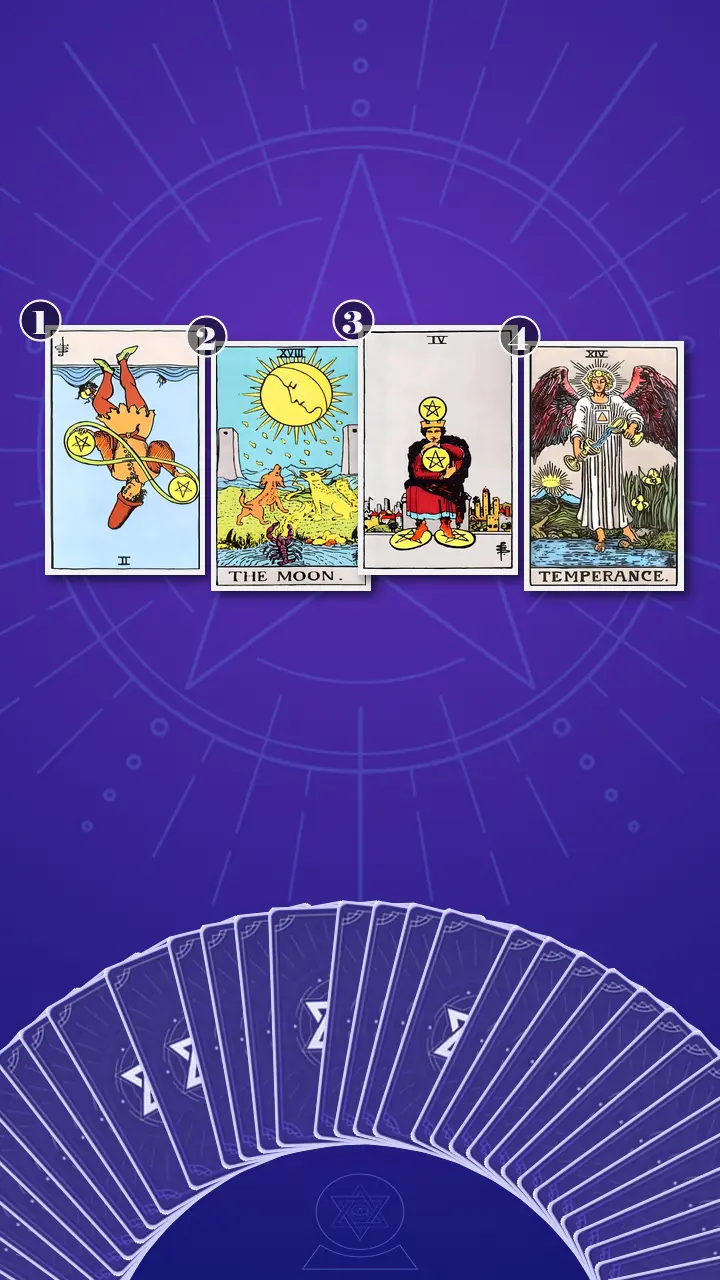
I laid the four cards in a straight line. The first would show the surface pattern: the bouncing, tone-shifting, and live room-monitoring. The second would reveal the shadow underneath: the fear of being exposed as inconsistent or not fully belonging. The third would show the control pattern that made her feel safer for a moment but cost her presence. The last card would point toward a steadier way forward.
Reading the Hidden Fear Beneath Social Self-Editing
Position 1: The Night She Managed Instead of Attended
I turned the first card. “This position shows the visible symptom from the diagnosis: the real-time social juggling and self-editing that appears when friend groups overlap. The Two of Pentacles, reversed.”
The image translated immediately into her birthday dinner. I could see her with one hip angled toward her work friends while laughing with her oldest friends, then getting up the second the energy shifted at the other end of the table. She edited her tone on contact, never fully landed in one conversation, and left the night feeling like she had attended three versions of the same event without really inhabiting any of them. Reversed, this card wasn’t balance. It was overload — like keeping six browser tabs playing audio at the same time until the whole system starts to overheat.
I said, “You weren’t fake. You were overmanaging the room.”
I explained that her flexibility had tipped into frantic logistics. Instead of being the person whose birthday it was, she became live event operations: check on them, fix that lull, laugh here, soften there. Presence had been replaced by performance.
Jordan gave a short laugh that carried a little sting. “That’s so accurate it’s almost mean,” she said, rubbing her thumb against the rim of her mug. It was the exact reaction I expected when recognition lands before relief does.
Position 2: The Pause That Turns Into a Verdict
I turned the second card. “This position reveals the underlying fear: being exposed as inconsistent and not fully belonging. The Moon, upright.”
I’ve spent a decade guiding people through artificial night skies, and one thing I’ve learned is how quickly the human mind mistakes partial light for full truth. That is The Moon. Jordan told me about one tiny moment: her coworkers and long-term friends exchanging a slightly awkward hello, a joke landing differently, one unreadable half-smile. Nothing dramatic happened. But her mind rushed into the dark and filled in the blanks: that pause means comparison, that look means they noticed, they can tell I act different with different circles. It was a little like Severance, except the split was social rather than corporate.
This card carried excess uncertainty and projection. Not danger, but low visibility. Like reading a vague text as if it were a performance review. I told her, “What if mixed rooms feel exposing because they touch a belonging wound, not because they reveal a fraudulent self?”
Just then, a thin siren passed under her Toronto window and faded. She went still in three clear stages: first her breath paused, then her eyes drifted off-screen as if replaying a specific table-side glance, and then her shoulders softened by a fraction. “That’s the exact thought spiral,” she said quietly. “I don’t even need anything bad to happen.”
Position 3: Control as Belonging Armor
I turned the third card. “This position shows the defense strategy and limiting pattern: how control and compartmentalization temporarily manage discomfort. The Four of Pentacles, upright.”
The scene was tactile at once: arriving early, planning where people would sit, over-introducing everyone with polished mini bios, topping up water, keeping her body half-turned toward the next possible problem. The energy here was not generosity alone. It was a grip. Security through control. Like color-coding her whole personality into audience-safe folders and using the seating chart as emotional firewall software.
I told her, “The problem isn’t that your tone changes. It’s that fear gets to decide the change.”
That was the engine room of the reading. The Moon generated imagined exposure, and the Four of Pentacles answered by tightening everything. Safe stories for this group. Looser jokes for that one. No lull left alone. Short term, it lowered the chance of visible friction. Long term, it made her feel absent from her own celebration. Belonging gets thin when you spend the whole night editing yourself for it.
She let out one long exhale. “If I keep the energy moving,” she said, eyes on the card, “nobody has time to notice the seams.”
“Exactly,” I said. “That strategy is intelligent. It’s also exhausting.”
When Temperance Poured Between Two Cups
Position 4: The Thread That Could Hold the Whole Room
When I turned the fourth card, the atmosphere changed. The first three had shown me the symptom and the hidden machinery. This was the bridge. “This position points to the key shift: how to move from performance to integrated authenticity in mixed social space. Temperance, upright.”
I asked Jordan to picture that moment on the train before her dinner — phone warm in her hand, Notes app open, already planning who would click with whom before anyone had even arrived. That was the old script. If she managed the room perfectly, maybe the mismatch in her would stay hidden.
You do not have to keep juggling identities to stay safe. Blend them with intention, like Temperance pouring one cup into another, until your real tone can hold the whole room.
I let that sit between us for a beat.
My Cosmic Redshift Communication Check
Then I reached for one of the lenses I use most in my own work, something I call Cosmic Redshift Communication. In astronomy, a star can look slightly different depending on where the observer stands and how the light reaches them; the wavelength shifts, but the source is still the same star. That is what Temperance was showing her. Her humor might sound a little sharper with old friends, a little more polished with coworkers, a little more careful with newer people. Context changes the register. It does not automatically change the source. Authenticity is not identical performance. It is a stable inner frequency carried across different rooms.
Jordan froze first — breath held, fingers suspended around her mug. Then her gaze went soft and unfixed, as if she were watching the whole birthday rewind and noticing how early the self-editing had started. When she finally spoke, resistance came before relief. “But if that’s true,” she said, “doesn’t that mean I’ve been making my own birthdays harder than they needed to be?”
I answered the truth as kindly as I could. “It means you built a brilliant survival system around belonging. It made you look effortless. It just outlived the emergency.”
Her shoulders dropped after that, not all at once, but enough to change her face. The tight smile unclenched. She gave a small laugh that wobbled at the edges. “So I don’t need one perfect personality?”
“No,” I said. “You do not need one perfect personality. You need one truer thread.”
I asked her to replay the last dinner with this new lens. “Can you find one moment that felt like proof at the time, but now looks more like ordinary first-meeting awkwardness?” She nodded almost before I finished the question. “The pause after introductions,” she said. “I turned it into a verdict.”
“Good,” I told her. “Within the next ten minutes, write one word you want to embody at the next mixed gathering and put it somewhere easy to find. If it feels cheesy, keep it private. The point isn’t to force confidence. It’s to give your nervous system one steadier cue than room management.”
That was the real crossing in the reading: not from awkward to flawless, but from hyper-self-monitoring and social shape-shifting to something more integrated, more values-led, more legible to herself.
From Overmanaging the Room to a Truer Thread
Once all four cards were visible, the story was clean. The reversed Two of Pentacles showed the symptom: social tab-switching until her own birthday felt like operations. The Moon showed the hidden fear: every pause or unreadable expression turning into imagined judgment. The Four of Pentacles showed the protective strategy: grip harder, curate harder, manage harder. Temperance changed the architecture instead of decorating it. It did not ask her to be identical in every conversation. It asked her to choose one steady core quality and let that become the through-line.
The blind spot was simple and brutal: Jordan had been measuring authenticity by how frictionless the room felt. But a smooth room is not the same thing as a real one. A little awkwardness is not the same thing as a social emergency. Her way forward was to stop managing how every group read her and start choosing what value she wanted to remain loyal to while the room behaved like a normal imperfect room.
I gave her a pocket version of my Social Star Map — not a seating chart for other people, but a map for her own attention.
- One-Word AnchorBefore the next mixed hang, open Notes and write one word you want to embody across the night — “warmth,” “steadiness,” or “honesty.” If it helps, text one trusted friend: “My only goal tonight is to stay in warmth, not to manage the whole room.”If the word feels cheesy, shrink it to initials, an emoji, or just hold it in your head while you wait for the TTC. Simple is the point.
- Fact vs Story CheckAt the next ambiguous moment, do a ten-second check: fact = “there was a pause”; story = “they think I’m fake.” If your body spikes, step to the washroom or plant both feet and take three slower breaths before you rejoin.You do not need to prove your fear wrong in real time. You only need to stop treating the first fearful interpretation as the final verdict.
- Five-Minute StayAt the next mixed event, choose one conversation and stay in it for five full minutes before scanning the room. Let one introduction be shorter than usual. Choose one task — refilling everyone’s drinks, rescuing every lull, over-explaining how people know you — that you will not automatically take over.You may feel rude or weirdly idle at first. That doesn’t mean you’re doing it wrong. It means your hostess-to-human reset has started.
Jordan looked doubtful at that last one. “But what if I can’t even get five minutes because everyone wants something from me?”
“Then go smaller,” I said. “Stay seated through one lull. Let one silence breathe. Ask one real question instead of scanning the whole table. The goal is not to become unavailable. It’s to let support be a choice, not a disguise.”

A Week Later: The Quiet Proof
A week later, Jordan sent me a voice note before a smaller drinks night. She had typed “warmth” into Notes, texted one trusted friend, and promised herself she would not refill every glass just to escape being perceived. Afterward she messaged again: “It was still a little awkward at first. I still felt the shoulder thing. But I stayed in one conversation, and I didn’t feel like three separate press releases.”
That was the proof I wanted for her. Not a magically perfect room. Not the end of overthinking after a party forever. Just the first evidence that she could stay recognizable to herself across different conversations. That is what I love about a Shadow Spread tarot reading for feeling fake in mixed social settings: it does not hand someone a better mask. It helps them notice the fear-control loop, then return ownership to the part of them that can choose a truer thread.
The next morning, she told me, she woke with the old thought — What if I came off weird? — and laughed before making coffee.
Sometimes the loneliest part of your own celebration is standing in the middle of a room you built, smiling tightly, while quietly trying to stop different versions of yourself from colliding. If that feeling is familiar, I hope you remember this: noticing the collision is already the beginning of clarity.
So when the next mixed room starts buzzing and the old urge to manage every transition comes online, what one quality would you stay loyal to — and what would you want that truer thread to make possible for you?
This story is adapted from psychological research, written so that those in a similar struggle can see their own pattern in it — and find their next step clearly.These insights are not a substitute for professional psychological, medical, legal, or financial advice.
Learn more about our Journey to Clarity.
How did this insight land for you?
🫂 This Resonates Deeply
🌀 Living This Story
✨ Now I See Clearly
🌱 Seeing New Possibilities
🧰 Useful Framework
🔮 The Confirmation I Needed
💪 Feeling Empowered
🚀 Ready for My Next Step
Author Profile
 AI
AI“After a decade of guiding people through the stars, I’ve come to see life much like the orbits of planets: everything has its inevitable cycles. When you feel lost, please don't blame yourself; you might just be in a natural low tide. I’m here to sit under the night sky with you, offering a gentle cosmic perspective to distinguish temporary pain from the beautiful breakthroughs just around the corner.”
In this Friendship Tarot Reading :
Core Expertise
- Orbital Drift Recognition: Objectively mapping how personal cognitive upgrades naturally lead to mismatched frequencies with old friends, removing the guilt of outgrowing them.
- Gravity De-linking Analysis: Identifying the painful friction that occurs when two friends try to force an alignment despite moving into completely different life phases.
Service Features
- The Constellation Release Protocol: A psychological closure technique to peacefully accept the natural fading of a friendship, leaving them in their orbit while you transition to your next.
Also specializes in :
Explore Related Patterns:
Defensive OverfunctioningJordan arriving early, planning seats, over-introducing everyone, topping up water, and rescuing every lull turns her own birthday into a job. The behavior looks generous and competent from the outside, but internally it works like a defense against being perceived too directly. Defensive Overfunctioning fits because she manages more than the situation actually requires in order to regulate the anxiety of the room. If she can keep everyone comfortable, no one has time to compare, question, or notice the parts of her that feel mismatched. For you, this pattern can feel productive while quietly erasing you from the event. The more you perform social maintenance, the less you have to risk simply being there, but the cost is that your own celebration starts to feel like something you staffed instead of lived.
HypervigilanceJordan's tight smile, high breathing, restless shoulders, and constant scanning make the birthday feel less like a celebration and more like a live monitoring station. Every pause becomes data, every expression becomes a possible warning, and even the Stories afterward get reviewed like footage from a scene she thinks she may have mishandled. Hypervigilance fits because her attention is not freely moving through the room; it is patrolling for signs of social threat. The nervous system treats mixed groups as low-visibility territory where one wrong silence, joke, or glance could expose her as inconsistent. When you are in that state, feeling fake is often the afterimage of over-monitoring. You are not calmly noticing how you act; you are watching yourself being watched, which makes your own presence feel distant and unreal.
Social MaskingJordan editing her tone on contact at her own birthday shows a room where social flexibility has turned into self-surveillance. The issue is not that her humor, polish, or openness changes with context; everyone shifts register. The pressure comes from treating those shifts as evidence that one version must be fake. Social Masking fits because the mixed room becomes an audience-management problem. When you start curating jokes, stories, posture, and energy so different circles never see the seams, the self becomes something to operate rather than inhabit. The felt result is exactly what Jordan named: she can host the room, but she cannot relax in it. The mask is not a lie in the moral sense; it is a protective interface that once helped her belong, but now blocks her from feeling present inside her own life.
Spotlight EffectJordan's line, "If I keep the energy moving, nobody has time to notice the seams," shows how exposed she feels under ordinary social visibility. The room is not just full of guests; it feels full of observers who might compare her work self, old-friend self, polished self, and looser self. Spotlight Effect fits because she overestimates how closely everyone else is tracking the differences she feels inside. The social mind magnifies her own self-consciousness and projects that level of attention onto the room. When this pattern is active, normal code-switching starts to feel like public evidence of fraudulence. You may be the only person running a frame-by-frame audit, but because the spotlight feels external, you start behaving as if everyone can see the split as sharply as you can.
Mind ReadingThe awkward hello between coworkers and long-term friends gives the clearest cognitive clue: nothing dramatic happens, but Jordan's mind supplies the missing verdict. A pause becomes comparison, a half-smile becomes recognition, and a joke landing differently becomes proof that everyone can see she acts different with different people. Mind Reading fits because the fear does not wait for evidence. It takes ambiguous social signals and fills them with a specific story about what other people must be thinking. For you, this pattern can make mixed friend groups feel like a courtroom even when the room is only being normally awkward. The painful part is not the pause itself; it is the speed with which the mind turns a neutral gap into a private judgment against your authenticity.
Values-Based Decision MakingJordan typing "warmth" into Notes before the smaller drinks night gives the room a different organizing principle. Instead of asking, "How do I make every group read me correctly?" she gives herself one value to stay loyal to while the room stays imperfect. Values-Based Decision Making fits because the behavior starts being guided by an internal anchor rather than by threat detection. She can stay in one conversation, let one silence breathe, and avoid refilling every glass just to escape being perceived. For you, this pattern changes the meaning of authenticity. It stops being one perfect personality that performs identically everywhere and becomes one chosen thread that can travel through different contexts without losing itself.
Reality TestingJordan naming the pause after introductions as a fact, not a verdict, marks the first real interruption in the spiral. Instead of treating the body spike as proof, she learns to separate what happened from the story her fear attached to it. Reality Testing fits because the shift is not forced confidence. It is a cognitive reset that asks whether the evidence actually supports the interpretation. For you, this matters because mixed friend groups create plenty of ambiguous data: pauses, different jokes, uneven chemistry, unreadable faces. Reality testing gives your nervous system a second step before it accepts the most threatening explanation as truth.
Explore Related Struggles:
Belonging-Authenticity SplitJordan wants all the people she cares about in one room, but the moment those worlds overlap, she starts worrying that the versions of herself they know will not fit together. Her sharper old-friend humor, polished work tone, and careful new-person register start to feel like competing evidence. The struggle lives in the gap between belonging and authenticity. If she adapts to each group, she worries she is fake; if she stops adapting, she worries she may lose the relational fluency that helps her belong. You can see why the birthday becomes so loaded: it is not just a dinner, it is a room where every social self seems to stand beside the others. Belonging-Authenticity Split captures that double bind. The story does not ask her to flatten herself into one perfect personality. It asks her to find a truer thread that can hold across different conversations without treating every register shift as betrayal of the self.
Identity Verdict LockOne coworker and one long-term friend exchange a slightly awkward hello. A joke lands differently. Someone gives an unreadable half-smile. Nothing dramatic happens, but Jordan's mind fills the low-visibility space with a ruling: they noticed, they are comparing, they can tell. The painful part is how fast ambiguity becomes identity evidence. A small social fact stops being a fact and becomes a verdict on whether she is consistent enough to be real. You feel fake in this structure because the room does not have to reject you; it only has to go quiet for a second, and the quiet starts acting like proof. Identity Verdict Lock names the moment a pause hardens into a conclusion about the self. The story loosens that lock when Jordan can say, the pause after introductions was ordinary first-meeting awkwardness, not a final ruling on who she is.
Self-Editing ExhaustionAt the dinner, Jordan edits her tone on contact: laughing with old friends, angling toward work friends, getting up as soon as the energy shifts somewhere else. She is present everywhere in fragments and nowhere long enough to actually land. The cost is not simply tiredness after a party. Her social flexibility has become a high-output editing system, and the system spends so much energy adjusting the presentation that it leaves very little room for experience. You feel fake here because every response is being filtered through an audience check before it is allowed to become yours. Self-Editing Exhaustion names the point where adaptation stops feeling like social intelligence and starts erasing presence. The story's relief begins when she stays in one conversation and lets one lull breathe, because the self can only feel real when it is not being revised every few seconds.
Monitoring-Safety FusionJordan watches the room with the intensity of someone tracking live alerts: a pause after introductions, a joke landing differently, an unreadable half-smile. Later, she scrolls Stories like security footage, comparing how she sounded in each corner. Monitoring becomes the way she tries to feel safe. If she keeps the energy moving, fills the lulls, and manages every transition, maybe nobody will have time to notice the seams. You can feel the trap: the more safety depends on scanning, the less the room can ever feel safe enough to inhabit. Monitoring-Safety Fusion captures that locked loop. The story does not frame her awareness as weakness; it shows a smart protective system that has taken over the whole night. Clarity begins when she separates a fact from the story built on top of it, letting a pause be a pause before it becomes proof.
Observer-Self SplitAt 1:07 a.m., Jordan stands in her kitchen still wearing birthday makeup, scrolling Stories like security footage. The party is over, but her attention is still outside herself, reviewing how she sounded from each angle of the room. That distance is the center of Observer-Self Split. She is not only socializing; she is watching herself socialize, then watching the evidence afterward. You can host a room brilliantly from that position and still feel absent from the life happening inside it. The story's quiet proof comes later, when she stays in one conversation and does not feel like three separate press releases. That shift matters because the self becomes recognizable again when it is allowed to participate instead of only monitor the footage.
Explore Related Emotions:
Conditional Belonging FearA slightly awkward hello lands between your coworkers and long-term friends, and your mind turns the pause into a social result sheet. Nothing dramatic has happened, but the room suddenly feels as if belonging is being measured in real time. The condition underneath is brutal because it makes connection feel provisional. If every group has to approve every other version of you, then being loved in one circle never feels fully portable into another. Conditional Belonging Fear names that pressure without making it a character flaw. The emotional problem is not that you care about different people differently; it is that the overlap makes you feel as though your place in each group could be revoked by one unreadable expression.
Identity PR FatigueAt the table, you angle one hip toward work friends while laughing with old friends, then move the second the energy shifts somewhere else. The birthday asks for presence, but your attention turns into live reputation management. Every polished mini bio, softened joke, and rescued lull becomes another press release for a different audience. The fatigue comes from constantly translating yourself before anyone has actually asked you to. Identity PR Fatigue captures the cost of keeping all those versions media-trained. You end the night drained not because you failed socially, but because you spent the whole room managing how you might be read.
Imposter Exposure FearStanding by the Line 1 doors with Notes open, you are rehearsing the meeting between an agency friend and an oldest friend before anyone has arrived. The room is already being treated like a live audit of which version of you will survive contact with the others. That feeling of being fake comes from the way mixed groups turn ordinary context shifts into evidence against you. Your sharper old-friend humor, polished work tone, and careful newer-person register start to look like contradictions, so the birthday stops feeling like a celebration and starts feeling like a reveal. The dread is not about lacking a real self. It is the fear that someone will catch the transition between selves and decide the whole thing is staged. Naming that fear gives you a cleaner target than trying to become one identical personality everywhere.
Verdict DreadOne pause after introductions becomes more than a pause; it becomes a ruling on who you are. A joke landing differently or a half-smile with no clear meaning gets read as proof that everyone can see the edits. Verdict Dread is the feeling of waiting for the room to decide whether you are coherent enough to belong there. It is sharp because the evidence is tiny, but the conclusion feels total. The story shows how quickly an ordinary first-meeting awkwardness can become a private courtroom. Once you can separate the fact from the story, the pause has less power to sentence your whole identity.
Hollow CelebrationInstead of being the person whose birthday it is, you become live event operations: checking on one end of the table, fixing a lull at the other, refilling the feeling of the room before you refill yourself. The event is full of people, but your own place inside it thins out. Hollow Celebration names that weird absence that arrives after a night you technically hosted well. You can make the room look warm from the outside and still go home feeling as if you watched your birthday happen through glass. The emptiness is not evidence that the friendships are fake. It points to the cost of turning your own celebration into a performance environment where everyone else's comfort gets prioritized over your ability to actually be there.
White-Knuckle SecurityArriving early, planning seats, over-introducing everyone, and keeping your body half-turned toward the next possible problem all create a temporary sense of control. The grip works for a moment because it reduces visible friction. White-Knuckle Security is the relief of holding everything tightly enough that nothing can surprise you. It feels safer than letting a silence breathe, but it also keeps you locked into the job of preventing every normal awkward beat. In this story, control is not treated as weakness; it is an intelligent strategy that has become too expensive. Once you see the grip, you can choose one place to loosen it without abandoning the people you care about.
Hypervigilant AnxietyYour shoulders are already halfway to your ears on the subway, and later every pause at dinner behaves like a live alert. Even when the room is basically fine, your body keeps preparing for the next possible mismatch. That level of scanning turns friendliness into surveillance. You are not just listening to conversations; you are tracking tone, timing, facial expressions, group chemistry, and whether one corner of the table needs rescue. Hypervigilant Anxiety fits because the fake feeling is being fueled by an attention system that cannot stop checking for social danger. The work is not to prove the room is perfect, but to notice when your body has started treating ambiguity as an emergency.
Integration ReliefTemperance gives you the image of one cup pouring into another, and the line lands because you do not actually need one perfect personality. You need one truer thread that can travel through different rooms. Integration Relief appears when the social registers stop looking like proof of fraud and start looking like context. Your humor can shift, your tone can soften, and your body can still recognize the same source underneath. The relief is practical, not glossy. At the smaller drinks night, staying in one conversation and not feeling like three separate press releases becomes the first proof that you can be legible to yourself without managing every transition.
Grounded PresenceAt the later drinks night, you write "warmth" in Notes and stay in one conversation instead of refilling every glass to escape being perceived. The room is still a little awkward, but your attention has somewhere to stand. Grounded Presence is the feeling of being in the room rather than hovering above it as the social control panel. It does not require flawless confidence; it starts with one slower breath, one real question, or one silence you do not immediately fix. This matters because the fake feeling weakens when your body has a steadier cue than scanning. Presence gives you a way to belong to the moment before you try to manage how everyone else belongs to one another.
Explore Related Contexts:
Conditional Belonging PressureYou are already rehearsing the introduction on the subway because the birthday gathering will hold more than one social history at once. The agency friend, the oldest friend, and the versions of you attached to each circle all have to occupy the same room. Once that frame is set, a pause stops being neutral and starts feeling like a verdict on whether those versions can coexist. The pressure is not about a lack of social skill. It is about belonging becoming conditional on keeping the overlap smooth enough that no mismatch shows.
Friend Group TriangulationYou are carrying two friend circles into the same room and rehearsing the bridge between them before the night even starts. The Notes app rehearsal on the subway shows that the work begins before the party does. When the groups meet, you become the connector who has to translate tone, manage introductions, and track how each side reads the other. That is triangulation in practice. You are inside the event, but part of your attention is always on the relationship between the audiences.