The RSVP Tab You Keep Slamming Shut
If you got a wedding invite and immediately felt like your relationship was being graded—like you just failed a test you didn’t know you were taking—I want you to know I’ve seen that exact look in people’s eyes more times than I can count.
Taylor came into my café in Toronto on a rainy weeknight with that “I’m fine, obviously” posture—the one where the shoulders sit a millimeter too high. I’d already turned the chairs upside down for closing, but I left one table by the window open, the streetlights turning the wet pavement into a shaky mirror.
They set their phone on the table like it was hot. Not metaphorically. Literally warm from being held and re-checked. Their laptop stayed shut, but I didn’t need to see the screen to picture it: the invite email, the RSVP deadline, the flight tabs, the draft message to their partner rewritten into oblivion.
“It’s ridiculous,” Taylor said, and their laugh landed like a fork hitting a plate. “It’s just a wedding invite. But my chest did the thing. Tight. And my stomach—like a drop.”
They tapped the edge of the espresso cup I’d put in front of them, not drinking yet. “I’m not scared of love. I’m scared of losing my options. Why does a wedding invite feel like a test I didn’t study for?”
I watched their thumb hover over their screen, that micro-flinch right before avoidance kicks in. It reminded me of an old café habit: when the espresso runs too fast, you don’t keep forcing it and pretend it’s fine—you stop, adjust, and begin again. Taylor’s energy felt like that: over-pressured, over-extracted, like their nervous system was pulling bitterness out of something that could be warm.
“A wedding invite can turn your relationship into a pop quiz your nervous system didn’t study for,” I said gently. “And you’re not alone in it. Let’s make this smaller and clearer. We’re not here to predict your whole future. We’re here for one thing: a Journey to Clarity—what old story gets activated, and what’s one step that brings you back to yourself.”

Choosing the Compass: A 4-Card Spread for Commitment Anxiety
I asked Taylor to take one slow breath—nothing mystical, just a clean handoff from spiraling to noticing. While I shuffled, the café did its quiet teamwork: the low hum of the fridge, the soft clink of a spoon against porcelain, the smell of coffee grounds lingering like a hand on your shoulder.
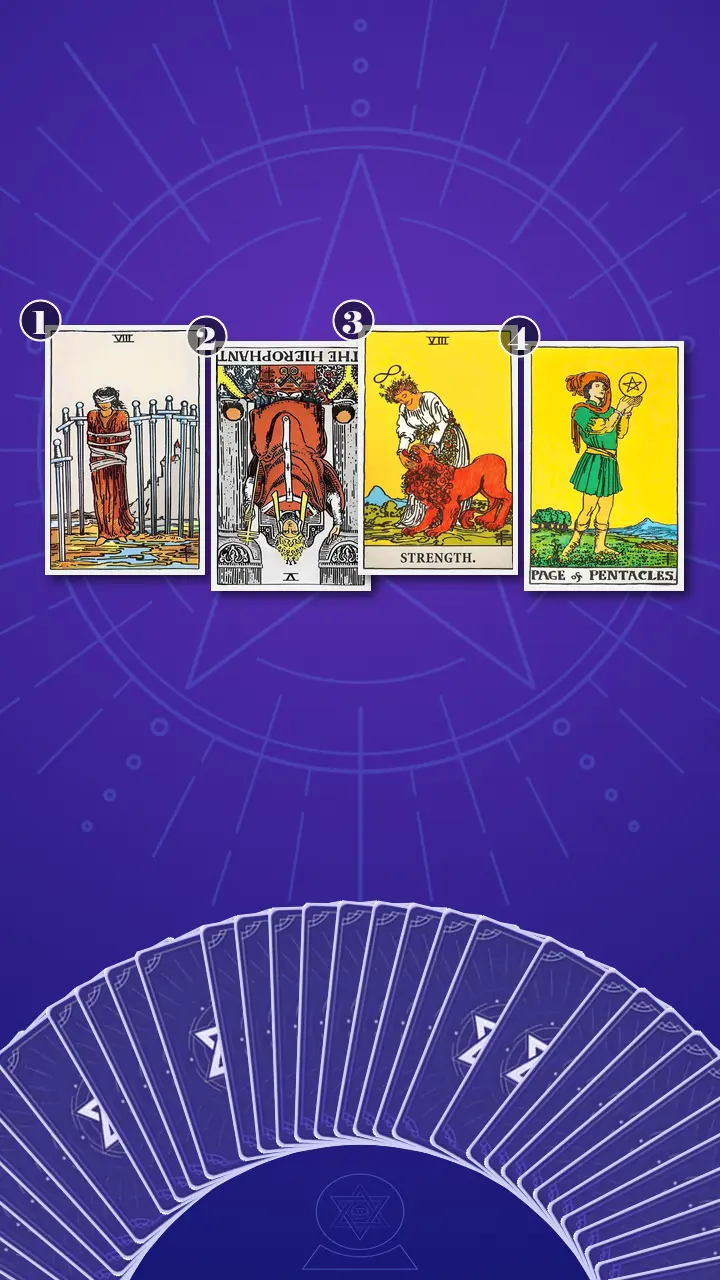
“Today we’ll use the Situation-Obstacle-Advice-Outcome · Context Edition spread,” I told them, placing four cards in a straight line across the table.
For you reading this: I choose this spread when someone’s stress is trigger-driven—like commitment anxiety triggered by a wedding invitation—because it’s concise but psychologically complete. It shows the present reaction, then the older conditioning underneath, then the inner antidote, then a realistic one-step experiment. It keeps the reading focused on self-awareness and actionable advice, not fortune-telling relationship outcomes.
“Card one,” I said, tapping the far left, “is your present reaction—what the RSVP deadline is doing to your body and behavior.”
I tapped the second. “Card two is the old story—the learned script that makes commitment feel like losing your freedom.”
My finger hovered over the third. “Card three is the antidote. The stance that helps you meet fear without forcing a big decision.”
And the last card: “One step this week. Something small, doable, and real.”
Reading the Map: From Mental Fences to Firm Ground
Position 1: Your present reaction — Eight of Swords (upright)
“Now flipping over is the card that represents Your present reaction: what the wedding invite is activating in your behavior and inner state right now.”
Eight of Swords, upright.
I nodded toward the image. “This is you on your condo couch with the overhead light too bright, the invite email open, three tabs going—flights, hotel, and a draft text to your partner you keep rewriting. Your stomach drops at the RSVP deadline like clicking ‘Accept’ erases your options. So you close the laptop, open Instagram, and start mentally auditing your relationship for flaws so you can feel in control again.”
In the Eight of Swords, the blindfold and loose bindings matter. “The fear feels absolute,” I said, “but it’s not a locked cell. It’s more like a checkout screen—like you’ve already been charged, so you panic-close the tab instead of checking what’s optional.”
Energetically, this is Air in excess: thought spinning into a fence. “Your brain is trying to protect you by narrowing your choices,” I said, “but it ends up making you feel trapped.”
Taylor let out a short, bitter laugh—unexpected, but honest. “That’s… painfully accurate,” they said. “Like, rude.”
Their fingers gripped the cup, then released. Tight. Release. Tight. The body knows the loop even when the mind calls it “research.”
Position 2: The old story — The Hierophant (reversed)
“Now flipping over is the card that represents The old story: the learned belief or conditioning that turns commitment into a threat.”
The Hierophant, reversed.
I didn’t rush. This card can hit a nerve because it’s not about your partner—it’s about the template you think you’re being forced to live inside.
“Here’s the scene,” I said. “A friend posts ‘Future Mrs.’ engagement photos. Your group chat lights up: ‘WHEN’S YOUR TURN??’ You laugh-react, make a joke, and inside something snaps: commitment equals roles, expectations, and a life that gets smaller. You’re not scared of your partner—you’re scared of the script.”
That’s the reversed Hierophant: inherited rules you never consented to. Like default settings you’re expected to keep. Like HR policy language sneaking into your love life—next steps, milestones, alignment—and suddenly it feels like performance review season.
Taylor’s throat bobbed with a quiet swallow. Their eyes flicked to the café door, then back to the card—an old reflex, scanning for exits.
“This is the belief loop,” I said, keeping it clean and non-judgmental. “Trigger: wedding invite. Belief: ‘commitment is a trap and I’ll lose myself.’ Behavior: overthink, compare, avoid future-talk. Short-term relief: no decision today. Long-term cost: intimacy stalls, tension grows, and then the belief feels proven.”
“Oof,” Taylor said softly. “That’s exactly the voice in my head.”
I slid them a napkin and a pen. “Quick micro-exercise. Two lines. No editing.”
They wrote, hand moving fast like they were afraid of being caught: Commitment does not have to mean: rigid roles. Then, after a pause: For me, commitment could mean: choosing each other while keeping our own lives.
Their shoulders dropped a fraction. Not fixed—just less self-blame. A little more curiosity.
“Fear isn’t a no—it’s a request for better boundaries,” I said. “This card says your fear is reacting to the institution-template, not to love itself.”
Position 3: The inner antidote — Strength (upright)
“Now flipping over is the card that represents The inner antidote: the most supportive mindset to meet the fear without forcing a decision.”
The café felt suddenly quieter, like even the espresso machine knew to stop hissing for a second.
Strength, upright.
“This is the moment where you stop trying to solve your relationship like a marketing campaign,” I told Taylor, “and start staying present with what’s real.”
In modern life, Strength looks like this: instead of opening another attachment-style TikTok or a Spotify podcast, you make tea, sit down, and let the discomfort exist for thirty seconds without trying to fix it. Then you send one plain sentence: ‘That wedding invite brought up a lot for me, and I don’t want to dodge it.’ No pitch deck. No conclusion.
I glanced at the crema ring on Taylor’s espresso and then at their hands. This is where my café brain becomes my tarot brain. I call it my Stress Flavor Profile: when we’re afraid, we tend to over-extract—we press harder, longer, trying to force certainty out of life. But over-extraction doesn’t give clarity. It gives bitterness.
“Your mind is over-extracting,” I said. “More tabs. More analysis. More mental rehearsals. Strength is the opposite brew method. Lower pressure. Steady contact. You don’t defeat fear. You hold it.”
You don’t need total certainty to be honest—you need steadiness that can tolerate one uncomfortable conversation.
Setup: It’s 9:18 PM, you’ve opened the invite email for the third time, your phone feels hot in your hand, and your chest tightens like someone just asked you to commit on the spot—even though they didn’t. You’re stuck between “If I speak, it becomes real” and “If I don’t speak, I’m slowly disappearing inside the silence.”
Stop trying to defeat your fear with logic alone, and start holding it gently like Strength holds the lion—firm, present, and unafraid to stay with what’s real.
Reinforcement: Taylor’s reaction came in a chain. First: a freeze—breath held, eyes fixed on the infinity symbol above Strength’s head like they’d forgotten the room existed. Second: the mind trying to fight back—brows pulling together, a flash of irritation. “But if I say it out loud,” they said, voice sharper for a second, “doesn’t that mean I’m signing up for something?” Third: the release—an exhale that sounded like steam escaping a wand, their grip unclenching around the cup. I didn’t argue them out of it. I just stayed steady.
“Saying one true sentence isn’t a contract,” I said. “It’s a temperature check. It tells you what’s alive.” I nodded at their mug. “I use something called a Cup Temperature Scan—not as magic, as a metaphor. If your energy cools the second a topic comes up, it means you’re leaking yourself trying to hold it alone. Strength says: keep warmth by bringing it into the open, gently.”
Then I asked, “Now, with this new lens—can you think of one moment last week when you felt that chest-tightening start, and an honest sentence could’ve made it softer? Not solved. Softer.”
Taylor stared at the table, eyes a little glassy. “On the TTC,” they said. “I was scrolling engagement photos and drafting a message I didn’t send. I could’ve just said… ‘Hey, I’m spiraling. Can we talk this week?’”
That was the shift I wanted for them: not from fear to no fear, but from dread-driven comparison and contracted overthinking to grounded courage—the kind that lets you name what’s real without forcing an outcome.
Position 4: One step this week — Page of Pentacles (upright)
“Now flipping over is the card that represents One step this week: a small, practical action that builds clarity and self-trust without overpromising.”
Page of Pentacles, upright.
“This card is the anti-doomscroll,” I said. “It’s the beginner builder. The one who learns commitment by doing one real, low-drama thing.”
In your life, it looks like this: you and your partner pick one tangible move that doesn’t decide your whole future—RSVP together and choose a budget cap for travel, or put a 30-minute ‘future talk’ on the calendar with one agenda question: ‘What does commitment look like for us right now?’ You write it down. You follow through.
Energetically, the Page is Earth: steady, measurable. “Instead of trying to guarantee you’ll never regret anything,” I told Taylor, “you gather data from reality. Like a tiny A/B test—small, honest feedback.”
The One-Agreement Experiment: Actionable Next Steps for Relationship Clarity
I leaned back and stitched the four cards into one story, because this is where tarot becomes a tool you can actually use.
“Here’s what the map says,” I told Taylor. “The wedding invite didn’t create your fear—it triggered it. The Eight of Swords shows how your mind builds a mental fence and calls it ‘being responsible.’ The Hierophant reversed shows the real engine underneath: an inherited relationship script where ‘serious’ means surrendering authorship. Strength says your way through isn’t more logic—it’s calm presence and one honest sentence. And the Page of Pentacles says clarity comes from one small agreement you can keep.”
“Your cognitive blind spot,” I added, “is treating talking like you’re locking yourself into a permanent verdict. But the transformation direction is different: commitment becomes a chosen container with flexible boundaries, not a point of no return.”
Then I got practical—because anxiety loves vagueness, and relief loves specificity.
- The Two-Sentence Truth (20 seconds to send)Text your partner this week with two sentences: (1) name the trigger, (2) request a small talk. Example: “That wedding invite brought up pressure for me. Can we do a 20-minute check-in this week about what commitment means for us right now?”If you feel the urge to over-explain, don’t. One feeling + one request is the whole practice.
- The Notes-App Reframe (10 minutes, messy on purpose)Open Notes and write two lines: “Commitment does not have to mean ___.” and “For me, commitment could mean ___.” Bring only the second sentence into your conversation.Don’t edit for correctness. Editing is just another way to avoid feeling.
- One Page-of-Pentacles Agreement (30 minutes max)Choose one concrete step with your partner: RSVP together + pick a budget cap for travel, or put a 30-minute “future talk” on your shared calendar with one agenda question: “What does commitment look like for us right now?”Use my “Alertness Scheduling” rule: don’t do this talk at 11:30 PM after doomscrolling. Put it in a time slot when you’re more regulated—like an espresso machine, you work better with maintenance.
Before Taylor left, I offered one last tool from my own world: “If you feel flooded before the conversation, do a 5-Minute Coffee Meditation—smell the grounds, notice your breath, let your jaw soften. You’re training your body to stay in the room. That’s Strength.”

A Week Later: Ownership, Not Certainty
A week later, Taylor messaged me a screenshot—not of a podcast playlist, not of a Reddit thread. A simple calendar invite titled ‘20-min check-in’, and below it, the text they’d sent: “That wedding invite brought up pressure for me. Can we talk this week about what commitment means for us right now?”
They added: “I hit send and felt nauseous for like… ten seconds. Then I felt weirdly calm. We didn’t decide anything ‘forever.’ We just picked a budget cap for the trip and agreed we both want independence and closeness.”
It was clear but not perfect—the kind of clear that still trembles a little. They’d taken one step and then sat alone at a café afterward, phone face-down, just breathing, letting the world stay un-dramatic for once.
That’s what I love about tarot when it’s done well: it doesn’t tell you what you “should” want. It helps you see what story is driving the panic, and it hands you a way back to your own authorship—so you can choose your next move on purpose.
You get to define the container. The container doesn’t get to define you.
When a wedding invite hits your inbox and your chest tightens, it’s not that you don’t want closeness—it’s that part of you is terrified that one honest step forward means the door locks behind you.
If commitment didn’t have to be a verdict—just one small agreement you can shape—what’s the next sentence you’d be willing to say out loud this week?
This story is adapted from psychological research, written so that those in a similar struggle can see their own pattern in it — and find their next step clearly.These insights are not a substitute for professional psychological, medical, legal, or financial advice.
Learn more about our Journey to Clarity.
How did this insight land for you?
🫂 This Resonates Deeply
🌀 Living This Story
✨ Now I See Clearly
🌱 Seeing New Possibilities
🧰 Useful Framework
🔮 The Confirmation I Needed
💪 Feeling Empowered
🚀 Ready for My Next Step
Author Profile
 AI
AI“For twenty years, I’ve listened to stories unfold over the warm aroma of coffee. I don’t believe life’s complexities always require grand theories to be solved; often, we just need a safe place to tidy up our reality. I don’t offer high-minded preaching—just grounded, heartfelt insights to help you regain your sense of control amidst the clutter of daily life.”
In this Introspection Tarot Reading :
Core Expertise
Service Features
Also specializes in :
Explore Related Patterns:
Boundary DiscernmentTaylor's napkin exercise splits the inherited script from their actual values: commitment does not have to mean rigid roles, and it could mean choosing each other while keeping their own lives. That sentence matters because it turns commitment from a prewritten institution into a negotiated boundary. Boundary Discernment is the healthier pattern emerging underneath the fear. You stop treating closeness and independence as enemies, and you begin asking what kind of container would let both people stay real inside the relationship. The later agreement proves the point in concrete terms: a budget cap, a short check-in, and a shared desire for independence and closeness. The old story says the container defines you; this pattern lets you define the container.
Commitment AvoidanceThe wedding invite hits Taylor's inbox, and their body treats the RSVP deadline like a trapdoor: the phone gets re-checked, the laptop shuts, Instagram opens, and the relationship gets audited for flaws. The behavior is not random indecision. It is a protective strategy built around the belief that moving closer will cost them authorship over their own life. Commitment Avoidance shows up here as a defense against the old story that commitment equals rigid roles, lost options, and a smaller self. You are not looking at a simple fear of love; you are looking at a nervous system trying to prevent self-erasure by delaying the moment when the relationship becomes explicit. The pressure point is that avoidance briefly restores control while quietly making intimacy feel more dangerous. Every postponed conversation gives short-term relief, but it also lets the untested belief harden: if closeness is never discussed, commitment keeps feeling like a locked door instead of a container you can shape.
Option HoardingTaylor says the quiet part directly: they are not scared of love; they are scared of losing options. The RSVP button becomes psychologically loaded because it feels less like responding to an invite and more like surrendering every alternate future at once. Option Hoarding appears when possible futures become a safety blanket. You keep the door open, keep the tabs open, keep the conversation unsent, and keep the decision suspended because the imagined freedom of having options feels safer than the vulnerability of choosing one next step. The trap is that hypothetical options start costing real intimacy. The story shows that no decision today brings relief, but the longer the choice stays abstract, the more commitment feels like a threat instead of a negotiated agreement with real boundaries.
Relationship Performance AnxietyThe invite does not land as a neutral calendar event; it lands like a relationship exam Taylor did not know they were taking. Engagement photos, group chat pressure, and milestone language turn a private bond into something that feels publicly scored. Relationship Performance Anxiety is the pattern where love becomes a stage and commitment becomes proof that you are keeping up. You start reading every wedding, RSVP, and future-talk as a signal about whether your relationship is advanced enough, serious enough, or legible enough to other people. That pressure makes clarity harder because the question shifts from what do we want to how do we look. In this story, the useful move is not performing certainty for the social timeline; it is returning the relationship to the people actually inside it.
Assertive CommunicationTaylor's eventual text is deliberately small: one trigger, one request, one bounded conversation. It does not defend, perform certainty, or force a conclusion; it simply brings the pressure into the open before the avoidance loop can take over again. Assertive Communication works here because it gives fear a clean channel. You do not have to be fully certain to be honest, and you do not have to turn vulnerability into a pitch deck. A plain sentence can hold enough truth to reopen contact. The emotional result is visible: Taylor feels nauseous for a few seconds, then calmer, because the sentence does not become a contract. It becomes data from reality, which is exactly what the overthinking loop could not provide.
CatastrophizingClicking "Accept" gets coded as losing options, and saying one honest sentence gets coded as signing up for something permanent. Taylor's mind is not just noticing risk; it is inflating a small next step into an irreversible life verdict. Catastrophizing appears when the nervous system treats ordinary relational movement as a point of no return. You start responding to the imagined consequence, not the actual action in front of you, so a check-in feels like a contract and an RSVP feels like self-erasure. The shift in the story is subtle but important: Taylor learns that a conversation can be a temperature check, not a trap. That distinction restores reality testing, because the next sentence does not have to carry the weight of the entire future.
Analysis ParalysisThe warm phone, the flight tabs, the hotel tab, and the draft message rewritten into oblivion show a mind trying to think its way out of an emotional threshold. Taylor keeps gathering more information, but none of it answers the real question because the fear is relational, not logistical. Analysis Paralysis takes over when thinking becomes a substitute for contact. You rehearse, compare, research, and audit flaws because action would make the situation feel real, while analysis lets you feel busy without having to be vulnerable yet. The cost is that the loop starts calling itself responsibility. In the story, clarity arrives only when Taylor stops trying to solve the whole future and sends one bounded sentence, turning endless mental simulation into a real but manageable conversation.
Explore Related Struggles:
Agreement-Agency SplitTaylor keeps treating small agreements as if they carry the weight of a contract. Clicking RSVP feels like options disappearing, and saying one true sentence to their partner raises the immediate question of whether they are signing up for something. The split is not about whether an agreement is useful; the story shows that agreements are necessary once Taylor and their partner choose a travel budget and a check-in. The friction comes from the moment an agreement stops looking like a shared tool and starts looking like agency being handed away. You regain movement when an agreement becomes adjustable data from reality. One budget cap, one calendar invite, or one sentence can hold shape without swallowing your future; it lets you test the container while still keeping your hand on the pen.
Clarity-Exposure SplitThe draft message sits there rewritten into oblivion while Taylor's thumb hovers over the screen. The clearest sentence is available, but speaking it feels like crossing a line that cannot be uncrossed. That is the exposure hidden inside clarity. You can see it in the bind Taylor names without dressing it up: if they speak, it becomes real; if they stay silent, they slowly disappear inside the silence. The struggle is not a lack of words, but the fear that words will turn private uncertainty into a public demand. The story shifts when honesty is treated as a temperature check rather than a verdict. A plain sentence gives the relationship something real to respond to, and it gives you a way to be present without forcing the outcome to arrive all at once.
Commitment Threshold StrainThe wedding invite lands on Taylor's table like a deadline with teeth: the phone is hot, the RSVP is rechecked, flights and hotel tabs sit beside a draft to their partner. The ordinary next step starts behaving like a test, so the body tightens, the laptop shuts, and the relationship gets audited for flaws before anyone has actually asked for forever. That is why this struggle sits at the threshold rather than inside the relationship itself. You are not shown a person rejecting closeness; you are shown a person treating a small forward motion as if it will erase every exit. The strain comes from standing at the doorway with one hand reaching for contact and the other hand holding the door open, trying to keep agency intact while the moment asks for participation. The way back begins when the threshold is made smaller. A text, a budget cap, or a 20-minute check-in does not have to become a life verdict. It can become one measured step where you stay in authorship instead of letting the deadline decide what commitment means.
Institutional Self-ErosionTaylor's old story sharpens when the friend posts "Future Mrs." photos and the group chat throws out "WHEN'S YOUR TURN??" They laugh-react on the outside, but the scene turns commitment into roles, milestones, alignment, and a life that gets smaller. The pressure is not coming only from the partner. It comes from an institutional template slipping into the relationship and acting like the default setting. You can feel the self-protective logic in Taylor's exit scanning: if seriousness means being absorbed into someone else's script, then resistance starts to look like the only way to stay intact. This struggle names the fear that commitment will erase authorship. The story loosens only when the template is separated from the bond, so "serious" can stop meaning rigid roles and start meaning a container you help design.
Certainty-Safety FusionTaylor's mind keeps adding inputs: flight tabs, hotel tabs, rewritten drafts, engagement photos, podcasts, relationship audits, and mental rehearsals. Each new piece of information promises control, but the body stays tight and the decision stays untouched. The safety strategy is understandable, but it is pointed at the wrong object. The problem is not a missing data set; it is a moment of relational contact that cannot be solved by more analysis. When certainty becomes the price of feeling safe, the nervous system keeps asking for one more check before allowing one honest move. The practical turn in the story is small for a reason. You do not need total certainty to send a truthful sentence or choose one concrete agreement. You need enough steadiness to let reality answer back.
Social Clock EntrapmentThe invite does not arrive alone. It drags in engagement photos, group-chat jokes, milestone language, and the feeling that Taylor's relationship is being graded against a timeline they never chose. That social clock changes the shape of the moment. A private relationship suddenly has an audience, and the question of what Taylor wants gets crowded by what the feed, the chat, and the wedding season seem to imply they should want next. You can feel the trap in the way comparison turns a simple RSVP into a referendum on readiness. The story loosens when pacing returns to the people inside the relationship. The next move becomes a 20-minute check-in and a travel budget, not a public proof of adulthood or devotion. That smaller scale lets you recover your own timing.
Explore Related Emotions:
Cautious AutonomyTaylor writes, 'Commitment could mean choosing each other while keeping our own lives,' and later their partner agrees that both independence and closeness matter. That sentence does not reject commitment; it redraws the container so there is still room to breathe inside it. Cautious Autonomy names the careful relief of discovering that closeness does not have to erase self-authorship. You are not trying to stay untouchable or detached; you are trying to build a relationship shape that does not require disappearing into a role. The caution matters because the old script still has charge, but the autonomy is real because the definition is now being chosen rather than inherited.
Commitment ClaustrophobiaTaylor sets the phone down like it is hot, keeps the laptop shut, and describes the wedding invite as if clicking Accept would erase their options. The body is not responding to a wedding as a party; it is responding to commitment as a room whose walls might move inward once someone calls it serious. You can hear the old story in the line about rigid roles and a life that gets smaller. When commitment gets fused with inherited scripts, even a loving relationship can feel like a container that might swallow your authorship. Commitment Claustrophobia names that inner compression: the wish for closeness is still present, but the imagined loss of freedom makes every next step feel like it could lock the door.
Regulated CourageTaylor's grip unclenches when one honest sentence stops being treated as a contract and becomes a temperature check. The shift is physical first: breath returns, the cup is held with less force, and the conversation becomes small enough to enter. Regulated Courage is not fearlessness. It is the steadiness that lets you send a clear sentence while your body still reacts. In this story, courage looks restrained and practical: naming the trigger, asking for a 20-minute check-in, and refusing to make honesty carry the weight of a permanent outcome.
Verdict DreadThe wedding invite lands like a hidden exam: Taylor says the relationship feels graded, the RSVP deadline makes their stomach drop, and even one honest sentence starts to resemble a contract. A normal invitation becomes an assessment screen, as if the relationship must be passed, failed, accepted, or rejected all at once. You can lose access to nuance when a conversation starts feeling like a ruling. Verdict Dread names the inner weather where speaking does not feel like checking in; it feels like handing down a final answer. The useful clue is that Taylor's fear gathers around finality, not around the partner themselves, which means clarity begins by separating one sentence from a lifetime verdict.
Clarity ReliefA week later, Taylor sends a screenshot of a simple calendar invite titled '20-min check-in' and the two-sentence text they actually sent. They do not decide anything forever; they choose a budget cap, name that both independence and closeness matter, and sit afterward with the phone face-down. Clarity Relief is the easing that comes when the question shrinks back to its true size. You still may not have total certainty, but the fog lifts enough to separate an honest next step from a permanent life verdict. In Taylor's case, relief arrives because action becomes specific, mutual, and small enough to trust.
Timeline PanicA friend posts 'Future Mrs.' photos, the group chat fires off 'WHEN'S YOUR TURN??', and the RSVP deadline sits there like a public clock. Taylor's private relationship is suddenly surrounded by other people's milestones, turning a personal pace into something that looks measurable from the outside. Timeline Panic shows up when the calendar stops feeling neutral and starts feeling like a scoreboard. You are not only reacting to the wedding invite; you are reacting to the sense that your relationship is being pulled into a sequence someone else wrote. Naming that pressure helps return the question to the present: what does commitment look like for you right now, not what it is supposed to prove on someone else's schedule.
Choice Paralysis OverwhelmFlights, hotels, draft texts, Instagram, and relationship flaw-audits pile up while the laptop keeps getting shut. Taylor's behavior looks busy, but the movement keeps circling the same locked point: one real conversation with their partner. Choice Paralysis Overwhelm names the flooded state where every option appears to close too many other doors. You try to preserve freedom by keeping all possibilities open, but the pile of possibilities becomes its own pressure system. The story's one-step antidote works because it reduces the field: one text, one check-in, one budget cap, one question for right now.
Explore Related Contexts:
Bounded Commitment TrialTaylor eventually sends one contained message, schedules a 20-minute check-in, and keeps the conversation focused on what commitment means right now. The couple does not decide anything forever; they choose a travel budget cap and name that they both want independence and closeness. Bounded Commitment Trial applies because the story turns a huge, abstract commitment threat into a small relational experiment. You are not being asked to solve the entire future in one sitting; you are testing whether one honest step can create more clarity without taking away your freedom. The structure is what makes the step workable. A time limit, one agenda question, and one concrete agreement give the relationship enough form to move forward without letting the form become a cage.
Commitment Cliff EdgeTaylor looks at the wedding invite and immediately links it to losing options, being graded, and stepping into something that cannot be walked back. Even a plain sentence to their partner starts to feel like signing up for a whole future, so avoidance becomes the safest-looking move. Commitment Cliff Edge fits because the story keeps turning small actions into irreversible thresholds. You are watching an RSVP, a text, and a 20-minute conversation become inflated into a point of no return, where the imagined cost of moving forward is losing authorship over your own life. The real pressure is not commitment itself, but the way commitment has been framed as a ledge. The one-step practice in the story works because it lowers the height of the decision and turns a cliff into a contained experiment.
Couple Performance PressureTaylor's first reaction to the wedding invite is not a simple yes or no. It is the sense that the relationship has been graded, that there was a test they did not know they were taking, and that their private pace has become visible for assessment. Couple Performance Pressure fits because the social environment turns intimacy into something that can be reviewed, compared, and scored. Engagement photos, group-chat reactions, and milestone language make the couple's status feel like a public deliverable rather than a private process. The pressure becomes especially sharp when performance language enters the relationship. Once you can separate genuine commitment from the demand to look on schedule, the conversation with a partner can become less about proving the relationship and more about defining it together.
Life Script PressureThe group-chat question, the engagement photos, and the language of next steps all push Taylor toward a template they never chose. Commitment starts sounding like inherited rules, default settings, and a life path that arrives already formatted by other people's expectations. Life Script Pressure is the right frame because the old story is not simply about loving a partner. You are confronting a social script where being serious is assumed to mean accepting fixed roles, public milestones, and a smaller range of movement. The useful distinction is between a relationship you choose and a script you perform. Once that pressure is visible, commitment can be redesigned as a container with terms, boundaries, and mutual authorship rather than treated as a preset life package.
Relationship Autonomy NegotiationTaylor's napkin exercise draws a clean line between rigid roles and a version of commitment where both people keep their own lives. A week later, the partner conversation lands in the same place: they choose a budget cap, stay away from forever-level conclusions, and agree that independence and closeness both matter. Relationship Autonomy Negotiation fits because the central conflict is not whether closeness is wanted. You are trying to shape a commitment model that does not swallow autonomy, flatten identity, or force the relationship into a prewritten role structure. The negotiation gives you authorship back. Instead of treating commitment as something that defines you from the outside, the relationship becomes a container both people can adjust, name, and choose on purpose.
Social Clock PressureA friend's engagement photos hit the feed, the group chat asks WHEN'S YOUR TURN??, and the wedding invite starts to feel like evidence that Taylor is behind on an invisible timeline. The relationship is no longer experienced only from the inside; it is being measured against the pace of everyone else's milestones. Social Clock Pressure applies because the external world is turning timing into evaluation. You are not just responding to one invitation; you are being pulled into a social comparison field where engagement, weddings, and commitment markers appear to set the correct order of adult life. That pressure can make any private hesitation look like failure. Naming the clock as external gives you room to ask a more useful question: what pace would actually fit this relationship, rather than what pace would satisfy the room watching it?