Whose Timeline Are You Living?

Explore Comparison Entrapment through grounded struggle language, related tarot cards, and tarot reading insights from similar inner loops.

Comparison Entrapment
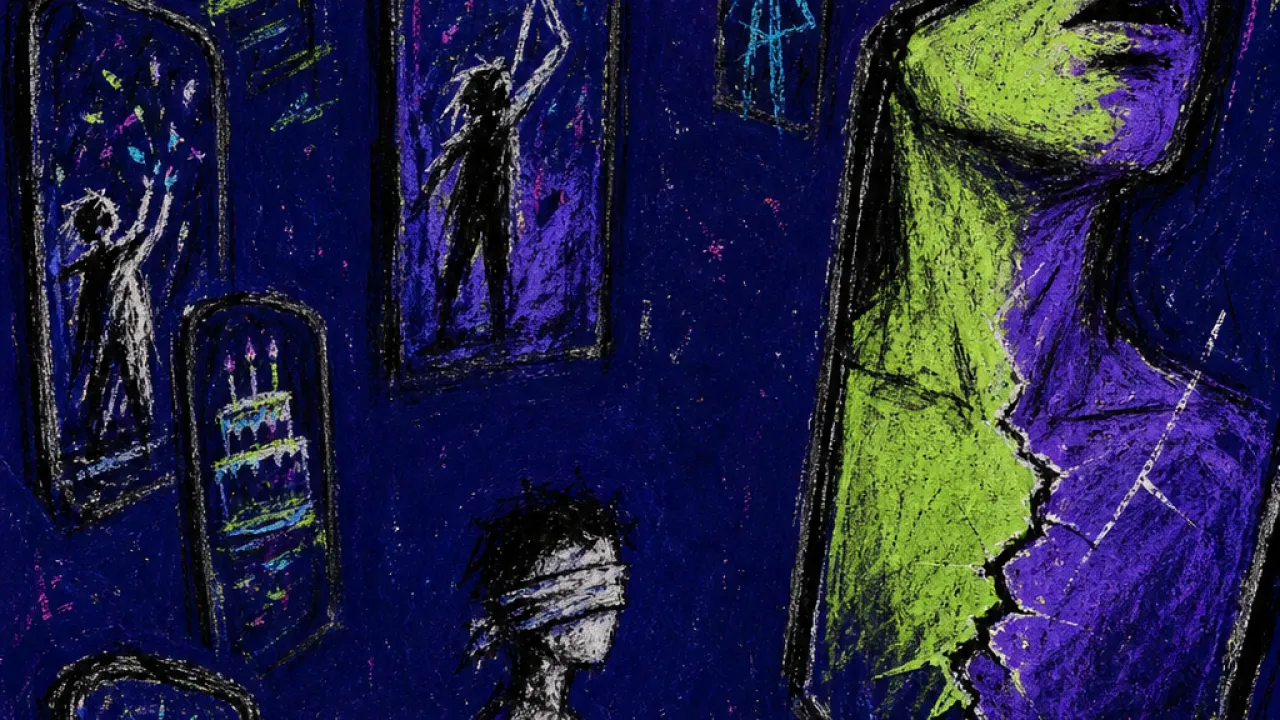
A blindfolded figure in a dark bedroom surrounded by tall glowing phone-screen mirrors, neon green split by cold violet

What does this feel like?

Comparison Entrapment — you open your phone for one harmless second and suddenly your whole life is being measured against someone else's highlight reel before you've even had water. A friend posts a new job, someone from school buys a place, an ex looks happier than you expected, a stranger your age seems to have the body, relationship, income, passport stamps, friend group, confidence, discipline, or clean apartment you keep promising yourself you'll build one day. You know, rationally, that you are seeing fragments. You know people crop the mess out. You know no one posts the part where they cried in the kitchen or refreshed their email twelve times. But knowing that does not stop the drop in your stomach, the heat behind your face, the tiny internal flinch that whispers, what if I'm late, what if I'm wasting it, what if everyone else got the instructions and I missed them? You start checking your own life like it's a profile someone else is judging: the way your room looks on camera, the words in your bio, the job title that feels too small, the relationship status that feels too loud, the plans you don't mention because they still haven't worked. Even good news from people you love can become a mirror you weren't ready to stand in front of. You smile, you comment something kind, and then you go quiet for a while because part of you is trying to be generous while another part is counting the distance between their life and yours. The trap is not that you want what they have; sometimes you don't even know if you want it. The trap is that comparison keeps stealing the floor from under your own wanting, until your choices start to feel less like choices and more like attempts to prove you are not falling behind. You begin living beside your life instead of inside it, watching yourself from the outside, asking whether this version of you would look impressive enough to someone who is not even paying attention, much like the figure on the Eight of Swords, bound and blindfolded among sharp edges, with space nearby but no clear way to trust it.

What's pulling at you?

You're not stuck because you lack direction; you're stuck because your own pace keeps getting interrupted by everyone else's visible milestones. One part of you wants to choose from the inside out, while another part keeps scanning the room, the feed, and the timeline for proof that you're still on track.

How It Shows Up?

  • You wake up and reach for your phone before your feet touch the floor, meaning to check one message, then suddenly you're looking at someone else's holiday, promotion, engagement, apartment, body, friend group, soft-launch, or 'life update.' Your stomach tightens before you've fully woken up, your thumb keeps moving even after your chest has gone heavy, and the day starts with the quiet sense that you're already behind. You can put the phone down without having to decide what your whole life means before breakfast.
  • You're talking to a friend who shares good news, and you smile because you do mean it, but a small part of you goes stiff behind the eyes. Your throat tightens, your shoulders lift, and while they're still speaking, your mind is already running a private spreadsheet of where they are, where you are, and what that says about you. You can be glad for someone and still need a second to come back to yourself.
  • You're at work, school, or scrolling job posts, and someone your age seems to have the title, salary, portfolio, following, or clarity you thought you were supposed to have by now. Your jaw locks, your breathing gets shallow, and the task in front of you starts to look smaller, almost pointless, like a single wand under the weight of the Ten of Wands. You can return to one doable next step without turning your whole future into a verdict.
  • You're at a birthday, dinner, group chat, or house party, and the conversation turns into milestones: who's moving in, who's travelling, who's launching something, who's saving money, who's dating, who's glowing up. You laugh at the right moments, but your hands feel tense around your drink, and you catch yourself rehearsing how to make your own life sound more impressive than it feels. You don't have to perform a polished version of yourself to stay in the room.
  • Late at night, you open a tab, close it, open another app, check one person's profile, then another, then someone you barely know from three years ago. Your eyes ache, your neck is tight, and your chest feels squeezed by a comparison that keeps changing shape every time you think you've named it. The screen becomes a row of swords around you, and it is enough to notice the loop before you decide what to do with it.

Comparison Entrapment in Tarot Cards

Comparison Entrapment lives in the moment your own pace gets swallowed by someone else's visible timeline. It shows up in the tight throat, locked jaw, and shallow breath that arrive before you've even named what you are measuring. From an existential perspective, the structural framework here is about being caught between wanting your own life and needing outside proof that it counts. The Tarot Cards below mirror that caught shape without turning it into a simple answer.

Justice
Reversed
A seated figure holds balanced scales in one hand and an upright sword in the other, positioned between pillars that frame judgment as a disciplined review of evidence. The composition depends on proportion: the scales can only clarify when what is placed on them is genuinely comparable. Reversed, the audit uses asymmetrical evidence. You place the hidden complexity of your entire life on one side and somebody else's selected achievement on the other, then treat the resulting imbalance as a fair verdict. The structure names why rational knowledge about curation does not automatically end the shame; the comparison process is still presenting itself as objective measurement while its inputs remain fundamentally unequal.
The Devil
Upright
Two chained figures remain beneath a dark pedestal, mirroring one another while facing the same dominating image above them. Their tails and exposed bodies make the attachment embodied rather than abstract, while the loose chains show a restraint sustained partly through continued participation. Upright, the scene holds the internal loop between shame and checking. You scroll because you feel uncertain about your position, comparison intensifies that uncertainty, and the intensified feeling sends you back for more evidence. The structure does not reduce the experience to weak willpower; it identifies a self-reinforcing attachment in which distress becomes both the cost of the behaviour and the trigger that renews it.
Judgement
Reversed
An angel sounds a trumpet above multiple figures rising together from grey containers, their attention directed toward one elevated summons. The collective response makes awakening visible, but it also creates a powerful scene of everyone apparently receiving the same call at the same moment. Reversed, that summons becomes entangled with an internal verdict about whether you have developed enough, awakened soon enough, or answered life correctly. You may hear other people's visible growth as proof that they received instructions you missed, while your own quieter call is drowned out by self-evaluation. The structure separates genuine evolution from the demand to demonstrate transformation on a shared public schedule.
Three of Cups
Reversed
Three figures form a close celebratory circle with raised cups, shared movement, and the fruits of abundance spread around their feet. The scene is designed to hold joy collectively, with each person's uplift participating in rather than diminishing the others. Reversed, that shared container loses its function and celebration becomes a site of private ranking. You can sincerely care about a friend's engagement, promotion, relationship, move, or creative win while another part of you calculates what the news implies about your own life. The inverted circle names the split between outward generosity and inward displacement, where comparison temporarily pushes you outside the friendship even while you remain physically present.
Seven of Cups
Upright
A solitary figure faces seven elevated cups filled with radically different promises, while cloud separates every image from practical ground. The display resembles an aspiration market in which bodies, status, wealth, romance, travel, power, and mystery can all be consumed as competing versions of a better self. Upright, the scene reveals a growth system overloaded by borrowed ideals. You may call each new comparison inspiration, then build goals around becoming impressive enough to silence the fear of falling behind. The cups preserve the difference between an image that activates desire and a value that can organise practice, showing where self-development becomes reactive self-replacement rather than an integrated expansion of your own life.
Ten of Cups
Reversed
Ten cups form a rainbow over a couple, two children, a home, and an abundant landscape, presenting emotional completion as one coherent and publicly legible image. Every component is visible at once, much like a relationship announcement that compresses years of private complexity into a single scene of arrival. Reversed, the image of completion stops functioning as a source of shared meaning and becomes a standard against which love is found deficient. You may compare a real relationship, a period of being single, or an uncertain bond with the polished totality of someone else's visible milestone. The tension lies between intimacy as lived experience and intimacy as a completed picture that can be displayed, recognised, and ranked.
Seven of Pentacles
Reversed
A worker leans heavily on a tool and studies a plant bearing seven pentacles, pausing between invested labour and an unfinished harvest. The crop is real, but its stage of development does not yet provide the final outcome against which the work is being judged. Reversed, the pause contracts into an impatient audit of whether progress is happening fast enough. You can look at a peer's visible harvest and reinterpret your own developing work as wasted time, even when the two processes began with different resources and conditions. Comparison entraps timing by converting growth into a race and by treating anything that cannot yet be displayed as evidence that nothing is working.
Five of Swords
Upright
One figure gathers swords while two others walk away beneath a jagged sky, arranging the scene around a visible winner and visible losers. The collected blades create possession, but the relational field has been thinned by the logic through which that possession was established. Upright, the image exposes the zero-sum model that comparison can import into friendship. You may begin treating a friend's success as movement above you and your own good news as evidence needed to recover position, even when neither person intended a contest. The cost is not only envy; it is the gradual replacement of mutual support with an internal scoreboard that makes closeness contingent on who appears to be winning.
Eight of Swords
Upright
A blindfolded woman stands bound within a loose arrangement of swords, unable to verify the open space that remains around her. The blades are external and visible, but the blindfold makes their apparent verdict difficult to test against the full environment. Upright, the image gives comparison entrapment its clearest internal shape. You carry other people's milestones into an imagined tribunal, then view your room, body, work, relationships, and pace from the perspective of an audience that may not be watching. The observer-self becomes so dominant that your own evidence is obscured, while the loose bindings show that the felt certainty of inadequacy exceeds what the available facts can establish.
Page of Swords
Reversed
The Page stands on uneven ground with a sword held high, head turned toward signals arriving from outside the immediate path. Wind presses through the trees, hair, and clouds, giving the entire image the quality of a social environment that never stops updating. Reversed, the Page's information sensitivity becomes compulsive social surveillance. You scan profiles, conversations, group dynamics, and subtle status cues in search of a stable answer about where you belong, but each new signal restarts the audit. The comparison trap is maintained by attention itself: the more social evidence you collect, the more variables appear available for ranking.
Five of Wands
Upright
Five figures press into the same limited field with raised staffs, making every individual effort legible only in relation to the efforts around it. Their tools cross before any shared task becomes visible, so the scene privileges ranking and interference over learning. Upright, the image reflects a study environment where grades, speed, placements, publications, and visible confidence become measures of intellectual worth. You can interpret a classmate's result as evidence that your own work has diminished, even when the two learning processes involve different histories and aims. Comparison turns knowledge acquisition into positional defence, making curiosity harder to sustain whenever somebody else appears ahead.
Six of Wands
Reversed
A wreath-crowned rider occupies the highest and most visible position in a public procession, with achievement confirmed by the surrounding crowd. Growth in this scene is legible because it can be displayed, recognised, and attached to a clear winner. Reversed, recognition becomes an unstable substitute for internally integrated development. You may pursue habits, confidence, discipline, appearance, or achievement partly because the improved self would look impressive enough to settle comparison. The inverted victory structure names the gap between changing in order to inhabit your life more fully and changing in order to secure a favourable rank in somebody else's imagined view.
Ten of Wands
Upright
A figure advances under ten gathered wands, shoulders folded and line of sight narrowed by the weight directly in front of the face. The town is close, yet the total load makes arrival harder to perceive and the route harder to evaluate. Upright, the burden models study plans expanded in reaction to high-performing peers. You add more hours, resources, subjects, revision systems, or extracurricular proof because somebody else's output made your current process feel insufficient. Comparison traps learning inside workload escalation: the volume of effort grows, while the mental bandwidth required for comprehension, retention, and realistic pacing becomes increasingly restricted.

Comparison Entrapment in Tarot Card Reading Insights

Comparison Entrapment is often carried into readings when someone can no longer tell whether they want something, or only feel behind without it. The shift from cards to readings shows how this pressure appears when people ask about timing, direction, visibility, and self-worth. Tarot Reading Insights connected to this struggle are gathered below.
When an Ex's Highlight Reel Grades Every New Date: Changing the Test

When an Ex's Highlight Reel Grades Every New Date: Changing the Test

Topic:Love Tarot Reading

Struggle:Idealization-Reality Split

Context:Nostalgia Timing Trap

Mocking a Promotion, Reopening the Post—Choosing a Personal Measure

Mocking a Promotion, Reopening the Post—Choosing a Personal Measure

Topic:Social Tarot Reading

Struggle:Belonging-Authenticity Split

Context:Status Anxiety Circle

Comparing Every New Date to an Ex at 11:40 p.m.: A Fairer Question

Comparing Every New Date to an Ex at 11:40 p.m.: A Fairer Question

Topic:Love Tarot Reading

Struggle:Idealization-Reality Split

Context:Past Relationship Idealization

A Promotion Post Turned Tuesday Into a Status Chase, Then a Pause

A Promotion Post Turned Tuesday Into a Status Chase, Then a Pause

Topic:Choice Tarot Reading

Struggle:Social Clock Entrapment

Context:Premature Career Pivot Pressure
Three Tabs After a Promotion: From Scorekeeping to a Feedback Ask

Three Tabs After a Promotion: From Scorekeeping to a Feedback Ask

Topic:Personal Growth Tarot Reading

Struggle:Value-Desire Split

Context:Insight Integration Window

Coat Still On, She Compared Her Date to Her Ex—Then Readiness Counted

Coat Still On, She Compared Her Date to Her Ex—Then Readiness Counted

Topic:Love Tarot Reading

Struggle:Idealization-Reality Split

Context:Chemistry to Commitment Test

Summer Trip Timeline Panic and the Move From Proof to Quiet Growth

Summer Trip Timeline Panic and the Move From Proof to Quiet Growth

Topic:Timing Tarot Reading

Struggle:Social Clock Entrapment

Context:Social Clock Pressure

Why You Delete Photos Before Posting—and How to Drop the Scoreboard

Why You Delete Photos Before Posting—and How to Drop the Scoreboard

Topic:Study Tarot Reading

Struggle:Aesthetic Self-Management Trap

Context:Personal Brand Performance

After a Coworker's Promotion: From Slack Spiral to Self-Trust

After a Coworker's Promotion: From Slack Spiral to Self-Trust

Topic:Love Tarot Reading

Struggle:Inherited Timeline Lock

Context:Promotion Criteria Black Box

A Coworker Promotion Email Hit—And the Shift from Proving to Routine

A Coworker Promotion Email Hit—And the Shift from Proving to Routine

Topic:Personal Growth Tarot Reading

Struggle:Desire-Shame Bind

Context:Always On Availability

My 'Pride' Was Actually Scorekeeping: How I Stopped Counting Hearts

My 'Pride' Was Actually Scorekeeping: How I Stopped Counting Hearts

Topic:Family Tarot Reading

Struggle:Internal Authority Collapse

Context:Family Script Pressure

After a LinkedIn Promotion Post, I Quit Spiraling and Sent One Thing

After a LinkedIn Promotion Post, I Quit Spiraling and Sent One Thing

Topic:Introspection Tarot Reading

Struggle:Visibility-Execution Split

Context:Networking Launch Window

Psychological Struggles Related to Comparison Entrapment