Coat Still On, She Compared Her Date to Her Ex—Then Readiness Counted

The 10:40 p.m. Highlight Reel
I met Maya, a 29-year-old product designer in Toronto, just after she had walked home from a first date that was kind, funny, and steady. Because there had been no immediate rush, she was already replaying the one conversation with her ex that had once felt effortless.
At 10:40 p.m., she sat on the edge of her bed with her coat still on. Her phone glowed hot against her palm as she typed, deleted, then retyped a polite reply to the new person's measured follow-up text. Through our video call, I heard the radiator tick and a streetcar hiss along the wet road below her condo.
“I know he wasn't ready,” she said. “So why does everyone else feel like the compromise? No one has done anything wrong, but they still feel like less.”
Each return to the old memory seemed to make her chest drop by another floor. The date had been pleasant, yet her mind had opened the ex's edited highlight reel before the present evening had even finished loading. She was not only asking whether the new person was right for her. She was asking whether giving someone available a genuine chance would mean admitting that the uniquely meaningful future she had imagined with her ex was gone.
“You are comparing a first draft with a memory you have edited for months,” I said. “That does not make your feelings foolish, and we are not here to order you to move on. We are going to separate what was meaningful from what was actually available, then see whether the present can be evaluated on its own terms. Let us give this fog a map.”

Choosing the Compass: A Five-Card Shadow Spread
I invited Maya to put both feet on the floor, take one unforced breath, and hold the question in mind while I shuffled. I use that pause as a psychological threshold. It gives a racing mind somewhere to set down its bags; it is not a ritual for surrendering a decision to fate.
I chose The Shadow Spread, a five-card relationship shadow tarot spread. This is how tarot works in my practice: the cards provide a structured set of images and questions through which a person can observe a pattern more objectively. They do not tell me whether an ex will return, whether a new date is destined to work, or what Maya must choose.
This spread fit because Maya's active difficulty was not an interaction between two current partners. It was an internal loop involving nostalgia, unresolved ambiguity, fantasy, and protection from loss. A relationship spread focused on the ex could have encouraged more speculation about his mind. The Shadow Spread kept the inquiry where Maya still had agency.
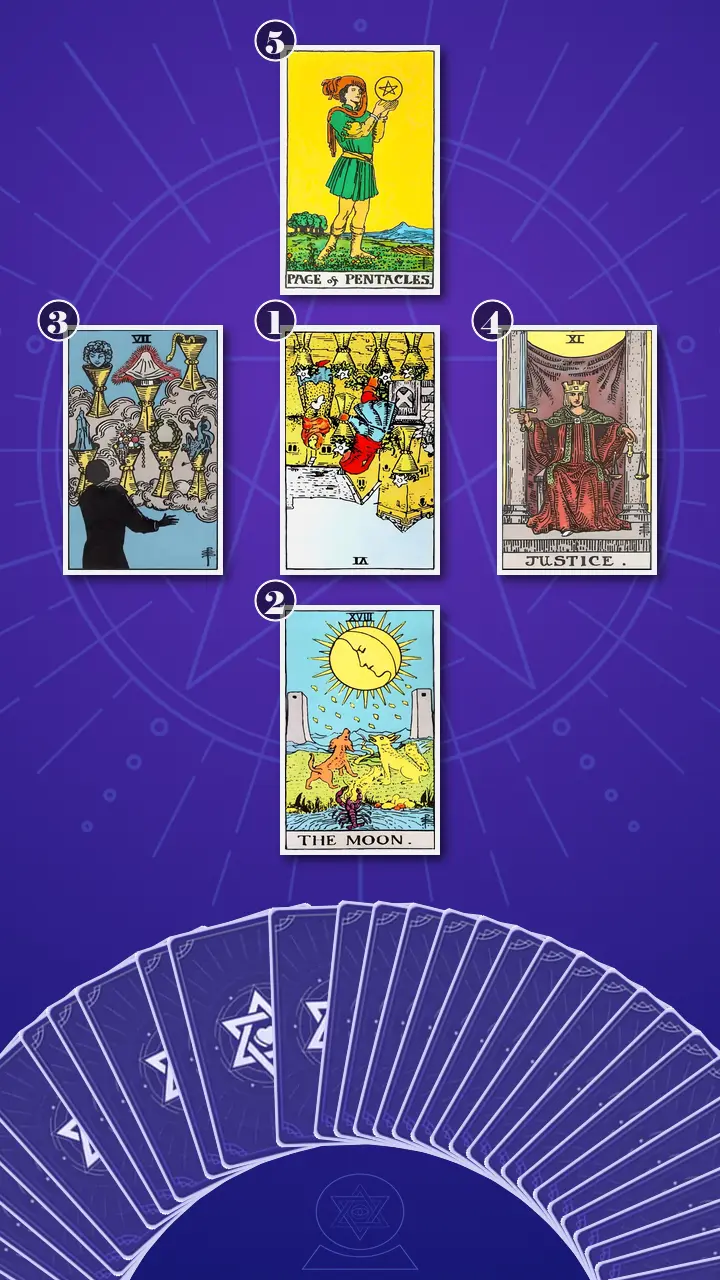
I laid the cards like a compass. The centre would show the current comparison habit. The card below would reveal the unresolved root, and the card on the left would show what idealisation was protecting. On the right, the balancing truth would become visible. The final card above the centre would turn that truth into a grounded next step.
The Past Kept Entering the Room
Position One: Six Cups Behind Glass
The first card I turned over represented the current expression of the shadow: the observable habit of comparing incomplete real dates with an edited memory of the unavailable ex. It was the Six of Cups, reversed.
I pointed to the child offering a flower-filled cup inside the enclosed courtyard. Upright, the card can hold tenderness, familiarity, and an uncomplicated exchange. Reversed here, that exchange had become a blockage. The memory was no longer moving through Maya's life as one meaningful part of her history; it was sitting behind protective glass and setting the admission standard for every new person.
In everyday terms, the card looked exactly like Maya comparing a new person's awkward first-date pause with the ex's most effortless conversation. She repeatedly returned to one protected emotional scene while leaving out the evidence that he had not been ready to build the reciprocal relationship she wanted. The new person was being graded as a complete disappointment before enough ordinary contact had occurred.
I gave the loop its private script: “I remember exactly how effortless that conversation felt, but I am not remembering what happened when I needed clarity.” The ex received his strongest moment, his most charged message, and the future Maya had supplied herself. The new person received one unfamiliar texting rhythm and thirty seconds of awkward silence. Repeated unavailability, unclear commitment, and the untested future had been cropped out of the old frame.
Maya gave a short, bitter laugh. Her thumb stopped rubbing the edge of her phone, and she looked away from the screen. “That is so accurate it feels a little brutal,” she said. “He gets the best conversation. This guy gets the moment he stumbled over a question about work.”
“What exact moment tonight reopened the comparison?” I asked.
“The text,” she said. “It just said he had a nice time. It was normal. My ex used to send these intense late-night messages, and suddenly normal felt like proof that there was nothing there.”
Position Two: The Road Built from Missing Information
The next card represented the underlying root: the ambiguity left by an ex who was not ready and the unresolved counterfactual that Maya's imagination continued to complete. I turned over The Moon, upright.
The winding path between the two towers gave us the central image. The Moon does not illuminate a landscape with enough clarity to verify every shape. Its balanced invitation is to move carefully while admitting what remains unknown. In Maya's pattern, however, lunar uncertainty had diffused into excess projection. A possible destination had begun to feel like a road she and her ex had actually travelled.
A delayed message, an ambiguous ending, or a remembered look could become a doorway into a complete imagined future. That future had never encountered schedules, boundaries, conflict, domestic habits, mutual commitment, or the ordinary Tuesday evening when neither person was especially magnetic. The Moon was not revealing a hidden destiny with the ex. It was showing how easily missing information had acquired emotional detail.
As a cloud moved across the streetlight behind Maya, the shadow of her window frame briefly crossed her face like one of the Moon's towers. I asked, “When he said he was not ready, what future did you begin completing for him?”
Her fingers tightened around the phone, then loosened. “That he would do the work and come back ready,” she said. “I turned not now into maybe later. I think I have been treating maybe as evidence.”
“An unfinished connection can stay perfect because it never had to survive ordinary life,” I said. “The feeling can be real while the continuation remains unconfirmed.”
Position Three: Seven Untouched Futures
The third card represented the protective function: what idealising the ex allowed Maya to preserve or avoid when a real connection required uncertainty, imperfection, and mutual vulnerability. It was the Seven of Cups, upright.
A silhouetted figure faced seven visions suspended in clouds. The figure could inspect every possibility without touching, testing, or choosing any of them. Here, the Cups energy was in excess: imagination generated emotionally persuasive options faster than reality could supply evidence.
For Maya, the card looked like an open browser window with seven possible futures. In one tab, the ex returned ready. In another, he finally explained everything. In a third, their connection proved so singular that every disappointing date became retroactive confirmation. None of those tabs had to survive an actual calendar, a boundary, or a difficult conversation.
I also compared it with a perfect product roadmap that never reaches the sprint where engineering constraints appear. As a product designer, Maya knew the seduction immediately: the untouched concept can retain every ideal feature because no user, deadline, or real-world trade-off has tested it. An available person cannot remain that pristine. A real person arrives with pauses, preferences, limits, and needs of their own.
“What would you have to feel if the ex were no longer preserved as your most meaningful possibility?” I asked.
Her breath paused. Her eyes drifted toward the unread text, as if another answer might be hiding beneath it. Then her shoulders curled slightly inward. “I would have to admit I couldn't make that future happen,” she said. “And I would have to risk wanting something different that might also disappoint me.”
I let the room remain quiet for several seconds. The fantasy was not evidence that Maya was shallow, disloyal, or incapable of love. It had been performing a protective job. Dismissing a new person quickly restored loyalty to the old story and removed the immediate discomfort of not knowing. The cost was that no present connection received enough time to become anything except unfamiliar.
When Justice Put Availability on the Scales
Position Four: The Truth Maya Could Reclaim
When I moved across the centre of the spread, the radiator on Maya's side went quiet. A straight line of lamplight caught the next card's raised sword. The fourth position represented the truth to reclaim: a fair evaluation that gave readiness and reciprocity the same weight Maya had been giving intensity and remembered potential.
I turned over Justice, upright.
Justice held level scales in one hand and a vertical sword in the other. The scales did not ask Maya to deny chemistry or reduce love to a spreadsheet. They asked her to apply the same present-day criteria to both the ex and a new date: readiness, reciprocity, consistency, follow-through, and actual ease. The sword separated lived fact from imagined continuation.
I told Maya that her comparison resembled a product designer testing a rough prototype against a polished launch video. The prototype revealed every hesitation because it was being used in real time. The launch video contained only its strongest sequence. A fair design critique would return both versions to the same criteria.
Seeing Justice, I remembered my years at a perfumer's bench, where even a beautiful note could overwhelm every blotter if I allowed it to diffuse across the workspace. I call the relational version of this a Boundary Permeability Assessment: I look for the point where one person's emotional presence ends and another person's experience begins.
Maya's memory of the ex had become too permeable. Like a powerful fragrance clinging to the room, it entered each new date before that person had a chance to reveal a distinct composition. Justice did not require Maya to scrub the memory away. It gave the memory its own testing strip. What she had felt could remain meaningful without being allowed to scent every piece of present evidence.
At that point, I returned to 10:40 p.m.: her coat still on, a kind text glowing in her palm, her chest dropping as an old playlist became more convincing than the date. She was trying to make remembered intensity deliver certainty before the present had time to speak.
Do not let unrealized potential pose as proof; place readiness, reciprocity, and lived experience on Justice's scales and take the next step from what is real.
For one beat, Maya did not move. Her inhale stopped halfway; her index finger hovered above the edge of Justice. Then her gaze slipped out of focus, as though she were replaying every time she had praised the ex's chemistry and omitted his retreat. Her jaw tightened.
“But if I count the unavailability, doesn't that mean I was wrong about us?” The words came sharper than anything she had said before.
I let the anger have room. “No,” I said. “It means your feeling was real and your evidence was incomplete. You do not have to shame the first to correct the second.”
Her eyes brightened. Her shoulders dropped by a fraction, then all at once. The fist in her lap opened, and she released a shaky “Oh” followed by a small laugh. Relief softened her mouth, but a blank, almost dizzy look followed it. Clarity had returned the decision to her, and that new responsibility felt more exposed than the old automatic comparison.
“Now, using this new perspective, think back to last week,” I said. “Was there a moment when this insight could have made you feel different?”
Maya thought of brunch with friends, where she had retold the ex's best conversation while leaving out the months when he could not meet her needs. “I could have said the whole sentence,” she replied. “The chemistry was strong, and he was not available. Both were true.”
I asked her to open a note titled Fair Witness. Within ten minutes, she wrote three lines about that evening: one observable fact about the new person's readiness, one sign of reciprocity, and one bodily response. She did not mention her ex. I reminded her that this was information, not an obligation to schedule another date, and that she could stop if the exercise made her body contract further.
I named the change I had just witnessed: Maya was taking one step from protecting an unavailable ex's edited highlight reel toward evidence-based dating discernment grounded in readiness, reciprocity, consistency, and present experience. This was not a command to stop caring. It was the beginning of trusting herself with a complete set of facts.
One Pentacle, Not the Whole Future
Position Five: The Date as a Piece of Evidence
The final card represented embodied integration: a small, present-focused dating practice that could replace instant comparison with grounded observation and curiosity. I turned over the Page of Pentacles, upright.
The Page stood in a cultivated field, holding one pentacle at eye level. After seven cloud-borne Cups, the single tangible object felt almost quiet. The card carried balanced earth energy: practical attention, beginner's mind, and a willingness to learn through contact rather than demand instant mastery.
In Maya's life, this meant treating each date as one piece of grounded information. After an interaction, she could record one fact, one felt response, and one genuine question. The date would no longer be an audition against a finished ideal or a verdict on her entire romantic future. It could support more curiosity, reveal incompatibility, or simply remain incomplete data.
I also pointed out the absence of Wands in the spread. Instant fire was not being condemned, but the cards did not support treating excitement as the only valid signal. The movement went from excess water, through Justice's clarifying sword, into earth. Emotion was not rejected; it was given a container and translated into experience that Maya could actually observe.
“What is one thing you would honestly be curious to learn about tonight's date, without asking him to defeat the past?” I asked.
Maya looked at the message again. This time, she did not open Spotify or her Instagram Archive. “I want to know whether the steadiness feels warmer when I am not testing it every five minutes,” she said. “I don't need to know the whole future tonight. I only need to notice what is actually here.”
The Blank Space Where Evidence Could Breathe
I drew the spread together as one coherent sequence. The Six of Cups reversed showed a meaningful memory preserved so carefully that it had become the current benchmark. The Moon showed why it stayed powerful: unreadiness had left a blank ending, and imagination had supplied the most flattering continuation. The Seven of Cups revealed the protection inside that fantasy. Untested possibility offered control and kept Maya away from the vulnerable, ordinary work of discovering what another person was actually like.
Justice corrected the unequal rules of comparison, and the Page of Pentacles made the correction usable. The visual progression mattered: six preserved flower cups became seven untouchable possibilities, then Justice introduced stable scales, and finally the Page held one real object. More imagined futures had not produced greater clarity. One present experience, fairly observed, could.
Maya's cognitive blind spot was not an inability to recognise thoughtful or emotionally available people. It was the use of two different standards. New dates had to produce evidence immediately; the ex was allowed to remain meaningful through possibility alone. The transformation direction was equally specific: stop asking whether a date recreates the ex, and begin noticing readiness, reciprocity, consistency, bodily ease, and whether curiosity grows through actual contact.
“I can already see myself turning this into another Notion board,” Maya said. “I work in product. I can overanalyse three lines.”
“Then we give the analysis a boundary too,” I replied. I introduced my Blank Space Protocol, a deliberate interval in which no decision has to be forced and the old emotional fragrance is not allowed to flood the room. This was not a dating game, a way to manufacture attraction, or pressure to grant someone more access. It was simply enough clean air for Maya to distinguish a genuine no from the reflex to restore the unavailable-ex benchmark.
The Fair-Witness Date Check
- Write the three-line Fair Witness note. Within ten minutes after a date, open the Notes app and record one observable sign of readiness, one sign of reciprocity, and one bodily response. Write only what a camera could have recorded, plus the physical sensation. Do not mention the ex. Tip: Stop after three lines. This is evidence collection, not an argument for or against another date. Pause if the exercise feels too activating.
- Create a 24-hour Blank Space. Until the following day, do not reopen the ex's messages, Spotify playlist, camera roll, or Instagram Archive. Notice the exact trigger that brought him back, such as a slow text, an awkward pause, or the absence of immediate intensity. Then label the decision: more contact, not for me, or not enough information yet. Tip: The pause is not a commitment to a second date. Clear disrespect, inconsistency, lack of attraction, or a firm internal no remains enough reason to stop.
- Choose one Pentacle-sized question. If no clear red flag appeared and some curiosity remains, choose one present-focused question about communication, values, or daily life before the next interaction. If continuing feels honest, send a low-pressure message such as, ‘I enjoyed talking with you. I would be open to continuing the conversation if you are.’ Tip: Explore one question, not the whole romantic future. You can revise your view after one more interaction, and you never owe continued contact or emotional labour.
The cards did not choose the new person, close the door on the ex, or promise that slow-building attraction would appear. They helped Maya see the criteria she had been using and decide which criteria she wanted to use next. The authorship remained hers.

Six Days Later: A Quiet Piece of Proof
Six days later, Maya messaged me from a quiet coffee shop. She had sent the low-pressure second-date text, then sat alone by the window. Her first thought was, “What if I am wrong?” This time, she let it pass without opening the playlist.
She had not solved her romantic future, and she had not forced herself to feel a cinematic spark. She had simply allowed one available person to exist outside the ex's atmosphere long enough to become distinct. That was the first proof of her Journey to Clarity: not certainty, but a fairer quality of attention.
I have learned that when we leave a kind date with our shoulders tight because calm feels like betrayal, we are not only missing an ex. We may also be trying to control the loss of a future that was never fully placed in our hands. Noticing that does not erase the memory. It gives the present room to breathe and returns the scales to the person whose life is actually being lived.
If your next interaction could be one pentacle held at eye level rather than a verdict, what small sign of readiness, reciprocity, or ease would you be curious to notice before the old fragrance fills the room?