When a Friend's Promotion Becomes a Private Scoreboard
If you make the “LinkedIn cringe” joke and then reopen the promotion post before bed, I know how quickly one polished update can become a full-body career audit.
At 11:40 on a Sunday night, Alex, a 28-year-old product designer in Toronto, had paused over a friend's new-role announcement in a condo bedroom near Queen West. As Alex described it to me, I could picture the radiator clicking beside an unwashed water glass while blue screen light washed over three open tabs: the friend's profile, the company page, and Alex's own portfolio. The phone had grown hot in their palm. Their jaw had locked before they even typed, “Work is becoming everyone's whole personality,” into the group chat.
The joke gave them perhaps thirty seconds of distance. Then they counted the congratulations, compared titles, and rewrote the opening of their portfolio until it sounded more senior. By the time they came to me, Alex could state the contradiction with painful precision: “I don't want their life, so why does their promotion ruin my evening? I keep pretending I'm above a scoreboard I check every day.”
I heard more than ordinary jealousy in that sentence. I heard a person trying to reject status as a measure of worth while fearing that a friend's visible status meant they were falling behind. The shame-tinged envy sat in their body like a seat belt pulled too tight across the chest: protective at first, then impossible to ignore. Their stomach dropped whenever someone else's success was mentioned, and sarcasm arrived before the more vulnerable sentence could surface.
“You want to reject the scoreboard,” I reflected, “but your body is already checking whether you're losing. I don't want to tell you that ambition is good or bad, and I won't use tarot to predict who gets ahead. I want us to understand what the comparison is protecting, what it is trying to tell you, and which next step would actually belong to you. Let's draw a map through this fog.”

Choosing the Five-Card Shadow Map
I invited Alex to place both feet on the floor and take one slower breath while holding the question in mind: “Why do I judge status-chasing friends while comparing myself too?” I shuffled slowly, not to manufacture mystery, but to give their nervous system a clean transition from replaying the problem to observing it.
I chose The Shadow Spread, arranged as a five-card cross. I think this is how tarot works best in a situation like Alex's: not as fortune-telling, but as an external structure for separating reactions that have become fused together. This particular five-card Shadow Spread is designed for uncovering projected ambition, fear of exclusion, values-based discernment, and grounded contribution. It gives card meanings in context instead of treating envy, ambition, or social media as proof of anyone's character.
The first position would reveal the visible defense: criticizing friends before privately comparing career markers. The central position would expose the fear carrying the weight of the pattern. The fourth would show the capacity Alex could reclaim, while the final card would translate that capacity into an observable practice. The cross resembled a balance beam anchored by a vertical spine, with the fear of exclusion sitting at its load-bearing center.
“We're not asking the cards to decide whether your friends are shallow or whether you should chase status,” I said. “We're asking a more useful set of questions: What gets triggered? What desire has been disowned? What fear gives the trigger so much force? And what can you choose once those pieces are visible?”

Reading the Shadow Behind the Scroll
Position One: The Trumpet That Became a Trial
Now I turned over the card representing the observable symptom: criticizing friends' status seeking before privately comparing visible career markers. The card was Judgement, reversed.
In the traditional image, an angel sounds a trumpet and figures rise to answer a call. I translated that trumpet into the push notification carrying a friend's promotion announcement. Instead of arriving as one person's update, it lands in Alex's feed like an alarm demanding an immediate ruling: Who is shallow? Who is ahead? What does this say about my entire career?
I returned to the exact Sunday-night sequence. The first thought was, “This is so performative.” The second was, “But how many people congratulated them?” The public verdict appeared in the group chat; the private self-review continued through profile checks, company tabs, and a portfolio rewrite. The joke was not evidence that Alex was cruel or fake. It was a fast attempt to regain control before the friend's news could open a much harsher internal performance review.
I read the reversed energy as both blockage and excess. Honest self-evaluation was blocked because it felt too exposing, while verdict-making had become overactive. The more Alex tried to prove that recognition did not matter, the more energy they spent monitoring it. Judgement reversed also warned against the overcorrection of hiding legitimate accomplishments, refusing to ask for advancement, or treating every wish to be visible as a moral failure.
Alex gave one short laugh with no warmth in it. Their eyes dropped to the card. “That's so accurate it feels a bit brutal.”
I did not rush past the sting. “Then let's make sure the accuracy does not become another weapon against you,” I said. “I am describing a sequence, not delivering a verdict on your personality. You are not above the scoreboard if you check it every day; you may just be tired of what it asks you to prove.”
Their mouth tightened in a brief wince, then they nodded. “I do it before I even realize I'm doing it.”
Position Two: The Wreath No One Was Supposed to Want
Now I turned over the card representing the disowned quality projected onto friends: Alex's own wish for recognition, visibility, and proof of progress. The card was Six of Wands, reversed.
The upright card shows a rider elevated above a crowd and crowned with a laurel wreath. Reversed, the crowd remains highly visible, but the ability to admit or receive recognition becomes unstable. In Alex's life, the wreath had become the polished LinkedIn announcement, the conference stage, the praise-filled Slack thread, and the visible stack of “Congratulations!” comments.
Alex told me about standing on the packed Line 1 platform at Union Station, the air smelling of wet wool and brake dust as an overhead announcement crackled through the station. They had zoomed in on name tags in a friend's industry-event photos while thinking, “I would hate that scene.” Yet the phone stayed warm in their hand as they inspected the guest list, the size of the room, and which mutual contacts had attended.
“Try finishing this sentence,” I said. “I don't want that life, except for the part where...”
Alex stared at the reversed rider. “Except for the part where people assume their ideas matter. Except for being invited into decisions before everything is already decided.”
That distinction mattered. Alex did not necessarily want the rooftop photo, the title, or the performance of access. They wanted creative influence and evidence that their product thinking was trusted. The Six of Wands reversed showed blocked Fire: initiative that could have supported meaningful visibility was being redirected into monitoring the audience. It was like saying they hated the algorithm while refreshing the analytics to see whether the algorithm had chosen them.
“Wanting your work to be recognized is not the same as wanting to win every room,” I said. “If you refuse to name the first desire because it resembles the second, other people's visibility gets even more power over you.”
Alex's shoulders stayed high, but their fingers stopped tapping the table. They looked at the wreath for several seconds before saying, more quietly, “I think I resent people for asking for credit because I don't know how to ask without feeling embarrassing.”
Position Three: The Lit Room Across the Snow
Now I turned over the card representing the underlying fear maintaining the cycle: that being less visible means being behind, excluded, or worth less. The card was Five of Pentacles, upright.
I was careful with this card. I did not read it as a prediction of financial loss or professional exclusion. That would have been both careless and needlessly alarming. I read it as an image of the moment when attention contracts around scarcity: two figures move through snow while illuminated pentacles remain visible in a building beside them.
Alex recognized the modern version immediately. On a grey morning in the office kitchen, they had listened to colleagues compare conference invitations beside the hiss of the espresso machine. They carried their coffee back beneath hard fluorescent light, opened Slack without reading the messages already waiting, and felt their stomach sink. A casual conversation became the conclusion, “Everyone is already inside the room where careers happen, and I'm outside pretending not to care.”
I told Alex, “Their update looks like access; your nervous system translates it into exclusion.” Slack praise threads, launch photos, former classmates' titles, and invite-only dinners had become digital stained glass. The light was visible, but Alex's narrowed attention temporarily hid the support, skill, relationships, and possible doors already within reach.
The card's Earth energy appeared as a scarcity-driven blockage. Toronto rent, career uncertainty, and the material value of a promotion made status feel less optional than Alex wanted it to be. Their comparison was not simply vanity. It carried questions about income, safety, belonging, and whether there would be room for them in a costly city. Still, the card did not confirm the scarcity story. It showed how quickly lower visibility was being mistaken for lower worth.
Alex's breath paused. Their gaze drifted away from the card as if they were replaying that office kitchen, then their compressed shoulders lowered by a fraction. “That's the part I don't say,” they admitted. “I don't just think they're ahead. I think their being ahead means there's less future left for me.”
“That is the fear beneath the argument,” I said. “Once we can see it, we no longer have to let it write every conclusion.”
When Justice Cut Recognition Away from Worth
Position Four: The Scales, the Sword, and Four Clean Columns
As I reached for the fourth card, rain moved softly against the window. A streetcar bell sounded once below us, clear enough to cut through the room's low hum. I turned over the card at the right side of the cross, the counterweight to the reversed Six of Wands.
Now I turned over the card representing what had to be reclaimed for transformation: honest, proportionate self-evaluation that could distinguish meaningful ambition from borrowed status goals. The card was Justice, upright.
Justice brought the balanced energy that the spread had been missing: honest self-accountability, proportion, and values-based discernment. Its scales did not ask Alex to suppress the desire to be seen. They asked Alex to separate four things that had collapsed into one moral emergency: desire, evidence, personal value, and borrowed prestige. Its sword cut the false equation between a friend's success and Alex's worth.
In everyday terms, Justice looked like a clean Notes-app page instead of an infinite feed. Alex could write, “I want more creative influence,” without adding, “Therefore I am shallow.” They could observe, “My friend was promoted,” without concluding, “Therefore I am behind.” Like the medal-and-diploma logic in The Wizard of Oz, credentials could confirm social recognition without creating the inner qualities they appeared to certify.
Seeing the scales, I thought of orbital mechanics. A body is not morally compromised because gravity acts on it; it simply needs accurate coordinates before it can change trajectory. I use a diagnostic lens called Gravity Well Identification for moments like this. I look for the old habits, environments, and assumptions exerting enough downward pull to make every attempt at movement curve back into the same loop.
Alex's friend's post was the trigger, but it was not the whole gravity well. The heavier forces were the rule that wanting recognition meant selling out, the assumption that another person's rise reduced Alex's available future, the habit of using sarcasm for instant altitude, and the feed that converted friendship into audience metrics. Toronto's financial pressure added real mass to the pull. Justice did not deny any of those forces. It gave Alex a way to measure them separately so they could stop confusing gravitational pressure with destiny.
I brought Alex back to 11:40 on Sunday night: the post still open, the joke already typed, the phone warm, three tabs waiting, and their body braced. They had treated the moment as a binary trial: either remain morally above status or admit they were shallow, compromised, and behind.
You do not have to prove that you are above the status game; use Justice's scales to weigh what you genuinely value and its sword to cut recognition away from self-worth.
I let the sentence settle. Then I gave its plain-language center: You do not have to prove you are above the status game. You can admit what you want, then refuse to let another person's visibility decide what you are worth.
Alex stopped breathing for a beat. Their fingers froze above the edge of the table, and their pupils widened before their gaze slipped past me toward the rain on the window. The first movement was not relief. Their jaw set harder, and their shoulders rose. “But doesn't that mean I've been a hypocrite?” they said, the word hypocrite coming out sharp. “Doesn't it mean all my values were fake?” I let the challenge stand. “No,” I said. “It means a real value and a real desire became tangled with a protective habit. The joke may have hurt people, and you can own that without turning yourself into a fraud. Accountability is a next choice, not a life sentence.” Their eyes shone; one hand tightened into a fist, then slowly opened flat on the table. A long breath left their chest. Their shoulders dropped, but they looked briefly unsteady, as if setting down the shield had revealed how much responsibility was underneath. “Oh,” they said, almost inaudibly. “Then I have to decide what I actually want.”
“Now, with this new perspective, think back,” I invited. “Was there a moment last week when this insight could have made you feel different?”
Alex remembered a Friday review in which a colleague received public praise for a launch. Alex had called the recap deck “very LinkedIn” in their head, then spent the commute wondering why their own contribution had not been named. With Justice on the table, they could finally make the desire specific: “I didn't want their applause. I wanted my research synthesis to be included when leadership discussed the product decision.”
“That is usable information,” I said. “Wanting to be seen is not the same as handing over your worth. A comparison trigger can be a clue before it becomes a verdict.”
I named the crossing Justice had opened: from defensive contempt and compulsive career benchmarking to honest desire, grounded self-respect, and values-led contribution. It was not a finished transformation. It was the first moment Alex could acknowledge recognition without either worshipping it or condemning it.
The Workbench Beyond the Feed
Position Five: Three Pentacles in a Shared Figma File
Now I turned over the card representing the grounded practice of integration: replacing profile-based ranking with skilled contribution, specific feedback, and collaborative progress. The card was Three of Pentacles, upright.
The traditional image shows an artisan at work while two collaborators examine a plan. I translated it into an unfinished Figma file brought into a constructive review. Instead of opening another person's profile and imagining a hierarchy, Alex could bring one onboarding flow to a trusted colleague and ask, “What is working here, and what is unclear?”
The energy was balanced Earth: value made tangible through practice, feedback, and something built with other people. It offered a mature counterpart to the reversed Six of Wands. Recognition did not have to disappear, but it could become specific and useful. It could sound like, “This decision is clear,” “This part needs evidence,” or “Your facilitation helped us reach the next iteration,” rather than an invisible crowd deciding who mattered most.
“Less proof of rank, more evidence of contribution,” I said. “Applause is loud evidence. Craft is durable evidence.”
I watched Alex lean toward the card for the first time that evening. They mentioned an unfinished onboarding flow they had kept polishing alone because showing a draft felt like exposing weakness. Then they opened their calendar and paused over a colleague named Priya, someone whose feedback was direct without becoming competitive.
The spread contained no Cups, and I found that absence revealing. Alex had been translating hurt, envy, longing, and fear into moral arguments before those feelings could be named directly. The Three of Pentacles did not ask them to achieve emotional purity before acting. It offered a practical bridge: acknowledge what the trigger touched, then build or request something real.
The Orbit Expansion Plan: Craft Over Crowd
I read the five cards as one continuous story. A friend's public announcement sounded Judgement's trumpet, but Alex's blocked self-review turned the signal into a verdict. The Six of Wands revealed the wish for meaningful recognition hidden behind criticism. The Five of Pentacles showed why that wish felt dangerous: social visibility had become entangled with belonging, financial safety, and worth. Justice reclaimed the ability to distinguish desire from rank, while the Three of Pentacles redirected the released energy toward craft, collaboration, and useful feedback.
The cognitive blind spot was not simply envy. It was the belief that wanting recognition invalidated Alex's values, combined with the assumption that another person's progress supplied evidence about Alex's rank. That double bind kept the same scoreboard in charge whether Alex chased it or mocked it. The transformation direction was not to stop caring about recognition. It was to become selective about which recognition supported creativity, security, contribution, and honest professional growth.
To turn the reading into actionable next steps, I adapted my Orbit Expansion Strategy. I drew a small trajectory on the page: trigger, pause, name the desire, identify the value, choose one craft-based move. The goal was not a dramatic escape from status culture. It was enough momentum to leave the old gravity well without entering a new comparison orbit.
“The joke may protect you for a minute,” I told Alex. “The question can protect your future attention.”
- Use the ten-minute Justice pause. The next time a promotion post, praise thread, or invitation activates the joke-then-scroll reflex, wait ten minutes before replying. Open a private note and write only three lines: “What am I judging?” “What might I want?” “What value could that desire serve?” End by choosing one action that takes under fifteen minutes and does not require copying the other person's path. Keep the note private and stop after three lines so it cannot become another ranking ritual. If ten minutes feels impossible, close the app, take three slower breaths, and try the sixty-second version.
- Replace profile checking with one feedback-first review. Before Friday, choose one unfinished prototype, case study, research summary, or design flow. Book twenty minutes with a trusted coworker, manager, or mentor and ask one narrow question: “What is working here, and what is unclear?” Measure the result by what becomes more specific, not by whether the reviewer praises you. Bring a draft, not a performance. Choose someone whose feedback is respectful and concrete, and change reviewers if the conversation turns competitive or unhelpful.
I reminded Alex that no card required them to congratulate someone before they were ready, disclose envy to friends, tolerate endless triggering content, or pursue every desire they uncovered. A boundary such as muting one account for a week could be a sensible attention choice, not a moral verdict. Justice asked for proportion; the Three of Pentacles asked for one inspectable experiment.
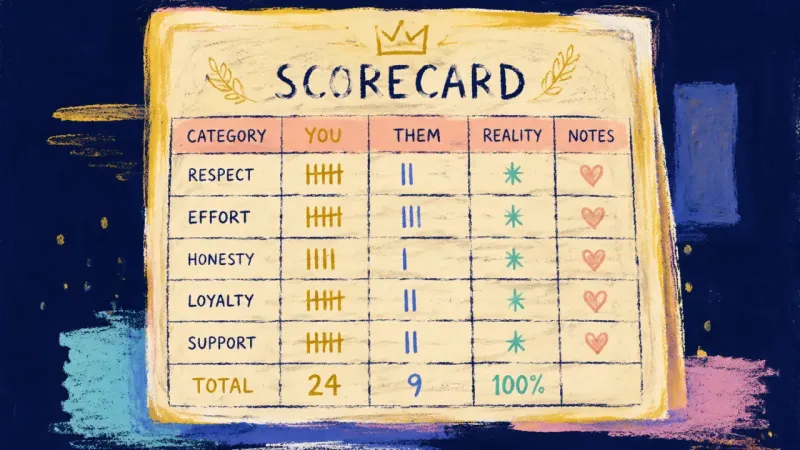
Six Days Later: The Quiet Proof
Six days later, I received a short message from Alex: “I saw another promotion post and wrote the note instead of sending the joke. The thing I wanted wasn't the title. It was more decision-making ownership. I asked Priya for twenty minutes with the onboarding flow.”
The review had not transformed their career. Priya had identified one strong product decision, one missing piece of evidence, and one place where Alex needed to state their role more clearly. Alex left with edits they could make and a follow-up conversation on the calendar. That was enough to turn imagined rank into observable contribution.
That night, Alex slept through until morning. Their first thought on waking was still, “What if I'm behind?” This time, they told me, it felt more like a weather report than a verdict, and they smiled before getting out of bed.
I did not credit the cards with changing Alex's orbit. Tarot provided a clear surface on which the hidden pattern could become visible; Alex supplied the honesty, chose the request, and opened the unfinished file. The Journey to Clarity did not end in certainty. It began with the ability to distinguish a temporary pull from a chosen direction.
I know that when a friend's good news tightens your jaw and drops your stomach, it can feel unbearable to want recognition while fearing that wanting it means you have become someone you do not respect. I also know that noticing the private scoreboard means you are no longer completely trapped inside its rules.
I will leave you with the question Justice left on my table: if the next comparison moment could become a clue rather than a verdict, what specific desire might you name before the crowd's scoreboard tells you what it means?
This story is adapted from psychological research, written so that those in a similar struggle can see their own pattern in it — and find their next step clearly.These insights are not a substitute for professional psychological, medical, legal, or financial advice.
Learn more about our Journey to Clarity.
How did this insight land for you?
🫂 This Resonates Deeply
🌀 Living This Story
✨ Now I See Clearly
🌱 Seeing New Possibilities
🧰 Useful Framework
🔮 The Confirmation I Needed
💪 Feeling Empowered
🚀 Ready for My Next Step
Author Profile
 AI
AI“After a decade of guiding people through the stars, I’ve come to see life much like the orbits of planets: everything has its inevitable cycles. When you feel lost, please don't blame yourself; you might just be in a natural low tide. I’m here to sit under the night sky with you, offering a gentle cosmic perspective to distinguish temporary pain from the beautiful breakthroughs just around the corner.”
In this Personal Growth Tarot Reading :
Core Expertise
- Cognitive Spiral Mapping: Validating that feeling 'stuck' is often just a necessary orbital slingshot phase before a major intellectual breakthrough.
- Gravity Well Identification: Diagnosing the obsolete habits or environments exerting a downward pull on your personal evolution.
Service Features
- The Orbit Expansion Strategy: A macro-perspective exercise to map the precise trajectory and momentum needed to escape your current cognitive gravity well.
Also specializes in :
Explore Related Patterns:
Comparison TrapAt 11:40 on Sunday night, Alex moves from a friend's post to the company page, their own portfolio, the congratulations count, and a rewrite designed to sound more senior. Similar ranking behavior appears around conference photos, Slack praise, former classmates' titles, and a colleague's launch recognition. One external cue repeatedly expands into a total audit of personal position. A comparison trap promises that one more check will establish where you stand, but every new metric creates another surface on which to rank yourself. The ritual therefore produces more uncertainty than it resolves. The useful interruption is not pretending that comparison never happens; it is converting the trigger into specific information about what you want to build, request, or clarify.
Emotional BypassingSarcasm reaches the group chat before Alex can say that their stomach has dropped or that another person's success makes the future feel smaller. The joke provides about thirty seconds of distance, and moral analysis takes over from hurt, envy, longing, and fear. The feelings have not disappeared; they have been converted into an argument that feels easier to control. When vulnerable information is repeatedly translated into critique, you may become highly articulate about what is wrong with other people's behavior while remaining unclear about what the trigger touched in you. Naming the feeling is not an instruction to obey it or disclose it publicly. It allows you to recover the need beneath it, such as influence, security, credit, or belonging, before the moral argument becomes another comparison ritual.
Shadow IntegrationAlex completes the sentence "I don't want that life, except for the part where people assume their ideas matter." That admission separates the rejected outer performance from the personally meaningful wish hidden inside it. The desire is no longer confined to friends who can then be judged for displaying it. When you reclaim a disowned ambition, you do not have to surrender your judgment or copy someone else's career. You gain the ability to decide which part reflects your values and which part does not. Alex's later recognition that they want decision-making ownership shows the practical effect of integration, because the charged comparison becomes a specific desire that can support a chosen request.
Shadow ProjectionAlex says they would hate the industry-event scene while keeping the event photos open, zooming in on name tags, and checking who was invited. The charged attention makes sense once Alex admits that they want people to assume their ideas matter and want access to decisions before those decisions are settled. A personally difficult desire has been easier to inspect and condemn when it appears in someone else. When a wish for recognition conflicts with your preferred identity, projection can make other people's visibility feel unusually irritating. Reclaiming the wish does not require adopting their title, audience, or style of self-promotion. It allows you to ask which precise element belongs to you, such as influence, credit, access, or trust, so the desire can guide a chosen action instead of returning as judgment.
Status DefenseAlex types "Work is becoming everyone's whole personality" before counting the congratulations, comparing titles, and opening a private review of their own career. The criticism creates a few seconds of distance from a status threat that otherwise feels immediate and bodily. By devaluing the visible achievement first, Alex can briefly occupy the position of judge instead of feeling judged. When your contempt arrives just before your comparison, it may be functioning as protective altitude rather than expressing your complete opinion of the other person. The protection becomes costly when it keeps the same scoreboard in charge and drives more monitoring after the joke wears off. Naming the defensive sequence lets you preserve your real values without requiring criticism to carry the fear of falling behind.
Visibility Shame LoopAlex resents people who openly ask for credit while keeping an unfinished onboarding flow private because showing it would feel exposing. They want their product thinking to be trusted, yet the act of requesting recognition feels embarrassing and morally suspicious. That shame encourages concealment, while concealment makes accurate recognition less likely. When visibility is bound to shame, you can become caught between wanting to be seen and protecting yourself from the meaning you assign to being seen. Other people's openness then has more power to provoke resentment. The loop loosens when visibility becomes bounded and specific, such as naming your role, requesting feedback on real work, or asking for decision-making ownership without making public approval the measure of your worth.
Cognitive DissonanceAlex can say, "I don't want their life," and also admit to checking the same private scoreboard every day. One belief protects a values-based identity that rejects performative status, while the other behavior reveals that recognition still carries information about progress, security, and influence. Sarcasm briefly lowers the tension between those positions, but the checking brings it back. Cognitive dissonance does not prove that your values are fake. It shows that two psychologically important truths have been forced into an unnecessary contest. You can dislike status performance and still want your contribution to be recognized. Separating those truths reduces the need to defend one by denying the other.
Conditional Self-WorthA friend's title, praise count, or invitation does not remain information about that friend's career. It becomes an immediate audit of Alex's progress, belonging, and value. The emotional force comes from the hidden equation that lower visibility means lower worth, not merely from a neutral preference for one job title over another. When self-worth depends on changing public markers, every feed becomes a potential performance review. You may then judge the marker while still needing it to reassure you. Separating recognition from worth does not make recognition irrelevant; it lets you evaluate whether a title, credit, or opportunity supports your goals without asking it to certify your value as a person.
Zero-Sum ThinkingIn the office kitchen, colleagues comparing conference invitations become evidence that everyone else is inside the room where careers happen while Alex remains outside. Later, Alex states the underlying conclusion directly. If other people are ahead, there must be less future left for Alex. The mind has converted separate career paths into competition over a fixed supply of access and possibility. When your nervous system reads another person's gain as your loss, congratulations counts and invitations begin to look like resource-allocation data. That interpretation can feel convincing even when it temporarily hides your skills, relationships, support, and available next steps. Identifying the zero-sum assumption does not deny real financial or career pressure; it prevents that pressure from turning every friend's success into evidence of your exclusion.
Black-and-White ThinkingAlex treats the Sunday-night trigger as a binary trial. They must either remain morally above the status game or admit that they are shallow, compromised, behind, and hypocritical. When their desire for recognition is named, the first conclusion is not that their motives are mixed; it is that all their values might have been fake. Black-and-white appraisal removes the psychologically accurate middle ground where a real value, a legitimate desire, and a protective habit can coexist. You can dislike performative status, want meaningful credit, regret a cutting joke, and still retain your values. That fuller account supports proportionate accountability without converting one contradiction into a global verdict on your character.
Secure VisibilityAlex opens the unfinished onboarding flow with Priya instead of keeping it hidden until it can perform seniority perfectly. The review produces bounded evidence about one strong decision, one missing piece of support, and one place where Alex's role needs to be stated more clearly. Being seen becomes connected to actual work rather than a crowd's generalized ranking. Secure visibility allows you to seek recognition without outsourcing your worth to the response. You can ask for credit, feedback, or decision-making access because those requests make contribution more legible. The aim is not to become indifferent to how your work is received; it is to choose forms of visibility that provide useful information and preserve your ability to evaluate yourself independently.
Values-Based Decision MakingDuring the Friday review, Alex realizes that the missing recognition was not general applause. They wanted their research synthesis to be included when leadership discussed the product decision. That level of specificity separates personal value from borrowed prestige and turns a vague rank threat into information about contribution and influence. Values-based choice becomes possible when you distinguish what happened, what you want, what the desire could serve, and what belongs to someone else's path. You can then pursue greater ownership because it supports meaningful work, not because a friend's promotion has issued a command. The comparison trigger still matters, but it no longer gets to choose the destination.
Reality TestingSix days later, another promotion post still activates the thought "What if I'm behind?" but Alex can experience it as a weather report rather than a verdict. They identify decision-making ownership as the relevant desire and gather concrete information from Priya about the actual work. The interpretation is now being compared with evidence instead of automatically treated as evidence. Reality testing does not require you to eliminate the first thought or argue yourself into artificial confidence. It asks whether the thought accurately describes the whole situation and what observable facts are available. A friend can be promoted while your future remains open, and your work can contain both a strong decision and a missing piece of evidence without either fact defining your total worth.
Explore Related Struggles:
Comparison EntrapmentAlex makes the LinkedIn joke, reopens the promotion post before bed, counts the reactions, compares titles, and edits the portfolio. Each move appears to create distance from the ranking system or catch up within it, yet both routes return attention to the same scoreboard. When you oppose a metric while repeatedly using it to audit yourself, resistance can keep the metric as central as pursuit does. The loop offers brief control but no stable answer about progress, because every new post can restart the calculation with a different person, title, or audience count. Seeing the loop makes a different question available: what evidence would show movement in the work you actually care about? That shift does not require pretending comparison never happens; it prevents the comparison ritual from deciding the next action automatically.
Recognition-Containment SplitAlex inspects the guest list while insisting they would hate the event, keeps the unfinished onboarding flow private, and admits that asking for credit feels embarrassing. The desired recognition is not absent; it has been held behind sarcasm, solitary polishing, and close observation of people who ask for visibility more openly. When you cannot comfortably name or request recognition, the need has no direct channel into the relationships where useful feedback, credit, and influence are negotiated. It can then surface indirectly as resentment toward people who claim space, even when the part you want is not their title or social performance but evidence that your ideas are trusted. A specific request changes the scale of the struggle. Asking for your research contribution to be named or bringing a draft into review allows recognition to become concrete information rather than a moral referendum on whether you deserve to be seen.
Value-Desire SplitAlex types that work is becoming everyone's whole personality, then counts the congratulations and rewrites the portfolio to sound more senior. The criticism and the comparison are carrying two commitments at once: resistance to borrowed prestige and a real wish for greater influence, trust, and credit. When you treat any desire for recognition as a betrayal of your values, the desire cannot become specific enough to guide a clean choice. It remains tangled with the status performance you reject, so another person's visibility keeps activating a false choice between having integrity and admitting what you want. Naming the desired influence does not require adopting someone else's path. It gives you enough separation to test whether a particular opportunity serves your work, your security, or only the crowd's ranking system.
Social Self-Judgment LockA friend's update immediately becomes a trial about who is shallow, who is ahead, and what the announcement says about Alex's entire career. When Alex later recognizes their own wish for visibility, the ruling turns inward through the question of whether they are a hypocrite whose values were fake. When you convert a mixed reaction into a judgment of character, there is little room to separate impact, desire, and choice. Condemning the friend protects you briefly from exposure; condemning yourself then protects the original moral rule, but both verdicts block a proportionate account of what happened. Accountability can remain specific without becoming a total identity sentence. You can own the dismissive joke, identify the recognition it concealed, and decide what to do next while leaving both your friend's character and your own worth outside the courtroom.
Status-Belonging FusionIn the office kitchen, colleagues compare conference invitations, and Alex walks away thinking that everyone else is already inside the room where careers happen. Event photos, praise threads, and promotion announcements become maps of who belongs, even though they show only the most visible edges of professional access. When you use status signals to locate yourself socially, another person's visibility can register as evidence that the group has made room for them and withheld room from you. The struggle is larger than wanting an invitation: belonging itself becomes conditional on being publicly selected, praised, or brought into view. Visible access can contain useful information without serving as a complete verdict on your place. Separating the event, title, or invitation from belonging lets you examine which relationships and decision-making spaces are genuinely relevant, rather than treating the entire professional world as one closed room.
Status-Safety FusionAlex connects a friend's promotion with Toronto rent, career uncertainty, and the thought that there may be less future left for them. A public title therefore carries several loads at once: income, stability, access, professional momentum, and proof that the city still has room for a viable future. When you compress those needs into status, another person's advancement can feel like a reduction in your own safety even when no resource has directly been taken from you. The comparison becomes difficult to dismiss because it is carrying practical concerns as well as rank, while public career markers offer no precise answer to any of them. Separating the concrete security question from the social hierarchy restores usable coordinates. You can assess compensation, ownership, opportunity, and living costs directly without requiring someone else's title to forecast the size of your future.
Explore Related Emotions:
Comparative JealousyAt 11:40 on Sunday night, Alex calls the promotion post performative, then reopens it, counts the congratulations, compares titles, and rewrites their portfolio to sound more senior. The friend's success does not remain separate information; it becomes a private ranking event that Alex can feel in a locked jaw and dropping stomach. When another person's gain automatically measures your own position, admiration, rivalry, and self-comparison can arrive in the same instant. Comparative Jealousy names that subjective sting without reducing it to cruelty: you are reacting not only to what your friend received, but to what their visibility appears to say about where you stand.
Hidden ResentmentSarcasm arrives before Alex can say, "I want my research synthesis included when leadership discusses the product decision." The sharper statement is directed at people who claim visibility, while the quieter statement reveals that Alex does not yet feel able to request credit without becoming embarrassed. Hidden Resentment develops when another person's self-advocacy displays a freedom you have denied yourself. The irritation is real, but it also carries information about an unmade request. Naming that layer restores choice: you can evaluate a friend's behavior on its own terms while separately deciding how your own contribution deserves to be represented.
Prestige ShameAlex admits, "I resent people for asking for credit because I don't know how to ask without feeling embarrassing." The desired outcome is not simply a title or a rooftop photo; it is having their product thinking trusted and being invited into decisions before those decisions are already settled. Because visible ambition has been placed in the same moral category as selling out, your own wish for recognition can feel contaminating even when it reflects a legitimate need for influence. Prestige Shame is the inward recoil that follows: you want your contribution to matter, then judge yourself for wanting any public evidence that it does.
Social Exclusion DreadOn the packed Line 1 platform, Alex zooms in on industry-event name tags and inspects who attended; in the office kitchen, colleagues discussing conference invitations become evidence that "everyone is already inside the room where careers happen." The imagined room is social as much as professional, filled with people whose ideas appear to be heard before Alex's. When visibility is translated into access, another person's success can make your own future feel spatially smaller. Social Exclusion Dread names the deeper atmosphere beneath the ranking: not merely wanting to be ahead, but fearing that influence, belonging, and opportunity are circulating inside a network that may not have a place for you.
Status AnxietyA single promotion announcement sends Alex through the friend's profile, the company page, their own portfolio, the congratulations count, and a rewrite designed to sound more senior. Slack praise, titles, event photos, and invitations have become signals in a ranking system that seems to update everywhere Alex goes. Status Anxiety emerges when those signals feel materially and personally consequential. Toronto rent and career uncertainty give advancement real weight, but the internal scoreboard goes further by translating lower visibility into lower worth. You are left with the sense that your position is always being recalculated, even when no one has actually issued a ranking.
Verdict DreadThe promotion notification lands like an alarm demanding an immediate ruling: who is shallow, who is ahead, and what does this say about Alex's entire career? Later, the moment Alex admits wanting recognition, the question becomes even harsher: "Doesn't that mean I've been a hypocrite? Doesn't it mean all my values were fake?" Verdict Dread is the fear that one mixed motive will become a final sentence about your character. Instead of allowing ambition, integrity, insecurity, and discernment to coexist, the inner trial demands a binary result. That pressure helps explain why judging the friend feels temporarily protective: issuing the first verdict can seem safer than waiting for the verdict to fall on you.
Quiet Self-RespectOn the clean Notes-app page, "My friend was promoted" no longer has to become "Therefore I am behind," and "I want more creative influence" no longer has to become "Therefore I am shallow." Alex later asks for clearer ownership and useful feedback rather than copying the title, event, or public performance that triggered the comparison. Quiet Self-Respect is the felt steadiness of allowing recognition to matter without letting it determine your worth. You do not have to prove superiority to the status game, and you do not have to submit to its loudest metrics. Your chosen direction can be based on the kind of contribution, influence, and working relationships you genuinely respect.
Accountable Self-CompassionThe joke is acknowledged as something that may have hurt people, but Alex is not asked to convert that impact into proof that they are fraudulent. The interpretation stays with the observable sequence: a trigger, a defensive comment, private comparison, and an underlying wish that had not been directly named. Accountable Self-Compassion lets you hold responsibility without using it as another instrument of self-punishment. You can recognize that a response was unfair, make a different next choice, and still preserve a proportionate view of yourself. That inner stance supports agency because it leaves room for repair, boundaries, and honest desire rather than demanding either innocence or total condemnation.
Clarity ShockAlex first gives a short laugh with no warmth and says the interpretation feels "a bit brutal." When the distinction between recognition and worth lands more fully, their fingers freeze, their pupils widen, and the word "hypocrite" comes out sharply before their fist eventually opens. Clarity Shock captures insight that arrives with enough force to unsettle an established identity. You may have understood yourself as someone who stands outside the status game; seeing that you also want influence does not immediately soothe you. It reorganizes the question, exposing a real value, a real desire, and a protective habit that had previously looked like one fixed truth.
Pattern Recognition CalmWhen the next promotion post appears, Alex writes the three-line note instead of sending the joke. The familiar thought about being behind still returns the following morning, but Alex can notice it, smile, and get out of bed without turning it into another full-body career audit. Pattern Recognition Calm comes from seeing the sequence while it is happening: trigger, bodily brace, judgment, comparison, and the hidden desire beneath them. You do not have to erase the first reaction to regain choice. Once the pattern becomes observable, it can function as information rather than an instruction you must immediately obey.
Explore Related Contexts:
External Scorecard PressureAt 11:40, Alex has the friend's profile, company page, and own portfolio open, then counts congratulations and rewrites the opening to sound more senior. Later, conference invitations, Slack praise, former classmates' titles, and an event guest list continue to operate as visible measures of career position. Those markers create an external scoring system that compresses creative contribution, access, income, and future possibility into one public ranking. You can challenge the scorecard without pretending that recognition has no material or professional consequences; the useful distinction is between evidence about a specific opportunity and a verdict about your worth.
Status Anxiety CircleAlex turns a friend's promotion announcement into a private scoreboard: the post triggers a joke, a count of congratulations, title comparisons, and a portfolio rewrite before bed. That sequence places a friendship inside a wider professional status field where another person's visible advancement is treated as evidence that your own future is shrinking. The same structure appears in the Line 1 event-photo check, the office kitchen comparison, and the Friday review. You are navigating a social circle where recognition, access, and belonging are displayed through titles, guest lists, praise threads, and invitations, so naming the status circle helps separate a friend's public milestone from the rank judgment the surrounding environment keeps supplying.