Comparing Every New Date to an Ex at 11:40 p.m.: A Fairer Question

The Idealized Ex in the Blue Light at 11:40 p.m.
When Maya came to me, she was a 29-year-old Toronto content strategist who had just returned from a perfectly pleasant first date, left the new person’s follow-up text unread, and opened her ex’s archived photos instead.
At 11:40 p.m., she sat on the edge of her bed with the phone warm in her hand. Blue screen light washed across her fingers while the radiator clicked in the corner. The new message said, “I had a really nice time tonight.” Behind it waited a preserved folder of rooftop photos, affectionate iMessages, and the easiest moments from a relationship that had ended nearly a year earlier.
“The date was good,” Maya told me over our video call. “He was kind. We laughed. But on the TTC ride home, all I could think was, It didn’t feel like us.”
I watched her shoulders pull toward her ears. Her longing seemed less like a simple wish to go back and more like an old chorus vibrating against her ribs, insisting that every new singer reproduce the same note. She wanted to experience each date as a real person in the present, yet she was using remembered intensity as the standard that person had to match immediately.
“I keep meeting real people and measuring them against a memory,” she said. “What if that relationship was the best connection I’ll ever have?”
I told her I was not going to use tarot to predict whether her ex would return, whether the new person was secretly perfect, or whether she should force herself onto a second date. That would only replace one verdict with another. I wanted to help her examine the idealized-ex comparison loop, the post-date overthinking, and the dating-app comparison fatigue without shaming the part of her that still missed something real.
“We’re not here to erase the past,” I said. “We’re going to make a map of what happens between a date ending and the old archive opening. Then you can decide what deserves your attention.”

Choosing the Switchback Map
I invited Maya to place both feet on the floor and take one ordinary breath. I shuffled slowly while she held the question, “Why do I keep comparing every new date to my idealized ex?” The pause was not a mystical performance. It was a way to move her attention from the latest emotional verdict into deliberate observation.
I chose the Transformation Path Grid · Context Edition, a six-card tarot spread using Rider-Waite-Smith symbolism. For anyone wondering how tarot works in a reading like this, I use the cards as a structured cognitive mirror. Their symbols help me separate behavior, perception, emotional reward, and possible response. They do not dictate a future or override anyone’s boundaries.
This spread fit Maya’s question because her difficulty was not one isolated feeling. It was a repeating system: unfamiliar chemistry created uncertainty; selective memory supplied a familiar surge; the temporary relief encouraged another comparison; and a potentially compatible person was dismissed before enough evidence could arrive. A larger predictive spread would have added noise. These six positions gave us the smallest honest map of the full loop.
I placed the first three cards across the top row. They would show the observable symptom, the fantasy-based blockage, and the emotional reward sustaining the habit. I placed the fourth card directly below the third as the interruption point. The fifth and sixth cards moved back across the lower row, showing a practical experiment and an integrated way of dating. The layout formed a switchback path: we would enter the loop through familiar choices and return through different ones.
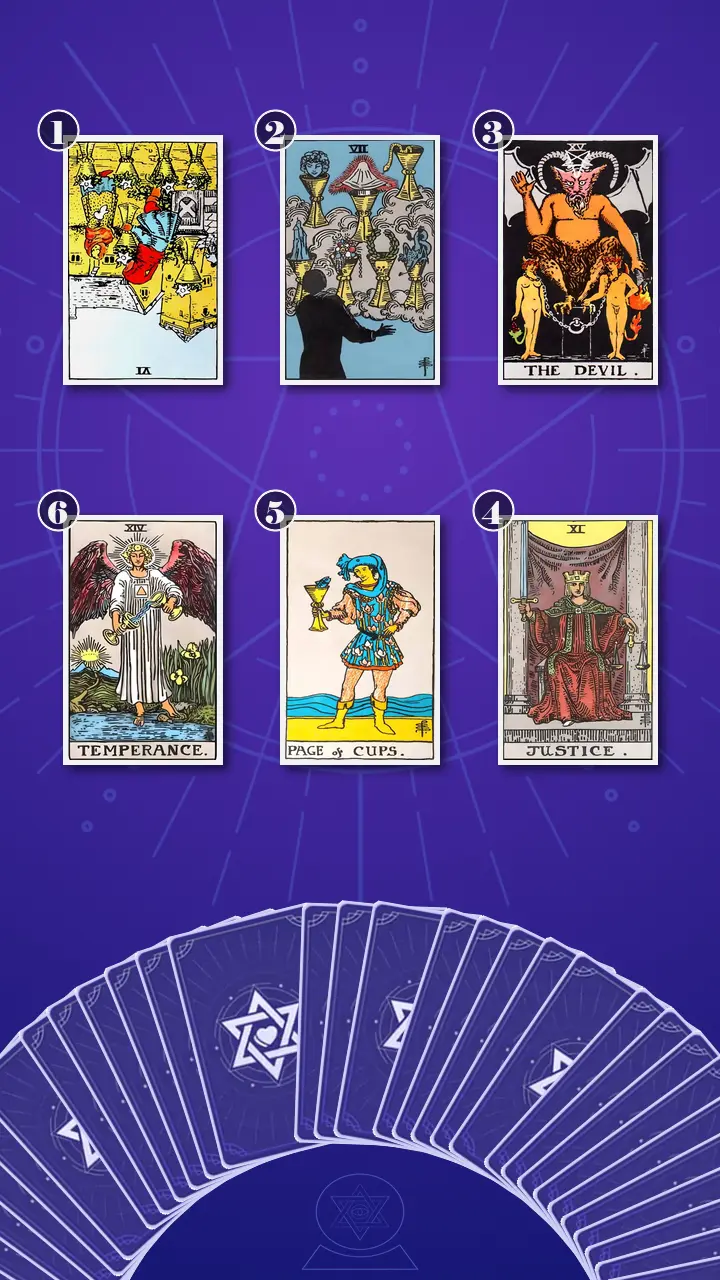
The Memory Garden, the Cloud, and the Loose Chain
Position One: The Archive That Looked Sweeter at Midnight
The first card I turned occupied the position representing Maya’s observable symptom: revisiting selected memories of her ex and using them to evaluate each new date.
It was the Six of Cups, reversed.
I pointed to the six cups filled with white flowers, the small figures, and the protected courtyard. Upright, the card can hold tenderness, familiarity, and the emotional continuity of the past. Reversed here, that Cup energy had become blocked and was pooling backward. There was an excess of preserved sweetness and a deficiency of present-tense context.
“This courtyard looks a lot like your phone archive,” I said. “The affectionate scenes are carefully contained. The arguments, long silences, unmet needs, and ordinary Tuesdays stay outside the frame.”
The card translated directly into Maya’s 11:40 p.m. ritual. After a pleasant date, she left a thoughtful message unread and entered a memory garden made from photos and iMessages. The sweetness in that garden was not fake, but it was incomplete. An Instagram archive is a highlight reel with the awkward pauses and unresolved friction edited out. Maya was not only remembering her former relationship; she was turning its most flattering edit into a measuring tool.
I asked, “In the first ten minutes after your last date, what did you actually do before deciding what the evening meant?”
Maya gave a brief laugh that carried no amusement. “I opened the rooftop photos before I even took off my coat. That’s so accurate it feels a little brutal.” Her fingers tightened around the sleeve of her sweatshirt, then released it.
“The card isn’t accusing you of being stuck or telling you to delete everything,” I said. “It’s showing us the order of operations. Memory enters before direct experience has had time to become language.”
Her expression softened, though I could still see disappointment at the edges of it. A remembered feeling could be real without being a fair ruler.
Position Two: The Composite Ex in the Clouds
The next card occupied the position representing the perceptual blockage: the filter that turned Maya’s ex into a composite fantasy no new person could realistically match.
It was the Seven of Cups, upright.
A shadowed figure faced seven cloud-borne cups containing jewels, a castle, a veiled luminous form, and several incompatible promises. The energy here was excess: imagination, desire, and possibility had become so amplified that observable reality could barely compete.
I told Maya that she was no longer comparing one complete former partner with one complete new person. She was comparing the person across the table with a custom benchmark assembled from her ex’s funniest conversation, most affectionate text, most magnetic night, best photo, and most promising imagined future.
“It’s like a Hinge filter trained on one relationship’s strongest moments,” I said. “The algorithm keeps serving the same emotional aesthetic until unfamiliar warmth starts looking like the wrong genre.”
The new date had one evening to demonstrate what her ex had accumulated across months, while also outperforming everything distance had polished. No real person could consistently inhabit that cloud-based composite, including the ex as they had actually been.
I asked, “Which difference do you treat as proof first: humor, texting pace, silence, affection, or the absence of that familiar rush?”
“Conversation rhythm,” Maya said immediately. “My ex and I could bounce off each other without effort. With someone new, every pause feels like evidence.” She looked away from the cards and pressed her lips together, as if replaying several dates at once.
I let the quiet hold for a moment. “A first conversation has not had time to build shared references, private jokes, or repair after misunderstandings. You may still discover genuine incompatibility, but unfamiliar timing by itself cannot tell you that yet.”
She nodded once, cautiously. I could see that part of her still feared this distinction might be a sophisticated way of telling herself to settle. I made the boundary explicit: curiosity could extend an inquiry, but it never had to overrule a no, excuse disrespect, or negotiate away a need.
Position Three: The Reward Hidden Inside the Loop
The third card occupied the position representing the root mechanism beneath the repetition: the familiar emotional reward and sense of control Maya received by returning to remembered intensity.
It was The Devil, upright.
I centered the loose chains around the two figures rather than presenting the horned figure as an outside force. The Devil’s energy was running in a closed circuit. Desire and fear were excessive, while agency felt blocked, but the chains were not locked. That detail kept the reading non-fatalistic: Maya participated in the pattern, which also meant she could interrupt it.
I mapped the phone ritual aloud. A new date created uncertainty. The archived thread delivered a familiar emotional surge. That surge supplied a clear story for a few minutes. The temporary certainty then taught her hand to reach for the archive again after the next date.
“The private subtitle sounds something like this,” I said. “I know this makes me compare harder, but at least I know what this feeling is.”
Maya winced and lowered her phone onto the bed beside her. “Yes. Missing him hurts, but it’s a hurt I already understand. With someone new, I don’t know whether I’m bored, scared, settling, or just not there yet.”
That was the emotional reward hiding inside the comparison habit. The archive converted an undefined present into a known past. It worked like an autoplay queue returning to the same song because the next track had not yet earned her nervous system’s trust.
I asked, “When you reopen the messages, what does the ritual give you immediately: relief, intensity, control, or protection from being surprised?”
“Control,” she said after a long pause. “And intensity. I can make myself feel something unmistakable.” Her shoulders dropped slightly, but her eyes reddened. Recognition had loosened her defence while exposing the quieter fear beneath it: without the old emotional surge, she could not control whether she would ever connect deeply again.
I tapped the image of the chains. “This is not a sentence. It is a saved route. The opening is the small moment when uncertainty arrives and your hand has not yet opened the old thread.”
When Justice Changed the Tempo
Position Four: Equal Evidence on the Scales
The fourth card occupied the position representing the key transformative trigger: separating observed facts from selective memory and applying a fair evidence standard to both past and present.
As I turned the card toward the camera, Maya’s radiator stopped clicking. The sudden quiet seemed to draw a clean line through the room.
It was Justice, upright.
The figure sat between two symmetrical pillars, holding balanced scales in one hand and an upright double-edged sword in the other. Justice brought balanced Air into a reading that had been flooded with nostalgic and projected Water. The scales asked for proportion. The sword did not cut away feeling; it separated what happened from the caption memory later added.
I placed two imaginary evidence files side by side. The ex received months of context, selected highlights, private language, and the benefit of hindsight. A new date received one incomplete evening, a TTC ride home, and a pass-fail chemistry score. Justice did not demand equal history. It demanded equal standards.
I often use what I call a Communication Dissonance Audit when conflict is being diagnosed. I listen beneath the words for a mismatch in emotional tempo and frequency. With Maya, I adapted the same lens: Was a new person’s rhythm actually unsafe, dismissive, or inconsistent, or was it simply unfamiliar because no shared tempo had been built yet?
For a moment, I thought back over ten years of sound-energy research. Familiar resonance can feel effortless because the system has repeated it many times, but recognition alone does not prove that the whole composition is stable. Maya had been evaluating first-date pauses against a rhythm rehearsed over months, while the arguments and defensive high notes from the old relationship had been muted in the final mix.
I brought her back to 11:40 p.m.: one pleasant date, one unread message, a warm phone, and a chest tightening around the demand for immediate certainty. She had been asking whether the new person could reproduce the old chorus, not whether their present behavior offered respect, consistency, curiosity, or room to breathe.
The ex is not the flawless measure that selective memory creates; let Justice's balanced scales weigh observed reality and let the upright sword separate present compatibility from familiar intensity.
I paused, then added, “Remembered intensity is evidence that something mattered, not proof that it was compatible or that every new person has to recreate it.”
Maya’s breath stopped midway into her chest. Her right hand remained suspended above the phone, fingers slightly curved, as though the archive icon were still beneath them. Her eyes moved away from me and lost focus; I could almost see the past week replaying across her face. Then her jaw set. “But doesn’t that mean I was wrong about every date I rejected?” she asked, sharper than she had sounded all evening. The anger lasted only a second before her voice thinned. Her shoulders lowered, her fist opened against the duvet, and she released a trembling “Oh.” Relief entered first, followed by the exposed, slightly dizzy look that can appear when a familiar burden drops and leaves responsibility in its place. Clarity had not removed uncertainty. It had shown her where her own choice began.
“No,” I said. “It means the method was unequal, not that every no was wrong. A fair review can still lead to no. Justice protects your standards by making them more accurate.”
I leaned closer to the screen. “Now, with this new perspective, think back to last week. Was there a moment when this insight might have made you feel different?”
Maya stared at the Justice card. “The person remembered my campaign deadline and asked how the client presentation went. I relaxed after maybe twenty minutes, but I barely counted that. I kept thinking their texting rhythm wasn’t right.” She took a slower breath. “I called the whole date flat because it didn’t sound familiar.”
That was the central audit. What had the person actually said? What action followed? Had the pace felt unsafe or merely new? Was there demonstrated consistency, or was Maya filling the silence with an old soundtrack? Justice’s evidence-based discernment did not ask her to distrust attraction. It asked her to stop using attraction’s familiarity as a complete compatibility report.
I named the transition clearly. This was one step from measuring real people against an edited memory toward present-tense observation, grounded self-trust, and openness to connection developing at its own pace. The new person was not losing to Maya’s ex; they had been asked to compete with an archive.
Position Five: The Question That Keeps the Cup Open
The fifth card occupied the position representing the actionable dating practice: curiosity, direct observation, and tolerance for an unfamiliar emotional pace.
It was the Page of Cups, upright.
The Page gazed at a fish unexpectedly emerging from a golden cup. Behind the figure, the sea continued moving. After the stale emotional circuit of the Devil and the sharp differentiation of Justice, fresh Cup energy could flow again. What had been deficient was not feeling; it was receptivity to feeling that arrived in a form Maya had not already learned to recognize.
I connected the card to an ordinary dating moment. A new person might share an unexpectedly nerdy story in a Queen West café, remember a minor detail, or express warmth in quieter language. Maya’s usual algorithm would compare that detail with her ex before it had time to register. The Page offered a smaller response: ask one sincere follow-up question and let the answer remain information.
“What could you have asked about the campaign conversation?” I said.
Maya considered it. “Maybe why he remembered it. Or what work pressure is like for him.”
“Good. You don’t have to manufacture chemistry. You’re allowing one living person to finish one answer before the old script grades them.”
She smiled, faintly but without bitterness this time. “So I’m not agreeing to like them. I’m agreeing to notice them.”
“Exactly. Curiosity is not commitment, and uncertainty is not a verdict.”
Position Six: Two Cups, Neither One Erased
The final card occupied the position representing integration: keeping useful lessons from the former relationship without allowing that relationship to control the evaluation of every new connection.
It was Temperance, upright.
I showed Maya the water moving continuously between two cups, the figure’s one foot on land and one foot in water, and the path extending toward a bright horizon. This was balanced energy: feeling remained present, but practical evidence gave it proportion. Nothing had to be deleted or forced into a premature conclusion.
In modern terms, Temperance was not smashing the nostalgic playlist or pretending the old song meant nothing. It was mixing two playlists without requiring the former track to play first. Maya could carry forward what she had learned about affection, communication, attraction, and incompatibility while allowing a new person to develop a distinct language and rhythm of trust.
I asked, “What lesson from the old relationship deserves to stay useful, and what rule can stop controlling the score?”
“I want emotional responsiveness to stay,” she said. “But the rule that it has to feel effortless immediately can go.”
Her face did not suddenly brighten into perfect confidence. Instead, I saw something quieter: her brow loosened, her hands rested open, and she seemed willing to leave one feeling undefined. Temperance did not promise that every connection would deepen. It suggested that past lessons and present evidence could remain in conversation without either one flooding the system.
A Lower-BPM Dating Debrief
I gathered the six cards into one coherent story. The reversed Six of Cups showed the preserved archive Maya entered after each date. The Seven of Cups showed selective memories expanding into an impossible composite. The Devil revealed the immediate reward: familiar intensity gave her temporary control over uncertainty. Justice introduced a fair evidence standard. The Page of Cups turned that standard into one curious interaction, and Temperance made room for memory and new information to coexist.
The blind spot was not that Maya’s standards were too high. It was that she had given the past a much larger evidence budget than the present. She compared months of edited context with one unfinished evening, then treated the emotional volume difference as objective proof. The transformation was equally specific: replace “How did they compare with my ex?” with “What did I observe, how did I feel in their presence, and what would I genuinely like to learn next?”
I gave her two small experiments. Neither required deleting the archive, replying before she was ready, or going on a second date she did not want.
- The Syncopation Pause and Present-Tense Note After one date this week, when your thumb moves toward the old archive, place the phone face down for three seconds. Listen for one nearby sound, one distant sound, and your own breath. Then use Focus mode for ten minutes and open a blank note with three headings: Observed, Felt, Curious. Write one concrete line under each without mentioning the ex, comparing, deciding, or sending a message yet. Tip: I adapted this from my Syncopation Pause, which lowers the emotional BPM before escalation writes the next line. The minimum version is one observed fact and one body sensation. This is a delay, not a deletion rule; afterward, you remain free to open the archive or stop the exercise.
- The One-Curious-Question Practice On the next date, notice one detail that genuinely surprises or interests you and ask one natural follow-up question. Afterward, record the answer and whether your attention became more open, neutral, or closed. Use that direct information alongside any boundary or need that was not met. Tip: Ask only one question. Curiosity does not obligate you to continue, excuse a red flag, or lower a standard. It simply lets unfamiliarity become information before it becomes a verdict.
I told Maya to treat both practices as experiments rather than new dating rules. If the note felt activating, she could stop and return only if and when she chose. If the observable evidence showed disrespect, inconsistency, incompatible values, or an unmet need, she could say no without asking tarot for permission.
The cards had supplied an objective structure for examining her attention, but they could not own the decision. That authority remained with Maya. Her next step was not to find certainty on command. It was to hear enough of the present interaction to make a choice that actually belonged to her.

Six Days Later: The Quiet Proof
Six days later, Maya messaged me: “I did the note and slept through the night. I still woke up thinking, What if I’m settling? I smiled, reread my observations, and said yes to coffee, not to a future.”
I read that message as the first small proof of her journey to clarity. She had not solved dating or stopped missing her ex. She had created a pause in which evidence-based discernment, personal boundaries, and curiosity could coexist.
For me, that is the lasting value of the six-card Transformation Path Grid: the spread did not reveal a predetermined romantic outcome. It helped Maya hear where her internal rhythm fell out of sync, lower the volume of the edited archive, and choose what to listen for next. The past could remain information without becoming the ruler held against every new person.
I know we can leave a good date with our chest tight and reach for the archived chorus, not because the past was flawless, but because a familiar rhythm feels easier to conduct than the slow uncertainty of discovering who is here now.
If your next date did not have to replace that old song, what one unscripted note, a thoughtful question, a remembered detail, or the moment your shoulders settle, might you let yourself hear before deciding what it means?