Mocking a Promotion, Reopening the Post—Choosing a Personal Measure

Status Anxiety at 11:47 p.m.: Mocking the Game, Tracking the Rank
I often meet mid-level creatives in expensive cities who call personal branding cringe but can recite their friends’ titles, promotion dates, and probable salary bands. I recognised that split almost immediately when Jordan, a 29-year-old brand strategist in London, told me why they had booked the reading: “I don’t care about the ladder, but I notice who just climbed it.”
I reconstructed the previous night from the details Jordan gave me. At 11:47 p.m., after group drinks in Soho, they had sat on the edge of their bed with a blue-white screen lighting their hands. Their phone was warm against their palm. The radiator clicked beside the traffic hiss while they reread a friend’s promotion announcement, searched the new title, checked who had reacted first, and opened their own profile views. They drafted a joke about “personal-brand theatre,” deleted it, then refreshed the post again.
“I’d already mocked it at drinks,” Jordan said. Their jaw shifted as if they were still biting back the next line. “Then I went home and basically conducted a forensic audit. If I admit I want recognition, I become exactly what I criticise. But I also want to leave the game without feeling like I lost it.”
That was the contradiction in its cleanest form: Jordan rejected the circle’s status games while fearing a lower rank within those same games. In public, contempt gave them distance. In private, every title, invitation, reaction, and rapid WhatsApp reply became evidence in an unofficial league table.
Their status anxiety did not look like dramatic panic. It felt more like a LinkedIn analytics dashboard running behind a closed tab: invisible during the day, quietly draining the battery, then glowing back to life the moment someone else announced good news. Jordan’s shoulders sat slightly raised. Their breathing stopped at the top of each inhale, as though their body were waiting for another result to load.
“I’m not going to tell you that wanting recognition makes you shallow,” I said. “And I’m not going to decide that your friends are villains or that you need to leave the group. We’re going to look at the loop: what triggers it, what reward it promises, and where your choice can re-enter. Let’s make a map of the fog instead of asking you to pretend the fog isn’t there.”
I framed our work as a Journey to Clarity, but I made one distinction at the outset: clarity would not mean becoming indifferent to money, career momentum, belonging, or praise. It would mean knowing which of those things Jordan genuinely wanted before the room assigned them a value.

Choosing the Compass: The Five-Card Shadow Spread
I invited Jordan to put their phone face down, take one unforced breath, and hold the question in plain language: “Why do I mock my circle’s status games but keep tracking my rank?” I shuffled slowly. I use this small ritual as a transition from reacting to observing, not as a performance of certainty.
For anyone wondering how tarot works in a consultation like this, I treat the cards as structured prompts rather than predictions. Traditional card meanings provide a stable symbolic vocabulary; the spread positions create a sequence of questions; Jordan’s real behaviour supplies the evidence. The value comes from seeing card meanings in context and testing them against lived experience. No image gets to overrule the person sitting with me.
I chose a classic five-card Shadow Spread because Jordan’s question was recursive. They mocked the hierarchy, monitored it, felt threatened by what they found, and then mocked it again. A ten-card Celtic Cross would have introduced timing and outcome material we did not need. A decision spread would have implied two external paths. The Shadow Spread was the smallest clear tool for examining the conscious identity, the disowned strategy, the projection onto other people, the need protected underneath, and the practice that could integrate all four.
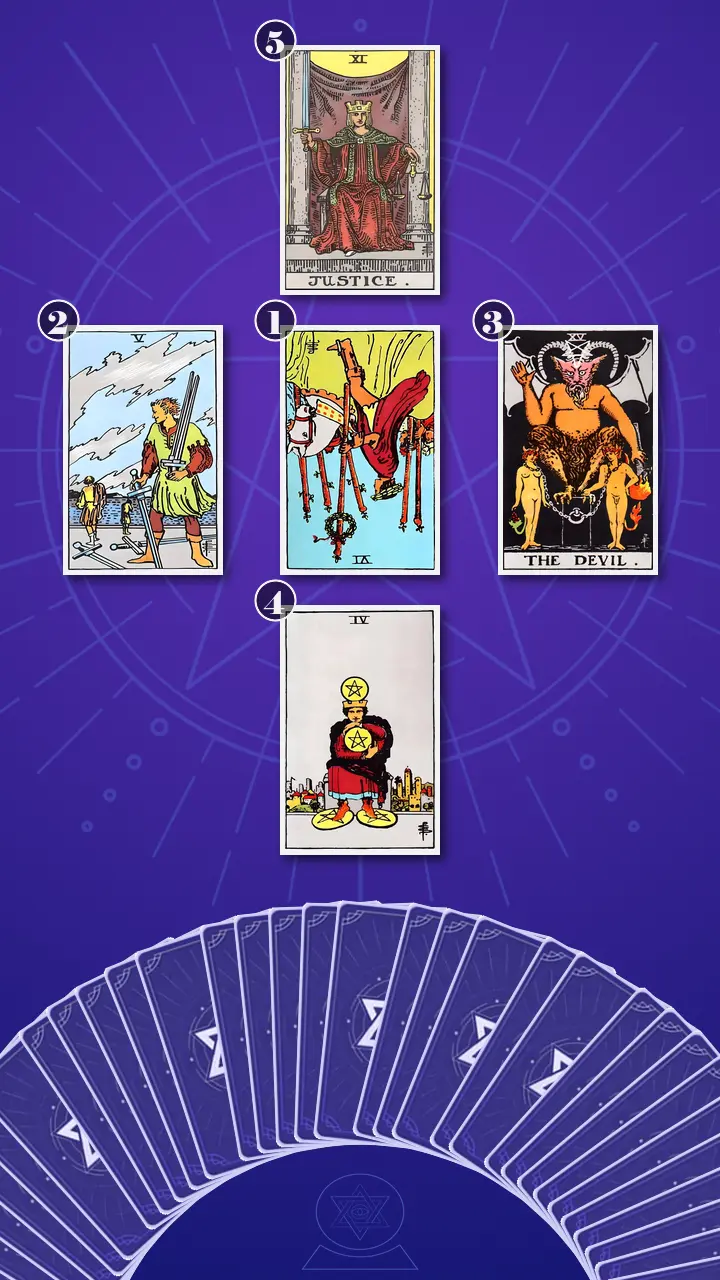
I laid the cards in a cross that resembled a compass. The first card sat at the centre for Jordan’s conscious anti-status persona. The second rested to the left for the competitive strategy they excluded from that identity, while the third lay to the right as the projection mirror. The fourth card went below the centre for the fear and need supporting the whole pattern. The fifth waited above it as a consciously chosen north: the principle that could stop the needle spinning.
“This spread isn’t asking whether your circle is objectively shallow,” I told Jordan. “Some of their behaviour may genuinely irritate you. We’re asking why the same signals keep acquiring authority inside you, and what you want to do with that authority once you can see it.”
Reading the Map Beneath the Mockery
Position One: The Parade Jordan Claimed Not to Watch
I began by turning over the card representing the conscious persona and the observable knot: Jordan’s habit of mocking visible ambition while monitoring titles, attention, access, and engagement for evidence of personal rank. The card was the Six of Wands, reversed.
In the Rider-Waite-Smith image, a laurel-crowned rider moves through an applauding crowd. Upright, the card can describe recognition, confidence, and public success. Reversed, I read its fire as blocked: recognition is still wanted, but it cannot be comfortably claimed, so the crowd’s response is monitored in private and never feels secure.
I connected the image directly to Jordan’s week. At the agency, they could call a colleague’s celebratory LinkedIn post “applause theatre,” then spend the evening comparing titles, campaign credits, reactions, and profile views. The claim that public recognition did not matter sat directly above the private question of whether the crowd had moved them down. Like the divided workplace selves in Severance, Jordan’s composed anti-status persona and their late-night ranking persona behaved as though they belonged to separate people.
“The practical question isn’t whether their promotion looks impressive,” I said. “It’s what you want from your own next step. Is it recognition, access, money, mastery, or belonging? Those are different needs. Treating all of them as one vague thing called status makes the crowd responsible for defining the reward.”
Jordan gave a short laugh, but there was no amusement in it. Their fingers stopped circling the rim of their mug. “That’s so accurate it feels a bit brutal. I literally thought, ‘I don’t care about their new title, so why am I searching the salary band?’”
“I’m not using the card to catch you being hypocritical,” I replied. “I’m using it to reunite two parts of the same scene. Mocking the scoreboard is still a way of watching it. Once you admit that you’re watching, you can decide whether its numbers deserve your attention.”
Position Two: The Joke That Won and Cost Too Much
I next turned over the card representing Jordan’s disowned competitive strategy: sarcasm, devaluation, and win-or-lose interpretation used to secure a brief position of superiority. The card was the Five of Swords, upright.
The foreground figure in the card gathers swords while two people walk away beneath jagged clouds. I read its air energy as excess. Perception becomes over-analysis; language becomes a weapon; every promotion or invitation becomes evidence that somebody has moved up and somebody else must have moved down.
I asked Jordan to recall a WhatsApp exchange after a friend posted a polished promotion recap. Jordan had replied, “Love a personal brand activation.” Three laugh reactions arrived quickly. For a moment, they felt like the only person perceptive enough to expose the performance. Then two friends stopped replying, and Jordan spent the journey home wondering whether the joke had made them look incisive or threatened.
“The figure collecting swords is the part that saves screenshots, accumulates evidence, and lands the sharpest line,” I said. “The retreating figures show the hidden invoice. You may have won the interpretation, but you’re more alone and more invested in the contest afterward.”
As an artist, I know a brilliant line can seize a scene while damaging the larger story. That professional association flashed through my mind as I looked at the card. Jordan’s wit was real; the problem was not that they were too perceptive. The problem was that their perception had been recruited into a ranking system they claimed to oppose.
“Contempt gives you the high ground, not an exit,” I said. “If nobody had to win that conversation, what might you have said?”
Jordan’s mouth opened, then closed. Their gaze moved from the collected swords to the two departing figures. After several seconds, they said, “Maybe nothing. Or maybe I could’ve asked if they were actually excited. I don’t know. I was right that the post was polished, but I felt more alone and more obsessed afterward.”
I let that distinction stand. The card did not require Jordan to praise a post they disliked. It showed how the immediate verbal win maintained the longer social comparison loop.
Position Three: The Refresh That Tightened a Loose Chain
I then crossed through the centre and turned over the card representing the projection mirror: the status hunger Jordan noticed in their circle that also reflected their own attachment to recognition and hierarchy. The card was The Devil, upright.
I saw Jordan’s shoulders tighten at the name, so I addressed it immediately. “This isn’t a prediction of danger, and it doesn’t mean you’re secretly bad,” I said. “The Devil often shows an attachment that feels absolute because its mechanism has gone unexamined. Look at the chains. They’re visibly loose.”
I asked Jordan to picture 12:08 a.m., when their thumb reopened the same promotion post for the sixth time before they had consciously decided to do it. They blamed the circle for making everything competitive, but each refresh asked the hierarchy for another verdict. The energy here was blockage through repetition: choice had not disappeared, but it had been compressed into such a familiar movement that the movement felt compulsory.
“This works like a recommendation algorithm trained by every hate-click,” I said. “Each irritated profile check teaches the feed, and your attention, to serve more rank signals. A loose chain can still feel permanent when you retighten it with every refresh.”
Jordan’s breath paused. Their thumb rubbed once across the side of their index finger, as if replaying the gesture of opening an app. Their eyes lost focus for a moment, then returned to the loose chain in the image. Finally, they exhaled from low in their chest.
“I keep saying they make everything competitive,” they said, “but I’m the one reopening it. Is that just blaming me instead?”
“No,” I said. “Blame says you should have known better and deserve shame. Participation says there is a repeatable action we can observe, which means choice can return one tap at a time. Your friends’ behaviour may still be competitive. You don’t have to pretend otherwise. We’re separating what they do from the authority each refresh gives it.”
I asked Jordan to complete one private sentence: “I’m hoping this check will give me…” They looked down and answered, “Proof that I still matter here.” The words did not end the habit, but they changed it from an external curse into a visible request.
Position Four: The Coin Pressed Against the Chest
I lowered my hand to the card representing the fear and need protected by scorekeeping: the attempt to secure worth, control, and belonging through measurable rank. The card was the Four of Pentacles, upright.
The figure holds one coin against the chest, balances another above the head, and pins two beneath the feet. I read the earth energy as excessive holding. Data fills the mind, guards the heart, and provides social footing, but the grip becomes so tight that uncertainty, openness, and honest desire have no room to move.
I translated the card into Jordan’s actual environment: titles, salary ranges, campaign visibility, invitation lists, and response times arranged like fixed columns in a Notion dashboard. Numbers felt easier to hold than the uncertainty of whether they were respected or included. The distant city in the card mattered too. Control offered protection, but it kept connection at arm’s length.
“I would never tell someone paying London rent that salary or career momentum is imaginary,” I said. “Some of this information has material value. The card is showing the moment practical data becomes a coin pressed against your chest: ‘If I can establish my rank, maybe I can stop fearing that I’m quietly becoming less valuable.’”
Jordan’s shoulders dropped by a small but visible degree. Their expression held embarrassment and relief at once. “That actually feels less disgusting,” they said quietly. “I’ve been treating this as proof that I’m secretly shallow. But part of me is trying not to get blindsided.”
I also pointed out how little water appeared in the spread. Jordan had been converting envy, shame, and longing into analysis before those feelings could be named directly. Sharper analysis would not solve a belonging wound. Water had to enter through one honest word, after which practical thought could do its proper job.
“What non-comparative evidence of stability or competence do you already have today?” I asked.
Jordan considered the question. “My last campaign worked. The client used the strategy. My rent situation is tight but planned for. None of that changes because someone else got applause.”
“Exactly,” I said. “You’re allowed to want recognition without outsourcing your worth to the room.”
When Justice Made the Hidden Scoreboard Visible
Position Five: The Criteria Jordan Could Read in Advance
I reached for the final card, representing the integration route: acknowledging mixed motives, making evaluation criteria explicit, and choosing behaviour aligned with personal values rather than opposition. The rain against the studio window softened at that moment, leaving the radiator’s low click unusually distinct. The room seemed to make space for the turn. The card was Justice, upright.
Justice holds balanced scales openly in one hand and an upright sword in the other. Unlike the Six of Wands crowd, the Five of Swords collector, The Devil’s chain, or the Four of Pentacles grip, this figure does not hide the standard or clutch the evidence. I read its energy as balance: clear air for honest language joined with grounded earth for observable action.
“Justice isn’t asking you to prove you’re above status,” I told Jordan. “It’s asking you to admit that recognition matters, distinguish useful career feedback from prestige that does not serve you, and decide in advance what will count. It can hold two truths at once: you may dislike your circle’s status rituals, and you may still want your work to be seen.”
I brought us back to 11:47 p.m. Jordan had made the smartest joke at drinks, yet sat on the bed with the phone warm in their hand, checking reactions and titles while insisting none of it mattered. They were still trying to become innocent of wanting recognition before choosing what recognition meant.
This was where I used what I call Typecasting Analysis. I explained that Jordan’s circle had gradually cast them as the sharp anti-status truth-teller: the person who spotted the networking move, punctured the over-polished announcement, and made everyone laugh. Jordan had helped maintain that casting because it brought attention without requiring them to expose ambition. The role had once protected their authenticity, but it had become restrictive. Every gathering now seemed to require a climber and a critic, and Jordan could only feel secure if they played the critic convincingly.
“Typecasting isn’t about blaming the group,” I said. “A social role is co-written. Other people reward it, and we repeat it because it once worked. Justice is showing you that the cast list isn’t fate. You can stop defining yourself only in opposition to the person who announces the promotion.”
I met Jordan’s gaze and said, “You can reject their rules and admit you want recognition; independence begins when you choose the measure before the room chooses it for you.”
Contempt is not independence; name the approval you want, choose the standard you will actually use, and let Justice's balanced scales replace the hidden scoreboard.
I left a short silence after the sentence. I watched Jordan’s breath stop first, their fingers suspended above the mug as if someone had paused the frame. Their eyes widened, then drifted beyond the table while memory appeared to replay behind them: the drinks, the joke, the warm phone, the salary search. Their jaw tightened once more before their face changed. “But doesn’t that mean I’ve been wrong this whole time?” they asked. The first words came out clipped, almost angry; the last became thin and unsteady. Their eyes reddened without spilling over. Then their hand lowered, their fingers slowly uncurled, and both shoulders sank on a long exhale. The release did not look purely comfortable. For a moment, Jordan seemed slightly unmoored, as though setting down the scoreboard had also removed the object that told them where to stand. I stayed quiet until their breathing settled, then asked, “Now, with this new perspective, think back to last week. Was there a moment when this insight could have made you feel different?”
Jordan stared at Justice’s scales. “The agency meeting,” they said eventually. “Someone else got chosen to present work I helped shape. I called it office politics, which it partly was. But I also wanted credit, and I never asked for it. I made the situation evidence that the whole place was fake instead.”
“That doesn’t make your critique false,” I replied. “It means the strategy was incomplete. You saw the politics, but you left your own desire out of the evidence. Owning that desire now doesn’t invalidate every earlier perception. It gives you more information and more options.”
Jordan’s resistance softened into a quieter vulnerability. “So I can say I want credit without becoming someone who treats every conversation like networking?”
“Yes,” I said. “Justice is proportion, not purity. You can want credit for work that used your judgement, refuse prestige rituals you find empty, and still evaluate your conduct by a standard you chose before anyone applauded.”
I named the transition clearly: this was a move from guarded contempt and covert rank tracking to honest self-accountability and values-based self-respect. It was not a complete personality renovation. It was the first step from treating status signals as verdicts to treating them as information that Jordan could accept, reject, or weigh against their own criteria.
Choose the Metric Before the Room Starts Scoring
I drew the cards into one continuous story. The reversed Six of Wands showed recognition that could not be owned openly. The Five of Swords showed wounded confidence turning into a contest of interpretations. The Devil revealed that the contest was renewed through each apparently automatic refresh. The Four of Pentacles uncovered the simpler protective need beneath it: measurable security, stable footing, and reassurance against being overlooked. Justice offered the unused resource: transparent criteria, honest language, and proportionate action.
I pointed out the descending minor-card sequence of six, five, and four. Beneath the sophisticated social critique sat increasingly basic needs: first recognition, then protection through winning, then security held close to the body. Jordan had been trying to solve all three by collecting more rank data. The extra information briefly reduced uncertainty, but it could not establish self-respect because the crowd still controlled the measurement.
The cognitive blind spot was the belief that Jordan had only two roles available: remain above status or admit they were a hypocrite. That binary kept them typecast. The actual transformation was less dramatic and more demanding: acknowledge the reward promised by comparison, decide whether it was worth pursuing, and choose one personal measure of success before entering a status-heavy setting.
I returned to the film metaphor that guides my work. Jordan had bravely stayed in the scene of the caustic outsider because that character once protected something important. I did not ask them to destroy the character or deliver a sentimental redemption speech. I handed them the pen for the next scene and helped them write three small stage directions.
The actionable advice from this five-card Shadow Spread tarot reading for status anxiety, shadow projection, and social comparison was deliberately private and low-pressure:
- The Seven-Minute Justice Note After one promotion, invitation, or collaboration triggers a profile check this week, open a private note with three headings: Trigger, Promised Reward, and Chosen Measure. Name what happened; choose recognition, access, money, mastery, belonging, or another precise reward; then write one measure you would still respect if nobody in the group saw it. Stop after seven minutes. Tip: If the note starts feeding the comparison loop, use the minimum version of one word under each heading and close it. This is observation, not a public confession or a productivity dashboard.
- The Recasting Exercise Before the next dinner, launch, or industry gathering, use Notes outside the venue to write one value and one visible behaviour. Recast yourself for one exchange from “the incisive outsider” to “the direct participant.” For example: “Curiosity: ask one real follow-up without converting the answer into rank,” or “Honesty: name one kind of work I want to do.” Tip: Recasting does not require praise, forced warmth, or tolerating behaviour you dislike. One honest question, one direct preference, or deliberate silence is enough. Afterward, score only the chosen behaviour as yes, no, or partly.
- The No-Winner Draft Pause When a sarcastic reply forms in WhatsApp, leave it unsent for ten minutes. Label the feeling with one word such as envy, shame, irritation, longing, or uncertainty. Notice one physical cue, then ask: “What would I say if nobody had to win this exchange?” Send a person-centred reply only if it feels genuine; silence remains valid. Tip: If ten minutes feels unrealistic, start with sixty seconds. The goal is not perfect kindness. It is to create enough space for choice to appear between the jaw tightening and the message being sent.
I told Jordan that every chosen metric could be revised. Justice was not replacing the group’s rigid hierarchy with a private one. The point was to make the criterion visible enough to question. Tarot had revealed the script, but it could not rewrite Jordan’s next gathering for them. That authority belonged with Jordan.

A Week Later: The Quiet Proof
Six days later, I received a message from Jordan before a Thursday dinner near Old Street. Outside the restaurant, with bass pulsing through the door and cold air catching at their sleeves, they had opened Notes and written: “Value: curiosity. Behaviour: ask one honest follow-up without comparing my news.”
During dinner, a friend mentioned a new role and an invitation-only launch. Jordan felt their jaw set. The familiar joke arrived fully written in their mind. They waited, tasted the sharp red wine, and asked, “Are you actually excited, or is it all a bit overwhelming?” The friend admitted it was both. For several minutes, Jordan listened without converting the answer into salary, access, or social weight.
Jordan did not report a perfect transformation. They still noticed who received the longest stretch of attention. On the way home, they opened LinkedIn once. But they caught the promised reward before beginning the forensic search: belonging. They closed the app and sent one direct email the next morning asking to be credited for strategy work they had actually contributed.
That night they slept through. Their first thought in the morning was, “What if I’m falling behind?” They told me they almost laughed, not because the thought had vanished, but because it no longer sounded like an instruction.
I took that as the quiet proof of our Journey to Clarity. The cards had not removed envy, guaranteed recognition, or predicted Jordan’s rank. They had helped make an invisible script readable. Jordan created the change by choosing a different line when the old one appeared.
I have never believed tarot should take the pen from the person whose life is in production. At its most useful, it offers continuity notes: this is the scene you keep repeating, this is the role you learned to play, and this is the place where another action becomes available. Jordan remained the author.
If someone else’s good news makes your jaw lock, it can feel safer to call the whole performance shallow than to admit how badly you fear being quietly placed below them. Noticing that reflex does not make you shallow, and it does not require you to endorse the room’s rules. It means you have reached the moment when the hidden scoreboard can finally be brought into the light and questioned.
Before the next room raises its invisible wands, what one measure could you place on Justice’s visible scales so that, afterward, you would know you acted like yourself?