The Slack Thread That Felt Like a Verdict
If you're a late-20s hybrid worker in a city apartment and your body goes tight the second a Slack promotion thread lights up, only for you to end up in a full LinkedIn spiral before lunch, this is probably career comparison anxiety with very good branding.
When Maya joined me that evening, it was 8:47 p.m. in Toronto and she was still half-standing at her kitchen counter in socks. Her company org chart was open in one tab, a half-edited resume in another, and a Notes page called 'next step' glowed beside a Slack thread full of clap emoji. The laptop fan held a thin mechanical hum under everything. The last inch of stale coffee on the counter had that metallic taste coffee gets when it has been sitting too long. She kept working her jaw like she was trying to chew through a thought.
'My coworker got promoted,' she said. 'And ever since, I keep hearing, don't fall behind. I know it isn't a race, but my body acts like it is.'
I believed her immediately. Their promotion had happened at work; the self-audit had happened in her body. I could see it in the tight lift of her shoulders and the way her cursor kept flicking toward the Slack window even while we were talking. The feeling wasn't abstract. It was more like she'd swallowed a phone set to vibrate and couldn't find where in her ribs the buzzing was coming from. Under that was the real contradiction: she wanted a career that fit her, but in moments like this her whole system treated visibility like survival.
'I get it,' I told her. 'We don't need to shame the reaction to understand it. Tonight, let's make a map of the loop and find the part that is actually yours. That is how we get to clarity.'

Choosing the Compass: The Shadow Spread for Career Comparison Anxiety
I asked her to put her phone face-down, close Slack for twenty seconds, and take one slow breath with both feet on the floor. I shuffled while she kept the question simple: why does someone else's good news become an internal command not to fall behind?
For that, I chose The Shadow Spread, a four-card tarot spread I use when the external event is obvious but the real mystery is the inner mechanism. This case did not need a sprawling layout or mystical fog. It needed a clean descent: first the trigger, then the belief beneath it, then the perspective that interrupts it, and finally the grounded behavior that can hold the change. That is how tarot works in my practice. I use the cards as symbols sturdy enough to reveal the structure a person has been living inside.
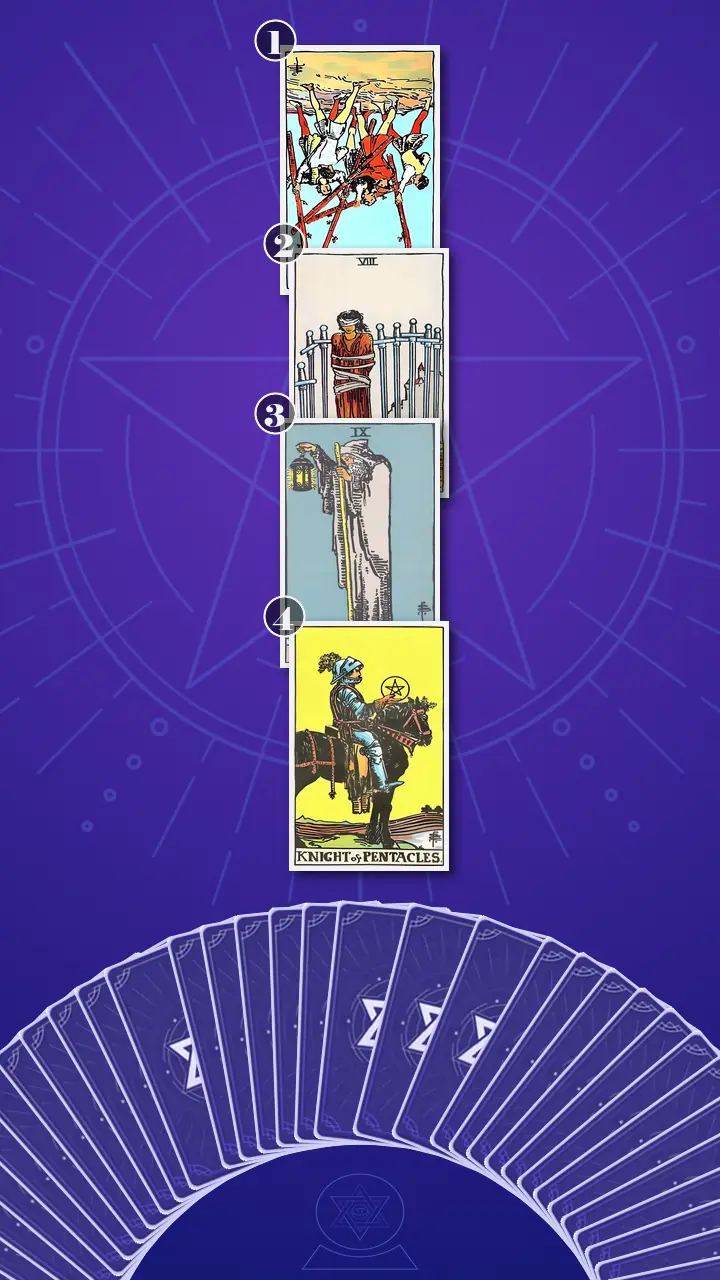
I laid the cards in a vertical line, like a stairwell leading from noise into quieter air. The first position would show the immediate comparison spike. The second would reveal the hidden fear sustaining it. The third, the heart of the reading, would show the medicine strong enough to restore self-trust. The fourth would answer the practical question that matters most after any insight: what do I actually do next?
Reading the Pressure Zone of Feeling Behind at Work
Position 1: The Private Scoreboard
Now I turned to the first card, the position showing the presenting problem from the diagnosis: the comparison spike that turns a coworker's promotion into self-ranking and frantic productivity.
Five of Wands, reversed.
Reversed here, this card showed competition turned inward. I told Maya it was the exact moment after the Slack announcement when she stopped doing the task in front of her, clicked through the org chart, mentally sorted teammates by title progression, and added two extra visible tasks to her week so nobody could mistake her for stalled. The crossed staffs on the card mattered because none of them were measuring the same thing. Title, salary, speed, visibility, access to leadership, timing after a reorg, who has a louder manager, who got lucky with a launch cycle: she had been treating all of it like one scoreboard. It was like turning her team org chart into a fantasy league she had never agreed to join.
Energetically, I read this as Fire in blockage. There was heat, urgency, motion, but no clean direction. That is why a normal week could suddenly become a visibility sprint full of extra replies, extra deck edits, extra offers to help, and yet still leave her feeling strangely less strategic. The card was not calling her lazy or petty. It was naming the scramble.
Maya let out a short laugh with a bitter edge. 'That is accurate to the point of being rude,' she said. Her fingers circled the rim of her mug faster, then stopped all at once.
Position 2: The Rule Hiding Under the Tabs
Then I turned the second card, the position revealing the core belief and underlying fear sustaining the spiral: the thought that a slower timeline means diminished worth or less control.
Eight of Swords, upright.
This is the one-correct-timeline story in card form. I told her I did not see a fixed prison here so much as a rule obeyed before the evidence had even arrived. In real life, this was her Sunday-night kitchen-counter scene: cold leftovers beside the laptop, LinkedIn open, an internal career ladder doc open, a half-updated resume open, and one sentence running the whole apartment like bad software: if I were really good, I'd already be further along.
The blindfold mattered to me more than the swords. The ties on the figure are loose. The space around her still exists. So do Maya's options, strengths, decent work, stable finances, and actual context. But once the phrase 'I'm behind' hardens into law, she stops seeing any of that. Borrowed deadlines create fake emergencies. The extra work then feels strategic, when really it is panic productivity acting as self-soothing.
I asked her, 'When you hear don't fall behind in your head, what do you think would actually happen if you stayed at your current pace a little longer?'
I watched the reaction move through her in three clear beats. First, her breath paused halfway in, like her body had hit a tiny freeze. Then her eyes drifted past the screen, unfocused, as if she were replaying every performance review where the praise did not fully land because the title had not changed. Finally, she gave one tight nod and said, very quietly, 'I think I'd become forgettable. The should already part got me.'
There it was. Not lack of ambition. Not a weak work ethic. A fear that staying in the same role while peers moved ahead might prove she lacked worth. The room went a shade quieter after that, the way rooms do when the real sentence finally gets spoken aloud.
When the Hermit Lit One Honest Question
Position 3: The Antidote
I reached for the third card more slowly. This was the position that identifies the key shift, the wisdom that interrupts the limiting pattern and restores self-trust. Even through the screen, I felt the atmosphere change. Slack was closed now. Her phone was face-down. The fridge hum had become the loudest sound in the apartment, and the overhead light no longer looked like an interrogation lamp. We had arrived at the heart of the reading.
The Hermit, upright.
When the Slack confetti dies down and you are still at the kitchen counter half an hour later, tabs multiplying, chest tight, trying to convert someone else's title into instructions for your own life, that is the exact moment this card wants to meet you. The Hermit does not arrive to make you less ambitious. He arrives to make you less available to noise.
As soon as I saw the lantern, my mind flashed to my years training in perfumery in Paris. In fragrance, the first note that hits you is rarely the whole formula. It tells you what is loud, not what will last. So I used one of my own diagnostic lenses with Maya, something I call Attraction Analysis. I asked her to break the promotion down like a scent. What was the top note, the first thing that hit her nervous system? A cleaner title. Public praise. The neat optics of momentum. What was the heart note, the thing she might actually want? More scope. Better pay. Greater ownership. Stronger mentorship. And what was the base note, the deep need underneath the whole reaction? Safety. Mattering. Proof that she would not disappear if she stopped proving herself for five minutes.
That is where The Hermit became so precise. Another person's promotion can smell compelling in the top note and still be the wrong formula for your life. This card asks for discernment, solitude, and self-trust long enough to separate genuine desire from borrowed urgency. Their promotion is data, not a verdict.
You do not need to win the crowd's contest; let the Hermit's lantern guide your next true step instead of running through the dark.
For one beat, Maya went completely still. Then came the reaction in layers. First, her mouth parted and no sound came out; even the muscles at the side of her neck held. Next, her gaze slid away from me and inward, and I could almost see her replaying the cursor hovering over a reply box, the late-night resume edits, the too-fast yes to tasks she never truly wanted. Then the heat showed up. She looked back at me with a flash of anger in her face and said, 'But doesn't that mean I've been letting random announcements run my week?'
'It means your nervous system has been treating visibility like survival,' I said. 'That is not the same thing as you being foolish. It is a pattern. Patterns can be interrupted.'
She exhaled like the breath had been stuck behind her ribs for months. Her shoulders dropped first. Then one hand opened flat on the counter. Then came the more vulnerable part of insight, the slight dizziness that follows a clean truth, when a person realizes the next step is smaller and more honest than panic would prefer. I asked her, 'With this new lens, think about last week. Was there a moment when this would have changed the feeling?'
She nodded almost before I finished. 'Yes. I was hovering over a message to volunteer for a webinar deck. If nobody could see my next move, I would not have wanted it at all.'
That was the shift right there: from panic-driven self-auditing and overwork toward grounded self-trust. Not a full life overhaul. A first clear step away from treating someone else's promotion as evidence about her worth, and toward treating it as information about what she actually wanted.
Position 4: The Quiet Builder
I turned the final card, the position that grounds the transformation into a realistic next step: how to act from steady values instead of urgency.
Knight of Pentacles, upright.
This card is almost aggressively unglamorous, which is exactly why I love it for feeling behind at work after a promotion announcement. In Maya's world, it looked like choosing one concrete development goal for the quarter, putting it at the top of her notes app, and giving it the same weekly slot on her calendar instead of chasing every high-visibility chance to look ahead. The still horse and the cultivated field are not about dramatic proof. They are about repeatable effort that builds leverage slowly enough to be easy to disrespect from the outside.
Energetically, this was Earth after too much Fire and Air. The reading had moved from inward competition to mental confinement and now finally into steadiness. I told her, 'A solid career can look boring in real time. Busy is not the same as aligned.' A recurring calendar block will outperform a panic-fueled sprint more often than your anxious brain wants to admit.
She made a face that finally held a little humor. 'So the answer is less theatrical?' she asked.
'Exactly,' I said. 'No dramatic reinvention. One boring but real action you keep doing.'
From Panic Productivity to Grounded Motivation
When I stepped back from the four cards, the story they told was clean. A public milestone had triggered the Five of Wands reversed, turning a coworker's promotion into a private contest inside Maya's body. The Eight of Swords showed the real engine beneath that reaction: the belief that there is one correct timeline, and that drifting from it could expose her as less valuable than she hoped. That was the blind spot. She had been treating other people's visible progress as private evidence about her worth, confusing motion with alignment and visibility with safety. The Hermit interrupted the pattern by asking a better question: not 'How do I catch up?' but 'What kind of growth is actually mine?' And the Knight of Pentacles turned that answer into a way of working that could survive contact with real life.
If I translate the whole reading into my perfumer's language, the message is simple: she had been letting the top note of someone else's applause decide the base note of her identity. That never lasts. The transformation direction was clear now: from borrowed deadlines to self-directed pacing, from self-ranking to self-trust, from panic productivity to grounded motivation.
So I gave her three next steps. Small. Practical. Designed for the exact moment a career comparison spiral tries to start again.
- The Info-Not-Verdict ResetThe next time a promotion post, kudos thread, or LinkedIn update hits, open a phone note titled 'Info, not verdict' and write two bullets only: what this shows you that you genuinely want, and what is not yours to copy. Do it wherever you are: at your desk, on the TTC, in your kitchen. Give it two minutes, not twenty.If two bullets feels like too much, use my Attraction Analysis shortcut: top note, heart note, base note. What grabbed you, what you actually want, what deeper need got activated.
- The 24-Hour No-Volunteer RuleOn any day comparison spikes, do not say yes to new high-visibility tasks until the next day. Before replying, take one slow lap around your apartment, office floor, or block with Slack closed so your body can come out of alarm before your calendar pays for it.This is not avoidance. It is heat reduction. If a full lap is unrealistic, stand up, get water, and wait for three unhurried breaths before typing.
- One-Skill QuarterChoose one concrete build for this quarter, such as lifecycle analytics, campaign strategy, or stakeholder communication, and block one recurring 45-minute session each week for it. Protect that slot from turning into random catch-up work unless there is a real emergency.Track repetitions, not outcomes. A checkbox is enough. One 20-minute session still counts. A solid career can look boring in real time.

A Week Later: The Quiet Proof
Five days later, I got a message from Maya. She had taken a screenshot of the note on her phone. At the top it said 'Info, not verdict.' Underneath: 'Want: more strategic ownership. Not mine to copy: his timeline, his team, his reorg luck.' She had muted a kudos thread for an hour, skipped volunteering for an extra deck, and blocked Friday morning for forty-five minutes of lifecycle analytics work. Her message ended with a sentence I loved for its honesty: 'I still had the chest drop. But I actually ate dinner sitting down.'
The next morning, the old thought still showed up: what if this pace makes me easy to forget? She noticed it, smiled at the checkbox in her calendar, and kept the block anyway.
That is all clarity has to be at first. Not a life solved. Not certainty delivered in cinematic lighting. Just one quieter, truer move repeated on purpose. That is what I use this Shadow Spread tarot reading for career comparison anxiety after a coworker's promotion to uncover: not whether you are winning, but what direction is actually yours.
If you know the very specific loneliness of smiling at someone else's promotion while your chest tightens and some part of you hears, see, you should have been there by now, I want to say this gently: the moment you notice that sentence is a sentence and not a law, the lantern is already on.
So the next time a promotion thread lights up and your body tries to turn the moment into a verdict before your mind has even caught up, if that moment were information instead, what might it gently show you about the kind of growth you actually want next?
This story is adapted from psychological research, written so that those in a similar struggle can see their own pattern in it — and find their next step clearly.These insights are not a substitute for professional psychological, medical, legal, or financial advice.
Learn more about our Journey to Clarity.
How did this insight land for you?
🫂 This Resonates Deeply
🌀 Living This Story
✨ Now I See Clearly
🌱 Seeing New Possibilities
🧰 Useful Framework
🔮 The Confirmation I Needed
💪 Feeling Empowered
🚀 Ready for My Next Step
Author Profile
 AI
AI“As a perfumer for fifteen years, I’ve learned to perceive human boundaries through the delicate metaphor of scent. Relationships need the right amount of space to breathe, and I've seen too many kind souls exhaust themselves trying to please everyone. I’m here with warmth and understanding—not to teach you to be guarded, but to help you gently clear the air and rediscover the comforting, safe boundaries that are rightfully yours.”
In this Love Tarot Reading :
Core Expertise
- Intimacy Distance Calibration: Using the metaphor of scent diffusion to diagnose whether your relationship suffers from emotional suffocation or detached coldness.
- Boundary Permeability Assessment: Objectively evaluating where your personal identity ends and your partner's begins, identifying unhealthy enmeshment.
Service Features
- The Blank Space Protocol: A behavioral challenge to intentionally create comfortable emotional or physical distance, allowing the 'oxygen' needed to reignite mutual attraction.
Also specializes in :
Explore Related Patterns:
Comparison TrapAfter the Slack promotion thread lit up, Maya stopped the task in front of her, opened the org chart, and started sorting teammates by title progression. You can see how one coworker's milestone became a private ranking system, with title, salary, visibility, access, timing, and luck compressed into one scoreboard. This is why Comparison Trap fits. The nervous system converts external progress into evidence about personal standing, then starts scanning for proof of being behind. The pattern does not require you to be petty or unambitious; it only needs a visible benchmark and a moment of insecurity to turn information into self-measurement. The useful audit is that the coworker's promotion was data, not a verdict. Once you separate what the event shows you from what your fear claims it proves, comparison can become information about desire instead of a courtroom for your worth.
External ValidationPublic praise, a cleaner title, and the optics of momentum hit Maya's nervous system before she could sort out what she actually wanted. Even past performance-review praise did not fully land because the title had not changed, so recognition without visible status movement failed to feel secure. External Validation fits because the story links worth to signals other people can see. The promotion thread, the title ladder, and the fear of becoming forgettable all become external mirrors that decide whether she feels solid. That is why she reaches for visible work. She is trying to regulate self-trust through public evidence. For You, this pattern is not a character flaw. It is a dependency loop between inner safety and outer proof. The shift is not to stop caring about recognition, but to stop letting recognition be the only place where your value becomes believable.
Productivity as SafetyMaya added two extra visible tasks, considered volunteering for a webinar deck she did not want, and turned a normal week into extra replies, deck edits, and offers to help. The action pattern is clear. When visibility felt threatened, productivity became the fastest available form of self-soothing. Productivity as Safety names the defense underneath the overwork. The goal is not only to get more done; it is to calm the fear that being less visible means becoming less secure, less valued, or easier to forget. That is why the extra work still left her feeling less strategic. It soothed the alarm without answering the real career question. For You, the key distinction is whether a task is building leverage or buying temporary relief. When work becomes proof of safety, the calendar starts paying for fear. When the pattern is seen, productivity can return to being a tool rather than a nervous-system emergency button.
Social Clock ComplianceThe sentence running Maya's apartment was not just don't fall behind. It was if I were really good, I'd already be further along. Her coworker's promotion activated a rule about timing before the actual evidence had been reviewed. Social Clock Compliance fits because the distress comes from obeying an external career timeline as if it were a law. A slower pace becomes personalized into diminished worth, and another person's title change becomes a fake deadline for her own identity. The pressure is cognitive before it becomes behavioral. You can hear the trap in the word should. Once should already hardens into a rule, your actual context, strengths, options, and pacing disappear from view. The interruption begins when You treat timing as information to evaluate, not a verdict to obey.
Reflective DistanceMaya put her phone face-down, closed Slack for twenty seconds, and took one slow breath with both feet on the floor. Later, she muted a kudos thread and used a note titled Info, not verdict before letting the workday rearrange itself around the spike. Reflective Distance fits because the healing move is the gap between stimulus and response. The coworker's promotion still lands in her body, but it no longer has immediate authority over her calendar, her self-worth, or her next message. The pause gives reality testing enough room to come back online. For You, this is not avoidance. It is heat reduction. When the first reaction is treated as data rather than instruction, You get enough space to ask what the event actually shows you instead of obeying what the alarm says it proves.
Values-Based Decision MakingMaya's note separated what she actually wanted from what was not hers to copy. She named more strategic ownership as the real desire, then skipped an extra deck and protected a Friday block for lifecycle analytics instead of chasing the most visible task. Values-Based Decision Making fits because the center of gravity moves from catching up to choosing direction. The question changes from how do I prove I am not behind to what kind of growth is actually mine. That shift turns ambition from a reflex into a filter. For You, the pattern becomes empowering when action is tied to values rather than threat. A single aligned skill block may look less impressive than a burst of public busyness, but it builds a career from self-trust instead of borrowed urgency.
Explore Related Struggles:
Comparison EntrapmentMaya keeps looking at the Slack promotion thread, the org chart, LinkedIn, and her half-edited resume as if each tab can tell her where she stands. The coworker's promotion is a workplace event, but her body turns it into a private ranking system before her mind has time to sort the facts. That is the core shape of Comparison Entrapment. You are not simply noticing another person's progress; you are being pulled into a scoreboard that uses uneven metrics as if they were clean evidence. Title, timing, visibility, manager access, and reorg luck all get compressed into one harsh question: am I falling behind? The struggle lands hardest because Maya does still want growth. The trap is that comparison steals the compass, so momentum starts being measured by proximity to someone else's milestone rather than by whether the next move actually belongs to her.
Panic Productivity TrapMaya does not just think about catching up; she starts turning that pressure into visible labor. The story shows extra replies, extra deck edits, offers to help, and a nearly sent volunteer message for a webinar deck she would not have wanted if nobody could see the move. Panic Productivity Trap names the moment productivity stops being strategy and starts becoming an alarm response. You keep moving because stillness feels exposed, but the movement does not necessarily build leverage. It burns through attention while making the week feel less aligned. The trap is subtle because the behavior can look competent from the outside. Inside the structure of the story, the extra output is trying to solve a worth threat with a visibility performance, so every task can briefly quiet the fear while keeping the larger loop alive.
Visibility-Safety SplitMaya says the quiet sentence out loud: if she stayed at her current pace, she thinks she might become forgettable. That line changes the promotion thread from a normal workplace update into a threat signal, because being seen starts carrying the weight of being safe. Visibility-Safety Split is the pressure of wanting a career that fits while also feeling that invisibility could cost you your place. You may know rationally that public applause is not the same as security, but the body still treats a lack of visible movement as exposure. This is why someone else's promotion can feel so personal. The story is not only about ambition; it is about the way recognition becomes a shield against professional erasure, making quiet steady growth feel less safe than public proof.
Identity Verdict LockMaya's apartment fills with tabs, but one sentence runs the scene: if I were really good, I'd already be further along. Even past praise struggles to land because the title has not changed, so the missing milestone starts outweighing the actual evidence of her work. Identity Verdict Lock names the compression of career status into a judgment about who you are. You are not only asking whether a promotion is due; you are fighting the possibility that a slower pace could expose something final about your value. That is why the question hurts more than ordinary ambition. The role level becomes a verdict machine, and every comparison thread threatens to reopen the case, even when the surrounding facts still show options, strengths, and room to choose deliberately.
Inherited Timeline LockMaya keeps trying to translate her coworker's title change into instructions for her own next move. The promotion carries facts about someone else's role, team, timing, and opportunity, but the phrase 'don't fall behind' turns those facts into a deadline she never chose. Inherited Timeline Lock captures the way an outside pace can harden into an inner rule. You still have your own context and options, but the borrowed clock starts speaking louder than the evidence in front of you. Slowness becomes difficult to experience as strategy because it keeps being misread as proof of decline. The story loosens when Maya separates what she wants from what is not hers to copy. That distinction matters because it returns authorship to her timeline instead of letting another person's visible milestone decide the speed of her self-worth.
Urgency-Compass FusionMaya's system heats up as soon as the promotion thread lands, and the next moves arrive faster than discernment can catch them. She hovers over a volunteer message, edits the resume, checks the org chart, and reaches for action before she has identified what she actually wants. Urgency-Compass Fusion is the confusion between speed and direction. You feel the pressure to do something now, and that pressure starts impersonating clarity. The body treats immediate motion as proof that you are still in the game, even when the specific move does not fit. The reading interrupts this by separating the loud first hit of the promotion from the deeper want underneath it. Maya can want more scope, ownership, money, or mentorship without letting urgency choose the vehicle before her own compass has spoken.
Explore Related Emotions:
Comparison FatigueMaya turns title, salary, speed, visibility, leadership access, reorg timing, manager volume, and launch luck into one private scoreboard. None of those measures are the same, but the mind compresses them into a single ranking system anyway. Comparison Fatigue names the drain of trying to calculate your place from too many unequal signals. You are exhausted not by ambition itself, but by the constant conversion of other people's milestones into measurements of your own adequacy.
Fear of Being ForgottenMaya answers quietly, "I think I'd become forgettable," after being asked what would happen if she stayed at her current pace a little longer. That line reveals that the painful center is not the coworker's promotion itself, but the possibility that steady work without a title change might stop registering. Fear of Being Forgotten fits because visibility is carrying the weight of proof. You keep reaching for visible tasks not because every task is desired, but because disappearing from attention feels like it would confirm something about your worth.
Not-Enough PanicThe sentence "if I were really good, I'd already be further along" runs the apartment like bad software. Praise from performance reviews has trouble landing because the title has not changed, so evidence of competence gets discounted before it can settle. Not-Enough Panic fits because the body reacts as if current progress is already a failure of worth. You are not calmly evaluating a career step; you are trying to outrun the feeling that where you are now is unacceptable.
Timeline PanicThe Slack promotion thread lights up, and the body goes tight before the mind can keep the moment in proportion. Maya says she knows it is not a race, but her body acts like it is, which shows the promotion has become a timing signal rather than simple news. Timeline Panic names the rush that appears when another person's milestone turns into a clock inside your own ribs. You are not only comparing jobs; you are feeling pushed onto a track where being later starts to feel like being wrong, and the phrase "don't fall behind" becomes louder than your actual context.
Verdict DreadThe Slack thread full of clap emoji feels like a verdict, and the laptop becomes a courtroom of tabs with the org chart, resume, Notes, LinkedIn, and career ladder all open. Public good news turns into evidence she starts using against herself. Verdict Dread names the inner weather where neutral information arrives with a sentencing tone. You are not simply noticing someone else move forward; you are bracing as if the announcement has already ruled on your value, your timing, and your right to move at your own pace.
Visibility PressureMaya adds visible tasks so nobody can mistake her for stalled, then later recognizes she would not have wanted the webinar deck if nobody could see the move. The action is less about appetite for the work and more about making sure her momentum remains observable. Visibility Pressure fits because being seen has started to feel like emotional oxygen. You are pushed to perform motion where desire is absent, and the workday becomes organized around proving you are still in the frame.
Cautious Self-TrustFive days later, the note says "Info, not verdict," with one line for what she wants and another for what is not hers to copy. She still has the chest drop, but she eats dinner sitting down and keeps the Friday analytics block. Cautious Self-Trust names the fragile but real shift from obeying the loudest workplace signal to honoring one chosen step. You do not need total certainty for this feeling to count; you only need enough inner steadiness to let an old thought appear without handing it the steering wheel.
Clarity ReliefSlack closes, the phone turns face-down, and the fridge hum becomes the loudest sound in the apartment. When the loop is named, Maya exhales, her shoulders drop, and one hand opens on the counter. Clarity Relief fits because the pressure loses some of its authority once it has a shape. You are not solved, but the reaction becomes observable, interruptible, and smaller than the whole of your career.
Self-Audit AnxietyThe org chart, half-edited resume, internal ladder doc, LinkedIn spiral, and Notes page all stay open around the same question. Even while speaking, Maya's cursor keeps flicking toward Slack, as if the thread might produce one more clue about her standing. Self-Audit Anxiety names the state where your own life starts getting inspected like a performance dashboard. You are scanning for proof, not because the facts are unavailable, but because the body does not yet trust that the facts will be enough.
Productivity AnxietyAfter the promotion, the normal week turns into extra replies, extra deck edits, extra offers to help, and the impulse to volunteer for a webinar deck she does not truly want. The calendar starts paying for a body signal that began in Slack. Productivity Anxiety fits because action becomes a way to quiet the pressure rather than a clean expression of strategy. You keep producing because stillness feels risky, even when the extra motion leaves you less aligned.
Explore Related Contexts:
Career Visibility ParalysisMaya's cursor keeps flicking toward Slack even while she is trying to talk through the situation, and the promotion thread keeps pulling her back into the need to be seen. Extra replies, extra deck edits, and extra offers to help become a substitute for a grounded career plan. Career Visibility Paralysis fits because the story takes place inside a hybrid work environment where value is constantly performed through visible digital traces. Slack, LinkedIn, kudos threads, and volunteer tasks become the channels through which Maya tries to prove momentum. The more she tries to appear active, the less strategic her movement becomes. For You, the key is that visibility can look like agency while quietly narrowing your choices. When every public signal feels like evidence of whether You matter at work, the next move becomes about being noticed rather than building leverage. This context helps You ask which actions actually grow your career and which ones are just attempts to stay visible inside a noisy system.
External Scorecard PressureA coworker's promotion lands in Maya's workspace as a Slack thread full of applause, and within the same day her org chart, LinkedIn feed, half-edited resume, and 'next step' note are all open at once. The external event is small on paper, but the surrounding workplace signals turn it into a ranking environment where title, speed, visibility, leadership access, and timing all appear to measure whether she is moving fast enough. That is why External Scorecard Pressure fits the story. Maya is not simply reacting to someone's good news; she is being pulled into a public system of comparison where another person's visible milestone becomes a demand to prove that she is not stalled. The pressure comes from the way modern hybrid work makes career progress highly visible while leaving the actual rules of advancement partly unreadable. For You, the useful clarity is that the command 'don't fall behind' is not a private truth. It is a scorecard effect produced by Slack applause, org charts, LinkedIn updates, and workplace visibility norms compressing different career variables into one false race. Once You can name the scorecard as external, You can decide which signals are useful data and which ones do not deserve control over your next move.
Panic ProductivityA normal week turns into extra replies, extra deck edits, extra offers to help, and a near-volunteer moment for a webinar deck Maya did not truly want. The work multiplies right after the promotion thread, before she has had time to decide whether any of it serves her actual growth. Panic Productivity names the outer work pattern created by that pressure. It is not laziness, ambition, or a personality flaw; it is a workplace response where visible output becomes the fastest available proof that You are still in motion. Borrowed deadlines from someone else's promotion create fake urgency, and the calendar starts paying for a fear that has not been examined yet. For You, this context matters because the behavior can look responsible from the outside while draining strategic clarity from the inside. The practical question is not whether You should work hard. It is whether the next task is building your leverage or simply trying to quiet the scoreboard for another day.
Promotion Criteria Black BoxMaya tries to read one coworker's promotion through title, salary, speed, visibility, access to leadership, reorg timing, manager loudness, and launch-cycle luck. The problem is that these factors do not form one clean measurement system, even though the promotion makes them feel like one. Promotion Criteria Black Box fits because the outcome is visible while the path behind it remains partly opaque. Maya can see who moved up, but she cannot fully see which mix of scope, timing, sponsorship, team context, business need, or luck made it happen. That gap turns a workplace announcement into a personal verdict. For You, this context redirects the question from 'why am I behind?' to 'what criteria am I assuming, and which ones are actually real here?' When advancement rules are unclear, your agency comes from getting specific about the standards that matter instead of filling the silence with self-blame or frantic extra work.
Career Identity AuditMaya writes 'Info, not verdict' and names what she actually wants: more strategic ownership. In the same note, she marks what is not hers to copy: the coworker's timeline, team, and reorg luck. Career Identity Audit fits because the promotion becomes a structured review of her own direction rather than a command to imitate someone else's path. The story moves from external ranking into discernment: what part of the promotion reveals a real desire, and what part belongs to another person's context? That distinction gives Maya a clearer career boundary. For You, this context turns comparison into useful information without letting it define your identity. The audit does not deny ambition; it makes ambition more precise. You can want scope, pay, ownership, or mentorship while still refusing to borrow a timeline that was built from someone else's team, manager, and organizational moment.