Who Keeps Everyone Together?

A clear look at unequal family emotional labor, reflected through relevant tarot cards and reading insights from others navigating it.

Family Emotional Labor Imbalance
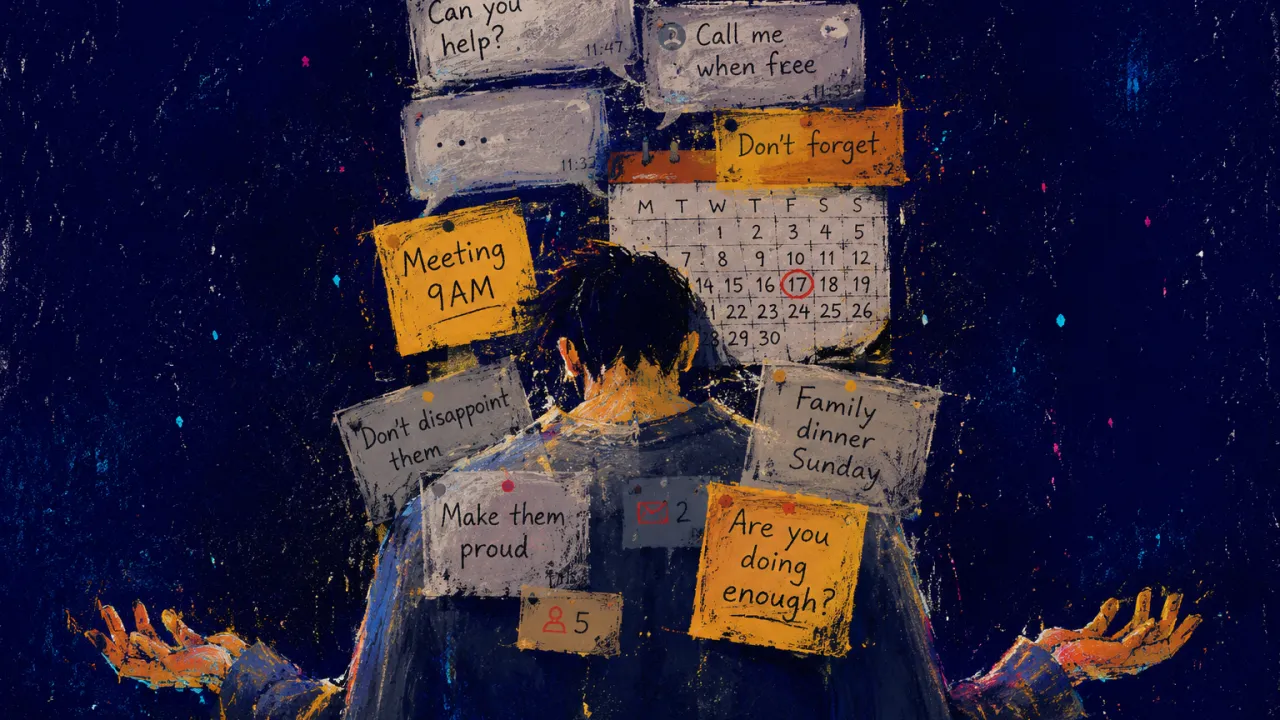
Figure with lowered shoulders and open palms beneath messages, calendar notes, and reminders settling from above.

What is this situation?

Family Emotional Labor Imbalance starts when you quietly become the person who remembers what everyone needs before anyone asks. A birthday, a tense group chat, a parent's appointment, a sibling's bad week, or a holiday plan lands with you, and soon you are sending reminders, smoothing awkward conversations, checking who has replied, and making sure nobody is left out. Other family members may care, but they wait for your prompt, ask you what needs doing, or step in only after you have broken the task into pieces. When conflict surfaces, you are expected to translate tones, pass messages, and find the wording that keeps dinner, the visit, or the chat moving; when things go well, that work disappears into the background. Your phone keeps lighting up, unfinished plans follow you between home, work, and school, and your shoulders tighten before you open another "quick question." If you stop coordinating, dates are missed, tensions sit untouched, and someone asks why you did not say anything sooner. The arrangement gives everyone else room to react while you carry the remembering, anticipating, and repairing. By the end of the week, your body is still braced under a load no one has formally named, much like the Ten of Wands figure bent forward beneath a bundled weight that fills the path ahead.

Why it's not you?

This is not a failure to set the right tone or organize well enough. The imbalance exists because the family arrangement makes one person the default tracker, translator, and follow-up system while everyone else can wait for a prompt. Work that is expected but rarely shared or acknowledged remains work.

Family Emotional Labor Imbalance in Tarot Cards

In Family Emotional Labor Imbalance, one person is left remembering, prompting, translating, and repairing so the rest of the family can react later. The tightened shoulders before another "quick question" show where that repeated workload lands in the body. This is an environmental, structural dynamic: the tasks stay concentrated because the family's routines keep routing them to the same person. The Tarot Cards below mirror the visible contours of that unequal load.

Justice
Reversed
Justice sits between two pillars with a sword raised and a scale held out in plain view; the scene is built around weighing actions and assigning consequence. Reversed, the scale no longer represents a balanced account: your family's visible outcomes are counted, while the remembering, translating, and follow-up that produced them stays off the ledger. That creates a familiar accountability asymmetry. If a birthday is missed or a tense message goes unanswered, the question becomes why you did not flag it sooner; if everything works, your preparation is absorbed into the background. The reversed sword and scale expose a recognition gap rather than a personal failure of tone or organization. The family system has made one person's preventive labor compulsory while leaving its value unofficial.
Temperance
Upright
An angel stands with one foot on land and one in water, pouring between two cups without spilling either; the body itself occupies the crossing point. That image fits the family translator who moves between tones, needs, and partial conversations so a dinner, visit, or group chat can keep moving. Upright, the flow is skillful and the two vessels can be brought into workable proportion. Yet the scene also shows the cost of successful mediation: you remain stationed between the sides, absorbing friction before anyone else has to name or repair it. The card gives that labor a precise social shape. It distinguishes shared emotional regulation from a family system that treats one person's balancing capacity as a permanent public utility.
Two of Pentacles
Reversed
Two pentacles circle in a continuous loop while ships pitch through changing waves in the background; the image ties everyday stability to shifting timing. Reversed, family dates, appointments, replies, and holiday decisions arrive as a sequence of moving deadlines that you must keep rechecking for everyone. You become the family's social clock, chasing confirmation before a plan can become real. When you pause, the delay is recast as your failure to warn people, even though the timing work was never formally assigned or shared. The reversed loop reveals a cycle rather than a single missed date. It names the pressure of being permanently on-call for other people's calendar decisions, where every new change creates another round of prompts and repair.
Three of Pentacles
Reversed
Three figures gather around a stone structure and a plan, with the work depending on visible roles and coordinated instructions. Reversed, the shared build loses its handoff: family members wait for you to turn concern into a date, a reminder, a message, or a specific job. You end up acting as project manager for an arrangement that is supposed to be relational. The group can appear cooperative once you have broken the work into pieces, while the invisible planning that made cooperation possible remains attached to your name. The reversed scene makes a coordination failure legible without reducing it to poor organization. You are carrying the missing workflow, and the family receives the finished structure without having to see who supplied the plan.
Six of Pentacles
Reversed
One standing figure holds a balance while coins pass down to two kneeling recipients; the picture makes giving, receiving, and access visibly unequal. Reversed, that exchange mirrors a family arrangement where care may be mutual in sentiment but prompts, sequencing, and emotional repair travel mainly through you. The recipients can wait because the giver is already positioned to distribute what is needed. In your family, other people may care and still leave you to ask who replied, explain the tension, or split a vague need into manageable tasks; when the outcome is smooth, the work is not counted as a contribution. Reversed, the broken reciprocity is structural rather than a verdict on your generosity. The card names the gap between being the person who keeps care moving and being treated as though care simply happened.
Eight of Swords
Upright
An encircled figure stands blindfolded and bound among upright swords, with the path narrowed by obstacles that are visible but difficult to navigate from inside. The image fits the inner rule produced by a family role that says no one will remember, translate, or repair the situation unless you do. Each unanswered message or missed date can feel like evidence that stopping is not available, even when the arrangement itself created that dependency. The restriction is reinforced by anticipated blame, not by a formal job description, so the role lives in the mind as a constant precondition for family stability. Upright, the swords describe a constrained field of perception rather than an unchangeable identity. The structure brings the assigned obligation into view: family responsibility has narrowed your available responses until carrying the load feels safer than testing whether anyone else will pick it up.
Five of Wands
Upright
Five figures raise wands in a crowded, directionless cluster; every body is active, but no shared line of action is visible. When conflict surfaces in the family system, that visual becomes the group chat, dinner, or holiday plan where you must sort competing tones and translate one person's position for another. You are not simply participating in the disagreement. You are assigned the extra layer of work that makes disagreement socially survivable: passing messages, softening wording, checking who is still engaged, and locating the sentence that lets the group continue. Upright, the wands remain in people's hands, which means the conflict belongs to the group rather than to its designated mediator. The structure makes visible how a lively family exchange can still distribute repair work unevenly.
Ten of Wands
Upright
The Ten of Wands figure bends beneath a bundle that blocks his view of the road, so the body carries the future before the eyes can assess it. That physical fact mirrors the inner cache created by family emotional labor: you anticipate who will need what, rehearse the right wording, and brace before opening another message. The load becomes mentally portable even when no one is actively asking. You can be at work, in class, or trying to rest while unfinished family threads keep running in the background as reminders, imagined reactions, and responsibility checks. Upright, the road is not erased; it is obscured by a role that has become cognitively continuous. The card reveals how a family arrangement can turn attentiveness into permanent internal monitoring without making that monitoring a measure of your worth.

Family Emotional Labor Imbalance in Tarot Card Reading Insights

Other people have brought Family Emotional Labor Imbalance into readings after becoming the default person for reminders, plans, and conflict repair. The articles below gather Tarot Reading Insights from readings shaped by the same uneven family workload.

Psychological contexts related to Family Emotional Labor Imbalance