Rewriting Texts to an Unavailable Parent: Letting the Pattern Lead

The Face-Up Phone and the Unavailable Parent
If you can turn around client copy before lunch but spend Sunday night rewriting “Hope you’re doing okay” to an emotionally unavailable parent, you already know how parental validation chasing can turn one text into a high-stakes pitch.
At 8:42 p.m. in a small Parkdale apartment, Alex (name changed for privacy), a 27-year-old junior communications strategist, sat beside a half-finished campaign deck and edited the same check-in for the fourth time. The radiator clicked in the corner, the laptop fan whirred, and cold pad thai left a faintly sweet smell on the counter. Her phone was warm in her restless hand, face-up beside the keyboard.
“I keep thinking there is one version of the message they will answer,” she said. “I know I cannot force closeness, but I still keep trying to prove I’m worth choosing.”
I could see the contradiction without turning either person into a villain. Alex wanted spontaneous warmth from a parent who had remained emotionally unavailable, yet every delayed or one-word reply sent her back to the same locked door, drafting, checking, explaining, and knocking again. Her longing was not an abstract feeling. It was a taut wire across her chest, restless fingers, and a sudden drop in her stomach whenever the phone stayed silent.
“You are not only waiting for a reply,” I told her. “You are waiting to learn whether you can stop earning your place. We can look at that pattern without blaming you, predicting the parent, or forcing a decision about contact. Let’s draw a map through the fog and see where your choice begins.”

Choosing a Compass for Family Contact
I asked Alex to take three ordinary breaths and name the question she wanted the cards to hold. Then I shuffled slowly, using the movement to narrow attention from the open message thread to the present room. There was no demand for belief in a hidden verdict. The preparation was simply a way to pause the reflex and make room for observation.
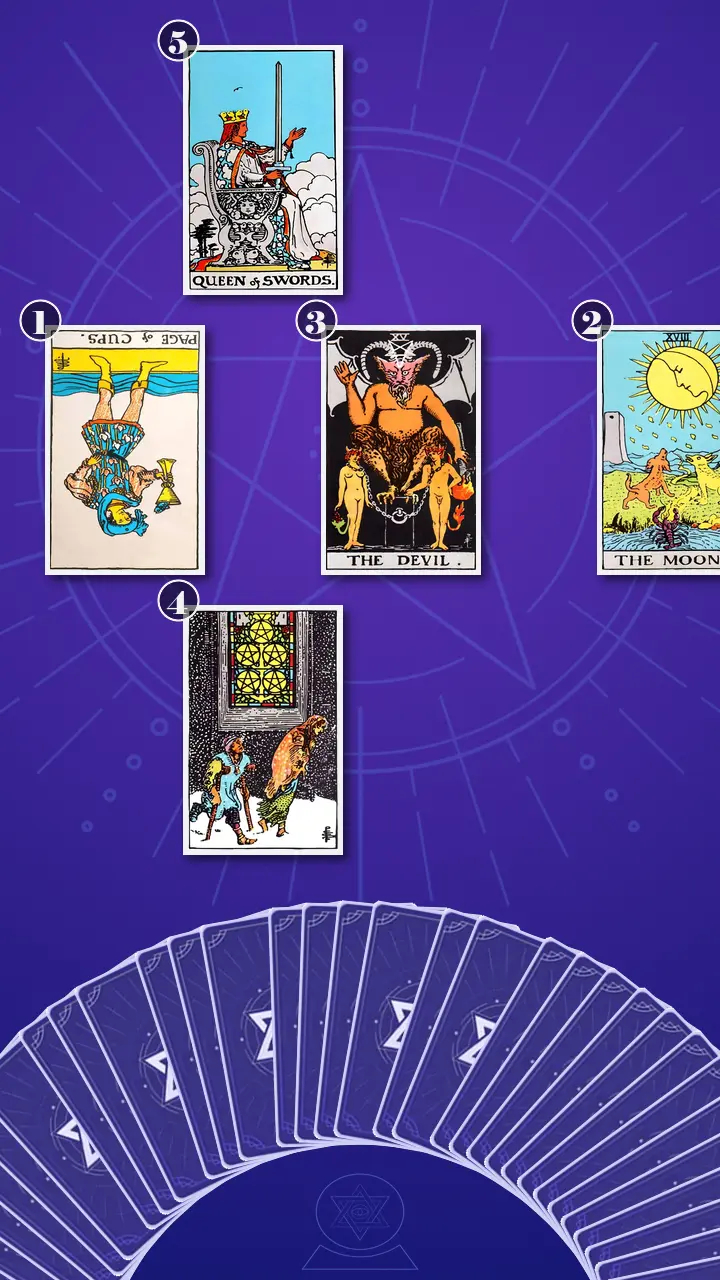
For this reading, I used a five-card Relationship Spread · Context Edition. This structure suits a family relationship because it maps the observable chase for closeness, the signals Alex can and cannot reliably read, the attachment loop beneath the pursuit, the belonging wound that gives the loop urgency, and a self-directed boundary she can choose. It examines contact as experienced, rather than pretending to know the parent’s private motives or predicting what the parent will do.
I placed the third card in the centre, the first to its left, the second to its right, the fourth below, and the fifth above. The first card would show the presenting pattern: what Alex actually does after contact feels distant. The second would explore perceived availability and the difference between evidence and interpretation. The central card would name the bond that keeps the chase repeating. Below it, I would look at the core wound, and above it, the final card would offer self-directed integration, not a command about the parent.
Reading the Map of a Reply
Position 1: The Message That Carries Too Much
I turned over the card for the presenting pattern, the observable way Alex keeps pursuing closeness after contact feels unavailable. It was the Page of Cups, in reversed position.
The modern scene was almost exact. On a Sunday evening, Alex edits a gentle check-in four times, sends it, and keeps the phone face-up beside her campaign deck. A delayed “Hope you’re good too” makes her reopen the thread, compare punctuation with older messages, and wonder whether a warmer version of her text could have produced the closeness she wants.
In this reversed position, the Page’s water is not absent. It is blocked and over-concentrated. The vulnerable message goes out, but emotional attention remains fixed on the cup, waiting for one surprising sign to explain the whole relationship. The fish is not a promise. It is a small, unexpected signal that captures the Page’s entire gaze. The card asks Alex to separate what she actually received from what she needed the response to mean before making another bid.
Her inner sentence sounded like careful client work: “If I can make this warm but not needy, honest but not too much, maybe they will answer differently.” The wish for uncomplicated closeness had become an attempt to engineer a response that could not reject her.
Alex did not nod. She gave a small, bitter laugh, turned her phone over, and said, “That’s too accurate. It’s almost cruel.” I kept my voice steady. “The card is not calling your hope foolish. It is showing how much weight one small signal has been asked to carry.” Her thumb stopped above the screen, and the tension in her wrist softened by a fraction.
Position 2: The Uneven Light of The Moon
For the position of perceived availability and relational signal, I turned over The Moon, in upright position. This card describes what Alex can and cannot reliably read in the parent’s replies. It does not grant me access to the parent’s inner state.
I brought in the image of the TTC platform at night. A short reply can provide enough light to keep moving, but not enough to see what lies beyond the next turn. Alex might read the same message as affection, distraction, obligation, or a quiet invitation to try again. The energy here is uneven and unclear. Uncertainty becomes a blockage when it is treated as an instruction to investigate harder.
“Let’s make three labels,” I said. “Observable. Inferred. Unknown.” Under observable, Alex could place the exact words, the time of the reply, whether the parent asked a question, and what action followed. Under inferred, she could place the story she built around punctuation or silence. Under unknown, she could place the parent’s private motives, which neither of us needed to invent.
“I do know,” she said slowly, “that I turn ‘I don’t know’ into a research assignment.”
“And ‘I don’t know’ can also be a complete description,” I said. “A small reply can be real without being enough. Ambiguity can sustain hope; it cannot guarantee access.”
Alex’s jaw released first. Then her shoulders lowered, as if someone had loosened a strap across them. She looked at the card’s path between the two towers and let the uncertainty remain unresolved for several seconds without reaching for her phone. That pause was the first sign that not every shadow needed to become a message.
Position 3: The Loose Chain in the Centre
At the centre of the spread, I turned over the card for the underlying bond, the dynamic that keeps the pursuit repeating. It was The Devil, in upright position.
I explained the card carefully. The Devil does not mean doom, possession, or an external villain. Here it represents attachment, compulsion, and a loop that feels stronger than conscious choice. The RWS figures wear chains that are loose enough to show agency, but heavy enough to explain why the next message can feel urgent.
The modern version was a variable-notification loop: send, refresh, receive one warm phrase, feel relief, wait, feel distance, compose again. Alex knew another carefully timed message was unlikely to make the relationship mutual. Still, not sending it felt like admitting she had never mattered enough. Stopping seemed more dangerous than continuing because continued pursuit kept the possibility of belonging alive.
“This is where loyalty and compulsion can start borrowing each other’s clothes,” I said. “Your care is real. The repeated checking is also taking over the job of deciding where your attention goes.”
I thought of an excavation I once worked on near Cambridge, where a later wall had been built directly over an older foundation. The newer structure looked inevitable until we cleared the soil around it and saw the earlier line beneath. A pattern can feel like architecture simply because it has been reinforced for a long time.
Alex’s hands went still. Her eyes moved from the loose chains to the phone in her lap, and for a moment she seemed to replay every send-refresh-reread cycle at once. Then she exhaled and said, “Stopping would mean I never mattered. Trying again feels safer than finding out what is actually available.”
“That sentence is the hinge,” I replied. “The card is not asking you to shame the longing or make a permanent decision tonight. It is asking you to notice the moment a request for closeness turns into proof-seeking, then identify one choice that returns attention to your own values.”
Position 4: The Lit Window and the Belonging Wound
Below the centre, I turned over the card for the core wound and blind spot, the fear that makes being shut out feel like a statement about worth. It was the Five of Pentacles, in upright position.
I returned to a Line 1 scene Alex had described. At 6:04 p.m., leaving Union, she opened an Instagram Story showing a friend’s mother dropping off soup after a difficult week. The brakes screeched, damp wool coats crowded the aisle, and the bright screen reflected in the dark train window. Alex felt happy for her friend, then felt her own stomach drop. Before the next stop, she had opened the parent’s thread to look for a reason to try again.
The Five of Pentacles carries heavy earth. It names exclusion, loneliness, and the physical experience of seeing warmth nearby without reliably having access to it. The illuminated window in the card shows that care exists; it does not say Alex must keep trying to enter through one unavailable door. When friends receive help with a move, groceries, an airport pickup, or a hard appointment, the contrast can become a false equation: they receive easy parental support, therefore something about me must explain why I do not.
“Other people seem to get this without negotiating for it,” Alex said. “What does it say about me that I don’t?”
“It says that access has been painful and inconsistent,” I answered. “It does not say that you are less worthy of belonging. Someone else’s limit is not a verdict on your belonging.” I did not rush her toward reassurance. Her eyes stayed on the window in the card, her breath caught once, and then she let it out slowly. Grief and dignity could occupy the same room.
When the Queen of Swords Cleared the Fog
Position 5: The Open Hand and the Clean Blade
The room grew quieter when I reached the final card. For the self-directed integration position, the perspective Alex could choose rather than a prediction about the parent, I turned over the Queen of Swords, in upright position. This was the key card and the antidote to the pattern.
The Queen’s raised sword separates facts from projections. Her open hand keeps honest contact possible. Together, they resemble one direct request paired with a private attention boundary: openness without repeated pursuit. I showed Alex the life translation: writing, “Would you be open to a 20-minute call next Sunday at 4 p.m.?” and deciding in advance that an unclear answer would not lead to a second follow-up that week.
This was also the point where I used my Generational Trauma Excavation lens. I was not trying to identify an ancestor to blame or diagnose the parent. I was tracing the family loop across layers: perhaps the inherited rule was that a good daughter keeps the door open, absorbs distance, explains everyone else’s limits, and knocks more carefully. Once that layer was visible, Alex could stop treating the rule as a personal moral obligation.
My second lens, Inherited Belief Stratigraphy, helped us separate the authentic value from the obsolete doctrine. The authentic value was, “I want honest, mutual connection.” The fear-based layer was, “If I stop pursuing, I lose my place.” The first could be preserved. The second could be examined, revised, and eventually buried without burying Alex’s capacity for love.
Before I said more, Alex was still inside the old equation: if I stop trying, I will prove I was never important enough; if I find the exact words, perhaps the door will open. The Queen did not promise a better reply. She asked what Alex’s attention was doing while she waited.
“The answer is not to keep knocking until unavailability becomes closeness; choose clear boundaries and honest requests, like the Queen of Swords who meets reality with a steady mind and a clean blade.”
For three seconds, Alex’s breath stopped. Her eyes fixed on the sword, then moved to the open hand as if the two symbols had to be tested together. A small pulse moved in her cheek; her shoulders remained raised, and her fingers tightened around the edge of her sleeve. Then the meaning reached the older wound. Her grip loosened, her mouth parted, and a shaky breath left her chest. She looked suddenly younger, not helpless, but tired from carrying the same question through so many ordinary evenings. “So I can want more and still let the pattern tell me what is workable,” she said. I waited rather than filling the silence. She sat a little straighter, saved the sentence in her Notes app, and imagined placing the phone screen-down after one honest request. I asked, “Now, use this new perspective to recall whether there was a moment last week when this distinction might have let you feel different.”
Then I offered a seven-minute experiment, not as a test she could fail but as a small piece of evidence. In the Notes app, Alex could make three columns: “What I received,” “What I hoped it meant,” and “What is mine to choose.” She needed only the most recent exchange and one line in each column. She did not need to send, confront, forgive, or decide anything that night. If her chest tightened, she could close the note and return later or contact someone she trusted. The one-line version still counted.
This was the movement from attachment-driven signal scanning toward reality-based discernment. It was also the first step from grief and worth-based pursuit toward steadier self-trust. The parent’s availability remained outside Alex’s control. Her attention, language, and emotional access did not.
The Lineage Artifact Review
When I stepped back from the five cards, their story was coherent. The reversed Page of Cups showed a vulnerable message carrying the weight of an entire relationship. The Moon showed how partial replies invited interpretation without proving availability. The Devil revealed why the loop felt like loyalty and why stopping could feel like surrendering belonging. The Five of Pentacles named the grief beneath the chase: warmth was visible elsewhere, and limited access had begun to feel personal. The Queen of Swords introduced clear air, direct language, and a boundary around attention.
The blind spot was not that Alex hoped too much. It was that she had been treating pursuit as evidence of love and another person’s limit as an invitation to try a more perfect version of herself. The key shift was from trying to unlock the parent’s availability through better pursuit to assessing the contact that was consistently available and choosing a self-respecting response. Tarot had not decided what the relationship meant. It had helped us put the pattern where Alex could see it.
I called the practical exercise The Lineage Artifact Review. We would look at each inherited belief as though it were an artifact recovered from a family site. Some values could be consciously preserved. Some fear-based rules could be permanently buried. Some could remain in storage until Alex had enough distance to decide. The goal was not estrangement, confrontation, or a forced forgiveness story. It was to stop confusing an old family instruction with a law of belonging.
Small Next Steps for Finding Clarity
I gave Alex three low-pressure actions. Each one interrupted the loop without demanding that she stop caring.
- The Observed / Hoped / Unknown CheckDuring one lunch break this week, Alex can open the Notes app and sort the last three exchanges with the parent under “Observed,” “Hoped,” and “Unknown.” After the next reply, she can set a seven-minute timer, quote the words she actually received, write one hoped-for meaning, and name one fact that remains unknown.Start with one exchange and one sentence per column. “Unknown” is a valid answer and does not need to be solved.
- The Lineage Artifact ReviewOn Wednesday evening, Alex can spend ten minutes in her bedroom or kitchen writing two lines: “The family rule I inherited is...” and “The value I choose to keep is...” She can name the rule that says stopping proves she never mattered, then preserve the desire for honest connection while placing the proof-seeking rule in the category of beliefs she no longer has to obey.If the exercise feels too exposed, write only the two sentence openings and finish them later. Reflection is complete even when the decision is not.
- The Clean Ask and Self-Directed LimitBefore the next family message, Alex can draft one direct request in the Notes app: “Would you be open to a 20-minute call next Sunday at 4 p.m.?” Beneath it, she can write, “If I receive no clear answer, I will not send a second follow-up for seven days.” After sending, she can mute the thread for 30 minutes and place the phone in a drawer while returning to her work or making tea.Drafting without sending is already a useful first step. A boundary is not a test for the parent to pass; it is a decision about where Alex’s attention goes.
“These are not strategies for making the parent change,” I said. “They are ways to let the pattern, rather than the next notification, inform what contact is workable. You can keep, reduce, pause, or change contact as you learn more. The choice remains yours.”

A Small Proof of Belonging
Four days later, Alex sent me a message during a lunch break. “I used the three columns after their last reply,” she wrote. “I didn’t send the second follow-up. I finished my deck, then called a friend instead.” It was not a repaired relationship or a solved lifetime. It was one interrupted loop, made visible before it could take the whole evening.
On Sunday, she sent the direct request once and placed the phone screen-down. The plan was clear but not perfectly peaceful. She slept through the night, then woke with the familiar thought, “What if I get this wrong?” This time she noticed it, made tea, and smiled faintly before opening her laptop. The fear had not vanished. It simply no longer held the only key.
That was Alex’s Journey to Clarity: not forcing an unavailable parent to become available, but moving from one-reply hope to pattern-based clarity, from earning access to choosing emotional access, and from attachment-driven signal scanning toward steadier self-trust. The cards offered images and language. Alex supplied the boundary, the grief, and the next decision.
When the person whose warmth you want stays just reachable enough to keep hope alive, your chest can tighten around every reply as if finding the right words could secure both closeness and your place in the family. If you let the pattern, rather than the next reply, guide you for one evening, what small limit on your attention might feel honest?