Family Peacemaker Burnout: From Guilt to Measured Support

The Cold Dinner Behind Family Peacemaker Burnout
If you are the project coordinator who keeps a Toronto agency on schedule all day and then becomes the unpaid referee when the family group chat erupts at night, you may know the hidden mechanics of family peacemaker burnout.
Jordan, a twenty-nine-year-old creative-agency project coordinator, joined our video consultation from the shared Toronto apartment she rented to keep city life manageable. She described the previous Friday at exactly 7:20 p.m.: dinner cooling on the kitchen counter, three family threads open, the phone warm in her palm, and the smell of garlic fading while she edited the same neutral message for the fifth time. Each buzz pulled her shoulders closer to her ears. Before pressing send, she had already texted a friend, “Sorry, family thing. I can't make it.”
“I know exactly what everyone means,” she told me, rubbing the hinge of her jaw, “but no one will say it directly. If I don't step in, this will become a whole thing.”
Her workplace strength had followed her home without a job description, compensation, or end time. At the agency, anticipating blockers made her effective. In the family chat, it turned every relative's feeling into a task automatically assigned to her. She softened other people's words, accepted separate calls, and suppressed her own position until the volume dropped. The room became quieter, but the cost inside her became louder.
I heard guilt-laden exhaustion in the shape of her story. It was like carrying a tray of full glasses through a room where everyone kept striking the table: her jaw, stomach, and shoulders remained braced for a spill she believed she would be blamed for failing to prevent.
“I want to help without disappearing inside the help,” she said.
“Then that is our question,” I replied. “Not how to make every relative calm, and not whether you should cut anyone off. We are looking for a way to protect your needs and limits while staying connected on terms you can actually sustain. Let us draw a map of the pressure before we decide what belongs in your hands.”
Years spent at Cambridge and on archaeological sites have taught me not to treat a visible crack as a prophecy of collapse. A fracture can show where a structure has carried too much weight. Tarot, used responsibly, helps me examine that structure; it does not tell Jordan that conflict is destiny or that a card outranks her judgment.

Choosing the Compass for a Family Boundary Reading
I invited Jordan to place her phone face down, take one unforced breath, and hold the question in plain language: “How can I stop sacrificing myself to keep every family conflict calm?” I shuffled slowly. The pause was not a mystical performance. It was a transition from reacting to observing.
I chose the Relationship Spread · Context Edition, a five-card relationship tarot spread for family conflict, boundaries, and sustainable support. For anyone wondering how tarot works in a consultation like this, I use the cards as structured prompts. Their positions separate details that can feel fused together when a group chat is moving quickly: Jordan's behaviour, the family's contribution, the loop between them, the capacity that could interrupt it, and the form of support Jordan could choose afterward.
This was the smallest spread that could hold the whole relational problem without pretending to predict what every family member would do next. Position one would show Jordan's current stance. Position two would identify the conflict cues coming from the family system. Position three, placed at the centre, would expose the maintenance loop. Position four would reveal the transformation lever, while position five would show self-led integration rather than a fixed future.
I arranged the cards as a cross resembling a bridge around a central hinge: Jordan on the left, the family's contribution on the right, the repeating pattern in the middle, the new foundation below, and sustainable participation above. The design mattered because we were not asking whether Jordan could eliminate disagreement. We were asking how she could cross it without becoming the bridge everyone else refused to build.
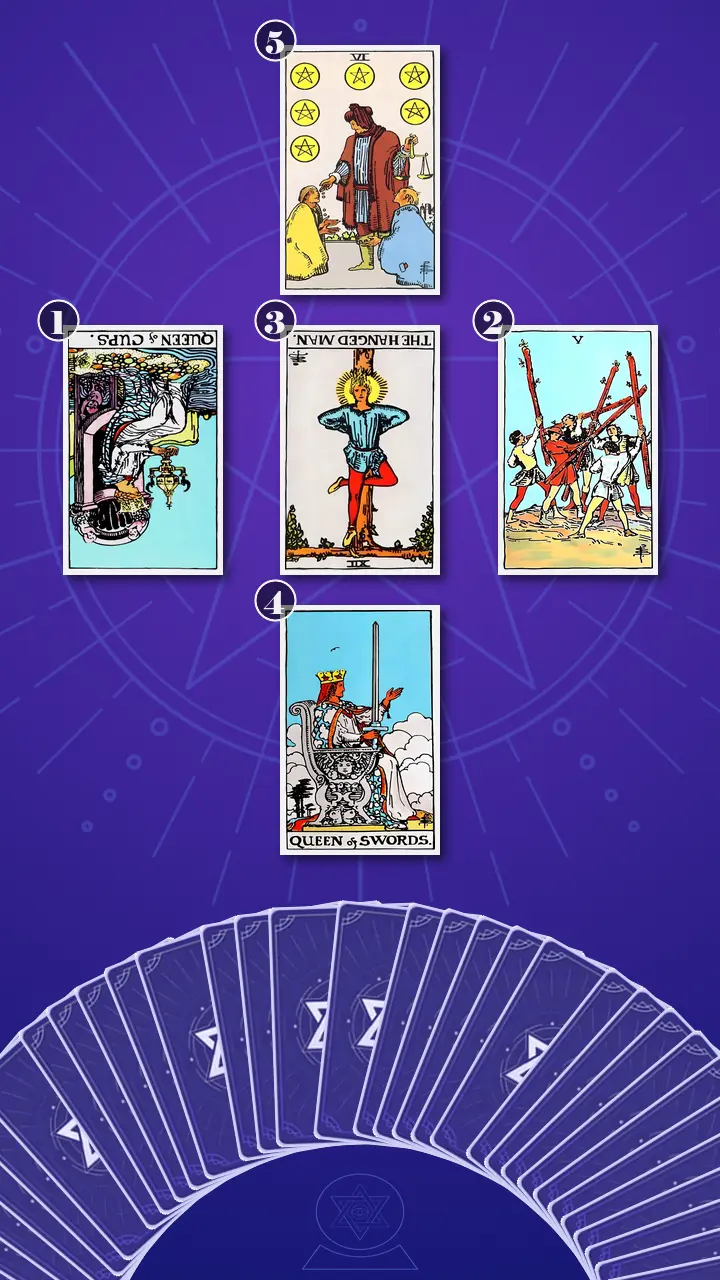
The Closed Cup and the Crossing Staffs
Position 1: The Phone That Held Everyone's Feelings
“Now I am turning over the card representing your current stance: the way you absorb tension, answer quickly, and lose contact with your needs while trying to maintain calm.”
The card was the Queen of Cups, reversed.
I showed Jordan the Queen's ornate closed cup, held in both hands beside moving water. In an upright position, this Queen can represent emotional attunement and receptive care. Reversed, I read her Water as a blockage: Jordan's sensitivity had not disappeared, but nearly all of it was flowing toward the surveillance and containment of other people. Her own internal signals were left on unread.
The modern-life card meaning was almost literal. At 7:20 p.m., Jordan was holding three relatives' feelings in separate threads, rewriting a soothing message while her dinner cooled, and checking everyone else's emotional temperature before noticing her own resentment. The cup resembled the phone in her hand: a single vessel expected to contain several incompatible emotional conversations without spilling any of them.
I repeated the sequence I had heard beneath her description: “Who is most upset? What wording will calm them? How fast do I need to answer?” Then I stopped.
“Which question is missing?” I asked.
Jordan stared at the reversed Queen. Her thumb moved over the edge of her phone even though the screen was dark.
“What is happening in me?” she said at last.
She gave a short, bitter laugh. “That is so accurate it is almost rude. I always know who is offended. I don't know what I wanted until after I've cancelled it.”
I did not tell her that caring was the problem. Her emotional intelligence was real, and it had value. The problem was compulsory direction: every signal went outward. To prove that she was still loving, she answered faster, explained more, and made herself increasingly central to the process that depleted her.
“Before your next non-urgent reply,” I said, “the first question is not, ‘How do I calm this?’ It is, ‘What am I feeling, and what part of this actually belongs to me?’”
Position 2: Five Voices Mistaken for One Emergency
“Now I am turning over the card representing the family's contribution: the competing agendas, indirect messages, and conflict cues that recruit you as translator.”
The card was the Five of Wands, upright.
Five figures raised separate staffs that crossed without forming a stable structure. I read the card as Fire in excess: visible, noisy, uncoordinated energy. It resembled overlapping notifications, typing bubbles, voice notes, and incompatible accounts of the same birthday argument. Everyone remained visibly distinct, but Jordan's reflex was to turn five positions into one acceptable version.
She told me about reading two conflicting accounts on a wet TTC commute. The train brakes screeched, damp coats pressed against her sleeve, and four typing bubbles appeared before she reached the office. She opened Notes and began drafting a neutral summary even though the relatives involved had not attempted a direct conversation.
“Your project-coordinator brain sees an unowned task,” I said, “and assigns it to the person most capable of closing it. That person is always you.”
I thought of the pattern as an algorithm trained on urgency. Every time Jordan responded immediately, the family system learned that conflict sent through her would receive translation, scheduling, and emotional quality control. This did not make her the cause of the conflict. It showed why a well-intended intervention could reinforce the route through which the conflict travelled.
“Conflict is uncomfortable; it is not automatically catastrophe,” I told her. “Several adults disagreeing does not create an automatic vacancy for a referee.”
I watched her shoulders descend by perhaps half an inch. She inhaled more fully, then pressed her lips together.
“But loud has always meant it's about to get worse,” she said.
“That expectation makes sense given what you have experienced,” I replied. “We can still distinguish an immediate safety concern from ordinary relational friction. Noise is data. It is not automatically your assignment.”
Position 3: The Friday Night Permanently Marked Tentative
“Now I am turning over the card representing the relationship's central maintenance loop: the repeated sacrifice that produces temporary quiet while direct communication remains suspended.”
The card was The Hanged Man, reversed.
The suspended figure wore a halo, suggesting that a changed perspective was available. Reversal turned a purposeful pause into prolonged self-suspension. I read this Major Arcana energy as a blockage: Jordan was giving up time, rest, and visibility, but the sacrifice was no longer producing movement or insight.
In modern terms, the figure was Jordan's Friday calendar held indefinitely on “tentative.” She kept the evening open for follow-up calls, postponed dinner, and remained between two relatives who continued to avoid each other. Her private bargain was simple: “I will give up tonight so everyone can settle down, and then I can relax.” The recurring result was just as clear: the night disappeared, the relatives still did not speak directly, and Jordan remained on standby the next time.
On archaeological digs, I have seen temporary supports placed beneath strained structures. A support can prevent an immediate fall, but if everyone starts treating the prop as the building's permanent architecture, the underlying load is never redistributed. Jordan had become that support: useful in the moment, exhausted over time, and increasingly mistaken for the only thing holding the family together.
“Is the sacrifice resolving the conflict,” I asked, “or is it keeping the arrangement familiar?”
Jordan's breathing paused. Her fingers tightened around the sleeve of her mug, her gaze moved away from the screen, and then her grip slowly loosened.
“They don't have to talk to each other if I keep translating,” she said. “And I keep calling that helpful because admitting I'm angry feels selfish.”
I told her resentment was not a verdict on her character. In this context, it was information that her current exchange was asking for more time and emotional labour than she could freely give.
“Your usefulness is something you offer, not rent you pay for belonging,” I said.
The Hanged Man reversed did not demand sudden disappearance. Muting every chat for weeks without explanation could become another form of avoidance. Its invitation was smaller and more exact: stop holding the middle in one recurring dispute long enough to see which responsibilities return to the people who own them.
When the Queen of Swords Drew a Clear Edge
Position 4: The Open Hand Beside the Upright Blade
The rain against Jordan's Toronto window had softened. Just before I turned the fourth card, a streetcar bell carried faintly through her microphone: one clean note beneath the city's background noise. The room seemed to make space around it.
“Now I am turning over the card representing the core challenge and transformation lever: the capacity to separate compassion from responsibility and state a limit clearly.”
The card was the Queen of Swords, upright.
I pointed to her upright sword and her extended open hand. The gestures appeared together. One established an edge; the other left honest contact available. I read her Air as balanced: clear discernment, independent judgment, direct communication, and compassionate detachment from responsibilities belonging to other people.
In Jordan's life, this was the difference between six unsent paragraphs explaining everyone's motives and one visible sentence describing her availability: “I care about both of you, but I am not going to carry messages between you. Please speak directly when you are ready.” The Queen did not guarantee that the recipients would approve. She showed Jordan how to speak without making approval a condition of clarity.
At 7:20 p.m., Jordan's dinner had been cooling beside three open message threads. She was rewriting one careful reply while cancelling her own plans because everyone else's anger felt urgent and her disappointment felt negotiable. She had been trying to find a boundary no one could dislike, which meant creating a boundary she could never finish.
I used an analytical method I call Inherited Belief Stratigraphy. On a dig, I do not treat every layer as if it came from the same period or served the same purpose. I separate what still belongs to the living structure from what reflects an older fear, pressure, or survival rule. I invited Jordan to do the same without blaming herself or inventing a story about her relatives that the cards could not prove.
The first layer was an authentic value: “I care about my family, and I want connection.” The second was a familiar role: “I am the reasonable person who can translate everyone.” Beneath it sat the fear-based rule: “If I stop being useful, I may lose my place.” The Queen of Swords did not ask Jordan to bury care. She asked her to stop confusing care with the obsolete rule that belonging had to be purchased through self-erasure.
Keeping everyone calm is not the price of belonging; one clear boundary is a wiser form of care, like the Queen of Swords holding an open hand beside an upright blade.
I let the sentence remain between us before adding:
Keeping everyone calm is not the price of belonging. You can care about the conflict without becoming its delivery system.
For one beat, Jordan did not breathe. Her fingers hovered above the face-down phone, motionless. Then her gaze lost focus; she later told me she was replaying the cancelled dinners, the separate calls, and the nights spent refreshing the chat. Her mouth tightened before her eyes began to shine.
“But doesn't that mean I have been doing it wrong this whole time?” she said. Her voice came out sharper than before, carrying anger alongside hurt. “I've lost so many evenings to this.”
I did not rush to turn her anger into relief. “No,” I said. “It means you developed a strategy that created short-term calm and perhaps once helped you feel secure. Seeing its cost now does not make your earlier self foolish. It gives your present self a choice.”
Her pupils widened slightly. Her hand closed into a fist, loosened finger by finger, and settled flat on the table. A breath left her in a thin, unsteady stream. Her shoulders dropped, but the release was followed by a blank, exposed look: the slight dizziness that can arrive when an old responsibility is removed and agency appears in its place.
“Now, with this new perspective, think back to last week,” I invited her. “Was there a moment when this insight could have made you feel different?”
Jordan recalled the Saturday café call. A relative had said, “You're the only person who can get through to them,” and Jordan had left her friend inside beside an unfinished coffee. She looked again at the Queen's open hand.
“I could have said, ‘I care about you. I am not available to mediate this. Please speak to them directly,’” she said. “They might still have been mad. But I would have stayed at the table.”
I set a seven-minute timer and asked her to open Notes rather than the family chat. She completed three lines: “I feel...”, “I can offer...”, and “I will not...” The last two became one sentence: “I can listen for twenty minutes tomorrow, but I will not carry messages between you.”
I reminded her that she did not have to send it that day. The minimum version was simply, “I cannot mediate this tonight.” The exercise was for non-urgent disagreements; immediate safety situations called for appropriate local, emergency, or professional support rather than relying on an unchosen family mediator.
I named the crossing plainly: this was one step from guilt-laden hypervigilance and self-erasure to clear boundaries and sustainable family connection. It was not certainty, permanent harmony, or control over anyone's reaction. It was the first movement from belonging through usefulness toward belonging with separateness.
Position 5: Six Measured Coins Instead of Unlimited Access
“Now I am turning over the card representing your self-led integration: how you can offer proportionate support without making family calm your personal duty.”
The final card was the Six of Pentacles, upright.
The figure held level scales while distributing coins in deliberate amounts. I read the card's Earth as balance: the Queen of Swords had supplied clear language, and the Six of Pentacles grounded that language in observable choices about time, attention, access, and effort.
In Jordan's life, this meant checking her calendar before accepting a call and deciding that she could listen for twenty minutes without cancelling dinner. It meant declining to relay accusations and leaving reconciliation to the relatives involved. Support became an energy budget rather than an unlimited data plan: it had an amount, a time window, and conditions that preserved everyone else's agency.
I gave Jordan three questions to ask before saying yes: “Did I choose this? Can I sustain it? Does it leave their responsibility with them?”
“That sounds almost too practical for tarot,” she said, placing both feet firmly on the floor.
“The cards are only useful if their meanings survive contact with a Tuesday evening,” I replied. “Measured support is still real support. A freely chosen twenty-minute call can be more honest than an entire night surrendered in resentment.”
I also asked her to notice the power dynamic inside giving. If her support allowed two capable adults to avoid direct communication indefinitely, more giving was not automatically more loving. The aim was not equal generosity or keeping score. It was participation that remained chosen, proportionate, and sustainable.
From Five Competing Voices to Six Measured Coins
When I read the spread as one story, I saw blocked Water first: Jordan's care had become private emotional containment. The family's uncoordinated Fire activated her urgency. The Hanged Man reversed then exposed the central workaround: she suspended her life, the volume dropped, and the actual speakers postponed the difficult work of communicating. The Queen of Swords introduced Air through one concise limit. The Six of Pentacles brought Earth by giving that limit a measurable form.
The deeper history Jordan described suggested that competence had gradually become proof of belonging. She had learned to interpret temporary calm as evidence that mediation worked, while treating her lost time, hidden opinion, and recurring resentment as private side effects. That was the cognitive blind spot: because her intervention lowered the immediate temperature, she assumed it protected connection. The spread showed that it could also preserve indirect communication and strengthen the expectation that she would intervene again.
The transformation was not from conflict to permanent calm. It was from absorbing conflict to participating with limits. When tension appeared, Jordan could pause before answering, state once what she could and could not offer, and leave direct communication with the adults involved. Other people were free to feel disappointed. Their reaction was information about their experience, not a final verdict on Jordan's care or worth.
I framed the next steps as small experiments rather than a new family role she had to perform perfectly. A boundary is information about availability, not a verdict on another person's feelings.
The Lineage Artifact Review and the Twenty-Minute Buffer
- Run a seven-minute Lineage Artifact Review. On Tuesday evening, open Notes and divide one page into “Preserve” and “Bury.” Under Preserve, write the family values Jordan freely chooses, such as care, honest contact, or practical help. Under Bury, place the rule that every conflict must pass through her. Then complete “I feel...”, “I can offer...”, and “I will not...” and turn the final two lines into one reusable boundary: “I care about both of you, but I am not going to carry messages between you.” Tip: prepare the sentence before the next notification arrives. If the urge to justify it appears, remove every paragraph that explains other people's motives. The minimum version is, “I cannot mediate this tonight.”
- Use the Twenty-Minute Conflict Buffer and protect one plan. The next time a non-urgent family conflict message arrives, set a twenty-minute timer before replying. During that window, name one feeling and one limit, keep the existing dinner, workout, or friend plan, and decide whether any response is actually required. If Jordan freely chooses to offer support, she can propose one twenty-minute listening call and say, “I can listen, but I cannot contact them for you or decide who is right.” Tip: use Do Not Disturb while allowing selected emergency contacts through. Success is not measured by whether the family becomes calm; it is measured by whether Jordan's participation remains chosen and the original speakers keep responsibility for their conversation.
I asked Jordan to try only one boundary in one non-urgent dispute. She did not need to redesign every family relationship in a week. If a conversation became abusive, coercive, or unsafe, she could leave it and seek support suited to the actual situation. Tarot did not require confrontation, reconciliation, continued contact, or distance. Those choices remained hers.

A Week Later: The Quiet Proof
Six days later, I received a short message from Jordan. A relative had asked her to forward a complaint. Jordan copied the sentence from Notes, declined to carry it, and kept the dinner she had planned with her friend. The relatives were still irritated when she put her phone on Do Not Disturb. The family did not collapse.
“I wanted to send five follow-up explanations,” she wrote. “I sent none. I ate while the food was hot. I was guilty and relieved at the same time.”
That night she slept through, but her first thought at 7:03 a.m. was, “What if they're still angry?” She told me she almost reached for the chat, then smiled at the reflex, put the phone face down, and made coffee.
I did not call that a solved life. I called it evidence of a changed role. The cards had not fixed the family or granted Jordan permission. They had helped her see the structure clearly enough to use permission that was already hers. She remained caring, but for one evening she was no longer the family's conflict-management system.
When the family chat lights up and your stomach drops, protecting one quiet evening may feel as if it could cost your place in the family. If you notice yourself becoming useful before asking what you need, remember the open hand beside the upright blade: care can remain present even when it has a clear edge.
If care no longer required you to stand beneath five crossing staffs, what one measured coin of support would you still freely choose to offer?