Caught in Adult-Child Triangulation: One Boundary for Both Parents

The 10:47 p.m. Family Switchboard: Adult-Child Triangulation in a Late-Life Parental Divorce
You can handle a client escalation without blinking, but one distressed voicemail from a parent can send you into family mediator mode before your morning meeting even starts. I said this to Maya (name changed for privacy), a thirty-one-year-old Toronto account manager, when she sat down across from me with the careful posture of someone who had been keeping several emotional fires from touching.
At 10:47 p.m., I watched her describe the scene she had lived the night before: perched on the edge of her bed near Dundas West, she played her father’s voicemail while drafting a carefully neutral reply to her mother. The laptop fan whirred beside her, a streetcar bell sounded through the closed window, and her phone felt warm in her palm. She deleted each sentence that might sound as if she were taking sides.
“Why does my parents’ divorce keep pulling me back into the middle?” she asked. “I do not want to take sides, but somehow I am carrying both sides. I keep saying this is the last message I will pass on.”
I could hear the contradiction clearly: Maya wanted to step out of the middle, yet felt compelled to mediate whenever either parent called. Guilt had become a smoke alarm installed inside her chest; every parental notification sent a sharp signal through her jaw, her breathing, and the pressure behind her sternum before she had even chosen whether to answer.
“I know this is their divorce, but my body reacts like it is my emergency,” she said. I did not treat that reaction as proof that she was failing, and I did not promise a supernatural answer or predict what either parent would do. I told her that the cards could help us place the pattern outside her body long enough to examine it. “We can sit together in the ruins of the old family arrangement,” I said, “and gently dust off what is actually yours. Our Journey to Clarity is not about deciding for you. It is about helping you hear your own boundary clearly enough to use it.”

The Cross That Made the Middle Visible
I invited Maya to put both feet on the floor, take one unhurried breath, and name the question again without editing it into something more acceptable. I shuffled slowly while she focused on the difference between caring for each parent and managing the space between them. The preparation was a psychological threshold, a way to move from the urgency of the phone screen into deliberate observation.
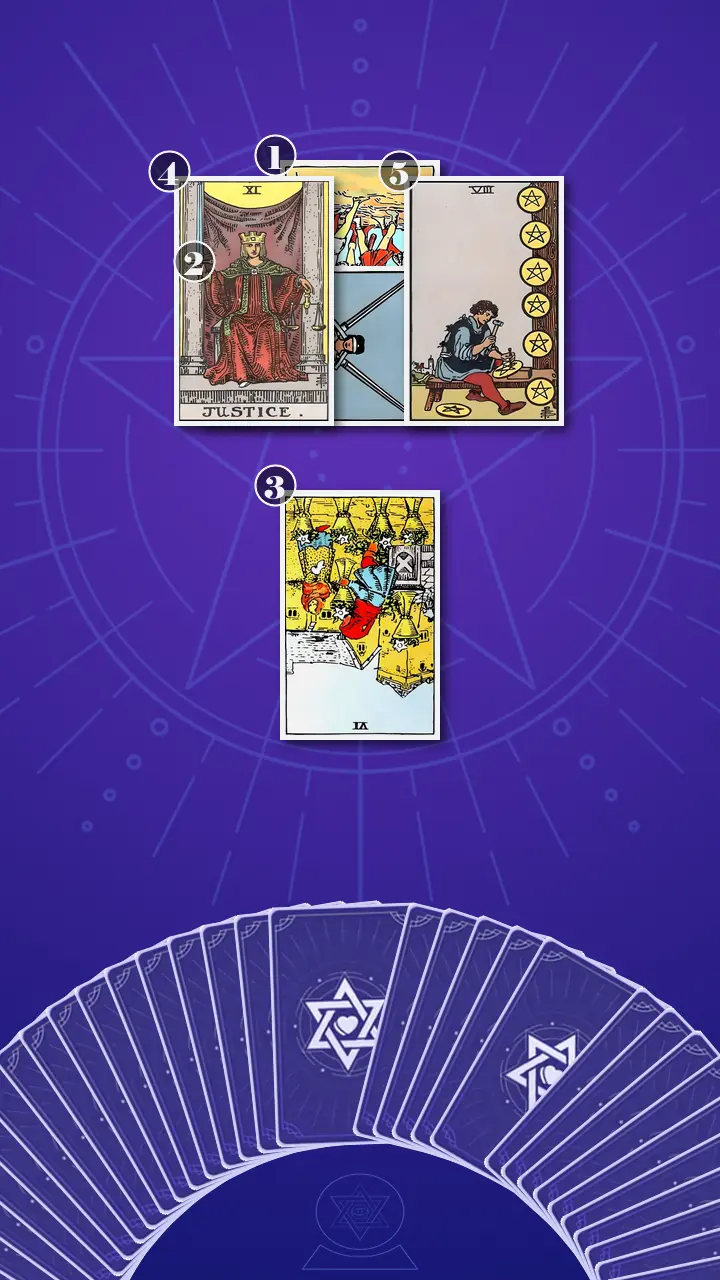
I chose the Five-Card Cross: Context Edition. For anyone wondering how tarot works in a family-boundary reading, this spread is not a verdict from outside the person asking. It is a compact map for tracing a repeating system: what is happening now, what keeps it stuck, what older pattern gives it emotional force, what principle can reorganise it, and what small practice can make the new direction real.
A Celtic Cross would have brought in more layers than Maya’s question required, while a standard relationship spread would have assumed only one other party. This version could hold the three-person structure of adult-child triangulation without making Maya responsible for solving it. The first card would reveal the present knot, the second the crossing belief that made neutrality feel necessary, and the third the childhood-rooted role underneath. Then Justice would show the corrective resource, followed by the Eight of Pentacles as the repeated boundary practice that could integrate the insight.
Reading the Knot in Real Life
The Present Knot: Five of Wands Reversed
Now I turned over the card representing the present knot: the observable conflict-management behaviours through which Maya absorbs and suppresses her parents’ competing demands. It was the Five of Wands, in reversed position.
The five staves crossed without a shared direction. No figure appeared to be coordinating the struggle, and there was no clear victor. In Maya’s life, that image became two parental message threads open at 10:47 p.m., one complaint softened, the other version checked, and a reply edited until it was too neutral to belong to anyone.
“This is like being added to two separate crisis Slack channels about the same incident,” I told her, “while the actual decision-makers refuse to enter one room. You think, I will just clarify this one thing. Then, five minutes later, the thought becomes, Why am I doing this again?”
Reversed fire showed conflict turned inward. Maya was not resolving the disagreement; she was absorbing its heat and lowering the temperature temporarily. That was an excess of appeasement and a deficiency of direct ownership. The parents might feel calmer after she translated their words, but the argument had merely relocated into her tight jaw, lost evening, and growing resentment.
Maya’s fingers stopped above her phone. Her breath paused; her eyes moved between the two cards still face down; then she gave a small, bitter laugh. “That is accurate,” she said. “Almost painfully accurate. The peace is real for about twenty minutes, and then I am the one who cannot sleep.”
I let the laugh stand without turning it into a dramatic revelation. “The first useful fact is that this is labour,” I said. “It is not a vague personality flaw or an inevitable family destiny. You are performing a communication job that belongs to two other adults.”
The Neutrality Stalemate: Two of Swords Upright
Now I turned over the card representing the crossing challenge: the belief that Maya must remain neutral between two parents even when neutrality requires her to keep carrying their communication. The card was the Two of Swords, upright.
In the image, a blindfolded figure holds two crossed swords over her chest, with still water behind her. I returned to Maya’s Bloor-Yonge scene: at 8:53 a.m., a distressed message from her mother appeared beneath a Slack reminder for a 9:15 client call. The train brakes screeched, her takeaway coffee had gone cold, and she rehearsed a perfectly balanced response because saying no to one parent felt like choosing the other.
The Two of Swords was not simple indecision. Its air was blocked by the effort of keeping every possible attachment consequence suspended. Maya gave both parents equally careful access even when she had capacity for neither. She screened a call but listened to the voicemail immediately, so the boundary existed on her screen before it existed in her body.
“Neutrality is not neutral when it requires your constant labour,” I said. “You are not standing outside the conflict. You are holding two doors shut with your arms and calling the position balanced because neither door has opened.”
I asked, “When you imagine saying, Please speak to them directly, what consequence are you afraid will follow? Anger? Withdrawal? An accusation that you chose a side?”
Maya pressed her thumb into the cardboard sleeve of her coffee. First her shoulders lifted as if bracing for impact; then her gaze lost focus and replayed a sequence of calls; finally, she released a long breath through her nose. “I picture one of them hearing no and deciding I am loyal to the other,” she said. “So I keep making myself available to both, and somehow that means I am not available to myself.”
The Buried Role: Six of Cups Reversed
Now I turned over the card representing the psychological root: the childhood peacemaker role and familiar attachment script that the current divorce repeatedly reactivates. It was the Six of Cups, in reversed position.
The card showed children, flower-filled cups, and an enclosed courtyard. Reversed, the water pulled backward toward a familiar emotional exchange rather than allowing the present to remain fully present. Maya described the moment a parent said, You are the only person I can talk to. She had been standing beneath supermarket fluorescents, with freezer cases humming and citrus cleaner sharp in the air. Her grocery list disappeared. Her adult schedule disappeared. Her voice became calm, helpful, and undemanding before she had consciously decided to offer anything.
“Be calm, be useful, do not make this harder,” she heard herself say quietly. “That rule feels older than the divorce.”
This was where I used my Generational Trauma Excavation lens. I do not use that phrase to diagnose Maya’s parents, assign blame, or claim that every family pattern has one hidden culprit. I use it to trace a behavioural loop across time so the person living inside it does not mistake inheritance for personal failure. A family can pass down an emotional rule without anyone deliberately choosing to harm the next generation.
On archaeological digs, I learned that a buried layer can explain what was built above it, but it does not have the authority to dictate what gets built next. I applied the same patience to Maya’s story. Through Inherited Belief Stratigraphy, I separated the layers: care, listening, and affection were authentic values she could keep; the fear-based doctrine that a good daughter must preserve family calm by becoming useful was an obsolete layer, not a law.
Maya went very still. Her hand closed around the edge of the chair, her eyes shone without spilling over, and then her grip loosened by degrees. “I thought I was just bad at having boundaries,” she said. “But maybe I am returning to the only role that used to make things feel safe.”
“That makes the pattern understandable,” I replied. “It does not make it permanent. Your body learned to treat their distress as your assignment. Your adult mind can learn to check whether the assignment was ever yours.”
When Justice Put the Sword Upright
The Corrective Resource: Justice Upright
The room grew quieter when I turned to the card representing the key corrective resource: assigning each adult responsibility for direct communication and defining fairness without becoming an intermediary. Justice appeared upright, its scales level and its single sword held vertically.
I asked Maya to imagine a parent’s name lighting up just before a client meeting. She felt the familiar clamp in her chest, heard urgency in the voicemail, compared both stories, and drafted the safest response within seconds. No one had asked what the interruption cost her, yet she had already treated her time as the least important item on the scales.
You do not have to hold both sides together to be a loving child; place responsibility back on the scales where it belongs and keep your own sword of clarity upright.
For a moment, the sentence seemed to remain in the air between us. Maya did not move. Her breath stopped high in her chest, and her fingers hovered over the phone as if the device had become evidence in a case she had been preparing for years. Her eyes lost focus while she replayed the last voicemail, the last holiday spreadsheet, and every carefully softened message. Then her jaw loosened. One shoulder dropped, followed by the other, and her hand opened against her knee. A small tremor entered her exhale. Her eyes reddened, but her voice, when it came, was steadier than before. “But does that mean I was wrong all this time?” she asked, with a flash of anger underneath the grief. I told her no: the old strategy had been intelligent in the circumstances that shaped it, and it was simply costing too much now. “Now use this new view to remember last week,” I said. “Was there a moment when deciding what was yours, instead of who was right, could have changed what you did next?”
Justice did not ask Maya to judge which parent was right. It asked her to apply one clear standard to both relationships. She could listen by choice, within a time limit she set; she could refuse to forward information; she could redirect divorce communication to the adult who owned it. Equal love did not require unlimited access. Fairness did not require her to become the judge.
This was the key shift from guilt-driven hypervigilance and compulsory mediation toward differentiated connection, fair responsibility, and steadier boundaries. The crossed swords of the stalemate had become one upright sword: not a weapon against either parent, but a clear line for Maya to stand behind.
The Practised Exit: Eight of Pentacles Upright
Now I turned over the card representing integration: practising the same concise boundary repeatedly until a new relational habit became more familiar than mediation. The Eight of Pentacles appeared upright.
An artisan worked on one pentacle at a time while completed pieces accumulated nearby. I translated the scene into Maya’s Notes app: save one no-relay response, practise saying it aloud, use it for one request, and record what happened without rewriting the rule after every disappointed tone. The card’s earth was grounded and practical. It did not promise that guilt would vanish before action began; it showed that confidence could be built through ordinary repetitions.
“The fantasy is one perfect family summit where everyone understands your boundary immediately,” I said. “The actual work may be much less cinematic: one delayed reply, one ten-minute call window, one sentence used with both parents.”
Maya opened her phone and typed, I care about you, but I cannot carry messages between you. Please tell them directly. She read it twice, then added three paragraphs of explanation. I watched her notice what she had done, delete the paragraphs, and leave the sentence alone.
“A boundary can feel unfamiliar before it feels wrong,” I told her. “You do not need to feel completely confident before practising it. The new response may feel awkward because it is new, not because you have failed.”
She nodded, this time without trying to make the nod reassure me. Her thumb hovered over Save. “I can practise it without sending it today,” she said. “That still counts as choosing my part.”
The One-Standard Boundary
The whole Five-Card Cross told a coherent story. The reversed Five of Wands showed why the immediate conflict kept entering Maya’s evenings: she absorbed competing messages and created temporary quiet by carrying the heat herself. The Two of Swords showed why she called that labour neutrality. The reversed Six of Cups revealed the older attachment script beneath it, the helpful child who once linked calmness with belonging. Justice offered the corrective principle, and the Eight of Pentacles gave that principle a body: a repeatable response, a defined call window, and a protected piece of adult life.
Maya’s blind spot was not a lack of love or communication skill. It was the assumption that the first reduction in her parents’ distress proved she had done the right thing, while the guilt that followed a boundary proved the boundary was wrong. I named the actual direction of change plainly: she could remain connected to both parents without serving as their communication channel. Care could remain available without becoming responsibility for their divorce.
I then introduced my Lineage Artifact Review, an intellectual exercise for deciding which family beliefs deserved preservation and which could be permanently buried. I asked Maya to make three columns in her Notes app: preserve, examine, and bury. Under preserve, she wrote listening, affection, and checking in when she genuinely had capacity. Under bury, she wrote translating complaints, coordinating adult logistics, and treating every distressed voicemail as an emergency. Under examine, she wrote the old sentence that had governed so much of her life: I must be immediately useful to belong.
“This is not a trial of your parents,” I said. “It is an inventory of what you want to carry forward. You are allowed to keep connection and retire the job of family switchboard.”
- The No-Relay RuleToday, save one reply in your phone Notes app. The next time either parent asks you to relay, interpret, confirm, or conceal information from the other, pause for twenty minutes if you are at work, on a date, or preparing for sleep, then use the same sentence: I care about you, but I cannot carry messages between you. Please tell them directly.Start with one redirected message this week. You do not need to debate the divorce, prove equal affection, or add an apology long enough to reopen the negotiation.
- The Chosen Call WindowBefore answering a divorce-related call from either parent, check your calendar and choose either ten minutes now or a specific call window tomorrow evening. If the conversation turns into criticism of the other parent, say that you are stopping because you cannot process that part with them, and end the call.If guilt spikes, send the boundary by text or shorten it to I cannot relay this. A parent’s disappointment can exist without becoming your assignment.
- The Mine-and-Theirs CheckBefore returning the next complicated message, draw two columns on paper labelled Mine and Theirs. Put your feelings, availability, work, sleep, plans, and chosen response under Mine; put their messages, decisions, legal logistics, and emotional regulation under Theirs. Protect one item from your column today.You can complete this after a call if the old role activates too quickly. Observation is enough. Do not coordinate one item simply because you can.
These were not instructions for cutting anyone off or forcing a confrontation. They were small experiments in fair differentiation. The Five-Card Cross: Context Edition had done its work by showing the pattern; Maya remained the person who would choose her pace, her availability, and the amount of contact she wanted to keep.

A Week Later, the Quiet Proof
Four days later, I received a message from Maya. She had sent the no-relay sentence to her father, then sat alone with a coffee while the first wave of guilt moved through her. His reply was only Fine. She stared at it for three minutes, took a breath, and did not write an essay.
She still felt a flicker of fear the next morning: What if I am wrong? But she noticed that the fear was a feeling, not an instruction. She arrived at her client meeting on time, and later called her mother during the call window she had chosen. The divorce was not solved. The family story was still changing. The small proof was that Maya had stayed connected as herself.
That was her Journey to Clarity: not the discovery of a perfect answer, but the first visible movement from compulsory mediation toward differentiated connection. The cards had not taken control of her choices. They had helped her recognise the old arrangement, name the responsibility line, and practise standing on her own side of it.
When a parent’s name lights up your phone and your chest tightens before you even read the message, it can feel as though keeping your place in the family depends on becoming useful enough to hold both sides. If care no longer had to travel through the family switchboard, what is one small way you might imagine staying connected as yourself?