A Family Boundary Draft Was Deleted; Three Days Later, It Held

The Inherited Family Fixer Role at 10:47 p.m.
If you are a late-twenties Toronto project coordinator who can hold a client timeline together but feels morally late after leaving the family group chat unanswered for twenty minutes, I have seen this kind of boundary guilt before. I met Jordan (name changed for privacy) on a Tuesday evening, carrying the particular tiredness of someone whose Slack responsiveness had been praised at work and quietly followed them home.
At 10:47 p.m., Jordan's paperback lay open beneath an amber lamp in their Toronto apartment. The family group chat buzzed against the wooden side table; the phone felt warm in their palm, and the radiator clicked through the otherwise quiet room. Jordan typed, "I will look at this tomorrow," deleted it, and began organizing a problem no one had explicitly assigned to them. Their chest tightened, their shoulders rose, and the hour meant for reading folded itself away.
"I only need an hour alone, so why does saying that feel cruel?" Jordan asked me. They wanted space without cutting contact, but a non-urgent family message landed like a summons. The wish for rest collided with the fear that taking it would make someone feel abandoned, while the old family fixer role offered immediate relief and left resentment waiting behind it.
I did not lecture Jordan or treat the cards as a verdict about their relatives. I told them that we could examine the sequence together: the notification, the body alarm, the automatic yes, and the lost personal time. Our aim was to move from anticipatory guilt and automatic availability toward clear capacity boundaries and connected personal space. "We can sit beside the old pattern," I said, "and see which part still belongs to you."

Choosing a Map Through Family Space
I asked Jordan to place both feet on the floor, take one unhurried breath, and focus on the question rather than on producing a perfect answer. I shuffled slowly. For me, this small ritual is a transition into attention: a way to let the phone, the workday, and the rehearsed explanations become observable rather than immediately obeyed.
I explained to Jordan, and to anyone reading along, that I was using the Relationship Spread · Context Edition, a five-card Relationship Spread designed for family roles and boundary guilt. This is how tarot works in this reading: it gives a symbolic structure to an automatic pattern so that separate parts of an experience can be examined without claiming supernatural access to another person's motives.
The spread fit because Jordan's question was relational, but it also carried a systemic layer. It could show the present-day behavior, the inherited family expectations as Jordan experienced them, the hidden bond that turned care into compulsory usefulness, the internal resource for a clear limit, and the practice that would make space real. I was not predicting whether the family would approve. I was mapping where a pause became confused with abandonment.
I told Jordan that I would begin with the card showing the old role in action, move to the family structure that seemed to support it, and then return to the central bond. The fourth card would offer the boundary resource, and the fifth would show how a communicated pause could become lived rest rather than silent vigilance.
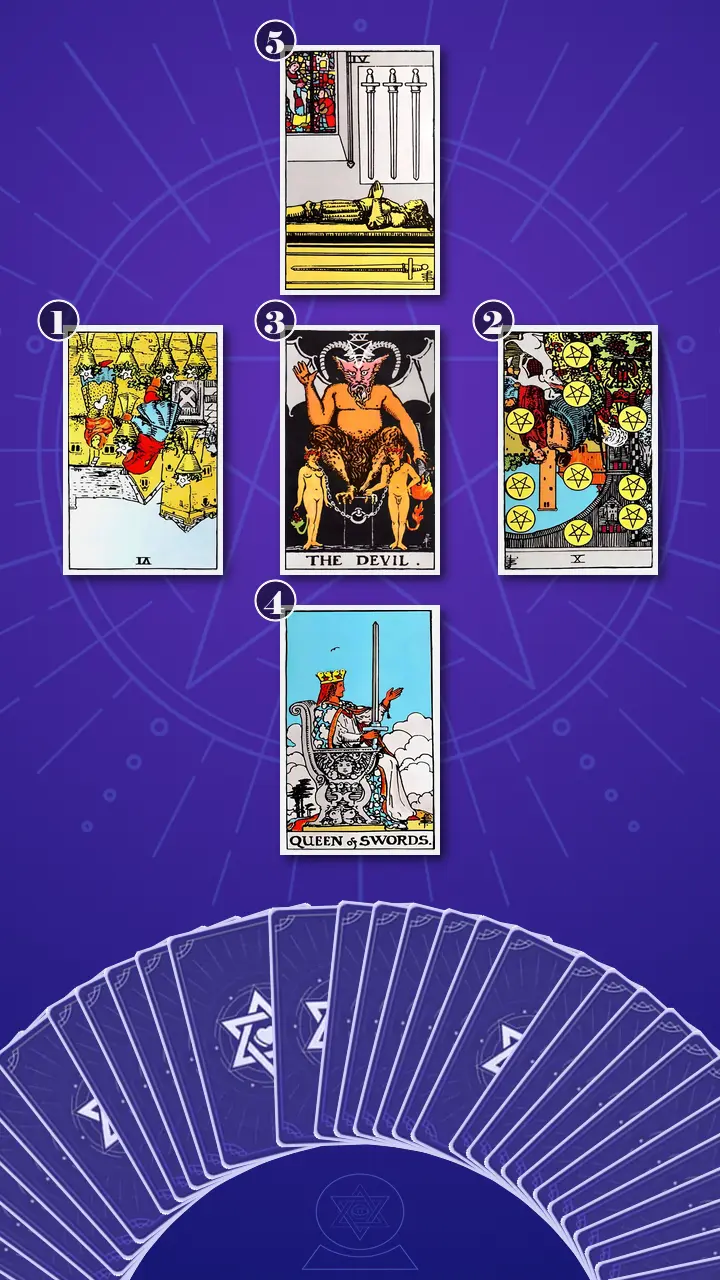
Reading the Old Job Description
Position 1: The Returning Child in the Group Chat
Now I turn over the card representing the present-day behavior through which Jordan automatically resumes the old fixer or caretaker role when personal space is needed. It is Six of Cups, in reversed position.
The Six of Cups traditionally carries childhood, memory, familiarity, and an exchange shaped by an earlier world. Reversed, its water is blocked in the past. The energy does not move forward into Jordan's adult capacity; it loops back to the familiar offering of care, usefulness, and emotional service before Jordan has checked their calendar, energy, or desire.
The image took me straight back to 10:47 p.m. Jordan saw a familiar name in the family chat and responded from an inherited job description. They drafted a tomorrow-message, deleted it, and started coordinating a problem that had never been given to them. Their present-day calendar disappeared behind the old exchange: offer care quickly, restore familiarity, and earn safety by being useful.
I said, "The card is not calling you childish. It is showing a context-triggered response. You can be twenty-nine, capable, and fully aware of your own plans until this name appears on the screen." I asked, "How old does this responsibility make you feel, and what would an adult-sized response look like today?" I then named the inner sentence I could hear in the pattern: "I am 29 until this name appears on my screen; then I am suddenly the person who has to keep everyone okay."
Jordan gave a small, bitter laugh and looked away from the card. "That is uncomfortably specific," they said. "I draft the boundary, delete it, reply immediately, and then resent the evening I volunteered away." I watched their thumb stop above the phone. The laugh had loosened the first layer of defense, but it also carried the ache of recognizing how familiar the role had become.
Position 2: The Inherited Constitution
Now I turn over the card representing the inherited family-system expectations as Jordan experiences them, especially the rules that equate availability with loyalty and stability. It is Ten of Pentacles, in reversed position.
The multigenerational scene on the card looked like a family constitution made visible: an elder, younger figures, a stone arch, and ten pentacles spread over the whole arrangement. Reversed, the structure is destabilized, but its rules have not necessarily disappeared. The energy is excessive in inherited structure and deficient in conscious choice. What has always been done can begin to look like an objective requirement.
Jordan described the family group chat as though "we always help" were an unwritten clause governing every interaction. A delayed answer did not feel like one scheduling decision. Inside their body, it felt like removing a support beam from the family house. When a relative asked, "Can anyone help sort this out?" Jordan heard, "You need to handle this before the whole arrangement becomes unsafe."
I clarified that this position described the family system as Jordan experienced it, not the private thoughts of any one relative. The card asked which inherited availability rule had been mistaken for love itself. Jordan's fingers moved to the edge of the table and back again. They could see that participation and permanent access were not automatically the same, but the distinction still felt delicate.
When the Loose Chain Became Visible
Position 3: The Request That Turned Into a Command
Now I turn over the card representing the central bond mechanism that keeps the old role active, including the fear that separating Jordan's needs from the family's needs could threaten belonging. It is The Devil, in upright position.
I did not read this card as a prediction, a moral judgment, or evidence that the relationship was doomed. I read it as the mechanism of attachment and compulsion. Its loose chains showed that the bond matters while the rule operating inside it can still be examined. The blockage is not simply a shortage of better wording. It is the shadow contract linking love, usefulness, and relational survival.
The image brought me to the 6:22 p.m. Line 1 commute. Jordan saw one missed family call, felt their stomach drop, and began redialing before listening to the voicemail or checking their capacity. Wet coats smelled faintly metallic, the rails screeched through a bend, and the phone vibrated in their cold hand. The actual message was a non-urgent weekend question. Jordan's mind supplied a much larger command: "Drop everything or risk your place in the family."
Jordan went quiet. Their chest drew tight before they could explain why. "They asked whether I was free," they said slowly, "but my mind heard, 'Prove that you belong.'" I placed the image of the loose chain between us and said, "The relationship can be real, and the command can still be learned. Those are two separate events."
Then I offered the sentence I use when a request has acquired the force of an order: An incoming request is information, not an assignment. Jordan reread it. Their eyes lost focus for a moment, as if replaying the last family message. They named one responsibility they had recently assumed without being asked to own it, and their first long exhale arrived with both relief and embarrassment.
"The urgency is real in my body, but that does not automatically make the task mine," Jordan said. I nodded. Awareness was the opening, not a demand for instant detachment. The point was to create enough space between contact and compliance for proportionate choice to enter.
When the Queen Raised Her Blade
Position 4: The Sword and the Open Hand
The room changed when I came to the card representing the internal resource Jordan could use to separate care from compulsory responsibility and communicate a specific capacity boundary. The streetcar bell outside faded, and even the radiator seemed to withdraw into the walls.
The card was Queen of Swords, in upright position. Her energy is balanced clarity: discernment without cruelty, independence without disappearance, and direct communication without a courtroom defense. The vertical sword defines a limit. Her open hand preserves honest contact. Together, they form the antidote to the loose chain.
The modern scene was simple and therefore difficult. Jordan could read a non-urgent request, check their calendar and energy, and write, "I care about this, and I am not available tonight. I can talk tomorrow after six." The work was not becoming colder. It was trusting that a truthful limit gives the relationship accurate information to adapt to.
Here I used one of my own analytical tools, Generational Trauma Excavation. On an archaeological dig, I do not blame the visible layer for being covered by an older one. I trace how a behavioral loop may have traveled through a family system so that the person standing in the present does not have to carry personal blame for every layer beneath them. I never use that metaphor to invent a family history or declare a relative guilty; I use it to make inherited pressure visible.
Then I applied Inherited Belief Stratigraphy. I asked Jordan to separate the authentic value from the obsolete dogma: care may be genuinely theirs, while "constant access proves loyalty" may be a fear-based rule inherited through repetition. The Queen's sword did not destroy connection. It separated the value from the demand.
Before I spoke further, I brought Jordan back to the concrete scene: it is 10:47 p.m., the book is open, the family chat lights up, and the draft saying "tomorrow" is deleted. The familiar response has already stolen the hour, while Jordan is trying to decide whether wanting it makes them cruel.
I said, "A boundary does not withdraw your care; it stops constant availability from being the price of belonging."
Space is not betrayal; choose a clean, direct boundary and hold it as steadily as the Queen of Swords holds her upright blade.
Jordan's breath stopped halfway. Their eyes fixed on the upright sword; their pupils widened, and their fingers hovered above the phone as if one more reply might still rescue everyone. For two seconds, the room narrowed to the radiator's tick and the blue edge of the screen. Then their jaw tightened. "But doesn't that mean I was wrong?" they asked, anger arriving before tears. I let the question stand. "It may mean the role was once a way you learned to keep connection intact," I said. "It does not mean you were foolish, and it does not make the old rule permanent." Their gaze unfocused, replaying the last message. The fist around the phone loosened, then closed once more. A breath came out with a tremor. Their shoulders dropped, not into certainty but into the unfamiliar weight of having a choice. Their eyes reddened. Jordan saved the sample sentence instead of defending it, then whispered, "I can care and still not be on call." Relief moved through their chest, followed by a small blankness, the dizzy edge of responsibility returning to its rightful owner.
I asked, "Now, use this new perspective to recall one moment last week when this insight might have let you feel differently." Jordan remembered a late-night request, the paragraph of explanation they had written, and the moment they replaced it with an immediate yes.
To make the insight practical, I suggested a ten-minute blank-note exercise. At the top, Jordan could write the latest non-urgent family request, then add two lines: "What was actually asked?" and "What can I genuinely offer?" They could draft, "I saw this, and I am offline tonight. I can reply tomorrow after 6." Sending it was optional; noticing the gap between the request and the responsibility automatically assumed was enough for a first attempt. Genuine emergencies and safety concerns could be handled differently. This was a capacity exercise for non-urgent contact, not a universal rule.
This was the first real crossing in the reading's emotional transformation: from anticipatory guilt and automatic availability toward clear capacity boundaries and connected personal space. It did not promise that every reaction would be comfortable. It gave Jordan a way to remain caring without becoming permanently on call.
Rest With a Return Point
Position 5: The Communicated Pause
Now I turn over the card representing the integration practice through which Jordan can experience communicated space without treating it as abandonment. It is Four of Swords, in upright position.
The reclining figure beneath the suspended swords made rest look deliberate rather than careless. Three swords are placed out of reach, while one remains nearby. Jordan does not have to abandon discernment or future contact; they have to stop wielding attention continuously. Upright, this is balanced retreat: a pause with a return point.
I translated the card into the modern scene. After stating when they would be available again, Jordan could set the phone to Focus mode, leave it in another room, and let the family issue remain unfinished for the evening. They could read five pages, take a shower, or sit with music without manually reopening the chat to measure anyone's reaction.
I asked Jordan to notice the moment after the boundary, when the hand still wants to reach for the phone. They said, "I stated the limit, but part of me is still standing guard over everyone's reaction." I replied, Rest is not protected if you spend it monitoring the reaction. Jordan placed the phone screen down and kept their hand on the table. The gesture was small, but it gave the boundary a body.
The Four of Swords did not ask Jordan to disappear. It offered a communicated pause: connection would resume at the stated time, while the unresolved issue was allowed to remain outside their attention. That distinction is how space becomes a boundary within connection rather than proof that connection has been abandoned.
The Artifact Review of Belonging
With all five cards visible, I read the spread as a sequence of Memory, Structure, Urgency, Language, and Rest. The flower-filled cup showed the old care offering that appeared before Jordan's adult calendar. The inherited arch showed the family rules that made usefulness look like loyalty. The loose chain exposed the added command that turned contact into compulsory responsibility. The Queen's sword and open hand offered clear capacity, and the resting figure showed how that capacity could become actual time.
The cognitive blind spot was treating the guilt that followed a boundary as evidence that the boundary was cruel. In this pattern, guilt may also be the sensation of an old availability rule being interrupted. The transformation direction was precise: pause before responding, check actual capacity, state one concise limit, and allow other people to have their reactions without immediately repairing them.
I introduced Jordan to my personal communication practice, The Lineage Artifact Review. We reviewed one belief rather than judging any person or relationship. On one side, Jordan wrote what they wanted to preserve: care, reliability, and showing up when they genuinely had capacity. On the other, they wrote what they were ready to bury: the rule that every family request required an immediate answer. The artifact to retire was the demand, not the bond.
Then I turned the reading into three small experiments. These were actionable next steps, not tests of whether Jordan was a good family member:
- The 30-minute request-versus-assignment checkWhen one clearly non-urgent family message arrives during an evening, meal, meeting, workout, or personal project, wait thirty minutes. Before replying, write what was actually requested and what responsibility your body tried to add.Start with one message and use a timer. If thirty minutes feels too large, take one slow breath and look at your calendar before typing.
- The One-Sentence Queen BoundaryCreate a text replacement named "capacity" containing, "I saw this. I am not available right now. I can respond by [time]." Edit the return time, then send it to the relative or family group only when the request is non-urgent and the sentence accurately reflects what you can offer.Keep care and the limit in separate clauses. Do not add a paragraph to manage every possible disappointment; saving the sentence as a draft is the minimum version.
- The Communicated Four of Swords PauseChoose one evening this week, tell the family when you will next check messages, and schedule a twenty-minute phone-free block. Use Focus mode, silence routine notifications, allow a chosen emergency contact if appropriate, and leave the phone in another room while you read, shower, or rest.If the urge to monitor appears, name it in five words or fewer, such as "checking whether they are upset." The minimum version is five phone-free minutes.
I reminded Jordan that these were experiments, not commandments. A reasonable emergency can follow a different plan, and another person's disappointment does not automatically make a boundary unsafe or wrong. The purpose of the five-card Relationship Spread - Context Edition was not to make Jordan stop caring. It was to help them decide what care could honestly look like today.

A Small Pause That Held
Three days later, I received a message from Jordan: "I waited thirty minutes. It was a booking question, not an emergency. I used the sentence and checked in after six." They had also put their phone in Focus mode long enough to finish a shower without listening for the next vibration.
On Saturday, the issue was still unresolved. Jordan read six pages alone, woke with the old thought, "What if I am wrong?", and smiled at it. They checked the chat at the promised time, not because the fear vanished, but because the pause had finally become theirs.
I think of that as a quiet proof. The cards did not create Jordan's authority, and they did not decide the future of the family bond. They helped Jordan see the fracture in an old structure clearly enough to choose what could be rebuilt. Finding clarity meant that care could remain, while access became something communicated rather than automatically surrendered.
When the family chat lights up and your chest tightens, it can feel as if the bond is being tested at the exact moment you need enough room to remain yourself. The Queen's sword, the open hand, and the Four of Swords offer another image: a communicated maintenance window can protect the relationship and the person inside it.
If care did not have to be proved in real time, what small pause would you let yourself imagine before your next reply?