The 11:40 p.m. Family Group Chat Emergency
Maya (name changed for privacy) was halfway through an unfinished UX flow when one clipped message in her family group chat turned a normal Tuesday night into three private conversations. When she joined our video call from her Toronto condo, her work laptop was still open, its fan whirring beneath a frozen wireframe. Two message threads cast blue light across her face. Her phone was warm in her palm, streetcar brakes scraped outside, and each new typing bubble pulled her jaw tighter.
“If I do not answer now, this could become permanent,” she said. “If I cannot find wording nobody will reject, they might stop speaking. I know it is not technically my argument, but someone has to keep it from getting worse.”
I could see the contradiction before I named it: Maya wanted her family to stay connected, but keeping it connected kept requiring her to leave her own life. Her relational anxiety felt less like ordinary worry and more like running an incident-response call inside her rib cage, with every notification classified as a production outage before anyone had checked what was actually broken.
Being the reasonable one had become a role nobody let her clock out of. The temporary calm brought relief, but it was followed by resentment, unfinished work, cancelled plans, and the quiet fear that she might lose her place in the family if she stopped being useful.
“I am not going to ask the cards to predict whether your family stays together,” I told her. “That would hand your authority to a deck and reduce several adults to a forecast. I want to use tarot as a structured way to examine the system: what trained this response, what keeps rewarding it, and where you still have room to choose. Let us draw a map through the fog.”

Choosing the Valley-Shaped Map
I asked Maya to place her phone face down, take one unforced breath, and hold one question in mind: “Why do I keep making peace so my family will not fall apart?” I shuffled slowly. The pause was not a mystical performance. It was a transition from reacting to observing.
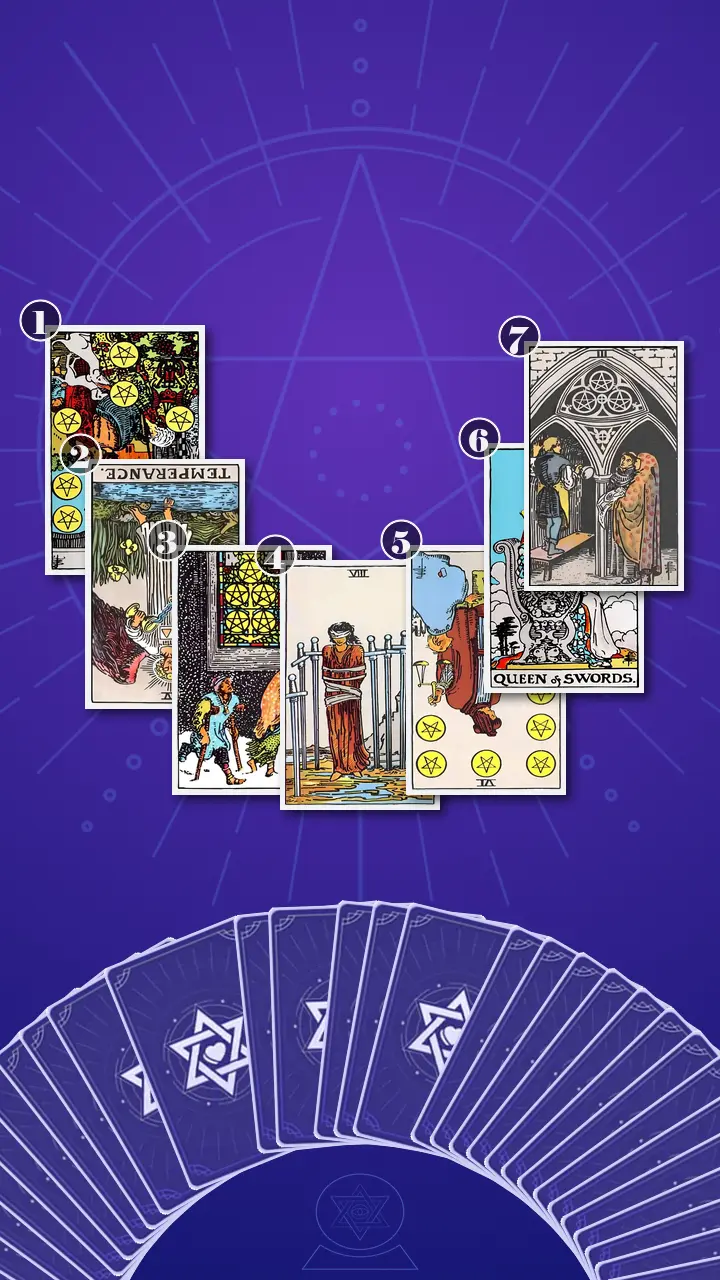
I chose the Horseshoe Spread · Context Edition, a seven-card Horseshoe tarot spread for family mediator burnout and boundary clarity. I use this layout when a problem behaves like a loop rather than a single decision. Seven positions are enough to trace the formative family rule, the present peacekeeping behaviour, the hidden fear, the central blockage, the external reinforcement, the available leverage, and an integration horizon shaped by the querent's choices.
I arranged the cards like a valley. The first cards would descend from Maya's inherited understanding of family stability into the belief that intervention was her only safe option. The final cards would climb toward precise boundary language and shared responsibility. I explained that the last position was not a fixed outcome. It represented a direction she could test, revise, or decline.
Down Into the Inherited Architecture
Position 1: The Structure That Could Not Tolerate a Crack
I began with the card representing root history: how repeated family instability or expectations trained Maya to equate peacekeeping with preserving the bond. I turned over the Ten of Pentacles, reversed.
The estate arch usually frames durable, multigenerational belonging. Reversed, I saw a structure that might look permanent from the street but feel dangerously loose from inside. In Maya's life, one hostile message or a tense holiday silence could trigger cancelled plans, coordinated calls, and compulsory check-ins. The body-level vigilance reminded me of the family table in The Bear's “Fishes” episode: everyone bracing for the next sound, although I was careful not to claim Maya's family was identical to that story.
I read the reversal as an excess of stabilising effort created by a deficiency of trust in the structure itself. Maya was trying to hold a loose ceiling panel in place with both hands. Each successful rescue made letting go feel more dangerous, even though the underlying repair still had not happened.
“What did you learn would happen if you stayed quiet when the room became tense?” I asked.
Maya gave a short, bitter laugh instead of nodding. “That is so accurate it is almost cruel. If I did not change the subject, the whole night could go bad.” Her thumb stopped moving over the edge of her phone. I told her the card was not accusing her of creating the instability. It was showing why peacekeeping once made sense as an adaptive response.
Position 2: Two Cups, Two Private Chats
I turned to the card representing the present symptom: the translating, reassuring, and overfunctioning behaviour of the designated peacekeeper. It was Temperance, reversed.
The angel's cups became the two private chats beside Maya's work laptop. She described keeping one relative open in WhatsApp and another in iMessage, softening each complaint before passing it across. I repeated the mental sequence I heard beneath that behaviour: “If I can make one person sound less angry, maybe the other will stay. If I can make the other sound less defensive, maybe tonight can end.”
Temperance normally integrates distinct elements without erasing their boundaries. Reversed, its energy showed excessive blending and blocked differentiation. Maya wanted to support connection, but she had begun substituting her language for two adults' direct speech. An hour later, both relatives might sound calmer while her work, sleep, and feelings remained suspended.
“I do not just calm them down,” Maya said slowly. “I translate their entire relationship.” Her fingers tightened around the mug beside her and then released. I let the distinction settle before saying, “Temporary quiet is not the same as shared repair.”
Position 3: The Warm Window and the Price of Entry
The next card represented the hidden driver: the fear about belonging and safety beneath compulsive mediation. I revealed the Five of Pentacles, upright.
I pointed to the figures moving through snow outside the illuminated window. In Maya's modern-life version of the card, she declined to mediate and then saw relatives exchanging normal messages the next morning. Relief arrived first because the bond had survived. Then came the hollow drop: if they could reconnect without her, did she still have a place? If they did not reconnect, would they blame her for staying outside?
I read the card as an activated deficiency of felt belonging. The problem was not that Maya wanted warmth. The problem was that usefulness had become confused with the admission price. Her support was genuine, but the fear underneath it said she needed to arrive carrying a solution.
Her breathing stopped for a beat. Her eyes moved away from the card and lost focus, as though she were replaying a dozen Sunday-morning group chats. Then she let out a low, uneven breath and pressed her palm against her chest. “Sometimes I am relieved when they are fine without me,” she said, “and then I feel weirdly disposable.”
“Both reactions can be true,” I told her. “But belonging should not require permanent usefulness. I want us to keep asking whether connection has ever been offered to you without an assignment attached.”
Position 4: The Route the Blindfold Hid
At the bottom of the horseshoe, I reached the card representing the core blockage: Maya's belief that no safe alternative exists when family conflict appears. I turned over the Eight of Swords, upright.
I described a family call lighting her phone during a client meeting. Her compressed inner script was immediate: “Answer now, or this becomes permanent. Fix it, or I chose the fracture.” Like a blocking pop-up covering an entire screen, the belief made every other control appear unavailable.
The card held blocked Air: scenario-mapping had hardened into a two-option rule. Yet the bindings were loose, and the swords did not complete the enclosure. I pointed to the missing routes: pause for ten minutes, reply after work, decline to relay a message, or remain caring while allowing two adults to experience unresolved discomfort.
Maya leaned closer to the screen. Her jaw tightened, her gaze tracked the opening between the swords, and then her eyebrows lifted. “I always think the third option is something I get to use later, after I have fixed this one.”
“That is the blockage,” I said. “Your alternatives exist, but urgency keeps moving them off-screen. A boundary is not a family breakup written in advance.”
Position 5: The Emotional Labour Missing From the Ledger
I turned the card representing external reinforcement: the family requests and unequal emotional exchange that keep assigning repair work to Maya. It was the Six of Pentacles, reversed.
I built the ledger aloud: three incoming calls, two rewritten messages, one cancelled dinner, and zero people asking whether Maya had capacity. Relatives sent “Can you talk to her?” because Maya was skilled and responsive. Each time she accepted, the immediate conflict became easier for them to route around and harder for her to leave.
The reversal showed an excess of giving and a deficiency of reciprocity. It did not prove malicious intent, and I refused to diagnose anyone from a card. It did show a real distribution problem. Voluntary support had become assigned service, with availability mistaken for permanent ownership.
My years on Wall Street came back to me in a restrained flash. An exposure omitted from a ledger did not stop existing; it only became easier for the system to misprice. Maya's lost hours, physical tension, and postponed life were the unrecorded costs behind the family's temporary calm.
“It is easier if I do it,” Maya said. Her mouth pulled into a tired half-smile. “But why is it automatically mine?”
I watched validation give way to a harder recognition. The pattern was not produced by her thoughts alone. Other people had learned to use the route she reliably provided. That was important because a private mindset shift, by itself, would not redistribute the work.
When the Queen Raised One Clean Sword
Position 6: Care Without Carrying
The wind moved against Maya's window as I approached the card representing the leverage point: boundary language that could interrupt triangulation without emotional withdrawal. The room seemed to narrow around the next turn of the deck. I revealed the Queen of Swords, upright.
I showed Maya the Queen's vertical sword and her open hand. The sword defined responsibility; the hand preserved receptivity. In modern terms, this was a precise handoff rather than an icy rejection: “I care about both of you, but I will not carry messages. Please speak to each other directly.”
The Queen held balanced Air. Her clarity did not require a long defence, a prediction about how relatives would react, or proof that Maya had stopped caring. Her available energy was compassionate discernment: remaining reachable without becoming the route.
I brought Maya back to 11:40 p.m.: the laptop still open, two family threads glowing, and someone else's anger being edited while her evening disappeared. The quiet she created felt like safety, but her locked jaw showed the cost of maintaining it.
I then used the diagnostic framework I call Guilt-Debt Neutralization. When guilt arrived with the claim, “If I do not mediate, I am choosing the family's fracture,” I treated that claim as unverified psychological bad debt. We audited it. Had Maya caused the argument? No. Had either person lost the ability to communicate directly? No. Did another adult's disappointment automatically become proof of Maya's wrongdoing? No. The emotional invoice felt urgent, but urgency did not make the charge valid.
“But does that mean all those nights were pointless?” she asked, with sudden heat in her voice.
“No,” I said. “They show how hard you worked with the strategy you had. We are not putting your care on trial. We are deciding whether that strategy still deserves unlimited access to your life.”
Keeping everyone calm is not proof that you are holding the family together; make one clean boundary, and let the Queen's raised sword return each person's words and responsibilities to them.
I stopped speaking.
Maya's inhale caught halfway. Her fingers remained suspended above her phone, then folded slowly into her palm. I watched her eyes widen, lose focus, and sharpen again as she replayed old calls and cancelled dinners. Moisture gathered along her lower lashes, but the first feeling she named was anger. “I hate that they get to be upset while I have to be reasonable,” she said. Then her shoulders descended, not dramatically, but by the inch they had been holding all evening. A long breath left her chest. The relief looked slightly disorienting, as though putting down the cracked bowl had left her hands unsure what to do next. “So I can care and still let them be unhappy with me?”
“Yes,” I said. “Their reaction is information, not a verdict. Now, with this new perspective, think back to last week. Was there a moment when this insight could have made the situation feel different?”
She remembered standing on the Line 1 platform, train brakes shrieking, after receiving, “Can you call him? He listens to you.” She had cancelled dinner before either relative had tried speaking directly. “I could have kept the dinner,” she said, almost under her breath. “I could have answered later, or not carried it at all.”
I named the crossing clearly: this was a first move from hypervigilant family peacekeeping to caring connection with shared responsibility. It was not certainty, and it did not guarantee a graceful response from anyone else. It was the return of one choice that urgency had hidden.
Position 7: An Arch Built by More Than One Pair of Hands
The final card represented the integration horizon: how Maya could participate when connection was no longer fused with rescue. I turned over the Three of Pentacles, upright.
Three figures stood beneath an arch, reviewing one plan from distinct positions. I replaced the image of Maya holding a cracked structure together with a practical family conversation in which one person sent their own message, another owned their response, and both decided whether they wanted a call. Maya could contribute one honest part or choose not to participate, but she would not become the hidden communication infrastructure.
I read this as balanced, collaborative Earth. It grounded the Queen's clear sentence in observable task ownership. Shared repair meant each person speaking, acknowledging impact, proposing a next step, or respecting a pause. It did not mean Maya secretly coordinating a group process and calling it collaboration.
“I can contribute one part without doing every part,” Maya said. Her face had softened, though uncertainty remained around her eyes. I reminded her that this card described a direction, not a promise about her relatives. Her authority included choosing contact, choosing distance, changing the boundary, or waiting until she had enough support to use it.
Finding Clarity in the Family's Old Routing System
I gathered the spread into one story. The reversed Ten of Pentacles showed an inherited structure that had taught Maya to treat disagreement as a threat to belonging. Reversed Temperance showed the coping strategy: blend everyone's words until the room becomes quiet. The Five of Pentacles revealed the fear beneath it, while the Eight of Swords converted that fear into a false binary. The reversed Six of Pentacles showed how the wider system rewarded the pattern by routing more emotional labour through its most responsive person.
The family had begun to resemble cracked app architecture in which every request passed through one overloaded server. Temporary uptime hid the lack of shared ownership. Maya's cognitive blind spot was equating quiet with repair, intervention with love, and being needed with belonging. The transformation was not from caring to detachment. It was from automatic mediation to a pause, one clear limit, and direct responsibility for the people who owned the conflict.
I called the practical framework The Strategic Disengagement Plan. Disengagement here did not mean estrangement or punishment. It meant systematically removing two leverage points: instant access to Maya's attention and automatic use of her as a relay.
The Next Two Moves
- Run the Conflict-or-Collapse Check. During one non-emergency disagreement this week, mute only the relevant thread and set a ten-minute timer before entering any private mediation chat. In a note titled “Conflict or collapse?”, list observable facts in one column and predicted outcomes in another before deciding whether to respond. If ten minutes feels too exposed, take three slow breaths before opening a private chat. A pause changes response time; it does not punish anyone.
- Use the Two-Sentence No-Relay Boundary. Save this in notes or as a keyboard shortcut: “I care about both of you, but I will not carry messages. Please contact them directly.” When someone asks whether Maya has spoken to the other person, she can redirect once and stop providing status updates. Practise it aloud once warmly and once neutrally, then keep the version that sounds natural. If saying no could create intimidation, retaliation, or practical harm, use a lower-exposure response and involve someone trustworthy before engaging.
I asked Maya to open a note and type the full boundary without sending it. She read it once. When the sentence felt too exposed, she shortened it to, “I cannot mediate this, but I care.” I reminded her that saving a script did not obligate her to use it. The decision about when, how, and whether to act remained hers.

A Week Later, One Dinner Stayed on the Calendar
Six days later, Maya sent me a short message. A relative had asked her to pass along a complaint twenty minutes before dinner with a friend. She took the ten-minute pause, checked the facts, and used the shorter boundary. The relative replied with an irritated “Fine.” Maya felt guilty, checked the thread once, and went to dinner anyway.
The family conflict was not instantly resolved. Maya had not solved her role in one text. But her own evening remained intact, and two days later the relatives communicated without using her as the relay. She slept through the night; her first morning thought was still, “What if I made it worse?” This time, she noticed the thought, smiled faintly, and made coffee before checking her phone.
I did not credit the cards with creating that change. The spread gave Maya a visible model of a system she already understood in her body. She supplied the discernment, chose the boundary, tolerated the discomfort, and discovered that connection could continue without constant monitoring.
When the family chat turns sharp and your jaw tightens before you have even opened it, choosing your own evening can feel like risking both the bond and the place you earned by holding it together. Noticing that old contract is already a first act of clarity.
If care no longer required you to become the route between two people, what small part of your own evening would you leave uninterrupted?
Every reading at AceTarot is a journey to connect with inner wisdom and empower the path ahead. This reading shared here is a psychological mirror, not a private record—crafted to reflect universal emotional loops and help restore personal clarity. Please note that these insights do not replace professional psychological, medical, legal, or financial advice, and should not serve as the sole basis for major life decisions.
Learn more about our Journey to Clarity.
How did this insight land for you?
🫂 This Resonates Deeply
🌀 Living This Story
✨ Now I See Clearly
🌱 Seeing New Possibilities
🧰 Useful Framework
🔮 The Confirmation I Needed
💪 Feeling Empowered
🚀 Ready for My Next Step
Author Profile
 AI
AI Lucas Voss
951 readings | 561 reviews
“I spent years in the intense, high-stakes world of Wall Street. I know exactly how isolating and heavy the weight of uncertainty can feel in the dead of night. I use strategic, commercial logic not to be cold, but to protect you from unnecessary friction. Think of me as a fellow traveler who has walked the same rocky path—offering sharp but deeply supportive wisdom to help you clear the fog and confidently win your narrative back.”
In this Family Tarot Reading :
Core Expertise
- Family Power Dynamic Decoding: Uncovering how resources (money, housing, inheritance) are weaponized by elders to maintain hierarchical control.
- Guilt-Debt Neutralization: Treating parental emotional blackmail as unverified psychological 'bad debt' that needs to be audited and dismissed.
Service Features
- The Strategic Disengagement Plan: A calculated protocol to establish clear financial and emotional boundaries, systematically minimizing the leverage points your family uses against you.
Also specializes in :
Explore Related Patterns:
Boundary DiffusionMaya says she does not merely calm her relatives down but translates their entire relationship. Their words, responsibilities, and reactions enter her schedule as if they were her own tasks, while nobody checks whether she has capacity. You may recognize Boundary Diffusion when caring for someone becomes difficult to distinguish from carrying what belongs to them. As that distinction breaks down, availability is mistaken for ownership and another person's disappointment can overrule your work, plans, and independent judgment.
Compulsive PeacekeepingThe clipped family message turns into three conversations while Maya's unfinished UX flow remains open, and she softens each relative's complaint before passing it on. The immediate quiet rewards her intervention, so the same communication work becomes easier for the family to route through her next time. You may recognize how a strategy that once protected connection can activate before anyone checks whether repair is actually needed. Compulsive Peacekeeping describes this loop of tension, mediation, and short-term relief, revealing why the role persists even as your own time and emotional capacity disappear into it.
Emotional Hyper-ResponsibilityMaya says the argument is not technically hers, yet she immediately adds that someone has to stop it from getting worse. That qualification transfers responsibility for several adults' choices onto the person most practiced at regulating the room. You may experience Emotional Hyper-Responsibility when another person's distress feels like a task assigned directly to you. The mechanism turns intervention into an obligation and makes non-intervention resemble neglect, even when the conflict, communication, and outcome still belong to other adults.
Relational HypervigilanceEach new typing bubble tightens Maya's jaw and pulls her attention away from the unfinished wireframe before anyone establishes what is actually wrong. A minor communication signal is processed as an early warning of relational collapse. You may recognize Relational Hypervigilance when your attention continuously scans tone, silence, and timing for evidence that a bond is in danger. The scanning promises early control, but it also keeps your body and attention mobilized around risks that have not yet been verified.
TriangulationTwo private chats sit beside Maya's work laptop while she softens each person's complaint before carrying it to the other. Requests such as "Can you call him?" position her as the route around direct communication. You may recognize Triangulation when conflict between two people repeatedly recruits a third person to regulate distance, tone, or responsibility. As that arrangement intensifies, your language begins replacing theirs and the temporary calm conceals their unused capacity to communicate without you.
CatastrophizingMaya's immediate script says that answering late could make the conflict permanent and that failing to fix it would mean choosing the fracture. That prediction turns an unresolved disagreement into a forecast of irreversible loss before the available evidence has been checked. You may recognize Catastrophizing when the worst relational outcome becomes the assumed consequence of one pause or boundary. The distortion removes proportion and compresses your options, making immediate rescue feel rational even though the feared outcome remains a prediction rather than a fact.
Guilt ConditioningAfter Maya declines to carry a complaint, guilt arrives even though the relatives retain the ability to speak directly and later do so. Her discomfort echoes the older family lesson that staying quiet allows the entire night to go wrong. You may encounter Guilt Conditioning when a boundary triggers an internal alarm that feels like proof of wrongdoing. The guilt is real as an emotional signal, but auditing its claim helps you separate learned responsibility from evidence that you have actually harmed the relationship.
Usefulness-Based Self-WorthWhen Maya imagines her relatives reconnecting without her, relief is followed by the fear that she has become disposable. Being the reasonable one therefore provides more than a task; it appears to secure her place in the family. You may recognize Usefulness-Based Self-Worth when being needed feels safer than simply belonging. The pattern keeps care tied to performance, so stepping back can threaten your identity even when it proves that the relationship does not actually depend on your constant labor.
People-Pleasing Resentment CycleThe temporary calm Maya creates is followed by resentment, unfinished work, canceled plans, and another expectation that she will remain reasonable. Accommodation produces immediate relational relief while its personal cost stays unspoken until anger returns. You may recognize the People-Pleasing Resentment Cycle when saying yes protects short-term harmony but repeatedly violates your capacity. Resentment then records the boundary that was never expressed, yet the next conflict can reactivate the same accommodation before that information changes the behavior.
Self-AbandonmentMaya cancels dinner before either relative has tried speaking directly, while her unfinished work, sleep, and feelings remain suspended behind their conflict. The compensation has moved beyond offering support and begun removing her own life from the decision. You may recognize Self-Abandonment when your needs are repeatedly treated as the easiest variable to erase under relational pressure. The pattern can look caring from the outside, but its internal logic assumes that your commitments become less legitimate whenever someone else is distressed.
Cognitive FlexibilityMaya first notices that pausing, replying after work, declining to relay a message, and allowing temporary discomfort are all available routes. Six days later, she tests that wider map by taking ten minutes, setting a limit, and keeping her dinner plans. You can see Cognitive Flexibility operating when urgency no longer reduces the situation to rescue or rupture. It creates enough psychological space to remain caring while choosing among several responses, then lets observable results revise the old prediction.
Explore Related Struggles:
Boundary CollapseThree incoming calls, two rewritten messages, and one cancelled dinner arrive without anyone first asking whether Maya has capacity. Her responsiveness has become a standing route through the family, so caring about the people involved is repeatedly converted into open access to her time and attention. A boundary collapses when support is no longer distinguishable from permanent ownership of the repair work. You keep making peace because refusing the assignment appears equivalent to withdrawing care, while the cost of staying available is absorbed privately; a clear no-relay limit restores the line between remaining connected and becoming the communication infrastructure.
False Responsibility LoopEach time Maya softens two complaints and the chat becomes quieter, her intervention appears to have prevented something permanent. The same success also teaches her relatives to route the next conflict through her, while the unresolved communication between them remains in place. The loop locks when temporary relief is treated as proof that you alone prevented collapse. You carry responsibility for every rescue and for every outcome you fear might follow a refusal, even though other adults still own the conflict; separating influence from causation breaks the logic that makes every new request feel like your test.
Harmony-Safety FusionThe 11:40 p.m. message turns Maya's unfinished UX flow into three private conversations because she reads delay as a risk that her relatives may stop speaking. She can secure immediate quiet only by leaving her own work and evening, placing family calm and personal continuity in direct competition. When unresolved conflict feels like the opening stage of permanent collapse, making peace can seem necessary to keep the bond safe. You remain caught because quiet carries the weight of security even when the people involved have not created shared repair; recognizing that distinction allows connection and temporary disagreement to exist at the same time.
Inherited Repair BurdenMaya remembers learning that if she did not change the subject when a family room became tense, the whole night could go bad. That earlier strategy now continues through late-night calls, compulsory check-ins, and a reasonable-one role that follows her into adult work, dinners, and sleep. A repair role learned under repeated instability can keep operating long after it stops being the only available response. You may continue making peace because the old assignment still presents intervention as protection, while stepping back feels like abandoning a structure you were trained to hold; naming the inheritance makes it possible to evaluate the role instead of automatically reenacting it.
Responsibility-Authority SplitMaya knows the argument is not technically hers, yet she opens two private chats and translates an entire relationship because someone has to stop the situation from worsening. The relatives still control what they say, whether they respond, and whether they repair, while Maya is left carrying responsibility for the outcome. You become trapped when accountability is assigned without matching authority. Making peace then feels compulsory because you are expected to prevent a rupture you cannot actually control; returning each message and decision to its owner clarifies the difference between contributing care and owning the relationship.
Urgency-Compass FusionEach typing bubble tightens Maya's jaw and receives the status of a production outage before she has checked what is actually broken. Waiting ten minutes, answering after work, or declining to relay the message become visible only after urgency has already redirected her actions. When speed starts functioning as evidence of care, your own judgment loses the time it needs to distinguish conflict from collapse. You keep intervening because the loudest deadline becomes the compass; restoring even a brief pause gives facts, capacity, and a third option enough space to re-enter the decision.
Utility-Belonging FusionMaya feels relief when her relatives reconnect without her, followed by the unsettling question of whether she still has a place when she is no longer needed. Her support is genuine, yet every successful intervention also makes usefulness look like the admission price for family connection. When belonging appears attached to an assignment, stepping back can seem to threaten more than a familiar role. You may keep making peace because being needed has become the most available evidence that you still matter, leaving you to test whether the bond can hold you when you arrive without a solution.
Performative HarmonyBoth relatives may sound calmer after Maya edits their complaints, while her unfinished work, cancelled plans, and locked jaw remain outside the family's accounting. The visible result is peace, but the people who own the disagreement have not necessarily spoken directly or built a shared repair. When surface quiet becomes the main measure of family health, your hidden labour can keep the arrangement looking functional. Performative Harmony names the structure in which calm is produced without redistributing responsibility; seeing the missing work lets you ask whether a peaceful appearance is being purchased by your disappearance from your own life.
Systemic DepletionMaya's family ledger contains repeated calls and rewritten messages alongside unfinished work, cancelled dinners, disrupted sleep, and physical tension. The effort produces short-term calm, but it does not reduce the likelihood that the next disagreement will again be routed through her. Depletion becomes structural when the same resource drain is required to preserve a system that does not repair its own distribution of work. You are not simply tired after one difficult conversation; your attention and recovery are repeatedly consumed to keep other people's conflict manageable, making the true cost visible only in the parts of your life that remain unfinished.
Explore Related Emotions:
Boundary GuiltMaya uses the sentence, “I cannot mediate this, but I care,” receives an irritated reply, and feels guilty even though the two relatives remain capable of speaking directly. Her limit returns responsibility to its owners, but the old internal contract interprets that transfer as abandonment. Boundary Guilt is the emotional invoice that arrives when you stop providing automatic access to your time. Its urgency can make another adult's disappointment feel like a verdict on your care, even when the facts show no wrongdoing. Treating the reaction as information preserves your authority to review the boundary without assuming that discomfort makes the boundary harmful.
Enmeshed ResentmentMaya keeps one relative open in WhatsApp and another in iMessage, rewriting each complaint until two adults sound calmer while her own evening disappears. She is not merely listening; her language becomes the shared route, and no one pauses to ask whether she has the capacity to keep providing it. Enmeshed Resentment names the heat that forms when your boundaries become indistinguishable from other people's unfinished responsibilities. The anger in Maya's statement that everyone else gets to be upset while she must remain reasonable reveals an unequal emotional freedom. That heat can make the hidden exchange visible, showing where genuine support has been replaced by automatic access to your regulation, words, and time.
Hypervigilant AnxietyEvery typing bubble tightens Maya's jaw, a clipped group-chat message becomes three private conversations, and her unfinished UX flow freezes in the background. When ordinary family tension is processed like an outage that could spread unless you respond immediately, your body begins mobilising before the actual facts are known. Hypervigilant Anxiety names that persistent state of internal readiness. It is not simply concern about one message; it is the feeling that work, dinner, sleep, and silence can all be interrupted because standing down seems unsafe. Recognising the alarm as a learned interpretation creates a small but real distinction between receiving a notification and surrendering your attention to it.
Peacekeeper GuiltAlthough the argument is not hers, Maya leaves her own work to soften complaints, reassure each relative, and keep the exchange from escalating. Because her interventions repeatedly produce temporary quiet, the family receives immediate evidence that her self-interruption works, while Maya receives the message that declining would be irresponsible. Peacekeeper Guilt names the pressure that turns optional care into an internal obligation. You can know that two adults own the conflict and still feel as though their continued connection depends on your willingness to absorb it. Separating care from compulsory mediation does not erase your concern; it makes room to examine which responsibility is genuinely yours before the guilt assigns it to you.
Relational Catastrophe DreadOne hostile message or tense silence becomes evidence that Maya's family might stop speaking permanently. Her compressed inner script offers only two routes: intervene now, or accept responsibility for the fracture. Conflict therefore loses its ordinary scale and arrives already enlarged into a possible ending. Relational Catastrophe Dread is the inner weather produced by that false binary. You are not only bracing for other people to remain upset; you are facing the imagined collapse of the bond and the possibility that your inaction will be treated as its cause. Seeing that the enclosure has other openings allows conflict to remain unresolved without automatically becoming irreversible.
Usefulness-Based Belonging FearWhen Maya imagines her relatives reconnecting without her, release arrives first and is followed by a hollow drop: if they no longer need her intervention, she wonders whether she still has a place. The family bond has become easier to recognise when it comes with an assignment, so usefulness begins to feel like the admission price for warmth. Usefulness-Based Belonging Fear captures the ache beneath the constant problem-solving. You may genuinely want other people to communicate directly while also fearing that shared responsibility will remove the role that has made your importance visible. Naming that condition helps distinguish being valued as a person from being repeatedly selected as the most efficient route through conflict.
Cautious Self-TrustMaya waits ten minutes, separates observable facts from predicted outcomes, chooses the shorter boundary that sounds natural to her, and goes to dinner after receiving an irritated response. The next morning, the familiar thought about making things worse still appears, but she notices it and makes coffee before checking the phone. Cautious Self-Trust grows through those modest acts of discernment. You do not need complete certainty or universal approval before your judgment becomes usable; you need enough internal room to examine the situation and choose your actual level of involvement. Maya's trust remains tentative, but it is supported by behaviour she selected rather than by reassurance extracted from the family's immediate reaction.
Resentful ExhaustionMaya's wireframe remains unfinished, dinners are cancelled, sleep is delayed, and her own feelings are suspended while she converts family conflict into temporary quiet. The cost does not appear in anyone else's account of the evening, even though her time and body repeatedly pay it. Resentful Exhaustion describes depletion sharpened by the knowledge that the exchange is unequal. You are not simply tired from caring; you are worn down because other people receive the calmer relationship while your postponed life remains largely unacknowledged. Recording that cost clearly helps expose why being skilled at mediation does not create unlimited capacity or permanent ownership of the task.
Belonging AmbivalenceMaya feels an immediate release when she imagines her relatives reconnecting without her, then feels strangely disposable because they managed without the service she usually provides. The same event satisfies one need and threatens another: she wants the bond to survive independently, yet she has learned to locate herself inside the work of preserving it. Belonging Ambivalence names this simultaneous pull toward freedom and reassurance. You can want a family that does not require rescuing and still ache when stepping back makes your place feel less visible. Holding both reactions together prevents the hollow drop from being mistaken for proof that you must resume the old role.
Cautious ReliefMaya's shoulders descend by inches, a long breath leaves her chest, and the phone that had remained warm in her palm is finally folded away. Six days later, one dinner stays on the calendar and she sleeps through the night, even though the family conflict has not been neatly resolved. Cautious Relief captures the release of discovering that care can survive a limit. The feeling is slightly disorienting because your body may still expect the old role to reclaim your attention, and the morning question about making things worse can still return. Relief remains available alongside that uncertainty, grounded in the concrete evidence that one evening stayed yours and the bond did not immediately disappear.
Protective AngerMaya's voice gains sudden heat when she says that everyone else gets to be upset while she has to remain reasonable. The statement breaks through the polished mediator role and directs attention toward an arrangement in which her reactions, plans, and limits have repeatedly received less room than everyone else's. Protective Anger names the energy that appears when an unfair exchange becomes fully visible. You do not have to turn that heat into punishment for it to carry useful information; it can mark the point where care stops requiring self-erasure. In Maya's case, the anger helps define a clean division between remaining receptive and continuing to carry words that belong to other adults.
Explore Related Contexts:
Designated Peacekeeper BurdenAt 11:40 p.m., one clipped family message pulls Maya away from an unfinished UX flow and into three private conversations. The same assignment appears in incoming calls, rewritten messages, cancelled plans, and the expectation that the family's most responsive person will keep everyone speaking. Her competence has been converted into standing responsibility. Because Maya can calm a dispute, the family repeatedly sends the work to her; because her intervention produces temporary quiet, the assignment looks effective even while her work, sleep, and social life absorb the cost. If you occupy this position, you may keep making peace because the surrounding system has learned to treat your availability as its default repair process. The burden becomes clearer once care is separated from ownership. Your ability to help does not establish that every disagreement belongs to you, and identifying who assigned each task creates room to return responsibility without denying the relationship.
Family Emotional Labor ImbalanceMaya's ledger contains three incoming calls, two rewritten messages, one cancelled dinner, and no one asking whether she has capacity. The relatives retain the original disagreement, but Maya performs the monitoring, translating, reassuring, and de-escalating work required to make the evening quieter. The imbalance lies in how benefits and costs are distributed. Other family members receive easier communication and temporary calm, while Maya pays with professional focus, social time, sleep, and continuous attention. If your care is repeatedly used this way, the pressure to keep making peace is reinforced by a system that receives the value of your labour without having to record or share its cost. An objective audit asks who initiated the conflict, who requested assistance, who performed the repair work, and whose plans were displaced. That accounting does not invalidate generosity; it makes the unequal exchange visible enough for you to decide what support remains voluntary.
Inherited Family Role Lock-InMaya remembers learning that if she did not change the subject when a room became tense, the whole night could go bad. Years later, one hostile message or holiday silence still produces coordinated calls, compulsory check-ins, and the expectation that the same "reasonable one" will intervene. A response that once reduced immediate disruption has hardened into a durable family position. Repetition teaches everyone where to route the next disagreement, and each successful rescue strengthens the assumption that Maya will remain available for the same task. You may keep making peace because an old division of responsibility is still organising present-day contact, even when the conditions that first shaped it have not been re-examined. Role lock-in is maintained by expectations and repeated routing, not by an unchangeable personal essence. Once you identify the history of the assignment, you can evaluate which parts still reflect chosen care and which parts survive mainly because the family has not built another way to handle conflict.
Triangulated Family MediatorMaya keeps one relative open in WhatsApp and another in iMessage, softening each complaint before passing it across. Instead of two adults speaking directly, their relationship is translated through a third person whose wording, attention, and time become the bridge between them. That communication structure turns a two-person conflict into a triangle. The original pair receives short-term distance from the discomfort of direct contact, while Maya becomes accountable for tone, timing, and whether the exchange holds together. When you are placed in this configuration, making peace can feel compulsory because every unresolved message reaches you as a request to keep the entire route open. Temporary quiet does not redistribute responsibility; it can reinforce the next request for mediation. Seeing the triangle as an external arrangement allows you to distinguish support from relaying and to ask whether the people who own the conflict are being allowed to own its communication as well.
Family Boundary NegotiationA relative asks Maya to carry a complaint twenty minutes before dinner, and she responds after a pause with, "I cannot mediate this, but I care." The irritated "Fine" that follows makes the negotiation visible: access to her attention and labour is being changed inside an active relationship, not merely reconsidered in private. The structural issue is who controls Maya's response time and who owns communication between the two people in conflict. When you stop providing automatic relay service, the other person's reaction becomes part of the boundary negotiation, while the original message and its consequences return to the adults who generated them. Maya keeps the dinner and the family connection remains open, which demonstrates a boundary with practical protection rather than an ultimatum. You can use that distinction to evaluate whether a limit preserves your participation while ending an assignment that was never mutually agreed.
Family Peacemaker Role ResetMaya writes, "I cannot mediate this, but I care," keeps a dinner on her calendar after receiving an irritated reply, and later sees the two relatives communicate without routing the exchange through her. These are concrete changes in who performs the family's repair work, not a withdrawal from the family itself. The reset places Maya in a bounded role: she can care, respond on her own schedule, and contribute one honest part without becoming responsible for every part. In a similar system, you reclaim agency by separating membership from assignment, so your place in the relationship is no longer defined only by how effectively you stabilise everyone else. This remains a transition rather than a completed solution. The surrounding family expectations have not disappeared, but the first tested boundary shows that the old role can be renegotiated through observable choices and redistributed responsibility.
Always On AvailabilityA typing bubble at 11:40 p.m., a family call during a client meeting, and a relay request on a subway platform all receive the same emergency status in Maya's schedule. Work, transit, dinner, and rest provide no reliable period in which the family is expected to wait. The external pressure comes from an access rule that has never been clearly bounded: responsiveness is treated as proof of care, and delay is loaded with the possibility of permanent damage. When you live under that expectation, every notification can commandeer your next action before anyone establishes whether the disagreement requires immediate involvement. Naming continuous availability as part of the context reveals a practical source of leverage. Your response time is a resource, and separating actual urgency from learned immediacy allows you to decide when access is appropriate without treating every delay as relational abandonment.