From Family Guilt to Chosen Boundaries: The Ten-Minute Return

The Guilt-Driven Load Behind Every Family Conflict
If you are a Toronto communications coordinator who can translate competing priorities at work but cannot leave a family group-chat argument alone, I know the particular guilt of seeing a short reply and immediately rewriting it into something safer. I have seen how family emotional labor can make an unofficial family mediator feel competent and trapped at the same time.
At 8:47 PM on a Tuesday, I found Jordan sitting on the edge of the bed in their small Toronto apartment. I watched them scroll between three family message threads, a private voice note, and a work notification that had been waiting long enough to feel accusatory. The phone was warm in their hand, the fluorescent hallway light buzzed through the half-open door, and I could see their shoulders lifted toward their ears while they drafted one careful reply.
Jordan looked at me and said, ‘If I can explain everyone to everyone else, maybe nobody will leave angry. But why am I responsible for peace I did not break?’ They wanted to rest, answer their partner, and return to their own evening as themselves. Instead, they were translating feelings, apologizing for tension they had not created, and preparing separate check-in messages in case anyone sounded disappointed.
I saw guilt less as a feeling than as a smoke alarm wired to every read receipt. A short ‘fine’ could set it off. A typing indicator could keep their hands reaching for the phone. Underneath the competence, resentment and sadness waited like two tabs Jordan had minimized so nobody else would have to see them.
‘You are not the family help desk, even when everyone knows you will answer,’ I said. ‘We can care about what is happening without making your nervous system responsible for settling it. Let us use the cards as a map, not a verdict, and see where the emotional load became attached to your sense of belonging. Our Journey to Clarity begins with finding the part that is yours to carry and the part you can put down.’

Choosing a Compass for the Responsibility Loop
I asked Jordan to put the phone face down, take one ordinary breath, and name the question without trying to make it sound reasonable. I shuffled slowly while they listened to the refrigerator hum and let the consultation become a deliberate pause between the family thread and the next reply.
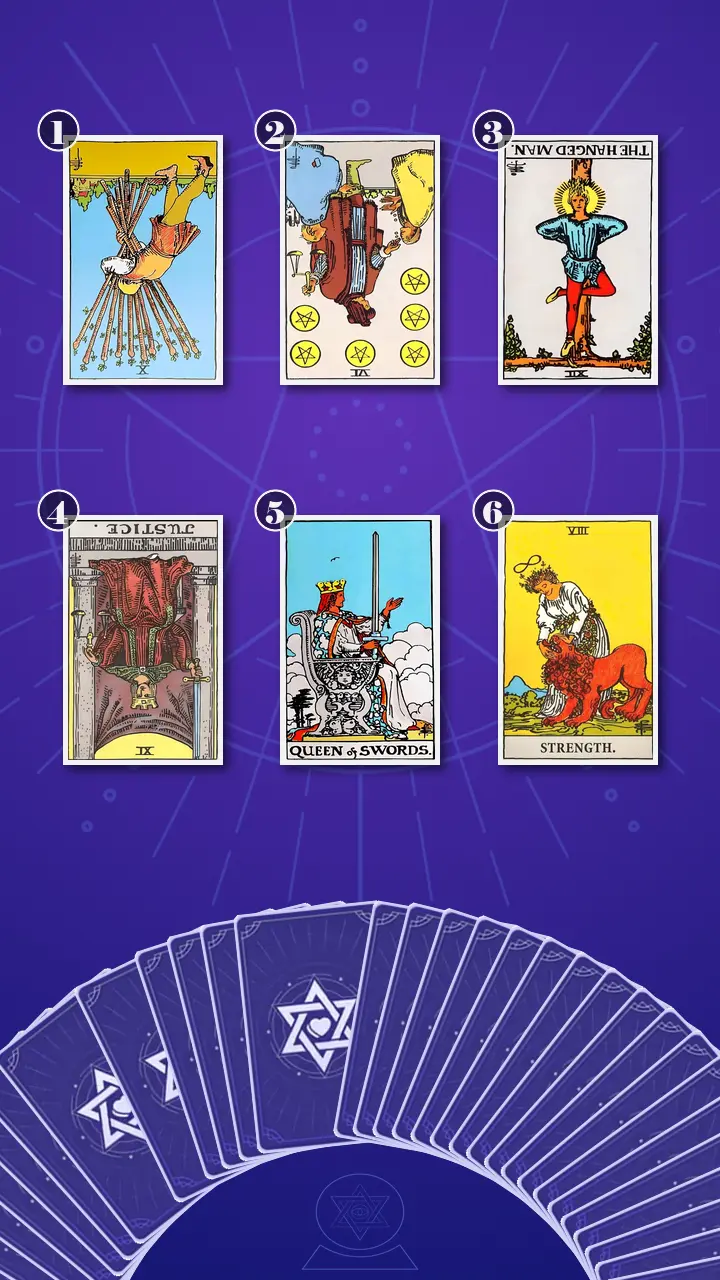
Today I chose the Four-Layer Insight Ladder · Context Edition, a six-position original spread built for F6 Systemic Deconstruction. For anyone wondering how tarot works in a recurring family conflict, this structure offers a practical way to trace a pattern from visible behavior to relational reinforcement, unconscious belief, hidden cost, clear boundary, and sustainable action. It does not predict what Jordan’s relatives will do. It makes the responsibility loop visible enough to examine.
The first position would expose the observable conflict behavior and contracted energy signature: monitoring tone, translating feelings, apologizing, and staying available after the argument. The second would map the Family Emotional Labor Imbalance and show how Jordan’s soft influence had become an expectation to give more soothing and interpretation than they received. The third would reveal the Martyr Complex beneath the behavior, including the belief that staying suspended in discomfort was necessary to preserve belonging.
Below those first three, the fourth position would show the short-term emotional payoff and long-term cost that kept the loop alive. The fifth, placed at the visual center of transformation, would translate the key shift from absorbing every family emotion to stating one clear boundary. The sixth would turn that insight into a small practice of compassionate self-possession. I told Jordan that the path would move from the crowded family room toward a clear doorway, one honest card at a time.
The Bundle Blocking the View
The Visible Pattern: Ten of Wands Reversed
Now I turned over the card representing the observable conflict behavior and contracted energy signature: monitoring tone, translating feelings, apologizing, and staying available after the argument. It was the Ten of Wands, in reversed position. Traditionally, this position describes the present situation and the pattern that is currently visible.
I pointed to the bent figure whose bundle blocked the path ahead. In Jordan’s life, the bundle was a phone full of parallel family threads. At 9:14 PM, with a communications deck still open on the laptop and several chats layered across the screen, they were holding every apology, explanation, and follow-up alone. The distant town on the card became the imagined peaceful ending that was always one more carefully worded message away.
The reversed energy showed excess effort and a blockage of self-perception. Jordan’s care had become so crowded with other people’s meanings that they could no longer see what they themselves felt until the conflict was over. I asked, ‘Which part of this disagreement is genuinely yours to carry, and which part are you carrying because the family has learned that you will?’
I also named the overcorrection risk. Putting down the bundle did not require suddenly refusing every request, disappearing from the group chat, or making silence into punishment. The invitation was narrower and more practical: after one family conflict, separate one feeling and one task that belonged to Jordan from one mediation task that did not.
Jordan gave a short, bitter laugh. ‘That is too accurate. Almost rude.’ I let the laugh stay in the room instead of rushing to reassure them. Their thumb rubbed the edge of the phone case, then stopped. I said, ‘The card is not calling you uncaring. It is showing the price of making your care carry the whole structure.’
The Unequal Exchange: Six of Pentacles Reversed
Now I turned over the card representing the Family Emotional Labor Imbalance and the expectation that Jordan would give, soothe, and interpret more than they received. It was the Six of Pentacles, in reversed position, traditionally associated with an external influence or relational environment shaping the situation.
The merchant’s scales and the coins moving downward toward kneeling figures gave me a precise modern image. I saw Jordan receiving separate voice notes from relatives who each wanted interpretation, reassurance, or a verdict. The family had become a help desk with no closing time: Jordan answered every emotional ticket, while nobody asked whether Jordan had capacity or what Jordan needed. Care flowed outward through listening, softening, and follow-up, but their own needs had no row in the ledger.
The reversal indicated an unequal exchange and conditional relief. Jordan’s mediation did create a brief sense of peace, but that relief also taught everyone that Jordan’s attention was available on demand. I asked whether the support was freely chosen or whether it was quietly purchasing temporary peace and the feeling of belonging.
This was where I used my Family Power Dynamic Decoding lens. I do not assume that relatives are deliberately controlling someone, and I do not label a family from one difficult thread. I ask where resources and permission are distributed: who can demand a response, who gets to be angry, who gets to define what caring means, and who is assigned repair. I also check for practical leverage such as money, housing, or inheritance, because those can make a boundary feel materially unsafe. Jordan told me the pressure was not financial. The leverage was emotional: the fear that stepping back would be read as rejection.
Jordan’s face tightened when I said that. They looked at the kneeling figures, then at the phone beside the spread. ‘I keep calling it generosity,’ they said. I replied, ‘Generosity requires choice. When the exchange renews automatically, it may be emotional labor wearing a generous outfit.’
The Tab That Never Finishes Loading: The Hanged Man Reversed
Now I turned over the card representing the Martyr Complex beneath the behavior: the belief that staying suspended in discomfort was necessary to preserve belonging. It was The Hanged Man, in reversed position, traditionally the underlying cause, unconscious belief, or root pattern beneath the visible behavior.
The bound ankle, the inverted body, and the calm face surrounded by a halo made the distinction clear. In Jordan’s life, this was the family thread left open like a browser tab loading all night. The useful conversation had already ended, but Jordan remained available, waiting for another person’s mood to settle before allowing themselves to sleep. They called the delay patience even when it produced no new understanding.
The reversed energy was stuck sacrifice, a blockage disguised as virtue. A chosen pause can create perspective. Compulsory suspension only keeps the body braced. I said, ‘The question is not whether you can tolerate discomfort. You clearly can. The question is whether you are choosing a pause that helps, or remaining uncomfortable to prove that you are loyal.’
Jordan went very still. First, their breath paused and their restless hand stopped above the phone. Then their eyes lost focus, as if an old sequence of late-night messages were replaying behind the wall: the unread thread, the polite apology, the waiting. Finally, their fingers tightened around the case and slowly released. I heard a long exhale leave their chest.
‘If I stay available, I am caring. If I close the tab, I am abandoning them,’ Jordan said. I recognized the structure immediately. My old Wall Street reflex surfaced, not as a trading metaphor for people but as a question about open positions: an unresolved situation is not automatically my active responsibility. Monitoring it does not guarantee control over the outcome.
I asked, ‘When someone stays upset after you have explained, apologized, and checked in, what do you fear their continued discomfort would prove about your place in the family?’ Jordan looked down and answered, ‘That I do not belong unless I am useful.’ I did not argue with the fear. I wrote it down so we could examine it rather than let it operate as an invisible instruction.
The Private Courtroom: Justice Reversed
Now I turned over the card representing the short-term emotional payoff and long-term cost that sustained the loop: temporary peace and usefulness in exchange for unspoken needs, resentment, and responsibility tilted toward Jordan. It was Justice, in reversed position, traditionally the hidden consequence, maintenance factor, or unseen cost beneath the pattern.
I focused on the sword and scales. In the reversed image, they became a private courtroom where Jordan was both judge and defendant. I saw them reread a conflict thread looking for the exact sentence they had gotten wrong, separate each relative’s intent, and write an apology for the atmosphere. Another person’s hurt was treated as unquestionable evidence, while Jordan’s boundary was entered into the record as proof of selfishness.
This was distorted accountability, an imbalance rather than a failure of love. The energy was contracted around a rule that sounded fair but was not: other people were allowed to be angry, while Jordan had to remain reasonable enough to make the room safe. The immediate payoff was unmistakable. Once Jordan apologized or translated, the exchange softened and they felt needed. The long-term charge was their own delayed anger, postponed rest, and growing resentment that nobody had asked what the role was costing.
Here I used my Guilt-Debt Neutralization practice. I asked Jordan to treat each guilt charge as unverified psychological bad debt, not as a binding invoice. I was not telling them to dismiss every responsibility. I was asking for an audit: What specific action did I take? What feeling is mine? What reaction am I trying to make disappear? Guilt can provide information, but it does not have automatic authority.
Jordan’s hand moved toward the notebook, then hovered. Their mouth opened as if an apology were already forming, and closed again. ‘I have never asked what I actually did before saying sorry,’ they said. I answered, ‘That pause is not cruelty. It is the beginning of fair ownership.’
When the Queen of Swords Cut One Clean Line
The Sentence That Did Not Ask Permission
The room seemed to narrow around the fifth card, the bridge between recognizing distorted responsibility and practicing compassionate self-possession. Now I turned over the card representing the shift from absorbing and repairing every family emotion to stating one clear boundary and returning each feeling to the person who experienced it. It was the Queen of Swords, in upright position.
The single upright sword became one direct sentence. The Queen’s open hand kept that sentence connected to care, while the wind-filled sky around her throne suggested clean language after too much emotional weather. In Jordan’s modern scene, she replaced several private explanations with one visible message: ‘I care about both of you, but I will not carry messages between you.’
Before I gave the card its full meaning, I asked Jordan to picture 8:47 PM again: three family threads open, the phone warm in their hand, a work notification waiting unanswered, and their shoulders raised while they drafted one more message to make everyone feel understood. I asked them to notice the moment when helping had quietly changed into taking custody of the conflict.
You do not have to use sacrifice as proof that you belong; let the Queen of Swords' upright blade separate your responsibility from everyone else's feelings and speak one boundary that remains truthful and caring.
I let the sentence stand without adding a softer explanation. Then I gave Jordan the plain-language core of the reading: You do not have to prove love by carrying every family emotion. Name what is yours, return the rest to its owner, and let clear language protect care from becoming self-erasure.
Jordan’s breath caught high in their chest, and their thumb stopped above the phone. The first reaction was a physical freeze. Then their gaze moved from the Queen’s upright blade to the blank space beside it, as if an old family thread had reopened behind the wall. I watched their jaw tighten, their fingers fold into a fist against their knee, and then slowly open. A recognition arrived before language. Their shoulders lowered by a fraction. Their eyes shone, not with a sudden miracle, but with the strain of seeing an old rule clearly. ‘But if I stop explaining, doesn’t that mean I was wrong?’ they asked. I said, ‘It means you are testing whether care can survive without your labor managing the result.’ Their mouth trembled into a small, uncertain smile. The air conditioner clicked on, and the room filled with an ordinary sound. Jordan looked at the boundary sentence again and whispered, ‘I can be loving without becoming responsible for the outcome.’
‘Now, use this new perspective to revisit last week,’ I asked. ‘Was there a moment when it could have let you feel different?’
Jordan remembered a relative replying, ‘Fine,’ and immediately reaching for the keyboard to repair the tone. The Queen of Swords did not promise that the reply would become warmer. She offered a tolerable gap in which Jordan could say, ‘I said what was true; their reaction can arrive separately.’ This was the movement from guilt-driven over-responsibility toward clear, compassionate boundary-setting, the first real evidence that belonging did not have to be purchased with constant emotional labor.
The Lion and the Ten-Minute Gap
Strength Makes Care Sustainable
Now I turned over the card representing the small, repeatable practice that could help the new understanding become sustainable: remaining connected without mediating every conflict. It was Strength, in upright position, traditionally practical guidance, integration, and the behavior that helps a transformation live beyond the reading.
The woman’s relaxed hands resting around the lion’s mouth showed me the difference between regulation and control. Jordan did not need to wrestle the family’s emotions into submission, and they did not need to mute themselves or withdraw as punishment. Strength was a steady breath after a relative said, ‘You are abandoning us,’ followed by a caring response that did not immediately reverse the boundary. Their disappointment could be real without becoming Jordan’s emergency.
At this point I introduced my Strategic Disengagement Plan. I framed it as a calculated protocol for reducing leverage points, not as a cold exit: notice the private relay request, choose whether to listen, decide, or fix, state one limit, create a short gap, and return only if returning is genuinely chosen. The leverage points here were late-night availability, read receipts, side conversations, and the family’s expectation that Jordan would translate. The plan did not punish anyone. It gave Jordan’s care an off switch and a return path.
When I described the first pause, I saw Jordan’s shoulders rise and their jaw set. They placed both feet on the floor, took one measured breath, and left their hands in their lap. That small physical choice mattered. Strength is a volume knob, not a mute button: the emotional room can become less urgent without care disappearing from it.
The Doorway Is Ownership, Not More Explaining
When I read the six cards as one story, I saw why the pattern repeated. The Ten of Wands reversed showed the visible bundle of messages, apologies, and follow-ups blocking Jordan’s view. The Six of Pentacles reversed showed how unequal emotional exchange made that bundle seem generous and temporarily rewarding. The Hanged Man reversed exposed the root belief that remaining suspended in discomfort proved loyalty. Justice reversed revealed the private courtroom where Jordan judged their own needs more harshly than everyone else’s reactions. The Queen of Swords opened a doorway with one clear sentence, and Strength showed how to stand there without turning the doorway into a wall.
I also noticed that no Cups appeared in the spread. I did not read that as a lack of feeling. I read it as a useful symbol: the feelings were present, but Jordan’s family system had routed them into tasks. Someone was angry, so Jordan translated. Someone was hurt, so Jordan apologized. Someone went quiet, so Jordan checked the phone. The problem was not that Jordan cared too much. It was that care had been converted into ownership.
The cognitive blind spot was subtle. Jordan believed that keeping a conflict manageable was a neutral act, but every extra explanation and private check-in quietly assigned them authority for the emotional temperature of the room. The temporary peace then reinforced the Martyr Complex: Jordan felt needed, the family relied on the mediation, and stepping back felt like betrayal. My Wall Street years taught me to look for the cost hidden inside a strategy that appears successful in the short term. Here, the strategy reduced immediate friction while charging Jordan’s sleep, anger, attention, and sense of self.
The transformation direction was therefore precise: move from proving care by absorbing and repairing every family emotion to expressing one clear boundary and returning responsibility for each person’s feelings to that person. The Four-Layer Insight Ladder - Context Edition had not told Jordan what their family would do. It had helped Jordan distinguish care from ownership, facts from feelings, and support from compulsory emotional labor. Jordan remained the author of the next move.
The Strategic Disengagement Plan: Care Without Carrying
I wrote the next steps in plain language. The goal was not a perfect family dynamic or instant relief. It was one small experiment that would let Jordan experience a boundary as information about their participation rather than a verdict on the relationship.
- The One-Sentence BoundaryBefore the next family group-chat conflict, I asked Jordan to save one sentence in a pinned Note: ‘I care about this, but I cannot carry the conversation for everyone.’ When a relative privately asks Jordan to relay a message, Jordan can send that sentence once and name their chosen role instead of explaining both sides.Draft it in under five minutes and keep it under twenty words. Do not add an apology just to make the boundary easier for someone else to approve.
- The Listen-Decide-Fix CheckBefore replying to one family request this week, I asked Jordan to label it listen, decide, or fix. They should answer only the role they consciously choose, then write three short lines after the exchange: what I feel, what I did, and what belongs to someone else.Use one specific event and take three minutes. If the writing increases the pressure, stop after one line or make a private voice memo instead.
- The Ten-Minute ReturnAfter sending a direct boundary, Jordan can set a timer for two to ten minutes, leave the family thread, and return to one concrete part of their own life: making tea, finishing a work email, eating, or getting ready for bed. When the timer ends, Jordan chooses whether to reply, wait until tomorrow, or ask the relatives to speak directly to one another.Treat the silence as a tolerable gap, not a verdict. A relative can be disappointed while Jordan remains caring and does not take over.
This is the actionable promise of the Four-Layer Insight Ladder for family emotional labor: trace the burden, identify the exchange, question the sacrifice, audit accountability, speak one boundary, and practice compassionate self-possession. Small steps matter because they let the nervous system learn what the mind has begun to understand.

A Week Later, the Quiet Proof
Four days later, I received a message from Jordan. They had used the sentence in a family thread. A relative replied, ‘Fine.’ Jordan set a ten-minute timer, made tea, and returned to an unfinished work email. The room stayed a little lonely, but the phone stopped being a control panel.
Nothing was perfectly resolved. Jordan still felt the old pull in the chest and noticed their hand reaching toward the phone before the timer ended. The difference was that they named the pull as guilt, not as an instruction. They told me, ‘Their disappointment was real, and it still did not become my emergency.’ That was not the end of the family pattern. It was the first small proof that care could remain while ownership moved back to the people who actually held each feeling.
I left the reading with the same principle I had brought to it: tarot is most useful when it gives a vague inner alarm a visible structure and returns the decision to the person sitting at the table. Jordan did not win belonging by carrying less. They began to reclaim a form of belonging that did not require constant emotional labor.
When the family chat goes quiet but your jaw is still clenched, it can feel safer to carry everyone’s feelings than to risk discovering whether belonging survives your own honest limits.
If one person’s disappointment could belong to them for the next ten minutes, what small, truthful sentence might you let yourself hear from your own side of the conversation?