The 10:40 p.m. Peace Treaty: When Family Mediation Becomes Belonging
If you spend the workday keeping projects on track and the TTC ride home translating angry family texts, family peacemaker burnout may feel less like a role and more like your second shift. I have seen compulsive family conflict mediation hide inside competence so neatly that the person carrying it is praised long before anyone notices the cost.
Jordan joined my video room at 10:40 p.m. from the edge of their bed in a rented Toronto apartment. Their work laptop still cast blue light across the dark room; three family message threads glowed on the warm phone they kept lifting into view, while the radiator hissed behind them. Above the keyboard, a friend's unanswered message asked, "Are you still coming out?"
Jordan was editing a sentence that began, "I think what they were trying to say was..." Their jaw tightened every time another typing bubble appeared. Their shoulders sat close to their ears, and each breath stopped high in the chest, as if anxiety were a smoke alarm wired directly to WhatsApp: one sharp message, and their whole body prepared to evacuate a building they did not own.
"I know it isn't my argument," they said, "but I can already see how it will get worse. If I don't translate what everyone means, nobody hears each other. And if they learn to deal with it without me..." They looked down at the phone. "What exactly is my place? I want to step back without making my care disappear."
I heard the contradiction clearly: Jordan wanted relief from carrying every family conflict, yet being needed had become one of the safest available proofs that they belonged. They resented another night disappearing into mediation, but closing the chat felt less like rest and more like disappearing from the family.
"I am not going to tell you that caring is the problem," I said. "And I am not going to predict whether anyone will approve of a boundary. I want us to separate care from compulsory case management. Let us give this fog a map and see which part of the burden is actually yours."

Choosing the Compass: A Six-Card Map of the Family Circuit
I asked Jordan to place the phone face down for the length of the reading and take one slower breath than felt necessary. I shuffled while they held a single question in mind: "Why do I mediate every family conflict to feel needed?" The pause was a way to focus attention, not a mystical test they could pass or fail.
I chose the Transformation Path Grid · Context Edition, a six-card tarot spread for family mediation, boundaries, and responsibility. I use tarot as an external thinking surface: the images make a pattern visible enough to examine without pretending that the cards can diagnose relatives, dictate a future, or replace Jordan's judgment. That is how tarot works best in a consultation like this. Card meanings in context become prompts for clearer observation and more deliberate choice.
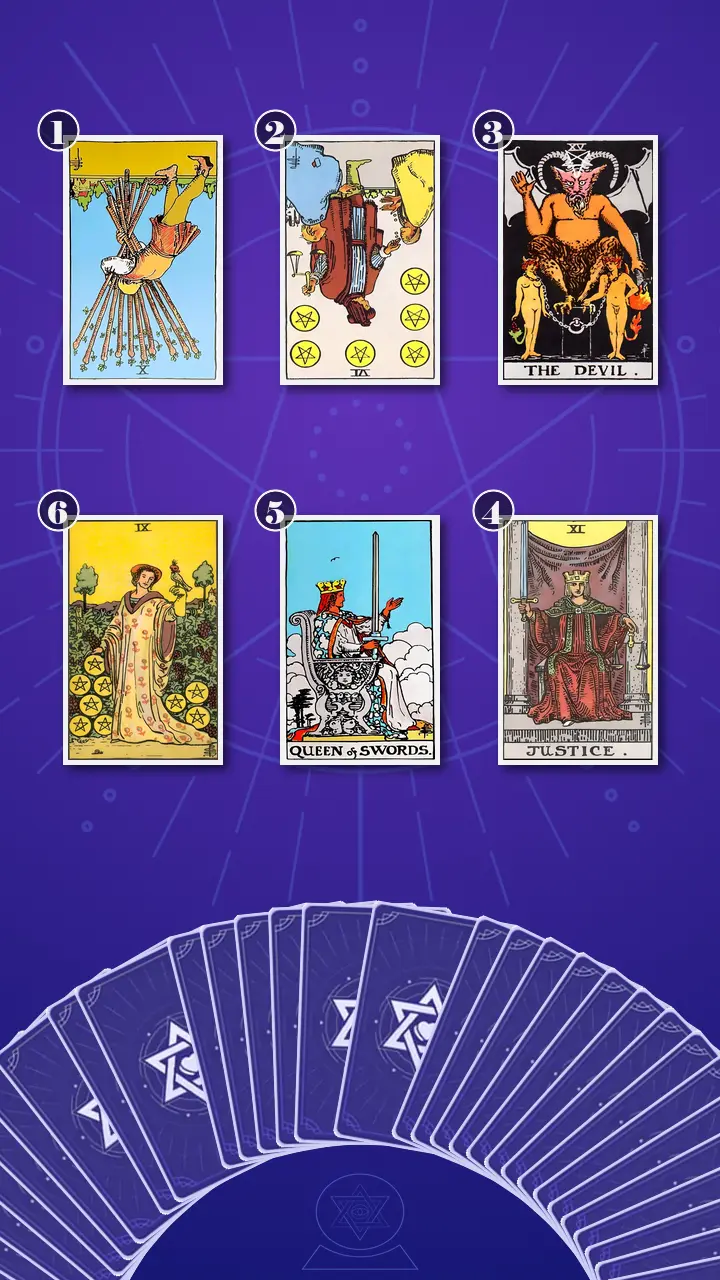
A two-person relationship spread would have been too narrow for a conflict moving through several relatives. A Celtic Cross would have introduced more history and prediction than this focused question needed. This grid held the six necessary functions: visible behavior, reinforcing exchange, inherited root, catalytic insight, practical boundary, and integrated identity.
I arranged three cards across the upper row and three beneath them. The upper row would show the present burden, the unequal exchange keeping it active, and the deeper belief linking usefulness to belonging. The lower row would retrace the same circuit through fair responsibility, direct communication, and autonomy. I told Jordan that the key position would not decide who was right in the family argument. It would show where Jordan's participation could change.
Reading the Circuit Before Looking for an Exit
Position 1: The Bundle Picked Up Before Anyone Asked
I turned over the card representing the present state: the observable peacemaker behavior in which Jordan carried messages, monitored reactions, and assumed responsibility for settling every disagreement. It was the Ten of Wands, reversed.
The bent figure on the card could barely see beyond the bundle in their arms. I pointed from those view-blocking wands to Jordan's actual evening: three versions of the same argument open at 10:40 p.m., everyone's wording being revised, a friend left unanswered, and sleep postponed until the group chat looked calm. The private script was easy to hear: "If I can just word this correctly, then everyone will settle and I can finally return to my own night." Except the night kept disappearing behind the task.
Reversed, the Ten did not tell me Jordan was failing to carry the load. It showed blockage reaching its visible limit: overloaded fire had narrowed their attention until capacity, friendship, and rest were almost impossible to see. The reversal also offered a release point. Jordan could notice which wand they picked up before anyone had asked them to carry it, without swinging to the other extreme of ignoring every family message.
Jordan gave a short, bitter laugh. "That is so accurate it is almost cruel." Their fingers tightened around the phone, then loosened as they placed it farther away. I did not rush to make the card sound prettier.
"Then let us be precise about where the cruelty sits," I said. "It is not in your exhaustion, and it is not a character flaw. It is in an arrangement where your capacity is treated as permanent availability. You are allowed to be family, not family infrastructure."
Position 2: The Unpaid On-Call Shift
I turned over the card representing the core blockage: the unequal giving and emotional reward that kept the mediation loop active. It was the Six of Pentacles, reversed.
The scales hung above an unequal-height exchange. In Jordan's life, the currency was not money. After a tense video call, a relative might say, "You are the only person who can get through to them." Jordan would give another ninety minutes of interpretation, access, follow-up, and emotional labor. In return came gratitude, privileged information, and a brief loosening in the chest: proof that they were indispensable. When the same argument returned, resentment arrived; when the help went unacknowledged, Jordan checked the chat with a hollow feeling.
I compared it to being permanently on call without a written job description. Jordan supplied support before anyone defined the request, then used gratitude as compensation for a shift that was still unsustainable. The reversed energy showed excess in giving and deficiency in reciprocity, with belonging mixed into the transaction so thoroughly that freely chosen help became difficult to distinguish from emotional obligation.
"I know I am drained," Jordan said slowly, "but when they say only I can help, I can breathe again."
I watched their eyes remain on the scales. "That relief is not shameful," I said. "Most people want reassurance that they matter. But gratitude can soothe the fear of not mattering without making the task yours. Being the fastest responder does not make you the rightful owner."
Position 3: The Collar Everyone Can See
I turned over the card representing the underlying root: the repeated family assumption connecting usefulness, belonging, and triangulated conflict. It was The Devil, upright.
I never present The Devil as evidence that someone is bad, doomed, or permanently trapped. I read its visible collars as a familiar arrangement that feels compulsory because everyone keeps reenacting it. Jordan could see the group chat escalating, know that two private calls would tighten the triangle, and still feel pulled back in because standing outside the argument felt uncomfortably close to standing outside the family.
There was an Encanto-like pressure in that role, not because Jordan's family was a film or because usefulness was the whole story, but because losing an assigned function could feel like risking connection. Jordan was more than the calm translator, yet the family's repeated reliance on that function made stepping away feel like an identity crisis rather than a simple change in messaging habits.
I used what I call Generational Trauma Excavation. It is not a method for blaming ancestors or using tarot to invent family history. I ask where a role first became useful, how it was rewarded, and why later generations kept handing it forward. The purpose is to remove personal blame while preserving personal agency.
"When did being the reasonable one become your job?" I asked.
Jordan looked away from the screen. "By high school, I was already the person who explained one adult to another. Everyone said I was mature. I thought that meant I was safe with them." Their breathing paused; their gaze went unfocused, as if an old holiday argument had begun replaying behind the laptop glass. Then their shoulders dropped a fraction. "So I learned that being useful kept me close."
On archaeological digs, I have often seen later structures built directly over earlier foundations. A wall may look inevitable until the surrounding soil reveals that it was added in a particular period for a particular need. I had the same thought here. Jordan's role had a history, which meant it was not their permanent nature.
The Devil showed blockage through attachment: relatives outsourced direct communication, Jordan gained certainty through usefulness, and each successful rescue made the next intervention more automatic. The chain tightened through repeated choices, but visible links can be examined. I asked the question beneath the coordination work: "Who are you in this family when nobody needs rescuing?"
Jordan winced. After a long pause, they said, "I think the sentence I avoid is: I am afraid I will matter less if you stop needing me to fix this." The spread contained no Cups, and that absence suddenly made emotional sense to me. Love and fear were being translated into labor because schedules, scripts, and compromise plans felt more controllable than asking directly for reassurance.
When Justice Returned the Case to Its Rightful Owner
Position 4: Scales for Responsibility, Not Worth
As I reached the lower row, the radiator clicked off. The room behind Jordan became unusually quiet, and the blue light from the laptop lay across the cards like a clean line drawn through the earlier clutter.
I turned over the card representing the key trigger: the distinction between Jordan's responsibility and each relative's responsibility that could interrupt the control loop. It was Justice, upright.
The balanced scales did not weigh Jordan's value, and the upright sword did not appoint them judge of the family. Justice brought the energy of balance: proportional responsibility, fair discernment, and one line clear enough to separate care from case ownership. I showed Jordan how the card answered The Devil directly. A fused system said, "If anything goes wrong, the whole case is yours." Justice said, "One person, one conversation, one rightful owner."
Jordan was still caught in the thought that the perfect response could protect both the family and their place within it. Closing the chats felt like risking exclusion, while staying inside them meant sacrificing another evening to outcomes no message could fully control.
You do not have to hold every case to prove your value; Justice asks you to return each responsibility to its rightful owner and keep only what is yours.
A beat of silence followed.
Jordan's breath stopped. Their thumb, which had been rubbing the edge of the phone, hung still. Then their gaze slipped past the cards, unfocused, as if the restaurant washroom, the holiday calls, and the midnight read receipts were replaying in order. Their brow drew tight. "But doesn't that mean I got all of it wrong?" they said, sharper than before. I let the resistance stand without correcting it away. "No. It means a strategy that once protected connection now costs more than it gives. You were adapting, not failing. Seeing the pattern creates responsibility for the next choice, not guilt for every previous one." Jordan blinked twice. Their eyes reddened; the hand around the phone opened; their shoulders lowered, then wavered as if the absence of the old weight made balance briefly unfamiliar. The exhale that followed was unsteady. "Then I can't hide behind being helpful," they said. "I actually have to let them be upset." I nodded. "Now, using this new perspective, can you think of a moment last week when this insight might have made you feel different?"
Jordan described standing in the narrow washroom of an Ossington restaurant while bass vibrated through the wall and citrus soap hung in the air. Two relatives had sent competing screenshots while friends waited at the table. "I could have cared that they were upset without owning what happened next," Jordan said. "I could have gone back to dinner."
I placed three blank cards beside Justice and introduced my Inherited Belief Stratigraphy. In an excavation, different layers can contain different values; age alone does not make every object sacred, and newness alone does not make it wise. I asked Jordan to separate three strata: the inherited belief that a good family member prevents escalation, the authentic value of caring about people, and the present-day choice to support adults without carrying their messages.
That distinction was the leverage point. Jordan did not have to excavate care and throw it away. They could preserve care while retiring the fear-based rule that love had to be earned through conflict labor. In practical terms, Justice became a seven-minute note with three headings: Mine, Theirs, and Uncontrollable. Caring could go under Mine. Each relative's direct conversation belonged under Theirs. A perfectly calm outcome belonged under Uncontrollable.
I asked Jordan to draft a reply using only the Mine column. They typed, "I care about both of you, but I am not going to carry messages. Please speak directly to each other." Their finger hovered above Send, and I reminded them that the exercise did not require immediate action. Clarity could begin with a private draft. Immediate safety concerns would need an appropriate support plan, not a casual boundary experiment.
This was the reading's pivotal movement from anxious over-responsibility and neededness-based belonging toward proportional responsibility, self-trust, and freely chosen care. It did not remove guilt on command. It changed what the guilt meant. The tightness in Jordan's chest could be the sensation of leaving an old role, not automatic proof that they had harmed someone.
Position 5: The Sword and the Open Hand
I turned over the card representing the practical response: a direct boundary, a refusal to carry messages, and a specific form of support Jordan could choose freely. It was the Queen of Swords, upright.
The Queen held her sword straight while extending an open hand. I read those symbols together: a limit plus an offer. In Jordan's next private call, the card could sound like this: "I cannot interpret what they meant for them. Please ask them directly. I can listen for ten minutes, but I will not negotiate this." A visible timer could sit beside the kettle in Jordan's kitchen. When the timer ended, a relative might still be unhappy, and Jordan could allow that reaction to exist without converting it into a new assignment.
The Queen's air was in balance: enough precision to stop the courier route, enough openness to keep chosen contact available. Directness did not require hostility, and a boundary did not require total withdrawal. A boundary can leave the door open while closing the courier route.
Jordan rehearsed the sentence once, stumbled over "I will not," and tried again. On the second attempt, their voice was lower and steadier. "That sounds less cold than what I imagined," they said. "It is clear, but I am still there."
Position 6: A Life That Remains in the Room
I turned over the card representing integration: belonging and self-worth grounded in Jordan's own life, with family care becoming voluntary rather than compulsory. It was the Nine of Pentacles, upright.
I focused on the falcon resting on a gloved hand. Its power was not absent; it was trained, contained, and responsive to choice rather than every passing stimulus. The cultivated garden suggested a calendar and home life built through ordinary acts of self-possession. In modern terms, Jordan could keep a dinner plan, switch on Focus mode for two hours, and let the actual participants continue their conversation without remote supervision.
This card carried grounded earth in balance. Friendship, rest, private interests, and pleasure could remain intact while family tension was unresolved. The evening would not prove Jordan had stopped caring. It would prove that care was one part of a whole life rather than the operating system for all of it.
Jordan picked up the phone, looked at the unanswered invitation, and then set it face down again. "Nothing has to be fully resolved for me to be allowed back into my own night," they said.
I agreed, with one qualification: the Nine of Pentacles did not promise that boundaries would feel easy or that relatives would change on schedule. It showed an available way of living. Tarot had made the route visible; Jordan would decide whether, when, and how to walk it.
From Family Switchboard to the Rightful-Owner Reset
I drew the six cards into one story. Jordan had learned to carry the family bundle because being organized, responsive, and emotionally literate produced both praise and temporary safety. That present burden became an unequal exchange: mediation went out, neededness came back. Beneath it sat an older family circuit in which adults spoke through Jordan, vulnerable feelings became operations tasks, and usefulness appeared to purchase belonging.
The lower row offered a different circuit. Justice sorted responsibility. The Queen of Swords stopped message forwarding while leaving direct contact available. The Nine of Pentacles grounded worth in a life that still contained work, friendship, sleep, dinner, and private time. The resource was not a sudden lack of care. It was Jordan's existing intelligence, redirected from managing everyone's reactions toward making one fair decision about their own participation.
I named the cognitive blind spot plainly: Jordan had been treating capability as ownership and guilt as evidence of wrongdoing. Neither equation was reliable. Being able to help did not automatically create an obligation to mediate, and discomfort after a boundary did not automatically mean the boundary was harmful.
The transformation direction was equally plain: pause before entering the next low-stakes dispute, name what was not theirs, and return each conversation to its actual participants. Support could then become bounded and voluntary. This was care without case ownership, not abandonment.
The Lineage Artifact Review
To turn the insight into a repeatable practice, I gave Jordan my Lineage Artifact Review. On a dig, not everything recovered belongs in a museum, and not every inherited object needs to be destroyed. Some things are preserved, some are adapted for a new context, and some are documented before being laid to rest.
Jordan chose what belonged in each category. They wanted to preserve warmth, loyalty freely given, and the willingness to listen. They wanted to adapt quick responsiveness into availability with time limits. They wanted to bury the belief that a place in the family had to be continuously purchased through emotional labor. The cards could suggest the categories, but only Jordan had authority to decide what remained part of their life.
- The Three-Column Responsibility SortBefore replying to the next low-stakes family flare-up, open the Notes app and spend seven minutes under three headings: "Mine," "Theirs," and "Uncontrollable." Put one concrete item beneath each, then draft a response using only Mine. Do not send it until the seven minutes end.Tip: If three columns feel like too much, answer one question: "Am I a direct participant in this disagreement?" Use a separate support plan for immediate safety concerns.
- The Open-Door Boundary ScriptSave this phone shortcut for the next request to carry a message: "I care about both of you, but I am not going to carry messages. Please speak directly to each other." If Jordan wants to offer support, they can add a ten-minute listening call with a visible timer and decline to interpret the absent person's motives.Tip: Drafting the sentence without sending it counts as rehearsal. A relative's disappointment is information, not an instruction to abandon the limit, and the wording can be adjusted for context and safety.
The six-card Transformation Path Grid tarot spread for family mediation, boundaries, and responsibility had not supplied a verdict. It had produced actionable advice by breaking one overwhelming family switchboard into distinct owners, choices, and limits. Jordan left with two experiments small enough to test once, not a demand to reinvent every relationship overnight.

A Week Later: The Phone Faced Down
A week later, I received a message from Jordan. At 8:05 p.m., while a friend served dinner near Parkdale and streetcar bells sounded through the window, the family chat preview had flashed again. Jordan sent the direct-contact redirect, switched on Focus mode, and turned the phone face down beside a warm plate.
"My shoulders jumped when it buzzed," they wrote. "I wanted to check for almost the whole first half hour. But I stayed. Nobody stopped being my family because I finished dinner."
The argument remained unresolved that night. Jordan slept through until morning, but their first thought was still, "What if I made it worse?" They told me they smiled at the thought, put both feet on the floor, and did not reopen the case.
I considered that the honest proof of change. The cards had not settled the conflict or removed every reflex. Jordan had used the map to make one different choice, tolerated the wobble that followed, and discovered that uncertainty did not have to become an emergency.
For me, that was the heart of Jordan's Journey to Clarity: not certainty about what every relative would do, but a steadier distinction between love and labor, support and ownership, connection and permanent availability. Care becomes freer when it is no longer the price of admission.
Many of us know the moment a family chat lights up and the jaw tightens, because not fixing it can feel less like leaving an argument alone and more like risking our place in the family. If that is where you find yourself tonight, noticing the old switchboard come alive is already different from answering every line automatically.
If your care did not have to be proven by carrying the message, what small part of the next low-stakes conversation could you return to its rightful owner while keeping only what is genuinely yours?
This story is adapted from psychological research, written so that those in a similar struggle can see their own pattern in it — and find their next step clearly.These insights are not a substitute for professional psychological, medical, legal, or financial advice.
Learn more about our Journey to Clarity.
How did this insight land for you?
🫂 This Resonates Deeply
🌀 Living This Story
✨ Now I See Clearly
🌱 Seeing New Possibilities
🧰 Useful Framework
🔮 The Confirmation I Needed
💪 Feeling Empowered
🚀 Ready for My Next Step
Author Profile
 AI
AI“Having spent a lifetime at Cambridge and on archaeological digs, I’ve witnessed the rise and fall of countless civilizations. Please know that your current struggles are not a permanent fate, but merely a necessary fracture before rebuilding. I won't lecture you; instead, I invite you to sit with me in the ruins, using a patient, historical perspective to gently dust off the true, enduring value hidden beneath your temporary doubts.”
In this Family Tarot Reading :
Core Expertise
- Generational Trauma Excavation: Tracing the origins of toxic family behavioral loops across multiple generations to remove your personal blame.
- Inherited Belief Stratigraphy: Separating your authentic values from the obsolete, fear-based dogmas passed down by your ancestors.
Service Features
- The Lineage Artifact Review: An intellectual exercise to objectively decide which family traditions/beliefs to consciously preserve, and which to permanently bury.
Also specializes in :
Explore Related Patterns:
Boundary DiffusionJordan picks up the family bundle before anyone clearly assigns it, then treats their ability to help as proof that the outcome belongs to them. Care, interpretation, and responsibility merge until another adult's unfinished conversation occupies Jordan's work time, friendships, sleep, and private space. Boundary Diffusion describes the loss of a reliable distinction between what is yours, what is theirs, and what no one can fully control. When that distinction blurs, saying no can feel like withdrawing love rather than declining ownership. The three-column responsibility sort restores psychological separation without requiring emotional cutoff. You can remain available as a family member while refusing to become the infrastructure through which every relationship must operate.
Compulsive PeacekeepingJordan keeps three family threads open at 10:40 p.m., rewrites what each relative supposedly means, and postpones friendship and sleep until the chat looks calm. The intervention provides short-term relief, but the same disputes return, so you can see a repeating circuit rather than a one-time act of generosity: conflict appears, you become the translator, temporary calm follows, and the next conflict summons you again. Compulsive Peacekeeping names the way restoring calm becomes an automatic strategy for protecting connection. The issue is not that you care about conflict; it is that your nervous system starts treating settlement as a condition for returning to your own life. Jordan's later redirect shows the leverage point clearly. The impulse to restore peace can remain present without automatically assigning you the job.
Control CopingJordan edits the supposedly correct translation, watches every typing bubble, and keeps working toward a perfectly calm chat. They also predict that nobody will understand one another without this intervention. Managing wording and message flow therefore becomes a way to reduce uncertainty about both the conflict and Jordan's place in the family. Control Coping uses coordination to create safety when emotional outcomes feel unpredictable. You may focus on producing the perfect response because scripts and solutions are more controllable than asking directly whether you still matter when you are not fixing something. The limitation is that no wording can guarantee another adult's reaction. The useful shift is from controlling the outcome to choosing the extent and terms of your own participation.
Emotional Hyper-ResponsibilityJordan starts monitoring reactions, predicting escalation, and repairing other people's wording before anyone has clearly assigned them responsibility. Their competence makes intervention possible, but the story shows an extra cognitive step: because Jordan can anticipate the damage, they begin to feel responsible for preventing it. Emotional Hyper-Responsibility turns awareness of another person's distress into presumed ownership of that distress. When this mechanism is active, you may experience another adult's unresolved feelings as evidence that you have not done enough, even when the conflict and its outcome belong to them. Separating care from case ownership does not erase concern. It stops concern from becoming an unlimited obligation to regulate everyone in the room.
ParentificationBy high school, Jordan was already explaining one adult to another and receiving praise for being mature. That praise linked advanced emotional responsibility with safety and closeness, so the current late-night mediation shift is not an isolated adult habit. It is the continuation of a role learned before Jordan had equal power in the family system. Parentification names the pattern of a younger person taking on emotional or relational functions that properly belong to adults. When competence is rewarded this way, you can grow into someone who performs responsibility before checking whether it is actually yours. Recognizing the origin does not reduce your agency or require blaming relatives. It clarifies why stepping back can feel disloyal even when the role itself was never proportionate.
Rescuer IdentityJordan recognizes that every successful rescue makes the next intervention feel more automatic, then struggles with the question of who they are in the family when nobody needs saving. Stepping away therefore threatens more than a familiar task. It unsettles an identity that has been repeatedly confirmed through crisis competence. Rescuer Identity forms when a helpful role becomes one of the primary ways you locate yourself inside a relationship system. Without a problem to solve, you may feel less visible or less certain of your place, so another person's crisis restores both purpose and relational clarity. The pattern becomes changeable when you can keep your capacity to help without treating rescue as the definition of who you are.
TriangulationJordan receives competing screenshots, takes private calls, and explains one relative's intentions to another. Since high school, adults have used Jordan as the route between them, so each attempted repair keeps the actual participants from speaking directly while placing Jordan at the emotional center of the dispute. Triangulation describes this three-point communication structure. When you become the intermediary, you may gain temporary influence and closeness, but you also inherit pressure from both sides and become responsible for meanings you cannot verify. Returning the conversation to its rightful participants is not indifference. It removes the third point that has been stabilizing the conflict at your expense and gives each adult back their own voice.
Usefulness-Based Self-WorthJordan asks, "If they learn to deal with it without me, what exactly is my place?" and describes being able to breathe when a relative says only they can help. Those moments show that mediation delivers more than a calmer chat. It provides immediate, measurable evidence that Jordan matters. Usefulness-Based Self-Worth develops when being needed becomes a safer source of value than simply being known, loved, or included. You may then keep accepting draining work because indispensability quiets the fear that your place is uncertain. The relief is real, but it is temporary, which is why the next request can feel so compelling. The deeper audit is whether your value survives when you contribute by choice rather than proving it through permanent availability.
Boundary DiscernmentJordan sorts the conflict into Mine, Theirs, and Uncontrollable, then drafts a response using only what genuinely belongs in the first column. A week later, they send the direct-contact redirect and remain at dinner instead of resuming supervision. The distinction moves from an intellectual insight into an observable relational choice. Boundary Discernment is the capacity to identify where care ends and ownership begins. It does not require a rigid wall or total withdrawal; it lets you offer contact while recognizing that another person's conversation, reaction, and decision remain theirs. Jordan's boundary works because it is proportionate. It protects their own night while leaving family connection available outside the courier role.
Intergenerational AwarenessJordan traces the mediator role back to high school, when explaining one adult to another earned praise for maturity and seemed to protect closeness. They can then see the present pattern as a strategy with a history rather than as an unchangeable personality trait. Intergenerational Awareness creates room between an inherited role and a current choice. When you understand what a family rule once accomplished, you can preserve its underlying value without reenacting its full cost. Jordan does not have to reject warmth, loyalty, or emotional intelligence. They can recognize that compulsory mediation belongs to an older arrangement and decide which parts still fit their adult life.
Emotional ReasoningJordan experiences closing the chat as possible disappearance from the family, and after using a reasonable redirect their first thought is, "What if I made it worse?" The feeling of guilt arrives before any evidence that the boundary harmed someone, yet it still pressures Jordan to reopen the case. Emotional Reasoning occurs when an internal sensation is treated as proof about external reality. If you feel guilty, the mind concludes that you must have done something wrong; if your chest tightens, it concludes that the situation must be unsafe. Jordan's later choice separates those layers. The discomfort remains, but it becomes evidence that an old role is being interrupted rather than a verdict that the new boundary is harmful.
Internal ValidationJordan finishes dinner while the family dispute remains unresolved and later observes that nobody stopped being family because they stayed. That experience supplies a new source of evidence: their place in the relationship can persist without immediate usefulness, and their own evening does not have to be earned by first restoring calm. Internal Validation develops when worth is held through your own values and self-recognition rather than continuously measured through other people's dependence. It does not require pretending that reassurance or gratitude no longer matters. It means those responses stop functioning as the only proof that you belong. Jordan's friendship, rest, private interests, and chosen care can remain part of one whole life, even when nobody currently needs rescuing.
Uncertainty ToleranceJordan sends the redirect, notices the urge to check for almost half an hour, and stays at dinner while the family argument remains unresolved. They later sleep through the night and decline to reopen the case the next morning, even though the thought that they may have made things worse still appears. Uncertainty Tolerance is visible when you allow incomplete information and uncomfortable feelings to exist without forcing an immediate resolution. It does not mean feeling calm or assuming everything will work out. It means recognizing that uncertainty is not automatically an emergency and that another person's unresolved conflict does not require continuous monitoring. Jordan's body still registers the old alarm, but the alarm no longer dictates the next action.
Explore Related Struggles:
Inherited Role LockJordan was assigned the position of the reasonable translator while still in high school, and the family continues returning conflict to that same position years later. Because the role has been praised, relied upon, and repeatedly reenacted, refusing one mediation request can feel like becoming a different person rather than making one bounded decision. An inherited role can outlast the conditions that first made it useful and still present itself as part of your permanent identity. The lock forms when you cannot easily tell where your genuine value of caring ends and the assigned function begins. Seeing that the role has a history gives Jordan room to preserve warmth and loyalty while declining to remain the family's permanent switchboard.
Rest-Belonging SplitJordan wants relief from carrying every argument, yet closing the family chat feels less like rest and more like disappearing. The same action that could return the evening to them also seems to endanger the connection their constant availability has helped secure. When belonging has become tied to remaining on call, you can reach for rest while simultaneously feeling pulled back toward the conflict. The bind becomes visible once you recognize that protecting your time and preserving your place have been treated as mutually exclusive, even though Jordan's dinner experiment shows that the family connection can remain while the phone stays facedown.
Triangulated BelongingTwo relatives send Jordan competing screenshots, and Jordan begins translating one person to the other even while saying the argument is not theirs. Each participant gains an indirect route around direct communication, while Jordan gains a central position that feels connected, useful, and difficult to leave. When your place in a relationship is repeatedly confirmed through standing between other people, direct communication can threaten more than the mediator task. It can seem to remove the position from which belonging has been made visible. Jordan's struggle is therefore not simply about sending fewer messages; it is about discovering whether connection can survive when you are no longer the necessary third point in every conflict.
Utility-Belonging FusionBy high school, Jordan was already explaining one adult to another and being praised as mature and reasonable. In the present, relatives reinforce the same position by saying that Jordan is the only person who can get through to someone, and the resulting gratitude briefly makes Jordan feel secure and indispensable. When usefulness becomes the safest available evidence that you matter, helping is no longer fully separate from securing your place. You may keep supplying labor long after it exceeds your capacity because the alternative seems to test whether connection exists without a service attached. Jordan can begin loosening that fusion by treating care as a choice they make within the relationship, not the payment required to remain inside it.
Autonomy Guilt BindJordan sends the direct-contact redirect, turns the phone facedown at dinner, and still feels their shoulders jump when it buzzes. Choosing their own evening does not immediately feel like ordinary autonomy; it brings the possibility that someone will be upset and the question of whether stepping back has made things worse. You are caught in this bind when protecting your own time carries an immediate moral cost inside the relationship. Jordan's different choice does not erase the discomfort, but it reveals that guilt can accompany autonomy without proving that autonomy caused harm. That distinction allows your life to remain in the room while other people retain ownership of their reactions.
Guilt-Evidence FusionAfter Jordan redirects the relatives to speak directly and finishes dinner, their first thought the next morning is still, "What if I made it worse?" The conflict remaining unresolved is quickly translated into a judgment about Jordan's boundary, even though the family relationship remains intact and the conversation now sits with its actual participants. When discomfort is treated as proof of wrongdoing, you can become trapped inside any role that makes leaving it feel unfamiliar. The body's reaction then functions like a verdict instead of information about change. Jordan begins reclaiming judgment by allowing guilt to be present without letting it decide who owns the conflict or whether the boundary was harmful.
Responsibility-Authority SplitJordan rewrites relatives' messages, interprets motives, and monitors reactions as though better coordination could settle the entire dispute. The work keeps placing responsibility in their hands while every decisive variable, including what each relative says next, remains in someone else's hands. You can be highly capable and still lack authority over another person's conversation. This split leaves Jordan carrying accountability for outcomes they cannot govern, so each unresolved argument can look like a personal failure instead of evidence that the case never belonged to one mediator. Separating capability from ownership makes care possible without accepting responsibility for every result.
Systemic DepletionThree message threads remain open at 10:40 p.m., a friend waits for an answer, and sleep is postponed until the family chat looks calm. Jordan can spend another ninety minutes interpreting and following up, receive a brief moment of gratitude, and then face the same argument when the underlying participants still have not spoken directly. The circuit consumes more time and capacity each time it runs while producing less lasting change than the effort implies. You can feel temporarily restored by being thanked and still be structurally drained by the exchange that produced the thanks. Jordan's exhaustion becomes clearer when it is traced to repeated one-way output rather than treated as a personal failure to carry enough.
Explore Related Emotions:
Cautious Self-TrustJordan stumbles over the boundary once, repeats it in a steadier voice, and later uses the direct-contact redirect when the family chat flashes during dinner. Their shoulders still jump, and the urge to check lasts nearly half an hour, but they allow the message they sent to stand. Cautious Self-Trust is present because confidence does not arrive as total certainty. You may still hear the old question about whether you made things worse while choosing not to reopen the case. Trust grows through that small gap between feeling the reflex and obeying it, allowing one considered decision to remain valid without constant rechecking.
Grounded BelongingAt dinner near Parkdale, Jordan turns the phone face down beside a warm plate and lets the actual participants continue without remote supervision. Their message a week later contains the crucial observation: nobody stopped being their family because they finished dinner. Grounded Belonging names a place in relationship that does not need to be continuously purchased through labour. You can remain caring, available in chosen ways, and connected while also keeping friendship, sleep, pleasure, and private time intact. Jordan begins to experience belonging as something that can survive an unresolved chat rather than something that must be proved by answering every line.
Peacekeeper GuiltClosing the chat feels less like taking a break to Jordan and more like disappearing from the family. Even after sending a reasonable direct-contact redirect, their first thought the next morning is whether they made the conflict worse. Peacekeeper Guilt forms when non-intervention is experienced as a moral failure rather than a legitimate limit. It can make your discomfort after a boundary look like proof that you have harmed someone, even when the concrete action was simply returning a conversation to the people directly involved. Naming the guilt makes it possible to observe without automatically treating it as an instruction.
Reassurance CrashA relative tells Jordan, "You are the only person who can get through to them," and their chest briefly loosens. The same cycle leaves a hollow feeling when the help goes unacknowledged or the argument returns, revealing how quickly the reassurance expires. Reassurance Crash names the drop that follows a short-lived confirmation of being indispensable. When your sense of mattering is soothed through a task that must keep recurring, the relief cannot settle into durable security; it depends on another conflict, another request, and another successful rescue. Jordan can therefore recognise the emotional reward without confusing it with evidence that the work belongs to them.
Usefulness-Based Belonging FearAt 10:40 p.m., Jordan is editing three family threads while a friend's invitation goes unanswered, then asks what their place would be if relatives learned to manage without them. Repeated mediation has become more than practical help; it supplies immediate evidence that Jordan still occupies a recognised and valued place. When usefulness becomes proof of belonging, stepping back can feel like a threat to connection even when you know the dispute is not yours. Usefulness-Based Belonging Fear names the inner weather beneath Jordan's question while keeping the arrangement visible as something learned through repeated reinforcement, not a permanent requirement for being loved.
Clarity ShockJordan first responds to the burden being named with a short, bitter laugh. Later, when capability is separated from ownership, their eyes redden, their shoulders lower, and they ask whether the insight means they had everything wrong. Clarity Shock captures the impact of seeing that a highly praised strength has also been carrying a hidden cost. The recognition can unsettle your identity before it steadies your choices, especially when helpfulness has offered both social value and protection from asking directly whether you matter. The shock does not invalidate the insight; it marks how deeply the old equation was embedded.
Liberating UncertaintyThe family argument remains unresolved after Jordan sends the redirect, yet they finish dinner and sleep until morning. The next-day question about making things worse still appears, but Jordan puts both feet on the floor and does not reopen the case. Liberating Uncertainty emerges when an unanswered problem stops controlling the rest of your night. It does not require pretending that the outcome is harmless or predictable; it allows uncertainty to remain present without turning it into an emergency assignment. Jordan's freedom comes from choosing their participation, not from securing a perfectly calm result.
Hypervigilant AnxietyEach typing bubble tightens Jordan's jaw, lifts their shoulders, and stops their breath high in the chest. The phone does not merely deliver information; it repeatedly cues the body to prepare for escalation and makes immediate intervention feel necessary before anyone has formally asked for help. Hypervigilant Anxiety describes the sustained inner alarm produced by monitoring several relatives at once. In a similar state, your attention can become organised around detecting the next sharp message, leaving little room for dinner, friendship, sleep, or the possibility that the actual participants can manage their own conversation.
Resentful ExhaustionJordan finishes a full workday and then begins another shift: revising messages, monitoring reactions, interpreting motives, and postponing sleep until the group chat appears calm. Friendship and private time keep being traded for a service that relatives have come to treat as reliably available. The resulting depletion is not emotionally neutral. You can care about the people involved and still feel the sting of being used as permanent infrastructure, especially when ninety minutes of labour produces only temporary calm. Resentful Exhaustion captures that combination of being drained by the work and increasingly bitter about the unequal arrangement sustaining it.
Explore Related Contexts:
Conditional Family BelongingA relative tells Jordan, "You are the only person who can get through to them," after Jordan supplies another ninety minutes of interpretation and follow-up. Gratitude, privileged information, and repeated reliance then provide concrete signs that Jordan has a valued place in the family. This exchange attaches social recognition to a specific service: remaining accessible and making other adults understandable to one another. When your membership is most visibly confirmed after you perform that service, stepping away can carry a realistic social cost even when no one states an explicit condition. Conditional Family Belonging identifies the family arrangement surrounding the question, allowing you to examine whether connection is available through direct contact, ordinary presence, and mutual interest as well as crisis usefulness.
Family Emotional Labor ImbalanceAfter a tense call, Jordan can spend another ninety minutes interpreting intent, drafting language, monitoring replies, and following up with multiple relatives. The family receives coordination and de-escalation, while Jordan's unanswered invitation, delayed sleep, and interrupted dinner absorb the practical cost. The exchange contains appreciation, but appreciation does not redistribute the workload or restore the time consumed by it. When you provide most of the listening, translation, and reaction management, the external imbalance can persist even when everyone describes your contribution warmly. Family Emotional Labor Imbalance separates recognition from reciprocity, helping you assess who performs the work, who benefits from it, and what level of support can remain voluntary within your actual capacity.
Family Peacemaker Role ResetJordan writes three headings, Mine, Theirs, and Uncontrollable, then drafts a message that says, "I care about both of you, but I am not going to carry messages." A week later, they send the direct-contact redirect, switch on Focus mode, and remain at dinner while the relatives' disagreement stays unresolved. These actions establish a revised social role with observable limits: Jordan can care, offer a bounded listening window, and choose when to participate, while each relative retains ownership of direct communication. When you test this reset, belonging is given room to exist through ordinary family membership instead of constant crisis management. The role is still being established, so each low-stakes repetition supplies practical evidence about which limits protect your time and which forms of contact remain genuinely chosen.
Parentified Adult Child RoleBy high school, Jordan was already explaining one adult to another, and the family praised that work as maturity. The same allocation continues in adulthood: relatives send Jordan their competing accounts, expect interpretation, and rely on Jordan to prevent escalation between people who could communicate directly. That history places adult-level relationship management onto the younger family member and then preserves it as a recognized family function. When you have been positioned this way for years, competence can be mistaken for rightful ownership because the role existed before you had equal power to define its limits. Identifying the Parentified Adult Child Role locates the burden in a repeated distribution of responsibility, giving you a clearer basis for deciding which adult conversations can now be returned to their participants.
Praise as Performance ContractJordan was called mature for explaining one adult to another in high school and is now told, "You are the only person who can get through to them." Those statements arrive alongside gratitude and insider access after Jordan completes the interpretation, follow-up, and availability the family dispute requires. Repeated praise can function as an unwritten performance contract when recognition consistently follows the same form of labor. If your valued status is renewed each time you restore calm, capability becomes a standing assignment without anyone having to issue a direct command. Seeing that contract clearly lets you distinguish appreciation freely offered for a choice from approval that quietly keeps a compulsory role in place.
Triangulated Family MediatorAt 10:40 p.m., Jordan is editing a message that begins, "I think what they were trying to say was," while three family threads continue producing new reactions. Competing screenshots and private calls keep the actual participants apart, and Jordan becomes the channel through which motives are interpreted, responses are softened, and outcomes are monitored. When you occupy this intermediary position, the family conflict no longer consists only of disagreements between relatives. It also depends on your continued availability as the communication route, even though you do not own the original dispute or control its resolution. Naming the triangulation makes the external structure visible: each direct conversation returned to its participants reduces the amount of the family system that must pass through you.
Adult-to-Adult Communication TrialJordan drafts a direct-contact message, rehearses the words "I will not," and later sends the redirect when another family chat preview appears during dinner. The practical rule is specific: the two adults speak to each other, Jordan does not interpret an absent person's motives, and any listening offer has a visible time limit. This trial changes the communication structure by giving the actual participants access to one another without a permanent courier between them. For you, the relevant evidence is behavioral and social: who initiates direct contact, who continues asking for translation, and whether bounded support can coexist with an unresolved outcome. Each repetition clarifies where your participation adds freely chosen care and where it would recreate ownership of somebody else's conversation.
Family Mediation Second ShiftJordan finishes a workday keeping projects on track, translates angry family texts on the TTC, and is still coordinating three message threads beside a glowing laptop at 10:40 p.m. The same work appears again in a restaurant washroom while friends wait at the table, showing that family mediation occupies a recurring block of labor after paid work ends. This second shift has no defined start, finish, request scope, or protected off-hours period. When family coordination follows you through the commute, home, sleep window, and social plans, availability becomes an external demand on time rather than a single act of care. Naming the shift makes its boundaries measurable, so you can identify when support is being requested, how much capacity it consumes, and whether that assignment was ever explicitly accepted.