Expected to Finish Without a Map

A close look at unsupported thesis work, the Tarot Cards reflecting its pressures, and readings shaped by uncertain academic guidance.

Unscaffolded Thesis Environment
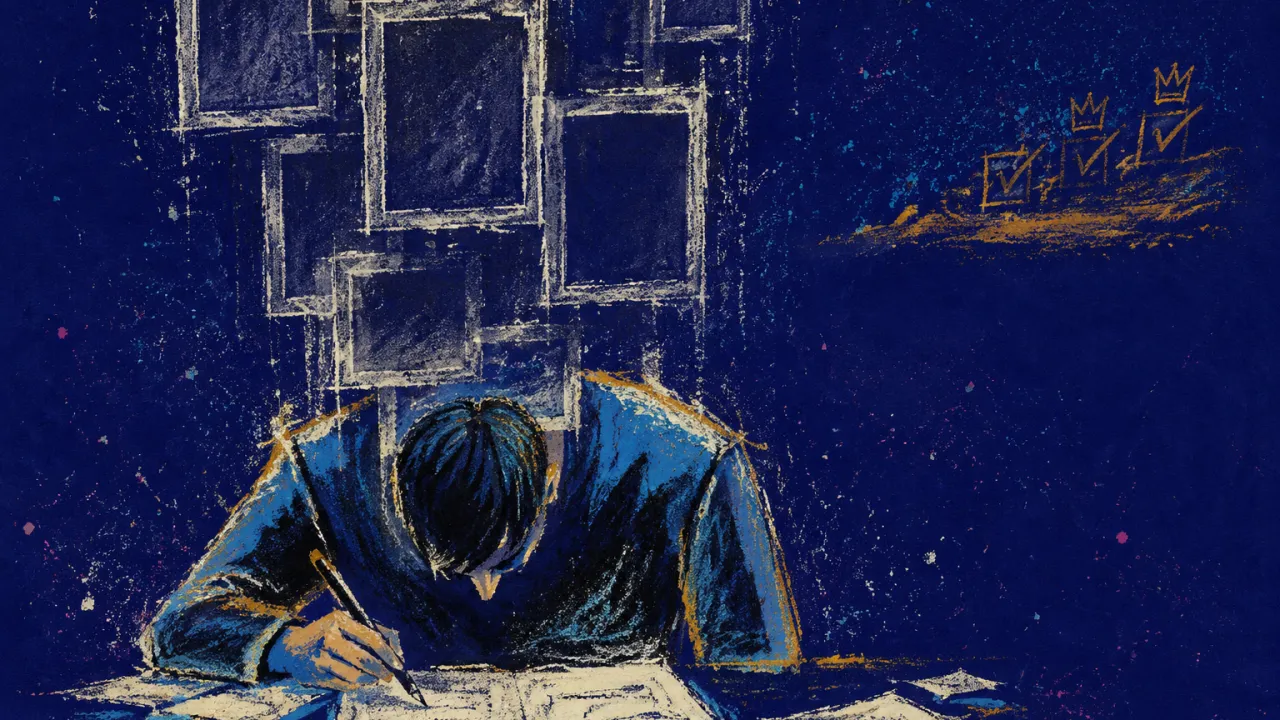
A solitary figure bent over a manuscript as blank frames settle above the shoulders and amber approval marks remain distant

What is this situation?

Unscaffolded Thesis Environment — you begin with a research question, a supervisor's name on the paperwork, and the assumption that someone will show you how a thesis moves from proposal to finished submission. Instead, the first meeting ends with "go away and read," no agreed milestones, no model chapter, and no clear standard for what counts as enough. Weeks pass between replies. When feedback arrives, it is brief, contradictory, or aimed at work you have already moved beyond; one person asks for more theory while another says the chapter is too abstract. You spend long days in the library or at your laptop trying to reverse-engineer expectations from old handbooks, other students' drafts, and scattered comments in tracked changes. Your supervisor still controls approvals, references, and whether the project is judged ready, yet access to that authority is intermittent, so every decision carries the risk of being reopened later. Administrative emails keep announcing fixed deadlines as though the route between them were obvious. You watch peers mention regular lab meetings, writing groups, or detailed chapter plans while your own calendar contains blank stretches followed by urgent corrections. The work expands because no one has defined its edges: another article to read, another method to justify, another rewrite prompted by guidance that came months late. By evening, your shoulders sit forward over the screen and your eyes keep returning to the inbox, because progress depends on direction that may not arrive, leaving you to carry both the research and the missing structure, much like the figure on the Ten of Wands, moving toward the destination with the entire bundle blocking the view ahead.

Why it's not you?

This is not a failure to be independent; it is an academic environment withholding the milestones, timely feedback, and accessible supervision needed to complete a long project. When decision-makers keep standards vague while retaining approval power, uncertainty is built into the process.

Unscaffolded Thesis Environment in Tarot Cards

In an Unscaffolded Thesis Environment, blank stretches between meetings and late, shifting feedback leave you carrying a project whose boundaries are never clearly set. The shoulders folding forward over the screen are a visible response to an environmental and structural dynamic in which guidance is intermittent but approval remains concentrated elsewhere. The Tarot Cards below reflect the outline of that situation: unsupported workload, obscured direction, and authority that is present on paper but difficult to reach.

The Emperor
Reversed
The armored ruler sits on a stone throne between ram heads, surrounded by symbols of command and fixed order. Turned upside down, that seat of authority becomes a useful image for a supervisor who retains approval power but does not provide the stable rules, milestones, or access that would make the academic route navigable. You still have to answer to the throne, even when the governing instructions arrive late or conflict with one another. The reversed structure distinguishes independence from institutional abandonment: the problem is not that you must make research decisions, but that the person who can reopen those decisions has not made the decision framework reliably available.
The Hierophant
Reversed
The seated teacher is framed by two pillars, two kneeling students, and crossed keys at his feet. With the image reversed, the formal teaching channel appears unable to deliver what the keys should provide: a shared way into the institution's standards, methods, and accepted forms of academic work. You can search handbooks and older dissertations, but those fragments do not replace an accessible teaching relationship. The reversed hierarchy names the hidden curriculum gap at the center of the thesis process: the university retains a recognizable ceremony of supervision while leaving you to infer the rules that determine whether your work is ready.
The Hermit
Upright
A solitary elder stands on a mountain with a lantern raised in one hand and a staff in the other. The lamp illuminates a small area, but no marked academic route, supervisor, or milestone appears around him. That limited field of light mirrors the way you can extract enough information from handbooks and tracked changes to keep working while still lacking a sequence for the whole thesis. The upright Hermit preserves the value of careful independent inquiry, but the image also shows its boundary: a lantern can support the next step without replacing a shared map. You are carrying the investigative work and the orientation work at once, while the institution retains the authority to decide whether the distant destination has been reached.
Justice
Reversed
A seated figure holds a sword and scales between two pillars, presenting a clear visual apparatus for formal judgment. Reversed, the scales no longer provide a dependable measure while the sword still carries the power to deliver a final decision. That imbalance mirrors a thesis system in which approval authority remains intact but the standard for reaching it shifts across meetings and comments. You can respond to one criterion only to discover that another evaluator wants a different kind of evidence. The image makes the procedural bottleneck visible: the problem is not that academic work lacks standards in the abstract, but that the standards are not being applied early and consistently enough for you to use them as a planning tool.
The Hanged Man
Upright
The figure hangs from one foot on a tree, arms held behind the back, with a clear halo around the head. The scene makes suspension physical: your thesis can be active in your mind and on your screen while its next legitimate movement remains attached to a response or approval that has not arrived. The upright posture is not a collapse; it is a forced interval in which ordinary forward motion is unavailable. You may continue reading or drafting, but the project still carries the risk that a later authority will reopen the route. The image gives that waiting period a structural name instead of treating it as wasted time or a failure of independence.
The Moon
Upright
The moon hangs above a winding path between two towers, with a dog, a wolf, and a crayfish responding to the same uncertain light. The scene creates a precise image of thesis navigation under incomplete guidance: the route exists, but the next bend does not reveal which standard, reviewer, or revision will determine whether you are still on it. You can collect signals from handbooks, old chapters, and tracked changes without converting them into one dependable map. The upright Moon does not declare the project impossible; it makes the information environment visible. Your work is being carried out under partial visibility while an external authority retains the power to decide whether the route has been followed correctly.
Seven of Cups
Upright
Seven cups float in a cloud before a solitary figure, each presenting a different object while none is attached to a visible plan or container. That crowded field mirrors a thesis environment where every article, theory, and method can appear relevant because no one has set the project's working boundaries. You can keep generating academically defensible possibilities without gaining a clearer route to submission. The upright image names the choice structure precisely: the problem is not that there is nothing to work with, but that an excess of plausible directions is being managed without a shared authority for deciding what the thesis can leave out.
Three of Pentacles
Reversed
The sculptor works below the cathedral while two figures hold the plan above him; with the image reversed, craft, review, and design no longer line up around a common build. That visual mismatch reflects a thesis environment where a supervisor may comment on the product without supplying the milestones or model that would organize the making of it. You are left doing detailed intellectual construction while the people with evaluative authority remain disconnected from the working plan. The reversed building scene names the missing scaffold as a coordination failure: expertise and standards may exist in the system, but they are not being translated into timely, usable supervision.
Six of Pentacles
Reversed
The robed figure distributes coins while scales hang from his hand and two figures wait below. Reversed, the scene turns support into an uneven exchange: you provide continuous research labor, while access to the feedback and approval that could stabilize it is released according to someone else's limited availability. The imbalance explains why a short or contradictory comment can have an outsized effect on the project. You are not simply asking for reassurance; you are trying to obtain the institutional resource that tells you whether a chapter is usable, yet the same power relationship that controls that resource keeps its timing and standards uncertain.
Seven of Pentacles
Upright
The gardener leans on a hoe and studies pentacles growing from a vine, pausing between cultivation and harvest. That physical checkpoint mirrors the thesis stage in which you have invested long hours but cannot tell whether the work has reached a defensible milestone because no one has defined what completion should look like. The upright scene preserves evidence of growth, yet it offers no supervisor, measuring tool, or posted deadline for the next stage. You are left to interpret the crop yourself while knowing that an external evaluator may later decide that more theory, method, or revision is required. The timing bottleneck is therefore not a lack of work; it is the absence of a shared harvest signal.
Eight of Pentacles
Reversed
A craftsperson hammers pentacles at a workbench while finished pieces line the wall behind him. Turned upside down, the repeated craft no longer reads as a dependable apprenticeship; it becomes a production loop in which effort continues without a stable signal that the current piece meets the required standard. You can revise carefully and still find the object of review has shifted by the time feedback arrives. The reversed workshop shows how the thesis absorbs more labor when supervision supplies corrections without a shared model of quality. The issue is not unwillingness to practice; it is that the academic workbench lacks a reliable handoff between making, feedback, and acceptance.
Two of Swords
Upright
A blindfolded figure holds two crossed swords against a dark shoreline, with the water and moon behind her but no visible route forward. The scene captures a thesis decision made under incomplete institutional information: you can compare methods or theories, but the criteria that would make one route safer remain hidden. The upright balance is not a lack of intelligence or evidence; it is a maintained stand-off between competing instructions. Each choice can be reopened because approval remains external and the supervisory system has not converted disagreement into a shared decision rule. The image makes the bottleneck visible as a blocked choice architecture rather than a personal inability to decide.
King of Swords
Reversed
A crowned figure sits high on a throne with a sword held upright, placing intellectual judgment and institutional authority in one elevated body. Reversed, the sword's precision becomes difficult to rely on: the authority can issue a strong correction, yet the communication around it may be delayed, contradictory, or detached from the stage of work you have actually reached. You are therefore expected to translate expert judgment without receiving the context that would make it actionable. The inverted throne names the asymmetry between a supervisor's power to reopen a thesis decision and the student's limited ability to obtain clarification before investing in the next version.
Eight of Wands
Reversed
Eight wands cut through the open sky in one direction, carrying the visual promise of rapid movement and timely arrival. Reversed, their trajectories read as stalled or dispersed messages, mirroring a thesis process in which a question can sit in an inbox long enough to disrupt the next stage of research. Your calendar still contains fixed institutional dates, but the work between those dates depends on a response system that does not keep pace. The image separates urgency from momentum: deadlines may be moving closer even while the information required to meet them remains suspended in transit.
Ten of Wands
Upright
The bent figure's face is hidden by a bundle of ten wands, and the road ahead is largely blocked by what he is carrying. That physical obstruction mirrors a thesis process in which missing milestones and late feedback become work you must carry yourself; you can keep moving, but cannot see where the next acceptable stopping point is. With no shared chapter model or stable definition of enough, every article, method decision, and correction adds weight to the same bundle. The image makes the bottleneck legible: the strain comes from carrying both the research and the missing structure, not from a lack of willingness to do independent academic work.

Unscaffolded Thesis Environment in Tarot Card Reading Insights

When thesis milestones stay vague and feedback arrives after the work has moved on, other students bring that same unsupported academic setting into their readings. The articles below collect Tarot Reading Insights shaped by unclear guidance, delayed responses, and the pressure to keep producing anyway.
Psychological Contexts Related to Unscaffolded Thesis Environment