Requiring Certainty to Choose: Turning a Thesis Into a Test

The Saturday Thesis Choice Paralysis Loop
Jordan came to me deep enough into a social-sciences master's that “broad interests” now needed to become one research question, but every Toronto library session ended with more saved papers and the same thesis decision paralysis. At twenty-six, she could complete clearly assigned tasks at her part-time research assistant job, yet her own project seemed to dissolve into possibilities whenever she tried to define it.
She described one Saturday to me with timestamp precision. At 9:07 a.m. in Robarts Library, she opened her thesis document and immediately switched to ProQuest, then Google Scholar, then Zotero. Dry radiator heat pressed against her legs, a keyboard clacked across the aisle, and her coffee had already gone lukewarm. By the time she colour-coded a fourth direction, her jaw was locked. She had come to leave with a question, but keeping all four possibilities alive still felt safer than testing one.
When Jordan sat across from me later, both hands stayed wrapped around the coffee I had placed beside her. Rain threaded down the window behind us, and the room carried that familiar mix of espresso and damp winter coats. She looked at the table rather than at me when she said, “I keep calling it research, but sometimes I'm just postponing the first real choice.”
Then she gave me the contradiction in one clean sentence: “I want to choose a direction and finally move forward, but every option looks possible until I imagine being responsible for it.”
What she called apprehension felt, from the way she described it, like a library security gate lodged behind her breastbone: every time she tried to carry one working question through, an alarm sounded in her jaw, shoulders, and hands. She responded by opening another tab. The pressure dropped for a few minutes, but the thesis remained exactly where she had left it.
“I don't hear laziness in that,” I told her. “I hear one decision being asked to carry the weight of your entire degree and your judgment as a researcher. We won't ask the cards to choose your thesis for you. We'll use them to separate the observable pattern from the rule keeping it in place, then make the next move small enough to test. Let's draw a map through the fog.”

Choosing a Compass at the Crossroads
I invited Jordan to take one slow breath and hold the question in ordinary language: “Why do I keep delaying my thesis instead of choosing a direction?” I shuffled while she did that. I treat this brief pause as a transition for attention, not as a mystical performance; it gives the mind a chance to stop rehearsing and begin observing.
I chose the Decision Cross · Context Edition, a four-card thesis reflection spread. For anyone wondering how tarot works in a session like this, I use the cards as a structured external surface. They help me place different parts of a problem where we can inspect them without treating every thought as a fact. Card meanings in context can reveal a loop, a trade-off, an unused resource, or a practical next step. They do not predict a thesis outcome, and they do not replace the student's authority over her own work.
This spread suited Jordan's question because her difficulty was not a simple shortage of topics. She was caught at a crossroads where a visible pattern of delay was being sustained by a less visible need for protected certainty. A compact cross could hold both layers without pretending to identify a single destined direction.
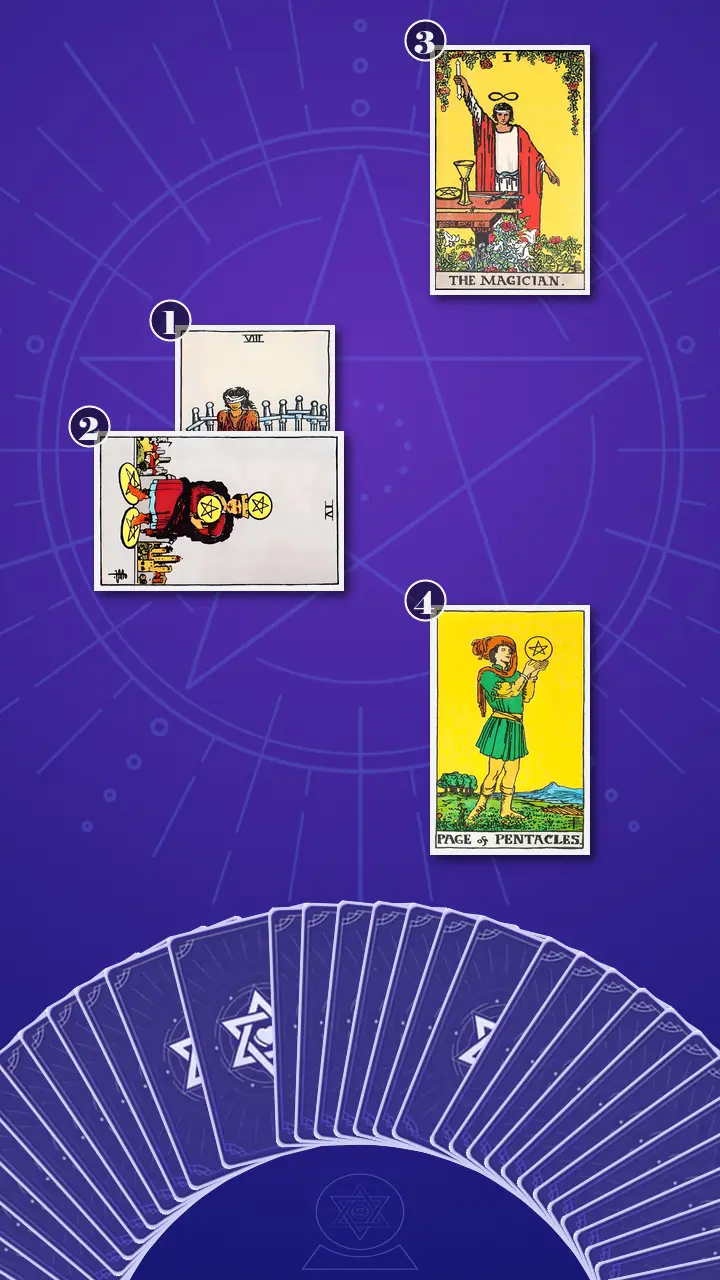
I placed the first card at the centre for the current impasse: what Jordan actually did when choosing became necessary. I laid the second across it for the underlying fear and protective strategy. The third would reveal the key shift from a permanent verdict to a working hypothesis, and the fourth would show the first grounded action that could turn a provisional choice into evidence. The layout was a crossroads becoming a short, walkable path rather than a map of a predetermined future.
The Blindfold Made of Browser Tabs
Position One: The Current Impasse
The card I turned first represented Jordan's current impasse: the observable pattern of delaying thesis work instead of selecting a direction. It was the Eight of Swords, upright.
I showed her the blindfolded figure with bound hands, surrounded by eight swords on difficult ground. The image is often read as mental restriction and self-imposed limits, but I was careful with the phrase “self-imposed.” It does not mean the restriction is fake or that a person can simply think positively and walk away. It means some of the enclosure may be made of rules that can be examined rather than facts that must be obeyed.
“At that Robarts desk,” I said, “you already had enough notes to draft a provisional question. But your laptop screen was ringed with database tabs, three competing outlines, and a crowded reference manager. Each time the cursor reached the research question, you searched for another article because the direction felt inaccessible until it felt certain. The restriction felt real, even though several workable paths were already present.”
The Swords brought Air, the energy of analysis and language, but here Air was in Excess and Blockage. Thought had stopped serving the decision and started enclosing it. Jordan's research routine had become like a recommendation algorithm trained by every new click: each request for more options taught the system that more options were the goal. It kept feeding the loop instead of helping her choose.
I gave the loop its inner voice: “I could choose once I know which literature is strongest. I could choose once I understand the methodological risks. I could choose once I know what my supervisor will think. But every new piece of information creates another condition.”
Then I said, “You are not out of options; you are surrounded by conditions for choosing one. Which condition is a genuine program requirement, and which one is a rule saying you must know the whole route before taking the first turn?”
Jordan let out one short, bitter laugh. “That's so accurate it feels kind of brutal.” Her breath caught first. Then her gaze drifted toward the window as if she were replaying the sequence of a dozen writing mornings. Finally, her fingers loosened around the mug, and she added, “I am not short on directions. I just keep making them pass more tests before I'm allowed to use one.”
I nodded. “That distinction matters. The card isn't accusing you of inventing a problem. It is showing us that the felt inability to move and the literal availability of a next move are not the same thing. Once we can see the rule, we can decide whether it still deserves authority.”
The Grip Behind the Delay
Position Two: The Protective Strategy
The card I turned next represented the underlying fear and protective strategy: the belief that more research or organisation had to happen before Jordan could choose. It was the Four of Pentacles, upright.
I pointed to the figure holding one pentacle against the chest, securing two beneath the feet, with the whole body closed around what it possessed. In many contexts this card concerns security, control, and reluctance to release. Crossing the Eight of Swords, it showed me why the mental enclosure persisted: keeping every topic available was providing a temporary sense of control.
“Before a supervisor meeting,” I said, “you keep three thesis directions equally detailed in separate folders. Then you give a broad update instead of naming one. Each folder becomes an escape route from being wrong. If no option is released, no single option has to absorb the risk of being tested.”
This was Earth held defensively: an Excess of control paired with a Deficiency of movement. The resources were real. Jordan had sources, methods, careful notes, and research skills. But she was holding them like protected assets instead of investing them in one inquiry. The balance remained intact; nothing received enough focused attention to grow.
“If you imagined emailing one provisional question to your supervisor tonight,” I asked, “what specific outcome would you be trying to prevent by keeping the other topics open?”
Jordan's thumbs pressed into the cardboard sleeve around her coffee. Her eyes lost focus for a few seconds. Then she set the cup down with deliberate care and released a breath through her nose. “I think I'm trying to stop her from seeing me choose badly. If I stay broad, I can still look like I'm being thorough. If I choose, I have to find out whether my judgment holds up.”
“That protection makes sense,” I said. “You found a way to reduce the immediate pressure of being seen making a revisable choice. I won't shame a strategy for doing the job it developed to do. But we do need to name its price: keeping every option open is still a choice, and it is costing the thesis evidence.”
I watched the sentence land in her hands before it reached her face. Her fingers tightened once, then opened flat against the table. The delay was no longer a vague character flaw. It had become a trade-off: safety from immediate evaluation in exchange for the information that only a tested direction could produce.
When the Magician Opened the Workbench
Position Three: The Key Shift
The radiator clicked off as I reached for the third card, and the room became unexpectedly quiet. A narrow strip of grey daylight moved across the table and stopped beside the card. This was the key card of the reading, the bridge between protected indecision and deliberate experimentation.
The card I turned now represented the key shift: the stance that could transform a thesis direction from a permanent verdict into a working hypothesis. It was The Magician, upright.
I traced the image with one finger without touching it. One hand points upward and the other toward the ground. On the open table lie the tools of all four suits: Wand, Cup, Sword, and Pentacle. The infinity symbol above the figure suggests continuing potential, but the table is what mattered most to me. Potential becomes useful only when something is selected, arranged, and put to work.
My mind flashed to two decades of conversations held over coffee: students asking one Tuesday morning to solve an entire degree, then blaming themselves when the morning could not carry that weight. The shift often began when the huge emotional object called “the thesis” was replaced by one task that could leave a visible receipt of learning.
“The Magician doesn't tell you to manifest the perfect topic,” I said. “It shows focused agency and resource integration in Balance. You already have question fragments, sources, methods, analytical language, and a reason you care. The unused potential is not another idea. It is your ability to coordinate what is already here around one deliberately limited test.”
I translated the image into Jordan's actual evening: she would close the search results, place one question fragment in a plain document, choose two existing sources and one feasible method, and title the page “Working Question: Seven-Day Test.” The change would not be sudden certainty. It would be authorship replacing passive preparation.
Syllabus Deconstruction at the Workbench
This was where I used the diagnostic lens I call Syllabus Deconstruction. I use it when a large deadline has absorbed so much emotional meaning that even the smallest related task feels like contact with the entire mountain. I strip the assignment down until it becomes mechanical enough to perform without first resolving every feeling attached to it.
Jordan's instruction “choose a thesis direction” secretly contained dozens of future demands: defend the literature, justify the method, satisfy the supervisor, write every chapter, graduate, and prove she belonged. No wonder one blank line felt impossible. I deconstructed it into four parts: one existing question fragment as the input, two sources or one method as the test material, a three-line evidence log as the output, and seven days as the expiry date. Nothing in that structure asked her to prove the final thesis in advance.
“A working question is a research tool, not a verdict on your judgment,” I told her. “A thesis direction is not a verdict on your judgment; it is a working question that earns clarity by being tested.”
I could see the old demand still running. If Jordan named one question, she believed she had to defend every future chapter at once. Her cursor had never been facing one sentence; in her body, it had been facing a verdict on whether she belonged in the program.
The search for perfect certainty is not the prerequisite for a thesis direction; place the sources, methods, and question fragments on The Magician's table and let one focused experiment create clarity.
I let the room stay quiet.
I watched Jordan's inhale stop halfway. Her fingers remained suspended above the notebook as though the sentence had interrupted a keystroke. Then her eyes moved past me and went slightly unfocused; I could almost see her replaying the saved papers, the deleted questions, and the careful supervisor updates. Her pupils widened. Her mouth tightened before her jaw finally released, and she blinked quickly as a thin line of moisture gathered along her lower lashes. Next, her shoulders dropped by a visible inch. The hand she had curled into a fist opened slowly against her thigh. “Oh,” she said on a shaky exhale, almost too quietly for me to hear.
The release did not arrive cleanly. Jordan sat straighter, but for a moment she looked almost dizzy with the responsibility that clarity returned to her. Then irritation crossed her face. “But doesn't that mean I spent months doing this wrong?”
“No,” I said. “It means the research served two jobs. Some of it built genuine knowledge. Some of it protected you from exposure. We can respect why you needed that protection and still decide that it has become too expensive. Evidence is not a punishment for choosing. It is how research helps you revise.”
I waited until her breathing settled, then asked, “Now, using this new perspective, can you remember a moment last week when this insight might have changed how you felt?”
Jordan looked down at the Magician's open table. “Wednesday after my RA shift. I wrote five versions of a question and deleted the strongest one because it seemed too narrow. If I'd called it a seven-day test, I think I could have left it there. I wouldn't have needed to defend it as my whole thesis.”
“Exactly,” I said. “You did not need to know that it would work. You needed to decide what would count as learning something this week. Clarity is allowed to arrive after contact with the work.”
I saw the first real crossing in her Journey to Clarity then. It was not a leap from uncertainty to perfect confidence. It was the smaller, more credible movement from apprehensive hyper-analysis and protected indecision toward curiosity and grounded confidence through bounded evidence. Jordan could still feel exposed and choose a reversible experiment. Those two states were allowed to coexist.
The Page Who Studied One Thing
Position Four: The First Grounded Action
The card I turned last represented the first grounded action: the concrete next step that could convert Jordan's working direction into evidence and progress. It was the Page of Pentacles, upright.
I showed her the Page studying one pentacle with complete attention. Behind the figure, a cultivated field stretches toward distant mountains. The mountains remain, but the Page is not trying to climb all of them that afternoon. The focus is one tangible object, one beginning, and one practice that can be repeated.
“In your week,” I said, “this looks like scheduling one 45-minute session with one provisional question. You read two relevant abstracts or one methods section, then record what supports the question, what complicates it, and what you need to test next. You end with a completed evidence log, not a final thesis identity.”
The Page brought Earth back in Balance. The Four of Pentacles had used Earth to hold and preserve; the Page used it to study, cultivate, and produce something observable. This was not dramatic productivity. It was patient contact with one question long enough for reality to answer back.
Jordan reached for her phone, then stopped. “Forty-five minutes sounds small, but after an RA shift I sometimes get home with nothing left. If I miss the session, it'll become one more thing I failed at.”
“Then forty-five minutes is the ceiling, not the entry fee,” I replied. “The minimum version is ten minutes, one question, one source abstract, and one sentence about relevance. If the timer ends and your jaw is tightening rather than the task becoming clearer, you stop. A bounded action includes a real exit.”
Her thumb resumed moving. I saw her open the calendar rather than Notion and create an event at Robarts for Thursday morning: “Test one question.” She did not build a semester dashboard around it. She set a start time and an end time.
“My job that morning isn't to become certain about the whole project,” she said, checking the wording with me. “It's to examine this question.”
“That's the Page,” I said. “This week, the question only has to be testable, not permanent.”
From Every Map to One Walkable Path
I gathered the four cards into one story. Jordan had moved from coursework and RA assignments, where expectations were clearly bounded, into independent thesis work, where freedom required her to define the task herself. The Eight of Swords showed how thought had become an enclosure at that transition. The Four of Pentacles revealed why the enclosure remained useful: keeping every direction available protected her from being seen making an imperfect, revisable choice. The Magician showed the resource she had overlooked, which was not more information but her existing ability to assemble information around a deliberate test. The Page of Pentacles grounded that agency in one modest research session.
The core metaphor was no longer a researcher with too few maps. Jordan had been standing at a trailhead with every map open, waiting for one to guarantee the entire journey before taking the first turn. Her cognitive blind spot was treating non-commitment as neutral and preparation as evidence. In practice, keeping all routes open was consuming time while producing no information about the ground beneath any one route.
The transformation direction was precise: replace the demand for the perfect thesis direction with a seven-day working question and one small evidence-gathering task. A provisional question could be revised, narrowed, or discarded after the test. Revision would not mean the experiment had failed; it would mean the experiment had produced usable knowledge.
I also used Study Environment Auditing to make the digital and physical conditions visible. Jordan's clutter was not a moral issue, but six active tabs, four topic folders, an open phone, and a half-rebuilt Notion dashboard were quietly charging rent against her limited attention. The workbench needed a boundary her eyes could understand before her mind was asked to choose.
“The cards have given us a sequence, not a command,” I told her. “You remain free to pause, revise, ask for feedback, or reject the question after the test. The point is to let your next decision respond to evidence rather than to the promise of certainty.”
The Seven-Day Research Workbench
I wrote the actionable next steps on one page. The full method was simple: a four-card Decision Cross Context Edition tarot spread for thesis choice paralysis, followed by a timed two-source evidence test. Jordan would not attempt an all-day thesis rescue.
- Run the Desktop Reset Ritual. Before the next writing session at a Robarts desk or her kitchen table, Jordan will set a 15-minute timer, remove unrelated papers and devices, close the extra database tabs, and move unused links into a folder called “Not This Week.” She will leave only the thesis document, one notebook, and the two selected sources visible. The timer is a hard stop. The reset ends after 15 minutes, even if the folders are imperfect; rebuilding the Notion dashboard is outside the task.
- Write the Seven-Day Working Question. On her next available writing morning, Jordan will open a plain document and spend no more than 10 minutes completing: “For the next seven days, I am testing whether...” Beneath it, she will name one source, dataset, interview, or method that could help her learn something specific. She will label the page “Working Question, Not Final” and add an expiry date. If pressure rises instead of settling, she can stop and bring the unfinished sentence to her supervisor.
- Complete the Two-Source Direction Test. During one scheduled 45-minute session, Jordan will read two source abstracts or one methods section only for what they reveal about the working question's scope. She will fill three rows headed “supports,” “complicates,” and “next question,” then bring the result to her supervisor with the line, “I'm treating this as a one-week scope test and would like feedback on what to narrow.” Success means finishing the test and recording evidence, even if the question becomes less workable. On a low-energy day, the minimum version is 10 minutes, one abstract, and one evidence sentence.

Six Days Later, One Question Out Loud
Six days later, I opened a message from Jordan. She had completed the desktop reset, moved twenty-three saved links into “Not This Week,” and tested the question she had deleted after her RA shift. Her evidence log did not tell her that the topic was perfect. It showed that the scope was too broad in one place and unexpectedly alive in another.
She had also sent the provisional question to her supervisor. Her message to me read, “She said it still needs narrowing, but now I know what to narrow. Weirdly, that felt much better than sending another email saying I'm still mapping the literature.”
Her follow-up held the bittersweet proof I trusted most: “I slept through the night. My first thought in the morning was, What if it's wrong? Then I laughed, opened the evidence log, and wrote, Then I revise it.”
I did not see a life magically solved. I saw a student complete one inquiry, tolerate one piece of imperfect feedback, and keep her authority over what happened next. The cards had not selected Jordan's thesis. They had helped us tidy the reality around the choice until she could see her own tools and use them.
That was the quiet achievement of her Journey to Clarity: she moved from trying to feel certain before acting to letting bounded action create evidence. The confidence was still tender, but it was grounded in something she had done rather than something she was waiting to feel.
If keeping every thesis option open is the only way you can feel in control, even opening the document may tighten your jaw as though your academic judgment is about to stand trial. I hope Jordan's workbench offers a gentler fact: noticing that hidden rule means you are already no longer fully inside it.
If one direction only had to earn its place on The Magician's workbench for the next seven days, which question would you be curious enough to test once?