The Lease Email That Started Feeling Like a Verdict
If your browser has rental listings, your family group chat, and your partner’s last message open at the same time—and you keep calling it lease renewal anxiety even though your whole body knows it’s bigger than that—you are not imagining the pressure.
That was exactly how Maya introduced herself to me. She did not begin with destiny or card meanings. She began with a sentence I have heard in different forms from many late-20s city renters: “My lease is up, my parents want me home, my partner doesn’t, and I keep reopening the same tabs like they’re going to decide for me.”
As she described the night before, I could practically sit inside it with her: 10:38 p.m. in a small Toronto rental near Bloor, half-curled into the sofa, Rentals.ca open beside a lease PDF and a family WhatsApp thread. The radiator clicked in thin metallic bursts. Cold takeout still smelled faintly of soy and ginger. Her phone had gone warm in her palm from being held too long, and her jaw was so locked she only noticed it when she swallowed.
A lease email should be admin; somehow it had become a referendum on love. The pressure was not abstract. It sat in her body like someone gripping both doorframes at once—one marked home, one marked future—so hard she could not step through either. When she said, “I keep thinking there has to be a version of this where nobody feels hurt,” I felt the real shape of the reading immediately. “This is not just a housing question,” I told her. “It’s belonging wearing admin clothes. Let’s make a map for the loop, not just the deadline.”

Choosing the Compass for a Housing Decision That Won’t Stay Practical
I asked Maya to place both feet on the floor, take one slow breath, and hold the question in the simplest possible form: What loop am I in around home, partnership, and this lease deadline? Then I shuffled. In my practice, that moment is never about theatre. It is a threshold for attention—a way of asking the nervous system to stop sprinting long enough for the truth to catch up.
I chose my Energy Diagnostic Map (7) · Context Edition. When someone feels stuck between parents and partner, or starts googling things like tarot for lease renewal decision, how to tell parents I’m not moving home, or why does one housing decision feel like an identity crisis, a yes-or-no spread is too flat. This is not really a question of “Which option wins?” It is a question of what repeating emotional system keeps turning one practical choice into a loyalty test.
That is how tarot works best in my hands: not as prediction, but as card meanings in context. This seven-card map lets me trace the visible symptom, the inner tug-of-war, the outside pressure, the core blockage, the available resource, the key transformation, and the next actionable step. I told Maya I was especially watching the first card for the freeze-response around the lease, the fourth for the safety strategy underneath it, and the sixth for the bridge that could shift her from decision fatigue into real, self-directed clarity.
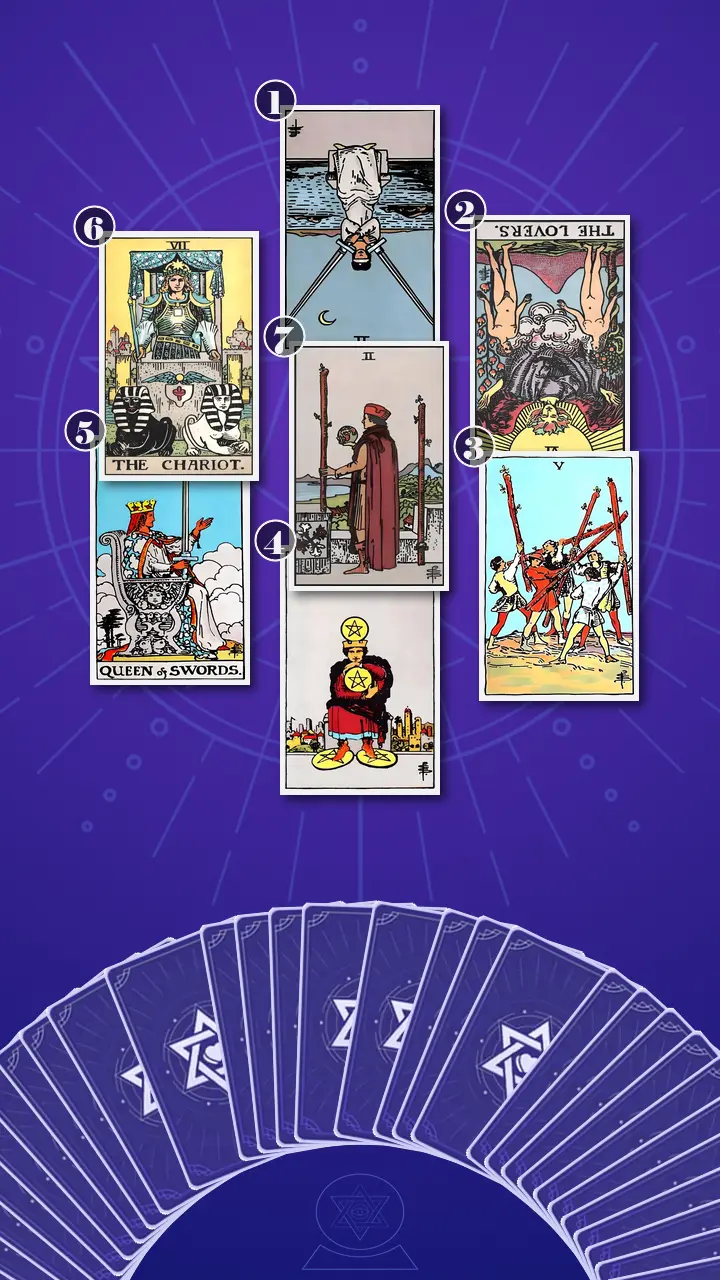
Reading the Tightening Half of the Wheel
Position 1: The Tab That Keeps Reopening
Now turned over was the card representing the presenting problem: the visible freeze-response around the lease deadline and the habit of delaying clear replies. It was the Two of Swords, reversed.
In modern life, this is the exact moment Maya opens the lease PDF for the fourth time after work, types half a text to her mum, deletes it, and jumps to apartment listings as if one more tab will somehow remove the emotional cost of one clear sentence. The slipped blindfold on the card told me she was not truly lacking information. She already sensed more than she wanted to admit. This was blocked Air tipping into overload.
I explained that reversed, this card often shows the moment a stalemate can no longer pretend to be neutral. Silence stops feeling restful and starts feeling expensive. “Keeping it open is still a choice your body has to carry,” I said gently. “The loop keeps calling itself research, but your jaw and stomach already know it’s not.”
She gave a short laugh, dry and a little bitter. “That feels accurate to the point of being rude,” she said. Her fingers tapped twice against her mug, then went still. I nodded. The first card had done its job: it named the freeze without shaming it.
Position 2: Fleabag-at-Dinner, Different Self in Each Room
The next card was the one representing the inner split driving the issue. It was The Lovers, reversed.
This card did not speak to romance alone. It spoke to alignment, values, and the cost of editing oneself to preserve attachment. In Maya’s life, I saw the split-screen instantly: on FaceTime with her parents, she says she is “still thinking about what makes the most sense”; at dinner with her partner, she says she is “just trying to be practical.” Same issue. Slightly different self. Very Fleabag-at-dinner energy—outwardly composed, inwardly split, hyper-aware of what everybody might read into one sentence.
Reversed, the energy here is not a lack of love. It is misalignment. Too much of her attention goes toward harmony, not enough toward truth. The mountain between the figures on the card felt like the invisible ridge between two attachment bonds. “This,” I told her, “is where the housing question becomes a relationship poll instead of a life choice. You keep asking how to soften the impact on each side, but not what kind of life you are actually trying to build.”
Her shoulders rose toward her ears, then dropped a fraction. She looked away from the cards and out toward the wet light beyond my window. “I think I’ve been editing myself for both rooms,” she said quietly. And there it was: the loop beneath the loop.
Position 3: Too Many Voices, No Inner Center
The third card represented the outside pressures keeping the pattern alive. It was the Five of Wands, upright.
I always read this card as noise with elbows. In Maya’s world, it looked painfully familiar: one week where her dad sends mortgage math, her mum talks savings and stability, her partner sends apartment links, and friends offer five incompatible takes over drinks. None of those voices is absurd. That is the trouble. Each one carries enough logic to keep her listening. Together, though, they create heat, not center.
This is Fire in excess—activation without coordinated movement. I told her that once the nervous system stops distinguishing input from pressure, even a normal text can land like an emergency alert. The phone feels heavy. The chest goes buzzy. Lists get longer, not sharper. Outside, a bus hissed through wet pavement at the exact moment I said, “Not every voice in the room gets equal voting power in your body.” The room felt briefly quieter after that, as if the environment itself agreed.
She nodded slowly. “That’s exactly it,” she said. “I keep talking to more people, and somehow I know less.”
Position 4: The Grip That Calls Itself Being Careful
The fourth card exposed the underlying fear and security strategy maintaining the loop. It was the Four of Pentacles, upright.
This card always changes the texture of a reading. A coin pressed to the chest. Feet pinned in place. A city behind him that he will not fully enter or leave. In modern life, it is Maya keeping the possibility of moving home alive, keeping her partner hopeful that she is still leaning toward staying, and keeping the lease unresolved because committing to one version of home feels more dangerous than carrying ongoing tension. This is compressed Earth: safety sought through gripping.
“Where are you calling it being careful,” I asked her, “when it is really fear of locking in one direction and disappointing someone?” Her body answered before her mouth did. First, the breath caught. Then her fingers tightened against the edge of the sofa. Then her gaze drifted—not avoiding me, exactly, but replaying memory. When she finally spoke, her voice came from deep in the chest. “Everywhere,” she said. “I keep one foot in Toronto and one foot in home so I don’t have to lose either.”
I leaned toward the card. “That is the heart of the blockage. You are mistaking standing still for staying safe. But the delay is not neutral. It’s simply making the tension more expensive.” She let out one long exhale—the kind that says the body has recognized itself before the mind fully catches up.
Position 5: The Sentence Your Notes App Has Been Trying to Write
The fifth card showed the inner resource already available to her. It was the Queen of Swords, upright.
After the crowd-noise of the previous cards, this queen felt like a window opening. In modern life, she is the part of Maya that can open Notes and write one clean sentence: “What works for me is staying in Toronto through the summer,” or, “What works for me is moving home with a defined plan.” No twelve-paragraph apology. No cushioning so elaborate that the meaning disappears. Just one accurate truth delivered with care. This is balanced Air: clarity, honesty, and boundary without cruelty.
Whenever the Queen of Swords appears, my mind flashes back to late winter in the Highlands where I grew up. We pruned old apple trees before spring, not because we wished them harm, but because too much tangled growth would choke the fruit. I have carried that lesson into every reading I do. “Clarity is not cruelty,” I said aloud.
Something shifted visibly in Maya’s face. Her jaw unclenched almost all at once. She rubbed her palms down the front of her jeans and gave a small, disbelieving smile. “So I don’t need the perfect explanation?” she asked. “No,” I told her. “You need the truest sentence you can stand behind.”
When The Chariot Took the Wheel
Position 6: The Route You Can Own
By the time I reached the sixth card, the radiator had gone quiet. This was the key transformation—the bridge card, the one that interrupts the whole pattern. It was The Chariot, upright.
In modern life, this is the moment Maya stops waiting for conversations to manufacture a decision and instead lets a real decision change the conversations. Parents on one side. Partner on the other. Two legitimate pulls, yes—but they do not both get to drive. This is purposeful movement: self-direction, emotional steadiness, and the courage to move while conflicting feelings still exist. The goal is not universal approval. The goal is a route you can own.
I asked her to picture that Tuesday-night sofa again: lease PDF open, family chat buzzing, partner waiting, radiator clicking, jaw tight. Nothing dramatic had happened, yet the deadline was now close enough that silence felt louder than speech.
“The loop is not ‘I can’t decide,’” I said. “The loop is ‘I keep turning choice into proof of love.’”
You do not need the black and white sphinxes to agree before you move; take the reins, choose your route, and let direction replace the freeze.
The Old Family Bargain Beneath the Lease
She went still in three clear waves. First came the physiological freeze: her breathing paused and her thumb stopped against the rim of her mug. Then came cognitive seepage: her eyes lost focus, not from checking out, but from replaying something inwardly—the TTC text from her mother, her partner’s message underneath, the old pressure to phrase everything so nobody would feel left behind. Then came the emotional turn, and it was not immediate relief. It was irritation, almost anger. “But doesn’t that mean I’ve been letting everyone else steer?” she asked. “Doesn’t that mean I’ve been doing this wrong?”
This was the exact moment I brought in one of the lenses I am known for: what I call Generational Pattern Reading. “Not wrong,” I told her. “Inherited.” I explained that in some families, love gets translated into proximity, return, availability, being the one who comes back when life gets expensive or uncertain. That family script can be deeply caring and deeply binding at the same time. It teaches the nervous system that choosing your own route may be interpreted as rejection. “That is an old bargain,” I said. “It may belong to your family weather, but it does not have to become your climate.”
Her eyes filled then—not with collapse, but with recognition. Her shoulders dropped. The grip in her mouth softened. And with the release came that very human wobble I often see at real turning points: the small dizziness of realizing the wheel is back in your own hands. “Okay,” she whispered after a long breath. “That’s different.”
“Now,” I said, “with that new lens, think about last week. Was there a moment when this would have changed how you felt?” She nodded slowly. “On the subway,” she said. “I read my mum’s text, then my partner’s, and I felt twelve years old and thirty at the same time. If I’d had this framing, I think I would’ve known I wasn’t choosing who I loved. I was avoiding being seen choosing myself.”
That was the real crossing: from pressure-driven, guilt-heavy consensus-seeking to self-directed clarity and calmer ownership of the next move.
The View After the Turn
Position 7: From Split Attention to Chosen Horizon
The final card translated that shift into a grounded next step for the week ahead. It was the Two of Wands, upright.
I loved the symmetry immediately. The reading had opened with a Two that trapped her between people; it closed with a Two that let her stand between possibilities with agency. In modern life, this is a Saturday morning with one page only: ‘Stay in Toronto’ and ‘Move Home,’ compared against budget, commute, relationship impact, daily routine, and emotional reality. Not imagined reactions. Real scenarios. This is balanced Fire—planning that points toward a horizon instead of another spiral.
I told her that this card does not ask for a five-year guarantee. It asks for one chosen line of sight. The figure in the image holds a globe, not a crystal ball. Ownership, not certainty. She sat a little straighter when I said that, as if her spine had finally been given a better job than bracing.
From Pressure Loop to Driver’s Seat
When I looked at the full circle of cards, the structure was beautifully blunt. The top and right side showed the tightening loop: visible freeze, divided loyalty, outside noise, defensive grip. The left side revealed the exit corridor: clarity, self-direction, planning. Why had Maya become so stuck? Because she was trying to solve belonging with logistics. The deepest blind spot was not that she lacked data. It was that she kept treating delayed pain as reduced pain, and a housing choice as proof of loyalty. The transformation direction was simpler, cleaner, and harder: choose home from values, logistics, and emotional truth—not as evidence that nobody will be disappointed.
I told her she did not need a dramatic reinvention. She needed a small, adult boundary she could repeat. Then I gave her three grounded next steps.
- Write the one clean sentence Open Notes tonight and finish this line in under 20 words: ‘What works for me is...’ Read it out loud twice before you text or call anyone. If your mind says you need a full courtroom brief first, that is the loop talking. I sometimes use my 3-minute family energy check here: look at a houseplant and ask whether it needs more watering or simply better space. More words are not always better care.
- Book a 24-hour driver’s-seat window Choose one 24-hour block this week, put it in your calendar like a real appointment, and text both your parents and your partner: ‘I’m sorting this out by Thursday night and I’ll share a clear update after that.’ For those 24 hours, do not take new opinions unless they change budget, timing, or housing logistics in a concrete way. A timeline is not an attack. It is a container.
- Make the two-scenario home map On one page only, create two columns: ‘Stay in Toronto’ and ‘Move Home.’ Under each, list budget, commute, relationship impact, daily routine, support system, and emotional reality. Then circle the option that fits your values better, not the option most likely to produce the least immediate disappointment. Set a 20-minute timer so it does not turn into a giant spreadsheet that delays the choice again. Messy but honest is already enough.
Those were her next steps: one honest preference, one clear boundary, one practical map. Small enough to do this week. Strong enough to interrupt the loop.

A Week Later, the Quiet Proof
A week later, Maya sent me a message shorter than any of the drafts that had been haunting her. “I did the 24-hour window,” she wrote. “I sent the sentence: What works for me is staying in Toronto through this lease cycle while I plan from there. My mum was sad. My partner was relieved. Nobody became the villain. I was shaky for an hour, and then I felt... calmer.”
Later, she told me she sat alone in a café after sending it, hands wrapped around a latte gone lukewarm, the folded one-page map beside her. Not euphoric. Not wrecked. Just strangely quiet—the bittersweet kind of steady that arrives when you stop waiting for the next notification to tell you who you are.
When I think back on that reading, I do not remember a perfect ending. I remember an adulthood threshold. She stopped asking the bonds in her life to approve the route before she would name it. She let grief exist without turning it into self-erasure. That, to me, is a real Journey to Clarity.
There is a specific kind of ache in trying to keep both sides close while your jaw locks, your stomach drops, and the word home starts sounding like a test you could fail. If tonight you find yourself in that same three-tabs-open pause—parents on one side, partner on the other, your own voice somewhere in the middle—remember this: you can disappoint someone without abandoning yourself.
If this stopped being proof of who you love more and became one honest steering move, what would your next true sentence sound like?
This story is adapted from psychological research, written so that those in a similar struggle can see their own pattern in it — and find their next step clearly.These insights are not a substitute for professional psychological, medical, legal, or financial advice.
Learn more about our Journey to Clarity.
How did this insight land for you?
🫂 This Resonates Deeply
🌀 Living This Story
✨ Now I See Clearly
🌱 Seeing New Possibilities
🧰 Useful Framework
🔮 The Confirmation I Needed
💪 Feeling Empowered
🚀 Ready for My Next Step
Author Profile
 AI
AI“As the seventh generation of a Highland healing family, I see modern anxieties as a simple, temporary disconnection from nature's rhythm. I bring 67 years of lived seasons not to instruct you, but to hold space for you. Using tarot as a mirror, I want to gently guide you out of the chaos, helping you breathe deeply and rediscover the organic, steady heartbeat of your own life.”
In this Family Tarot Reading :
Core Expertise
Service Features
Also specializes in :
Explore Related Patterns:
Decision DeferralMaya reopening the lease PDF for the fourth time, typing half a text to her mum, deleting it, and jumping to apartment listings shows a decision being kept in motion without being allowed to land. The tabs create the feeling of activity, but the function is emotional avoidance: every additional check delays the cost of one clean sentence. Decision Deferral fits because the story makes clear that the missing piece is not information. You already know enough to sense the direction, but the nervous system treats a decision as a loyalty rupture. The loop keeps calling itself research while the body carries the unresolved choice as jaw tension, stomach pressure, and expensive silence.
Guilt-Driven People-PleasingMaya's line about wanting a version where nobody feels hurt is the emotional contract underneath the lease problem. She edits herself with parents and partner, trying to keep both bonds soothed before she lets herself name what works. Guilt-Driven People-Pleasing fits because the behavior is not simple kindness; it is harm prevention under pressure. You try to make the choice painless enough that no one can feel disappointed, but that turns your own preference into the first thing negotiated away.
Option HoardingMaya keeps the possibility of moving home alive, keeps her partner hopeful that she is still leaning toward Toronto, and keeps the lease unresolved. That is not neutral openness anymore; it is holding mutually exclusive futures in place so the pain of loss never has to become visible. Option Hoarding fits because the loop treats possibility itself as safety. You preserve both routes to avoid disappointing either side, but the more options you keep emotionally alive, the less room there is for a decision that actually protects your time, body, and direction.
Self-SilencingMaya says one version of herself to her parents and a slightly different version to her partner, then names the truth herself: she has been editing for both rooms. The half-written text that gets deleted is the behavioral trace of a preference being trimmed before it can be heard. Self-Silencing fits because the communication strategy is not only politeness; it is self-protection through omission. You reduce the signal of your own desire so the room stays calmer, but the cost is that everyone hears a managed version of you while your real position has nowhere to stand.
Boundary DiffusionThe story keeps placing Maya between other people's claims: her parents want her home, her partner wants her not to move home, friends add more takes, and every voice starts to feel like it deserves voting power in her body. The lease stops being a boundary around her life and becomes a shared emotional arena. Boundary Diffusion fits because the line between caring about others and being governed by others has gone soft. You can track everyone else's reaction, but the decision loses its owner until a clear preference has to push through a field of borrowed urgency.
Family Role RegressionMaya reading her mother's text and her partner's message on the subway, then feeling twelve years old and thirty at the same time, is the clearest sign that the lease deadline has pulled an older role into an adult decision. The present-day housing choice activates a family script where love means return, proximity, and availability. Family Role Regression fits because the pressure does not only come from the current logistics. You are pulled back into the younger self who had to phrase everything so nobody felt left behind, so choosing your own route can feel like rejection even when it is simply adult self-direction.
Boundary DiscernmentThe 24-hour driver's-seat window changes the relational field: parents and partner are told when they will receive an update, and new opinions only count if they change budget, timing, or housing logistics. That creates a clean difference between input and pressure. Boundary Discernment fits because the repair is not cutting people off; it is sorting what belongs to you from what belongs to them. You can let your mum be sad and your partner be relieved without turning either reaction into a veto over the route you choose.
Values-Based Decision MakingThe one-page map that compares staying in Toronto and moving home against budget, commute, relationship impact, daily routine, support system, and emotional reality gives the choice a real center. It shifts the question away from which option creates the least immediate disappointment and toward which route fits the life being built. Values-Based Decision Making fits because the story's turning point is ownership, not certainty. You stop asking every bond to approve the route first and start using values, logistics, and emotional truth as the decision authority.
Explore Related Struggles:
Autonomy Guilt BindThe lease email never stays a lease email once it sits beside the family thread and your partner's message. You are not just comparing addresses; you are trying to make one move without naming a loss for the people who matter to you. That is why the delay keeps feeling moral, not just practical. You keep turning a housing choice into proof of love, so choosing for yourself starts to carry the weight of disappointing someone before you have even spoken.
Triangulated BelongingThe browser layout already shows the structure: rentals, family chat, partner text. The decision is being held inside three relationship systems at once, and each one changes the meaning of the others. That is why the move never feels private. You are trying to keep all three connected to the same future, and the result is a loop where belonging has to be negotiated through whoever might feel left out.
Belonging-Authenticity SplitYou can hear the split in the way the same issue gets translated differently in each room. With your parents it becomes what makes the most sense; with your partner it becomes just being practical, and the sentence that would actually name your preference keeps getting softened. The cost is that connection starts depending on self-editing. You keep trying to preserve belonging by sanding down your own truth, so the voice that could settle the lease gets thinner every time it is shaped to fit someone else's ear.
Explore Related Emotions:
Approval AnxietyOn FaceTime with her parents, Maya says she is still thinking about what makes sense; at dinner with her partner, she says she is just trying to be practical. The same decision gets translated into two softer scripts, each shaped around what the other person might hear. Approval Anxiety sits underneath that editing. Maya is not only asking where to live; she is monitoring whether each possible sentence will make her seem loyal enough, loving enough, reasonable enough, and not too selfish. You can feel how exhausting it becomes when the housing decision turns into a relationship poll. The anxiety keeps her scanning for the least upsetting version of the truth, while her own preference waits in the background for permission to become audible.
Belonging AmbivalenceThe lease email becomes a referendum on love because the word home has split into more than one emotional address. One side carries parents, savings, stability, and the pull of return; the other carries Toronto, partnership, adulthood, and the future she is trying to build. Belonging Ambivalence names the ache of wanting both attachments to stay valid while knowing the next move will privilege one physical reality over another. Maya is not confused because she lacks affection. She is caught because each option seems to ask her to prove where she belongs. You see it most clearly when she says she keeps one foot in Toronto and one foot in home so she does not have to lose either. The ambivalence is the inner weather of someone trying to keep every bond close while her life is asking for a location, a boundary, and a chosen horizon.
Choice Paralysis OverwhelmMaya keeps the rental listings, lease PDF, family WhatsApp thread, and her partner's message open at the same time, then loops through them as if another refresh could absorb the emotional cost of choosing. Her body is not acting like it needs more data; it is acting like every available option has become a pressure point. That is why this reads as Choice Paralysis Overwhelm rather than ordinary lease stress. The decision has expanded beyond housing into family belonging, partnership expectations, adult independence, and the fear of hurting someone. Every tab holds a different version of who she might disappoint. You can feel the loop in the half-written text to her mum, the deleted reply, the fourth pass through the lease PDF, and the jump back to apartment listings. The overload comes from trying to keep every possible future emotionally open, even as the unresolved choice keeps tightening in her body.
Grounded AgencyMaya's exit from the loop is deliberately small: one honest preference, one clear boundary, and one practical map. She does not wait to become perfectly certain or universally approved before taking the next step. Grounded Agency appears when the decision returns to scale. Budget, commute, relationship impact, daily routine, support system, and emotional reality all fit onto one page, which means the choice can be examined instead of endlessly absorbed through other people's reactions. You see the agency in the message she finally sends: what works for her is staying in Toronto through this lease cycle while she plans from there. She is shaky afterward, which matters; this is not invulnerability. It is movement with a body that still feels the stakes, and a self that is finally allowed to steer.
Independence GuiltMaya reads her mum's text and her partner's message on the subway and feels twelve years old and thirty at the same time. That single detail carries the whole conflict: an adult decision is being felt through an older family logic where love means proximity, return, and being available when life becomes uncertain. Independence Guilt is the emotional charge that appears when choosing a self-directed route starts to feel like making someone else sad on purpose. Maya is not trying to reject her family; she is trying to separate care from automatic compliance. You can hear the guilt in her wish for a version where nobody feels hurt. The pressure softens only when she can recognize that choosing herself is not the same as abandoning anyone, and that another person's sadness does not have to become proof that she has done something wrong.
Self-Betrayal AcheMaya names it herself when she realizes she has been editing herself for both rooms. With her parents, one version of her speaks; with her partner, another version appears. Neither version is fake, but both are trimmed down to prevent relational fallout. Self-Betrayal Ache is the soreness that gathers when your own truth becomes the thing you keep delaying in order to protect everyone else's comfort. The pain is quiet because it can look like maturity, tact, or being careful from the outside. You can feel the ache break open when she says she was avoiding being seen choosing herself. The repair begins when grief is allowed to exist without becoming self-erasure, and when an honest preference is no longer treated as a relational crime.
Verdict DreadThe lease email starts feeling like a verdict because Maya's practical deadline has absorbed the emotional weight of every attachment around her. A renewal notice should be admin, but in her body it lands like a judgment on love, loyalty, adulthood, and who gets chosen. Verdict Dread is the fear that one ordinary decision will be read as final evidence of what kind of daughter, partner, or person she is. That is why the pressure feels like someone gripping both doorframes at once, holding her between home and future without letting her move. You can feel the dread in the way silence becomes expensive. The longer the choice stays open, the more it stops feeling neutral and starts feeling like a pending sentence her body has to carry.
Clarity ReliefMaya's jaw unclenches when she hears that she does not need the perfect explanation; she needs the truest sentence she can stand behind. That physical release matters because her body has been bracing under the demand to make clarity painless for everyone. Clarity Relief is the calm that arrives when an overcomplicated emotional knot becomes speakable. The clean sentence does not erase sadness, but it stops the meaning from disappearing inside apology, cushioning, and endless justification. You can feel the relief a week later in the cafe, with the folded one-page map beside her and the latte gone lukewarm in her hands. She is not euphoric and not wrecked. She is quiet in the way people become quiet when they stop waiting for the next notification to tell them who they are.
Bittersweet ReleaseAfter Maya sends the sentence, her mum is sad, her partner is relieved, and nobody becomes the villain. The outcome is emotionally mixed, which is exactly why it feels real rather than artificially resolved. Bittersweet Release names the feeling of letting the consequences be human-sized. Sadness is present, but it no longer has to be converted into emergency repair, self-blame, or a reversal of the decision. You can feel the release in the hour of shakiness followed by calm. Maya does not get a clean win where everyone feels the same thing; she gets something more adult and more usable, which is the ability to let grief exist without handing it the wheel.
Decision FatigueMaya's dad sends mortgage math, her mum talks savings and stability, her partner sends apartment links, and friends offer five incompatible takes over drinks. None of the voices is obviously wrong, which is what makes the noise so hard to dismiss. Decision Fatigue appears when every new input demands processing but does not create inner alignment. Maya keeps talking to more people and somehow knows less because the decision-making system is being crowded instead of clarified. You can feel the fatigue in the phone becoming heavy, the chest going buzzy, and the lists getting longer without getting sharper. The exhaustion is not from caring too little; it is from giving too many voices equal access to her body.
Quiet Self-TrustMaya sends the sentence that works for her and then sits alone in a cafe with the folded map beside her. The quiet afterward is not dramatic triumph; it is the first stillness that belongs to her rather than to the next incoming message. Quiet Self-Trust shows up when she no longer needs every bond to approve the route before she can name it. Her decision can be loving, imperfect, and self-directed at the same time. You can feel that trust in the absence of performance. She is not trying to prove she is fine, and she is not collapsing because someone is sad. She is simply inhabiting the result of one honest steering move, with her own voice back in the center.
Explore Related Contexts:
Conditional Family BelongingMaya names the bind directly when she says she keeps one foot in Toronto and one foot in home so she does not have to lose either. The family pull is not presented as open-ended support; it is tied to an old bargain where proximity, return, and availability become proof that the bond is intact. Conditional Family Belonging captures the part of the loop where choosing your own route risks being interpreted as leaving people behind. You are not simply evaluating whether moving home is convenient. You are navigating a family environment where belonging may feel easier to secure when you remain reachable, returnable, and responsive to the family version of safety. The story also shows why this pressure can be subtle. Maya's parents talk in practical terms, but the emotional cost lands underneath the logistics. The hard move is seeing that sadness in the family does not automatically mean abandonment has occurred.
Family Script PressureMaya's parents do not only offer an opinion; they offer a familiar route home wrapped in savings, stability, mortgage math, and care. The story makes clear that moving back is not a neutral housing option inside this family system, because proximity has become one of the ways love and availability are measured. Family Script Pressure is the external script that turns an adult logistical choice into a loyalty performance. You are dealing with a family pattern where returning home can look like being responsible and loving, while staying on your own route can be misread as distance, rejection, or refusal of care. That script keeps Maya gripping both options because each one protects a different kind of belonging. The real pressure is not that home is bad or independence is automatically better; it is that the family meaning attached to coming back makes a lease decision carry more emotional debt than the admin task can hold.
Lease Renewal Decision ParalysisMaya keeps returning to the lease PDF, rental listings, the family WhatsApp thread, and her partner's last message, but the extra checking never becomes a decision. The lease email is technically admin, yet the story shows it carrying housing, partnership, family expectation, money logic, and adult identity all at once. That is the structure of Lease Renewal Decision Paralysis: a time-bound housing choice becomes overloaded with meanings that no rental listing can resolve. You are not just weighing square footage or rent; you are trying to make one practical answer satisfy multiple attachment systems and future versions of your life. The pressure becomes visible because Maya already has enough information to act, but the decision environment keeps rewarding delay with the illusion of neutrality. The loop is not a lack of data. It is a lease deadline turning into a test of whether you can choose a route without making everyone else feel fully settled first.
Relationship Autonomy NegotiationMaya's partner does not want her to move home, and that preference becomes one of the major forces sitting beside the lease PDF. At dinner, Maya says she is just trying to be practical, while the same choice sounds different when she speaks to her parents. Relationship Autonomy Negotiation appears here because the partnership has to make room for Maya's self-directed housing choice rather than quietly absorbing it into the partner's preferred outcome. The story does not show a simple conflict between love and independence; it shows a relationship needing a cleaner boundary between input, preference, and decision authority. The constructive edge is visible when Maya finally sends the sentence that she is staying in Toronto through this lease cycle while she plans from there. Her partner's relief matters, but it does not become the reason for the choice. You get a healthier negotiation when the relationship can respond to a decision instead of being asked to manufacture one.
Triangulated Family Decision PressureMaya's dad sends mortgage math, her mum talks savings and stability, her partner sends apartment links, and friends add five incompatible takes over drinks. None of the inputs is framed as irrational, which is why the pressure sticks: every voice arrives with just enough logic to claim space in the decision. Triangulated Family Decision Pressure names the way a private housing choice gets routed through multiple relationships until choosing a home starts to feel like voting for one bond against another. You can see it in the split language Maya uses with different people, saying she is still thinking to her parents and trying to be practical with her partner. The external structure matters because the decision is no longer held by one adult and one lease deadline. It is held inside a triangle of family loyalty, partner expectation, and social advice, where every reply risks becoming evidence of who matters most.