Family Boundary Guilt: From Moving Couple Plans to One Hour on Sunday

When Family Boundary Guilt Lit Up the Dinner Table
“You were halfway through dinner with your partner when a family ‘quick favor’ arrived, and you said yes before asking what Saturday already held,” I said. “That is not just poor scheduling. It is family boundary guilt turning a relationship commitment into a movable appointment.”
Alex, a 29-year-old account manager in Toronto, gave me a pained little wince through the video call. The radiator clicked somewhere beyond her laptop, and the blue light from her phone sharpened the tired shadows beneath her eyes. “Damn,” she said. “That is exactly what I do.”
She had brought me the scene in precise detail. At 7:18 p.m., dinner had been cooling in the rented apartment she shared with her partner. The room smelled faintly of reheated food. Her phone vibrated against the wooden table beneath the edge of her plate, and she read the family message below the table as though hiding it might also hide the decision that followed. Her fingers pulsed. Her shoulders rose. Before asking what the favor involved, she typed that she could help on Saturday.
Only afterward did she open the shared Google Calendar. Their protected day together was already there, color-coded and agreed. Ten minutes later, she was telling her partner that the plan would need to move again.
“I keep saying it is the last time,” Alex told me. “But in the moment, it feels like it will take less energy to say yes than to deal with the guilt of saying no. I do not know where support ends and obligation starts.”
I watched her throat tighten as she spoke. The anticipatory guilt did not look like a vague cloud around her; it behaved like a smoke alarm wired directly into her body. A notification appeared, the alarm sounded in her throat, and her hand moved before she had checked whether anything was actually burning. Beneath that reflex, I could hear tenderness for her family, resentment about always being needed, and the fear that one delayed reply might be remembered as proof that she did not care.
“I am not going to ask the cards to decide whether your family or your partner matters more,” I told her. “That would turn a complicated relationship pattern into a loyalty contest. I want us to see what happens between the message arriving and your answer leaving. Let us make a map of that moment, so you can choose instead of simply react.”

Choosing the Bridge: A Five-Card Relationship Spread
I invited Alex to place her phone face down, feel both feet against the floor, and take one unforced breath. I shuffled while she held a practical question in mind: What keeps me choosing my family's needs before protecting the commitments I have made with my partner?
I explained that this was a focusing transition, not a performance of mystery. Tarot, as I use it through a Jungian psychological lens, does not prove what another person secretly thinks or issue a fixed verdict about the future. It externalizes patterns. The images give us enough distance to examine a familiar reflex without reducing Alex to it.
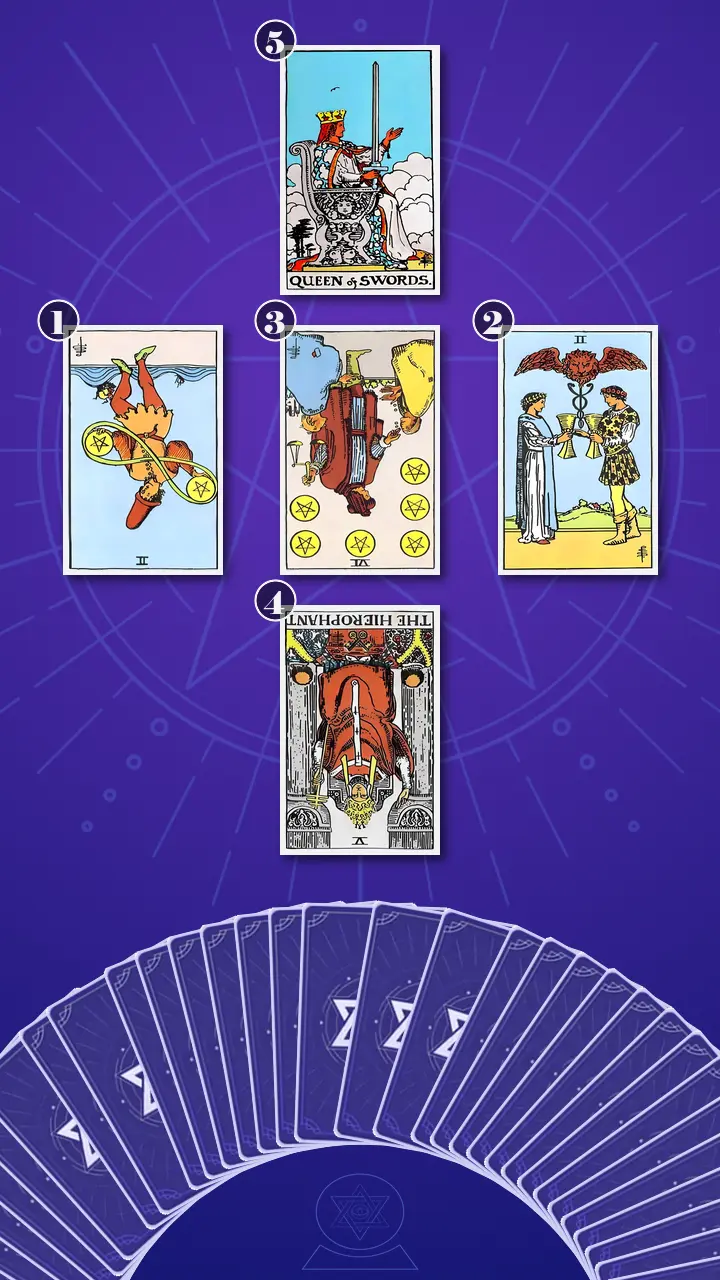
I chose the five-card Relationship Spread · Context Edition. A ten-card Celtic Cross would have pulled in more life domains than this focused relationship question needed. These five positions were enough to trace Alex's automatic behavior, the partnership needs already visible through direct conversations, the way time and decision-making power were being distributed, the inherited rule beneath that distribution, and the next conscious boundary available to her.
I laid the cards like a bridge crossed by a support column. Alex's behavior sat on the left, the partnership's observable needs on the right, and the shared exchange occupied the center. Beneath that center lay the hidden rule making ordinary limits feel dangerous. Above it waited the response that could help the bridge hold: discernment, consultation, and a boundary specific enough to repeat.
“I will not read your partner's private mind from position two,” I added. “We will use what your partner has directly said, what you have agreed together, and what has happened when plans change. Card meanings in context should sharpen evidence, not replace it.”
The Juggler Who Never Gets to Put the Coins Down
Position 1: The Calendar That Never Settles
The card I turned over first represented the diagnosis-level symptom: Alex's automatic acceptance of family requests and her habit of treating existing partnership plans as adjustable. It was the Two of Pentacles, reversed.
I pointed to the lone figure shifting his weight while two coins moved through an endless loop. Behind him, ships rose and fell on rough water. “This is the first five minutes after the family chat lights up,” I said. “You are at dinner with your partner, but you are also tracking agency deadlines, TTC timing, the family request, and Saturday's calendar. You add the new demand first and look for what it displaces afterward.”
The reversed energy showed an excess of reactive motion and a deficiency of conscious prioritization. Flexibility had become a blockage because nothing was allowed to settle long enough to be ranked openly. Alex was trying to preserve every option, but the shared couple plan was functioning as the easiest coin to drop quietly.
“The card is not saying you are incapable of managing your time,” I told her. “It is showing that your system marks every incoming family task as urgent. It is like a project board where every new request gets the red priority label, so the real cost disappears into whatever keeps being pushed to next week.”
Alex let out a brief laugh, but bitterness caught underneath it. “That is so accurate it feels a bit brutal,” she said. Her fingers rubbed the rim of her mug. “I tell myself I am being flexible, but I already know whose plan I am going to move.”
I did not rush to soften the recognition. “Accurate does not have to mean condemning,” I said. “This card is describing a learned sequence, not your character. When the next message arrives, the useful question is simple: do you answer first, check the shared calendar first, or turn toward your partner first?”
Position 2: Two People Looking at the Same Calendar
The next card represented what the partnership visibly needed, based on Alex's observations, previous conversations, and shared agreements. It was the Two of Cups, upright.
Two figures stood face-to-face on equal ground, each extending a cup. I contrasted that deliberate exchange with the solitary juggler. “Your partner has already asked to be consulted before shared plans change,” I said. “The modern version of this card is not a cinematic declaration of love. It is you showing her the family request before replying, naming the plan already in the calendar, and asking what you both want to protect.”
The Two of Cups carried balanced relational energy: mutual participation, direct exchange, and an agreement made by two people rather than edited privately by one. It did not demand that Alex withdraw care from her family. It revealed an underused resource: partnership reciprocity could become part of the decision process.
I asked Alex to imagine the phone lighting up beside her plate again. “Instead of reaching under the table, what would happen if you turned toward the person beside you and said, ‘My family has asked for help on Saturday. We already made a plan. Can we look at this together before I answer?’”
Her hand, which had been resting near her phone, moved toward the open calendar beside her laptop. Her breath left a little more slowly. “Then I would not have to decide which relationship matters more by myself,” she said.
“Exactly,” I replied. “The repeated Twos matter. The problem is not that two important bonds exist. One card shows a single person juggling both sides; the other shows two people participating in an exchange. Your leverage point is not choosing one bond as worthy and the other as unworthy. It is changing how the decision gets made.”
Position 3: Who Receives the Time, and Who Absorbs the Cost
The third card occupied the center of the spread. It represented the relational pattern created when Alex distributed time and attention unilaterally between family requests and partnership commitments. It was the Six of Pentacles, reversed.
I drew her attention to the standing figure holding scales in one hand and distributing coins with the other. “In your current pattern, the resource being handed out is not only your personal time,” I said. “It includes time you have already promised to someone else. You decide that the family request receives Saturday morning. Your partner receives the cancellation and the explanation after the allocation has already happened.”
This reversal showed a blockage in reciprocity and an excess of unilateral control. Alex's generosity was not the problem. The imbalance appeared when she alone controlled both the scales and the distribution while her partner absorbed the scheduling consequence.
“The problem is not that two people need you,” I said. “It is that one person keeps deciding which promise moves.”
Alex stared at the central card, then pressed her thumb against the gold block marked Saturday on her calendar. She told me her partner had once said, “I do not need your family to matter less. I need our plans to mean something before the next request arrives.”
That direct evidence mattered more than anything I could speculate about her partner's feelings. “The Six asks three observable questions,” I said. “Who decides? Who receives the support? Who absorbs the cost? If every family request is permanent ink, your partnership never gets a fair say.”
I also named the overcorrection before it could become another all-or-nothing rule. “This is not an instruction to reject every family request or send a dramatic group-chat manifesto tonight. Sustainable boundaries are made case by case. Some requests will be urgent. Some will be freely chosen. Some will feel urgent mainly because guilt has entered the room first.”
The Invisible Handbook Inside the Family Chat
Position 4: The Rule That Was Never Signed
The fourth card represented the mechanism-level obstacle: the internalized rule that declining or delaying a family request threatened Alex's identity as a caring person and her sense of belonging. It was The Hierophant, reversed.
The traditional image showed an authority figure raising a formal teaching gesture while two followers looked toward him. Crossed keys rested below. In Alex's life, I saw the family group chat as an inherited app with a default setting she had never consciously reviewed. Its invisible terms of service read: caring members answer immediately; dependable members stay available; disappointment means the bond is in danger.
The reversed energy was a blockage of personal consent. Too much authority had been assigned to an inherited standard, while Alex's adult values and present commitments had too little room to speak. The card did not prove that her family had deliberately imposed this rule. It showed that Alex was consulting the rule internally before consulting the actual request, her own capacity, or her partner.
I returned to the notification beneath the dinner plate and gave the conflict two distinct lines:
“A good family member answers now.”
“A caring adult can answer after checking what they already promised.”
Alex's lips parted, but no answer came. Her gaze moved away from the cards as though an old memory had begun playing just beyond the edge of the screen. Then she lowered both shoulders and said, very quietly, “I have been treating that family standard like official policy.”
Having traveled across cultures, I have seen how rules of belonging can become almost invisible to the people carrying them. They can feel less like beliefs and more like gravity. I thought of all the thresholds I had crossed where care was expressed through entirely different customs, yet each custom could be mistaken for the only morally valid language of love.
“The Hierophant reversed is not asking you to disrespect your family culture,” I said. “It is asking whether the rule still has your adult consent. When you imagine waiting thirty minutes before answering a non-urgent request, what consequence do you actually fear?”
“That they will notice,” Alex said. “That someone will sound hurt. And then I will feel like I have shown them where they rank.”
“Notice how quickly a delayed reply becomes a verdict about belonging,” I said. “That forecast is emotionally powerful, but it is not the same thing as evidence. The urgent feeling may belong to the fear of disappointing your family rather than to the request itself.”
When the Queen Raised Her Sword and Kept Her Hand Open
Position 5: A Limit That Does Not Withdraw Love
The room seemed to quiet before I turned the final card. Even the radiator behind Alex stopped clicking. This position represented the transformation and next conscious step: clear discernment, consultation, and specific limits that protected existing commitments without withdrawing family care.
The card was the Queen of Swords, upright.
I showed Alex the Queen's paired gestures. Her right hand held a sword vertically, clean and exact. Her left hand remained open toward the space before her. “The sword says what is unavailable,” I explained. “The open hand names what you can genuinely offer. This is not coldness. It is emotionally informed precision.”
The Queen carried balanced Air energy: clear perception, direct communication, and the ability to separate a fact from a fear-driven interpretation. Her modern-life sentence was brief enough to stand without a defensive essay underneath it: “I cannot change our plans tonight, but I can help for one hour on Saturday.”
I asked Alex to picture 8:47 p.m. on the TTC after a long day at the agency. Her phone warmed in her palm as the family chat lit up. Her shoulders braced, and she promised help before opening Google Calendar. Ten minutes later, Saturday with her partner was the plan being edited.
This was where I brought in my Shadow Projection Analysis. I use it to separate another person's observable behavior from the unacknowledged fear being projected onto that behavior. I was careful not to claim that Alex's family would never react badly. I asked her to distinguish what the message actually contained from the story her nervous system supplied.
“The observable message is: ‘Quick favor, are you around Saturday?’” I said. “There is no stated emergency, no deadline, and no accusation. The projected narrative is: ‘If I do not answer now, they will decide I do not care, and I may no longer belong in the same way.’ The fear deserves compassion. It does not automatically deserve control of the calendar.”
“If I do not overexplain,” Alex asked, “what stops them from deciding I do not care?”
“Nothing gives us total control over another person's interpretation,” I replied. “The Queen's power is not controlling every reaction. It is making your own answer truthful, proportionate, and compatible with what you have already promised.”
You do not need to prove love through constant availability; name what you can offer, protect what you have promised, and let the Queen's upright sword separate guilt from responsibility.
I let the sentence remain between us without filling the silence.
Alex's breath stopped. Her index finger, which had been tracing the table edge on my screen, hung in place. For two beats she stared at the Queen, pupils widening as if she were replaying every quiet calendar edit. Then her jaw tightened instead of softening. “But does that not mean I was wrong all this time?” she asked, sharper than before. “That I chose this. That I kept doing it to my partner.” Her eyes shone, and one hand closed around her sleeve. I let the anger have room before I answered. “It means this strategy protected you from a kind of disappointment you learned to fear. It also has a real cost. Understanding both is accountability without self-punishment.” Her fist opened first. Then her shoulders dropped by a fraction. A trembling breath left her, followed by a stunned half-laugh. The relief was real, but so was the brief blankness of realizing that clarity now asked something of her.
“Now, with this new perspective, think back to last week,” I said. “Was there a moment when this insight could have made you feel different?”
Alex returned to the TTC scene. She told me the favor had been a ride that was helpful but not urgent. She could have checked the calendar, spoken with her partner, and offered another time. “I could have let the message wait until I got home,” she said. “I could have offered an hour on Sunday instead of handing over the whole Saturday.”
I named the movement clearly: this was a first step from anticipatory guilt and reflexive family-first compliance to deliberate boundaries and steadier connection. It was not a promise that guilt would disappear. It was the discovery that discomfort could be present without making the decision.
When the Calendar Stops Being a Loyalty Test
I gathered the five cards into one coherent story. The Two of Pentacles reversed showed Alex responding to each new demand before identifying what it would displace. The Two of Cups reminded her that partnership time was not hers to reallocate alone. The Six of Pentacles reversed revealed the unequal distribution process: family received the support while her partner absorbed changes she had not helped choose. The Hierophant reversed exposed the inherited belonging rule that made this distribution feel morally necessary. The Queen of Swords restored adult authority through a precise limit and an open, defined offer.
In other words, Alex had been keeping partnership commitments in pencil while treating family requests as permanent ink. The cognitive blind spot was not her love for her family. It was the assumption that the intensity of guilt proved the request was urgent, combined with the assumption that she could privately move time that had been promised jointly.
The transformation direction was equally specific: pause before accepting, check what the yes would displace, consult her partner before changing protected time, and answer with a clear amount of help. Tarot had made the pattern visible, but the cards could not perform those choices for her. That authority belonged to Alex.
Because Fire was absent from the spread, I did not give her a grand declaration to make. The reading needed a small behavioral experiment to create momentum. We agreed on three actions:
- The Commitment-First Pause For one non-urgent family request this week, Alex would set a 30-minute phone timer before replying. During that window, she would open Google Calendar and name the exact work, rest, or couple commitment that a yes would displace. Start with a message containing no stated emergency. The minimum version is one breath, one calendar glance, and one reply: “I need to check what I have already committed to, and I will get back to you within half an hour.”
- Shared Calendar Consent Alex and her partner would use one ten-minute check-in at home to review the next seven days and agree on one process rule: before either person changes protected couple time for a non-emergency request, they consult the other first. Add the rule as a shared calendar note. Keep the conversation about process, not about proving which relationship matters more, and pause if it turns into a loyalty contest.
- The Projection Detachment Exercise In her notes app, Alex would choose one recent family request and make two columns: “What actually happened” and “What my triggered narrative predicted.” She would then label the request urgent, freely chosen, or guilt-driven and draft one specific limit. Use ten minutes only. Draft: “I cannot change tonight, but I can help for one hour on Saturday.” Do not add a defensive paragraph. Alex could close the note without sending it if the exercise felt too activating.
“You can offer one hour without offering your whole weekend,” I told her. “A caring family member can still be unavailable on demand. The goal is not perfect comfort. It is a decision you can see, discuss, and repeat.”

A Week Later, Saturday Stayed Put
Six days later, I received a message from Alex. A relative had asked for help during another protected Saturday. She felt her throat tighten, set the timer anyway, checked the calendar, and showed the message to her partner before replying. She offered one hour on Sunday afternoon instead.
The relative's answer was not dramatic: “Sunday works.” Alex admitted that she still reread it three times, looking for disappointment between the words. Saturday remained untouched in the calendar, bright and strangely vulnerable. Her partner thanked her for asking before deciding.
I did not see that exchange as proof that every future boundary would be easy or warmly received. I saw it as quieter, more useful evidence: Alex had experienced discomfort without obeying it. The cards had not rescued her from guilt. They had helped her recognize the difference between an inherited alarm and a present responsibility, and she had made the next choice herself.
I know that when a family notification tightens your throat and your hand reaches for the phone before you look at your partner, it can feel safer to disappoint the person beside you than to risk being seen by your family as someone who does not belong. Noticing which promise has been written in pencil is already a small return to choice.
If your next pause could count as care rather than rejection, which existing promise or feeling would you notice before answering, and what one-hour, open-hand offer could let you protect it?