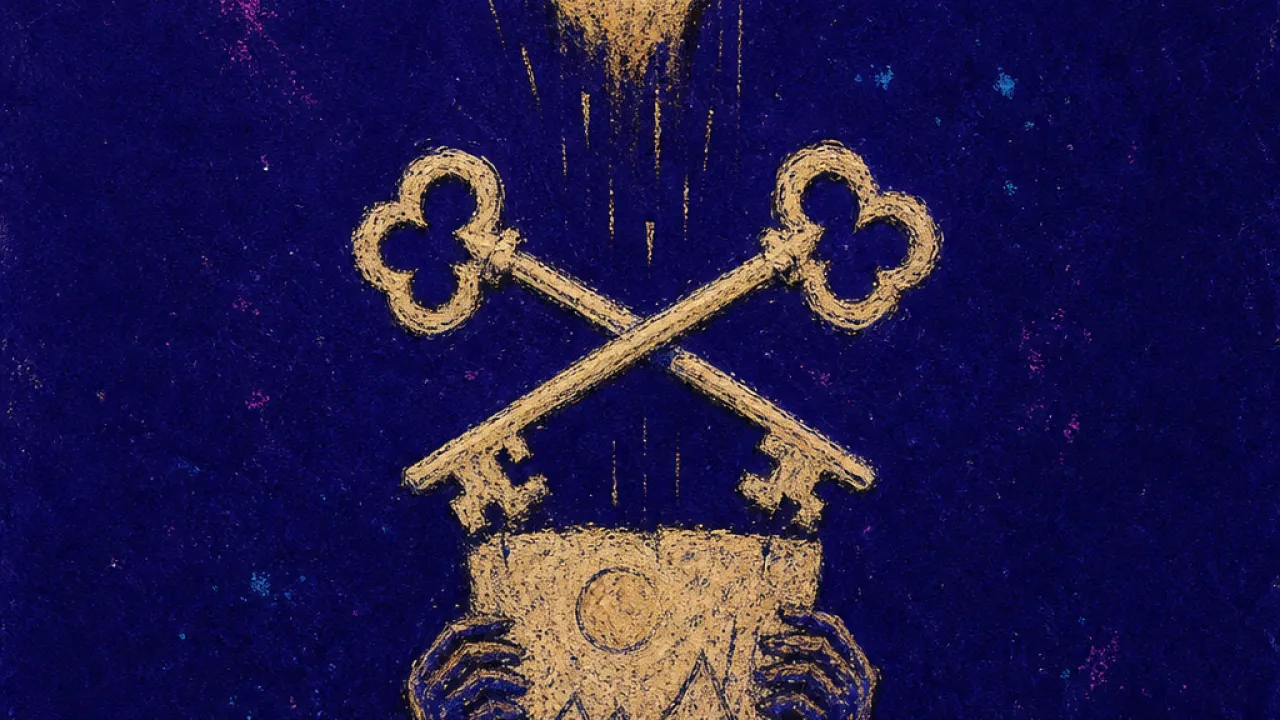
That moment when guidance, feedback, and access all seem to pass through one senior figure is the core shape of Mentorship Trial. The body often registers it in small, specific ways: shoulders tightening before a meeting, a message rewritten three times, unfinished work carried into a room where feedback and evaluation overlap. This is an environmental, structural dynamic, not a private flaw; the hierarchy around knowledge and opportunity shapes what feels possible. The Tarot Cards below reflect the contours of this kind of tested guidance.
The Hierophant UprightThe Hierophant seated above two listening acolytes turns learning into a visible social arrangement: one figure holds the framework, the others enter through attention, posture, and ritual. The raised hand, staff, temple steps, and crossed keys all point to a growth process that is not self-invented from scratch but received through a structured channel. In personal growth, that structure can be useful precisely because it gives form to vague ambition. You are not just looking for motivation; you are entering a guided container where feedback, sequence, and discipline can turn scattered intention into a real developmental path. The trial sits in the distance between guidance and dependency. The card highlights a mentor relationship that can open a gate, while asking whether the framework is helping you stand taller in your own life or keeping the keys permanently in someone else's hands.
The Lovers UprightThe woman looks upward toward the angel while the man looks toward her, creating a chain of attention rather than a closed pair. The guidance figure is present but distant, with open hands that influence the scene without directly doing the work. That structure mirrors the academic mentor relationship when a tutor, advisor, supervisor, or professor becomes part of the decision field. You may have access to guidance, but the card keeps the bodies separate to show that mentorship only helps when it clarifies your agency instead of replacing it. The garden is supportive, yet not fused. A Mentorship Trial appears when the relationship has potential but still needs to prove whether it can hold honest feedback, intellectual independence, and a clean path forward.
Strength UprightThe woman does not stand above the lion with a weapon; she enters its space with precise contact, a fixed gaze, and a garland that visually links the two bodies. The scene is built around guidance under pressure, where power is being handled through proximity rather than domination. In a personal growth setting, this maps onto the trial of working with a mentor, coach, teacher, or accountability structure. You need enough outside containment to meet the lion directly, but the card also asks whether the container keeps your agency intact or quietly becomes the main source of control.
The Hermit UprightThe elder's lantern is held outward, but the staff remains planted under his own hand. Guidance is visible, contained, and disciplined; it is not a crowd, a broadcast, or a demand for obedience. That makes the Mentorship Trial a fitting outer context for this card. You are not just looking for someone impressive; the structure asks whether another person's light helps you locate your own framework, or whether it keeps your growth dependent on their altitude.
Temperance UprightThe angel’s focused handling of the cups makes the scene feel like a controlled demonstration. The tools are intact, the transfer is visible, and the surrounding space gives the action enough calm to be observed and repeated. In a career context, that structure resembles a mentorship trial: a temporary container where guidance, feedback, or sponsorship might become useful, but only if the exchange actually develops your capacity. The card does not assume that support is automatically valuable; it shows support being tested through a real transfer of skill, judgment, and timing. The shoreline matters because mentorship sits between practice and exposure. You are close enough to the path to move forward, but the learning relationship still has to prove that it can carry you beyond reassurance into usable career leverage.
The Star UprightThe large star does not do the earthly work for the kneeling figure; it gives orientation from above while the hands still manage the vessels below. Guidance is present, but it remains a signal rather than a command. That is the exact structure of an academic mentorship trial. You may be testing whether an advisor, tutor, supervisor, or senior student can help you navigate the field without turning your judgment over to them. The visual hierarchy matters: sky, water, land, and body all have separate roles. The card links to mentorship when support becomes useful as calibration, not as permission to stop reading the terrain yourself.
Ace of Cups UprightThe cloud-borne hand does not seize the cup; it steadies it just enough for the descending offering to reach the vessel. The whole scene depends on support that is present, careful, and limited, with the cup still remaining responsible for receiving and circulating what comes in. In academic life, that structure fits the trial period of working with a supervisor, tutor, TA, mentor, or supportive professor. The guidance may be real, but it only becomes useful when it gives your thinking a stable container rather than turning into another approval checkpoint. The card points to a mentorship field where the key issue is not whether help exists, but whether help can be translated into learning movement. You may be testing whether feedback, encouragement, or office-hour access can actually stabilize your next draft, topic choice, or study system.
Two of Cups UprightThe caduceus rising between the two cups places negotiation, repair, and structured exchange at the center of the image. The figures do not simply admire each other; they meet across a symbolic framework that gives the relationship rules, courage, and a shared language. In a mentorship context, that central staff becomes the question of whether guidance can clarify your growth path without overruling your judgment. The forward step shows readiness to engage, while the stable receiving posture shows the need for feedback that can hold pressure without becoming control. The clear horizon and distant town suggest that this exchange should lead somewhere practical. You are testing whether the mentor, coach, teacher, or experienced peer can help translate aspiration into a more stable personal system, rather than keeping You dependent on their approval.
Four of Cups UprightThe hand emerging from the cloud presents a cup from outside the figure's self-contained posture. The offer is close, elevated, and distinct from the three cups already on the ground, making the scene a visible exchange between an external source and a person who has not yet committed to receiving it. At work, that exchange can resemble a mentorship trial, sponsorship opening, recruiter conversation, or senior colleague extending access. The value of the offer depends on whether it can move from symbolic encouragement into usable guidance, visibility, or protection inside the career structure. The seated figure's non-reaction is important because not every offer of help deserves instant acceptance. The card asks you to inspect the channel itself: who is offering, what they can actually transfer, and whether this support connects to the professional path you are trying to build.
Six of Cups UprightThe extended hand, the intact cup, and the blooming flowers create a scene of transfer: something useful is being passed from one person to another without force. In career terms, this is the physical shape of mentorship before it proves itself, when advice, access, and feedback are offered but not yet tested by outcomes. The older figure in the distance adds a second layer. Experience exists in the background, but it does not automatically become sponsorship, advocacy, or skill development. The visible exchange has to cross from kindness into concrete professional movement. You can read this card as a trial of support quality. The structure is asking whether the person offering guidance can help you become more capable and visible, or whether the relationship stays in the safe glow of encouragement without changing your position.
Page of Cups UprightStanding with the cup lifted to shoulder height, the Page holds a delicate object as if it is both an assignment and a lesson. The fish emerging from the cup turns the tool in his hand into a live feedback channel, so the scene is not mastery; it is supervised learning around a signal that can still surprise him. In a career setting, this becomes the structure of a mentorship trial: your developing skill is visible, but it is still being read through someone else's response. You are not outside the system or fully established inside it; you are in the training threshold where guidance, evaluation, and approval share the same container.
Queen of Cups UprightThe Queen holds a cup decorated with small winged figures, while the throne around her repeats images of care, guidance, and symbolic mediation. She is not standing in a crowd; she is seated behind a boundary, close enough to the other shore for contact but still protected by water and wall. In academic life, this becomes the delicate stage where support from a mentor, tutor, supervisor, or trusted instructor could matter, but only if the exchange has the right shape. The scene shows care with boundaries, not unlimited access or automatic rescue. Mentorship Trial names the period where you test whether an academic relationship can hold uncertainty without taking over your agency. The card points to a supportive channel that may help you interpret the work, while still requiring you to keep ownership of the cup in your own hands.
King of Cups UprightThe king holds a cup in one hand and a scepter in the other, making care and authority visible as two separate tools. His throne is centered in unstable water, so guidance is shown as a regulated presence inside complexity rather than a simple answer from above. This fits the moment when a mentor, coach, elder peer, or emotionally steady guide enters a personal growth process. You are not just choosing whether someone is impressive; the deeper question is whether their container helps you hear yourself more clearly without handing over your agency. The fish pendant and shell throne keep the guidance tied to depth, not performance. The trial is to distinguish support that strengthens your own navigation from support that quietly makes the guide the center of your development.
Ace of Pentacles UprightThe hand emerging from the cloud holds the pentacle like an offer that has to be received carefully, not swallowed whole. Below it, the garden gate shows that access comes through a threshold, not through dependence on whoever opens the door. In study, that makes mentorship a trial of usable support: a professor, tutor, advisor, or TA may provide the coin, but the academic path still has to be walked by you. The card's structure separates guidance from surrender, allowing help to become scaffolding rather than another authority bottleneck.
Three of Pentacles UprightThe craftsperson standing on a workbench with a hammer in hand is not alone with the pillar; two figures face him, and one holds the plan that keeps the work connected to the larger build. That arrangement turns personal growth into a supervised workshop. Your unfinished skill is visible, the standard is externalized in the blueprint, and feedback becomes part of the material process rather than an interruption to it. Mentorship Trial fits because the card shows growth happening through role clarity and calibrated outside input. The useful pressure is not blind obedience to an authority figure; it is the chance to test which guidance sharpens your craft and which commentary simply pulls you away from your own hand on the tool.
Six of Pentacles UprightThe scales held in one hand and the coins released from the other create a visible scene of guided distribution. The figure at the center has resources, judgment, and timing, while the people below gain access only when the exchange becomes concrete. In personal growth, this is the structure of a mentorship trial: You are not just absorbing advice, you are testing whether another person's framework can help you build your own. The card connects to this context because support is present, but it is measured, relational, and dependent on how clearly the roles around giving, receiving, and acting are held.
Ten of Pentacles UprightThe elder seated at the threshold, the dogs approaching, and the couple conversing under the arch show knowledge moving through recognized contact. The scene is not solitary achievement; it is structured transmission across age, experience, and social position. In academic life, this is the moment when an advisor, supervisor, tutor, or senior peer can become more than a name on a page. The trial is learning how to receive guidance without surrendering ownership of the work, and how to turn feedback into a system rather than a verdict. The card grounds mentorship in practical exchange. You are looking at a support relationship that can stabilize the study path when the roles, expectations, and channels of communication are made explicit.
Page of Pentacles UprightThe young figure raises the pentacle carefully at eye level, not as a finished owner of wealth but as someone presenting value for inspection. The hands, gaze, and posture all organize around a small material symbol, creating the visual structure of a learner whose competence must become visible before trust expands. In a career setting, that image maps cleanly onto the trial period around mentorship, supervision, or early sponsorship. You may have access to guidance, but the relationship is still conditional: your work has to be concrete enough to hold, examine, and show. The card frames this stage as a real external container rather than a personal inadequacy. The leverage point is not blind obedience to a senior person, but noticing what kind of proof the environment is actually asking you to produce before it opens the next gate.
Queen of Pentacles UprightThe queen’s throne gives her a recognized position, but the pentacle in her hands keeps the authority grounded in something concrete. She is not floating above the material world; she is seated inside it, holding the object that needs care, evaluation, and development. That visual structure fits the academic test of mentorship. A tutor, advisor, supervisor, or senior student can provide real containment only when the shared object is clear: the essay, method, research question, exam plan, or body of knowledge that both people can look at together. This context asks whether the hierarchy around your learning is becoming usable support or remaining symbolic authority. The card makes the exchange visible: guidance has value when it helps you handle the pentacle more steadily, not when it simply confirms that someone else sits higher in the academic landscape.
King of Pentacles UprightThe seated king holds the scepter without strain while the pentacle rests within reach, making authority appear practical rather than abstract. For study, this visual pattern points to guidance that can translate broad academic ambition into concrete standards, feedback, and pacing. You are standing near a figure or system that can offer structure, but the trial is whether that structure actually teaches you how to produce stronger work. The card frames mentorship as a working relationship that must prove its usefulness through clear expectations and grounded feedback.
Six of Swords UprightThe ferryman stands behind the passengers with one foot set forward, one foot braced back, and a long oar reaching into the water. The movement depends on guidance, but the passengers still occupy the crossing; the rower supports the passage without becoming the destination. In personal growth, that arrangement mirrors a real test of external structure: a mentor, coach, teacher, or accountability partner can help translate intent into movement. You are not outsourcing your evolution; the card shows a support role being evaluated by whether it creates actual forward motion across a difficult threshold.
King of Wands UprightThe planted wand, lion emblems, and live salamander create a chain between authority, environment, and active transformation. The figure does not merely possess status; his command has to touch the ground and prove that it can produce movement. In study, this becomes the trial of mentorship: a professor, advisor, tutor, or senior academic figure may offer force, vision, and pressure, but the question is whether that influence gives your work usable traction. You are reading the difference between guidance that expands capacity and authority that only performs expertise.
No cards available for this filter.