When Holding On Holds You Back
See why staying attached can freeze change, which Tarot cards mirror the bind, and what surfaced across related readings.

Permanence-attachment Bind
What does this feel like?
Permanence-Attachment Bind is the point where keeping a person, place, role, or imagined future unchanged starts to feel inseparable from keeping yourself intact. You notice it on a quiet Sunday when you open a drawer for a charger and find an old ticket, a spare key, or a note in handwriting you recognize instantly. Your fingers stop over it; your shoulders lift, and your breath turns shallow. For a few seconds, the room seems to organize itself around that small object, and the question you have been keeping at a distance returns: if this changes, what happens to the version of your life built around it? You can see what is different now in the conversations that circle, the plans repeatedly postponed, the friendship held together mostly by history, or the path that still looks right on paper but no longer fits when you picture another year inside it. Yet release does not feel like a clean decision. It feels as though moving forward might demote the past, turn promises into wasted time, or make something meaningful look temporary. So you preserve dates, objects, routines, titles, and possibilities, even while part of you watches the present becoming smaller around them. When someone asks what you want, you say, 'I don't know,' because the full answer contains two things at once: you want room to move, and you want proof that what mattered cannot simply disappear. Your jaw tightens when you imagine an ending; your chest feels braced when you imagine staying. The cost is a life that keeps narrowing around what you do not yet feel able to let change, with the present made to wait so the past can remain untouched, much like the figure on the Four of Pentacles, seated with the city behind them, one coin held against the chest and two beneath the feet, holding everything so carefully that no hand remains open for movement.
What's pulling at you?
You are trying to protect two things that cannot both stay untouched: the continuity that tells you something mattered, and the freedom to respond to what is different now. Letting the bond change can feel like erasing its meaning, while keeping it exactly as it was asks your present life to stop moving.
How It Shows Up?
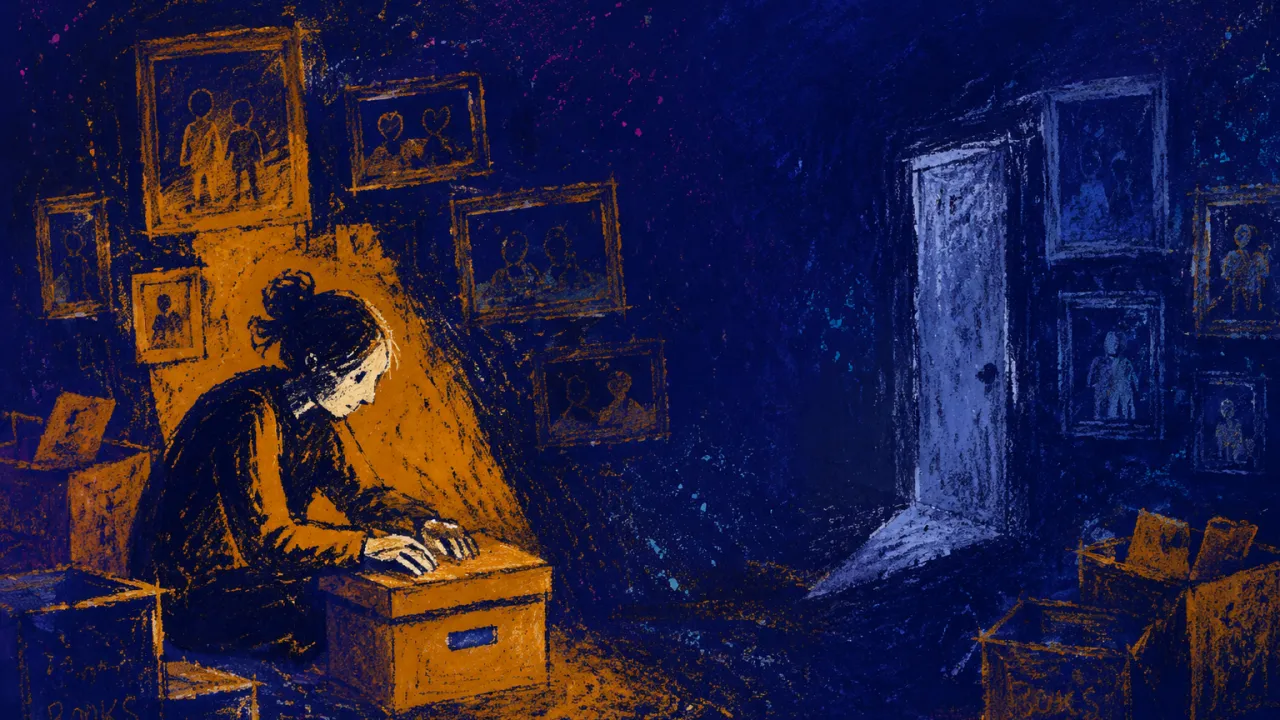
- On a Saturday afternoon, you open the closet for a charger and find the half-packed moving box you have been avoiding: framed photos, ticket stubs, a spare key, all arranged as if their order can keep an earlier life in place. You sit on the floor and lift one item, then another, while your palm goes cool and your shoulders creep upward. The box is not heavy, but your chest feels braced as you rest both hands on the lid, caught between clearing space and preserving every trace. You can close the box for today without deciding what any of it must mean.
- At dinner, a partner or close friend says, 'Maybe things need to change,' and your fork stops halfway to the plate. You ask what they mean in practical terms, but the words sound far away as your stomach drops, your jaw firms, and your breath moves higher in your chest. Part of you wants the honest conversation; another part wants the table, the routine, and the version of the relationship from ten minutes ago restored before dessert arrives. The plates sit untouched while the moment seems to hover. The pause is allowed to remain a pause tonight; it does not have to become a verdict before the meal ends.
- You have an email open asking to transfer off a project you once fought to join. The team name in your signature, the bookmarked launch plan, and the recurring meetings in your calendar make the cursor feel heavier than it should. Your hand stays on the trackpad while your shoulders pull toward your ears, and you think, 'If I leave now, what were those years for?' You reread the same three lines until the words flatten into shapes. The draft can remain unsent for the evening; certainty does not have to be manufactured while your body is braced.
- At a group dinner, one friend announces that they are moving to another city, and everyone starts trading memories and promises about visits. You smile at the right moments, but your fingers press into the condensation on your glass and a quiet pressure gathers behind your ribs. When an old group photo is passed around, it carries the Six of Cups feeling of everyone held in an earlier season, before routes began to diverge. You hear yourself wondering whether change in one friendship means the whole group is already slipping away. You can take in the news without deciding tonight what it means for every bond at the table.
- At 1:17 a.m., you search an old chat for one practical detail and keep scrolling long after you find it. The timestamps turn into a private calendar of who you were together; your eyes sting, the phone warms both palms, and your shoulders curl toward the small light. You stop on a message that once sounded permanent and read it again, as if the same words might still secure the future they described. When the screen dims, your chest feels tight and your thumb wakes it again. Putting the phone face-down is allowed to be only a pause; it does not require deleting the thread or defining the entire bond.
Permanence-attachment Bind in Tarot Cards
Permanence-Attachment Bind lives in the deadlock between needing continuity as proof that something mattered and needing enough freedom to meet what has changed. At the memory box, your shoulders lift and both hands stay flat on the lid. Through an existential lens, its structural framework is a life narrowing around what feels as though it must remain untouched. The Tarot Cards below mirror the visible contours of that bind.
Permanence-attachment Bind in Tarot Card Reading Insights
When preserving a bond, role, or future makes the present wait, others have carried that same bind into a card reading. The Tarot Reading Insights below gather what surfaced in those sessions.

A Charger Moved Between Bags, Then One Tray Became a Return Point
Topic:Lifestyle Tarot Reading
Struggle:Stagnation Lock
Context:Unstable Home Environment
A Vague Reply, a Kept Dinner: Letting the Slow Fade Speak for Itself
Topic:Love Tarot Reading
Struggle:Reciprocity Deficit

When Every Family Fight Feels Final: Making the Next Step Reversible
Topic:Direction Tarot Reading
Struggle:Binary Choice Lock
Context:Family Boundary Negotiation

Three City Tabs and an Unanswered Lease: Learning to Test a Base
Topic:Direction Tarot Reading
Struggle:Freedom-Structure Conflict
Context:Digital Nomad Rootlessness

An Unopened Books Box—And a 30-Minute Homecoming Shift Now
Topic:Lifestyle Tarot Reading
Struggle:Freedom-Structure Conflict
Context:Career Transition Fog

Hanging One Print: From Keeping Life Packed to Inhabiting the Week
Topic:Timing Tarot Reading
Struggle:Meaning-Collapse Split
Context:Permanent Temporary Mode

From Uneasy Suspension to Grounded Belonging: One Corner at a Time
Topic:Lifestyle Tarot Reading
Struggle:Manifestation Gap
Context:Scarcity Lifestyle Lock-In
Apartment Listings Hid a Local Class Until Saturday Took Shape
Topic:Introspection Tarot Reading
Struggle:Evidence Disconnection
Context:Community Integration Trial

A Holiday Plan Changed, Then a Loyalty Test Became an Honest Ask
Topic:Friendship Tarot Reading
Struggle:Clarity-Exposure Split
Context:Direct Communication Trial