The 11:47 p.m. Slow-Fade Spiral
I know the particular split screen Jordan was living inside: by daylight, she could calm a client during a campaign crisis, rewrite a brief between meetings, and chase three departments for an answer without taking any of it personally. By 11:47 p.m., one unanswered WhatsApp message could swallow her entire evening.
On the Tuesday she described to me, she was lying in bed in her shared London flat with the same thread open again. Rain tapped the window; the charging cable pressed a hard line into her wrist; the blue-white screen made her eyes ache. She deleted a carefully composed follow-up for the third time, checked whether the person had viewed her Instagram Story, and finally sent a meme so she could make contact without naming what she wanted.
“I know they are fading,” she told me. “But if I stop texting first, I might never hear from them again.”
That was the conflict beneath every draft. Jordan wanted someone whose participation was decreasing to remain emotionally close, yet stopping the chase felt less like accepting information and more like helping the disappearance become final. She knew what was happening, but she still searched the old messages for proof that the earlier closeness could return. She knew the plans were vague, but she still kept Friday partially open. She knew a Story view was not a conversation, but she still let it calm her for a few minutes.
I could see the shame in the way she minimised the behaviour, calling it “just checking” while rubbing her thumb against the edge of her phone. The attachment anxiety sat beneath her ribs like a trapped notification that would not stop vibrating: tight chest, falling stomach, restless hands, and the conviction that one more message might turn the alarm off.
“I keep calling it patience,” she said, looking away from the screen, “when I am really waiting for proof that I matter.”
I told her I was not there to shame her tenderness or declare what the other person secretly felt. I wanted us to separate three things that had become tangled together: what Jordan wanted, what the other person was observably offering, and what the silence had begun to mean about Jordan's worth. I said, “Let us give this fog a map. Not so the cards can make the choice for you, but so you can see what your nervous system has been trying to solve through contact.”

Choosing a Compass for Mixed Signals
I invited Jordan to place both feet on the floor and take one slower breath before focusing on her question: “Why do I keep chasing someone who slowly fades?” I shuffled while she breathed. I treat this small ritual as a transition for attention, not a performance of mystery; it gives the mind a moment to stop refreshing the same internal thread.
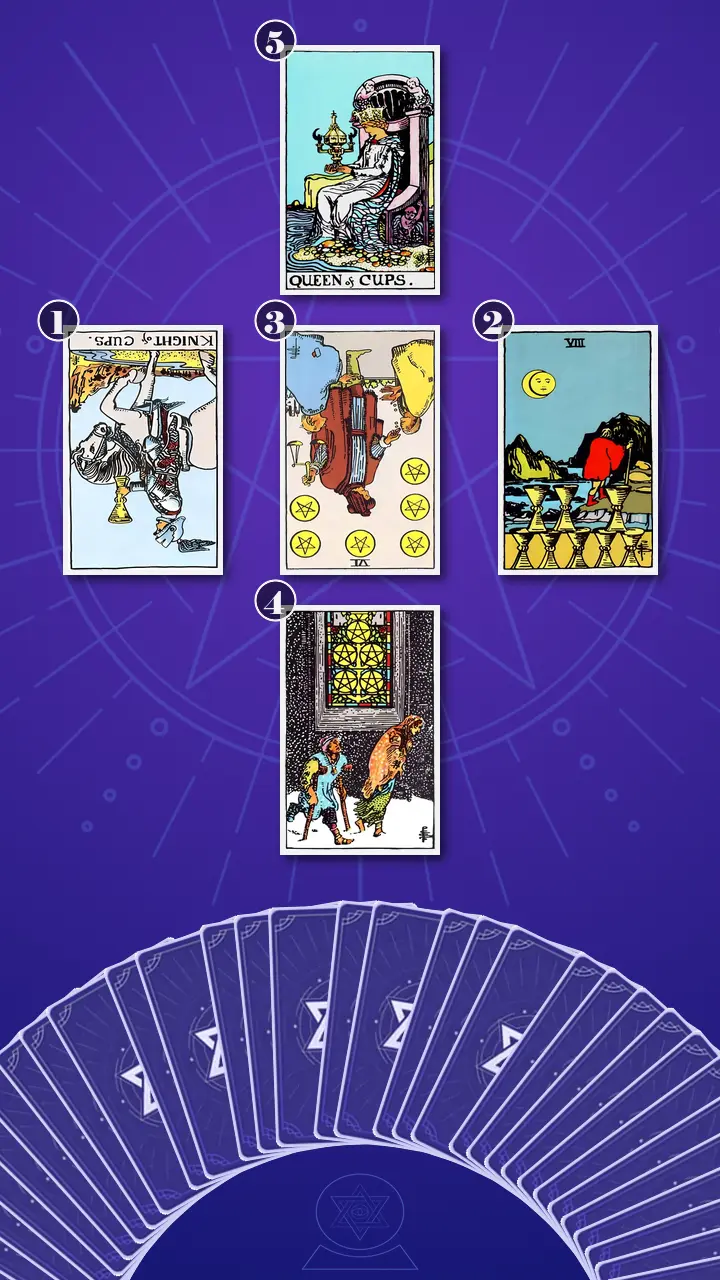
I chose the Relationship Spread · Context Edition, a five-card spread designed to examine a connection without pretending that tarot grants access to another person's private motives. To me, this is how tarot works responsibly: the cards organise attention, reveal patterns, and help a querent test an interpretation against observable life.
I chose this spread because Jordan's question contained both a relationship dynamic and a self-reinforcing attachment loop. Five positions were sufficient. The first would show what she did when uncertainty appeared. The second would examine the other person's visible participation through replies, plans, and follow-through. The centre would reveal the exchange between them. Beneath it, a fourth card would expose the wound making inconsistency feel dangerous. Above it, the final card would offer a self-directed way forward.
I placed the centre card first, then set Jordan's card to the left and the other person's card to the right. I placed the underlying challenge below and the guidance above. The shape resembled a balance suspended over a buried root, with a compass held over the centre. I explained that we would read across the visible chase and withdrawal, descend into what fuelled the pattern, and then rise toward emotional self-possession.
Reading What the Message Thread Was Already Saying
Position One: The Cup Disguised as a Meme
I began with the position revealing Jordan's observable chasing behaviour: the emotional offers, extra flexibility, and increased effort she contributed whenever contact decreased. I turned over The Knight of Cups, in reversed position.
I pointed to the cup extended ahead of the rider and the horse stepping carefully across a dry landscape. In Jordan's life, that cup was the second message being edited to look effortless: first a paragraph, then a joke, then a meme. At 11:47 p.m., she had already sent one honest message, but refining another offer felt more controllable than waiting to discover whether the other person would move toward her without prompting.
The Knight's Water energy was not wrong; Jordan's wish for closeness was sincere. The distortion came through Excess and Blockage. Too much feeling was being pushed into outward motion, while too little space remained for receiving information. Romantic initiative had quietly become a reassurance task. Her account-manager instinct assumed that uncertainty could be solved with a better follow-up, as if the connection were a client project stalled because nobody had sent the right email.
I gave voice to the thought hidden inside the reversed Knight: “If I can make this warm enough, casual enough, and undemanding enough, maybe the earlier closeness will come back.” Then I asked Jordan what she had hoped the meme would make her feel for the next ten minutes.
She gave a short, bitter laugh. “Less forgettable. That is horribly accurate.” Her fingers tightened around her mug, then loosened. I told her the accuracy was not an accusation. The card was distinguishing honest desire from strategic self-editing, and caring from carrying the entire forward movement of a connection.
“You are not foolish for caring,” I said. “You are exhausted from carrying the evidence for both sides.”
Position Two: The Cups That Still Mattered
I moved to the position identifying the observable signs of fading contact without assigning motives to the person behind them. I turned over The Eight of Cups, upright.
The figure's back was turned, but the cups remained standing. I wanted Jordan to notice both facts. The earlier closeness did not have to be fake for the current movement to be away from regular participation. The thread still held warm messages from three weeks earlier, yet the reply cadence had stretched from hours to days, weekend plans remained “maybe,” and the other person was no longer reliably initiating or confirming anything.
I told Jordan that the upright Eight carried active withdrawal energy. I did not call it a prophecy, a moral judgment, or proof of why the person was stepping back. It was simply a card of movement, and the visible movement in her situation was reduced participation. The blockage appeared when Jordan used the emotional history of the connection to overrule its present direction.
Years of travelling had taught me how easily people confuse delay with destination. I remembered standing beneath a departure board and watching travellers invent explanations before any announcement had been made. A delay notice could not tell me the cause, but it did tell me not to behave as though the train were on time. Jordan's unanswered message worked the same way: it did not reveal a hidden motive, but it did describe what was available now.
“What have they initiated or confirmed in the last two weeks without you prompting them?” I asked.
Jordan stared at the card. Her eyes moved as though she were scrolling through the thread from memory. “They replied. They did not really initiate anything.”
I nodded. That distinction was painful, but clean. Memory could honour what had existed; it could not substitute for current participation.
Position Three: When Relief Pretends to Be Reciprocity
I turned to the central position, the card exposing the pursuit-withdrawal loop and testing whether initiation, emotional labour, and availability were being exchanged reciprocally. I revealed The Six of Pentacles, in reversed position.
I asked Jordan to look at the scales above the exchange and the unequal distribution beneath them. She recognised the scene immediately. She proposed the date, offered three neighbourhoods, worked around the other person's schedule, remembered their difficult week, and kept her own need for consistency out of the conversation. When a short reply eventually arrived, the relief felt valuable enough to justify another round of effort.
She described standing outside the agency lift at 6:18 p.m., thirty hours into the silence, when a two-line message appeared. The fluorescent lights buzzed and burnt coffee lingered in the corridor. Her shoulders dropped before she had even read the message properly. It contained no question and confirmed no weekend plan, yet her body had already interpreted the notification as repayment.
“They replied, so maybe the imbalance was only in my head,” I said, reflecting the loop back to her.
The Six of Pentacles reversed showed distorted Earth energy: the exchange could be measured, but it was not balanced. Jordan's attention had become like an algorithm trained on intermittent rewards. One unpredictable reply taught her to keep refreshing through long periods of uncertainty. She counted response times and Story views, but the analysis obscured the simpler question of who consistently followed through.
A reply can relieve the fear without repairing the imbalance.
Jordan's breath caught. She looked toward the window, then back at the scales. I watched the recognition arrive in stages: first the stillness of someone resisting a conclusion, then a tiny crease between her brows as she replayed the lift scene, and finally a slow exhale that lowered her shoulders.
I told her that the card was not asking her to put the other person on trial. It was asking her to stop accepting relief as settlement. The useful measure was not how emotionally significant each reply felt, but whether there was mutual initiation, confirmed planning, returned care, and dependable follow-through.
Position Four: The Locked Door That Became the Whole City
I descended to the position revealing the core nurture deficit: the fear of being left outside care that made inconsistent contact feel like a threat to personal worth. I turned over The Five of Pentacles, upright.
The Earth sequence had moved backwards from Six to Five. First there was a measurable imbalance; then the imbalance collapsed into an experience of scarcity. “They are not meeting me halfway” became “No one stays unless I work for it.” A relationship problem became a worth problem.
I drew Jordan's attention to the two figures moving through snow beneath an illuminated window. She told me about the previous Sunday, when she had sat at the kitchen table while her flatmate cooked. Garlic and hot oil filled the room, the extractor fan rattled, and a close friend's voice note waited in another chat. Jordan saw the person active on Instagram while her direct message remained unanswered. Her jaw locked, her stomach dropped, and every available source of warmth disappeared behind one green activity dot.
“I can see other care,” I said, giving shape to the feeling, “but I cannot feel it while this door is closed.”
The Five showed Deficiency: not necessarily an objective absence of all care, but a nervous system organised around the least available source. I used my Shadow Projection Analysis carefully here. I did not want to dismiss the actual slow fade or tell Jordan it existed only in her head. Instead, I asked which older fear had attached itself to the present facts and made one person's limited participation seem like a global verdict.
“When the message stays unanswered, what sentence does your mind add?” I asked. “Not the fact. The sentence beneath it.”
Jordan stopped rubbing the mug. Her fingers hovered, her gaze lost focus, and I could almost see the memories rearranging behind her eyes. Then she said, very quietly, “People leave when I stop being useful.” The words seemed to surprise her. Her mouth tightened before a deeper breath moved through her chest.
I told her that projection did not mean she had imagined the other person's withdrawal. It meant the current silence was being asked to carry an older story about usefulness, belonging, and being chosen. The observable fact was limited participation. The shadow narrative was that limited participation proved she was disposable.
Silence is information about participation, not a verdict on your worth.
I let the room stay quiet. A car moved through the wet street below, its tyres making a soft hiss that faded instead of demanding pursuit. Jordan looked back at the illuminated window in the card and said, “I think I have been trying to get back inside a room that may not actually be offering me a seat.”
When the Queen Held the Cup Still
Position Five: Care With a Shoreline
I reached the final position, the card offering the key transformation: emotionally attuned self-care, one clear expression of need, and investment guided by reciprocal behaviour. The room seemed to settle as I turned over The Queen of Cups, upright.
I pointed to the ornate lidded cup held securely in both hands and the throne placed at the water's edge. The Queen did not drain the sea, deny its force, or let it carry her away. Her Water energy was in Balance: feeling remained deep, but it had a vessel, a shoreline, and a standard for access.
In Jordan's life, this looked like opening Notes in a cafe near London Fields and writing, “I enjoy seeing you, and I am looking for plans and communication that are more consistent.” It meant deciding whether to send that need once, without an apology, a meme, or a softer second message, and then protecting the rest of her evening while observing what the person actually did.
I could see Jordan still caught in the old equation: if she did not keep moving the connection forward, its disappearance would become her fault. The Queen challenged that equation without asking her to become colder. She could want closeness and still stop making every feeling an instruction to pursue.
Then I gave her the sentence at the centre of the reading:
You are not required to keep pouring your cup toward someone walking away; hold it as the Queen does and offer it where care is met with care.
I left a pause around the words before making the shift even plainer:
You do not have to earn consistent care by pursuing inconsistent contact; make one clear bid, then let follow-through tell you what your fear cannot.
Jordan's first response was not relief. Her back straightened and colour rose across her cheeks. “But does that mean I have handled all of this wrong?” she asked. “Does it mean I made the connection happen by myself?”
I told her no. It meant her strategy had once offered short-term protection from uncertainty. It had produced contact, but contact was not the same as mutual commitment. Her care had been real, the earlier closeness could have been real, and the imbalance could still be real now. Clarity did not require her to rewrite the whole connection as a lie.
I used my Attachment Loop Diagnosis as a simple map rather than a clinical label. I traced four points with my finger: visible withdrawal triggered the fear of being forgotten; fear produced another rescue message; any reply delivered brief bodily relief; that relief encouraged more investment while revealing little about reciprocity. The Queen interrupted the loop between feeling and action. She made room for longing to exist without immediately turning it into another bid.
Jordan's breath stopped for a beat, and her hand remained suspended above the Queen as if touching the card might make the conclusion final. Her gaze drifted past me while she replayed the unanswered messages, the lift notification, and the vague Friday plan. Then her expression changed: her eyes widened, filled slightly, and narrowed again with the effort of staying composed. Her shoulders lowered first. Her clenched fingers opened next. Finally, a shaky breath left her, carrying both relief and grief. I could see the lightness unsettle her; without the chase, there was suddenly empty space and the responsibility of deciding what she would accept. “Oh,” she said. “I have been treating the next message as proof that I did not imagine being wanted.”
I asked, “Now, with this new perspective, think back: was there a moment last week when this insight could have made you feel differently?”
Jordan remembered being on the Overground when the person wrote, “might be around later, will let you know.” She had nearly abandoned a confirmed evening with friends for the possibility of access. “I could have read it as an unconfirmed plan,” she said, “instead of a test of whether I cared enough to stay available.”
That was the first real movement from urgent, ashamed pursuit toward steadier self-respect. Jordan was not promising never to feel the stomach drop again. She was learning to hold longing with emotional self-attunement and let reciprocal care, rather than temporary relief, guide her investment.
“The goal is not to care less,” I told her. “It is to stop making care audition for a place to land.”
The Cup-and-Shoreline Plan
I gathered the five cards into one coherent story. Jordan had met the connection with genuine romantic openness, but she had imported a work habit into dating: when communication became unclear, she followed up harder. The other person's present participation had visibly decreased, even though the earlier connection still mattered. At the centre, intermittent attention was being exchanged for Jordan's sustained initiation, flexibility, and emotional labour. Beneath that imbalance sat a deeper fear that being left outside one connection meant being outside care itself. Above it, the Queen offered the resource Jordan had not yet trusted: the ability to hold a feeling before obeying it.
The spread's cup sequence made the transformation visible. The reversed Knight pushed one cup down the road. The Eight showed cups being left behind. The Queen held a single cup securely. Jordan did not need to throw her tenderness after a departing figure. She needed to change who was responsible for containing and valuing it.
I named her cognitive blind spot directly: she had been treating reduced pursuit as the cause of disappearance, rather than allowing reduced participation to reveal the current condition of the relationship. She had also confused physical relief with evidence of repair. Once those two things separated, the transformation direction became practical: make one direct invitation, tolerate the space that follows, and evaluate the connection through mutual follow-through.
“One clear bid is communication,” I said. “Repeated rescue attempts are unpaid emotional labour.”
Jordan frowned at the idea of a full-day pause. “I honestly do not think I can do twenty-four hours without checking or explaining something,” she said.
I adjusted the plan. A boundary that is too large to practise becomes another standard to fail. We agreed that her first experiment could last two hours, with no requirement to feel calm during it.
- Make One Clear Bid If Jordan chose to contact the person that week, she would send one specific invitation or need: a clear day, time, or request for more consistent planning. Any follow-up would go into a Notes file titled “Not for sending tonight” for at least two hours, building toward twenty-four only if the shorter pause felt manageable. The pause was not a test designed to provoke a response. It was a boundary around Jordan's attention. One draft, one slower breath, and two hours counted as the complete first version.
- Use the Projection Detachment Exercise For ten minutes in daylight, Jordan would create two sections in Notes. Under “Observable behaviour,” she would record only who initiated, what plan was proposed, what was confirmed, and what was followed through on during the previous two weeks. Under “Triggered narrative,” she would write the meaning her fear added, such as “I am forgettable.” She would finish with one reciprocity standard: “Plans count when both people help confirm a time and place.” The exercise was private information for her choices, not a prosecution case. If tracking every message increased compulsive checking, she would record plans only and return to one question: “Did they follow through?”
I asked Jordan to place both feet on the floor once more and name three facts: “I sent a message. I do not have a reply. I do not know more than that yet.” The facts did not erase longing, and they were never meant to. They created a small distance between the person's actual behaviour and the shadow story that silence had already decided Jordan's worth.

A Week Later: The Quiet Proof
Six days later, Jordan sent me a short message. She had made one clear invitation. The reply was warm but vague, and for the first time she did not send a second message to rescue the plan. She kept the dinner she had already arranged with friends and left her phone in her bag through most of it.
She slept through the night, but her first thought in the morning was still, “What if I handled this wrong?” This time, she noticed the thought, gave a small laugh, and made coffee before opening WhatsApp.
I did not see that as a perfect ending. I saw it as evidence. Jordan had not solved every attachment wound, stopped wanting the person, or forced the connection into a neat conclusion. She had allowed a response to describe the other person's participation without letting it define the whole city of care available to her.
That is the Journey to Clarity I trust the Relationship Spread · Context Edition to support. The cards did not command Jordan to stay, leave, block, wait, or become indifferent. They helped her see the chase, the imbalance, the scarcity story, and the capacity she already possessed to choose her next step with steadier self-respect.
Many of us know the tight-chested moment when putting the phone down feels less like ending a chase and more like helping someone disappear, as though their silence could finally decide whether we were worth choosing. I think of the Queen's shoreline then: feeling is allowed to arrive in full, but it does not receive automatic access to every hour, plan, or boundary.
If their next response were allowed to be information rather than a score of your worth, what small part of your attention would you choose to hold inside your own cup?
This story is adapted from psychological research, written so that those in a similar struggle can see their own pattern in it — and find their next step clearly.These insights are not a substitute for professional psychological, medical, legal, or financial advice.
Learn more about our Journey to Clarity.
How did this insight land for you?
🫂 This Resonates Deeply
🌀 Living This Story
✨ Now I See Clearly
🌱 Seeing New Possibilities
🧰 Useful Framework
🔮 The Confirmation I Needed
💪 Feeling Empowered
🚀 Ready for My Next Step
Author Profile
 AI
AI“Having traveled across cultures... I've learned that what we often lack isn't a simple answer, but a moment of being truly understood. I use a Jungian psychological lens to help you deconstruct your subconscious patterns—not to prove anything, but to be the gentle companion who helps you unravel your knots, free of judgment, so you can reconnect with your inner wisdom.”
In this Love Tarot Reading :
Core Expertise
- Attachment Loop Diagnosis: Logically decoding whether your relationship friction is driven by an anxious-avoidant trap or deep-seated insecurity.
- Shadow Projection Analysis: Identifying the unacknowledged fears or unmet childhood needs you are unconsciously projecting onto your partner.
Service Features
- The Projection Detachment Exercise: A structured psychological journaling prompt to separate your partner's actual behavior from your triggered internal narrative.
Also specializes in :
Explore Related Patterns:
Anxious AttachmentJordan can manage campaign crises without taking them personally, yet at 11:47 p.m. one unanswered message consumes her evening. She drafts extra follow-ups, checks for a Story view, and fears that stopping the chase will make the disappearance final. When you experience reduced contact this way, uncertainty is processed as a threat to the bond rather than as neutral space. The chase is therefore doing more than expressing interest. It is trying to regulate the fear of being forgotten by creating another opportunity for contact. Because any reply briefly quiets that alarm, you can feel compelled to pursue again even when the broader pattern still shows decreasing participation.
Intermittent ReinforcementAfter thirty hours of silence, Jordan's shoulders drop as soon as a two-line message appears, before she has even read it properly. The reply contains no question and confirms no plan, yet the bodily relief feels substantial enough to make the previous imbalance seem less certain. Unpredictable rewards can hold attention more powerfully than dependable ones because the next moment of relief cannot be timed. When you receive occasional warmth amid long uncertainty, your nervous system may learn to keep refreshing, waiting, and investing. The reply relieves the fear, but that relief is not evidence that the exchange has become reciprocal.
Protest BehaviorJordan turns one unanswered honest message into a carefully edited paragraph, then a joke, then a meme that can reach for contact without openly naming her need. She also leaves time available for vague plans. These actions appear casual on the surface, but they are activated specifically when the other person begins to withdraw. When you use extra contact to pull a fading connection back into reach, the behaviour functions as a protest against perceived separation. It offers immediate action in place of helpless waiting, but it can also hide the central question: whether the other person will initiate, clarify, or move toward you without being prompted.
Pursuer DistancerAs the other person's replies stretch from hours to days and their plans remain vague, Jordan increases her initiation, offers more options, and keeps herself available. The resulting contact briefly closes the distance, but Jordan has supplied most of the movement required to close it. In a pursuer-distancer loop, one person's withdrawal intensifies the other's pursuit, and that pursuit can temporarily stabilise an otherwise fading connection. When you repeatedly bridge the gap, you receive contact but lose the information that unfilled space could provide: whether the other person will notice the distance and move toward you on their own.
Usefulness-Based Self-WorthJordan proposes the date, offers several neighbourhoods, works around the other person's schedule, remembers their difficult week, and keeps her own need for consistency out of the conversation. She eventually identifies the belief beneath that effort: "People leave when I stop being useful." When you connect being wanted with being useful, increased effort can feel like protection against abandonment. You may try to earn continuity through flexibility, competence, or emotional labour, then interpret fading contact as proof that you did not provide enough. The pattern makes another person's participation appear dependent on your performance rather than their willingness and capacity to participate.
Personalization BiasJordan sees the person active on Instagram while her direct message remains unanswered, and the closed message thread quickly becomes a statement that she is forgettable or disposable. The observable fact concerns their limited participation, but her mind adds a conclusion about what that participation proves about her. When you personalise a slow fade, another person's behaviour becomes evidence in a trial of your worth. That interpretation intensifies the urge to repair the situation because restoring contact now seems capable of repairing your self-image as well. Separating participation from worth removes a burden the message thread cannot validly resolve.
Boundary DiscernmentJordan gives unsent follow-ups a separate place in Notes, keeps her confirmed dinner instead of waiting for an unconfirmed possibility, and decides that plans count when both people help establish a time and place. Her care remains available, but vague access no longer receives unlimited control over her schedule. When you practise boundary discernment, you distinguish wanting closeness from owing indefinite availability. A boundary does not force the other person to participate differently; it determines how much of your time, attention, and emotional labour you will invest in what they are currently offering. Reciprocity, rather than temporary relief, becomes the guide for access.
Self-AbandonmentJordan keeps Friday partially open for a plan that has not been confirmed and nearly abandons a definite evening with friends after receiving "might be around later." At the same time, she suppresses her need for consistency so that expressing it cannot threaten the remaining contact. When you preserve uncertain access by sidelining your plans, preferences, and voice, the pursuit begins to cost you your own participation in your life. The fading connection receives priority not because it offers the most care, but because it activates the most fear. Self-abandonment occurs when avoiding their possible absence requires you to become less present for yourself.
Reality TestingJordan creates separate Notes sections for observable behaviour and the narrative triggered by that behaviour. She records who initiated, what was confirmed, and what was followed through on, then distinguishes those facts from conclusions such as "I am forgettable." When you keep facts, unknown motives, and self-worth in separate categories, the connection becomes easier to assess without dismissing your feelings. Reality testing does not require pretending the slow fade is harmless. It allows reduced participation to count as real information without expanding it into claims the evidence cannot support.
Uncertainty ToleranceJordan initially says that twenty-four hours without checking or explaining feels impossible, so she begins with a two-hour pause that does not require her to feel calm. Six days later, she receives a warm but vague reply, sends no rescue message, keeps dinner with friends, and makes coffee the next morning before opening WhatsApp. When you tolerate uncertainty, you stop requiring immediate action to remove every uncomfortable possibility. The unanswered question remains, but it no longer receives automatic control over your next message, plan, or hour. This capacity lets follow-through reveal the relationship while you remain present with yourself during the waiting.
Compulsive CheckingJordan reopens the thread, deletes the same follow-up three times, checks whether her Story was viewed, and searches old messages for signs that the earlier closeness might return. Each action promises a small piece of certainty, even though none can establish whether the other person will initiate or follow through. When you check to regulate uncertainty, the ritual may briefly reduce tension while training your attention to return to the same source. The absence of decisive information then creates another urge to check, turning the phone into a short-term soothing device that repeatedly reactivates the question it was meant to settle.
Explore Related Struggles:
Availability-Worth FusionJordan calls the waiting “proof that I matter,” says the meme might make her feel less forgettable, and later recognises that she has treated the next message as proof that she did not imagine being wanted. The other person's availability is no longer functioning only as information about the relationship; it has become a score applied to Jordan herself. When you are caught in this fusion, a delayed reply can expand from one person's limited participation into a global verdict on whether you are worth choosing. That expansion makes pursuit feel necessary because you are not only seeking contact; you are trying to reverse the verdict. Separating the two restores a crucial distinction. Their response can describe what they are offering without being granted authority to define your value.
Permanence-Attachment BindJordan says that if she stops texting first, she may never hear from the person again, and the pause feels less like receiving information than helping the disappearance become final. Her repeated drafts and partially reserved Friday keep the connection moving just enough to postpone the moment when the other person's initiative would have to stand on its own. When you occupy this bind, pursuit carries two jobs at once. It expresses genuine care while also trying to prevent absence from becoming conclusive. Stillness therefore feels causally dangerous, as though your restraint could destroy something that mutual participation should be able to sustain. The deeper struggle is separating your responsibility for making one honest bid from responsibility for whether the bond continues.
Utility-Belonging FusionJordan can chase three departments for an answer at work, and she brings the same skill into the connection when participation becomes unclear. She follows up, adapts the plan, softens the message, and withholds her need for consistency. Her own sentence exposes the rule beneath that labour: “People leave when I stop being useful.” You become trapped between wanting to be chosen freely and trying to make yourself too useful to lose. Every extra accommodation may preserve contact for another moment, but it also prevents you from seeing whether care survives without your management. Belonging then feels earned through performance rather than encountered through mutual desire. The point of releasing that labour is not to become less caring; it is to discover whether connection can meet you when usefulness is no longer the admission price.
Ambiguity-Promise FusionJordan keeps Friday partially open even though the plan is vague, and on the Overground she nearly abandons a confirmed evening with friends after receiving, “might be around later, will let you know.” The wording offers possibility without commitment, yet it is allowed to reserve real space in her schedule. When you fuse ambiguity with promise, an unconfirmed option begins to carry the weight of a future plan. Remaining available can then feel like loyalty to something emerging, while choosing your existing life feels like closing the door too soon. The result is a suspended state in which possibility receives the benefits of commitment without providing its structure. Reading uncertain language at its actual level lets you remain open without handing it automatic access to your time.
Reciprocity DeficitJordan proposes the date, supplies three possible neighbourhoods, works around the other person's schedule, remembers their difficult week, and leaves her own need for consistency unspoken. Across the same period, the other person replies without reliably initiating, confirming plans, or carrying the next part of the exchange. You can care sincerely and still become the only person supplying momentum. The friction appears when your effort keeps producing contact but cannot establish whether the other person will participate without being prompted. You are then caught between preserving something meaningful and allowing the imbalance to become measurable. Reciprocity becomes visible only when your care is no longer required to provide the evidence for both sides.
Relief-Progress FusionOutside the agency lift, Jordan's shoulders drop as soon as a two-line message appears, before she has properly read it. The reply contains no question and confirms no weekend plan, yet her body has already registered it as repayment. A Story view produces a smaller version of the same effect, calming the alarm for a few minutes. When you fuse relief with progress, the end of immediate discomfort can look like evidence that the relationship itself has improved. An unpredictable reply then becomes valuable enough to finance another long round of waiting, flexibility, and pursuit. The distinction that breaks the lock is concrete. Relief tells you that uncertainty paused; progress would require mutual initiation, confirmed plans, returned care, and follow-through.
Then-Now SplitThe message thread still contains warmth from three weeks earlier, while the current reply cadence has stretched from hours to days and weekend plans remain at “maybe.” Jordan searches the earlier messages for evidence that the first version of the connection can return, even as present behaviour points in another direction. You may be holding two valid facts that feel impossible to place beside each other. The earlier closeness may have mattered, and the current withdrawal may still be real. The split forms when memory receives authority over present participation, making new evidence feel like an interruption rather than an update. Clarity does not require you to dismiss the past; it requires the past to stop overruling what is available now.
Monitoring-Safety FusionAt 11:47 p.m., Jordan keeps the thread open, deletes a follow-up for the third time, checks whether the person viewed her Story, and studies old messages. The phone supplies a stream of tiny signals, but none of them answers whether the other person will initiate, make a plan, or participate consistently. When you rely on monitoring for safety, checking feels like staying connected to the situation rather than remaining exposed to uncertainty. Each signal can briefly reduce the distance, yet the repeated observation never creates the dependable access you are looking for. Your attention stays tethered to a dashboard of activity while the central relational question remains untouched. Safety begins to return when observable follow-through, rather than constant visibility, becomes the measure that guides your investment.
Explore Related Emotions:
Cautious Self-RespectJordan sends one clear invitation, receives a warm but vague reply, and does not send a second message to rescue the plan. She keeps dinner with her friends, leaves her phone in her bag, and makes coffee the next morning before opening WhatsApp. You do not need to feel completely secure before treating your time and needs as valuable. Cautious Self-Respect is the tentative steadiness of acting as though your attention deserves protection while the old fear still asks whether you have handled everything wrong.
Fear of Being ForgottenJordan says that if she stops texting first, she might never hear from the person again. You are no longer only waiting to see whether they will initiate; you are trying to prevent yourself from slipping out of their awareness. Each message then becomes a small act of self-preservation, and even a Story view can briefly feel like proof that you still exist in their world. Fear of Being Forgotten captures the pain beneath the chase: the sense that remaining memorable requires continuous effort from you.
Finality DreadStopping the messages feels to Jordan like helping the disappearance become final, so she sends a meme rather than remaining still. You may understand that another person's participation is declining while still feeling that your next action could decide whether the connection survives. That belief makes non-pursuit feel dangerously irreversible. Finality Dread is the inner recoil from allowing silence to stand, because doing nothing seems emotionally equivalent to closing the door yourself and accepting that no future message will restore what existed.
Guarded LongingJordan does not stop wanting the person, and she does not promise that the stomach drop will never return. She allows the earlier closeness and her present tenderness to remain real while declining to translate every wave of longing into another bid for contact. Guarded Longing is not emotional withdrawal or manufactured indifference. It is the feeling of wanting someone while keeping a shoreline around that want, so the depth of your care no longer grants automatic access to your schedule, attention, or standards.
Mutuality HungerJordan initiates, proposes plans, adjusts her availability, and remembers what matters to the other person, while their participation increasingly consists of replies rather than self-directed movement. You may keep chasing because what you want is not simply contact; you want to experience someone choosing to cross the distance without being managed toward you. Mutuality Hunger is the ache for care that arrives with its own energy, not care that appears only after repeated prompting. The irregular reply can briefly feed that hunger, but it cannot satisfy the deeper need to feel met, considered, and actively included.
Need Exposure DreadJordan deletes the carefully composed follow-up three times and finally sends a meme, making contact without naming what she wants. You may find it easier to offer another piece of warmth than to reveal the need underneath it and risk receiving a clear answer. The indirect message protects you from being fully seen, but it also leaves the real question unspoken. Need Exposure Dread names the feeling that asking plainly for consistency would expose too much of your longing, your investment, and your hope of being chosen.
Reassurance CrashThe two-line message appears outside the agency lift, and Jordan's shoulders drop before she has even read it properly. You can feel immediate bodily relief from contact even when the message contains no question, no confirmed plan, and no evidence that the exchange has become more mutual. The relief is real, but it cannot last because the underlying uncertainty remains unchanged. Reassurance Crash describes the return of the alarm after a brief signal settles it, creating the urge to seek another reply rather than assessing whether anything dependable has actually been repaired.
Retroactive Rejection DreadJordan searches old messages for proof that the earlier closeness could return and later realises that she has been treating the next message as proof that she did not imagine being wanted. You are not only trying to recover present contact; you are trying to protect the emotional reality of what happened before. A slow fade can make the past feel unstable, as though current distance might reveal that every earlier sign meant less than you believed. Retroactive Rejection Dread names the fear that losing the connection now will reach backward and invalidate the version of you who once felt genuinely chosen.
Slow Fade DreadThe replies stretch from hours to days, weekend plans remain 'maybe,' and the other person rarely initiates without prompting. You can recognise the direction of the connection while still living inside a series of small delays that never provide a clean ending. That prolonged reduction keeps the loss approaching without allowing it to arrive all at once. Slow Fade Dread names the suspended inner weather of watching someone become less available while each warm fragment keeps the possibility alive for one more evening.
Usefulness-Based Belonging FearJordan proposes the date, offers three neighbourhoods, works around the other person's schedule, remembers their difficult week, and eventually says, 'People leave when I stop being useful.' You may begin carrying the practical and emotional movement of a connection because effort feels like the price of remaining included. When belonging seems conditional on usefulness, another person's withdrawal does not feel like information about their capacity or interest. It feels like evidence that you have not done enough to earn your place, which makes increasing your effort seem safer than discovering whether care would remain without it.
Clarity ReliefJordan distinguishes between receiving a reply and seeing the other person initiate, then names three facts: she sent a message, she has no reply, and she does not know more than that yet. You regain room to think when observable participation is no longer fused with the meanings your fear adds to it. Clarity Relief does not make the fading contact painless. It comes from discovering that the situation can be understood without turning every delay into a verdict on your worth, leaving you with cleaner information and more authority over what you choose next.
Bittersweet ReleaseJordan's shoulders lower, her clenched fingers open, and a shaky breath carries both relief and grief as she sees that she has been using the next message to validate the earlier connection. You may feel lighter when the pursuit pauses while also mourning the possibility that your effort had been keeping emotionally alive. Bittersweet Release holds both reactions without forcing either one away. The pressure to rescue the connection loosens, but the newly open space also asks you to face what may not be returned and decide what you will accept without the chase filling every silence.
Explore Related Contexts:
Relationship Reassurance LoopAt 11:47 p.m., Jordan deletes a follow-up for the third time, checks the person's Story, and sends a meme instead of naming what she wants. When a short message arrives after thirty hours, her shoulders drop before she has read it fully, even though the message contains no question or plan. That sequence links another contact attempt to a brief interruption of uncertainty, then leaves the underlying participation gap intact. You can separate the immediate settling effect of a reply from the larger evidence of mutual care, so the next message is evaluated as information about participation rather than proof of personal value.
Relationship Reciprocity GapJordan proposes the date, offers three neighbourhoods, works around the other person's schedule, remembers their difficult week, and keeps her own need for consistency out of the exchange. You can see a concrete split between the labour supplied by one side and the participation returned by the other. At the agency lift, a two-line reply contains no question and confirms no weekend plan, yet it feels like repayment because it interrupts the silence. That is how a relationship can keep receiving your planning and flexibility while giving back contact without dependable follow-through; measuring reciprocity by completed plans makes the imbalance visible.
Slow FadeThe reply cadence stretches from hours to days, weekend plans remain vague, and the other person no longer reliably initiates or confirms anything. You are being asked to read a present pattern of reduced participation while the warm messages from three weeks earlier keep the older version of the connection active in your planning. When Friday stays partly open and an Instagram Story view is allowed to stand in for conversation, the connection offers fragments of access without a dependable route back to mutual participation. You can preserve the history without treating it as evidence that the current pattern has changed; the useful reality check is what is initiated, confirmed, and followed through now.