When Every Family Fight Feels Final: Making the Next Step Reversible

Finding Clarity When Every Family Fight Feels Final
I recognized the pattern the moment Alex sat down: they were a hybrid project coordinator in Toronto who could make a clean call at work, then draft and delete "I need some space" in the family group chat after midnight because family conflict had turned one text into a point-of-no-return decision.
At 11:47 p.m., in the small apartment Alex had described to me, they had opened the family thread and typed the same sentence for the fourth time. I could almost feel the warmth of the phone against their palm as they spoke; behind them, the refrigerator hummed steadily, while their restless thumb kept deleting the words. Asking for room felt like ending the relationship. Replying felt like surrendering the boundary.
When I asked what happened after the latest argument, Alex said, "I know it is one message, but it does not feel like one message." They told me they had checked tomorrow's Google Calendar for a safer time to respond, reopened six months of old messages, and postponed an ordinary plan because they could not tell whether they were setting a boundary or ending something. Then they added, "Every fight makes the next step feel bigger than the fight itself."
The apprehension I heard was not a vague cloud. It was a phone keyboard in predictive-text mode, filling in the most dramatic ending before the sentence was finished. Anger sparked underneath it, guilt tightened around it, and longing kept reaching for connection. Their jaw was clenched, their breathing stayed shallow, and their hands kept returning to the screen as if one more reread might finally reveal a version of the future with no anger, blame, or misunderstanding.
I leaned forward and said, "You are trying to protect two real things at once: your need for a thoughtful boundary and your wish not to turn a heated moment into a permanent declaration. We do not have to decide the entire family relationship tonight. Let's use the cards as an objective map, so we can separate what happened from what the moment is making you predict. Our Journey to Clarity begins with finding one next step that leaves you room to breathe and revise."

Choosing the Compass: A Five-Card Relationship Spread
I asked Alex to place the phone face down for a moment, feel both feet on the floor, and take two unhurried breaths. I shuffled slowly while they held the question in mind. The point was not to create suspense or summon a fixed answer; it was to mark the transition from being inside the argument to observing the pattern around it.
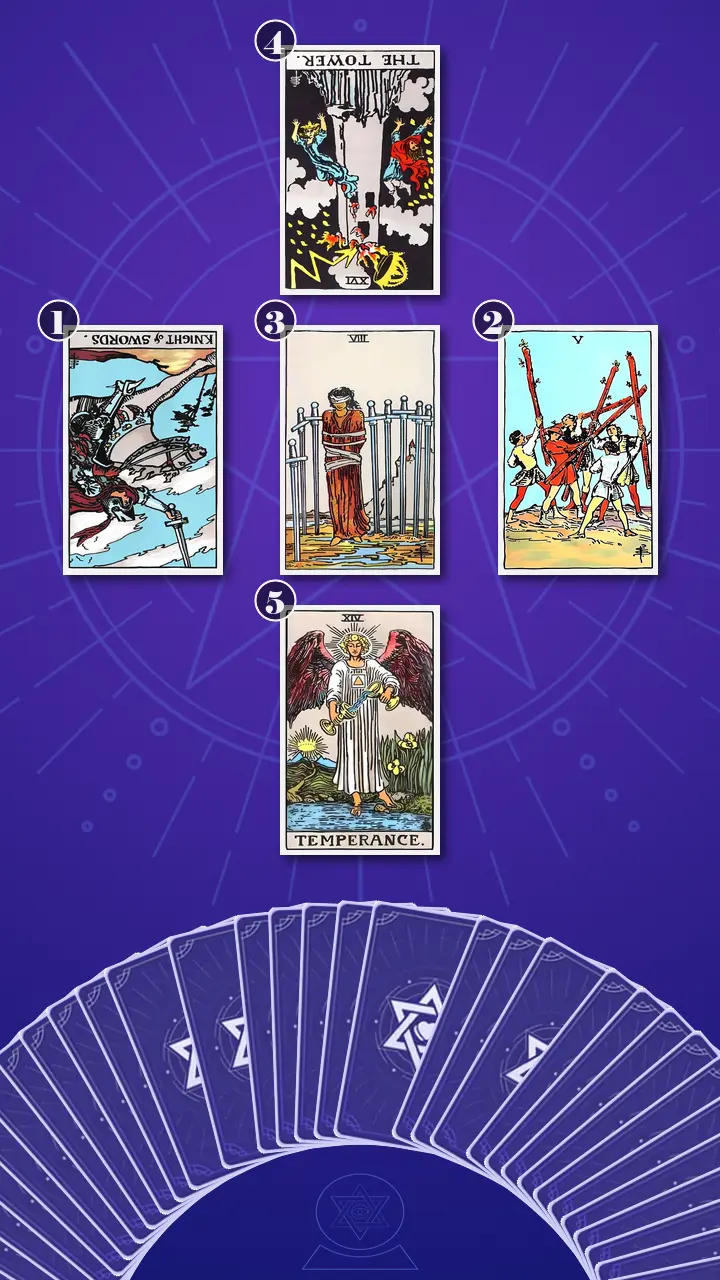
For this reading, I chose the Relationship Spread · Context Edition, a five-card relationship tarot spread for family conflict and self-exploration. The question is primarily about relationship dynamics: how conflict, boundaries, and the meaning assigned to the next response interact. The five cards give us the smallest useful structure for looking at Alex's immediate reaction, the family interaction that can be observed without guessing at anyone's private motives, the shared trapped dynamic, the fear beneath it, and a paced next step.
A Celtic Cross would have added ten positions and more layers than this question needed. The Context Edition keeps the reading proportionate. It does not predict whether the family will reconcile, withdraw, understand, or change. It gives us a clear frame for asking how tarot works in a practical setting: an image can externalize a recurring thought, let us test it against evidence, and make a choice feel smaller without pretending the conflict does not matter.
I explained the map to Alex and to anyone reading along with us. The first card would show the diagnosis-level reaction immediately after a fight. The second would show the observable family pressure from the other side, without claiming access to hidden intent. The central third card would reveal how both pressures combine into the belief that no move can be reversed. Above it, the fourth card would expose the feared collapse hanging over the conflict. Below it, the fifth would translate the insight into a bounded, reviewable direction rather than a verdict about the relationship's future.
Reading the Map Without Calling It a Verdict
The Sword That Arrived Before Clarity
"Now I'm turning over the card that shows the diagnosis-level reaction you can observe immediately after a family fight: accelerated drafting, urgent prediction, and pressure to act before clarity returns."
The card was the Knight of Swords, in reversed position. In its standard relationship meaning, this position describes the querent's current stance, energy, or contribution to the dynamic. I pointed to the raised sword, the horse charging into strong wind, the bent trees, and the turbulent clouds. The figure was moving with enormous force, but the image offered no guarantee that speed had produced a chosen direction.
I connected it to the Notes app on Alex's phone. After the argument, they had started composing a relationship-defining message before their breathing settled. The draft had grown from "I need tonight to myself" into a full explanation of six months of hurt, then been deleted and rewritten in harsher language. The reversed Knight captured the moment urgency outran clarity: the faster the message felt, the more permanent the decision seemed.
This was excess air, not a bad omen. Thought, language, prediction, and analysis were moving too quickly to be useful. The blockage came when Alex mistook the intensity of the impulse for evidence that a final choice was due. I told them, "The card is not saying you will send the wrong message. It is showing that your nervous system is asking for the heat to come down before your relationship mind is asked to make a lasting claim. Urgency is a body signal, not a deadline."
Alex did not nod. They let out a short laugh with a bitter edge and said, "That is too accurate. It is almost cruel." I welcomed the reaction rather than treating agreement as the goal. First, their thumb stopped above the keyboard. Then their eyes flicked toward the phone as if checking whether the card had quoted the draft. Finally, the laugh left their chest, and their hand lowered into their lap.
"You do not need to perform calmness for this reading," I said. "Let the card be a mirror, not a judgement. We can take the message seriously without obeying the first surge it reflects."
Five Voices, No Shared Focal Point
"Now I'm turning over the card that shows the observable family-conflict pressure meeting you from the other side. It describes interactional friction, not anybody's private motives or future behaviour."
This was the Five of Wands, upright. Its standard meaning in the second position is the other party's visible stance, energy, or contribution to the relationship dynamic. The five crossed staffs looked to me like several people replying to different parts of the same family group-chat conflict. Each person was moving, but there was no shared focal point and no settled direction.
I translated the image into the call Alex had described. One person defended the original issue, another corrected the tone, and someone else asked for an immediate answer. The thread jumped from the missed plan to the wording of the reply to whether anyone felt respected. Messages overlapped. The volume rose. Nobody had actually agreed on what needed to happen next.
"This card lets us name the pressure you can observe without inventing a story about what your relatives secretly intend," I said. "Several legitimate positions can be present at once. Friction is real, but intensity alone does not prove that a final outcome has been reached." The Five of Wands carried excess fire: heat and movement without a container. It fed the reversed Knight's speed, but it did not decide Alex's next move for them.
I watched Alex's shoulders rise again as they remembered the overlapping voices. Their fingers pressed together, and then they slowly separated them. I asked, "Looking at the last call or thread, which words were the concrete disagreement, and which parts became several reactions answering different versions of the problem?" That question moved the reading from judging the family to observing the exchange.
The Blindfold and the Gaps
"Now I'm returning to the centre. This card shows how your inner conflict and the escalating interaction combine to create the belief that there is no reversible next move."
The centre card was the Eight of Swords, upright. Its standard meaning is a shared dynamic of restriction, limited perspective, and perceived powerlessness. The blindfolded figure and loose bindings made the mental experience vivid, but I also drew Alex's attention to the visible gaps between the swords. The enclosure felt sealed. The image itself showed that it was incomplete.
I asked Alex to picture the real-life version: the phone held in one hand while they scrolled through six months of family messages with the other. In the Notes app were three possible choices: answer immediately, ask for space, or wait. The inner lines had become, "If I answer, I lose the boundary. If I pause, I lose the relationship." I asked, "Which outcome is documented in the exchange, and which one is being predicted because the fight felt intense?"
Alex's breathing paused halfway in. Their thumb remained suspended over the archive, and their eyes went unfocused as though the old messages were replaying behind the blue screen. Then their hand turned the phone face down. A long breath came out of them, uneven at first, followed by a quiet sentence: "Nothing in the thread actually says that asking for space means permanent rejection. I have been filling in that part."
I let the silence stay long enough for the distinction to register. The Eight of Swords did not dismiss the family conflict or tell Alex to ignore a boundary. It identified the central blockage: the mind was trying to think its way to total certainty, and the attempt was turning several available actions into one imagined point of no return. A narrower boundary, a temporary pause, or a scheduled follow-up could still exist even while the emotional stakes remained real.
The Crown Falling in the Mind
"Now I'm looking above the centre, at the card revealing the underlying fear that turns disagreement into a point-of-no-return moment: the expectation that relational change will become total collapse or permanent loss of belonging."
The card was The Tower, in reversed position. In this position, its standard meaning is the primary challenge, blockage, or unresolved pressure affecting the relationship. I held the image of the lightning-struck tower and the falling crown as the feared picture Alex carried internally, not as a forecast. The crown became the belief that perfect wording could control every consequence of changing how family contact worked.
When Alex considered asking for one week of space, their mind jumped straight to a full system outage: no more calls, permanent estrangement, and proof that they had never securely belonged. The reversed Tower showed resisted upheaval and internalised crisis. It also showed the overcorrection risk. Trying to prevent all change could make Alex retract a reasonable boundary and resume ordinary contact immediately, preserving the same conditions that made the next conflict accelerate.
I used one of my signature ways of working here, Turning Point Catalysis. "Sometimes what feels like a dead end is actually the inciting incident for the next act," I said. "That does not make the fight good, and it does not guarantee a happy outcome. It means we can ask what structure needs a limited adjustment instead of assuming the whole structure has to be saved exactly as it is or abandoned entirely."
I asked Alex to listen to the two halves of the fear. "If I ask for one week, everything may collapse," they said. I waited, then asked what the other half sounded like. Alex swallowed. "If I say nothing, the same conditions remain." The difference landed with a sharper edge than comfort. First, their hand closed around the phone. Next, their eyes moved from the falling crown to the path beneath the central figure. Finally, their fingers released the case, and they gave a small, frustrated exhale.
"We are not proving that the family will end," I said. "We are making the catastrophe expectation visible. Changing one contact pattern for seven days is not the same act as declaring the entire bond destroyed. You can take a relationship seriously without translating one heated exchange into a permanent identity for it."
When Temperance Made Room for Two Truths
Temperance's Two Cups
The room felt quieter when I reached for the card below the centre. Even the refrigerator hum seemed to recede behind the soft click of the card leaving the deck. This was the reading's antidote: a direction that could hold both present protection and future choice.
"Now I'm turning over the card that translates the key shift into a paced, bounded, and reviewable action. It supports self-protection without pretending to determine the relationship's final outcome."
The card was Temperance, upright. Its standard meaning in the fifth position is future potential or the direction in which the present relationship energy may be developed. In this Context Edition, that potential is deliberately practical rather than predictive. The angel pours water steadily between two cups, with one foot on land and one in water, while a path leads toward distant light.
I translated the two cups into two truths Alex had been forcing apart: "I care about this relationship," and "I am not available for this conversation tonight." Temperance is balance, not forced reconciliation. It is a measured flow between autonomy and belonging, anger and care, distance and contact. Its water allows emotional processing; its foot on solid ground gives that emotion a container.
Alex was still standing in the mental doorway: if they stepped toward a boundary, they feared the lock would click behind them; if they stayed, they feared they would abandon themselves. The phone was warm, their jaw tight, and the latest fight had begun masquerading as a decision about the entire relationship. They were searching for one reply that could not be misunderstood.
A family fight is not a final verdict; choose one measured, revisitable step and let Temperance's two cups replace all-or-nothing force with proportion.
A family fight can matter without becoming a final verdict. You do not have to settle the family's future while your inner conflict is at full volume; one limited, revisitable boundary can give you information without declaring the relationship over.
At first, the words did not bring instant relief. Alex's eyebrows lifted, and the hand holding the phone tightened. Their breath stopped high in the chest, creating a brief physiological freeze. Then their eyes lost focus and moved away from the card as if they were replaying the last six months of messages, sorting what had actually been said from what they had expected each sentence to cause. Their jaw worked once, twice. The fist around the phone loosened finger by finger. A flush gathered under their eyes, and their voice arrived with a thin edge of protest: "But if I choose a measured step, does that mean I was wrong to take the fight seriously?"
"No," I said. "Proportion is not denial. You can recognise harm, anger, or exhaustion and still refuse to make one message carry the entire future." A longer breath left Alex, uneven but complete. Their shoulders sank. They looked down at the two cups, then gave a small nod that contained relief and a new vulnerability: the old emergency had loosened, but now the choice belonged to them.
I asked, "Now, use this new perspective to think back to last week: was there a moment when this insight might have let you feel differently?" Alex named the unanswered call that had followed the argument. Nothing in the card required them to call back. Nothing in it required permanent distance. The new information was that a pause could be an action with a scope, not an empty space they had to fill with a verdict.
The Messy Middle, Not the Final Scene
My other signature diagnostic is Macro-Narrative Arc Auditing. I look at a difficult moment and ask whether it is a false climax, a dead end, or the messy middle of a transition montage. In Alex's spread, the Knight's urgency and the Tower's falling crown made the conflict look like the final scene. Temperance offered a more accurate scale: this could be a meaningful turning point without being the ending.
That is the emotional transformation I wanted Alex to feel in their body first: from urgent post-conflict apprehension and all-or-nothing prediction toward measured self-trust, emotional proportion, and a revisitable boundary that can hold autonomy and belonging together. The cards did not make that shift. Alex recognised the gap, and that recognition was theirs.
The Next Move Can Be a Container
When I connected the five cards, the pattern became clear. The reversed Knight began with language moving faster than the person could check its direction. The Five of Wands supplied overlapping family friction without a shared focal point. The Eight of Swords turned that pressure into a mental enclosure, while The Tower reversed revealed the hidden fear that one structural adjustment would demolish the whole bond. Temperance changed the scale of the story by replacing blades and collapse imagery with two open cups, a grounded foot, and a path that could be crossed in stages.
The old loop was simple and expensive: the fight was interpreted as a point of no return, so Alex reviewed every message and rehearsed permanent rupture; delaying the reply brought short-term relief because no immediate choice could be blamed for making things worse; the unresolved tension then made the eventual move feel even more historically important. The cognitive blind spot was not that Alex cared too much or lacked communication skills. It was the assumption that meaningful action had to be permanent to be real, and that perfect wording could control another person's reaction.
The key shift was more modest and more powerful: replace a relationship-defining decision made during conflict with one time-limited boundary or revisitable next step. A boundary can have a review date. The next move can be a container, not a conclusion. That container can protect present capacity, gather information, and leave later choices voluntary.
I told Alex, "You are the person who decides the scope of the boundary. The cards can help you notice the pattern, but they do not own the pen. You can send a message, save it, ask for support, choose distance, or decide that no response is appropriate right now. The point is not to force repair. The point is to make your next action truthful, limited, and yours."
The Director's Cut for the Next Seven Days
I then offered my communication practice, The Director's Cut Reframe. Because I think of lives as films still in production, I asked Alex to draft an objective logline for the next six months, not a dramatic ending. The exercise would reclaim their authorial voice without demanding certainty: one sentence about the life they are building, one boundary that supports it, and one larger relationship question that can remain unwritten for now.
- Use the phone-down pauseAfter one family conflict this week, put the phone face down for thirty minutes instead of reopening the entire family archive. In the Notes app, write one factual sentence about present capacity, such as "I am not available for another call tonight." Notice your jaw, shoulders, hands, and breathing before deciding whether the sentence needs to be sent.Keep a two-minute version available if thirty minutes feels too large. The draft is an option, not a requirement, and no immediate reply is owed.
- Separate fact from forecastDuring the first ten minutes after the urge to reread old messages appears, set a timer and write the exact words that were sent or spoken under "Confirmed in the exchange." Under "Predicted if I move," record no more than three feared consequences, such as "They will hear space as permanent rejection." Circle one detail that actually needs a response and leave the rest outside tonight's decision.Do not search six months of messages during this exercise. Anxious prediction can feel like useful research; stop when the timer ends, and close the thread if the distinction becomes too intense.
- Hold the two-cup boundaryIn under eight minutes, draft one clear limit, one specific request, and one Google Calendar review point. For example: "I care about staying connected, and I am not able to discuss this tonight. I will revisit it on Thursday at 6:00 p.m." Read it aloud once, edit only for factual accuracy, then choose whether to send it, save it, or use it privately before making tea, showering, or preparing your work bag. When you are steadier, use The Director's Cut Reframe to write an objective six-month logline: "I am building a life where I can protect my capacity and leave meaningful relationships open to thoughtful review."The review date is a container, not a promise to reconcile. Give the action a stopping point and a small ordinary reward; connection and autonomy can remain open in the same frame.
I reminded Alex that these are experiments, not tests of moral worth. If a message feels unsafe or the exercise increases distress, they can stop, choose distance, and reach for a trusted friend or appropriate support. A temporary family boundary does not need to prove anything about belonging. It only needs to tell the truth about what is possible today.

A Week Later, the Quiet Proof
A week later, I received a text from Alex: "I sent the message, slept a full night, and woke with 'What if I got it wrong?' as my first thought. Then I smiled." They spent the afternoon alone in a café, not celebrating a solved family relationship, just letting one ordinary hour remain theirs. The clarity was real, but it was still fragile.
I smiled when I read the message, because this was the kind of proof I trust: not a perfect conversation, not a guaranteed repair, and not a dramatic ending. Alex had chosen a measured boundary, given it a review date, and allowed the rest of the story to gather more information. Their life had continued while the family question remained open.
That is what our Journey to Clarity had revealed. Tarot had not decided what Alex should do, and Temperance had not erased the anger, guilt, or longing underneath the apprehension. The spread had helped make the mental mechanism visible. Alex, the querent and the author of the next act, had turned one enormous imagined threshold into a sequence of choices they could observe, revise, and own.
When a family fight ends but your jaw is still locked around the phone, asking for space can feel like risking belonging while replying feels like betraying yourself; you are trying to protect connection and your right to breathe at the same time.
If your next move only had to hold the next seven days, what small way of protecting your breathing while leaving the future unwritten would feel most like yours?