Two Sealed Boxes and Three City Tabs: Choosing One Month Here

The Waiting Room With No Departure Date
I met Alex, a 29-year-old contract content designer in Toronto who measured life in six-month work cycles and still called the same twice-renewed apartment temporary. At 10:30 on a Tuesday night, they joined our video session from the laminate floor beside two sealed moving boxes. Three city searches glowed across their laptop; the fan whined beneath them. A six-week workshop invitation waited on the kitchen counter while the radiator clicked into the quiet.
“I keep saying I'll settle in after the next thing,” Alex told me. “But the next thing keeps moving. Buying a proper table feels strange when I might leave. Joining that workshop feels even stranger. It's like I'd be admitting this is it.”
Their limbs looked weighted to the floor, yet one hand kept refreshing a job listing. Their restless dissatisfaction felt like sitting in a train station after the departures board had gone dark: the body heavy, the chest still listening for an announcement. They wanted to inhabit their current life fully, but they were withholding commitment until a future chapter felt like the real one.
“Nothing is exactly wrong,” Alex said, rubbing their sternum, “which somehow makes it harder to change. I'm busy planning a life I never quite enter.”
I understood the logic before I named its cost. Keeping options open had helped Alex preserve autonomy through uncertain contracts, high Toronto rent, and a genuine career crossroads. The problem was not that they planned ahead. The problem was that the future got all the furniture. Their permanent-temporary living was being sustained by fear-driven decision paralysis and postponed present-day commitments.
“I'm not going to ask the cards which city you're destined to live in,” I said. “That would hand your authority to a deck, and the authority belongs with you. I want us to see why participation feels dangerous, then find one next step that doesn't demand a lifetime promise. Let's draw a map through this fog.”

Choosing the Inner Compass in a Life in Limbo
I asked Alex to place both feet on the floor, take one unforced breath, and hold the question without trying to solve it. I shuffled slowly. The pause was not a mystical performance; it was a clean psychological threshold between refreshing tabs and paying attention.
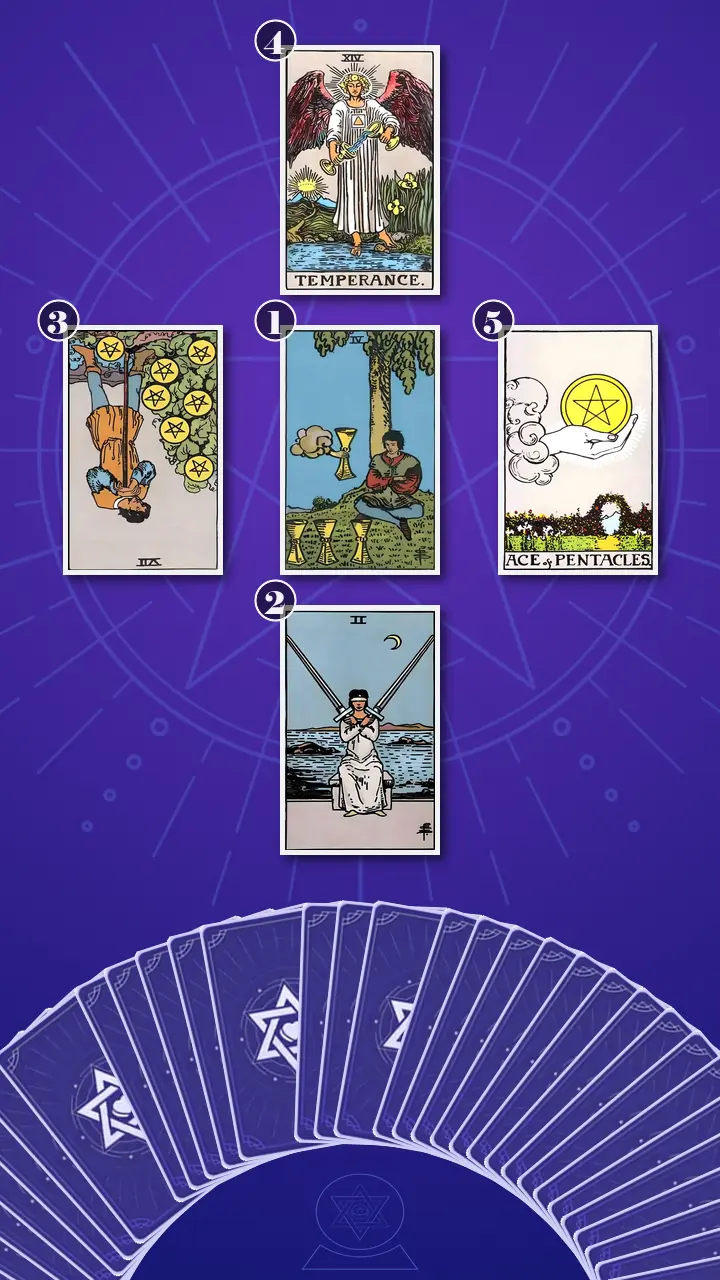
I chose a five-card spread called The Inner Compass. For anyone wondering how tarot works in a situation like this, I use it as a structured self-reflection tool. The cards do not issue a verdict. Their symbols let me separate a crowded problem into observable behaviour, protective logic, blind spots, values, and testable action. Card meanings in context matter more than generic predictions.
This spread was more useful than a broad ten-card reading because Alex was not asking for a forecast across every life area. They were asking why one internal stance kept turning home, work, friendship, and free time into an administrative gap. Five positions were enough to trace that mechanism without adding noise.
I placed the first card at the centre for the present waiting-room behaviour. Beneath it, the second would reveal the inner conflict that made suspended participation feel safer. To the left, the third would expose the belief obscuring Alex's judgment. Above the centre, the fourth would become true north: the principle capable of holding present belonging and future possibility together. The fifth, placed to the right, would translate that principle into one reversible action.
Seen from above, the cards would form a compass. I told Alex that a compass does not choose a destination for the traveller. It restores orientation so the traveller can move deliberately.
Reading the Life Already in the Room
The Folded-Arms Life: Four of Cups
The card I turned at the centre represented Alex's present state: the observable waiting-room behaviour and the stagnant emotional quality surrounding it. It was the Four of Cups, upright.
I pointed to the seated figure's tightly folded arms, the three cups already on the ground, and the fourth cup being offered just outside the figure's chosen field of attention. The card did not accuse Alex of being ungrateful. It showed withdrawal as a posture: usable parts of life were present, but attention was fixed on what those parts were not.
“This is Tuesday at 10:30,” I said. “You're beside two sealed boxes in an apartment you've renewed twice. The job-search tabs are the three cups already occupying your attention. The workshop invitation is the fourth cup within reach. Nothing available is necessarily wrong. It simply doesn't resemble the imagined permanent life, so allowing it to matter feels premature.”
The Water energy here was blocked and pooled. Alex wanted connection and meaning, but emotional participation had been withheld until the setting could guarantee it deserved investment. Like the split-self atmosphere of Severance, their body occupied one environment while meaning and agency seemed assigned to another version of life.
Alex gave a short laugh that landed closer to a wince. “That's so accurate it's almost rude.” Their fingers pressed into the cuff of their sleeve, then released. “There are things here I could use, join, or care about. I just don't think of them as part of the real life yet.”
“I hear the sting,” I said. “But the card isn't calling you lazy or resistant. It is showing us where your attention goes when caring starts to feel risky. Temporary does not mean disposable.”
I asked what unfinished object, unanswered invitation, or absent routine made the pattern most visible. Alex looked over their shoulder at the boxes before answering. “The workshop. The invitation has been there for nine days. I've opened the website about six times.”
The Choice Screen With No Exit: Two of Swords
The next card represented the underlying influence: the inner conflict that made suspended participation feel safer than choosing how to live now. I turned over the Two of Swords, upright.
The blindfold covered the figure's eyes. Two blades crossed evenly over the chest while unsettled water waited behind them. I read this as defensive Air: thought was active, but its energy had become a blockage. The two arguments were kept perfectly opposed, preventing lived information from disturbing either one.
I brought Alex back to a Monday morning on the TTC. A lease-renewal email had prompted them to open apartment listings elsewhere. Staying seemed to mean becoming trapped in the wrong life; leaving without a clear reason seemed reckless. Closing both screens gave immediate relief, but it also prevented them from honestly evaluating Toronto or testing another possibility with a targeted application, visit, or deadline.
“The false interface gives you two buttons,” I said. “Stay forever or leave now. But neither button describes your actual situation. You can renew a lease and keep exploring. You can participate locally and still leave later. The blindfold stays in place when those middle options are treated as invalid.”
Alex's jaw shifted to one side. I watched their eyes move away from the card and settle on the workshop envelope. When I asked what postponing had protected them from feeling, they took a long breath.
“If I make this place matter and then leave, I'm scared it means I wasted the effort,” they said. “Or that I couldn't control the plan well enough to get it right the first time.”
“That makes sense,” I said. “Suspension gives you the sensation of control because no option has been lost. But keeping every option open can become a way of closing the present. More comparison cannot provide information that only participation can produce.”
The Lifetime Return Test: Seven of Pentacles Reversed
The card to the left represented the obscuring pattern: the belief that a present investment was worthwhile only if it served a permanent future. It was the Seven of Pentacles, reversed.
In the upright image, a worker leans over a slowly developing crop. Reversed, Alex's evaluating gaze had overtaken cultivation itself. Earth energy was blocked by excessive assessment and insufficient contact with ordinary use. Every modest commitment had become a referendum on a life that did not yet exist.
I described the small table Alex had recently considered. They had calculated its cost, portability, resale value, and usefulness in an unknown future apartment. They had treated a secondhand table like a long-term investment proposal requiring a five-year forecast. Unable to guarantee the return, they left it behind and ate from the sofa again.
“The same standard hits the workshop,” I said. “If it cannot prove a permanent career identity, perhaps it isn't worth six weeks. But no temporary chapter could pass that test. Refusing the investment keeps the apartment unfinished and the social calendar thin. Then that thinness appears to prove Toronto was never worth inhabiting. That's the loop.”
I sometimes call the next layer Persona Fatigue Diagnosis. It is my way of naming the toll of maintaining a social character that has drifted away from the person underneath. Alex had become “the one who's probably moving soon” in conversations, group chats, purchases, and plans. Keeping that character believable required them to avoid evidence that they might care about the life already here.
“You don't have to turn into someone who wants to settle forever,” I said. “I'm noticing that the performance of perpetual departure has become heavy. The authentic part of you asking for a table, a class, and a recurring coffee is not betraying your freedom. It is asking to exist in the present tense.”
Alex's hand went still on the mug. Their gaze lowered as if they were reviewing a list: the unbought table, the declined running group, the friend who had stopped proposing plans more than a week ahead. Recognition crossed their face first as pain, then as a quieter honesty.
I also named the overcorrection risk. The answer was not an impulsive relocation, a sudden permanent job, or a full apartment makeover designed to prove life was finally moving. With no Wands in the spread, this reading did not ask for a dramatic leap. It asked for proportion and practical evidence.
When Temperance Put the Water in Motion
True North Between Two Cups
The room seemed to contract around the next card. The radiator gave one hard click and fell silent while I turned over the card above the centre, the position of true north: the integrative perspective that could hold future possibility and present commitment together. It was Temperance, upright.
I followed the stream of water moving between two held cups. One foot rested on land and the other in water; neither state had to defeat the other. This was balanced energy, but not passive balance. Temperance coordinated two realities through repeated, adjustable movement.
In Alex's life, the cups could become two calendar containers: one bounded block for researching future roles or cities, and one protected block for participating in Toronto now. The future would retain legitimate space, but it would no longer consume every evening under the label of keeping options open.
I brought us back to Tuesday at 10:30: Alex on the floor, warm phone in hand, comparing three cities while the workshop invite waited on the counter. Their thinking had narrowed until choosing either life seemed capable of destroying the other.
Here I used one of my closest reading tools, Internal Monologue Auditing. I asked Alex to listen not only to what their inner voice said, but to the genre it had chosen. Their subconscious narration had turned an ordinary table, a six-week class, and a lease decision into a high-stakes thriller in which one wrong move locked every exit.
As an artist, I thought of a rough cut in an editing room: ominous music can make even an open door look dangerous. The soundtrack is emotionally convincing, but it is not objective evidence. Temperance changed the genre. The scene was no longer a final-act verdict. It was a measured documentary experiment in which Alex could gather information, adjust the proportions, and retain authorship.
You are not trapped between staying forever and refusing to arrive; practise a measured commitment now, like Temperance pouring between two cups rather than waiting for one perfect vessel.
For one beat, Alex's breathing stopped. Their fingertips, halfway to the mug, stayed suspended; their pupils widened, then their gaze slipped past me toward the sealed boxes, as if the lease email, the furniture shop, and every unanswered “maybe” were replaying on a private screen. Their mouth tightened. “But doesn't that mean I've been doing all of this wrong?” The words came out sharper than anything they had said all evening. I let the anger have room. “No. Keeping things reversible protected your sense of control. We're noticing the moment a useful strategy began charging more than it returned.” Their fist loosened against their knee. A breath left them in a slight tremor, their shoulders dropped, and their eyes brightened, not with uncomplicated relief but with the exposed look clarity can bring when it hands responsibility back. I asked, “Now, using this new perspective, think back to last week. Was there a moment when this insight might have changed how you felt?” Alex pictured the table beneath fluorescent lights. “I could have bought one month of dinners,” they said quietly, “not a whole future.”
I named the threshold we had just crossed. This was not certainty about Toronto, a career, or the next lease. It was a movement from detached restlessness and provisional living toward grounded participation without requiring certainty. The new clarity carried relief, but also responsibility: once the false binary was visible, Alex could no longer pretend that waiting was the only neutral option.
“Your present life does not have to pass a permanence test before it deserves your participation,” I said. “You can keep the future open without keeping today empty. You can care for this life without declaring it final.”
I translated Temperance into a realistic week. Alex could set a twenty-five-minute future-research window, close the city-comparison tabs when it ended, and then use a separate twenty-five-minute block to answer the workshop invitation. Nothing would be decided forever, but something would start moving today.
The Garden Path Before the Distant Mountain
Ace of Pentacles and the Thirty-Day Seed
The final card represented the integrated next step: the practical action through which Alex could test the new perspective. I turned over the Ace of Pentacles, upright.
A single pentacle rested in an open hand above a cultivated garden. Beyond it, a path passed through an arch toward distant mountains. The path did not require Alex to know the final destination before accepting the resource at its entrance.
In daily life, this looked like choosing one thirty-day commitment, paying or borrowing only what felt reasonable, placing four dates on the calendar, and setting a review date in advance. It could be the workshop, a borrowed table, one opened box, or Sunday coffee with a nearby friend. The point was visible form: a confirmation email, a usable corner, or an event that existed somewhere other than a planning document.
The Ace restored upright Earth after the reversed Seven of Pentacles. Instead of demanding guaranteed lifetime value from seven imagined returns, Alex could plant one workable seed and observe its current-month value. Participation would create direct evidence that another Notion dashboard could not.
“This is a personal beta release,” I said. “Small enough to revise or end, but real enough to generate information. You do not need to choose forever to choose for thirty days.”
Alex nodded once, slowly. Their caution had not disappeared, and I did not want it to. Caution could set a budget, choose a review date, and protect an exit. It simply no longer needed to leave the whole present blank.
The Thirty-Day Arrival Experiment
I gathered the cards into one coherent story. Contract cycles had trained Alex to watch for the next transition. Each lease email or quiet evening triggered future-life comparison. Research provided short-term relief because every option stayed theoretically available. Yet the boxes remained sealed, invitations went unanswered, and the current life grew thin. That thinness then seemed to confirm the original belief that real life had not started.
The cards mapped the pattern cleanly: the Four of Cups showed emotional withdrawal from what was available; the Two of Swords revealed the defended binary beneath it; the reversed Seven of Pentacles exposed a permanence standard that no ordinary investment could satisfy. Temperance restored movement by giving present belonging and future exploration explicit proportions. The Ace of Pentacles grounded that integration in one reversible, observable beginning.
Alex's cognitive blind spot was the assumption that commitment only counted as freedom when it remained hypothetical. In practice, keeping every choice reversible had become its own consequential choice. It was producing an under-lived home, a sparse calendar, and less information about what actually nourished them.
The transformation direction was precise: not from flexibility to settling down, but from withholding commitment until certainty arrived to making one bounded investment in the life that existed now. Future possibilities could remain open. They simply did not need every chair in the room.
I reminded Alex that tarot had not discovered a hidden command. The spread had externalised their pattern so they could evaluate it with less noise. The cards supplied a map; Alex would decide what to test, what to spend, what to decline, and when to stop.
The Director's Cut of Self-Compassion
Before we chose the practical next steps, I gave Alex my Director's Cut of Self-Compassion. When their internal narrator said, “This tiny action is cosmetic,” or, “You're wasting money on the wrong life,” I asked them to call a mental cut. First, describe the frame without prosecution: I am considering one useful thing for one month. Then replace the punitive judge with an objective, supportive observer: This experiment may teach me something, and I have already scheduled the right to reassess it.
This was not a positive-thinking trick. It was a change in editorial responsibility. Alex could remove the horror soundtrack without deleting the practical risks. From that calmer cut, we chose three actionable next steps.
- The Present-and-Possible Calendar On Tuesday evening, place one twenty-five-minute future-research block and one twenty-five-minute Toronto-life block in the same calendar week. Use the first for one defined city or role question. When the timer ends, close the tabs. Use the second to reply to a local invitation or make one current plan. If fifty minutes feels unrealistic, use two fifteen-minute blocks. The hard stop matters more than the duration because it prevents research from consuming participation.
- One Recurring Plan With an Exit Reply to the six-week workshop before bed tomorrow. Ask whether a trial or four-session option is available, place the first four dates on the calendar, and add a thirty-day review date. The commitment is to attend for the chosen period, not to remain in Toronto. If the chest pressure returns, use the Director's Cut: “This is a trial of participation, not a lifetime contract.” A free event or four Thursday walks with a friend also counts.
- The Ten-Minute One-Corner Reset This weekend, set a ten-minute timer beside one sealed box. Remove five items you expect to use this month and give them visible places. Make the corner usable by rearranging, borrowing, repairing, or buying only within a pre-set budget. Stop when the timer ends. Ask only, “Will this support one ordinary day in the next thirty days?” If ten minutes feels pressuring, do two. The rest of the box may remain closed.
“Participation is evidence, not a life sentence,” I told Alex. “The experiment succeeds if it gives you honest information. Enjoying the workshop does not force you to stay. Disliking it does not prove Toronto is wrong. Either result gives you more reality and less rehearsal.”

A Week Later, One Corner Had Arrived
Six days later, Alex messaged me a screenshot: four workshop dates in their calendar and five unpacked objects on a borrowed side table. They had slept through the night. Their first morning thought was still, What if I leave? This time, they smiled and made coffee.
I did not read that message as proof that their life was solved. Alex still had a contract decision ahead, a savings buffer for a possible move, and real questions about what they wanted next. The change was smaller and more credible: their current week contained something personally chosen.
The five-card Inner Compass had helped Alex move from preserving possibility to inhabiting the present, but no card performed that movement for them. They replied to the email. They placed the dates. They opened the box. Their agency was the active ingredient.
I came away from our Journey to Clarity thinking about the table Alex had once treated as a verdict. When buying a table or making a plan six weeks out tightens your chest, the hard part may not be the commitment itself. It may be the fear that caring for this life means losing control of the next one. Noticing that hidden equation already changes the scene.
If thirty days of participation did not have to mean forever, which offered cup would you be curious to pick up: the unfinished corner, the local invitation, or one recurring plan that could finally let this chapter matter?