A Charger Moved Between Bags, Then One Tray Became a Return Point

The Tote by the Door: Finding Clarity in a Shared Rental
I recognized renter burnout in the scene before I knew Jordan's question: a 27-year-old junior project coordinator in London, checking a shared-flat WhatsApp chat before the morning commute and calling it flexibility when they were really managing housing anxiety. Jordan (name changed for privacy) stood in their bedroom at 7:42 AM, moving a charger, keys, and medication from the bedside table into a tote. The kettle clicked off, the radiator ticked, and the phone felt warm in their palm. Their shoulders were already lifted, as if the room might change before they returned.
I watched Jordan glance at the half-unpacked box beside the bare wall. Their room was quiet, but quiet did not seem to count as safe enough to settle into. They told me, “I can settle once things stop changing. But every time I unpack or make a plan, something shifts again.” Their friends posted lamp-lit rooms, houseplants, and Sunday apartment resets online. Jordan kept a ready-to-go pile instead.
“Why do I keep adapting to a home setup that never feels settled?” they asked. The contradiction was plain: they wanted the room to restore them, but kept arranging their life as if they might need to leave it. The insecurity sat in their body like carrying a packed suitcase through a bedroom, useful in an emergency but impossible to put down. Jordan gave a small, tired laugh and added, “I keep calling it flexibility, but it feels more like staying on standby.”
I told them I would not pretend a small ritual could repair a tenancy problem, change a landlord's decision, or make an unsafe arrangement safe. We could use the cards as an objective map of the pattern, separating what belonged to the flat, the lease, the wider housing system, and Jordan's own available choices. “We are not here to predict whether this room will suddenly become permanent,” I said. “We are here to find one honest point of clarity inside a situation that keeps moving.”

Choosing the Compass: The Transformation Path Grid
I asked Jordan to take one slow breath and name the question without trying to solve it. I shuffled at an even pace, giving the body a short transition out of the morning commute and into observation. For me, this is how tarot works at its most useful: not as a supernatural verdict, but as a structured way to notice a pattern that ordinary overthinking keeps circling.
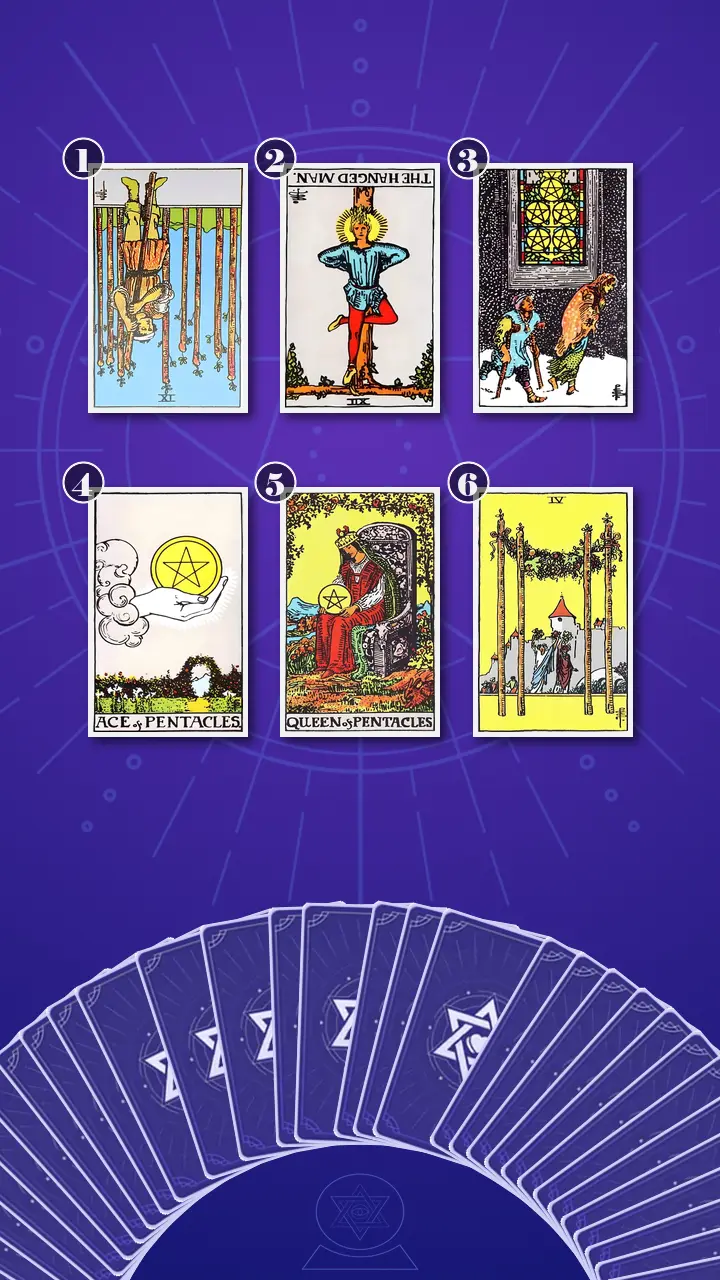
I explained that we would use the Transformation Path Grid (6) · Context Edition, a six-card spread designed for a self-reinforcing system rather than a simple either-or choice. A Celtic Cross could show broad pressures, but its ten positions would be too diffuse for this question. A Decision Cross would assume that Jordan had two defined options, when the deeper issue was why every option remained provisional. This six-card tarot grid would trace the loop in sequence, from visible behaviour to its root, then toward a practical alternative.
The upper row would show the Presenting state, the Stagnation Lock, and the Survival-mode root. The lower row would identify a Grounded catalyst, a Practical action, and a Settled-enough integration. I told Jordan that the first three positions would explain why staying ready had become so exhausting, while the final three would ask what could be chosen without claiming control over the entire home.
“The cards will not tell you that you have failed to settle,” I said. “They will help us see which parts of the situation are observable, which parts are structural, and where your agency can begin without waiting for perfect external certainty.”
The Closed Corridor of Constant Adaptation
The Ready-to-Go Bag
Now flipped was the card for Position 1, the Presenting state, showing the observable adaptation behaviour and contracted survival energy. It was the Nine of Wands, in reversed position.
The card showed the bandaged figure looking back toward the line of wands, and I connected it directly to Jordan's packed tote beside the door. They checked the flat chat before work, shifted essentials between bags when a repair, noise issue, or household rule appeared, and treated a quiet evening as a temporary pause rather than a chance to land. It had the recognisable feeling of an apartment-reset video that never reaches the reset, with the camera returning to the same unfinished corner.
In a reversed position, the Fire of the Nine of Wands was overextended while recovery had become deficient. Adaptation had once helped Jordan stay functional. Now it kept the defensive posture active after the immediate disruption had passed. The card did not say, “Stop being careful.” It asked which low-risk response could be paused for one week without compromising immediate safety. Keeping every possession portable, refusing to personalise the room, or rechecking the same message might reduce exposure for a moment, but it also kept the room from becoming a dependable base.
Jordan did not nod. They let out a short, bitter laugh. “That is too accurate,” they said. “Almost a little rude.” Their fingers tightened around the mug, then loosened. I told them that the card was not accusing them of creating the instability. It was showing the hidden cost of managing it. “A quiet room is not the same as a settled body,” I said. “The question is not whether you are allowed to stay ready. It is whether readiness has become the only way you know how to occupy the room.”
The Browser Tab on Hold
Now flipped was the card for Position 2, the Stagnation Lock, revealing how suspension, postponement, and repeated accommodation maintain the cycle. It was The Hanged Man, in reversed position.
The bound foot became a housing decision left on “awaiting response” in an open browser tab. When a flatmate changed a household plan, Jordan opened SpareRoom and Rightmove, compared deposits and commute times, and waited for more certainty before asking one factual question or naming one boundary. Unpacking, decorating, inviting someone over, and making longer-term plans all remained suspended until the environment gave permission.
Reversed, The Hanged Man showed blocked perspective rather than useful surrender. The pause had stopped creating insight and had become a holding pattern. I heard the internal sequence in the way Jordan described their evenings: “Once the room settles, I will unpack. Once the lease is clear, I will decide. Once I know, I will begin.” Waiting felt sensible because it reduced the chance of making a choice that might need to be undone. But the suspension itself was now postponing the experience Jordan wanted.
Jordan's breath paused. Their thumb hovered over the phone as though the flat chat might change while we spoke. Their eyes lost focus, replaying saved listings and unanswered questions, and their shoulders rose another fraction. Then they exhaled and said quietly, “I keep calling it being sensible, but I may also be keeping my life on hold.” I answered, “A bounded step does not require you to decide the whole housing situation. It could be one clear question, one written limit, or one option identified without commitment.”
The Warm Window Across the Street
Now flipped was the card for Position 3, the Survival-mode root, identifying the fear that settling could expose Jordan to loss, reduced support, or the absence of a dependable base. It was the Five of Pentacles, upright.
I asked Jordan to picture the walk home after a crowded London commute. The card's two figures moved through snow beneath a lit stained-glass window, and that window became the warm, personalised homes Jordan saw online. Shelter was visible, close enough to recognise, but not experienced as something they could confidently approach. The image matched the way Jordan thought about rent, deposits, repairs, emergency moving costs, and the possibility of having nowhere reliable to return to.
The Five of Pentacles was not a prediction of deprivation. It described an emotional structure built around exposure. If Jordan stopped adapting and the home shifted again, they feared the loss would prove that safety had never been dependable. Readiness therefore felt more rational than comfort. It protected money by delaying useful purchases, protected privacy by avoiding invitations, and protected hope by leaving future options open. At the same time, it made support harder to approach. A flatmate, friend, tenant advice service, or housing resource might be available, but asking could feel like admitting that the home was not secure.
Jordan looked toward the window of my studio, where the afternoon light had turned the glass pale and cold. Their hands closed around their keys. I asked, “When a message arrives, what is the frightening possibility beneath the practical planning? Is it losing money, access, privacy, support, or somewhere dependable to return to?” They did not answer immediately. That silence was useful. It separated a real housing limitation from the belief that every form of comfort had to be postponed until the limitation disappeared.
When the Ace Put Weight in the Open Hand
The room seemed to quiet when I moved to the lower row. Now flipped was the card for Position 4, the Grounded catalyst, identifying one concrete source of agency that could interrupt the loop without pretending the unstable external home was fully controllable. It was the Ace of Pentacles, upright.
The open hand offering one pentacle was not a promise of a complete solution. It was one shelf, tray, hook, routine, boundary, or practical housing resource that could remain useful even while the wider arrangement stayed imperfect. In balanced Earth energy, the Ace offered grounded agency, practical self-trust, and patience with a small beginning. It challenged the all-or-nothing condition behind Jordan's sentence, “I can settle once things stop changing.”
I asked Jordan to imagine the exact moment when the pattern usually took over. At 8:47 PM on a Tuesday, on the train home, you move your keys and charger between two bags while the flat chat stays open. The phone is warm, the carriage lights flicker, and you are already preparing for a home nobody has said is changing. Their shoulders tightened as they recognised the scene. They were not responding to an actual instruction to move. They were rehearsing the next disruption so they would not be surprised by it.
The Foothold That Does Not Pretend
This was where I used my signature Time-Asset Valuation lens. During my years on Wall Street, I learned to look past the visible transaction and audit the hidden sunk cost. I do not use that logic to turn a person into a spreadsheet. I use it to ask what a routine is actually returning. Five minutes spent moving the same charger, ten minutes checking a flat chat, and half an hour comparing listings might look like responsible preparation, but what was the return on that time? Often it was only a brief reduction in exposure, followed by less rest and less trust in the room.
I placed my finger beside the single pentacle and said:
You do not need to keep every part of your life provisional until the home stops changing; choose one grounded foothold, like the Ace of Pentacles held in the open hand, and let a small act of care become evidence that stability can begin with your participation.
I let the silence remain for a moment, then translated the card into the sentence I wanted Jordan to be able to use on an ordinary evening:
You do not have to make the whole home settled before you choose one concrete place, routine, boundary, or resource that supports you now. Stability can begin as something you participate in, even while the larger arrangement remains imperfect.
Jordan's thumb stopped above the phone. For a few seconds, their breath held and their face went still. Then their gaze moved from the card to the imagined shelf beside the door, as if replaying every time the keys had moved between bags. Their eyes softened, and the tight line at their mouth loosened. Finally, their shoulders dropped with a long, uneven exhale; the fingers that had been gripping the mug opened against the table. The release was not bright or complete. A small space appeared, and with it came a brief dizziness, the vulnerability of having fewer defensive plans to hide behind. “Maybe I have been waiting for the whole situation to become safe before allowing one small thing to support me,” they said. “What if stability can start as one thing I can actually repeat?” I asked them to take that new view back to last week: “Was there a moment when this insight might have let you feel differently?”
This was the first visible crossing in the emotional journey from depleted hypervigilance and provisional living toward grounded agency. It did not mean Jordan now trusted the flat completely. It meant they could distinguish participation from control. A shelf could be chosen by Jordan. A landlord's repair timeline, a flatmate's behaviour, or the housing market could not. That distinction was a beginning.
The Hand That Tends What Is Here
Now flipped was the card for Position 5, the Practical action, translating the shift from constant adaptation into a repeatable routine, boundary, or resource-building practice. It was the Queen of Pentacles, upright.
The Queen held the pentacle close and sat within a cultivated garden. I connected that posture to a form of care that was practical, embodied, and honest about available money, energy, space, and privacy. Jordan did not need to give the room a full influencer-style makeover. They could keep essential items in one dependable place, protect one evening ritual, communicate one factual household boundary, and allow one corner to feel personal without asking the whole flat to become permanent.
I also used my Bandwidth Bankruptcy Prediction lens. This is my way of checking for structural imbalance across work, sleep, and health before calling a habit a personal failure. Jordan spent a demanding day coordinating projects, travelled through a crowded commute, and then used the evening to monitor housing possibilities instead of recovering. The body was technically off the clock, but the attention was still working. That was fake rest, and the account was running low.
“So I have to make the room nice now?” Jordan asked. I heard the pressure inside the question. “No,” I said. “The Queen is not asking for performance. She is asking what care can be repeated without bankrupting your bandwidth. One small reset and one protected limit are enough to test the idea.” Jordan wrote that down, then underlined the word repeatable.
The Threshold That Can Be Noticed
Now flipped was the card for Position 6, the Settled-enough integration, showing how Jordan could recognise homecoming, belonging, and support without making perfect external permanence a prerequisite for rest. It was the Four of Wands, upright.
The four decorated wands, joined by a garland, became repeated supports rather than a flawless building. One weekly return ritual, one chosen corner, and one trusted person could create a visible moment of belonging. The castle in the distance did not represent a promised housing outcome. It represented a threshold Jordan could learn to recognise: a place where the body could arrive for ten minutes, even if the wider arrangement still had limits.
The Four of Wands returned Fire to the spread, but this time it was supported Fire. Energy could mark homecoming instead of defending against the next disruption. I asked Jordan, “At the end of this week, what would let you recognise one moment of arrival, even if the room, lease, or shared arrangement still has clear limits?” They looked at the Ace of Pentacles again and answered, “Maybe I do not need to feel completely at home to notice that I came home.”
The One-Anchor Home Practice
The cards told one coherent story. The Nine of Wands reversed showed the present cost of staying braced. The Hanged Man reversed showed how waiting for the flat to settle had become the mechanism keeping Jordan suspended. The Five of Pentacles showed the fear underneath: stopping adaptation might expose them to a loss of safety or support. Then the Ace of Pentacles offered one foothold, the Queen of Pentacles turned that foothold into repeatable care, and the Four of Wands showed how ritual and chosen support could become a settled-enough experience.
The cognitive blind spot was not that Jordan lacked flexibility. It was that they had begun treating constant adaptation as proof of safety, while treating rest and attachment as risks. The external housing problem was real, and no five-minute exercise could replace tenancy advice, financial support, a needed repair, or a safety boundary. The transformation direction was narrower and more workable: shift from making every part of life provisional to naming what is and is not within control, then build one small point of continuity inside that honest boundary.
I offered Jordan my Energy Portfolio Restructuring strategy, a 48-hour subtraction challenge. The aim was to cut one high-friction habit and reinvest that time exclusively into a high-yield recovery block. In practical terms, this meant reducing one stream of housing monitoring, not ignoring a genuine urgent issue, and using the recovered minutes for a repeatable action that helped the body return.
I kept the plan small enough to test rather than obey:
- One dependable home anchorBy Wednesday evening, choose one daily-use item, such as keys, medication, headphones, or a work notebook, and give it one visible place in the room. For five minutes at the end of two evenings, return only that item to its place, then note whether the next morning felt even slightly easier. Write: “This anchor helps with ___. It cannot solve ___.”Start with something already in the room and keep the experiment reversible. If you catch yourself redesigning the entire space, return to one object.
- Energy Portfolio RestructuringFor the next 48 hours, check the flat chat at two chosen times instead of continuously, unless there is a genuine urgent issue. Use one recovered ten-minute block for tea, an easy meal, a lights-down routine, or a quiet reset in the same corner. During that block, ask one factual household question or write one neutral boundary without committing to a larger decision.Expect the thought, “Why bother if I may have to move it?” Treat it as information about the fear, not an instruction to abandon the test.
- The settled-enough return pointChoose one weekly ritual, such as tea after the Tuesday commute, music while changing clothes, or ten minutes of reading in the same corner. If it feels supportive, tell one trusted person, “I am making one part of the room more usable, but I am not looking for advice or a big project.” At week's end, name one moment when the room functioned as a base.Belonging is not a performance. The smallest version is valid, and the ritual can be shortened, postponed, or cancelled if the space does not feel workable.
I reminded Jordan that if the issue involved safety, harassment, access, tenancy rights, or a serious housing threat, the appropriate next step was practical support from a qualified service, landlord, tenant adviser, or trusted person. The cards could clarify the personal loop around the problem. They could not be used to minimise the problem itself.

A Week Later: The Quiet Proof
Five days later, I received a message from Jordan with a photo attached. Their keys and charger sat on a small tray beside the door, and a mug was steaming in the corner of the frame. The flat chat was still unpredictable. The room had not become a new home. But Jordan had kept the tray in place for three mornings and had used the ten-minute return ritual twice.
“It is weirdly comforting,” they wrote. “Not because everything is fixed. Just because I know where these things are, and I did not move them in anticipation of a problem.”
That Sunday, Jordan drank tea alone beside the tray for ten minutes. The flat still had limits, and the small corner carried more emotional weight than a tray should have to carry. They felt relieved, then briefly sad, then relieved again. It was not a perfect homecoming. It was the first piece of evidence that a room did not have to prove permanence before one part of it could support them.
From my side of the table, the Journey to Clarity was not a prediction of a better tenancy. It was a movement from contracted vigilance to grounded agency, from provisional living to a settled-enough practice. Jordan remained the person making the choices. The cards only made the pattern visible long enough for their own judgement to return.
When the place around you keeps changing, your shoulders can stay lifted for so long that rest starts to feel like a risk: you want a home, but fear that getting attached will make the next loss hurt.
If one chosen shelf, evening ritual, or boundary could count as “home for now,” which small point of return would feel quietly yours this week, without asking the whole flat to prove it will stay?