When a Holiday Plan Becomes a Friendship Loyalty Test
I met Jordan, a 27-year-old digital marketing coordinator in Toronto, after one holiday group-chat update had turned adult friendship drift into a full loyalty investigation before her next campaign reminder had even disappeared.
At 11:38 p.m., Jordan appeared in my video window from her small condo, where the radiator clicked against the hush and blue screen light washed the room. Her phone looked almost hot in her palm. She opened the same message for the seventh time: “I may need to move the booking, sorry.” Then she showed me the pointed reply she had deleted, the “No worries” she had sent instead, and the empty space where she was still waiting for typing dots.
“I hate that I do this,” she said. “I say it’s fine, then wait to see whether she notices that it’s not. If she doesn’t chase me, I decide I was right. I just need to know whether I still matter to her.”
I could see the contradiction clearly: Jordan wanted reassurance that one changed holiday plan had not weakened the friendship, but she feared the change itself proved her friend’s loyalty was fading. Asking directly felt exposing, so she created a friendship loyalty test and hoped her friend would pass without being told the rules.
The fear of being deprioritized moved through her like a lift dropping three floors without warning: her stomach fell first, her chest locked second, and then her hand reached for the phone as if one more look could stop the descent.
“I’m not going to tell you that you’re dramatic, and I’m not going to pretend the changed plan doesn’t hurt,” I said. “I also won’t claim to know what your friend is thinking. Let’s make a map of what happened, what your body concluded, and what you can choose next. We’re looking for clarity, not a verdict.”

Choosing the Compass for Adult Friendship Drift
I asked Jordan to put both feet on the floor, take one ordinary breath, and hold the practical question in mind: “How can I respond when a holiday plan changes without hiding my hurt or testing my friend?” I shuffled slowly. The pause was not mystical theatre; it was a transition from reacting to observing.
I chose the five-card Relationship Spread · Context Edition. I use this friendship dynamics spread when two things need to be examined together: the visible interaction between people and the private meaning the querent is assigning to it. It shows how tarot works best in a relational conflict, not as surveillance of someone else’s mind, but as an objective framework for separating behaviour, interpretation, shared patterns, available resources, and constructive next steps.
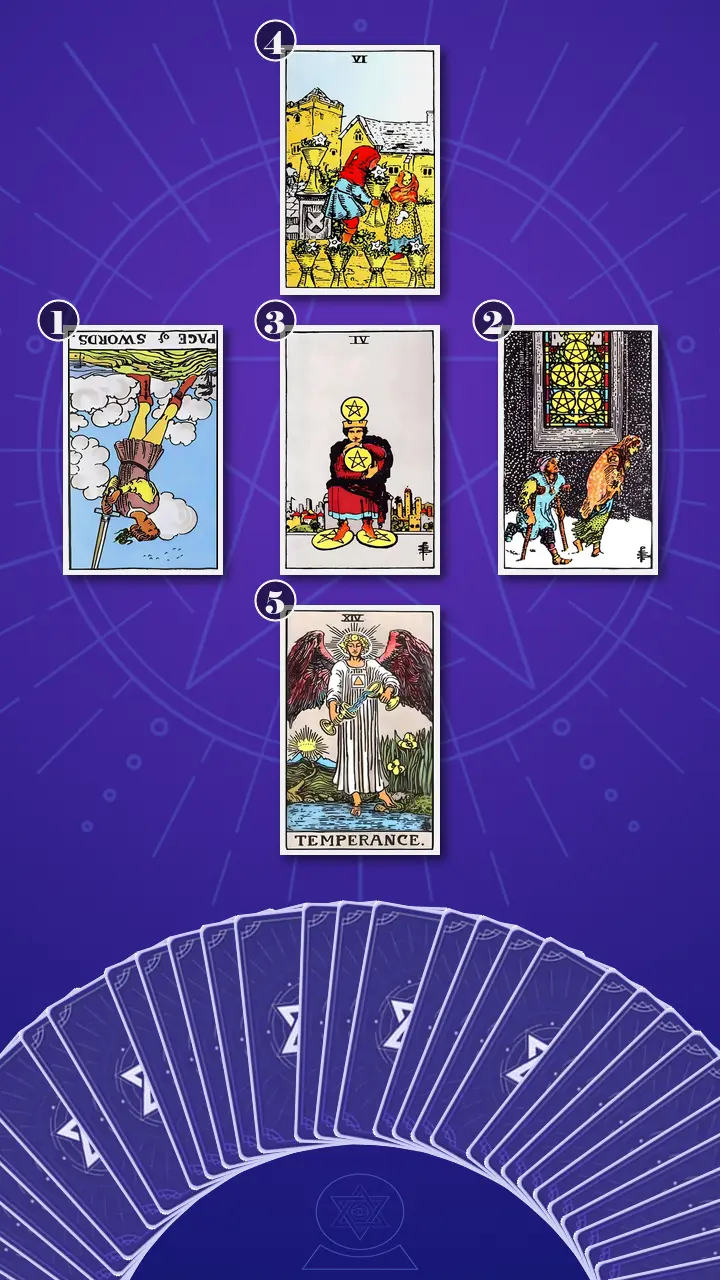
The first position would reveal Jordan’s observable response when uncertainty entered the friendship. The second would examine the story she attached to her friend’s scheduling change without pretending we knew the friend’s private intentions. The central card would expose the mechanism maintaining the conflict. Above it, a resource card would show what was still usable in the bond; below it, the final card would define a boundary-respecting repair practice rather than predict an outcome.
I arranged the cards as a cross, with the relationship pattern at the centre. It resembled a compass: perception on either side, shared history above, and grounded action below. That structure mattered because Jordan did not need ten layers of prediction. She needed enough context to understand why one calendar edit could feel like friendship rejection and how to answer it differently.
Reading the Group Chat Like a Map
Position 1: The Reply Held Like a Raised Sword
I turned over the card representing Jordan’s observable reflex when holiday plans changed. It was the Page of Swords, reversed.
On the card, the Page held a raised sword while glancing sideways into a windswept landscape. I saw Jordan’s phone in that posture immediately: a reply held ready, attention split between what had actually been said and every possible danger hiding behind it.
At 11:38 p.m., she had compared the apology’s wording, punctuation, and timing with older messages. She had checked her friend’s online status, drafted “Guess you have better priorities now,” deleted it, sent “No worries,” and continued monitoring the screen. This was the reversed Page’s modern life scenario almost frame for frame: alertness had become message forensics, and language had become a probe for detecting an unnamed hurt.
I described the card as blocked Air. Curiosity was available, but it could not move cleanly because fear had redirected it into surveillance and premature conclusions. Jordan’s internal algorithm had been trained on the possibility of replacement, so every ambiguous notification was ranked as confirming evidence. The original scheduling fact became buried beneath speculative browser tabs labelled “punctuation,” “response delay,” “Instagram Story,” and “if she wanted to, she would.”
“The Page isn’t condemning your need for clarity,” I said. “It’s asking whether you’re gathering information or conducting a cross-examination. You want reassurance, but you’re performing indifference because direct reassurance feels too vulnerable to request.”
Jordan gave a short laugh, but there was no amusement in it. Her thumb stopped rubbing the edge of her phone. “That is so accurate it’s almost cruel,” she said.
“Then let’s slow it down without shaming it,” I replied. “The watchfulness began as protection. We’re only examining whether it still gets you the connection you want.”
Position 2: The Warm Window on the Other Side of the Screen
I turned over the card representing the meaning Jordan assigned to her friend’s observable change of plan. It was the Five of Pentacles, upright.
Two figures walked through falling snow beneath an illuminated stained-glass window. I asked Jordan about the 504 streetcar ride she had mentioned before our session. She told me how the carriage had smelled of wet coats and takeaway coffee, how the brakes had scraped the rails, and how an Instagram Story had appeared two days after the rescheduling message. Her friend was laughing beneath amber bar lights.
“My shoulders went straight up,” she said. “I zoomed in on the timestamp. I thought, so she has energy for them, just not for me.”
The Five of Pentacles gave form to that body-level story: everyone else appeared to be inside the warm room while Jordan had been moved outside the friendship. Earth energy, which can offer grounded evidence, had contracted into a scarcity lens. One lost date began to feel as if secure belonging itself had become unaffordable.
“The fact is that the plan changed and you saw a social post,” I said. “The story arriving in your body is that you’ve been replaced. The hurt is real; the loyalty verdict is still an interpretation.”
I did not tell Jordan that exclusion existed only in her head. Through my Clique Power Dynamics lens, I look for repeated evidence of an actual hierarchy: selective invitations, recurring jokes at one person’s expense, private side conversations used to control status, or a pattern in which one friend’s needs consistently receive less consideration. A single Story could not establish that pattern, but neither did Jordan have to dismiss herself. She could watch behaviour over time without forcing one evening to carry the entire case.
Her breathing paused. Her eyes shifted away from me and held on the card as though replaying the streetcar scene. Then she exhaled through her nose and lowered her shoulders a fraction.
“I can admit I felt outside without claiming she put me there on purpose,” she said.
“Exactly,” I replied. “Naming the cold is not the same as deciding who locked the door.”
Position 3: The Date Gripped Against the Chest
I turned over the central card, the one representing the mechanism Jordan and her friend were repeatedly creating around uncertainty. It was the Four of Pentacles, upright.
The figure clutched one pentacle against the chest and pinned two more beneath both feet. Nothing could be lost, but nothing could move. In Jordan’s life, the pentacle was the original holiday weekend, the familiar tradition, the prompt reply, and the expensive early flight she had considered proposing even though it would strain both budgets.
“I knew the flight was ridiculous,” she admitted. “Part of me thought that if she agreed, I’d know I still mattered.”
The energy here was an excess of containment. The desire for security was understandable, but the strategy had become rigid: if the exact plan stayed fixed, perhaps Jordan’s place in the friendship would stay fixed too. The changed date was not only an inconvenience. Releasing it felt, in her body, like consenting to become replaceable.
“A friendship cannot breathe if every calendar change requires a loyalty payment,” I said. “Your need is consistency. The blockage begins when consistency can only be proven through sacrifice, pursuit, or preservation of the original plan.”
As an artist, I thought of an edit suite where one painful scene has been locked into the timeline because everyone is afraid that cutting it will erase what came before. The scene may once have carried the story, but holding it too long can stop the film from moving. Jordan was not wrong to value the old rhythm. She was trying to make that rhythm perform a job no calendar could safely perform: guaranteeing her permanent role.
Her jaw tightened before it released. She looked briefly irritated, then sad. “If I let the plan move, what else am I agreeing can move?”
“That’s the real question,” I said. “Not whether you should accept anything. It’s whether change automatically means demotion, or whether the friendship can develop a new structure without making its earlier closeness fake.”
Position 4: The Flower-Filled Cup That Was Never a Debt
I turned over the card representing the usable resource already present in the friendship. It was the Six of Cups, upright.
One figure offered another a cup filled with flowers. The cup was held out, not clutched. I asked Jordan to name concrete moments when care had moved both ways, not vague evidence that they had once been close.
She remembered an airport pickup after a delayed flight. She remembered groceries left outside her door when she had the flu. She remembered an ordinary voice note her friend had sent during a difficult commute, staying with her until she reached home. As Jordan spoke, the radiator clicked again, softer this time, and warm light from a passing car travelled across the wall behind her.
This was balanced Water returning to a spread that had been dominated by watchful Air and restrictive Earth. The friendship’s history could widen the context around one disrupted booking. It could not guarantee the future, but it could challenge the claim that Jordan had never been cared for.
“Shared history is context, not a contract for identical availability,” I said. “Those memories were real. You don’t have to invoice the present for a repeat performance to preserve their meaning.”
Jordan’s fingers loosened around the phone. “We used to make time without all this effort,” she said, her voice catching slightly. “I think I’ve been using that as proof that effort now means something is wrong.”
“Adult friendship often replaces effortless access with deliberate scheduling,” I replied. “That can feel bittersweet without being a failure. The useful question is whether care still circulates, not whether this year can perfectly reproduce an earlier version of your lives.”
When Temperance Let Both Truths Survive
Position 5: The Bridge Between Hurt and a New Date
The room seemed to quiet before I turned the final card. Even the radiator paused. I revealed the card representing Jordan’s self-directed, boundary-respecting repair practice: Temperance, upright.
Water moved between two cups. One foot rested on solid ground while the other touched water, and a path continued toward distant light. This was the bridge card, carrying emotional honesty, practical proportion, and flexible trust into a conversation that had previously demanded an immediate verdict.
At 11:38 p.m., the holiday chat was still open and Jordan’s phone was warm in her hand. She had sent “No worries” and was watching for the typing dots, hoping her friend would notice the hurt she had not named. Her mind insisted she must either appear completely chill or expose herself as needy.
I use a lens called Sidekick Syndrome Diagnosis when a friend group has quietly assigned someone a restrictive character: the clown, the therapist, the organizer, or the person who is always “fine.” I asked Jordan which character she believed she had to play.
“The low-maintenance one,” she answered immediately. “Everyone calls me chill. Then I get furious that nobody realizes how much I’m swallowing.”
I pointed to Temperance’s cups. “Balance does not mean pouring all your disappointment away so everyone else stays comfortable. It means allowing emotional truth and practical flexibility to remain visible at the same time. One cup can hold, ‘I was genuinely disappointed.’ The other can hold, ‘Could we find a different date?’ You can tell the truth without turning it into a verdict, and you can ask without forcing an answer.”
You do not have to secure friendship by forcing a loyalty verdict; build trust through one proportionate request and let Temperance's two cups hold both disappointment and change.
I let the sentence remain between us. Jordan’s breath stopped first. Her fingers hovered above the dark phone screen, motionless, and her pupils widened as though she had seen a private memory projected across it. Then resistance rose. Colour reached her cheeks, her shoulders drew up, and she said, more sharply than before, “But doesn’t that mean I’ve been wrong this whole time? That I created the distance?” I did not rush to smooth the anger away. I told her that seeing her contribution was not the same as accepting all responsibility, and that a protective strategy could have understandable origins while still producing unwanted pressure. Her gaze lost focus for a moment. Her fist slowly opened against her knee. Finally, a trembling breath left her chest, followed by a small, disoriented laugh. Relief was there, but so was the vulnerability of realizing that clarity would ask something of her. She would have to speak instead of setting a test.
“Now, using this new perspective, think back to last week,” I said. “Was there a moment when this insight could have made the experience feel different?”
Jordan returned to the streetcar, the amber Story, and the sentence that had arrived before she had checked the facts. “I could have said, ‘That post brought up the fear that I was optional, but I don’t actually know what it means.’ I could have waited before punishing her for it.”
I asked her to open a blank note. Together, we wrote three lines: “Fact: the date changed and no replacement is set.” “Feeling: I’m disappointed and scared of becoming optional.” “Request: could we choose another date by Friday?” I reminded her that she did not have to send it during the session. If writing intensified the urge to confront or monitor, she could stop after the fact line.
This was the key crossing in Jordan’s Journey to Clarity: from threatened message-monitoring and immediate proof-seeking toward emotionally honest communication, flexible reconnection, and steadier trust. Temperance did not ask her to erase disappointment or tolerate repeated unreliability. It asked her to replace one indirect loyalty test with one direct statement of hurt and one concrete, flexible request, then let the friendship reveal its capacity over time.
The Role Resignation Act and the Next Twenty Minutes
I gathered the spread into one continuous story. The reversed Page showed Jordan’s mind trying to secure clarity through surveillance. The Five of Pentacles revealed why the surveillance felt urgent: a changed booking landed in her body as exclusion. The Four of Pentacles showed that fear hardening into control over dates, traditions, and demonstrations of effort. The Six of Cups restored evidence that care had genuinely existed without making the past binding. Temperance offered the unused resource at the end of the path: direct emotional language joined to a workable request.
The pattern answered why Jordan kept testing her friend’s loyalty. She was not seeking drama for its own sake. She was trying to avoid the exposed sentence, “I’m hurt, and I want to know whether we can reconnect.” Her cognitive blind spot was the belief that direct need would make her weak while an indirect test would keep her safe. In practice, the test made ordinary scheduling feel punitive and encouraged the distance she feared.
I also made a boundary explicit. Treating a changed date as information did not require Jordan to explain away a repeated pattern of cancellations, selective exclusion, or one-sided effort. It simply allowed her to assess repeated behaviour with cleaner evidence. She could make one honest request, observe the response over time, and choose her limits without manufacturing an impossible test.
When I proposed a twenty-minute pause, Jordan shook her head. “Honestly, I don’t think I can wait twenty minutes when I’m in it. I’ll spend the whole time checking whether she’s online.”
“Then twenty minutes is not the starting line,” I said. “We’ll begin with two. A useful practice should meet your actual nervous system, not an imaginary perfect version of you.”
Two Small Practices for the Next Changed Plan
- The No-Worries Pause The next time a holiday message changes, start a two-minute phone timer before replying. Put the phone face down, mute the chat, and write one motive-free fact in Notes: “The December 21 booking changed, and we do not have a replacement date yet.” Build toward twenty minutes only if the shorter pause becomes manageable. The pause delays the reply; it does not cancel your instincts or erase your disappointment. Do not use it to check Stories, status, or punctuation.
- The Role Resignation Act In a private message to the friend involved, resign from the assigned character of “the one who is always fine.” Use one Fact-Feeling-Request message: “The booking changed. I was genuinely disappointed because I was looking forward to it. Could we look at December 28 or the first weekend in January?” Leave room for a third option or an honest limit. Keep it to one feeling and one flexible request. No screenshots, social comparisons, or evidence bundle. If the full version feels too exposed, send: “I’m disappointed. Can we choose a new date this week?”
I called the second practice a Role Resignation Act because it changed more than wording. Jordan was no longer waiting for someone to decode her performance of being unbothered. She was handing back a restrictive character and speaking as a full participant in the friendship. Temperance became practical: truth in one cup, flexibility in the other, with neither person forced to surrender autonomy.
“Your friend remains free to respond, suggest something else, admit limited capacity, or decline,” I told her. “You remain free to decide what that response means when placed beside the broader pattern. A request is not a demand, and flexibility is not self-erasure.”

A Week Later, the Quiet Proof
Six days later, I received a short message from Jordan. She had used the two-minute version after another planning update, written the fact line first, and sent the private Fact-Feeling-Request message without the pointed comparison she had drafted. Her friend did not respond instantly. Jordan noticed the familiar stomach drop, muted the chat, and returned to her campaign deck.
That evening, her friend acknowledged the disappointment, explained a work conflict, and suggested the first weekend in January. Jordan did not treat the new date as proof that everything was permanently secure. She simply added it to the calendar and noticed that neither of them had been forced into a loyalty trial to get there.
She slept through the night, but her first thought in the morning was still, “What if I’m becoming optional?” This time she gave a tired half-smile, read the actual message once, and got out of bed.
I did not see a life suddenly solved. I saw the first credible proof of change: Jordan had felt the fear, named the disappointment, made a proportionate request, and allowed an answer to arrive without extracting it under pressure. The cards had not secured the friendship for her. They had made the pattern visible, and Jordan had chosen how to rewrite the next scene.
For me, that is the purpose of a five-card Relationship Spread: Context Edition. Tarot can give intuition a structure, place facts beside fears, and illuminate choices that are difficult to see from inside the group-chat spiral. It does not own the outcome. The querent does.
When a holiday date moves and your stomach drops, it can feel as if the calendar has shifted your whole place in the friendship, leaving you caught between asking for reassurance and pretending you never needed it. Simply noticing those two cups, the hurt in one and the editable plan in the other, means you are no longer standing at the beginning.
If the changed date were information rather than a verdict, what one honest sentence would you place in Temperance’s first cup, and what flexible request would you let the second cup carry?
This story is adapted from psychological research, written so that those in a similar struggle can see their own pattern in it — and find their next step clearly.These insights are not a substitute for professional psychological, medical, legal, or financial advice.
Learn more about our Journey to Clarity.
How did this insight land for you?
🫂 This Resonates Deeply
🌀 Living This Story
✨ Now I See Clearly
🌱 Seeing New Possibilities
🧰 Useful Framework
🔮 The Confirmation I Needed
💪 Feeling Empowered
🚀 Ready for My Next Step
Author Profile
 AI
AI“I’ve always felt our lives are films currently in production. As an artist, I know that when you feel stuck, it’s often because you’ve bravely stayed in a painful scene for just a little too long. I’m not here to coldly analyze you. I want to sit closely with you, look at those difficult moments with profound empathy, and gently hand you the pen so you have the courage to write your next beautiful act.”
In this Friendship Tarot Reading :
Core Expertise
- Clique Power Dynamics: Deconstructing the subtle jealousy, micro-aggressions, and implicit hierarchies hidden within tight-knit friend groups.
- Sidekick Syndrome Diagnosis: Identifying how your friend group has boxed you into a specific, restrictive role (e.g., the clown, the therapist) to maintain their status quo.
Service Features
- The Role Resignation Act: A creative conversational pivot designed to gracefully but firmly refuse your assigned 'character' during your next group interaction.
Also specializes in :
Explore Related Patterns:
Anxious AttachmentJordan turns one changed booking into a question about whether she still matters, then sends 'No worries' while waiting to see whether her friend will detect the concealed hurt and pursue her. The loyalty test is therefore not random drama. It is an indirect attempt to restore relational security without risking a direct request for reassurance. When you experience a change in availability as evidence that your place in a friendship may be disappearing, monitoring and testing can feel safer than saying, 'I am hurt and I want to reconnect.' The test briefly protects you from visible vulnerability, but it also makes your sense of belonging depend on whether another person can decode and pass rules they were never given.
Confirmation BiasJordan sees a rescheduled booking, later notices her friend socializing, and concludes that there is energy for other people but not for her. She also treats the absence of pursuit after 'No worries' as confirmation, even though the message itself gives her friend no explicit hurt to answer. When you begin with the fear that you are becoming optional, ambiguous evidence can be filtered according to whether it supports that fear. Each selected detail then appears to strengthen the original conclusion, while the apology, unknown context, past reciprocity, and literal wording of your own reply receive less weight. The result feels like investigation, but its structure makes the feared verdict increasingly likely from the outset.
Control CopingJordan considers an expensive early flight even though it would strain both budgets, partly because her friend's agreement would prove she still mattered. She also grips the original weekend, familiar tradition, and prompt response as if keeping those details fixed could keep her relational position fixed. When you cannot control how a friendship will develop, controlling dates, response speed, or required effort can offer a temporary substitute for security. The calendar becomes responsible for guaranteeing something it cannot guarantee, and flexibility begins to resemble surrender. Loyalty then has to be demonstrated through a payment of sacrifice or pursuit instead of being evaluated through reciprocal behavior over time.
Protest BehaviorJordan deletes a pointed accusation, sends 'No worries,' and then watches for typing dots, hoping her friend will recognize the hurt that was deliberately left unspoken. Even the expensive flight becomes a possible test because agreement would count as proof that the friendship still has priority. When you hide the request but monitor whether someone responds as if they heard it, distance and indifference become protest signals designed to bring the other person closer. This can protect you from the exposure of asking directly, yet every delayed or ordinary response can then register as a failed loyalty test rather than a response to the words you actually sent.
Relational HypervigilanceJordan opens the scheduling message seven times, checks online status, compares punctuation with older texts, and zooms in on an Instagram Story timestamp. These actions turn the phone into a threat-detection system, as though enough digital detail could reveal whether her position in the friendship has changed. When you scan every ambiguous cue for relational danger, attention stops collecting balanced information and starts prioritizing whatever might signal rejection. The monitoring promises clarity, but repeated checking keeps the alarm active and gives small details more psychological weight than the observable scheduling fact can support.
Self-SilencingJordan deletes the message that reveals anger, sends 'No worries,' and continues performing the low-maintenance role even though she wants her disappointment recognized. The unexpressed feeling does not disappear. It returns as resentment, message monitoring, and the expectation that her friend should notice what she has concealed. When you silence a need to avoid looking demanding or needy, an indirect test can become the only remaining route to acknowledgment. That defense reduces the immediate exposure of speaking, but it also deprives the other person of usable information. You are then left evaluating their loyalty through their ability to detect a feeling your words were designed to hide.
Black-and-White ThinkingJordan's mind insists that she must either look completely chill or reveal herself as needy, while the friendship must either preserve the original rhythm or be moving toward demotion. That binary framing leaves little room for ordinary disappointment, mixed motives, work conflicts, or a friendship that remains meaningful while its logistics change. When you reduce a relational continuum to two extreme outcomes, an editable plan becomes a referendum on your entire place in the friendship. A hidden loyalty test then seems necessary because only dramatic pursuit or sacrifice feels strong enough to defeat the dramatic conclusion. The missing middle is the possibility that you can be disappointed, ask for repair, and still wait for a broader behavioral pattern before deciding what the change means.
Reality TestingJordan writes that the date changed and no replacement has been set, separating that observable fact from the conclusion that she has been replaced. She also places the Instagram Story beside concrete memories of reciprocal care rather than allowing one post to carry the entire case. When you distinguish what happened from what your body predicted, you do not have to invalidate the hurt or invent a reassuring explanation. You can let disappointment remain real while withholding claims about another person's intentions until repeated behavior supplies stronger evidence. That shift turns a loyalty verdict back into information you can evaluate.
Cognitive FlexibilityJordan says she can admit that she felt outside without claiming her friend deliberately put her there, and she later accepts a January alternative without using it as proof that the friendship is permanently secure. She also recognizes that earlier closeness can remain real even when adult schedules make access less effortless. When you can hold hurt and uncertainty at the same time, a changed plan no longer has to become either meaningless or catastrophic. Shared history can provide context without becoming a contract, and flexibility can coexist with standards for reciprocity. This wider frame lets you respond to the event in proportion while continuing to observe whether care circulates over time.
Secure VulnerabilityJordan sends a private message that names her disappointment and asks about alternative dates without adding the pointed comparison she had drafted. She makes her emotional reality visible while leaving her friend free to explain, suggest another option, or state a limit. When you disclose one proportionate feeling without converting it into an accusation, vulnerability stops functioning as a demand for guaranteed reassurance. You are no longer asking someone to decode an indifferent performance or pass a secret test. You are offering accurate information, making a clear request, and allowing the response to reveal what the relationship can actually support.
Uncertainty ToleranceJordan notices the familiar stomach drop after another planning update, mutes the chat, and returns to her campaign deck when her friend does not reply immediately. The pause does not erase the disappointment; it prevents the first alarm from becoming an instant verdict or a demand for proof. When you allow uncertainty to remain unresolved for a manageable interval, you stop treating immediate certainty as the price of emotional safety. You can make one honest request, let the other person respond on their own timeline, and evaluate that response beside the broader pattern. Waiting then becomes an active boundary choice rather than passive helplessness or covert surveillance.
Explore Related Struggles:
Availability-Worth FusionJordan sees a moved booking and then an Instagram Story of her friend at a bar, and the two events quickly become evidence that other people matter more. She even considers an impractical flight because her friend's willingness to agree would show that Jordan still has a valued place. When another person's availability becomes the measure of your worth, an ordinary limit can land as a ranking decision. You are no longer responding only to whether a date works because the calendar appears to answer whether you are important, chosen, or becoming optional. Separating availability from value allows repeated behavior to inform your boundaries without making every isolated scheduling change carry your entire standing in the friendship.
Clarity-Exposure SplitJordan reads the rescheduling message seven times, deletes a pointed reply, and sends "No worries" while waiting for her friend to detect the hurt. The route to the clarity she wants is a direct request, yet taking that route would expose how much the friendship matters to her. You can become caught between needing a clear answer and protecting yourself from being seen needing it. An undisclosed loyalty test keeps the vulnerable question out of view, but it also makes reliable evidence harder to obtain because the other person never receives the real question. Clarity becomes more reachable when you can name the disappointment and make one proportionate request without forcing an immediate loyalty verdict.
Expression-Reception GapJordan sends "No worries" while hoping her friend will notice that she is not fine and pursue the conversation. Her friend receives an explicit signal of acceptance, while Jordan judges the response according to disappointment and reassurance needs that never entered the chat. You may feel as though care should make the hidden meaning legible, especially when stating it openly feels risky. The resulting gap is structural because the response you need is being measured against information the other person was not given. Bringing one honest feeling into the exchange lets you evaluate the relationship through an actual response rather than through whether someone successfully decodes a performance.
Low-Maintenance Worth LockJordan immediately identifies the character she believes she must play as "the low-maintenance one." She sends "No worries," swallows the disappointment, and then waits for someone to recognize the cost of a role designed to make that cost invisible. When being easy to accommodate becomes tied to your place in a friendship, expressing an ordinary need can feel like risking the identity that keeps you acceptable. The role lowers visible friction while steadily removing your full participation from the relationship, leaving others to interact with the edited version you present. Resigning from that role means allowing one honest feeling and one flexible request to be visible without treating either as proof that you are difficult or less worthy of care.
Monitoring-Safety FusionJordan opens the same message seven times, compares punctuation and timing, checks online status, and zooms in on an Instagram timestamp. Each action looks like information gathering, yet none of those fragments can directly answer whether the friendship remains secure. Once monitoring becomes fused with safety, your attention can stay locked to the screen because stopping feels like surrendering the chance to detect danger. The system is self-reinforcing because every ambiguous clue creates another question and every delayed response supplies more material to inspect. A factual pause and a direct request restore the distinction between evidence you can observe and security that must be built through an actual exchange over time.
Security-Connection SplitJordan uses silence, monitoring, and an unannounced loyalty test to find out whether her friend will pursue her, preserve the date, or make a costly effort. Those proof demands are meant to secure the bond, but they turn a scheduling problem into a trial and place pressure on the connection before her friend has heard the real concern. You can become locked in a structure where the actions used to produce security make open connection harder to sustain. The other person is asked to demonstrate loyalty under hidden conditions, while you remain unable to trust the result because it was extracted through pressure rather than offered through mutual understanding. Naming the hurt and making one bounded request lets the relationship reveal its capacity without requiring either person to surrender autonomy for proof.
Permanence-Attachment BindJordan grips the original holiday weekend, the familiar tradition, and the earlier period when making time felt effortless. She considers an expensive flight because preserving the plan would seem to preserve her place, while letting the date move feels uncomfortably close to agreeing that the bond itself can move. You can value consistency while also asking a fixed plan to provide more permanence than any calendar can hold. The attachment becomes stuck when a rescheduled date, changed rhythm, or practical compromise appears to threaten the reality of everything that came before. Allowing the plan to change does not settle the friendship's future, but it gives you room to assess whether care continues through new arrangements rather than demanding that one old structure guarantee it.
Explore Related Emotions:
Cautious TrustJordan's friend does not reply instantly, and the familiar stomach drop still arrives. Jordan mutes the chat, returns to her campaign deck, and later accepts the proposed January date without treating it as permanent proof that the friendship is secure. When you practise trust this way, you are not forcing yourself to dismiss uncertainty or ignore repeated behaviour. You are allowing one answer to be one piece of evidence rather than a final verdict. Cautious Trust names the restrained willingness to leave space for another person's response while preserving your own right to assess the wider pattern over time.
Cautious VulnerabilityJordan writes, in substance, that the booking changed, she was genuinely disappointed, and she would like to choose another date. She does not include the pointed comparison, an evidence bundle, or a demand that her friend prove the relationship. When you name one feeling and make one flexible request, your inner truth becomes visible without taking away the other person's autonomy. The exposure is still real because the answer cannot be controlled. Cautious Vulnerability describes this measured openness: you allow yourself to be understood while keeping enough proportion to hear an honest response, including one that may reveal a limit.
Certainty HungerJordan considers preserving the exact weekend and even proposing an expensive early flight because agreement would show that she still matters. The plan is being asked to do more than organise a holiday; it must certify that her role in the friendship has not changed. When you need one gesture to settle an ongoing question of belonging, ordinary reassurance rarely lasts. A fixed date may calm the question briefly, but no calendar can guarantee permanent closeness. Certainty Hunger names the longing that keeps generating new loyalty tests because each answer is expected to provide a level of security that a single answer cannot hold.
Friendship Drift GriefJordan remembers when making time felt effortless, then recalls the airport pickup, the groceries outside her door, and the voice note that stayed with her through a difficult commute. The old closeness was real, but its rhythm can no longer be reproduced automatically by the current calendar. When you let those memories remain meaningful without making them binding, the loss becomes something you can acknowledge rather than litigate. Friendship Drift Grief names the bittersweet recognition that a bond may still contain care while its form, availability, and pace are changing. That grief helps explain why one moved holiday can carry the weight of an entire earlier era.
Hypervigilant AnxietyJordan opens the same scheduling message seven times, compares its punctuation with older texts, checks online status, and zooms in on an Instagram timestamp. Her attention has moved beyond the changed booking into continuous threat detection, where every digital detail might contain the answer she cannot safely ask for. When you enter this state, uncertainty feels too consequential to leave alone. The checking promises a moment of control, but each new clue creates another possible interpretation. Hypervigilant Anxiety names that charged inner weather: your body remains on watch because it believes one missed signal could confirm that your place in the friendship is disappearing.
Need Exposure DreadJordan says she needs to know whether she still matters, yet she cannot place that need inside the message her friend receives. Asking directly feels exposing, so she chooses 'No worries' and waits for reassurance to arrive without a request. When you believe visible need could make you weak, needy, or easier to reject, concealment can feel safer than honesty. The cost is that your friend is asked to respond to a sentence you never said. Need Exposure Dread names the internal recoil that occurs at the threshold of disclosure, when being understood requires exactly the openness your protective strategy is trying to prevent.
Performative CalmJordan deletes the pointed reply, sends 'No worries,' and then watches for typing dots that might prove her friend noticed what the message concealed. The easygoing wording becomes a performance with an invisible second layer: she appears fine while silently asking to be pursued. When you hide disappointment this way, calm stops being a settled feeling and becomes a relational disguise. You are trying to preserve dignity and avoid appearing demanding, yet the concealed need keeps the interaction emotionally charged. Performative Calm captures the strain of looking unbothered while your attention remains fixed on whether someone can see through the act.
Replaceability DreadA holiday booking changes, and two days later Jordan sees her friend laughing with other people under amber bar lights. Her body combines those separate facts into one verdict: there is energy for them, but no longer enough for her. The moved date begins to represent a moved position in the friendship. When you experience change through this lens, flexibility can feel like consenting to your own demotion. The deeper pain is not simply missing a holiday; it is the possibility that someone else can quietly take your place. Replaceability Dread names the fear beneath the loyalty test, which seeks costly proof that you remain singular and secure.
Low-Maintenance ShameJordan immediately identifies the character she believes she must play: the low-maintenance friend who is always fine. She hides disappointment to protect that identity, becomes furious when nobody notices what she swallowed, and then says she hates herself for repeating the test. When you have attached acceptability to needing very little, an honest request can feel like a personal failure rather than normal participation in a friendship. Low-Maintenance Shame captures the inward sting of believing your needs disqualify you from the version of yourself others prefer. The test becomes a way to seek care without openly breaking character.
Reciprocal WarmthJordan names an airport pickup, groceries delivered during illness, and a voice note that accompanied her home through a difficult commute. These are concrete moments in which care moved through the friendship, not vague claims that the bond was once close. When you let such memories provide context without turning them into debts, warmth can remain available in the present. It does not cancel disappointment or guarantee future access; it reminds you that one changed date is not the relationship's entire record. Reciprocal Warmth names the felt nourishment of recognising that care has circulated and may still support a more direct conversation.
Resentful WaitingJordan watches the empty space for typing dots after sending a message that conceals her disappointment. She is not waiting only for a reply; she is waiting for her friend to recognise an injury, pursue her, and prove that the hidden feeling matters. When you have swallowed the truth to remain low-maintenance, another person's failure to detect it can feel like a fresh neglect. Anger accumulates inside the silence even though the rules of the test were never shared. Resentful Waiting describes that suspended state in which you feel increasingly unseen while refusing to reveal what the other person is expected to notice.
Clarity ShockJordan's thumb stops rubbing the phone when the pattern is named, and later her jaw tightens before her fist slowly opens. She reacts sharply to the possibility that the loyalty test may be contributing to the distance it was designed to prevent. When you recognise your participation in a painful cycle, insight may arrive before comfort. You can feel exposed, resistant, and relieved within the same moment because the explanation changes both your understanding and your responsibility. Clarity Shock names that jolt of seeing the protective logic clearly while realising that greater freedom will require a different response from you.
Hard-Won ComposureSix days later, another planning update produces the same stomach drop, but Jordan writes the factual line first, mutes the chat, and returns to her campaign deck. The next morning, the old thought about becoming optional appears again; she reads the actual message once and gets out of bed. When composure is hard won, steadiness does not require the trigger to vanish. You feel the jolt and still retain enough room to choose your next action. Hard-Won Composure captures the grounded inner state created by that small but credible shift, where the feeling remains present without taking over the phone, the workday, or the entire meaning of the friendship.
Explore Related Contexts:
Low-Maintenance Friendship PressureEveryone calls you chill, so when the booking changes you perform the familiar role by sending 'No worries' and keeping the actual impact offstage. You then wait for your friend to recognize what you have deliberately made difficult to see. A low-maintenance identity can function like an informal friendship contract: easy access to you is expected, while a direct request risks appearing out of character. The pressure is sustained when other people continue interacting with the role and you accumulate evidence that the person behind it has not been noticed. Stepping out of that role does not require making your friend responsible for every reaction. It means letting one honest statement and one bounded request enter the relationship, so your place is negotiated through visible participation rather than continued performance.
Unspoken Expectations GapYour friend receives 'No worries,' while the response you are actually waiting for is recognition, pursuit, and a replacement plan initiated without prompting. The visible message and the required response belong to two different conversations. That gap leaves ordinary scheduling cues carrying invisible rules. A slower reply, altered punctuation, or social post can count as failure even though neither person has agreed on what those signals mean or what repair should look like. You can close part of the gap by making the request available to the person expected to answer it. Their response may still reveal limited capacity or weak follow-through, but it will be evidence from a shared exchange rather than a test whose criteria existed on only one side.