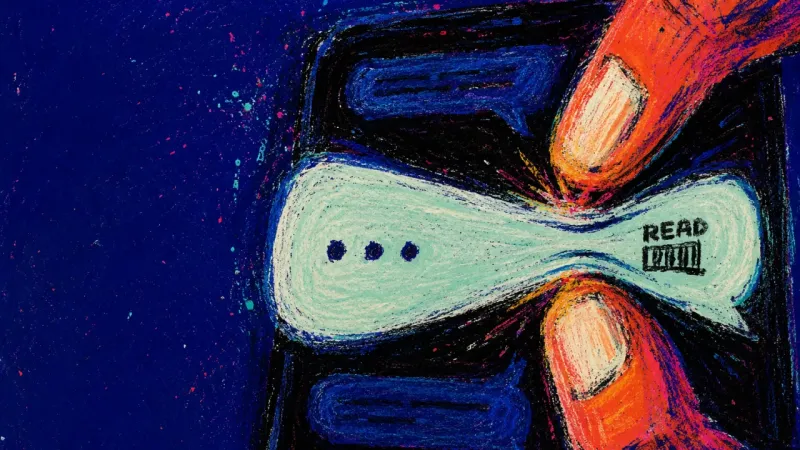
The Read-Receipt Math at 10:43 p.m.
Jordan told me they had a very specific kind of post-message regret: the kind where your thumb keeps opening the same thread like it’s a door you can’t stop checking.
They were 27, Toronto-based, early-career, hybrid office—exactly the demographic that lives inside Slack etiquette and iMessage group chats at the same time. “After I disagree in the group chat,” they said, “I spiral. Like… instantly.”
As they spoke, I could almost see the scene they were describing: 10:43 p.m. in a Toronto apartment, propped against the headboard, phone on low battery, that cold white screen-glow drying your eyes out. The radiator clicks like it’s keeping score. Cars on Queen St. whoosh by like the world is still moving, while you’re rereading one sentence as if it’s evidence.
Jordan’s body described dread more clearly than their words did: tight stomach, warm face, a buzzing urge in their hands to pick up the phone again. It wasn’t “anxiety” in the abstract—it was like their nervous system had turned their phone into a smoke detector that wouldn’t stop chirping.
“I should have just kept it to myself,” they admitted, staring at the table between us instead of my eyes. “What if it came off rude? I can already tell they’re annoyed. I need to fix this before it gets weird.”
I nodded slowly, letting the silence do some work. “We can work with this,” I said, warm but direct. “Not by trying to write the perfect follow-up. By getting clarity on what’s actually happening in the aftermath—what your mind is doing, what your body is doing, and what you can do next time without losing yourself to the thread.”

Choosing the Compass: The Transformation Path Grid (6)
I asked Jordan to take one breath that was slightly longer on the exhale—nothing mystical, just a clean physiological handbrake. While I shuffled, I had them hold the question in plain language: “After I disagree in the group chat, why does my overthinking spiral?”
For this kind of modern trigger—group chat anxiety, read receipt obsession, the “typing dots as a full-body experience”—I use a spread I built for exactly this: the Transformation Path Grid (6) · Context Edition. It’s a tarot spread for anxiety after conflict that moves from the visible moment (what you do with your phone) to the mental habit underneath, to the deeper fear that keeps it alive—then back into an actionable shift.
I like it because it separates the symptom from the engine. Position 1 shows the spiral as it happens. Position 2 names the block that keeps you stuck. Position 3 reveals the deeper driver—usually a belonging fear wearing a logic costume. Then Position 4 is the pivot: the inner resource that stops the loop without needing the group to reassure you. Position 5 gives a concrete communication move you can use this week, and Position 6 shows what integration actually feels like in real life.

Reading the Map: When Thinking Turns on You
Position 1 — The observable moment of the spiral
“Now the card we’re turning over represents the observable moment of the spiral: what you do and think immediately after disagreeing in the group chat,” I said.
Nine of Swords, upright.
The image is brutal in its simplicity: someone sitting up in bed, face in hands, like sleep is being held hostage by their own mind. “This is the moment right after you hit send,” I told Jordan, “when you put the phone down, pick it back up, reopen the thread, reread your wording… then reread it again like you’re trying to find the one phrase that’ll get you convicted of being ‘rude.’”
The energy here is excess Air—thoughts racing so far ahead of reality that the mind becomes a courtroom, and you’re both defendant and prosecutor. The chat hasn’t even done anything yet, but your body braces as if the verdict is already being written.
Jordan let out a small laugh that didn’t reach their face. “That’s… yeah. That’s exactly it,” they said, and the laugh tipped into something bitter. “It’s accurate in a way that’s kind of rude.”
I softened my voice. “It’s not rude. It’s precise. And precision is how we stop blaming your personality and start naming the pattern.”
Position 2 — The mental habit that keeps the loop running
“Now the card we’re turning over represents the mental habit that turns a simple disagreement into an all-night loop,” I said.
Two of Swords, reversed.
In the classic image, a blindfolded figure holds two swords crossed over their chest. Upright, it can be a calm pause. Reversed, that pause becomes agitation—like you’re stuck at a loading screen and your whole system treats it as an emergency.
“This shows up as the inability to let the chat be unresolved for even a few hours,” I told Jordan, using their exact lived rhythm. “Draft a clarification. Delete it. Open the chat. Check who’s online. Scan reaction emojis. Draft again.”
I heard my old cruise-ship training voice in my head—nights on the Atlantic where guests would try to ‘fix’ awkwardness by talking faster, smiling harder, filling every gap. The ocean taught me something group chats don’t: gaps are normal. Your nervous system just hates them.
“Read receipts aren’t reassurance. They’re just data your nervous system is trying to turn into safety,” I added, watching Jordan’s shoulders climb a millimeter as if the line touched something true.
The energy here is blockage through uncertainty intolerance. Not knowing becomes unbearable, so the mind tries to manufacture certainty through monitoring. And that’s the trap: the checking gives a tiny hit of relief, but it also trains your brain that ambiguity equals danger.
Jordan nodded once—tight, almost reluctant. Their fingers worried the edge of their sleeve like they were trying to hold their own hands still.
“You’re not overthinking the message—you’re trying to over-control the uncertainty,” I said. “That’s a different problem. And it has different solutions.”
Position 3 — The deeper fear and projection beneath the surface
“Now the card we’re turning over represents the deeper fear and projection that fuels the spiral—especially around belonging and being judged,” I said.
The Moon, upright.
The Moon is where the mind fills missing data with stories. It’s not that you’re irrational; it’s that you’re human with an imagination in a dark hallway. In group chat terms: one delayed reply becomes “they’re annoyed,” a subject change becomes “they’re icing me out,” a neutral emoji becomes “I’m the difficult one.”
I leaned in slightly. “Let’s do it in two columns,” I said, keeping it grounded and practical.
What you know: you disagreed. The thread went quiet for a bit. People replied to other messages. No one explicitly said you were rude.
What you’re guessing: they’re screenshotting. They’re side-chatting. You’ve been demoted from ‘thoughtful’ to ‘difficult.’
Jordan’s gaze unfocused for a second—the way it does when someone is rewatching a scene from last week in their head. Then they swallowed. “The guessing feels… like knowing,” they said quietly. “Like I can already feel the vibe shift.”
“That’s The Moon’s specialty,” I replied. “It makes a story feel like a fact because your body is reacting to the possibility of exile.”
When Strength Put a Hand on the Phone
Position 4 — The inner resource that stops feeding the spiral
I paused before turning the next card. The room felt quieter, as if even the city outside had lowered its volume for a second.
“Now the card we’re turning over represents the key inner resource you can access in the moment to stop feeding the spiral—without needing external reassurance,” I said. “This is the turning point.”
Strength, upright.
Jordan’s whole pattern snapped into focus: 11:22 p.m. on a quiet Sunday, the thread glowing back at you, no new pings—just your own message and that electric urge to ‘fix it’ before anyone decides you’re too much.
Stop trying to win the chat’s approval and start calming your nervous system with gentle strength, like the woman who steadies the lion without forcing it.
I let the sentence hang there like a bell tone. Jordan’s reaction came in a chain, not a single beat: first, a tiny freeze—breath held, eyes widening just slightly. Then, a cognitive seep—their gaze dropped to their hands as if they were noticing, for the first time, how hard they’d been gripping their own phone every night. And then, an emotional release—one slow exhale that sounded like surrender and relief at the same time.
“But if I don’t smooth it over,” they said, and I heard a flash of anger under the fear, “doesn’t that mean I’m just… leaving it there? Letting them think whatever?”
I met that honestly. “It means you’re changing how you take care of yourself,” I said. “Not abandoning kindness. You’re moving from bargaining to self-trust.”
On cruise ships, I used to teach what I called Social Role Switching—not in a fake way, but as a conscious choice: different scenarios require different internal modes. A chaotic crowd? You go into calm leadership. A nervous guest? You go into warm listening. A boundary moment? You go into clear, slow, contained speech.
“Right now,” I told Jordan, “your brain goes into what I’d call PR Mode: fix the vibe, manage perception, over-explain. Strength is a different switch. Strength is Supportive Mode for your own nervous system. It’s you putting a hand on the lion—except the lion is the surge in your chest, and the hand is a simple, non-dramatic pause.”
I pointed to the lion’s mouth in the card. “This isn’t domination. It’s gentle restraint. In real life it looks like ‘hand on the phone’ energy: feet on the floor, shoulders down, three slow exhales before you even decide whether to reopen the thread.”
Then I gave them a pivot question, the kind Jung would’ve approved of because it turns the light inward without judgment: “When you reopen the thread, are you looking for information—or are you trying to force a feeling of safety?”
Jordan’s eyes went glossy, not in a dramatic way—more like their body had finally been named correctly. “I’m trying to force safety,” they whispered. “And it never works.”
I nodded. “That’s the shift right there. This isn’t about becoming someone who doesn’t care. It’s about becoming someone who can hold a little ambiguity without turning it into a trial.”
I offered them the micro-practice embedded in this card, exactly as an experiment: “Try the 30-Minute Notes Draft once this week. When you feel the urge to clarify, set a 30-minute timer. Write a two-sentence version in Notes, but do not send it until the timer ends. If your body gets more activated, you’re allowed to stop and put the phone face down. The point isn’t to force calm—it’s to stop feeding the loop.”
I watched Jordan take another breath and then asked, gently but specifically: “Now, with this new lens—was there a moment last week when you could feel the spiral recruiting you? A delayed reply, a weird emoji, the chat moving on?”
They nodded immediately. “Tuesday. Someone reacted to someone else with a laughing emoji and my brain decided it was about me.”
“That’s The Moon,” I said, “and Strength is how you don’t obey it.”
What I saw, right then, was the emotional transformation beginning: from dread-and-shame under ambiguity to the first flicker of grounded self-trust—small, but real.
The Queen’s One Clean Blade: Clarity That Doesn’t Spiral
Position 5 — A concrete communication and boundary move within a week
“Now the card we’re turning over represents the concrete communication and boundary move you can take within a week,” I said.
Queen of Swords, upright.
I’ve always loved how the Queen holds her sword: upright, visible, not hidden behind a smile. She’s not cruel—she’s contained. And for someone who over-explains, containment is kindness.
“Within a week,” I told Jordan, “this looks like one clean follow-up at most. If you truly need to clarify, you send one short message that states your point once—then you step away for a set time.”
I gave them the line I’ve watched save people from essay-mode more times than I can count: “Clarity can be short. Repair doesn’t have to be long.”
This is where my old maritime protocol comes in. On ships, there’s a social rule that keeps peace in tight quarters: you don’t chase people down the hallway to correct a vibe. You make one clean, respectful statement—and then you let the corridor breathe.
“I also want you to borrow a script,” I said, switching into my Cruise Intuition Trainer practicality. “Because when you’re activated, you don’t need more creativity—you need something ready-to-use.”
For a work Slack moment, I offered an Assertive Mode version: “I hear you. My concern is X. I’m good to leave it there unless we need to adjust the plan.”
For a friend chat, a softer closure: “I see it differently, but I get your point. Happy to leave it there.”
“One message,” I said. “One reread. Then close the tab—literally.”
Leaving the Chat Courtroom
Position 6 — What integration looks and feels like
“Now the card we’re turning over represents how it feels when you can disagree and then mentally move on without self-punishing,” I said.
Six of Swords, upright.
This card doesn’t promise the thoughts disappear. The swords are still in the boat. But the boat moves anyway—toward calmer water.
“Integration looks like disagreeing and then returning to your life,” I told Jordan. “You close the app, make dinner, answer one work email, go for a short walk—without the thread pulling you back every ten minutes.”
I added, because it matters: “You can be a good person and still be briefly misunderstood.”
Jordan looked at the card for a long moment and then said, almost surprised, “That sounds… quiet.”
“Yes,” I said. “Quiet is the proof.”
From Insight to Action: Next Steps for Overthinking Texts
I pulled the whole spread together for Jordan in one clean storyline: the Nine of Swords showed their immediate rumination—thoughts pinning them to the bed. The Two of Swords reversed named the true blockage: the inability to tolerate the pause, so the mind turns silence into an emergency and tries to solve it with checking. The Moon revealed the deeper engine—projection and mind-reading driven by belonging fear. Strength offered the antidote: regulate first, don’t bargain with the chat for safety. The Queen of Swords gave the behavior change: one clean message at most, then stop. And the Six of Swords promised a realistic outcome: thoughts still exist, but they stop steering.
The cognitive blind spot was clear: Jordan wasn’t spiraling because they were “bad at texting.” They were treating ambiguity like a social evacuation alarm—then trying to earn safety through perfect wording. The transformation direction was equally clear: shift from controlling others’ reactions to practicing a structured pause and a calm boundary.
I gave Jordan a small set of experiments—nothing heroic, just actionable advice they could actually do in Toronto life, on the TTC, in a hot-desk office, on a Sunday night.
- The 30-minute no-check windowNext time you disagree in a group chat, set a 30-minute timer. During the timer, you’re allowed to draft in Notes, but you’re not allowed to reopen the thread.If 30 feels impossible, start with 10. This is nervous-system training, not a willpower test.
- Two-sentence Notes draft (then decide)Write a two-sentence version in Notes: (1) one clear point, (2) one respectful closure line like “Happy to leave it there.” Only send after the timer ends—and only if it’s truly needed for logistics or genuine repair.If you’re drafting to stop the dread, you’re not drafting—you’re bargaining. Put the phone face down and do three longer exhales first.
- One-message / one-reread ruleIf you choose to follow up, send one clean clarification. Read it once. Then log off (mute the chat for one hour if you need a barrier).Try it for one week as an experiment. You’re collecting evidence that nothing explodes when you stop performing reassurance-seeking.

A Week Later: The Quiet Proof
About a week later, Jordan sent me a message that was almost disappointingly ordinary—which is exactly what I wanted.
“I did the timer,” they wrote. “Drafted two sentences in Notes. Didn’t send. Muted the chat. Nothing exploded. I still felt weird for a bit… but then I made pasta and watched one episode of The Bear without checking my phone every ten minutes.”
It was that specific kind of bittersweet progress: steadier, but not magically fearless. Clear, but still human. They didn’t sound euphoric. They sounded like someone who had moved one inch closer to their own center.
That’s what this Journey to Clarity looks like to me as a Jungian psychologist who reads Tarot: not a personality overhaul, but a new relationship with uncertainty—one where you can speak up honestly and then let the chat be a tool, not a scoreboard for belonging. And if you ever want a structure for it, the Transformation Path Grid (6) tarot spread for post-conflict rumination is one of the cleanest maps I know.
When you disagree and the chat goes quiet, it can feel like your body is bracing for exile—like one imperfect sentence could cost you your place with people you care about.
If you didn’t have to earn safety with a perfect follow-up, what small pause or boundary would you want to try the next time you hit send?
This story is adapted from psychological research, written so that those in a similar struggle can see their own pattern in it — and find their next step clearly.These insights are not a substitute for professional psychological, medical, legal, or financial advice.
Learn more about our Journey to Clarity.
How did this insight land for you?
🫂 This Resonates Deeply
🌀 Living This Story
✨ Now I See Clearly
🌱 Seeing New Possibilities
🧰 Useful Framework
🔮 The Confirmation I Needed
💪 Feeling Empowered
🚀 Ready for My Next Step
Author Profile
 AI
AI“Having traveled across cultures... I've learned that what we often lack isn't a simple answer, but a moment of being truly understood. I use a Jungian psychological lens to help you deconstruct your subconscious patterns—not to prove anything, but to be the gentle companion who helps you unravel your knots, free of judgment, so you can reconnect with your inner wisdom.”
In this Friendship Tarot Reading :
Core Expertise
- Guilt-Trip Deconstruction: Uncovering the subconscious codependency that forces you to act as an unpaid 'emotional dumping ground' for friends.
- Savior Complex Auditing: Identifying whether your inability to set boundaries stems from a deeply ingrained psychological need to 'fix' others.
Service Features
- The Compassionate Detachment Protocol: A psychological boundary script to validate a friend's emotions while firmly refusing to absorb their psychological toxic waste.
Also specializes in :
Explore Related Patterns:
Anxiety SpiralJordan puts the phone down, picks it back up, reopens the thread, and rereads the same sentence as if one phrase could explain the whole social verdict. The body is already activated, the screen becomes a threat cue, and the mind starts treating a normal disagreement like an unresolved case that has to be solved before sleep is allowed. That is the engine of an anxiety spiral: a loop where threat detection, rereading, and imagined consequences feed each other faster than reality can update. You are not simply thinking too much; your nervous system is using thought as an emergency response, trying to regain safety by prosecuting your own wording. The pattern becomes especially sticky because the group chat offers partial signals but no clean closure. Silence, timing, and unreadable reactions keep the loop open, so the mind keeps returning to the thread as if one more check will finally settle the question of whether you still belong.
Certainty SeekingJordan drafts a clarification, deletes it, checks who is online, scans the reaction emojis, and then starts the cycle again. The visible behavior looks like trying to communicate better, but the deeper function is trying to turn an unresolved social pause into something measurable, controllable, and finished. Certainty seeking shows up when not knowing feels more threatening than the disagreement itself. You start treating read receipts, response timing, and emoji choices like evidence because the nervous system wants a final answer: are we okay, or am I in trouble? The trap is that group chats rarely provide the kind of certainty the loop demands. Each scan gives a small hit of relief, but it also teaches the brain that ambiguity is dangerous enough to monitor, which makes the next silence feel even harder to tolerate.
Compulsive CheckingJordan's thumb keeps opening the same thread like a door they cannot stop checking, even after the phone has already been put down. The repeated action is concrete: reopen, reread, scan, close, feel the surge again, reopen again. Compulsive checking works as a short-term safety behavior. You check because the body wants relief now, and for a moment the act of checking can feel like doing something responsible. But the relief is brief because the check does not answer the deeper question: whether disagreement has changed your standing with the group. Over time, the checking trains the threat system to treat the thread as the place safety must be confirmed. That is why the phone starts feeling less like a tool and more like a scoreboard for belonging.
Reassurance SeekingJordan says they need to fix the message before it gets weird, then later recognizes that reopening the thread is less about gathering information and more about forcing a feeling of safety. The follow-up impulse is not only about clarity; it is an attempt to get the group to regulate the dread. Reassurance seeking turns other people's signals into the thing that decides whether you can calm down. You look for proof that the group still sees you as thoughtful, kind, or acceptable, and the absence of that proof feels like danger. The problem is that reassurance outsourced to a chat thread is unstable by design. Even if one message calms you for a moment, the next pause can reopen the question, because the deeper skill is learning how to self-stabilize without needing the group to certify that you are safe.
Threshold ToleranceThe 30-minute no-check window gives Jordan a structured way to let the chat remain unresolved without immediately reopening it. The point is not to force instant calm; it is to stop teaching the nervous system that every pause requires an emergency response. Threshold tolerance is the capacity to stay present while uncertainty remains unfinished. You practice holding the discomfort of not knowing what everyone thinks, without converting that discomfort into checking, overexplaining, or self-erasure. In this case, the skill directly addresses the spiral's engine. The chat can stay quiet for a while, and your system can learn that quiet is not the same thing as danger.
CatastrophizingThe chat has not explicitly rejected Jordan, but the body braces as if the verdict is already being written. One imperfect sentence starts to feel like it could cost them their place with people they care about. Catastrophizing is the jump from social ambiguity to worst-case consequence. You are not only worried that the message landed badly; the mind escalates the possibility into exile, status loss, or being permanently reclassified as difficult. That escalation makes the loop feel urgent. If the imagined cost is belonging itself, then checking, clarifying, and overexplaining can start to feel like survival moves rather than optional responses.
Emotional ReasoningJordan's tight stomach, warm face, and buzzing hands arrive before anyone in the group chat actually says something is wrong. Then the felt sense of a vibe shift starts behaving like evidence, as if the body's alarm can confirm what the group secretly thinks. Emotional reasoning happens when the intensity of a feeling gets mistaken for the accuracy of a conclusion. You feel exposed, so the mind concludes you must have done something socially unsafe; you feel dread, so the chat must be turning against you. The important distinction is that the feeling is real, but the conclusion still needs testing. When the body reacts to the possibility of exclusion, it can make a guess feel like knowledge before the facts have caught up.
Mind ReadingOne delayed reply becomes “they're annoyed,” a subject change becomes “they're icing me out,” and a neutral emoji becomes “I'm the difficult one.” Nothing in the chat explicitly says Jordan was rude, but the mind starts filling missing social data with a complete story of hidden judgment. Mind reading is the cognitive shortcut that makes the spiral feel convincing. You are not just wondering what others think; you begin acting as if their private reactions are already knowable through timing, silence, or tone. This pattern is powerful because it turns ambiguity into apparent intimacy with other people's thoughts. The group never has to reject you out loud for your body to start bracing as if the rejection has already happened.
Defensive OverexplainingJordan's brain moves into PR Mode: fix the vibe, manage perception, over-explain. The repeated drafting and deleting is not just editing; it is a defensive attempt to make the disagreement impossible to misread. Defensive overexplaining uses extra words as a shield against being judged. You may tell yourself you are being clear, but the emotional job of the message is to prevent anyone from deciding you were rude, difficult, or too much. The loop becomes costly because repair turns into bargaining. Instead of one clean clarification, the mind keeps searching for the perfect sentence that will remove all possible discomfort from the room, which no sentence can realistically do.
Assertive CommunicationJordan is given one clean follow-up at most: one clear point, one respectful closure line, one reread, then stepping away. The communication move is intentionally short because the problem is not a lack of words; it is the use of extra words to chase safety. Assertive communication lets you disagree without turning the aftermath into a performance of innocence. You can state your concern, acknowledge the other view, and leave the conversation open enough for other people to have their own reactions. The boundary is subtle but important. Clear does not have to mean exhaustive, and repair does not have to become a full campaign to manage how everyone sees you.
Self-SoothingJordan is guided to use a longer exhale, feet on the floor, shoulders down, and the phone face down before deciding whether to reopen the thread. The intervention starts in the body because the spiral is not only cognitive; it is a nervous-system surge looking for somewhere to go. Self-soothing is the move from asking the chat to make you safe to giving your own system a first layer of containment. You are not abandoning the conversation; you are refusing to let activation make the next decision for you. The Notes draft works because it gives the urgency a place to land without feeding the loop. You can write the sentence, wait, and then decide from a steadier state whether communication is actually needed.
Explore Related Struggles:
Approval-Safety FusionJordan names the impulse clearly. If they do not smooth it over, maybe they are leaving the group to think whatever they want. The old move is PR Mode, fixing the vibe, managing perception, and over-explaining. You are trying to make the group's approval do the work of inner steadiness. That makes every delayed reaction feel personal, because safety is being outsourced to whether other people seem comfortable with what you said. The shift toward self-trust matters because approval is too unstable to use as a home base. A clean disagreement can be kind without becoming a campaign to make everyone read you correctly.
Certainty-Safety FusionThe thread goes quiet for a few hours, and Jordan's whole system treats the unresolved gap like an emergency. Draft, delete, check who is online, scan the emoji reactions, draft again. The pause is no longer just a pause. It becomes a demand for a verdict. You are trying to make uncertainty stop moving. The problem is that group chats rarely provide clean emotional closure on command, so the mind starts treating certainty as the only acceptable form of safety. The spiral keeps feeding itself because every unanswered cue asks for another check. Until ambiguity can be held without being converted into danger, the phone keeps looking like the place where safety might finally appear.
Monitoring-Safety FusionJordan's thumb keeps opening the same thread like a door they cannot stop checking. The phone goes down, comes back up, and the wording gets reread as if read receipts, online status, and reaction emojis might finally release the pressure. You are not only looking for information. You are trying to force a feeling of safety through monitoring, and the tiny relief from checking teaches the loop to ask for more. That is why the behavior feels urgent even when nothing new has happened. The more the chat is watched, the more powerful it becomes as a safety device, until stepping away feels like leaving the social situation unattended.
Read Receipt Worth LockJordan's night gets organized around tiny digital signals like read receipts, online status, reaction emojis, typing gaps, and the absence of new pings. The chat stops being a tool and starts acting like a scoreboard. You are trying to read your standing through interface crumbs. A receipt or emoji cannot actually measure whether you are valued, but the spiral treats those signals as if they can locate your place in the group. This lock is especially sticky because the evidence looks objective. The screen gives you data, but the data gets recruited into a worth-and-belonging trial that the group never formally opened.
Truth-Connection SplitJordan disagrees in the group chat, then immediately wants to rewind the act of speaking. The message itself becomes a place where honesty and connection collide, because a simple difference of opinion starts to feel like a threat to how the group will hold you. You are not just rereading a sentence for grammar. You are carrying the friction between wanting to be clear and wanting to stay acceptable, so every possible wording error starts to look like social evidence. The struggle is that your voice feels safest when it stays invisible, but the relationship only stays real if it can survive a clean disagreement. That is why the spiral starts after you speak, not before. The moment you become visible, connection feels negotiable.
All-or-Nothing BelongingJordan's body reacts as if one imperfect sentence could cost them their place with people they care about. The imagined demotion from "thoughtful" to "difficult" turns a small disagreement into a binary membership test. You are not simply worried that someone might disagree back. You are carrying the sense that belonging can flip all at once, so a quiet chat starts to feel like the first sign of social exile. That is why the spiral has such force. If belonging feels all-or-nothing, then no amount of rereading can feel neutral. Every clue becomes evidence for whether you are still safely inside the group.
Projection-Connection SplitOne delayed reply becomes "they're annoyed," a subject change becomes "they're icing me out," and a neutral emoji becomes "I'm the difficult one." Jordan separates what they know from what they are guessing, then admits that the guessing feels like knowing. You are watching missing data turn into social narrative. The group has not actually delivered a verdict, but the mind fills the blank space with a story about connection being withdrawn. The core struggle is not imagination itself. It is the moment imagination starts standing in for relationship evidence. Once the projection feels like proof, every silence becomes harder to survive without checking or repairing.
Explore Related Emotions:
Ambiguity DreadJordan knows only a few concrete facts: they disagreed, the thread went quiet, people replied to other messages, and no one explicitly called them rude. The mind fills the space between those facts with screenshots, side chats, vibe shifts, and demotion from thoughtful to difficult. Ambiguity Dread names the bodily pressure of that gap. You are meeting uncertainty as if it is already evidence, so the pause becomes heavier than the actual message and the unread social meaning starts to feel more real than what anyone has said.
Approval AnxietyJordan names the urge plainly: fix the vibe, manage perception, over-explain, smooth it over before anyone decides they are too much. The imagined group reaction starts making decisions for them before any actual reply arrives. Approval Anxiety sits in that handoff of authority. You are trying to get the chat to confirm that disagreement has not made you less acceptable, so every follow-up draft becomes less about clarity and more about earning permission to have spoken.
Conditional Belonging FearWhen the chat goes quiet, one imperfect sentence starts to feel like it could cost Jordan their place with people they care about. A delayed reply, a neutral emoji, or the conversation moving on gets read as evidence that belonging has become provisional. Conditional Belonging Fear names the deeper weather under the overthinking. You are not simply worried about a wording issue; you are bracing for the possibility that connection depends on never creating friction, never sounding difficult, and never taking up too much space.
Read Receipt AnxietyAt 10:43 p.m., the phone is low battery, the screen is cold, and the same thread keeps reopening under Jordan's thumb. Read receipts, silence, online status, and reaction emojis become a private dashboard where every tiny signal feels like it might reveal whether the group is safe to return to. Read Receipt Anxiety fits because the body is treating interface data as emotional proof. You are not only waiting for a reply; you are trying to make a device answer a relational question it cannot answer: am I okay with these people after I disagreed?
Shame SpiralJordan looks down at the table and says they should have kept it to themselves, then replays the message to find the phrase that might prove they were rude. The more they search, the more the sentence becomes a mirror for whether they were wrong to speak at all. Shame Spiral fits because the review does not stay attached to the message; it folds inward toward the self. You are not only asking whether the wording landed badly, you are starting to treat a disagreement as evidence that something about your presence in the group needs correcting.
Verdict DreadThe story keeps returning to courtroom language: one sentence becomes evidence, the mind becomes prosecutor and defendant, and the body braces as if the verdict is already being written. The chat has not judged Jordan, but the silence is experienced like a deliberation room. Verdict Dread captures the pressure of waiting to be defined by other people's reaction. You are not just concerned about the conversation; you are sitting inside an imagined ruling on whether you were reasonable, rude, thoughtful, or difficult.
Certainty HungerJordan drafts, deletes, opens the chat, checks who is online, scans reaction emojis, and drafts again before the group has given any clear sign of conflict. The behavior is not random; it is an attempt to turn fragments into enough certainty to let the body stand down. Certainty Hunger is the craving beneath the checking. You are not looking for more information because the thread is rich with facts; you are looking for the one signal that would end the suspense and let you stop managing the unknown.
Conflict HangoverJordan hits send, puts the phone down, picks it back up, reopens the thread, and rereads the same sentence as if the disagreement is still happening in the room. The conflict is no longer limited to the message; it leaves an afterimage in the body, in the night, and in every tiny pause from the group. Conflict Hangover names that post-disagreement residue: the way a simple difference of opinion keeps producing heat after the conversation has technically moved on. You are not just replaying words for accuracy; you are carrying the social impact of speaking up and trying to discharge it before it hardens into awkwardness.
Cautious Self-TrustA week later, Jordan drafts two sentences, does not send them, mutes the chat, makes pasta, and watches one episode without checking every ten minutes. The progress is ordinary and slightly weird-feeling, which is exactly why it is credible. Cautious Self-Trust fits because the center of safety starts moving back inside the person rather than staying outsourced to the thread. You still notice the discomfort, but you no longer have to bargain with the chat for permission to be okay.
Hard-Won ComposureJordan's shift begins in small physical moves: one longer exhale, a hand on the phone, feet on the floor, a Notes draft held for 30 minutes instead of sent immediately. Nothing dramatic is required; the body gets a slower sequence before the thread gets another chance to pull them in. Hard-Won Composure names the steadiness that has to be practiced under real pressure. You are not becoming indifferent to the group; you are learning to hold the surge long enough to choose a response instead of handing the next move to the spiral.
Explore Related Contexts:
Group Chat TribunalJordan rereads their wording like evidence, watches the thread for reactions, and imagines that one delayed reply or neutral emoji could prove they came off wrong. The group chat becomes a public room where the message is not just communication; it is a visible record of whether they have stayed acceptable to the group. You are facing the social architecture of the thread, not just a private thought spiral. Everyone can see the disagreement, the silence, the timing, and the eventual replies, which makes the channel feel less like a conversation and more like a place where social standing can be judged without anyone naming the judgment. That is the tribunal effect. No one needs to accuse you for the room to feel evaluative; the combination of visibility, delayed response, and group audience is enough to make one sentence feel like it is on trial.
Read Receipt PressureJordan puts the phone down, picks it back up, reopens the same thread, checks who is online, scans reaction emojis, and rereads one sentence as if the interface can reveal whether the disagreement has damaged their standing. The pressure does not come from the message alone; it comes from a platform environment that keeps producing partial signals while withholding any clear social answer. You are not dealing with a neutral chat window here. Read receipts, delayed replies, and online status turn into a scoreboard that looks measurable but cannot actually tell you whether people are annoyed, thoughtful, busy, distracted, or simply done talking for the night. That is why the spiral has so much fuel. The more the thread offers tiny pieces of data, the more it invites interpretation, and the more interpretation makes the phone feel like the only place where safety might be confirmed.
Silent Evaluation PeriodAfter Jordan disagrees, the thread goes quiet, people reply to other messages, and no one explicitly says the message was rude. That gap creates a suspended social period where nothing has been confirmed, but the absence of confirmation starts acting like information. You are placed in a waiting room built out of silence. The group has not rejected the message, yet the delayed response creates enough ambiguity for every small cue to become part of an unofficial evaluation. The spiral intensifies because the situation has no clean endpoint. Until someone replies, reacts clearly, or changes the subject in an unmistakable way, the mind keeps trying to close a social file that the group chat has left open.
Conditional Belonging PressureJordan says they can already tell people are annoyed, worries they have been recoded from thoughtful to difficult, and feels pulled to fix the message before the chat gets weird. The disagreement lands inside a social field where belonging appears conditional on being agreeable, smooth, and easy to keep in the group. You are not simply trying to win an argument. You are trying to protect your place in a group that suddenly feels less stable because the rules of acceptance seem tied to tone, timing, and whether anyone has to sit with your difference. This pressure explains why the reaction feels bigger than the sentence itself. When belonging feels conditional, a quiet thread is not just a quiet thread; it becomes a possible sign that one honest disagreement has changed your category in the group.
Unspoken Social RulesJordan lives between hybrid-office Slack etiquette and iMessage group chat culture, where disagreement has to be direct enough to be honest but soft enough not to be read as rude. No one hands them a rulebook for how long to wait, how much to clarify, or when silence means nothing. You are navigating an etiquette system that operates through implication. The rules are social, fast-moving, and mostly unwritten, so the thread forces you to infer meaning from timing, emojis, subject changes, and whether anyone picks up your point. That hidden-rule environment makes overthinking feel useful even when it drains you. If the rules are never stated, the mind keeps scanning for them after the fact, trying to reverse-engineer what a socially acceptable disagreement was supposed to look like.