The Rainy Tuesday When Quiet Slack Felt Like a Verdict
Before I even reached for the deck, I said what I have learned to say when a career reading walks in wearing the face of competence and the nervous system of a fire alarm: if you are a late-20s project person on a hybrid tech team, and a slow Slack afternoon makes you check the green dots like a pulse check, you are not being dramatic. You are usually standing inside productivity-based self-worth.
Alex nodded from her kitchen table in East London. Rain streaked the window behind her. Slack was pinned on the left side of her laptop; a Jira board glowed on the right. I could hear the radiator clicking through my headphones. Her coffee had gone cold. The light from the screen was a little too bright, the way it always is when a quiet day at work starts to feel accusatory. She glanced offscreen, then back at me, and said, “If nobody needs me all day, I start wondering what I am even doing here.”
I watched the sentence land in her body before it fully left her mouth: shoulders rising, chest tightening, that tiny hollow drop low in the stomach that comes when no notification appears and the brain decides silence must mean something personal. The shame in her voice felt like a lift dropping one floor inside her ribs every time the chat stayed still. I told her, gently, that this did not sound like laziness or lack of talent. It sounded like work validation anxiety — the kind that uses Slack notifications like a heartbeat monitor for your value. “Let’s draw a map for the fog,” I said. “We’re not here to make you more indispensable. We’re here to find clarity.”

Choosing the Crossbeam: A Five-Card Cross for Career Self-Worth
I asked Alex to put one hand over the center of her chest, take one slow breath, and hold the question in plain language: why do I feel useless at work when my team doesn’t need me? Then I shuffled slowly, not for theatre, but for focus. I have spent years guiding people beneath artificial night skies in a Tokyo planetarium, and I trust simple rituals for the same reason I trust a darkened dome before a constellation appears: the mind needs a threshold.
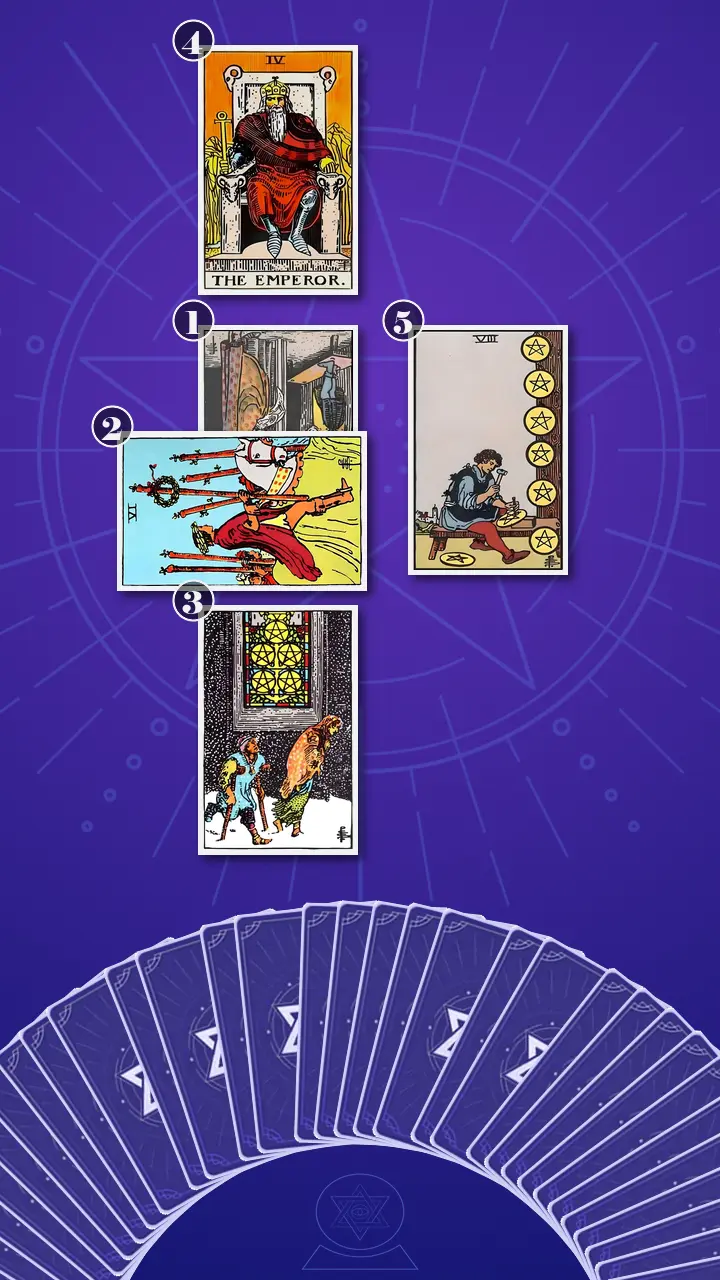
For a question like this, I use a Five-Card Cross tarot spread for career self-worth and workplace validation anxiety. I did not need a heavier spread. A Celtic Cross would have added more weather than this sky required. What mattered here was the chain itself: the present symptom, the pressure point, the deeper wound, the corrective principle, and the habit that could make the insight livable. The cross shape is especially useful when someone feels caught between external team dynamics and internal worth; it lets me show exactly where those lines intersect.
I told her how I would read it. The center card would show the surface pattern — what actually happens in the first minutes of a quiet work block. The crossing card would reveal the active tension that makes the moment sting harder than it needs to. The lower card would uncover the root driver underneath the productivity story. The upper card, our key card, would offer the stabilizing principle. And the card to the right would show the next steps: how insight turns into muscle memory.
Reading the Threads Beneath the Thread
Position 1: The Blueprint You Keep Reopening
I turned over the first card and said, “Now I’m opening the card that shows the surface workplace pattern — what happens when quiet periods or low team dependency trigger the feeling of uselessness.” It was the Three of Pentacles, reversed.
I know this card well in career readings. Reversed, it often shows blocked earth: contribution exists, but the sense of place inside the structure is unstable. I showed Alex the image and translated it into her actual life. A project brief sits live in Notion. Engineering has moved. Design has left comments. Nobody tagged her. The spike hits immediately, and she jumps in with extra edits or a quick ‘happy to help’ message — not because the task truly needs her, but because visible involvement briefly reassures her that she still has a place in the build.
“Yes,” she said, and then gave a short, bitter laugh. “That’s accurate to the point of being rude.”
I smiled. “The card is not calling you needy. It’s showing me that your role starts feeling unreal unless you can see yourself reflected in the group project in real time.” The reversal mattered. This was not a lack of skill. It was a blockage in belonging through structure. She was rereading team threads for proof of where she fit, treating normal teammate autonomy as evidence that the blueprint no longer included her.
I watched her rub her thumb along the rim of her mug. That tiny motion told me the card had already pierced the surface.
Position 2: The Private Scoreboard
I moved to the crossing card. “This position reveals the active challenge — the habit of using visible recognition and demand from other people as a measure of worth.” The card was the Six of Wands, reversed.
This is where blocked fire turns inward and starts grading you. I told Alex that the raised wand and cheering crowd in this card, when reversed, become something painfully modern: a private performance dashboard made of Slack mentions, follow-up asks, meeting shout-outs, reaction emojis, and whether anyone publicly thanks you for something. On a slow afternoon, the loop can get brutally clean: Nobody asked for me. Nobody mentioned me. Did I even matter today?
I could see her face tighten before she answered. “The private scoreboard part is exactly it.”
“That’s the pressure point,” I said. “Not simply being useful, but being witnessed being useful.” I told her that this card often shows excess effort built on deficient self-trust: speaking just to be seen, rewriting status updates so the contribution sounds more central, offering too much on the next task because the last quiet hour felt like failure. “A quiet inbox is not a character reference,” I said. “And if your worth only shows up in emergencies, your nervous system never gets a quiet day.”
She winced, then let out a long breath through her nose. Her hand fell away from the mug. That was the sound of a defense loosening.
Position 3: The Lit Window You Assume Is Closed
I turned the third card. “This one sits underneath everything. It shows the deeper fear — the part of you that hears quiet and translates it into exclusion, replaceability, or lack of worth.” The card was the Five of Pentacles, upright.
The room changed when this card appeared. The Five of Pentacles always asks me to stop talking about efficiency and start talking about belonging. I told Alex that this was the image of having the job, the salary, the manager’s trust, the valid ticket — and still emotionally feeling as if she had been left at the gate. The glowing window in the card is the support already nearby. The cold outside is the shame story that makes support hard to register.
“Nothing is technically wrong,” I said, “and that’s part of why it hurts so much. You’re not reacting to an actual firing. You’re reacting to the feeling of standing outside a lit office window while everyone else seems already inside.” For a second it reminded me of the emotional atmosphere of Severance — not because her workplace was sinister, but because ordinary silence had become alienation inside her own interpretation of it.
Alex went very still. Her throat moved once before she spoke. “That’s embarrassing,” she said quietly. “Because yes. That’s exactly what it feels like.”
“It isn’t embarrassing,” I told her. “It means the work problem is wearing the clothes of a belonging wound.” In this position, the card showed deficiency and scarcity, not objective reality. Her mind had fused being included with being valuable, so any quiet spell at work risked feeling like being left out of the room entirely.
When the Emperor Took the Chair
Position 4: The Stone Seat Above the Noise
When I turned the fourth card, I felt the entire reading click into focus. The small lamp on my desk threw a clean line across the card’s stone throne, and on my screen the London rain had softened to a grey blur. “This,” I said, “is the guidance position — the corrective stance, the higher principle, the most stabilizing perspective available to you.” The card was The Emperor, upright.
Alex had been living in that remote-work moment where the coffee goes cold, the Slack dots barely move, and the cursor starts drafting little offers to help just so the day will confirm she still belongs. Her mind kept asking the same old question: Do they need me right now?
Silence is not proof that you do not matter; take your seat on the Emperor’s throne and let structure, not urgency, define your worth.
I let the sentence sit between us for a beat.
Then I watched the reaction arrive in three clear waves. First, a small physical freeze: her breath stopped halfway in, and her fingers hovered over the trackpad as if they had forgotten their next command. Then came cognitive seep-through: her eyes slid to the side of the screen where Slack was still open, unfocused now, as if she were replaying a dozen quiet afternoons at once — the dead air after a stand-up, the resolved Google Doc comments, the one-on-one where “everything’s fine” somehow landed like abandonment. Then the release: one deep exhale from the chest, shoulders dropping at last, followed by that strange, almost dizzy stillness that sometimes comes when a person is no longer holding the old argument together.
But relief was not the first emotion that fully formed. She frowned. “But if that’s true,” she said, and I heard a flicker of anger under it, “doesn’t that mean I’ve built half my workday around being noticed?”
“Around being reassured,” I said softly. “That’s not the same thing.”
This was the moment I brought in the lens I call Orbital Resonance. After so many years working under a planetarium dome, I have a reflex I trust: I look for what stays true in a system even when nothing dramatic is happening. Planets do not prove their existence by being watched. They hold their orbit because structure, mass, and relationship are already there. In healthy workplace energy, people do not need to collide every minute to be affecting one another. Sometimes the quiet is not rejection. Sometimes it is a stable orbit doing its job.
The Emperor, in that sense, was not asking Alex to become colder. He was asking her to stop using incoming requests as her real-time job description. “Being needed is one signal,” I told her. “It is not your job description. What you need is a seat in the structure that does not vanish whenever the room goes quiet.” In my mind, I flashed to the planetarium again — children staring up at Saturn, assuming a thing becomes real only when everybody looks. I have spent a decade correcting that misconception in the sky. Here I was correcting it in a career.
Then I gave her the practical interrupt. “Within ten minutes,” I said, “open Apple Notes, Notion, or a notebook and title a page, ‘What I own even on quiet days.’ List three responsibilities that still count when nobody pings you, one quality standard for each, and one next step you can do without being asked. If your chest tightens and the list turns into self-surveillance, stop at one item. This is orientation, not self-criticism.”
I leaned in a little closer to the camera. “Now, with this new perspective, think back to last week. Was there a moment when this would have changed how you felt?”
She nodded slowly. “My manager said everything was in a good place,” she said. “And I walked away thinking that meant I was irrelevant. If I’d had this… I think I would’ve heard trust instead.”
That was the crossing. Not perfection. Not instant healing. But the first real move from shame-driven approval-seeking to grounded self-trust and role ownership. From feeling replaceable in every quiet hour to carrying an internal sense of role that could survive one.
Position 5: One Coin at a Time
I turned the final card. “This position shows the embodied next step — how to turn insight into daily habits that build steadier self-trust at work.” The card was the Eight of Pentacles, upright.
I love this card after The Emperor because it takes authority out of theory and puts it on the workbench. Here the energy is balanced earth: repetition, craft, visible progress, one coin at a time. I told Alex that this looked like keeping a quiet record of systems improved, handoff notes clarified, timelines cleaned up, risks caught early, and skills sharpened even when nobody applauds it that day. It was the opposite of rescue-mission confidence. It was a body of work.
“Move from being seen to being solid,” I said.
She inhaled more evenly this time. I could almost see the thought rearranging itself. Instead of ending the day with six half-touched tasks and no clean proof of what she had built, this card invited her to trust the kind of evidence that does not trend on LinkedIn. It wasn’t flashy. But it was real. That is how self-trust accumulates — not as a dopamine spike, but as quiet compound interest.
From Being Seen to Being Solid
When I stood back from the spread, the story was clean. At the center, the Three of Pentacles reversed showed a shaky sense of place inside the team structure. Crossing it, the Six of Wands reversed showed the applause habit — the part of Alex that had outsourced confidence to visible demand and public acknowledgment. Underneath both sat the Five of Pentacles, the deeper scarcity wound: the fear that if she was not actively needed, she was drifting toward the edge of belonging. Above them, The Emperor offered the antidote of internal authority, role clarity, and self-defined standards. And the Eight of Pentacles showed the lived path forward: repeatable craft, quiet evidence, steadier ownership.
I also named the blind spot clearly. “Your mind keeps reading team autonomy and manager trust as omission,” I said. “You’re translating hurt feelings into productivity questions because that sounds more manageable. But this is both a work problem and a belonging problem.” I pointed out something I always notice in spreads like this: there were no Cups here. The feelings were real, but they had been rerouted into workflow. That mattered. Once named, the transformation direction became simple, even if not easy: stop using other people’s immediate dependence as proof of worth, and start measuring value through ownership, consistent craft, and standards you can recognize even on a quiet day.
- Seat-in-the-Structure ResetBefore your next morning stand-up or the first quiet work block of the day, use my Earth-rotation perspective before morning meetings: put both feet on the floor, take one breath, then open Notes and write a three-line list — ‘What I own,’ ‘What good looks like,’ and ‘What is not mine to chase.’If three lines feel rigid or your role is especially fluid, keep only one item. This is orientation, not self-surveillance.
- Applause Habit InterruptBefore you type ‘happy to help’ in a live Slack thread, wait ten minutes and ask whether there is a real gap or whether you are hungry to be visible. If support is still useful, make it narrow and time-bound: ‘If useful, I can review X by 3 PM.’If ten minutes feels impossible, start with two. The goal is not detachment; it is boundary-friendly contribution.
- Receipts of Good WorkSpend five minutes at the end of the day logging one system improved, one risk reduced, or one piece of work clarified in Apple Notes, Notion, or a Friday folder. Build a quiet Git commit history for your competence.One line counts. If a daily log starts feeling performative, switch to a Friday-only version and make evidence gentle.

A Week Later, the Quiet Held
A week later, Alex sent me a message with a screenshot of a note titled ‘What I Own This Week.’ No dramatic career plot twist. No cinematic promotion. Just three bullets, a cleaner timeline update, and one sentence beneath it: ‘A thread moved without me today and I finished my actual work instead of jumping in.’
She told me the quiet still felt strange sometimes. One morning she woke with the old thought — what if I’m still getting this wrong? — but this time she smiled, opened her ownership list before Slack, and let the question pass without obeying it. Clear, but still a little vulnerable. That, to me, is real change.
This is why I trust tarot for questions of career self-worth. A good reading does not flatter the wound or shame the coping pattern. It separates the trigger from the story, gives the story structure, and turns structure into actionable advice. In Alex’s case, the Five-Card Cross did exactly what I hoped: it helped her stop auditioning for a role she already held.
If the chat goes quiet and your chest drops anyway, it can feel as if you have to earn your seat from scratch, as though usefulness is the only thing keeping your place in the room. So when the next quiet hour opens, what part of your role would you choose to sit in a little more deliberately — your standards, your craft, or that stone chair — instead of refreshing the green dots for permission?
This story is adapted from psychological research, written so that those in a similar struggle can see their own pattern in it — and find their next step clearly.These insights are not a substitute for professional psychological, medical, legal, or financial advice.
Learn more about our Journey to Clarity.
How did this insight land for you?
🫂 This Resonates Deeply
🌀 Living This Story
✨ Now I See Clearly
🌱 Seeing New Possibilities
🧰 Useful Framework
🔮 The Confirmation I Needed
💪 Feeling Empowered
🚀 Ready for My Next Step
Author Profile
 AI
AI“After a decade of guiding people through the stars, I’ve come to see life much like the orbits of planets: everything has its inevitable cycles. When you feel lost, please don't blame yourself; you might just be in a natural low tide. I’m here to sit under the night sky with you, offering a gentle cosmic perspective to distinguish temporary pain from the beautiful breakthroughs just around the corner.”
In this Career Tarot Reading :
Core Expertise
- Career Cycle Phase Identification: Determining if your current bottleneck is a personal skill gap or an inevitable industry-wide macro contraction.
- Promotion Window Calibration: Mapping the trajectory of organizational shifts to locate the path of least resistance for advancement.
Service Features
- The Micro-Orbit Observation: A 30-day tracking strategy to detect subtle organizational 'blueshifts' (opportunities) and 'redshifts' (layoff risks).
Also specializes in :
Explore Related Patterns:
External ValidationThe private performance dashboard of mentions, follow-up asks, shout-outs, reaction emojis, and public thanks turns Alex's team environment into a mirror. The issue is not only whether she is contributing, but whether the contribution is being reflected back quickly enough for her to feel real inside the group. External Validation appears when your self-assessment depends on visible signals from other people. In Alex's case, the absence of a tag or a public thank-you starts to feel like missing evidence of worth, so silence gets over-interpreted as a verdict. The shift from being seen to being solid matters because it changes the evidence system. You can still value feedback and recognition, but they stop functioning as the only proof that your work counts.
Productivity as SafetyAlex checking Slack green dots like a pulse check shows how the workday has become a value monitor. When nobody tags her, the nervous system treats low demand as information about identity, not just as a normal sign that the team is functioning without immediate escalation. Productivity as Safety is the pattern where being useful becomes the fastest route back to emotional steadiness. You are not simply wanting another task; you are wanting the task to confirm that your seat in the structure still exists. That is why a quiet afternoon can feel accusatory even when the objective facts still show a job, a role, a manager's trust, and work to own. The ownership list works because it moves safety away from urgency and toward structure. You regain clarity when value is measured through responsibilities, standards, and craft that remain true even when nobody is actively requesting you.
Reassurance SeekingAlex checking the green dots, rereading threads, and preparing little offers to help shows a clear reassurance loop. The moment the team goes quiet, she starts looking for proof that she still matters, and any signal from Slack can briefly calm the drop in her chest. Reassurance Seeking is not the same as laziness or neediness. It is a short-term regulation strategy: your system asks the outside world to confirm what your internal self-trust cannot yet hold steady. The relief works for a moment, but it teaches the brain to need another ping the next time silence returns. The ten-minute pause before sending 'happy to help' interrupts the loop at the behavioral level. You are not banning contribution; you are asking whether the offer is responding to a real project gap or to the old need for confirmation.
Rejection SensitivityAlex hearing quiet Slack as exclusion, and hearing her manager's 'everything is in a good place' as possible irrelevance, shows how neutral work signals become relational threats. The team does not need to reject her for the body to brace as if rejection may already be happening. Rejection Sensitivity makes ambiguous distance feel personal. You may know intellectually that a thread moving without you can mean trust, efficiency, or normal autonomy, while another part of you reads it as proof that you are being edged out of the room. The most important correction is not to force yourself to stop caring. It is to separate the trigger from the story: a quiet team is a data point, not a verdict, and belonging does not have to be re-earned every time nobody asks for you.
Boundary DiscernmentThe instruction to write 'What is not mine to chase' and pause before typing 'happy to help' gives Alex a boundary where the old reflex used to take over. It asks her to distinguish a real project gap from the emotional hunger to be visible. Boundary Discernment is not withdrawal from the team. It is the capacity to stay available without making every quiet thread your responsibility. You can contribute cleanly when help is useful, and you can let teammates own their lanes without treating their autonomy as a threat. The week-later moment is the evidence: a thread moved without her, and she finished her actual work instead of jumping in. That small choice shows a new boundary forming between belonging and constant involvement.
Defensive OverfunctioningThe extra edits, quick offers, rewritten status updates, and half-touched tasks show Alex trying to restore security by doing more than the moment actually asks for. The action looks productive on the surface, but its emotional function is to make her harder to overlook. Defensive Overfunctioning happens when extra contribution becomes a defense against feeling replaceable. You take on more visibility, more responsibility, or more centrality than the project requires, because the alternative is sitting with the fear that your value might not be obvious enough. The story's practical advice narrows the offer instead of removing generosity. Asking whether there is a real gap, then making help specific and time-bound, lets you contribute without turning every quiet moment into an audition for belonging.
Purpose AnchoringThe note titled 'What I own even on quiet days' gives Alex a structure that exists before Slack reacts to her. Responsibilities, quality standards, and one next step become a steadier reference point than whether someone happens to need her in that hour. Purpose Anchoring is the adaptive pattern underneath the Emperor's guidance. You locate yourself through role, standards, and chosen contribution rather than through emergency demand. The internal question changes from 'Do they need me right now?' to 'What am I here to hold, improve, or complete?' That is why the manager's 'everything is in a good place' can later be heard as trust instead of abandonment. When the anchor is internal, quiet stops being proof of uselessness and starts becoming space to do the work that is already yours.
Explore Related Struggles:
Performance-Worth FusionAlex's private scoreboard is made of Slack mentions, follow-up asks, meeting shout-outs, reaction emojis, and public thanks. She starts speaking to be seen, polishing status updates, or offering help beyond the actual gap because the work only feels solid when someone else witnesses it. Performance-Worth Fusion is active because value has to appear on a visible dashboard before it feels believable. You may have done useful work, but if the room does not reflect it back quickly, the body treats the day as under-evidenced. The struggle is not laziness; it is the exhausting need for your worth to be publicly confirmed before you can inhabit it.
Utility-Belonging FusionAlex watches a live Notion brief, a Jira board, and a quiet Slack thread as if the team's need for her is the only proof that her seat still exists. When engineering moves and design comments without tagging her, normal teammate autonomy stops feeling like flow and starts feeling like evidence that the blueprint no longer includes her. Utility-Belonging Fusion is the lock at the center of the question. You are not only asking whether the team has a task for you; you are asking whether being unneeded for an afternoon makes you less real in the structure. The struggle is that belonging has been routed through utility, so quiet stops being neutral space for ownership and becomes a verdict you feel pressured to disprove.
Evidence DisconnectionAlex has the job, the salary, the manager's trust, the valid ticket, and visible signs that the system is functioning. Still, a quiet thread can feel like standing outside a lit office window, watching everyone else continue inside while she is left at the edge. Evidence Disconnection captures the gap between what the workplace is showing and what her inner system can register. You may be surrounded by proof that you are trusted, but the proof arrives in a form your fear misreads as absence. The struggle is not a lack of evidence; it is that calm evidence cannot land while silence is being translated as exclusion.
Internal Authority CollapseAlex keeps asking whether they need her right now, and that question begins acting like a real-time job description. Even when her manager says everything is in a good place, her mind hears irrelevance rather than trust, then reaches for another offer, another edit, another signal from the room. Internal Authority Collapse fits because the center of authority has moved outside the self. You are not lacking competence; you are struggling to feel your role unless the team continuously activates it for you. The work of the story is learning to sit in the responsibilities you own before Slack gives you permission to feel legitimate.
Productivity Shame BindAlex's quiet work block turns bodily before it turns logical: shoulders rise, chest tightens, coffee goes cold, and the screen starts to feel accusatory. Instead of naming the sting as a belonging problem, she translates it into a productivity question she can try to solve by becoming more visible. Productivity Shame Bind is the structure that makes an ordinary lull feel like a personal failure. You are pulled to prove usefulness not because the task demands it, but because shame has attached itself to idle space, low dependency, and unobserved work. The way out begins when usefulness stops being treated as the only acceptable language for needing reassurance.
Explore Related Emotions:
Approval AnxietySlack notifications become a heartbeat monitor for Alex's value, and the story shows exactly how that monitor is built: mentions, follow-up asks, meeting shout-outs, reaction emojis, and public thanks. When those signals stop, her confidence does not simply dip; it starts searching for external proof that she still belongs. Approval Anxiety fits because the emotional pressure is not just about doing good work. It is about needing the work to be witnessed in real time before it feels real inside her. The team can trust her, the project can be fine, and the role can still exist, but without visible demand her inner ground starts to wobble. You are watching a feeling that has outsourced reassurance to other people's attention. Naming it gives the pattern a cleaner edge: the need is not to become endlessly needed, but to notice when recognition has been asked to do the job of self-trust.
Belonging ShameAlex has the job, the salary, the manager's trust, and the valid ticket, yet she describes quiet workdays as if she has been left outside the lit window. The facts say she is inside the structure; her body says she is still waiting at the gate. Belonging Shame names the sting underneath the productivity question. When nobody needs her immediately, the feeling does not stay at the level of workflow. It drops into a more personal place, where not being pulled into the thread can feel like not being wanted in the room. You can hear it in the line, “If nobody needs me all day, I start wondering what I am even doing here.” The shame is not proof of incompetence; it is the emotional residue of tying inclusion to usefulness. Once that link is visible, the work problem can be handled without letting it define the whole self.
Grounded Self-TrustAlex opens her ownership list before Slack and lets the old question pass without obeying it. A thread moves without her, and instead of jumping in for reassurance, she finishes her actual work. Grounded Self-Trust fits because the shift is not dramatic confidence or instant certainty. It is a steadier internal reference point: what she owns, what good looks like, and what is not hers to chase. The quiet still feels strange, but it no longer gets full authority over her sense of value. You can feel the agency returning in the smallest move. She does not need the team to become louder for her to become clearer. She starts carrying a sense of role that can survive a quiet hour.
Replaceability DreadWhen nobody tags Alex, the spike hits immediately. A project can move forward, comments can resolve, and the team can function normally, but her mind translates that smoothness into a more frightening question: if they can move without me, do I still matter here? Replaceability Dread is the pressure behind that translation. It is not based on an actual firing, a bad review, or a stated loss of trust. It grows in the gap between team autonomy and her need to feel actively included, where ordinary independence from others starts to feel like evidence that her seat is unstable. You can see how exhausting this becomes. Every quiet hour forces her to re-earn an inner sense of place from scratch. Naming the dread helps separate being replaceable in a story from being unsupported in the facts.
Verdict DreadA slow Slack afternoon makes Alex check the green dots like a pulse check, and her body reacts before any actual workplace problem appears. Her shoulders rise, her chest tightens, and the missing notification starts carrying more meaning than the facts can support. That is the emotional logic of Verdict Dread: silence stops feeling neutral and starts feeling like a ruling. The quiet screen, the still chat, and the lack of tags become a private courtroom where her value seems to be assessed without anyone actually saying anything. You can see why this feeling belongs at the center of the story. Alex is not simply bored during a slow work block; she is reading stillness as judgment. Naming the dread separates the trigger from the conclusion, so the quiet can become evidence to examine rather than a sentence to obey.
Grounded AgencyAlex lists responsibilities that still count when nobody pings her, defines what good looks like, and chooses one next step she can take without being asked. The quiet hour becomes a place to orient instead of a place to self-monitor. Grounded Agency names the moment her value starts moving back inside her own field of action. She cannot control whether the team needs her every minute, but she can choose how to inhabit the role she already holds. You see the change most clearly a week later, when a thread moves without her and she finishes her actual work instead of jumping in. The absence of a ping no longer has to erase her agency; it can become space for deliberate ownership.
Quiet Self-RespectAlex begins keeping evidence of systems improved, handoff notes clarified, timelines cleaned up, risks caught early, and skills sharpened. These are not flashy signals, and that is exactly why they matter in this story. Quiet Self-Respect names the dignity of work that does not need to trend in the room to be real. Instead of chasing proof through pings and public thanks, she starts recognizing the substance of her own craft. You can see the emotional reframe in the line “Move from being seen to being solid.” This is not detachment from the team; it is a cleaner relationship to contribution, where her value is allowed to exist even when nobody is actively pointing at it.
Visibility PressureAlex jumps in with extra edits, types quick offers to help, and rewrites status updates so her contribution sounds more central. The work itself is not always asking for that level of intervention; the pressure comes from needing her usefulness to stay visible. Visibility Pressure captures the strain of treating attention as emotional oxygen. A quiet inbox can make her feel as if she is disappearing, so she creates signals of involvement to keep herself legible to the team and to herself. You are not looking at a simple desire for praise. The story shows a person trying to keep her place in the structure by staying visibly in motion. Naming the pressure makes room for a different kind of evidence: ownership, craft, and standards that still count when nobody is watching.
Clarity ReliefAfter the sentence lands, Alex exhales from the chest and her shoulders finally drop. Her eyes move toward Slack, but now she is replaying the old afternoons with a different map in hand. Clarity Relief appears when the trigger and the story separate. The quiet thread is still there, but it no longer has to mean exclusion, failure, or irrelevance. The body releases because the mind can finally see the chain it had been living inside. You can feel the relief sharpen when being noticed gets distinguished from being reassured. That distinction does not solve every workday, but it gives Alex a usable point of intervention: she can meet the need for reassurance without turning every Slack silence into proof against herself.
Explore Related Contexts:
Conditional Belonging PressureAlex has the job, the salary, the manager's trust, and a valid place in the project system, yet the team can still feel out of reach when nobody tags her. The story keeps returning to one concrete pattern: her role feels real only when the group project reflects her back in real time. That makes belonging conditional on immediate inclusion. A quiet Slack thread, a manager saying everything is in a good place, or teammates moving independently can all be misread as evidence that the room has continued without her, even when the formal structure still includes her. You can work with this context by separating formal belonging from live reassurance. The question is not whether every thread proves your place; it is which stable markers already show that you have one, and which signals are only temporary weather inside a digital workplace.
Silent Evaluation PeriodAlex's slow Slack afternoon behaves like a review without a reviewer. The green dots, the dead air after stand-up, the resolved Google Doc comments, and the manager's calm everything-is-fine signal all get scanned as if they contain a hidden verdict about her usefulness. This is a specific feature of digital work environments: silence is information-poor but interpretation-rich. When feedback is absent, the mind can start treating the blank space as an evaluation system, even though no one has actually issued a warning, criticism, or exclusion. You can use this context to name the difference between ambiguity and evidence. A quiet channel is not automatically a workplace judgement; it is a low-signal interval that needs clearer anchors, such as owned tasks, explicit standards, and scheduled feedback rather than constant pulse-checking through chat activity.
Undefined Role ScopeAlex is not only reacting to silence; she is using incoming requests as a real-time job description. When the room goes quiet, the map of her role blurs, which is why the corrective exercise has to name three external anchors: what she owns, what good looks like, and what is not hers to chase. The structural problem is role scope that has become too dependent on signals from other people. In hybrid project work, a person can be responsible for timelines, handoffs, risk reduction, and standards without being visibly pulled into every thread. Without a defined ownership map, those quieter forms of value become easy to miss. You can treat this context as a role-clarity audit. The useful move is not to make yourself constantly available; it is to identify which outcomes remain yours on a quiet day, which standards prove the work is healthy, and which gaps are actually someone else's domain.
Workplace Recognition PressureAlex names the private scoreboard almost exactly: Slack mentions, follow-up asks, meeting shout-outs, reaction emojis, and public thanks all start counting as evidence that she mattered today. The moment those signals drop, she reaches for extra edits or a quick offer to help, not because the project has a clear gap, but because visible involvement briefly confirms her place. The external structure here is a workplace where recognition travels through digital traces. Hybrid tech teams often make contribution visible through comments, tags, reactions, and status updates, so the social proof of work can start to feel more real than the work itself. You can read this context as a pressure system, not a personal flaw. The practical lever is to stop treating public acknowledgment as the only valid receipt and start building a second evidence base: owned responsibilities, quality standards, risks caught early, and work that still counts when no one is applauding it that day.
Productivity TheaterAlex jumps into extra edits, drafts quick offers to help, speaks to be seen, and rewrites status updates so her contribution sounds more central. These actions are not presented as laziness or incompetence; they are work-shaped performances created by the fear that quiet equals irrelevance. The external pressure comes from a workplace surface where activity is highly visible and actual value is sometimes slower to prove. Slack participation, status language, and fast offers of support can become a stage where usefulness is performed, even when the better contribution would be to keep the owned work clean and bounded. You can treat this context as a signal to check whether an action serves the project or only restores visibility. The strongest intervention is not disappearing from the team; it is making contributions narrower, time-bound, and grounded in real gaps rather than in the need to be seen moving.