Finding Clarity in the Phone-Glow Silence
If you’re the kind of person who can run a project timeline at work, but one “we need to talk” text from a friend sends you into full-on rumination mode at 11 PM (hello, friendship anxiety spiral), I need you to know: you’re not broken. You’re under-informed.
Alex came into my café in Toronto the next afternoon with that particular tired look I’ve learned to recognize over twenty years of watching people try to be fine while their nervous systems do something else entirely. Outside, March slush was melting into the curb. Inside, my espresso machine exhaled little bursts of steam like it had opinions. The air smelled like dark roast and warm sugar.
She wrapped both hands around the ceramic cup I gave her—like her fingers needed a job—and said, almost too casually, “My friend texted me last night. Just: ‘We need to talk.’”
I watched her eyes flick down to her phone, then back up, then down again. That reflex. The tiny muscle under her jaw worked like she was chewing something she didn’t want to taste.
“I set my phone face-down to calm down,” she told me, “and then I flipped it back over every two minutes. Re-opened the same iMessage thread. I rewrote a reply in Notes like twelve times. I didn’t send anything. But my body acted like I was getting fired.”
Her dread wasn’t an abstract feeling. It was a stomach-drop like stepping off a curb you thought was there, a tight chest like someone had cinched a strap one notch too far, and a restless urge that said: do something right now—text, explain, fix, or disappear.
And underneath it, the core contradiction I hear all the time in close friendships: wanting closeness and reassurance, while bracing for rejection the second anything gets serious.
“The phrase ‘we need to talk’ feels like a breakup text but for friendship,” she said, then laughed once—quick and bitter. “I can handle feedback. I just can’t handle not knowing what I’m walking into.”
I nodded, slow. “That makes sense. Your brain is trying to turn missing context into certainty. It just… picks the worst kind.”
I slid my tarot deck onto the table between us, right beside a little dish of biscotti. “Let’s make a map. Not to predict whether the friendship survives—tarot isn’t a verdict machine—but to understand why this one line spikes you so hard, and what you can do in the first five minutes after it hits. We’re going to aim for clarity: the kind you can actually use the next time your phone lights up.”

Choosing the Compass: The Celtic Cross · Context Edition
I didn’t light candles or ask the universe to deliver a grand sign. In a café, the ritual is simpler: I asked Alex to put both feet on the floor, take one slow breath in, and exhale like she was fogging up a window.
“Just hold the exact moment in your mind,” I said. “The screen. The words. The first ten seconds in your body.”
I shuffled while the grinder clicked and the milk pitcher cooled under my palm. The point of this isn’t mystique—it’s focus. When our attention stops ricocheting, the pattern becomes visible.
“Today we’ll use the Celtic Cross · Context Edition,” I told her, turning the deck in my hands. “It’s the classic deep-dive spread—present reaction, the block, the root cause, the memory imprint, your conscious aim, a near-term opening, your stance, the relational environment, the fear story, and then integration guidance.”
For readers who ask how tarot works, this is the practical part: the spread gives the mind a structure. Instead of spiraling in a fog of ‘what if,’ you get labeled places to put your experience: this is the reaction, this is the block, this is the old wound, this is the next move. The cards don’t create your reality; they mirror it sharply enough that you can make a different choice.
“The first card will show what happens in your mind and body right after the text,” I said. “The crossing card will show where you get stuck. And the final card—our integration—will show the healthiest way to communicate, regardless of what the talk turns out to be.”
Alex swallowed and nodded, like she was agreeing to walk into a room with the lights on.
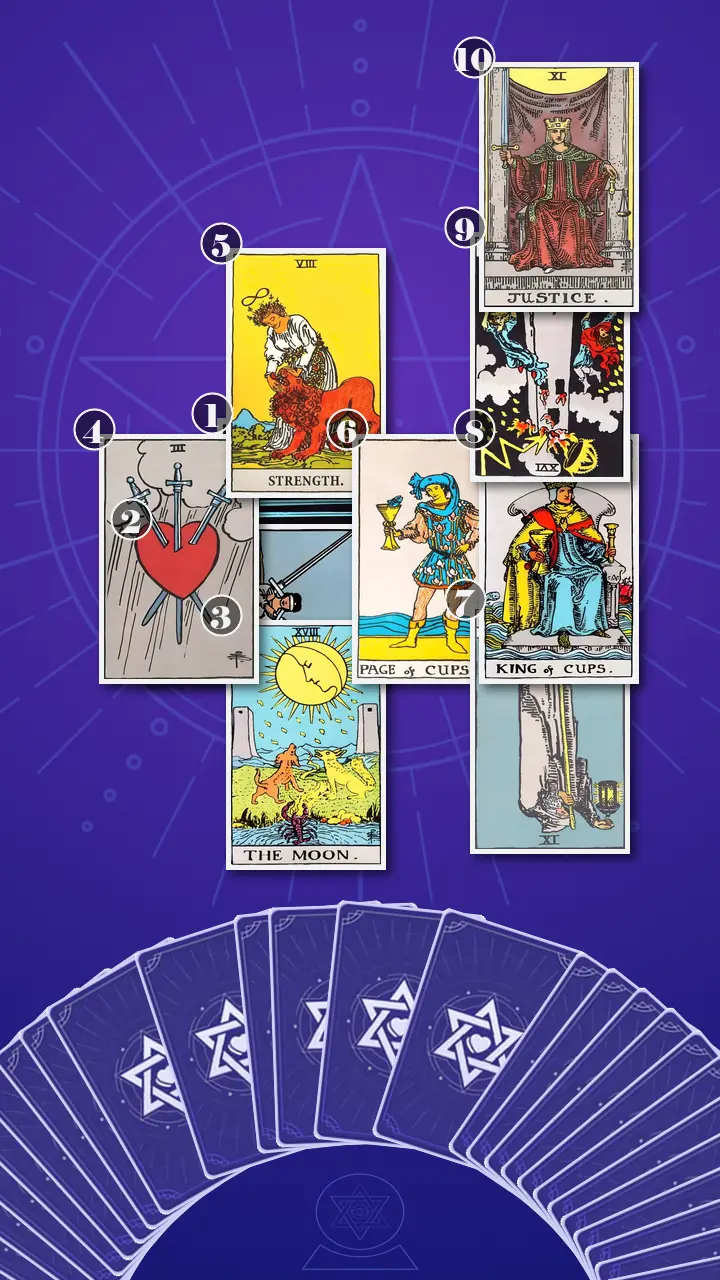
Reading the Map: Swords, Moonlight, and the Freeze Button
Position 1: The immediate internal reaction
I turned over the first card. “Now we’re looking at the card representing the immediate internal reaction to the ‘we need to talk’ text—what’s happening in your mind/body right now.”
Nine of Swords, upright.
The image always gets people in the gut: someone sitting up in bed, head in hands, in a dark room—like the whole night has turned into a courtroom.
“This is the 2 a.m. phone glow,” I said. “Re-reading the same thread in the dark. Drafting a dozen versions of the conversation in your head. Waking up already tired from a talk that hasn’t even happened.”
In energy terms, the Nine of Swords is excess Air: thinking as overdrive. It’s your mind trying to reduce ambiguity by building worst-case narratives and scanning for hidden meaning.
Alex let out a small laugh again, but this time it shook. “That’s… rude accurate.” Her fingers tightened on the cup, then loosened. “I literally zoomed in on a period. Like it was evidence.”
“Your system is responding as if danger is confirmed,” I said gently. “Before you draft a single reply, try naming the fear in one plain sentence—no poetry, no explanation. Something like: ‘I’m afraid they’ll end the friendship.’ It’s not to shame you. It’s to stop the fear from masquerading as facts.”
Position 2: The block that keeps the spike going
I tapped the next card, laid across the first. “Now we’re looking at the card representing the specific block that keeps the reaction spiking—how you get stuck after the message.”
Two of Swords, upright.
“This is the freeze,” I said, and I pointed to the blindfold and the crossed swords. “You can’t see what the talk is about, so you lock down. Protective indecision.”
And immediately, a split-screen scene formed in my mind—because I’ve watched this exact choreography play out across café tables for years.
Left side: your thumb hovering over “Reply.” Right side: you lock your phone, then unlock it five seconds later. Left side: the typing bubble appears. Right side: it disappears. Your stomach drops again, like your body is trying to fall through the floor and hide there.
“The inner monologue here is brutal,” I said, keeping my tone plain and nonjudgmental. “‘If I ask, I’m needy. If I wait, I’m careless.’ Both options feel dangerous, so your nervous system chooses a third option: silently spiral.”
Alex gave a quiet exhale, the kind that sounds like a truth landing. She nodded once, small. “Oh. That’s exactly the stuck point.”
“And I want you to hear this,” I added. “Freeze is a protection strategy. It’s not a character flaw. But it keeps ambiguity in charge.”
Position 3: The deeper root—why ambiguity feels threatening
I turned the next card. “Now we’re looking at the card representing the deeper psychological root of why ambiguity in friendship feels threatening.”
The Moon, upright.
The Moon is not a liar card the way people think—it’s a projection card. Moonlight makes everything look like it might be something else. A path runs between two towers. A dog and a wolf howl. Something crawls out of the water like a thought you didn’t invite.
“This is your nervous system reacting to what you can’t see,” I said. “The text is a blank screen and your brain starts running old footage over it—memories, half-formed cues, imagined subtext—and it all feels equally true.”
Energetically, The Moon is blockage through uncertainty. It feeds mind-reading: “They’re upset” becomes “They’re dropping me” becomes “I’m not keepable.”
“The Moon asks for a clean distinction,” I said, and I held up my index finger like a bookmark. “What are the literal facts you have—the exact words? And what interpretations are you adding in the dark?”
Alex’s gaze went slightly unfocused, like she was replaying the moment on the TTC when the phrase kept looping in her earbuds’ silence. “I don’t even realize when I switch from facts to… vibes,” she admitted. “I just end up convinced.”
“That’s the Moon,” I said. “Conviction without context.”
Position 4: The memory imprint—why serious talks equal danger
I turned over the card to the left. “Now we’re looking at the card representing what recent experiences trained your nervous system to treat serious talks as danger.”
Three of Swords, upright.
The pierced heart against storm clouds is not subtle. It’s sharp words, disappointment, feeling misunderstood.
“Your body learned a lesson,” I said. “Not logically—somatically. Hard talks lead to hurt. So now, when someone says ‘we need to talk,’ your system braces like the rain is already coming.”
Alex’s mouth pressed into a line. She didn’t look at the card at first. Then she did, and her eyes softened with something older than last night.
“A friend ended things out of nowhere two years ago,” she said quietly. “We were fine, and then we weren’t. I didn’t see it coming. So now I try to… catch it early.”
“That makes so much sense,” I said. “But notice the hidden cost: you’re reacting to an old rupture while standing in a new room.”
Position 5: Your conscious aim—how you want to handle it
I turned the card above the center. “Now we’re looking at the card representing what you’re trying to embody instead—your conscious goal.”
Strength, upright.
Strength is not about forcing calm. It’s about gentle hands on a lion—soft power. The infinity symbol floats like a reminder that capacity can be built.
“You’re not actually trying to avoid the conversation,” I said. “You’re trying to meet it with steadiness instead of panic.”
In energy terms, Strength is balance: emotion is present, but it doesn’t run the room.
Alex’s shoulders lowered a fraction, like her body recognized permission. “I want to be the kind of friend who can just… talk. Without turning it into a referendum.”
“Exactly,” I said. “Regulate first. Respond second.”
Position 6: The near-term opening—how to respond differently
I turned the card to the right. “Now we’re looking at the card representing the next best opening for responding differently.”
Page of Cups, upright.
The Page looks into the cup like they’re surprised by the fish—like a message doesn’t have to be a threat; it can be information.
“This is your tone shift,” I said, and I watched Alex’s jaw unclench a little. “It’s swapping a twelve-line Notes draft for one warm, structured sentence. Not corporate. Not performative. Human.”
I gave her a micro-script that sounded like a real person: “I’m here. Is this about something specific?”
Alex blinked, then nodded slowly. Her fingers stopped worrying the cup. “That feels… doable,” she said, surprised by herself. “Like I’m not begging. I’m just asking.”
“Exactly,” I said. “Curiosity instead of self-prosecution.”
Position 7: Your stance—how you relate to the uncertainty
I turned the next card at the base of the staff. “Now we’re looking at the card representing your stance and coping style in this moment.”
The Hermit, reversed.
“This is the lantern turned too far inward,” I said. “Introspection becoming a closed room. You try to solve the whole situation alone: hours in Notes, no reality-checking, no asking for clarification.”
Energetically, this is blockage through isolation. The Hermit’s gift is wisdom, but reversed it becomes interrogation—your mind becomes a searchlight that never finds what it’s looking for.
“The reframe is simple but not easy,” I said. “Turn the lantern outward just one click. One context question. Then a short pause. That’s not being dramatic. That’s being in relationship.”
Alex’s eyes lifted to mine—like she was checking whether she was allowed to do that. I held steady.
Position 8: The environment—what the friendship can hold
I turned over the next card. “Now we’re looking at the card representing the relational field around you—what emotional container may be available.”
King of Cups, upright.
The King sits calmly on choppy water. The waves exist. They just don’t get to run the meeting.
“This is important,” I said. “This suggests the friendship may be capable of holding emotion without drama—especially if one of you brings steady emotional leadership.”
Energetically, this is balance through containment: feelings can be named without becoming a flood.
Alex’s expression changed—less braced, more thoughtful. “She actually is pretty direct,” she said. “Not mean. Just… adult.”
“Then this ‘we need to talk’ might be her trying to be responsible,” I said, “not her trying to be cruel.”
Position 9: Hopes and fears—the catastrophe story
I turned the next card. “Now we’re looking at the card representing the fear-story you most want to avoid—and how it shapes your texting and tone.”
The Tower, reversed.
“This is the fire alarm when it might just be a kitchen timer,” I said. “Your body hears the words and assumes collapse. Then you try to prevent it by controlling every word.”
I could almost see the behavior as she described it: writing the “covers-everything” paragraph, three paragraphs long, bullet points, pre-emptive apologies—like she was preparing for cross-examination instead of a check-in.
“Discomfort gets mislabeled as catastrophe,” I continued. “And then the stakes inflate. The talk gets heavier before it even starts.”
Alex winced—full recognition. “I do treat it like a friendship breakup text,” she said, and there was irritation in her voice now, not at her friend—at the pattern. “And I hate that about me.”
“We’re not going to hate it,” I said. “We’re going to understand it. And then we’re going to give it a smaller job.”
I leaned in slightly. “Try one tolerable outcome line: ‘They might be upset, and I can still handle hearing it.’ That’s the Tower reversed becoming a renovation instead of an explosion.”
When Justice Held the Scales Steady
Position 10: Integration guidance—how to communicate, regardless of outcome
I placed my hand over the final card for a beat. The café noise softened in my awareness—the clink of a spoon, the low hum of the fridge behind the counter—like the room was making space. “Now we’re turning over the card representing integration guidance: the healthiest way to communicate and make meaning of the talk, regardless of outcome. This is the card that changes your operating system.”
Justice, upright.
Scales in one hand. Sword in the other. A face looking straight ahead, not at shadows.
For a second, Alex didn’t move. Her eyes tracked from the scales to the sword and back again, like she was learning a new language.
Setup: I could feel exactly where she’d been living: staring at “we need to talk” with her stomach dropping, thumb hovering over the chat, already drafting an apology in Notes like she was trying to prevent an ending before she even knew the topic.
Then I let the sentence land as cleanly as a cup placed on a saucer.
Stop treating ambiguity as a conviction; choose a fair question and a clear boundary, like Justice holding the scales and sword steady.
I didn’t rush to fill the silence. In my work—tarot and coffee both—I’ve learned that extraction time matters. Pull too fast and you get sour panic. Pull too long and you get bitterness. The middle is where the flavor lives.
Reinforcement: Alex’s reaction came in layers, like a body translating insight.
First: a physiological freeze. Her breath caught. Her thumb stopped tapping the edge of her phone case mid-motion, suspended like a cursor.
Second: the cognitive shift. Her gaze went slightly unfixed, not dissociating—more like her mind was rewinding last night’s spiral and seeing, for the first time, how she’d been collecting “clues” the way you refresh a tracking page that says Delayed: checking again and again, gaining zero control, only more adrenaline.
Third: the emotional release. She exhaled, long and shaky at the end. Her shoulders dropped, not dramatically—just enough that I could tell her body believed the room was safer than it had been a moment ago.
“I’ve been treating uncertainty like evidence,” she said, voice quieter. “Like if I feel scared, it must mean something bad is true.”
“That’s Justice teaching you the difference between facts and stories,” I said. And here I brought in the framework my regulars tease me for—because of course I would use coffee to explain communication. It’s my native language.
“I call this Milk Foam Layer Analysis,” I told her. “Foam is what sits on top: tone guesses, punctuation readings, the vanished typing bubble, the vibe. Espresso is what’s real and measurable: the exact words they sent, what you actually know. Your anxiety tries to drink only foam. Justice says: sip the espresso first.”
“So… facts vs stories,” she murmured.
“Yes. And we can make it even more practical with what I call Social Espresso Extraction,” I added. “Different social contexts have different optimal extraction times. At work, speed is rewarded. In friendship, speed can become over-functioning. Justice isn’t asking you to respond instantly. Justice is asking you to respond fairly.”
I kept my voice grounded, the way I do when a customer looks overwhelmed at the pastry case. “Now, use this new lens and tell me: last week, was there a moment when a serious tone showed up and you could have asked for context instead of writing the closing argument?”
Alex blinked hard, eyes a little wet around the edges, and gave a small, incredulous smile. “Literally last night. I wrote a whole apology without knowing the headline.”
“Don’t write the closing argument before you’ve heard the headline,” I said, and she nodded like the phrase had finally found its home.
That was the shift—moving from dread and mind-reading to grounded clarity and steadier self-trust. Not perfect calm. Just a new step: context before conclusion.
The One-Page Justice Protocol: From Insight to Actionable Advice
When I looked at the whole spread together, the story was painfully coherent.
Nine of Swords showed the immediate spike: midnight rumination and self-blame. Two of Swords showed the lock: freeze, because both asking and waiting feel risky. The Moon explained why the lock is so strong: ambiguity becomes a projection screen. Three of Swords showed the imprint: your body remembers a past rupture. Strength showed your intention: steadiness. Page of Cups offered the bridge: one warm, human sentence. The Hermit reversed warned about the detour: isolating in Notes. King of Cups suggested the friendship can hold an adult conversation. Tower reversed revealed the fear engine: catastrophe story. And Justice—Justice gave you a way out that doesn’t require perfect performance.
“Here’s the cognitive blind spot,” I told Alex, keeping it simple. “You’re treating ambiguity like a silent verdict about your worth and belonging. Your body reacts like rejection has already happened. The transformation direction is the opposite: regulate first, then ask for context—so you’re responding to reality, not to midnight prosecution.”
“Okay,” she said, and then—because she’s a project coordinator and I could feel her craving something structured—she added, “What do I actually do when it happens again?”
I nodded. “We keep it small. We keep it repeatable. One clear question beats ten perfect paragraphs.”
- The 60-Second Strength ResetBefore you type anything, do five rounds of breath: 4 seconds in, 6 seconds out. Both feet on the floor. If you’re on the TTC or in the PATH, just press your heels down and let the exhale be longer than the inhale.If breath work annoys you when you’re activated, use a physical cue instead: cold water on your wrists or holding your latte cup with both hands until your chest loosens one notch.
- The Justice Reset (Facts vs Stories)Set a 9-minute timer. For 3 minutes, write two columns: Facts (their exact words) vs Stories (what your brain is adding). For 3 minutes, take slow exhales with your feet grounded. For the last 3 minutes, send one neutral context question—then put your phone face-down for 3 minutes.Expect resistance like “This feels awkward.” Keep it contained: one sentence only, no extra justification. Clarity works better than speed.
- The One-Sentence Context Text (3-Second Latte Art)Send: “Totally—what’s the topic so I can show up well?” Add a time anchor if needed: “Do you want to talk tonight or tomorrow?” If you’re in a meeting: “I’m in a meeting—can you share a quick headline so I’m not guessing?”Read it out loud before sending. If it sounds like a customer service email, shorten it. Warmth isn’t length.
I added one more tool, because friendship is a living thing, not a spreadsheet. “Use my Social Thermometer,” I said. “Different relationships have different ideal temperatures. With a close friend, it’s fair to ask for a headline. With an acquaintance, you might simply say: ‘Sure—what’s up?’ Justice is not one-size-fits-all. It’s proportional.”
Alex stared at her phone and then, for the first time since she walked in, set it down without flinching.

A Week Later: Ownership, Not Certainty
Five days later, I got a message from Alex while I was wiping down the counter after the morning rush.
“It happened again,” she wrote. “Different friend. Same phrase. I did the 60-second reset. Then I sent: ‘Totally—what’s the topic so I can show up well?’ I didn’t add a paragraph. I put my phone face-down. I hated the three minutes. But I didn’t spiral.”
Her friend’s reply had been simple: they wanted to talk about plans for a birthday weekend, because they felt weird about money and didn’t want resentment. Not rejection. Not a hidden indictment. Just logistics with feelings attached—the most human thing in the world.
Bittersweet, in under a minute: she told me she slept through the night for the first time in weeks—then admitted she still woke up with the thought, “What if I did it wrong?” But this time, she made coffee, breathed, and didn’t reach for her phone like it was a defibrillator.
This is what I mean when I say tarot can help you find clarity: not by making life frictionless, but by giving you a fairer interpretation of what’s happening—and an actionable next step that fits inside a real day.
When someone texts “we need to talk,” it can feel like your stomach drops not because you did something wrong, but because closeness is what you want most—and losing it is what your body is bracing for before you even have the facts.
If you didn’t have to earn your place in the friendship with the perfect reply, what’s one simple context question you’d feel okay sending first?
This story is adapted from psychological research, written so that those in a similar struggle can see their own pattern in it — and find their next step clearly.These insights are not a substitute for professional psychological, medical, legal, or financial advice.
Learn more about our Journey to Clarity.
How did this insight land for you?
🫂 This Resonates Deeply
🌀 Living This Story
✨ Now I See Clearly
🌱 Seeing New Possibilities
🧰 Useful Framework
🔮 The Confirmation I Needed
💪 Feeling Empowered
🚀 Ready for My Next Step
Author Profile
 AI
AI“For twenty years, I’ve listened to stories unfold over the warm aroma of coffee. I don’t believe life’s complexities always require grand theories to be solved; often, we just need a safe place to tidy up our reality. I don’t offer high-minded preaching—just grounded, heartfelt insights to help you regain your sense of control amidst the clutter of daily life.”
In this Friendship Tarot Reading :
Core Expertise
Service Features
Also specializes in :
Explore Related Patterns:
Anxiety SpiralAlex setting the phone face-down, then flipping it back every two minutes, shows how one vague text becomes an activation loop before it becomes a conversation. The iMessage thread offers no new information, but each check briefly promises relief, then hands her nervous system the same ambiguity again. The pattern is not just ordinary worry. It is a self-reinforcing cycle where checking, drafting, bodily alarm, and self-blame keep each other alive. You get pulled toward action without enough context, and the mind fills the gap with threat until the phone starts to feel like the only place safety could come from.
CatastrophizingAlex describes 'we need to talk' as feeling like a breakup text for friendship, and later recognizes that she treats it like a fire alarm when it might only be a kitchen timer. The message carries no topic, but her mind builds the heaviest possible version of the conversation before it starts. Catastrophizing is the inflation of stakes under uncertainty. Discomfort becomes collapse, seriousness becomes rejection, and a future talk becomes a courtroom. You can see why the spike feels so intense: the body is not preparing for a conversation, it is preparing for an ending.
Certainty SeekingAlex says she can handle feedback, but she cannot handle not knowing what she is walking into. That distinction matters. The pain point is not the conversation itself; it is the context gap, and her brain tries to close that gap by rereading, drafting, and controlling the reply. Certainty Seeking turns ambiguity into a problem that must be solved immediately, even when the available data cannot solve it. You can see how the strategy backfires: every attempt to know more without asking for context produces more interpretation, more adrenaline, and less trust in the present moment.
Mind ReadingAlex zooming in on a period, watching typing bubbles, and reading tone into a short text shows the mind trying to extract certainty from fragments. The friend has not given the topic, so Alex starts treating punctuation, delay, and vibe as if they reveal the friend's hidden motive. Mind Reading reduces the discomfort of not knowing by pretending the missing context has already been decoded. You can see the trap: the more closely she studies the tiny cues, the more convincing the invented story becomes. A fair context question would add information, but decoding keeps her alone with interpretation.
Rejection SensitivityAlex hears 'we need to talk' and her body reacts as if the friendship has already moved into danger. The story gives the pattern a clear history: a friend ended things out of nowhere two years ago, and now Alex tries to catch the signs early before another ending can blindside her. That is how a neutral or incomplete cue turns into a social verdict. The mind moves from 'they may be upset' to 'they are dropping me' to 'I am not keepable' without enough evidence to support the jump. You are watching fear of rejection become a filter for interpreting silence, seriousness, and delay.
Anxious AttachmentAlex names the core contradiction directly: she wants closeness and reassurance, but the second a friendship conversation gets serious, her system braces for rejection. The vague text does not just ask for a talk; it touches the part of her that treats relational uncertainty as a possible loss of belonging. Anxious Attachment shows up here as the pressure to secure the bond before the facts are available. You can see it in the urge to explain, fix, disappear, or produce the perfect reply. The friendship matters so much that ambiguity stops feeling like information is missing and starts feeling like the connection itself is at risk.
Compulsive CheckingAlex putting the phone face-down and then flipping it back every two minutes is the clearest behavioral loop in the story. The thread has not changed, but the body keeps reaching for it as if one more look might finally make the ambiguity safer. Compulsive Checking works like a temporary regulation ritual that stops regulating. It gives a tiny sense of action, then returns the same incomplete data and restarts the alarm. You are seeing how the phone becomes both the trigger and the attempted cure, which is why the anxiety keeps spiking instead of settling.
Action ParalysisAlex's thumb hovers over Reply, her Notes app fills with rewritten drafts, and still nothing gets sent. The stuck point is not laziness or indifference; both available moves feel psychologically unsafe, because asking might make her needy and waiting might make her careless. Action Paralysis is the freeze response translated into texting behavior. It protects her from choosing the wrong move in the short term, but it also leaves ambiguity in charge. You can see why the spike continues: no new context arrives, no boundary is set, and the mind keeps prosecuting every possible response.
Boundary DiscernmentAlex sending 'Totally, what is the topic so I can show up well?' without adding a paragraph shows a cleaner boundary than the original spiral allowed. She is not refusing the conversation, and she is not surrendering to invisible pressure; she is asking for the minimum context needed to participate fairly. Boundary Discernment turns the message from a verdict into a relational exchange. You can respect the friend's wish to talk while also respecting your own need for a headline, a time anchor, and a pause before responding. The shift is small, but it changes the power dynamic from self-prosecution to mutual clarity.
Emotional ReasoningAlex names the shift herself when she says she has been treating uncertainty like evidence, as if feeling scared means something bad must be true. Her body reacts like rejection has already happened, even though the only confirmed fact is a vague text. Emotional Reasoning makes the intensity of the feeling stand in for the accuracy of the story. You can see how the body alarm becomes persuasive: tight chest, stomach drop, restless urgency, and suddenly the fear feels like data. The work is not to shame the feeling, but to stop letting it testify as fact.
Defensive OverexplainingAlex writing the covers-everything paragraph and the preemptive apology before she even knows the headline shows language being used as armor. The imagined conversation becomes cross-examination, so she tries to arrive with every possible defense already prepared. Defensive Overexplaining is an attempt to earn safety through exhaustive clarity. It can look responsible on the surface, but underneath it is trying to control how the other person will feel, judge, or leave. You can see the hidden cost: the reply becomes a performance for survival instead of a real opening for contact.
Emotional RegulationAlex's later response shows the new sequence clearly: she does the reset, sends one context question, puts the phone face-down, hates the waiting, and still does not spiral. The feeling does not disappear, but it no longer gets to run the entire interaction. Emotional Regulation is the capacity to create a pause between activation and action. You can see it in the longer exhale, the feet on the floor, the short script, and the belief that someone might be upset and you can still handle hearing it. The goal is not perfect calm; it is enough steadiness to respond to reality instead of to the first alarm.
Explore Related Struggles:
Certainty-Safety FusionAlex keeps staring at one vague line, then her body reacts as if the outcome is already known. The message does not say she is being rejected, but the lack of context gets converted into a verdict before the conversation exists. You are not just reacting to words on a screen here. You are watching a system that has learned to equate certainty with social safety, so the unknown has to be filled in fast. When facts are missing, the mind reaches for the most threatening version because even a bad certainty can feel more manageable than open space. The useful shift is not to force calm or pretend the text is harmless. It is to separate what is measurable from what is being supplied by the spike: the exact words, the missing topic, the fair question you can ask, and the boundary around how long the unknown gets to run the room.
Clarity-Exposure SplitAlex already has access to the move that would reduce the spiral: ask what the talk is about. But her thumb hovers because the clarifying question does not feel neutral; it feels like a reveal. You are watching clarity and exposure get welded together. A simple request for context starts to carry a social risk: maybe asking makes you look needy, maybe waiting makes you look detached, maybe any move will be read as the wrong kind of friend. That pressure turns a normal relational question into a test of how much need you are allowed to show. The struggle loosens when the context question is treated as participation, not pleading. Asking for a headline is not a demand for reassurance; it is a fair way to enter the conversation with the lights on.
Inner Tribunal LockAlex drafts an apology before she even knows the headline. The Notes app becomes a courtroom, the punctuation becomes evidence, and the reply starts sounding like a defense brief for a charge no one has named. You are not merely overthinking in that scene. You are being pulled into an inner trial where uncertainty is treated like prosecution and the perfect reply is supposed to secure acquittal. The problem is that the trial has no external evidence yet, so every draft keeps the case alive instead of resolving it. This is why a short text can become so exhausting. The real conversation has not started, but an internal one has already begun judging, defending, and sentencing. Clarity returns when you refuse to write the closing argument before you have heard the topic.
Vigilance-Connection SplitAlex wants to be a steady friend, but the moment the conversation sounds serious, her attention starts scanning for signs of rejection. The same bond that makes her care also makes the silence feel loaded. You can see the split in the way every possible move gets charged. Asking for context might protect the connection, but it risks feeling too needy. Waiting might look composed, but it risks seeming careless. So the desire to stay close and the impulse to brace against being dropped both activate at the same time. That is why the text spikes so hard: the threat is not only the unknown topic, but the possibility that closeness itself could become the place where you lose footing. The way out begins when vigilance is given a smaller job, so it can notice signals without taking over the entire friendship channel.
Projection-Connection SplitAlex looks at the exact words, then the mind starts adding footage over them: punctuation, tone, vanished typing bubbles, old memories, imagined subtext. The friend has sent a low-context message, but the blank space does not stay blank for long. You are trying to connect with the person in front of you, while a second conversation starts forming with projections from what is not yet known. “They want to talk” becomes “They are upset,” then “They are dropping me,” then “I am not keepable.” The friendship is still present, but the imagined version begins competing with it for authority. The key is not to shame the projections; they are attempts to make the dark navigable. The stronger move is to put them in the right column: not facts, not evidence, but stories asking to be checked against reality.
Social Collapse ImprintAlex names the older event clearly: a friend ended things out of nowhere two years ago, and she did not see it coming. Now the phrase “we need to talk” arrives in a new friendship, but her body reaches for the old ending first. You can see how the present message gets crowded by a previous rupture. The current friend may be direct, adult, and capable of an honest conversation, but the older loss taught the body that serious language can arrive right before belonging disappears. So the text is not only a text; it becomes an early warning signal. The imprint does not have to run the next conversation. Its job can shift from predicting collapse to naming what is being activated: this is a new room, a new friend, and a new chance to ask for context before the old ending takes over the whole script.
Monitoring-Safety FusionAlex puts the phone face-down to calm herself, then flips it back over every two minutes. She reopens the same iMessage thread, studies the same line, and even zooms in on a period as if the screen might finally give up the missing context. You are watching monitoring become fused with safety. Each check promises relief, but it returns you to the same tiny data set: the words, the silence, the bubble, the imagined tone. The behavior feels active because your hands are doing something, yet the relational situation has not moved. The pressure drops when the phone stops being treated as the only place safety can be found. One grounded pause and one fair context question do more than another scan of the thread, because they move the situation from private surveillance back into actual relationship.
Explore Related Emotions:
Ambiguity DreadAlex sets her phone face-down to calm down, then flips it back over every two minutes and reopens the same iMessage thread. The text itself contains almost no information, yet her body treats that blank space as something urgent and dangerous. You are watching ambiguity become the emotional event. Because the friend has not supplied a topic, timing, tone, or headline, the mind rushes to fill the gap with the heaviest possible version of the story. The fear is not built from facts; it is built from the absence of facts. Ambiguity Dread fits because the spike begins before the conversation exists. The unknown does not stay neutral for Alex. It turns into a charged room she has to walk into without knowing whether she will be welcomed, criticized, or left behind.
Certainty HungerAlex says she can handle feedback, but she cannot handle not knowing what she is walking into. That sentence locates the emotional pressure exactly: the open loop feels harder to tolerate than the possibility of difficult information. You can see the mind trying to buy certainty with effort. Drafting, rereading, replaying, and predicting all become attempts to close the gap before the friend offers context. The problem is that the mind chooses a harsh answer because a harsh answer can feel more solid than no answer. Certainty Hunger fits because the craving for a conclusion becomes stronger than the evidence available. Alex does not need a perfect reply first; she needs enough context to stop mistaking intensity for truth.
Rejection ChillAlex says the phrase feels like a breakup text for friendship, and her body answers with a stomach-drop, a tight chest, and the impulse to text, explain, fix, or disappear. The reaction is physical before it is logical. You are not just seeing discomfort with conflict. You are seeing the body brace for social loss while the facts are still missing. The friend has not rejected her, yet the possibility of rejection lands with enough force to make both asking and waiting feel unsafe. Rejection Chill fits because the fear arrives as a cold readiness for impact. Alex wants closeness, reassurance, and a fair conversation, but the seriousness of the message makes her body prepare for being pushed out before the friend has spoken.
Relational AnxietyAlex wants to be the kind of friend who can simply talk, yet one serious message makes her retreat into Notes and try to solve the whole situation alone. The closeness matters, which is exactly why the possible rupture feels so charged. You can see two needs pressing against each other: the need for connection and the need to protect yourself from being blindsided. When asking feels needy and waiting feels careless, the relationship becomes a place where every move seems to carry emotional risk. Relational Anxiety fits because the spike is specifically about attachment to the friendship, not just a vague fear of bad news. The text threatens her sense of being secure with another person before the conversation has even begun.
Verdict DreadAlex writes a whole apology before she knows the headline, studies a period like it might be evidence, and prepares for a conversation as if it has already become cross-examination. The friendship talk turns into a courtroom long before the friend explains what they need. You can see the inner structure: uncertainty becomes accusation, and accusation becomes a question of belonging. The message does not simply ask for a talk; inside Alex's body, it starts to sound like a decision has already been made about whether she is too much, not enough, or no longer wanted. Verdict Dread names the specific weight of that moment. It is the fear of being judged before being heard, and the exhaustion of defending yourself against a conclusion that may not even exist.
Cautious Self-TrustFive days later, Alex gets the same phrase from a different friend, sends one context question, puts the phone face-down, and hates the three minutes without spiraling. The old activation is still present, but it no longer gets full control of her behavior. You can see self-trust arriving in a careful, believable form. She does not become instantly relaxed or perfectly certain; she still wonders whether she did it wrong. What changes is that she can stay with herself long enough not to make the phone the emergency center of the room. Cautious Self-Trust fits because the growth is modest and real. Alex begins to believe that she can ask, wait, and handle the answer without earning her place through a flawless reply.
Grounded AgencyAlex replaces the twelve-draft Notes spiral with one sentence: 'Totally, what is the topic so I can show up well?' The action is small, but it changes her position from bracing alone to participating in the real exchange. You can see agency returning through structure. She breathes, separates facts from stories, asks for context, and gives herself a short pause instead of trying to control every possible outcome. The friendship is no longer managed through invisible overwork. Grounded Agency fits because the power here is practical and self-possessed. Alex does not need total certainty to respond; she needs one honest question, one boundary, and enough steadiness to let reality answer back.
Hypervigilant AnxietyAlex reopens the same thread, drafts the reply twelve times, watches the typing bubble, and even zooms in on a period as if punctuation might reveal the truth. Every tiny cue becomes loaded because the larger context is absent. You can feel the attention narrowing until the phone becomes the whole room. Instead of receiving information, the mind starts hunting for threat signals in fragments: timing, tone, dots, silence, imagined subtext. The checking promises control, but it keeps the body activated. Hypervigilant Anxiety is the right fit because the spike is maintained by scanning. Alex is not gaining clarity from each check; she is training the moment to feel more consequential every time she looks again.
Clarity ReliefAlex exhales, her shoulders drop, and she names the shift herself: she has been treating uncertainty like evidence. The moment does not erase the friendship risk, but it gives her a cleaner way to read what is actually happening. You can feel the relief come from precision. Facts and stories are no longer blended into one threatening fog; the exact words sit in one place, and the interpretations sit in another. That separation gives her enough room to choose a fair question instead of a defensive paragraph. Clarity Relief fits because the body softens when the mind stops prosecuting the unknown. The situation becomes smaller, clearer, and more workable without pretending the feelings are gone.
Hard-Won ComposureAlex's jaw unclenches when the one-sentence reply finally feels doable, and later she follows the reset even though the waiting still feels uncomfortable. The steadiness is not effortless; it is built under pressure. You can see composure becoming a practiced rhythm rather than a personality trait. Feet on the floor, longer exhales, one context question, phone face-down: each step gives her body a smaller job than solving the whole friendship before the talk begins. Hard-Won Composure fits because Alex does not reach perfect calm. She reaches enough steadiness to act fairly, stay connected, and stop turning uncertainty into an emergency verdict.
Shame SpiralAlex drafts an apology before she knows what the friend wants to discuss, then later admits she still wakes up with the thought, 'What if I did it wrong?' The unknown conversation quickly turns into a private audit of her own adequacy. You can see how the fear folds inward. Instead of simply wondering what the friend needs, Alex starts acting as though she must already have failed. The pressure to be the perfect friend, the perfect responder, and the perfectly calm person all pile onto the same moment. Shame Spiral fits because the emotional movement is downward and self-directed. The message begins outside her, but the pain intensifies when she makes herself the problem before anyone has named a problem.
Explore Related Contexts:
Digital Intimacy Boundary ConfusionAlex receives only four words from a friend, with no topic, timing, or emotional scope attached. The message arrives through a channel that can carry intimacy and alarm at the same time, so the phone becomes the whole relational room before the actual conversation has even begun. You can run a project timeline at work because the roles, deliverables, and next steps are visible. In this friendship exchange, the rules are missing: whether this is logistics, feedback, conflict, or an ending is not stated. That missing context makes ordinary digital silence feel loaded with social consequence. Digital Intimacy Boundary Confusion fits because the problem is not simply that Alex checks her phone. The external setup asks her to manage closeness, timing, tone, and possible rejection from a tiny message with almost no usable information. The path back to agency starts with separating the channel's ambiguity from the actual facts of the relationship.
Direct Communication TrialAlex's workable next move is not a perfect paragraph; it is one warm context question: "Totally, what's the topic so I can show up well?" The story shows that this small move changes the social architecture of the exchange. Direct Communication Trial fits because the friendship is being tested at the level of clarity, not performance. The friend may be direct rather than cruel, and the conversation may be able to hold a fair question without turning into drama. You regain agency here by entering the friendship as a participant rather than a defendant. The trial is whether a serious text can become a clearer conversation through proportionate communication, boundaries, and a request for usable context.
Silent Evaluation PeriodAlex locks the phone, unlocks it again, reopens the same thread, and watches weak signals like typing bubbles as if they could reveal the verdict. Nothing has officially happened yet, but the waiting period starts acting like a social assessment she cannot see or answer. This is the structure of a Silent Evaluation Period: the person is suspended between a serious signal and the missing explanation behind it. You are not in a clear disagreement, repair conversation, or breakup, but the lack of a headline makes the silence feel like a hidden review of your place in the friendship. The spike comes from that undefined middle space. A fair context question changes the social conditions of the moment because it moves the exchange out of silent evaluation and into shared information.
Unspoken Expectations GapThe serious text arrives without a headline, and the later explanation turns out to be about birthday weekend money. What one friend meant as a responsible request to talk reached Alex as a vague social alarm because the expectation behind the message was not stated. Unspoken Expectations Gap fits the external structure of the problem: one person has a topic in mind, while the other person is left managing the emotional weight of not knowing. The gap between intention and available information becomes the pressure point. A neutral context question repairs that gap without demanding reassurance or over-explaining. You are not asking the friendship to remove all discomfort; you are asking for enough shared context to respond to the real conversation rather than the blank space around it.
Friendship Loyalty TestAlex starts preparing an apology before she knows the topic. A message that could be about plans, money, feedback, or logistics gets processed like a referendum on whether she still belongs in the friendship. The external pressure is a Friendship Loyalty Test because the serious-talk setup temporarily changes her role. Instead of entering as an equal participant who can ask for context, she starts acting like someone who must prove she is still acceptable before the conversation even opens. That pressure is strengthened by the earlier friendship that ended without warning. You are not responding only to this friend's words; you are standing in a social stage where vague seriousness can feel like a test of whether the bond is still secure.