Why Won't Your Family Role Change?

See how family expectations resist change, explore relevant tarot cards, and browse related reading insights from sessions.

Family Role Renegotiation
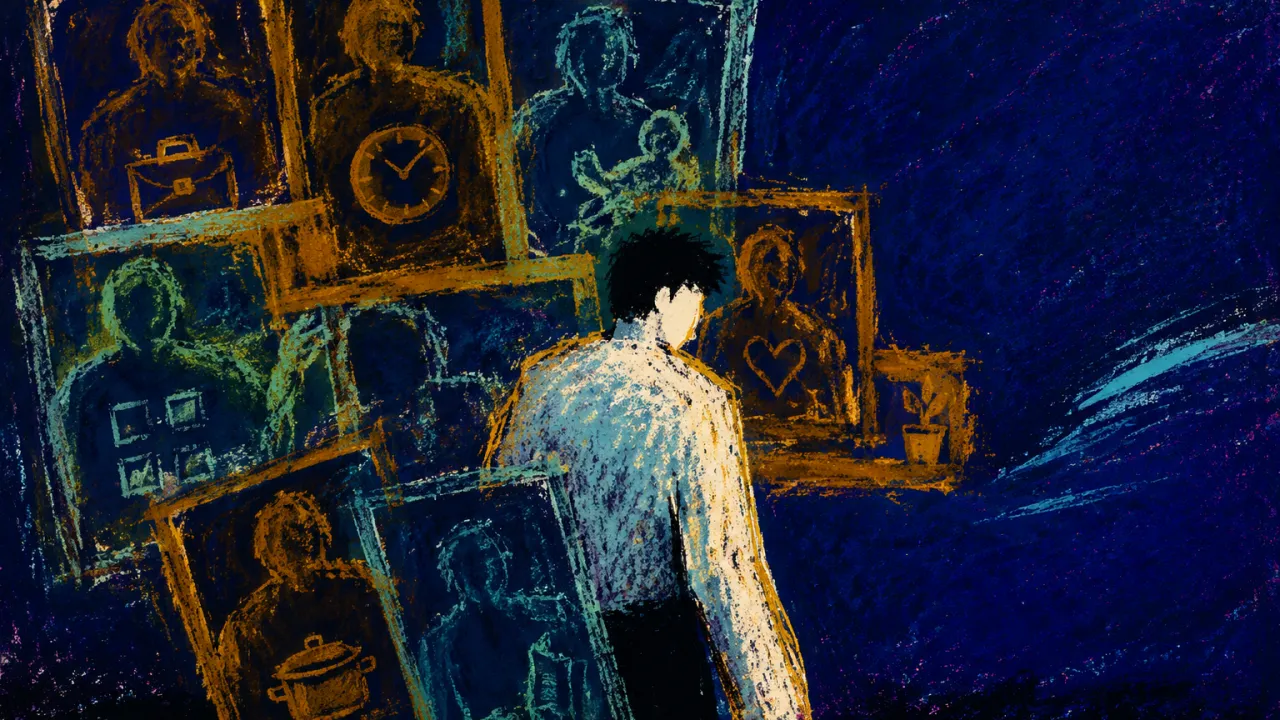
A solitary figure turns from overlapping amber frames as silhouettes press inward around the torso in deep indigo space.

What is this situation?

Family Role Renegotiation is what happens when you try to change the part your family automatically assigns you, but everyone keeps interacting with the version of you that made the old arrangement work. It may start after you move out, begin a serious relationship, take on a demanding job, stop managing a parent's admin, or simply say you can no longer be the default organizer, peacekeeper, translator, emergency contact, or person who answers every late-night call. The next group chat still arrives with dates for you to coordinate; a disagreement between relatives is forwarded to you with “Can you sort this out?”; plans are made around your availability without anyone asking; and a boundary is treated as the opening line of a negotiation. When you decline, the conversation shifts from the request itself to how much you have changed, who used to do what, or why this should not be a big deal. Older relatives may invoke precedent, siblings may step back because you have always stepped in, and even ordinary visits can become checkpoints where the old script is quietly reassigned. Your shoulders tighten when the family chat lights up because a simple notification can contain a task, a dispute, and an expectation that you will absorb both without altering the mood. The strain does not come from one dramatic argument; it accumulates through repeated handoffs, selective surprise when you say no, and access to your time being treated as already agreed. You are not only discussing chores or availability; you are contesting who gets to define your place in the family and whether a role built around their convenience can change, much like the Six of Pentacles, where one standing figure holds the scales while deciding how resources are distributed to those below.

Why it's not you?

The friction is not proof that you are selfish, difficult, or inconsistent; it comes from an established family arrangement continuing to route time, labor, and conflict through you. When other people benefited from your old role, even a clear change can disrupt their routines, and that disruption belongs to the arrangement, not to a flaw in you.

Family Role Renegotiation in Tarot Cards

In Family Role Renegotiation, recurring requests and disputes keep returning to you even after you have said your part needs to change. The shoulders tightening when the family chat lights up mark where that pressure enters the day. This is an environmental pressure sustained by a structural family arrangement and a repeating dynamic of access, handoffs, and resistance to change. The Tarot Cards below mirror the visible contours of that arrangement without deciding what you should do.

The Emperor
Reversed
Armored beneath formal robes, the ruler sits on a rigid stone throne decorated with rams while barren mountains close the background. Reversed, that fixed architecture becomes authority without adaptability: a parent or senior relative may treat your changed availability as a challenge to family order and convert a boundary into a debate they expect to control. The missing resource is not discipline but a legitimate channel for shared governance. You can identify where family leadership assigns responsibility downward while reserving decision-making upward, leaving you accountable for outcomes you were not allowed to define.
The Hierophant
Reversed
Between two formal pillars, an authorized teacher faces followers positioned to receive an established doctrine, while crossed keys mark the threshold of legitimacy. Reversed, the inherited rulebook no longer offers a viable route to adulthood because it defines maturity as continuing the family role that benefits the existing hierarchy. The blocked path reveals a cognitive upgrade from precedent-based identity to consciously authored participation. You can examine which family rules express values you still hold and which merely preserve a division of labor that was never opened to adult review.
Justice
Upright
The seated figure holds balanced scales beside a raised sword, combining proportional exchange with terms that can be stated clearly. The image directly counters a family system that measures your obligations through precedent while leaving other members' time, authority, and benefits outside the calculation. Upright, a fairer structure is accessible when roles can be named rather than treated as personality traits. You can examine who requests, who decides, who performs, and who absorbs the consequences, then locate the exact point where the old arrangement stops being reciprocal.
Death
Upright
A skeletal rider advances past a fallen ruler, a pleading authority figure, a child, and a rising sun between distant towers. The procession shows that structural change reaches every social position, mirroring the way moving out, partnering, or building an adult career can make an inherited family role materially obsolete even when relatives keep addressing its former occupant. Upright, the road toward the sunrise remains open, but it requires the old classification to end rather than receive another cosmetic adjustment. You can locate the conflict in the transition between family versions of you: the role that once stabilized the household cannot remain untouched while your wider life changes around it.
Temperance
Reversed
One figure transfers water between two cups while standing with one foot on land and one in water, physically bridging separate conditions. Reversed, the flow no longer produces integration: the family keeps using you as the channel between fighting relatives, incompatible expectations, or practical and emotional demands without creating direct communication between the people involved. The missing resource is distributed regulation across the family, not more skill from its designated mediator. You can see where translation has become a permanent second shift that protects others from having to tolerate or resolve their own relational friction.
The Devil
Upright
Two figures remain chained to a central pedestal while the dominating figure above them controls the architecture of the scene. The loose collars show that the family role is sustained not only by direct force but by repeated access, guilt, precedent, and the belief that refusing the assignment would threaten belonging. Upright, the role system remains fully operational: requests can still travel through familiar channels, and each reluctant yes reinforces the chain as normal family procedure. You can name the specific exchange keeping the arrangement active, especially where love, loyalty, or competence has been fused with permanent availability.
Reversed
The chained figures remain attached to a central pedestal, yet their collars are visibly wider than their necks. Reversed, that physical looseness becomes the opening through which a fused belief can be examined: being loving, useful, or loyal does not have to mean remaining permanently reachable for every family task and dispute. The path is blocked while identity and obligation remain treated as the same thing, but the visible slack shows that the equation can be dismantled. You can identify the repeated bargain beneath the role, especially where compliance purchases temporary approval while making future access more automatic.
Judgement
Upright
Figures of different ages rise from fixed containers in response to a trumpet sounding across the landscape. The image frames development as a conscious reclassification of identity: the family may still call for its organizer, peacekeeper, or emergency responder, but you are able to evaluate that summons from a wider adult position. Upright, reflection can produce a usable new standard rather than another cycle of guilt and automatic response. You can distinguish the self that was shaped by the family's needs from the self that now decides how competence, care, and connection will be expressed.
Six of Cups
Reversed
A flower-filled cup passes between unequal figures inside an old, protected courtyard, with the surrounding architecture holding the interaction in a familiar past. Reversed, the scene blocks present-day self-definition whenever entering the family environment pulls you back toward the younger role that complied, mediated, organized, or needed less autonomy. The growth gap lies between knowing you have changed elsewhere and retaining that adult position inside the original system. You can observe which settings, phrases, or relatives reactivate the old script, making the regression a contextual role response rather than proof that your development was unreal.
Eight of Cups
Upright
Turning from eight carefully stacked cups, the cloaked figure takes a narrow path toward unfamiliar mountains under an eclipsed sky. The intact cups show that the old family arrangement may still appear functional from the outside, while the departure reflects a decision not to keep occupying the position that makes that apparent completeness possible. Upright, the path away is difficult but physically open, and the figure is already using it. You can examine the choice as a spectrum of reduced access, selective participation, or full withdrawal from specific duties rather than accepting the family's binary of total compliance or total rejection.
Ten of Cups
Reversed
A couple and two children celebrate beneath a complete rainbow of cups, with the family home secured in the distance. Reversed, that idealized canopy blocks honest renegotiation because visible harmony depends on one member continuing to coordinate, soothe, translate, or absorb conflict without changing the mood. The disrupted resource is authentic cohesion, not the appearance of togetherness. You can see where accusations that you have changed are protecting a family performance whose calm was subsidized by your invisible labor.
Two of Pentacles
Upright
Two pentacles loop endlessly through the juggler's hands while ships rise and fall on unstable water behind him. The moving coins resemble family admin and emotional logistics repeatedly fed into your personal schedule, while the rough sea reflects the job, relationship, study, or housing demands that the family system does not account for. Upright, coordination remains possible because the juggler can still alter the sequence and rhythm of what he carries. You can treat family access as one live demand among several rather than allowing the inherited role to outrank every other part of your life automatically.
Three of Pentacles
Reversed
A craftsperson, a planner, and a robed stakeholder stand beneath a visible design, placing execution, specification, and authority in the same worksite. Reversed, those roles fail to integrate: the family may discuss shared plans while continuing to hand coordination to you, leaving nominal collaboration without shared ownership. The blocked resource is workable cooperation, not individual competence. You can identify whether relatives are participating in decisions, execution, and follow-through equally, or whether your role remains the single point where every unfinished detail is expected to land.
Six of Pentacles
Reversed
Standing above two kneeling figures, the coin-holder controls both the scales and the direction of distribution. Reversed, that vertical arrangement blocks mutual exchange: family members may decide which requests are reasonable, when your time is available, and whether your refusal is acceptable while leaving you responsible for supplying the labor. The imbalance is not only about how much you give; it concerns who is authorized to define need and allocate your resources. You can identify where apparent family reciprocity relies on one-sided access, selective gratitude, or support that becomes conditional when you try to change roles.
Ten of Pentacles
Reversed
An elder, an adult couple, a child, dogs, and ten pentacles occupy the same inherited archway, embedding several generations inside one material system. Reversed, the arch no longer guarantees a stable route between generations; family continuity becomes dependent on preserving old roles even when those roles no longer fit the lives or resources of the people performing them. The blockage sits in the family contract beneath the visible request. You can examine whether belonging, practical support, or approval is being made conditional on continuing a legacy function such as organizer, caretaker, translator, or dependable fixer.
Queen of Pentacles
Reversed
Cradling a pentacle inside a carefully cultivated garden, the seated queen embodies the material attention required to keep everyday life functioning. Reversed, the enclosed gaze and tightly held resource become a blocked care circuit: your practical competence remains visible to the family, but the time, rest, and domestic capacity that sustain it are treated as endlessly renewable. The garden cannot support every external claim without losing its own maintenance. You can read the pressure around errands, care work, and household administration as evidence that the family depends on a resource system it has not helped replenish or redistribute.
Eight of Swords
Upright
Blindfolded and loosely bound, a figure stands inside a partial enclosure of swords while an elevated settlement remains visible behind her. The scene mirrors the internal cache left by an inherited family role: even when no relative is physically present, anticipated guilt, criticism, or escalation can narrow the options you perceive when a request arrives. Upright, the restriction is active and embodied, but the enclosure is incomplete and the bindings do not erase movement. You can distinguish the family's likely reaction from the actual range of available responses, exposing where old role training is continuing the assignment before anyone has directly enforced it.
Nine of Swords
Upright
Sitting upright in bed beneath nine horizontal swords, the figure covers their face while a patterned quilt keeps the body inside the domestic scene. The image mirrors the after-hours psychological load of family notifications, anticipated arguments, and repeated rehearsal of how to decline without being recast as selfish or disloyal. Upright, the pressure is fully visible rather than hidden inside vague unease, creating a usable distinction between the incoming request and the mental tribunal that follows it. You can locate which part of the dread belongs to the task itself and which part comes from expecting the family to reopen your entire role whenever you say no.
Queen of Swords
Upright
An upright sword defines the queen's vertical line while her open hand acknowledges what approaches across a windswept sky. The combined posture mirrors a family boundary that does not require emotional disappearance: you can remain in relationship while making availability, responsibility, and access explicit. Upright, communication and discernment remain usable resources even when relatives dislike the result. You can keep the discussion attached to the actual request and its terms, reducing the family's ability to replace a practical boundary with a trial of your character.
Two of Wands
Upright
Holding a globe above the walls of an established estate, the figure looks toward ships and distant land while one wand remains fixed behind him. The scene mirrors an adult future that is visibly expanding beyond the family base while part of your identity remains attached to the role that once made that base function. Upright, the horizon is available and the globe can be held as a real field of choice, not merely imagined escape. You can frame the family's repeated assignments as a directional conflict between inherited availability and the time, mobility, and commitments required by the world beyond the wall.
Five of Wands
Upright
Five figures raise crossing wands without a shared direction, creating a noisy field in which activity is high but coordination is absent. The scene mirrors relatives forwarding disagreements, competing over plans, or pulling you into disputes because the family has assigned you responsibility for converting collective friction into order. Upright, participation channels remain open, but the conflict does not automatically require one designated referee. You can separate being present in a family disagreement from owning its resolution, making the transferred mediator role visible before it is accepted again.
Seven of Wands
Upright
From higher ground, one figure braces a wand against six demands rising from below, with mismatched shoes emphasizing a defense mounted under imperfect conditions. The scene mirrors the repeated family follow-ups, objections, and exceptions that arrive after you state a limit, turning one boundary into an ongoing requirement to justify your changed role. Upright, the higher ground remains available even though holding it requires effort. You can treat the pushback as evidence that the boundary alters a working family arrangement, rather than as automatic proof that the limit is unreasonable.
Ten of Wands
Upright
Bent beneath an entire bundle of wands, one figure carries the load toward a settlement while no other person appears beside him. The visual isolates the family's central operating assumption: separate responsibilities have been consolidated into your role, while siblings or relatives can step back because the bundle is already moving. Upright, the inherited system still functions because you remain capable of carrying it, which allows capability to be misread as consent. You can name each separate wand, making visible which duties belong to shared family life and which were transferred to you through repetition rather than agreement.

Family Role Renegotiation in Tarot Card Reading Insights

When relatives continue assigning you the role you are trying to change, others have brought the same recurring requests, handoffs, and boundary negotiations into their readings. The Tarot Reading Insights below show what appeared in those sessions when this family arrangement was placed on the table.
Psychological Contexts Related to Family Role Renegotiation