Ownership Without Authority?

See how restricted ownership plays out, which tarot cards mirror it, and what surfaced across related reading insights.

Bounded Delegation Trial
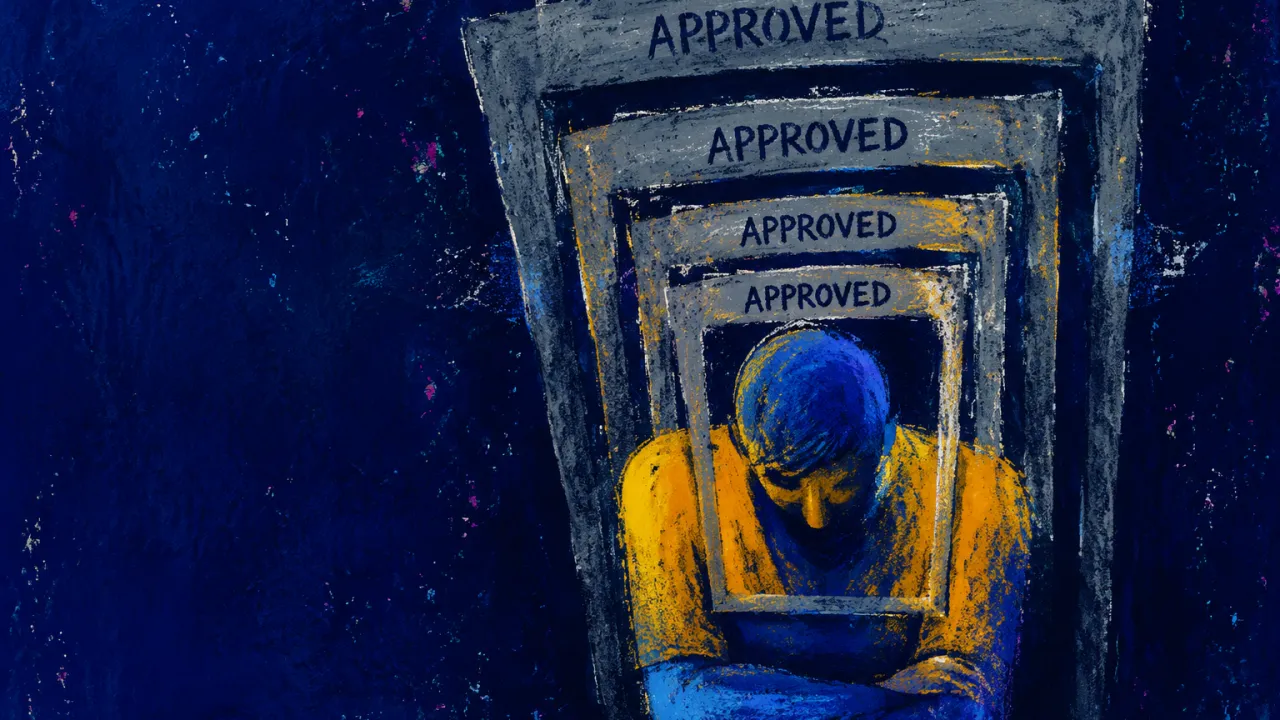
A solitary figure with lowered shoulders as stacked grey approval frames settle inward around the torso against deep indigo.

What is this situation?

Bounded Delegation Trial is the stretch of work where you are told to take ownership, but the person above you keeps the permissions, approvals, and final say. It often begins in a one-to-one or planning meeting: your manager hands you a project, calls it a chance to prove yourself, and sets a review date. By the time you open the brief, the limits are already visible: you may coordinate the work, but cannot change the timeline, commit budget, choose the team, or send anything without sign-off. Each Slack update becomes a checkpoint; each draft returns with edits that quietly replace your judgment; each decision is yours until someone senior dislikes it, at which point authority moves back up while accountability stays with you. In meetings, colleagues are directed to come to you, yet they can bypass you for a different answer, leaving you to reconcile instructions you did not give. Your calendar fills with status calls and approval waits, while the work itself still has to land on time. By late afternoon, your shoulders sit tight and your palms hover over messages you have rewritten to sound decisive without promising what you are not allowed to decide. The trial consumes attention through its central contradiction: you must demonstrate independent ownership inside boundaries that can be tightened at any moment, much like the figure in the Eight of Swords, given a patch of ground but visibly fenced from moving freely.

Why it's not you?

The contradiction is built into the assignment: you are being held accountable for an outcome while key decisions remain elsewhere. Approval gates, shifting limits, and visible evaluation make this a constrained test of authority, not evidence that you cannot lead.

Bounded Delegation Trial in Tarot Cards

In a Bounded Delegation Trial, ownership is announced while permissions and final decisions remain with the person evaluating you. The tightness across your shoulders after another approval checkpoint registers how much work it takes to operate inside those limits. This is an environmental and structural dynamic: accountability moves toward you while authority stays elsewhere. The Tarot Cards below reflect the visible contours of that arrangement.

The Emperor
Reversed
The stone throne, armoured ruler, and firmly held sceptre concentrate command in one elevated seat. Under reversal, that architecture becomes a delegation system in which the title of ownership travels downward but permissions, resources, and veto power remain attached to the manager. You can be asked to lead the project while every consequential move still returns to the throne for approval. The friction is therefore structural: your performance is being evaluated inside a hierarchy that can tighten your mandate whenever your judgment differs from senior preference.
The Chariot
Reversed
The armoured charioteer occupies the driver's position above two opposed sphinxes, yet no working reins are visible. Reversed, the image separates the appearance of command from control over the forces, permissions, and dependencies that determine whether the vehicle can move. You may be told that the assignment is evidence of a leadership path while contradictory instructions and senior overrides keep redirecting it. The stalled motion does not automatically measure your ambition or readiness; it exposes a career route in which the steering role has been assigned without stable steering mechanisms.
Justice
Reversed
The scales in one hand and the raised sword in the other place evaluation and enforcement under a single authority. Under reversal, that concentration exposes an accountability arrangement in which outcomes are weighed against you even though the power to authorise key decisions remains elsewhere. You are left carrying explanations for timelines, budgets, staffing choices, or final edits that you could not independently control. The imbalance clarifies the core audit question: whether the scorecard reflects your actual mandate or quietly assigns you the cost of decisions still owned above you.
The Hanged Man
Upright
The figure hangs by one foot from a fixed wooden beam, visibly alert but unable to convert awareness into forward motion. The halo preserves clarity inside the suspension, making the image a precise analogue for work that is ready to move but held at an approval gate controlled elsewhere. You can see the deadline approaching and understand what the project needs, yet your calendar fills with follow-ups while release authority remains above you. The pause makes dependency ownership visible: elapsed time may appear on your delivery record even when the clock is being consumed by someone else's sign-off process.
Three of Pentacles
Reversed
The craftsperson, the two reviewing figures, and the plan held inside the cathedral arch create a visible system of commissioned work, expertise, and approval. Under reversal, those roles stop functioning as a coordinated build: reviewers overwrite the maker's judgment, instructions diverge, and nominal ownership no longer corresponds to who can authorise the result. You can produce the draft and coordinate the contributors while colleagues still seek a different answer from someone senior. The image identifies the practical failure as role misalignment inside the project structure, not an inability to collaborate or lead the work.
Four of Pentacles
Upright
The seated figure clamps one pentacle to the chest, pins two beneath the feet, and balances another above the crown while the working city remains at a distance. The arrangement turns resources into a control system: money, permission, and status are held tightly by one position rather than circulated to the person responsible for delivery. You may be authorised to coordinate the project but not to commit budget, choose the team, change scope, or release the result. The grip on the pentacles reveals that your constraint is not a shortage of ownership language; it is resource authority being deliberately retained elsewhere.
Six of Pentacles
Reversed
The standing giver controls both the scales and the flow of coins while the lower figures wait for access. Under reversal, the same arrangement exposes conditional resourcing: the senior role decides what support is released, when it arrives, and which needs are recognised, while the dependent role remains responsible for making the outcome work. You can be labelled the project owner without controlling the team, budget, approvals, or exceptions needed to deliver. The uneven distribution shows why each request for permission can feel like another test of worth, even though the underlying issue is an asymmetrical allocation of organisational resources.
Eight of Swords
Upright
The blindfold, bindings, and surrounding swords turn uncertain boundaries into a constant demand for internal monitoring. Because the figure cannot clearly map which route is open, each possible movement carries the extra task of anticipating consequences before taking a step. You can find yourself rewriting messages, softening commitments, and second-guessing decisions because yesterday's permission may become today's overreach. The image locates that psychological load in the inconsistent mandate around you: the internal hesitation is functioning as a response to unstable external authority, not proof that you lack judgment.
King of Swords
Reversed
The enthroned king holds a single upright sword from an elevated position, concentrating interpretation, judgment, and final decision in one figure. Under reversal, that authority becomes an override channel: the manager can redefine the brief, replace your judgment, or reclaim the decision while leaving delivery accountability attached to your role. You may be expected to sound decisive in meetings even though every statement remains subject to unilateral correction. The raised sword clarifies that the problem is not simply demanding feedback; it is a governance structure in which one person remains the final author of decisions another person must publicly own.
Two of Wands
Reversed
The figure holds a globe inside a battlement while one wand remains fixed to the wall and the wider landscape lies beyond the parapet. Under reversal, the offered horizon becomes a bounded planning exercise: strategic responsibility is visible, but the means to cross from plan to independent action remain secured by the surrounding structure. You may be invited to treat the project as proof that your career scope is expanding, even though the timeline, budget, team, and final release are already decided. The contrast between globe and wall helps distinguish meaningful directional ownership from a contained simulation of it.
Ten of Wands
Upright
The figure bends beneath ten bundled wands while the destination remains visible ahead. The load fills his field of vision, mirroring a role in which delivery work, coordination, status reporting, approval chasing, and reputational accountability have been bundled onto one person without equivalent authority. You may still be capable of getting the project to its destination, but the burden now includes compensating for a weak delegation design. The visible strain separates a demanding stretch assignment from an arrangement where managerial control generates extra work that is then recorded as your responsibility.

Bounded Delegation Trial in Tarot Card Reading Insights

Others have brought the same Bounded Delegation Trial into readings, with restricted decision rights sitting beside full accountability. The Tarot Reading Insights below collect what appeared in those sessions.

Psychological Contexts Related to Bounded Delegation Trial